



Abstract
Saccade-induced retrieval enhancement (SIRE) refers to the phenomenon that actively engaging in horizontal eye movements before recall enhances subsequent memory performance. This effect is thought to be the result of interhemispheric interactions stimulated by saccades. An alternative explanation is that saccades promote memory retrieval by improving top–down attention control. Thus, the mechanisms of SIRE are unclear, and the present meta-analysis quantitatively analysed the effect of saccades on memory performance and examined the mechanisms of SIRE. We searched “Web of Science,” “PubMed,” and “Springer” for peer-reviewed papers using the keywords “eye movements + memory” and “saccades + memory.” Twenty-two papers were included in the final analysis. There was a significant facilitation of horizontal saccades on overall memory performance, with a pooled effect size (Cohen’s d) of 0.45 (p < .001). However, the overall effect of vertical saccades was not significant (d = 0.1, p = .14). Moderation analysis showed that the handedness of participants was a significant moderator of SIRE, with strongly right-handed individuals benefitting more from horizontal saccades than non-strongly right-handed individuals (p < .01). Horizontal saccades improved memory performance, particularly for strongly right-handed individuals. These results support the interhemispheric interaction hypothesis.
Introduction
Saccade-induced retrieval enhancement (SIRE) refers to the phenomenon that the voluntary control of horizontal eye movements to a moving target prior to recall can enhance subsequent memory performance (Lyle & Martin, 2010). Christman et al. (2003) first described SIRE. In that study, participants were asked to initially learn a word list and were then guided to visually follow a black dot on the screen that moved horizontally for 30 s before a recognition test. Their results showed a higher sensitivity (d’ in signal detection theory) following horizontal saccades relative to the control condition (i.e., no eye movements). Since then, SIRE has been examined in many studies, and most of these studies found that horizontal saccades promoted recognition (Christman et al., 2003, Experiment 1; Lyle et al., 2008, Experiment 2; Parker et al., 2008), free recall (Christman et al., 2004, Experiment 2; Lyle et al., 2008, Experiment 1; Nieuwenhuis et al., 2013; Samara et al., 2011), reduced false memories (Christman et al., 2004; Parker & Dagnall, 2012), and facilitated autobiographical memory (Christman et al., 2003, 2006; Parker & Dagnall, 2010; Parker et al., 2013).
Nonetheless, SIRE has been challenged by other empirical evidence. For example, a preregistered collaborative study failed to replicate the enhancing effect of horizontal saccades on memory retrieval and reported contradictory results (i.e., participants’ free recall performance was worse in the induced eye movements condition than that of the no eye movement condition (Matzke et al., 2015)). In addition, whether horizontal saccades are necessary in SIRE remains unclear. Vertical saccades, which have often been used as the control condition, were also found to enhance word recognition (compared with the no eye movement condition, d = 0.68) (Lyle et al., 2008). Furthermore, handedness has also been suggested to be an important factor that could affect SIRE. According to the interhemispheric interaction hypothesis, strongly right-handed people have a lower baseline level of interhemispheric interaction, and their memory performance should benefit more from horizontal saccades (Christman et al., 2004; Lyle et al., 2008), although some research findings did not fully support this view (Lyle & Jacobs, 2010). Generally, there are inconsistencies in the research results examining SIRE; thus, it is necessary to conduct a quantitative review of the existing evidence to clarify whether SIRE exists and examine the potential mechanisms.
According to the interhemispheric interaction hypothesis proposed by Christman et al. (2003), horizontal saccades improve memory retrieval by enhancing interhemispheric interactions in the brain, which are crucial for the retrieval of episodic memories. This hypothesis was based on the hemispheric encoding/retrieval asymmetry (HERA) model. This model suggested that the encoding and retrieval of episodic memory is lateralized to the left and right prefrontal regions, respectively. Specifically, encoding is associated with increased activity in the left prefrontal lobe, while retrieval is associated with increased activity in the right prefrontal lobe (Tulving et al., 1994). Cabeza and Nyberg (2000) summarised positron emission tomography/ functional magnetic resonance imaging (PET/fMRI) findings and found that the encoding of episodic memory involved the left hemisphere, and the retrieval of episodic memory involved the bilateral hemispheres or tended to be right-lateralized. Studies on split-brain individuals also showed that cutting off the connections between the two hemispheres hindered episodic memory recognition (CroninGolomb et al., 1996). Based on this evidence, Christman et al. (2003) suggested that the interaction between the two hemispheres provides a basis for accurate episodic memory. Recent studies have also supported this model; for example, Prendergast et al. (2013) found that processing verbal material was consistent with the HERA model. Johansson et al. (2020) calculated the HERA index based on neuroimaging data and found that this index predicted episodic memory impairment in ageing.
Two methods have been used to distinguish the level of interhemispheric interaction in previous studies. One is to select mixed-handed individuals by handedness tests. Since mixed-handed individuals have a larger corpus callosum (Luders et al., 2010), their level of interhemispheric interaction should be higher than that of right- or left-handed individuals, and consequently, they should have better memory performance. The other method is to provide certain visual stimuli to guide horizontal saccades; the level of interhemispheric interaction can be temporarily improved, and subsequent memory retrieval can be enhanced. It is debatable whether the above two methods can separate individuals with different levels of interhemispheric interaction. However, previous studies have shown that memory was superior in mixed-handed individuals than in strongly right-handed individuals (Christman et al., 2004, 2006; Propper et al., 2005). Moreover, the memory performance of strongly right-handed individuals could be temporarily improved following horizontal saccades. In contrast, horizontal saccades failed to improve memory performance for non-strongly right-handed individuals and, in some cases, were even detrimental to their memory performance (Lyle et al., 2008). These results provided some support for the interhemispheric interaction hypothesis. Furthermore, Nieuwenhuis et al. (2013) found that both horizontal eye movement and alternating left–right tactile stimulation enhanced memory retrieval, while alternating left–right auditory stimulation did not enhance memory retrieval. These results also support the interhemispheric interaction hypothesis because both the visuomotor system and the somatosensory system have a strict contralateral organisation, while the auditory system has a much less lateralized organisation.
To test the interhemispheric interaction hypothesis, several studies have examined the influence of eye movements on electroencephalography (EEG) coherence. Propper et al. (2007) compared EEG coherence between the left and right frontal lobes between eye movement and control conditions. However, they did not observe any increased interhemispheric EEG coherence following manipulation of horizontal saccades. Samara et al.’s (2011) study used a within-group design and compared the changes in EEG coherence before and after saccades. The results showed that although the recognition of emotional words was better following horizontal saccades relative to no eye movements, they failed to observe increased EEG coherence between the two hemispheres following horizontal saccades, and memory enhancement was not correlated with changes in EEG coherence. In a more recent study, the effects of horizontal saccades on EEG power and coherence were examined (Fleck et al., 2018). Similarly, the results of this study failed to support the interhemispheric interaction account.
Taken together, although many studies have demonstrated the enhancing effect of saccades on memory retrieval, there is no direct evidence indicating that this effect is attributable to interhemispheric interactions. Lyle and Edlin (2015) proposed that saccades may improve memory retrieval by promoting top–down attention control. From this perspective, SIRE can be regarded as the effect of a short attention control “exercise.” If the subsequent memory test primarily relied on top–down attention control, the effect of this eye movement “exercise” would be manifested. In contrast, if the memory test is simple and depends more on bottom–up spontaneous processing, eye movements would not benefit performance (Lyle & Edlin, 2015). This theory explains why eye movement manipulations can also enhance performance on other cognitive tests, such as attention (Edlin & Lyle, 2013) and creativity (Shobe et al., 2009). The “top–down attention control hypothesis” was derived from early neuroimaging studies, which suggested that saccades were associated with activations of the frontal eye field, intraparietal sulcus, and superior parietal lobe, namely, brain regions that have long been implicated in top–down attention control (Corbetta & Shulman, 2002). Fleck et al. (2018) found that delta-band coherence across frontal-posterior electrode sites was maintained following horizontal saccades, but it was decreased in the no eye movements condition. It was suggested that the stability of delta coherence over time reflected a beneficial effect of sustained executive attention resulting from horizontal saccades. Unfortunately, this study did not report changes in attention or memory performance caused by horizontal saccades. To date, studies have failed to establish a direct relationship between the enhancement of memory performance and activation of attention-related brain regions caused by the manipulation of horizontal saccades.
The discrepancies between the two theories are as follows: (1) According to the interhemispheric interaction hypothesis, eye movements specifically improve memory performance, particularly memory retrieval; the effect is mainly manifested in strongly right-handed individuals who have a lower level of interhemispheric interaction. Only horizontal saccades are effective, whereas vertical saccades do not affect interhemispheric interaction and are therefore not beneficial to memory retrieval (Christman et al., 2003); (2) From the perspective of top–down attention control theory, the effect of eye movements is not specific to memory but to all cognitive activities related to top–down attention control (Lyle & Edlin, 2015). Since free recall was considered to involve more top–down attentional control than recognition (Lyle & Edlin, 2015), according to attention control theory, eye movements may enhance free recall performance to a larger degree than recognition performance. Furthermore, according to this theory, the direction of eye movements will not affect the SIRE effect.
Despite accumulating studies, the mechanisms of SIRE are still unclear. This study aimed to clarify the following questions through meta-analyses: (1) whether horizontal saccades enhance memory performance; (2) whether handedness moderates this effect; and (3) whether vertical saccades enhance memory performance. These analyses would help us to understand the underlying mechanisms of SIRE.
Method
Literature search
The “Web of Science,” “PubMed,” and “Springer” databases were searched using the combination of the keywords “eye movements + memory” or “saccades + memory” for articles published from January 2001 (when Christman and Propper (2001) conducted the first study to examine the relationship between memory performance and interhemispheric interaction) to 1 April 2018. The paper selection process is illustrated in Figure 1. The included studies needed to meet the following criteria: (1) they were published peer-review studies; (2) eye movements were manipulated, and the differences in memory performance between eye movements and control conditions were compared; (3) they used standardised procedures to manipulate the saccades (for example, participants watched a dot that alternately appeared on the left and right side of the screen every 0.5 s); and (4) they reported sufficient data to calculate the effect sizes. For studies fulfilling other criteria but did not report enough data to calculate the effect sizes, authors of the paper were contacted for the potential provision of additional data.
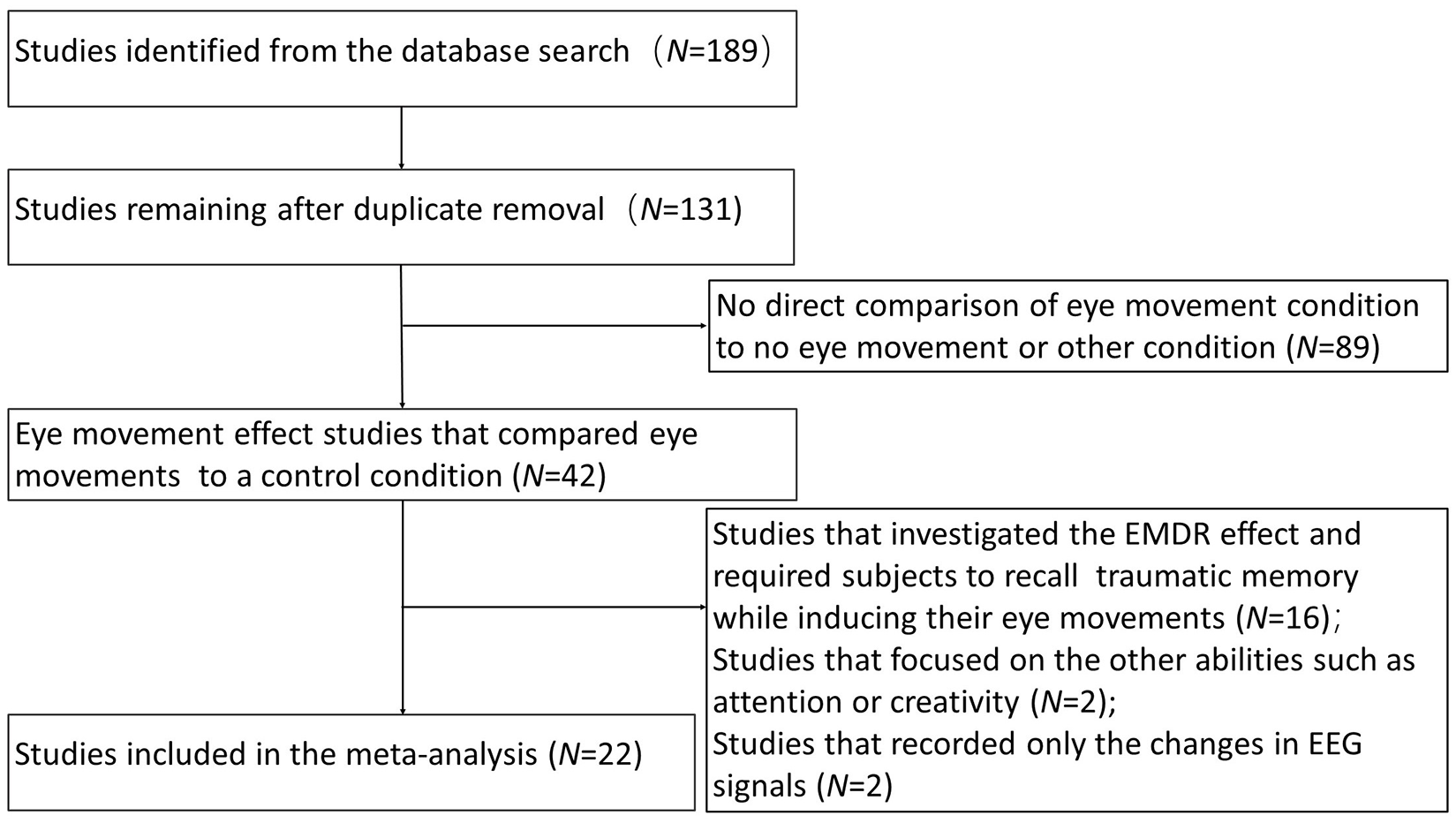
Flowchart of the selection and inclusion process following the PRISMA statement.
Studies investigating the effect of eye movement desensitisation and reprocessing (EMDR; Shapiro, 1989) on the emotionality and vividness of traumatic memory were excluded based on the following reasons. First, most EMDR studies were designed to examine the effect of EMDR in participants with a posttraumatic stress disorder or a distressing memory, and these studies usually used self-reported distress or vividness of distressing memory as outcome measures, while SIRE studies mainly focused on the effect of eye movements on memory performances (mostly neutral, not necessarily emotional or trauma-related, and not necessarily self-related) in healthy participants. Second, there are differences in eye movement induction procedures between EMDR and SIRE studies. For example, in some EMDR studies, subjects were asked to recall traumatic memories while making eye movements by following a therapist’s finger. In these cases, the amplitudes of the saccades and duration were relatively subjective. In SIRE studies, the manipulation of eye movements was rigorous; for example, participants were asked to follow a black dot that appeared sequentially on the left and right side of the computer screen for 30 s, and the dots changed position every 500 ms at a distance of 27° visual angle apart. Four other studies met the inclusion criteria for eye movement manipulation but were excluded because they focused mainly on the promoting effects of eye movements on attention (Edlin & Lyle, 2013) and creativity (Shobe et al., 2009) or only on EEG signal changes after saccades, without relevant behavioural data (Fleck et al., 2018; Propper et al., 2007).
Data extraction and study characteristics
Our final analysis included 22 articles, with 28 pairs of data in total, of which 16 focused on episodic memory, 6 focused on false memory, 5 on autobiographical memory, and 1 on face memory (Table 1). The following information was extracted for each study: (1) the first author and year of publication; (2) the type of experimental design and the number of participants in each experimental group; (3) the materials (sentences, figures, or words) used in the memory test; (4) the direction of eye movement manipulation (horizontal or vertical); (5) whether handedness was measured; and (6) the type of memory and main indicators of memory performance. We classified the memory tasks adopted in these studies into four categories: (a) episodic memory tasks that included recognition or free recall of words or pictures, (b) false memory tasks that induced false recall or false recognition, (c) autobiographical memory tasks in which self-related events in daily life were recalled, and (d) tasks that did not belong to any of the above categories were classified as “Not clear to be classified.” 1
Summary of studies included in the meta-analysis.
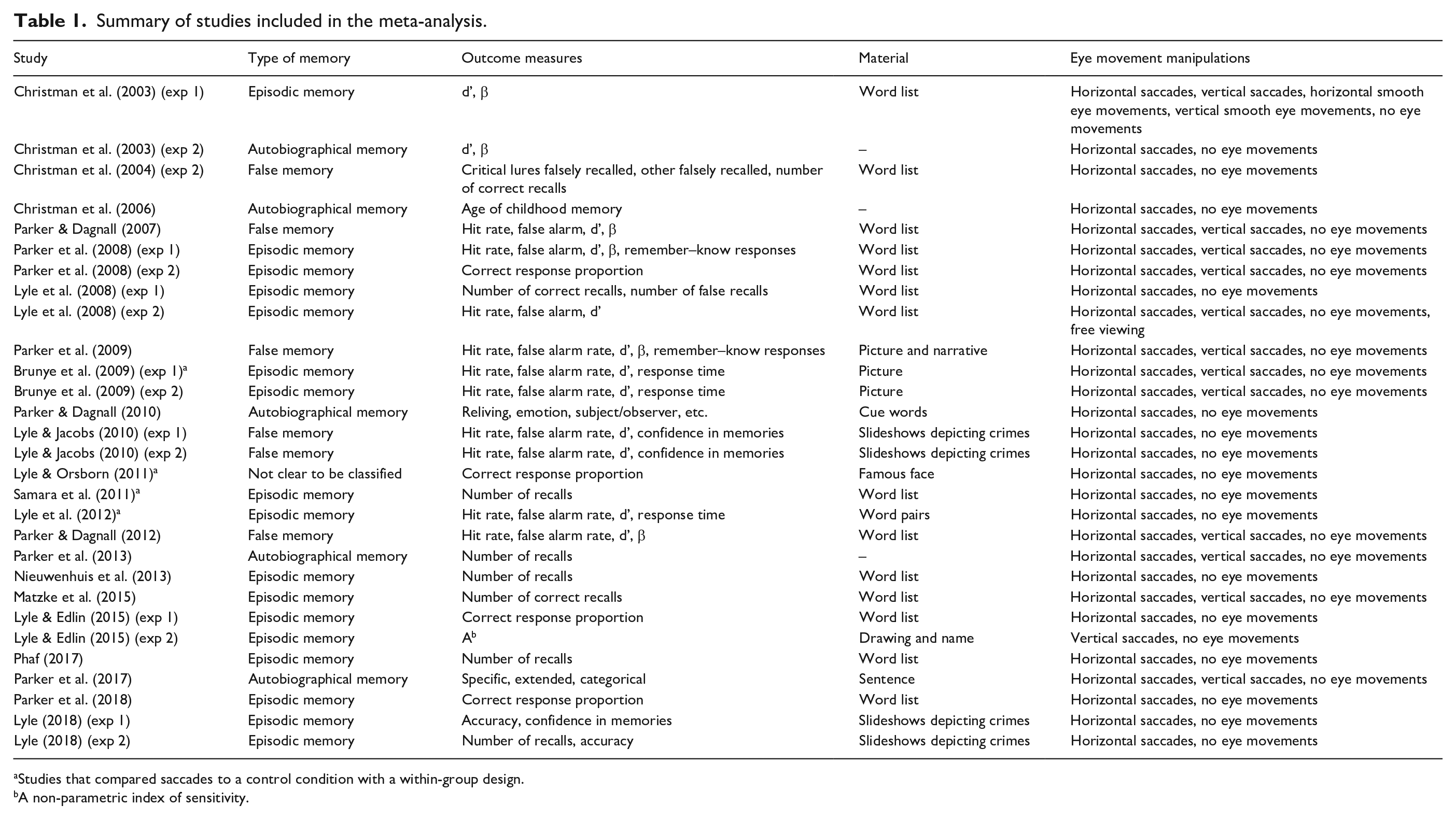
Studies that compared saccades to a control condition with a within-group design.
A non-parametric index of sensitivity.
The current meta-analysis distinguished these four types of memory tasks when calculating the effect sizes. We selected the indexes for each type of memory in the following way: First, the main indexes of episodic memory tasks were accuracy, discriminating index d’, and the number of correct recollections. Our analysis took discriminating index d’ as the main indicator. For studies that did not report d,’ accuracy or the number of correct recollections were regarded as alternatives. Second, the main indicator of false memory was the discrimination index d’ of lure words, and if d’ was not reported, the number of false alarms for key lure words was used. 2 Finally, the indicators of autobiographical memory were relatively subjective, including the numbers of events recalled, the vividness of the recalled events, and so on. The unweighted average effect size of the main indexes of autobiographical memory was used as the indicator of the effect of eye movements on autobiographical memory.
Meta-analyses
The comprehensive meta-analysis (CMA, version 2.0) (http://www.meta-analysis.com/index.php) was used for data analysis in this study. We used means, standard deviations and sample sizes to calculate effect sizes (Cohen’s d). For studies that did not report means or standard deviations, effect sizes were calculated using t or F statistics and sample sizes. Heterogeneity was assessed by Q-statistics, while publication bias was measured by combining a funnel plot and Egger’s intercept. Duval and Tweedie’s (2000) trim and fill procedure was also adopted to obtain the adjusted effect sizes. Due to the significant heterogeneity of the studies included in our analyses, random effect models were used (Hedges & Vevea, 1998).
We first evaluated the pooled effect size of horizontal saccades’ effect on memory retrieval. Then, we conducted the following moderator analyses. (1) Type of memory: The effect of eye movements on different types of memory performance was compared (in this analysis, we only included episodic memory, false memory, and autobiographical memory). (2) Handedness: According to the interhemispheric interaction hypothesis, strongly right-handed individuals are more likely to benefit from horizontal saccades; thus, we included handedness as a potential moderating variable. Studies that did not report the effect of handedness or distinguish strongly right-handed from non-strongly right-handed individuals were classified as handedness unknown. (3) Vertical saccades: To understand whether the SIRE effect was selectively caused by horizontal saccades, several studies also examined whether vertical saccades had beneficial effects on memory performance. We also calculated the pooled effect size of vertical saccades on memory retrieval. Finally, publication bias was analysed. The data for meta-analysis are available upon request.
Results
Effect of horizontal saccades on memory retrieval
Overall effect and subgroup analysis on different types of memory
There was a significant overall effect of horizontal saccades on memory retrieval (28 contrasts, Cohen’s d = 0.45; 95% confidence interval [CI] = [0.29−0.62], Z = 5.40, p < .001). The heterogeneity of the studies was significant (Q = 113.98, p < .001; Table 2), indicating non-negligible differences among studies.
Saccade-induced retrieval enhancement for all studies and different types of memory.
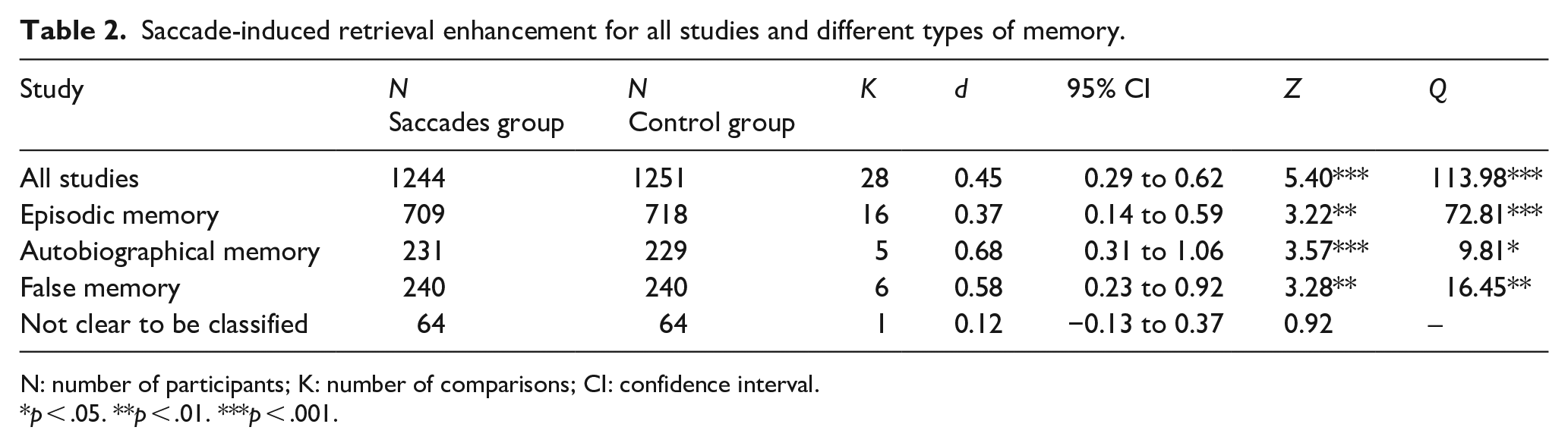
N: number of participants; K: number of comparisons; CI: confidence interval.
p < .05. **p < .01. ***p < .001.
Analysis of different types of memory showed that horizontal saccades had a medium to large effect on autobiographical memory (5 contrasts, d = 0.68; 95% CI = [0.31–1.06], Z = 3.57, p < .001) and on reducing false memory (6 contrasts, d = 0.58; 95% CI = [0.23−0.92], Z = 3.28, p < .01) and a small to medium effect on episodic memory (16 contrasts, d = 0.37; 95% CI = [0.14−0.59], Z = 3.22, p < .01). There was no significant difference among the three memory categories (Q = 2.37, p = .31).
Studies on false memory and episodic memory included different types of tests. We conducted another subgroup analysis on the type of test. Seven contrasts with free recall tests showed a non-significant effect (d = 0.22; 95% CI = [−0.13 to 0.56], Z = 1.21, p = .23), eight contrasts with recognition tests showed a medium effect (d = 0.62; 95% CI = [0.26−0.97], Z = 3.41, p = .001), four contrasts with associative recognition tests showed a small to medium effect (d = 0.47; 95% CI = [0.04−0.90], Z = 2.159, p = .031), and four contrasts with cue-recall tests showed a medium but non-significant effect (d = 0.51; 95% CI = [−0.02 to 1.04], Z = 1.9, p = .06) (see Supplementary Material Figure S1 for details). A comparison between free recall and recognition tests suggested that there was no significant difference between the effect of horizontal saccades on these two types of tests (Q = 2.48, p = .12).
The moderator effect of handedness
Fifteen contrasts in strongly right-handed individuals showed a near medium effect size, d = 0. 51 (95% CI = [0.27−0.76], Z = 4.17, p < .001), and significant heterogeneity (Q = 41.57, p < .001); 12 contrasts in non-strongly right-handed individuals showed a non-significant effect, d = −0.07 (95% CI = [−0.21 to 0.07], Z = −0.99, p = .33), and the heterogeneity was not significant either (Q = 10.38, p = .50); and 13 contrasts in unknown handedness individuals showed a medium to large effect size, d = 0.59 (95% CI = [0.33−0.85], Z = 4.46, p < .001; Table 3; see Supplementary Material Figure S2 for details), and the heterogeneity was also significant (Q = 50.99, p < .001). The moderator effect of handedness was significant (Q = 29.23, p < .001). Further pairwise comparisons revealed that memory performance of strongly right-handed individuals benefitted more from horizontal saccades compared to non-strongly right-handed individuals (Q = 16.86, p < .001). 3
Saccade-induced retrieval enhancement for different handedness groups.
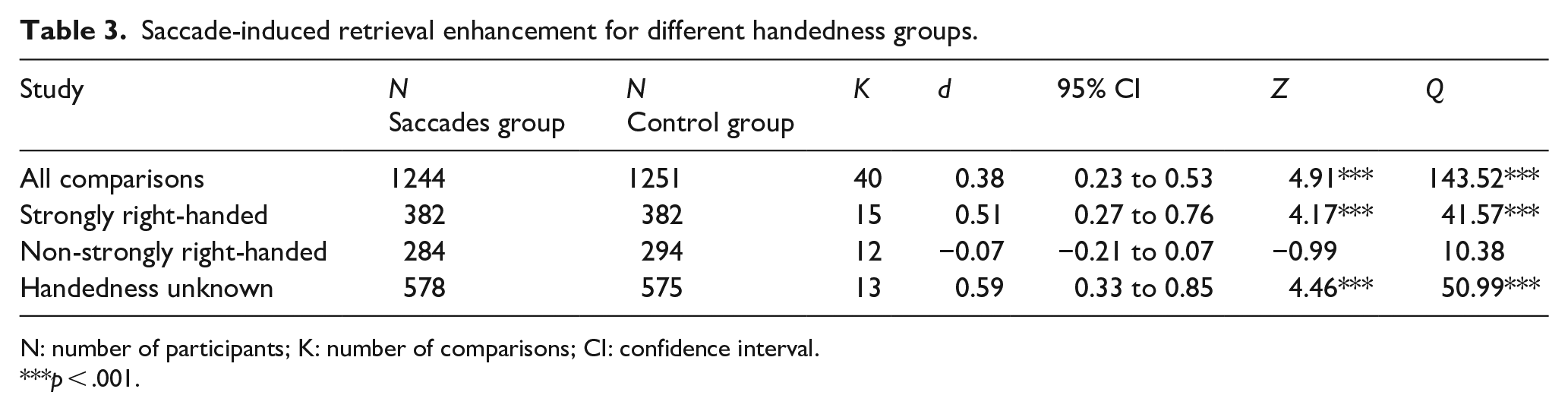
N: number of participants; K: number of comparisons; CI: confidence interval.
p < .001.
Effects of vertical saccades on memory retrieval
The overall effect size was calculated based on 12 pairs of data comparing vertical saccades with no eye movement condition. The overall effect of vertical saccades was not significant (d = 0.10; 95% CI = [−0.03 to 0.23], Z = 1.47, p = .14), with non-significant heterogeneity (Q = 7.33, p = .77). This result suggested that memory performance was benefitted only from horizontal saccades.
Publication bias analyses
For the overall effect, funnel plots showed asymmetrical graphics, and the results of Egger’s linear regression analysis further suggested notable publication bias (intercept 2.23, 95% CI = [0.17–4.28], p = .02). After adjusting for missing studies (N = 8; Figure 2) using Duval and Tweedie’s (2000) trim and fill procedure, the overall effect size decreased from 0.38 to 0.19 but was still significant (95% CI = [0.02−0.36]). For the strongly right-handed group, five missing studies were added, and the effect size was reduced from 0.51 to 0.30 but was still significant (95% CI = [0.05−0.55]). For the unknown handedness group, after adjustment for missing studies (N = 5), the effect size decreased from 0.59% to 0.27 (95% CI = [−0.02 to 0.60]), which was not significant. Detailed results are shown in Table 4. Generally, despite publication bias and reduced effect sizes after adjustment, our results demonstrated that strongly right-handed individuals could benefit from horizontal eye movement manipulations, while non-strongly right-handed individuals were insensitive to this procedure. The overall effect was relatively small (d = 0.19), possibly due to the inclusion of non-strongly right-handed participants, but the effect remained robust.
Publication bias and adjusted effect sizes.
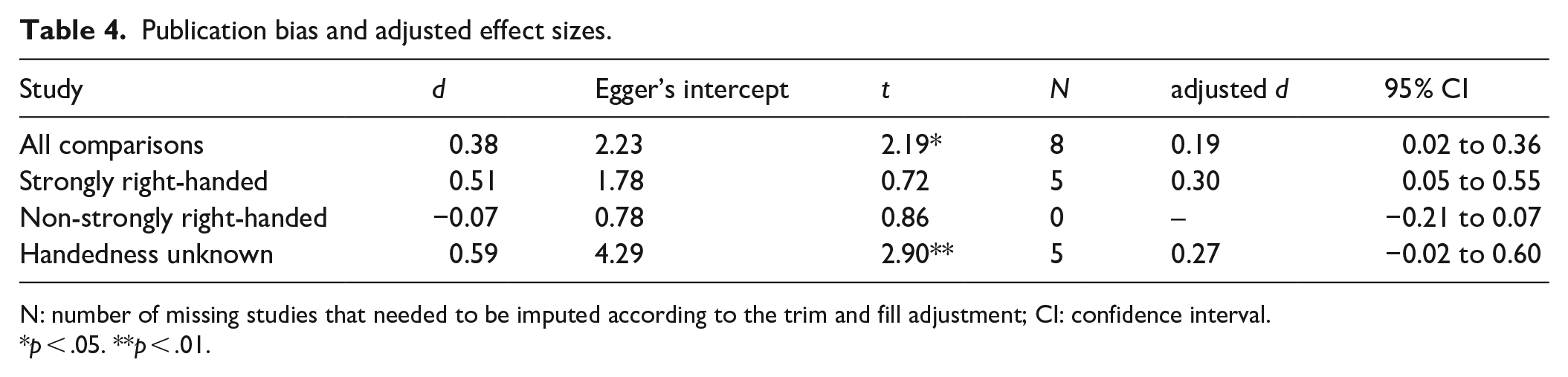
N: number of missing studies that needed to be imputed according to the trim and fill adjustment; CI: confidence interval.
p < .05. **p < .01.
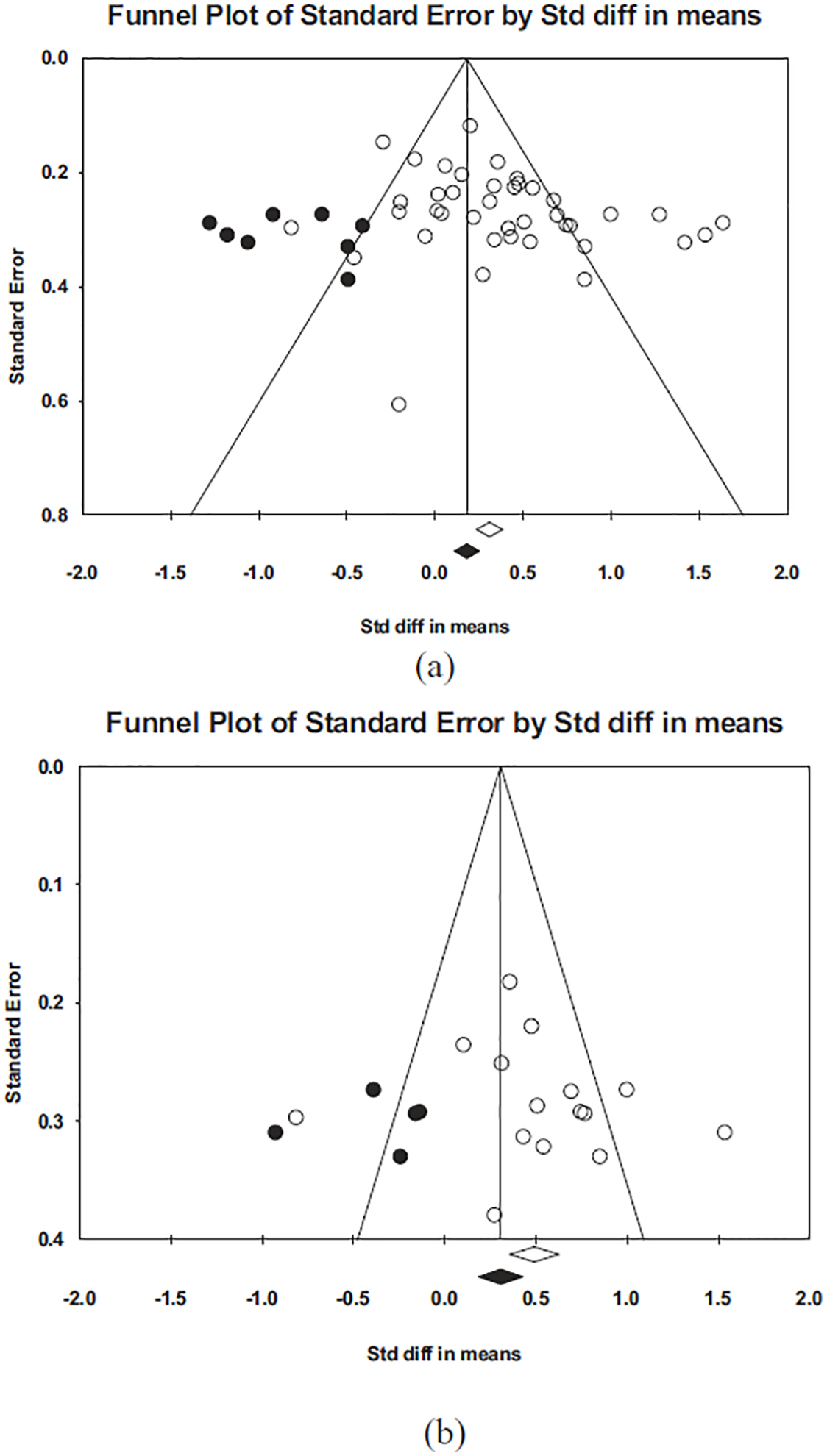
Funnel plots for the trim and fill procedure: (a) results for all comparisons including strongly right-handed, non-strongly right-handed and handedness unknown groups and (b) results for strongly right-handed group only.
Discussion
This study synthetically and quantitatively analysed previous studies on the effect of saccades on memory performance. The main findings were as follows: (1) horizontal saccades could improve memory performance, irrespective of memory type (Q = 2.37, p = .31); (2) strongly right-handed individuals benefitted from the implementation of horizontal saccades, while non-strongly right-handed individuals did not benefit from this manipulation; and (3) vertical saccades showed negligible memory enhancement, indicating that episodic memory retrieval was selectively enhanced by horizontal saccades. The results were influenced by publication bias to some extent; however, the conclusions did not change after elimination of publication bias.
This study yielded a median effect (d = 0.45) of horizontal saccades on memory retrieval, though with considerable heterogeneity (Q = 113.98, p < .001). Moderator analysis revealed that handedness was an important source of differences. Effect sizes of SIRE were d = 0.51 for the strongly right-handed group but d = −0.07 for the non-strongly right-handed group, and the latter indicated a null effect. Together with previous evidence, we propose three potential reasons for the inconsistencies in this research field: (1) some studies failed to take handedness into consideration, and our results suggested that it is a moderating factor of SIRE; (2) there was a large variability in the paradigms and memory types among different empirical studies, and although the moderating effect of type of memory was not significant, the studies within each type of memory were heterogeneous; and (3) the difference in time duration between the end of saccade manipulation and the completion of memory tasks may be another reason for the inconsistent results. Since the enhancing effects of eye movements may be temporary, the benefits may not be maintained if the interval between saccades and recall was too long (Samara et al., 2011). Despite this variability, the enhancing effect of saccades persisted after taking publication bias into consideration; therefore, it might be taken as a strategy to temporarily improve memory in daily lives.
As mentioned in the introduction, there are mainly two theories on the underlying mechanisms of SIRE. The interhemispheric interaction hypothesis proposes that horizontal saccades improve memory retrieval by facilitating interhemispheric interactions in the brain (Christman et al., 2003), whereas the top–down attentional control hypothesis suggests that eye movements promote memory by improving attention control (Lyle & Edlin, 2015). Controversy between these two hypotheses can be partly elucidated by the present meta-analysis. The interhemispheric interaction hypothesis suggests that the retrieval of episodic memory relies on the level of interhemispheric interaction and that any facilitation of interhemispheric interaction would improve memory retrieval. According to this theory, strongly right-handed individuals who had lower levels of interhemispheric interaction benefitted more from saccades, which was supported by our results. Another important discrepancy between the two theories is whether the direction of saccades affects the effect on memory retrieval. The interhemispheric interaction hypothesis suggests that only horizontal saccades can facilitate interhemispheric interaction, which would be beneficial to memory retrieval. In contrast, the top–down attentional control hypothesis proposes that the activation of the frontoparietal network caused by saccades was the primary reason for memory improvement. According to the latter theory, saccades would improve memory retrieval regardless of whether they were horizontal or vertical. Our results demonstrated that only horizontal saccades were beneficial to memory retrieval, which again supports the interhemispheric interaction hypothesis. Regarding the type of test, since free recall involved more cognitive control than recognition, according to attentional control theory, eye movement would enhance free recall performance to a larger degree than recognition, and the present results also failed to support this prediction. Although the three EEG studies (Fleck et al., 2018; Propper et al., 2007; Samara et al., 2011) did not reveal increased interhemispheric coherence after horizontal saccade manipulation, there were some limitations in these studies, such as the small sample size, limited number of electrodes used to measure coherence, and lack of behavioural measures. Given that recent behavioural and EEG studies did not support the interhemispheric interaction hypothesis, other possible mechanisms of SIRE could not be ruled out. Therefore, the mechanisms of SIRE call for further research and discussion. Previous studies have either focused on memory enhancement caused by horizontal saccades or investigated the effect of horizontal saccades on resting-state EEG. Future studies should adopt a more rigorous experimental design to examine task-related neural activity. In this way, a clearer understanding of the relationship among saccades, neural activity and memory performance could be obtained.
Another factor worth mentioning is that the level of interhemispheric interaction is not an all-or-none phenomenon but a continuous phenomenon. If the interhemispheric interaction hypothesis is true, then the visual angle, as well as the duration of saccades, should also affect the level of interhemispheric interaction. For instance, in the original research conducted by Christman et al. (2003), the saccade manipulation was as follows: 30 s of eye movements, 2 eye movements per second and 27° of visual angle as the eye movements’ spatial extent. Most of the subsequent studies, following the procedure of Christman et al. (2003), adopted similar parameters. If we increase the duration and vary the amplitude of eye movements, will the memory enhancement effect change? Future studies should clarify these issues by varying these methodological parameters.
Several limitations of this study should be noted. First, the studies included in this meta-analysis included individuals from a narrow age range since most of the studies were conducted in university students, and whether the effect would be present in other age groups needs additional study. Second, the criteria for strongly right-handed individuals and non-strongly right-handed individuals varied from study to study, and different indexes were used for memory performance (such as autobiographical memory), which may have created heterogeneity among the studies. Third, due to the small number of studies, it is impossible to conduct moderator analyses on some factors, such as the emotional valence of words or events and the age of participants. Finally, for the moderator analysis between horizontal saccades and vertical saccades on the SIRE effect, the number of studies examining vertical saccades was relatively small, which may have affected the results to some extent. More studies are needed to obtain more reliable results on the effect of vertical saccades on SIRE and the potential differential effects between vertical and horizontal saccades.
To conclude, this study demonstrated that horizontal saccades could improve overall memory performance. Strongly right-handed individuals are more sensitive to this effect. Vertical saccades do not improve memory performance. These results provide support for the interhemispheric interaction hypothesis.
Supplemental Material
sj-docx-1-qjp-10.1177_1747021821992276 – Supplemental material for Horizontal but not vertical saccades enhance memory retrieval: A meta-analysis and systematic review
Supplemental material, sj-docx-1-qjp-10.1177_1747021821992276 for Horizontal but not vertical saccades enhance memory retrieval: A meta-analysis and systematic review by Xiao-jing Qin, Han-xue Yang, Ji-fang Cui, Jun-yan Ye and Ya Wang in Quarterly Journal of Experimental Psychology
Footnotes
Declaration of conflicting interests
The author(s) declared no potential conflicts of interest with respect to the research, authorship, and/or publication of this article.
Ethical approval
This article does not contain any studies with human participants performed by any of the authors.
Funding
The author(s) disclosed receipt of the following financial support for the research, authorship, and/or publication of this article: This study was funded by the National Science Foundation of China (grant no., 32071062).

Notes
References
Supplementary Material
Please find the following supplemental material available below.
For Open Access articles published under a Creative Commons License, all supplemental material carries the same license as the article it is associated with.
For non-Open Access articles published, all supplemental material carries a non-exclusive license, and permission requests for re-use of supplemental material or any part of supplemental material shall be sent directly to the copyright owner as specified in the copyright notice associated with the article.
