



Abstract
Accumulating research provides suggestive evidence that acute aerobic exercise may, potentially, enhance episodic memory function post-exercise. Limited research has evaluated whether acute resistance exercise may also enhance episodic memory post-exercise. Furthermore, whether these two exercise modalities have a differential effect on post-exercise episodic memory is relatively unknown. To address these research questions, three experimental studies were conducted (N = 104) among young adults (18–25 years). The experiments implemented acute bouts of aerobic or resistance exercise for 15 min. Episodic memory was comprehensively evaluated post-exercise with a list-learning paradigm and a computerised assessment of what-where-when aspects of episodic memory. Various manipulations (e.g., between vs. within-group) of the study design were implemented across the experiments. Across these three experiments, we failed to find consistent evidence of either type of acute exercise affecting episodic memory performance post-exercise.
Introduction
Episodic memory refers to the retrospective recall of an event or episode in a spatio-temporal context (Tulving, 1972). As demonstrated previously (Chang et al., 2012; Labban & Etnier, 2018; Loprinzi et al., 2018; Roig et al., 2013, 2016; Tomporowski, 2003; Winter et al., 2007), among young adults, there is suggestive evidence that acute aerobic exercise (continuous rhythmic movement that involves large muscle groups; American College of Sports Medicine [ACSM], 2017) may, potentially, enhance episodic memory function when assessed post-exercise; for details on the effects and mechanisms of memory impairment during (high-intensity) acute exercise, the reader is referred elsewhere (Lambourne & Tomporowski, 2010; Tomporowski & Qazi, 2020). The potential mechanisms of post-exercise cognitive enhancement have also been extensively discussed elsewhere (El-Sayes et al., 2019; Loprinzi et al., 2017, 2018), and includes, for example, exercise-induced alterations in neuronal excitability and the ensuing effects on long-term potentiation; long-term potentiation refers to the sustained excitation of neurons, as demonstrated by sustained levels of excitatory post-synaptic potentiation (Bliss & Lomo, 1973). Although the mechanisms (e.g., increased neural excitability) through which acute exercise influence memory may differ from the mechanisms (e.g., structural brain changes) through which chronic exercise influence memory (El-Sayes et al., 2019), Both acute and chronic exercise have been shown to influence memory. Moreover, in a meta-analysis by Roig et al. (2013), 58% and 55% of the acute and chronic exercise studies, respectively, demonstrated improvements in long-term memory. Interestingly, however, Hopkins et al. (2012) conducted a 4-week chronic exercise study which involved the chronic exercise groups either engaging in their last bout of exercise on the final day of testing or not. Their findings showed that chronic exercise only improved memory (from baseline) when the final memory assessment occurred on the same day as the last bout of exercise. This underscores the importance of chronic exercise studies developing protocols that are not confounded by the potential memory enhancement effects of acute exercise.
There is a need for research to evaluate the effects of acute resistance exercise on episodic memory function, as minimal research has been conducted on this topic, with inconsistent findings observed in the literature. Resistance training is defined herein as the use of resistance to increase an individual’s ability to exert or resist force (Baechle & Earle, 2008). A recent review examined the literature on resistance exercise and episodic memory function (Loprinzi et al., 2018). This review demonstrated that few (N = 8) experimental studies have examined the effects of resistance exercise on episodic memory, with only one of these eight studies employing an acute resistance exercise protocol. These eight studies demonstrated mixed findings, underscoring the importance of conducting additional research on this topic, particularly acute resistance exercise studies. In a recent experiment, Loprinzi, Green, et al. (2020) examined the effects of acute resistance exercise on episodic memory and demonstrated evidence of a potential spatial- and non-spatial memory enhancement effect, particularly if the post-exercise recovery period was of at least 10 min. This aligns with the meta-analysis by Chang et al. (2012) showing greater effect sizes regarding the effects of acute exercise on cognitive function (globally) with post-exercise rest periods greater than 10 min (but less than 20 min). Based on this, the present set of experiments implemented a 10-min recovery period following the acute bout of exercise.
In addition to limited research evaluating the effects of acute resistance exercise on episodic memory function, to our knowledge, no study has compared the effects of acute aerobic exercise to acute resistance exercise on episodic memory function within the same experiment. Thus, in the absence of literature evaluating the effects of acute exercise modality (aerobic vs. resistance) on episodic memory among humans, some understanding of this relationship may be gained from evaluating animal studies using chronic exercise models. In animal studies, both aerobic and resistance exercise have been shown to activate different intracellular pathways thought to subserve episodic memory function (Cassilhas et al., 2012, 2016; Lee et al., 2012; Tang et al., 2017; Vilela et al., 2017). These studies demonstrate potential exercise modality–dependent alterations in growth factors and neuroelectrical potentials. Regarding the latter, strength training may have a slight differential influence on attentional resource allocation, which may help to optimise information processing and memory encoding. Further details are discussed in a review by Loprinzi, Moore, and Loenneke (2020).
As recently shown in a systemic review (Gu et al., 2019), different movement patterns (e.g., open-skilled [dynamic, unpredictable movement patterns, such as tennis] vs. closed-skilled exercises [more predicable movement patterns, such as treadmill exercise]), potentially occurring from different exercise modalities (e.g., aerobic vs. select resistance exercises), may uniquely influence memory function and its related molecular mediators (Hung et al., 2018). For example, acute resistance exercise may have unique cognitive demands relative to acute aerobic exercise, as certain resistance exercises may involve more complex movement patterns that require enhanced cognitive control and attention, ultimately priming brain structures (e.g., prefrontal cortex) critically involved in memory encoding and retrieval (Habib et al., 2003). Or, alternatively, it is possible that acute resistance exercise may have a less favourable memory effect than acute aerobic exercise, given that these exercise modalities have different cardiorespiratory and metabolic responses. For example, compared with acute aerobic exercise, acute resistance exercise results in lower oxygen consumption (Vilaca-Alves et al., 2016). Furthermore, research shows less right prefrontal cortex oxygenation after acute high-intensity resistance exercise, relative to acute high-intensity aerobic exercise (Chang et al., 2017). Thus, it is possible that acute aerobic and resistance exercise may have differential effects on episodic memory, but the direction of this modality effect is unclear, underscoring the need for research directly comparing these exercise modalities on episodic memory.
Within the context of acute exercise, recent work has started to investigate this paradigm with other (non-episodic memory) cognitive outcomes. For example, Dunsky et al. (2017) evaluated the effects of acute aerobic exercise (25 min of walking), acute resistance exercise (3 sets of 10 repetitions at 75% of 1 repetition maximum [RM]) and a control scenario on attention and executive function. They demonstrated higher changes in attention after acute aerobic exercise (but not resistance exercise) when compared with the control scenario. They also provided some suggestive evidence that both acute aerobic and resistance exercise (vs. control) were associated with improvements in executive function. Pontifex et al. (2009) compared an acute bout of aerobic (30 min at 60–70% of VO2max) and resistance exercise (30 min of three sets of 8–12 repetitions of 80% of their 1 RM) on working memory and showed that only acute aerobic exercise was associated with better working memory (faster reaction time).
The present study was designed to address the aforementioned gaps in the literature by evaluating the potential effects of acute aerobic exercise and acute resistance exercise on episodic memory function. We do this by conducting several experimental studies. As discussed by Pontifex et al. (2019), experimental designs have included, for example, (1) between-subject posttest comparison; (2) within-subject counterbalanced posttest comparison; (3) within-subject pretest posttest comparison; (4) between-subject pretest posttest comparison; (5) within-subject crossover posttest comparison; and (6) within-subject crossover pretest posttest comparison. In the current study, Experiment 1 employed a between-subject posttest comparison and Experiment 2 employed a within-subject counterbalanced posttest comparison. For these two experimental studies, we intentionally did not employ a pretest posttest comparison. One challenge when employing a pretest posttest design is that, for the word-list episodic memory task, it is necessary to employ a different word list for pretest and posttest assessments (before and after either aerobic, resistance, or control tasks, respectively), and it is possible that the pretest word list might induce a proactive interference effect on memory for the posttest word list (Frith et al., 2018). However, we would not expect the effect of proactive interference to be different across the three conditions, and without a pretest posttest comparison, it is difficult to conclusively attribute any potential results in the outcome (memory) to the exercise stimulus. Furthermore, a within-subject counterbalanced pretest posttest comparison, which involves the pretest and posttest assessments on the same day, may help to minimise any error variance that may be attributed to between-day variability in the outcome (memory). Using a within-subject counterbalanced pretest posttest comparison design, Experiment 3 further evaluated whether acute aerobic and resistance exercise have a differential effect on episodic memory function.
Thus, these collective experiments aim to comprehensively evaluate the effects of acute aerobic and resistance exercise on episodic memory. We specifically focus on episodic memory for three reasons. First, and as demonstrated above, it is an under-investigated memory outcome within the context of this topic; as illustrated elsewhere (Pontifex et al., 2019), studies evaluating the effects of acute exercise on cognition have predominately focused on inhibitory-based cognitive control as the outcome (see Figure 2 in Pontifex et al., 2019). Second, episodic memory constitutes a critical cognitive process that is involved in everyday function and communication (Mahr & Csibra, 2017). For example, students are consistently asked to encode and subsequently recall information. Furthermore, our daily lives require us to remember events and locations (e.g., Did I already make a doctor’s appointment? Do I remember how to get to the grocery store?). Third, as described above, and thoroughly discussed elsewhere (Loprinzi, Moore, & Loenneke, 2020), there is physiological plausibility in which these two exercise modalities may have a differential effect on episodic memory. We also see practical value in studying both aerobic and resistance exercise. If beneficial effects are observed for both modalities, then this may provide additional exercise options for individuals to choose, which may help to maximise initiation and maintenance of exercise behaviour. Finally, we study these research questions using a young adult sample, which is a critical time period when memory function starts to decline (Salthouse, 2009).
As stated, the primary research question of these three experiments is to evaluate whether aerobic and resistance exercise, when compared with a control scenario, have similar or distinct effects on episodic memory. We hypothesize that both aerobic and resistance exercise, when compared with a control scenario, will improve episodic memory. However, we do not make a directional hypothesis regarding whether episodic memory will differ between aerobic and resistance exercise. This non-directional hypothesis regarding these two exercise modalities is a result of an unclear picture from past research. For example, as stated above, both exercise modalities, particularly chronic exercise studies among animal models, have shown improvements in episodic memory, yet they potentially involve distinct underlying mechanisms (Loprinzi, Moore, & Loenneke, 2020). However, despite these favourable effects for both chronic exercise modalities (in animal models) on episodic memory, very limited research has directly compared the effects of acute aerobic and resistance exercise on cognition, let alone episodic memory, and these findings produced inconsistent results (Dunsky et al., 2017; Pontifex et al., 2009). Furthermore, it is unclear which, if any, exercise modality would benefit episodic memory more given that, in one scenario resistance exercise may more favourably increase memory-related neurotrophins (Hung et al., 2018), whereas in another scenario, resistance exercise may have a less favourable cardiorespiratory and metabolic response (Vilaca-Alves et al., 2016).
Methods—Experiment 1
Study design
A three-arm, between-subject, randomised controlled intervention was employed. For Experiment 1, we intentionally used a between-subject design for several reasons: (1) we were initially concerned with potential memory interference effects from pretest and posttest measurements on the same day, as well as between-day variability associated with a within-subject design; and (2) we intended to conduct follow-up experiments utilising a within-subject design to replicate the between-subject findings from Experiment 1.
Participants were randomised into one of three groups, including acute aerobic exercise, acute resistance-type exercise, and a control group. The experimental groups engaged in exercise for 15 min, while the control group engaged in a seated, time-matched control task. This study was approved by the authors’ institutional review board and participants provided written informed consent prior to study participation.
Table 1 provides a schematic of the procedures employed for each group (between-subject design). Further details are explained in the narrative that follows.
Study protocol for Experiment 1.

 Finish
WWW: what-where-when integration.
Participants
Sixty total participants were recruited, with 20 randomised into each of the three conditions. Randomisation was done via a computer-generated programme. Allocation concealment was performed by the researcher not determining the condition assignment until after the participant arrived in the lab and completed the consent form. Recruitment occurred via a convenience-based, non-probability sampling approach (classroom announcement and word-of-mouth). Participants included undergraduate and graduate students between the ages of 18 and 35 years.
In addition, to minimise potential confounding effects on memory function, participants were excluded from participating in the study if they Self-reported as a daily smoker (Jubelt et al., 2008; Klaming et al., 2016) Self-reported being pregnant (Henry & Rendell, 2007) Exercised within 5 hours of testing (Labban & Etnier, 2011) Consumed caffeine within 3 hours of testing (Sherman et al., 2016) Had a concussion or head trauma within the past 30 days (Wammes et al., 2017) Took marijuana within the past 30 days (Hindocha et al., 2017) Consumed >30 alcoholic drinks/month for women or >60 alcohol drinks/month for men (Le Berre et al., 2017)
Exercise protocols
The aim of the two exercise protocols (acute aerobic and resistance exercise) was to create protocols that would induce a similar degree of perceptual fatigue; this is important, as differences in perceptual fatigue may have unique effects on the degree of attention allocated towards memory encoding (Chun & Turk-Browne, 2007). As such, for both protocols, participants engaged in the respective exercise task with the goal of reaching task failure by the completion of the exercise bout. We specifically aimed to create a protocol that induced task failure for both exercise modalities, in an effort to create the same perceptual level of fatigue by the end of exercise.
Aerobic exercise
Participants randomised into the aerobic exercise condition were instructed to jog on a treadmill for 15 min, with the first 5 min at an easy self-selected jogging intensity (rating of perceived exertion [RPE] of 11–12 from a 6–20 RPE scale), the next 5 min at a self-selected faster pace (RPE of 13–15), and the last 5 min at a self-selected hard pace (RPE of 18–20). As stated, this progressive exercise intensity was employed to ensure that all participants reached a high-intensity, and near perceptual fatigue, by the end of the exercise bout. This exercise protocol, including the progressive nature of the exercise as well as the exercise duration, has been employed in other related experiments that have been shown to enhance memory (Frith et al., 2017).
After the bout of exercise, participants rested in a seated position for 10 min. During this resting period, they played an on-line game of Sudoku (described below; identical to the control condition). Notably, this control task has been shown to not enhance or prime memory function (Blough & Loprinzi, 2019), and as such, may be a suitable control condition. After this resting period, participants commenced the memory assessments, as described below.
Resistance exercise
In an effort to maximise external validity, all resistance exercises were weight-free, that is, only using the human body and no external loads. Participants performed five circuits, with each circuit lasting 3 min. Each circuit involved:
Bodyweight squats for 30 s
Push-ups for 30 s
Sit-ups for 30 s
Plank exercise for 30 s
Rest (laying) for 60 s
For the last circuit (rest [laying] for 60 s), instead of a rest period, participants performed push-ups to failure for 1 min (with the option of performing knee push-ups, if needed). This acute resistance exercise protocol has been utilised in other related experiments (Loprinzi, Green, et al., 2020). After the bout of exercise, participants rested in a seated position for 10 min. During this resting period, they played the on-line game of Sudoku. After this resting period, they commenced the memory assessments.
Control protocol
Those participants randomised to the control condition completed a medium-level, on-line administered, Sudoku puzzle for 25 min (time-matched to the two experimental conditions). The website for this puzzle is located here: https://www.websudoku.com/.
Memory assessment
Participants completed two memory tasks in a fixed order, including a word-list episodic memory task (first task) and a computer-based WWW (what-where-when) episodic memory task (second task). The word-list memory task involved participants listening to a recording (1 word/sec) of 15 words from the Toronto Noun Word Pool (Friendly et al., 1982). The mean (SD) imagery score of the 15 words was 5.26 (1.46), with a range of 2.2–6.6 (out of a possible range of 1 [low imagery] to 7 [high imagery]). Participants listened to the recording twice, with a 5-s pause between the trials. After listening the second time, they free recalled as many words as possible. After this free recall, participants completed a computer-based WWW memory task (Cheke, 2016; Cheke et al., 2016). After the completion of this WWW task, participants performed a delayed free recall of the word-list memory task. In addition to evaluating the immediate and delayed scores separately, we calculated a percentage retention score to control for individual differences and between-group variation at immediate recall. Percentage retention was calculated as ((delayed / immediate) × 100).
The WWW memory assessment (Cheke, 2016; Cheke et al., 2016) takes approximately 10 min to complete. In brief, this computer-based task involves hiding items in various scenes, and identifying what items were hidden, where they were hidden, and when (the order of the items) they were hidden. Performing well on this task requires the integration of item, location, and temporal memory into a single coherent representation. Participants were also assessed for their memory for the individual components (what, where and when) without requirement for integration. Figure 1 displays a schematic of the WWW task. Reliability for this task has been previously demonstrated (ICCs > 0.7) (Cheke et al., 2016). Validity of similar WWW tasks has also been demonstrated (Smulders et al., 2017). The outcome variables assessed included an absolute WWW score (in which the location of the correct object for the correct time is identified exactly), and the proportion of correct responses for the separate what, where, and when sub-tasks. This study used a “medium” difficulty version of this task, assessing 16 unique item-location-time combinations. Notably, performance on related WWW integrated episodic memory tasks have been shown to be sensitive to behavioural (e.g., sleep) and psychological (e.g., emotional) interventions among young adults (Abichou et al., 2019; Zlomuzica et al., 2016). Relatedly, performance on word-list memory tasks has also been shown to be sensitive to behavioural interventions (e.g., fist clenching, saccadic eye movements) in young adults (Loprinzi, Crawford, et al., 2020).

Illustration of an example version of the WWW task. To illustrate, an individual “hides” items in different scenes, across days (virtual time pass) that were labelled as “Day 1” and “Day 2.” Afterward, participants are prompted to indicate where they hid each of the items on each day (WWW score). After completing this, the participants complete recognition and discrimination tasks for the determination of the “where,” “what,” and “when” parameters.
Additional assessments
Various demographic (e.g., BMI), behavioural (e.g., habitual physical activity and resistance exercise) and psychological (e.g., RPE) assessments were completed to ensure that the groups were similar on these (potential confounding) parameters. As a measure of habitual physical activity behaviour, participants completed the Physical Activity Vital Signs Questionnaire to evaluate time spent per week in moderate-to-vigorous physical activity (MVPA) (Ball et al., 2016). Furthermore, participants self-reported whether they currently participate in resistance exercise at least 2 days per week (yes/no). Height/weight (BMI; kg/m2) were measured to provide anthropometric characteristics of the sample. Finally, before, during, and after (10 min post) the exercise and control conditions, heart rate (chest-strapped Polar monitor, F1 model) and RPE (range = 6–20) were assessed. For the 6–20 RPE scale, 6 represented no exertion at all, 9 was light exertion, 13 somewhat hard, 15 hard, and 20 being maximal exertion.
Statistical analyses
All statistical analyses were computed in JASP (v. 0.9.1.0). Bayesian analyses, with default priors (r scaled fixed effects of 0.50), were conducted to evaluate the extent to which our observed data supports the alternative hypothesis (BF10) or null hypothesis (BF01; equal to 1/BF10). Although the field of exercise science has predominately employed frequentist analyses in the past, herein we utilise Bayesian analyses for several reasons. First, conceptually, Bayesian analyses address the question that is often of greater interest to the researcher, that is, the probability of our hypothesis based on the observed data (p [H|D]; Bayesian), as opposed to the frequentist approach of evaluating the conditional probability of the observed data assuming the null hypothesis is true (p D|H)). Second, unlike frequentist analyses, Bayesian analyses allow for the ability to obtain evidence in favour of the null hypothesis and discriminate between “absence of evidence” and “evidence of absence” (Keysers et al., 2020).
Support for the alternative hypothesis would suggest that memory varies as a function of the evaluated factor (e.g., condition or time), whereas support for the null hypothesis would suggest that memory does not vary across the levels of the evaluated factor. As an example, evidence in support of the alternative hypothesis for condition would suggest that memory varies as a function of condition (e.g., aerobic ≠ control).
For evaluation of group differences, an analysis of variance (ANOVA) was employed for continuous variables, whereas a chi-square analysis was employed for categorical variables. For the word-list memory outcome, a 2 (time; immediate and delay) × 3 (group; aerobic, resistance, control) repeated measures ANOVA (RM-ANOVA) was employed. Main effects for time (immediate and delay), main effects for group (aerobic, resistance and control), and time by group interactions were evaluated. The Bayes Factor (BF) for the interaction analyses was calculated from the ratio of the interaction model (Factor 1 + Factor 2 + Factor 1 × Factor) over the main effects model (Factor 1 + Factor 2). That is

For the WWW memory task, an ANOVA was computed to evaluate potential differences in episodic memory function (WWW; what; where; when) across the three groups. From the Bayesian analyses, BFs are reported. A BF10 of 1 indicates no evidence; BF10 of 1–3 is anecdotal evidence for the alternative hypothesis; BF10 of 3–10 moderate evidence for the alternative hypothesis; BF10 of 10–30 strong evidence for the alternative hypothesis; BF10 of 30–100 very strong evidence for the alternative hypothesis; and BF10 > 100 extreme evidence for the alternative hypothesis (Lee & Wagenmakers, 2013), as cited by Wagenmakers et al. (2018). For illustrative purposes, a BF10 of 6.33 would suggest that the observed data are 6.33 times more likely under the alternative hypothesis than the null hypothesis. We also report BF for the null hypothesis (BF01), which is the inverse of BF10 (i.e., BF01 = 1/BF10).
Results—Experiment 1
Table 2 displays the demographic and behavioural characteristics of the sample across the three conditions. The mean (SD) age of the entire sample was 19.3 (1.3) years and 100% of the sample were females. All parameters, with the exception of age, were similar between groups.
Characteristics (point estimate and 95% credible interval) of the sample across the three conditions.
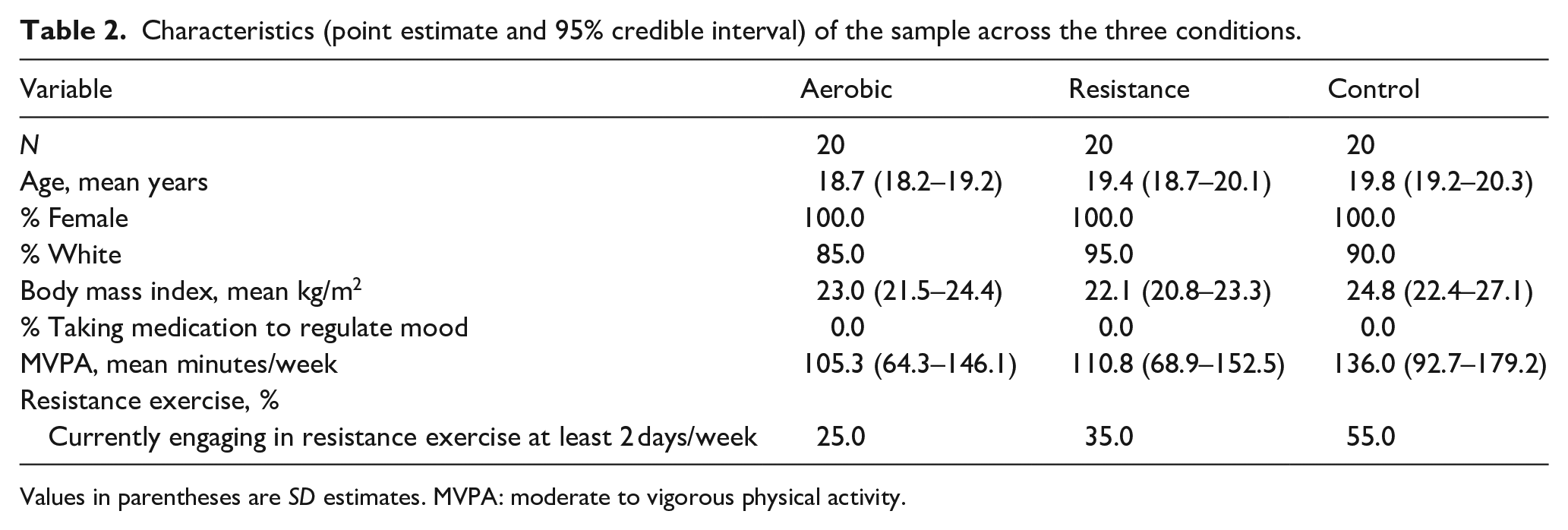
Values in parentheses are SD estimates. MVPA: moderate to vigorous physical activity.
Table 3 displays the physiological (heart rate) and perceptual (RPE) responses to the exercise and control conditions. Regarding the group (aerobic, resistance, control) by time (resting, midpoint, endpoint, post) interaction effect for heart rate, there was evidence for the alternative hypothesis (BF10 = 3.62e + 60). Similar results were observed for RPE (group by time interaction: BF10 = 5.84e + 78). Both heart rate and RPE were substantively higher in the aerobic group when compared with the other groups.
Physiological and perceptual responses across the three conditions.

HR: heart rate; BPM: beats per minute; RPE: rating of perceived exertion.
Table 4 displays the memory performance scores across the three conditions. For the 2 (immediate and delay) by 3 (aerobic, resistance and control) RM-ANOVA analysis for the word-list memory task, and for the main effect for time (immediate vs. delay), there was evidence for the alternative hypothesis (BF10 = 7.548e + 7), but no evidence in favour of the alternative hypothesis for the main effect of condition (BF10 = 0.225). Similarly, there was no evidence in favour of the alternative hypothesis for the time by group interaction (BF10 = 0.349) or the percentage retention score (BF10 = 0.438). 1
Memory performance (proportions and 95% credible interval) across the three conditions.

WWW: what-where-when integration.
Results were similar for the WWW memory outcomes, including overall WWW score (BF10 = 0.17; BF01 = 5.76), what-loop (BF10 = 0.19; BF01 = 5.19), where-loop (BF10 = 0.15; BF01 = 6.58), and when-loop (BF10 = 0.15; BF01 = 6.63). Thus, these findings suggest that there is evidence to support the null hypothesis. Notably, sensitivity analyses were computed that controlled for age in the models, but the same pattern of results were observed.
Sensitivity analyses were computed to evaluate whether currently engaging in resistance exercise (yes/no) or meeting self-reported physical activity guidelines (150 min/week) influenced memory (retention) performance or interacted with the study condition. Results did not demonstrate main effects of being a current resistance exerciser (BF10 = .42; BF01 = 2.35), or a condition by resistance exercise experience interaction (BF10 = .60; BF01 = 1.65). Similar results for self-reported physical activity (BF10 = .58; BF01 = 1.71), along with condition by self-reported physical activity interactions were observed (BF10 = .1.49; BF01 = .67).
Discussion—Experiment 1
Experiment 1 addressed a novel line of inquiry by examining whether acute aerobic and resistance exercise have a differential effect on episodic memory function. The results provided moderate evidence in favour of the null hypothesis regarding the effects of different exercise modalities on episodic memory. Strengths of this study include the study novelty, experimental approach, and employing multiple, comprehensive assessments of episodic memory function.
Not all (only about half) acute exercise studies demonstrate a beneficial effect on episodic memory (Roig et al., 2013), and thus, it is possible that our observed results may accurately depict the relationship between acute aerobic and resistance exercise on episodic memory function. However, it is also plausible that our null findings can be attributed to various characteristics of Experiment 1. These include (1) the sample consisted of exclusively female participants; (2) the two exercise protocols (aerobic and resistance) did not elicit the same physiological and perceptual response, as the aerobic exercise protocol increased heart rate and RPE to a greater extent than the resistance exercise protocol; (3) the delayed memory recall from the word list task was relatively short (10 min), considering that other work has demonstrated that acute exercise may not enhance immediate memory recall, but has been shown to enhance long-term memory at a 20 min follow-up period (Frith et al., 2017); and (4) the present experiment employed a between-subject design, and the null effects, in part, may be attributed to individual differences. Notably, a major advantage of a within-subject (vs. between-subject) design is that it reduces error variance associated with individual differences (Thompson & Campbell, 2004).
Experiment 2 aims to overcome these limitations from Experiment 1. Specifically, we recruited a sample comprising both males and females, (2) utilised acute aerobic and resistance exercise protocols that elicit a similar physiological (heart rate) response, (3) employed a longer delayed memory recall assessment (i.e., 20 min delay), and (4) employed a within-subject experimental design.
Introduction—Experiment 2
Previous research has examined the role that sex may play in memory function (Loprinzi & Frith, 2018). A notable limitation of Experiment 1 was the homogeneous sample of female participants, a factor which limits the external validity of the study. Experiment 2 attempted to overcome this limitation by including a mixed sample of males and females. Although recent empirical work suggests that sex may not moderate the effects of acute exercise on episodic memory (Johnson & Loprinzi, 2019), there is meta-analytic evidence that acute exercise is more likely to influence memory when conducted in a mixed-sex sample than one that is not mixed (Loprinzi et al., 2019). Thus, the most sensible approach, given this evidence and the increased generalisability of a mixed-sex sample, is to include a mixed-sex sample, which we accomplished in Experiment 2.
For Experiment 1, we anticipated that, by having participants engage in aerobic and resistance exercise to task failure, it would elicit a similar physiological and perceptual response. Clearly this was not the case with Experiment 1. Experiment 2 aimed to create a protocol that elicits a similar physiological response between the acute aerobic and resistance exercise protocols. Similar to work conducted in animal models (Cassilhas et al., 2012; Vilela et al., 2017), which involved the resistance trained rats engaging in movement with an external load (weight attached to the rat’s tail), Experiment 2 involved ambulatory exercise with a weighted vest for our resistance exercise protocol. Importantly, though, this ambulatory resistance exercise protocol occurred at the same relative physiological intensity (75% of heart rate reserve [HRR]) as the aerobic exercise group.
Another potential limitation of Experiment 1 was the relatively short follow-up assessment of the word-list memory task (i.e., 10 min). It is possible that such a short follow-up period may have hindered the consolidation process of the memory trace. In alignment with this assertion, a recent experiment demonstrated that acute aerobic exercise did not enhance immediate memory, but it did enhance long-term memory, as assessed following a 20-min delay (Frith et al., 2017). Experiment 2 addressed this issue by extending the follow-up (delayed recall) word-list memory assessment to a 20-min delayed period.
Finally, Experiment 1 included a between-subject design. The effects of acute exercise on memory function are usually of a small effect size (Roig et al., 2013), if any. This, coupled with the likelihood that the greatest source of outcome variance in a between-subject design on this topic are individual differences (in memory), underscores the importance of employing a within-subject design.
The purpose of Experiment 2 was to examine whether acute aerobic and resistance exercise have a differential effect on episodic memory. Couched within the above, Experiment 2 extends the findings from Experiment 1 by evaluating this research question using a within-subject design, among a mixed sample of males and females, utilising a longer memory follow-up assessment, and employing acute aerobic and resistance exercise protocols that are matched by relative physiological (heart rate) intensity.
Methods—Experiment 2
Study design
A within-subject, experimental design was employed. As stated, this specific design was employed to overcome the design (between-subject) limitation of Experiment 1. Thus, Experiment 2 overcame the concern from Experiment 1 that individual differences at the between-subject level may have contributed to the null results. In a counterbalanced order, participants completed three conditions, including aerobic exercise, resistance exercise, and a control condition. At least 24 hr (but less than 96 hr) separated each visit. In addition, all visits occurred around the same time of day (±2 hr). The experimental conditions involved participants engaging in exercise for 15 min, while the control condition involved participants engaging in a seated, time-matched control task.
Table 5 provides a schematic of the procedures employed for each condition (within-subject design). Further details are explained in the narrative that follows.
Schematic of the study protocol for Experiment 2.
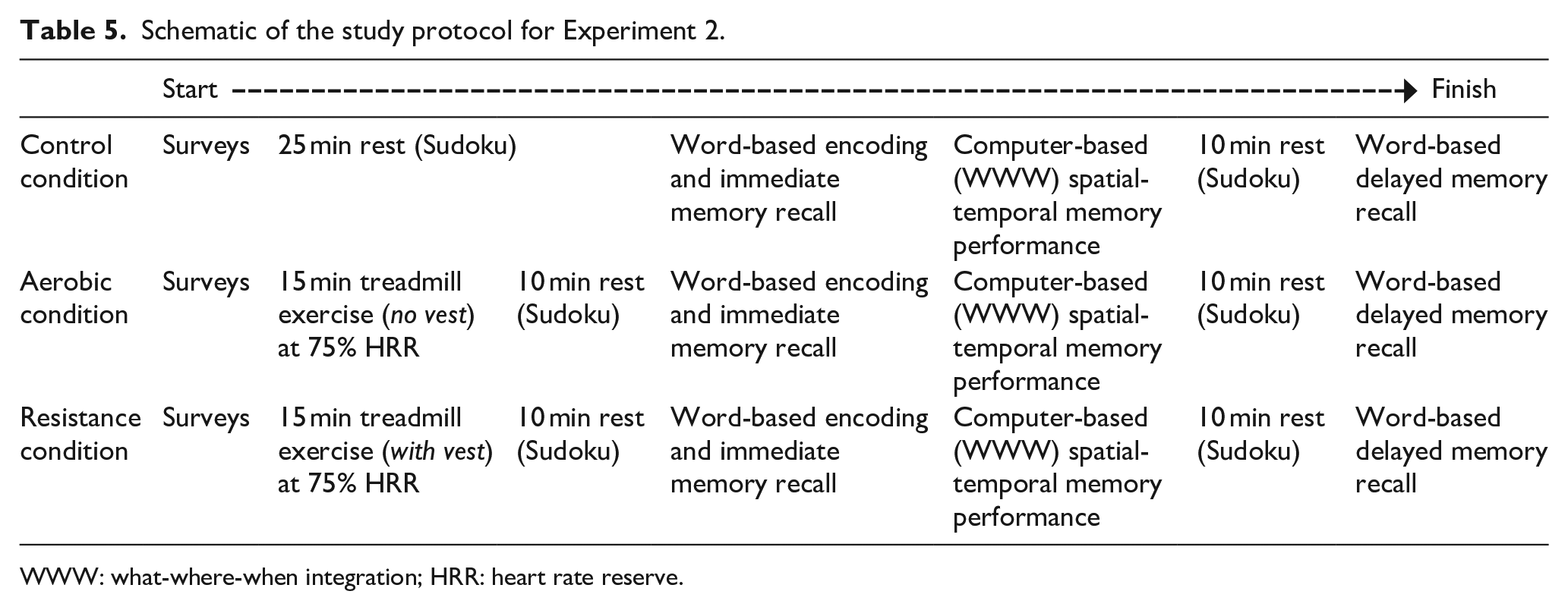
WWW: what-where-when integration; HRR: heart rate reserve.
Participants
Twenty-four participants (12 males and 12 females) were recruited and completed all visits. The recruitment approach and eligibility criteria for Experiment 2 were the same as Experiment 1.
Exercise protocol
It would be easier to match exercise intensity by having both protocols exercise to maximal exhaustion, but we intentionally chose not to do this, as acute maximal exercise, via psychological fatigue (for example), may impair memory function (Covassin et al., 2007). Thus, we had both conditions exercise at the same relative, submaximal exercise intensity. We chose a vigorous-intensity exercise protocol, as vigorous-intensity exercise may enhance episodic memory to a greater extent than moderate-intensity exercise (Loprinzi, 2018; Loprinzi et al., 2019).
Aerobic exercise
During the aerobic exercise condition, participants exercised for 15 min on a treadmill at 75% of their HRR, which constitutes vigorous-intensity exercise (Garber et al., 2011). The HRR equation used to evaluate exercise intensity was HRR = ([HRmax – HRrest] × % intensity) + HRrest. To calculate HRrest, at the beginning of the visit, participants sat quietly for 5 min, and HR was recorded from a Polar HR monitor. To estimate HRmax, we calculated the participants estimated HRmax from the formula, (208 − [0.7 × age]). Following this bout of exercise, participants sat for 10 min (played Sudoku) and then started the memory task.
Resistance exercise
During the resistance exercise condition, participants exercised for 15 min on a treadmill at 75% of their HRR. Notably, the resting heart rate to be used in this formula was obtained from this condition, as opposed to using the resting heart rate from the previous condition. However, while exercising, they wore a weighted vest (Perfect®; SKU: IM-PF-31023-X), with the vest weighing 10% of their measured body mass. This percentage (10%) was piloted tested and appeared to be of a reasonable weight (not too uncomfortable) to still carry out ambulatory treadmill exercise. Notably, this weight (10%) is the same (10%) as other studies evaluating cognitive outcomes from acute exercise (Lin et al., 2014), is within the range of other acute studies evaluating skeletal muscle microRNA expression (30% of body mass (Margolis et al., 2017), kinetic outcomes (40% of body mass [Carlos-Vivas et al., 2019]), but is slightly higher than other studies employing chronic training protocols (e.g., 5%; Rahbar et al., 2018). Notably, this weighted vest approach aligns with our previously listed definition of resistance exercise, which is to exercise a muscle against an external load.
To add weight to the vest, 1.25 lb sand weights fit into interior pouches of the vest, which are evenly distributed across the vest, including the front and back. Throughout the 15-min bout of treadmill exercise, the speed/incline was manipulated to keep the participants heart rate at 75% of their HRR. Following the 15-min exercise bout, participants sat for 10 min (played Sudoku) and then started the memory task.
Control condition
Identical to Experiment 1, for the control condition, participants completed a medium-level, on-line administered, Sudoku puzzle for 25 min (time-matched to the two experimental conditions).
Memory assessment
Similar to Experiment 1, for all three conditions, participants completed two memory tasks in a fixed order, including a word-list episodic memory task (first task) and the WWW (what-where-when) episodic memory task (second task). Unlike Experiment 1, which included a 10-min delay between the immediate and delayed word-list memory recall, for Experiment 2, a 20-min delay was employed. After the immediate free recall, participants completed the WWW task (same difficulty version as employed in Experiment 1; i.e., 16 unique item-location-time combinations), and then played Sudoku until 20 min elapsed, after which they completed the delayed free memory recall. Notably, for the word-list memory recall, a separate word list was employed for each visit, which included word lists of similar levels of imageability.
Additional assessments
Identical to Experiment 1, various demographic (e.g., BMI), behavioural (e.g., self-reported physical activity), physiological (e.g., heart rate), and psychological (e.g., RPE) assessments were evaluated. The same instruments and protocol employed in Experiment 1 were utilised for Experiment 2.
Statistical analyses
All statistical analyses were computed in JASP (v. 0.9.1.0). Bayesian analyses, with default priors (r scaled fixed effects of 0.50), were conducted to evaluate the extent to which our observed data supports the alternative hypothesis (BF10) or null hypothesis (BF01; equal to 1/BF10). For the word-list memory outcome, a 2 (time; immediate and delay) × 3 (visit; aerobic, resistance, control) RM-ANOVA was employed. Main effects for time (immediate and delay), main effects for visit (aerobic, resistance and control), and time by visit interactions were evaluated. For the WWW memory task, RM-ANOVA was computed to evaluate potential differences in episodic memory function (WWW; what; where; when) across the three visits.
Results—Experiment 2
Table 6 displays the demographic and behavioural characteristics of the sample. The mean (SD) age was 22.6 years (2.1).
Characteristics (mean [SD]) of the sample.
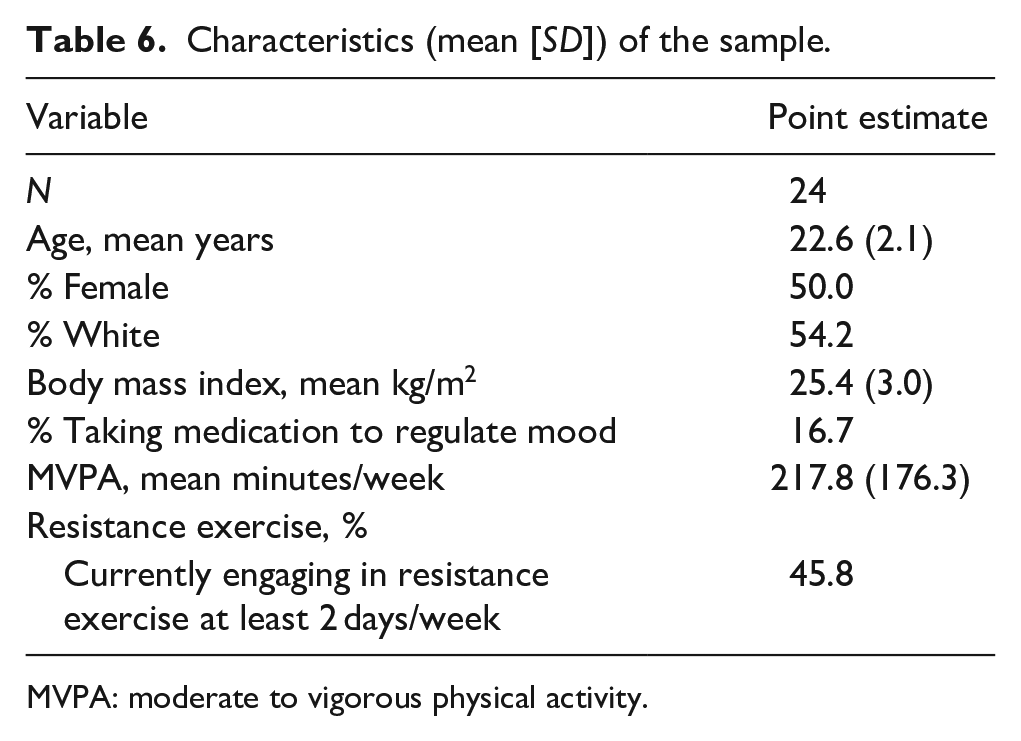
MVPA: moderate to vigorous physical activity.
Table 7 displays the physiological (heart rate) and perceptual (RPE) responses to the exercise and control conditions. Regarding the condition (aerobic, resistance, control) by time (resting, midpoint, endpoint, post) interaction effect for heart rate, there was evidence for the alternative hypothesis (BF10 = 9.37e + 98). Similar results were observed for RPE (condition by time interaction: BF10 = 1.74e + 55). Both heart rate and RPE were substantively higher in the two exercise conditions when compared with the control condition, but there was no evidence for the alternative hypothesis when comparing the two exercise conditions to each other.
Physiological and perceptual responses across the three conditions.
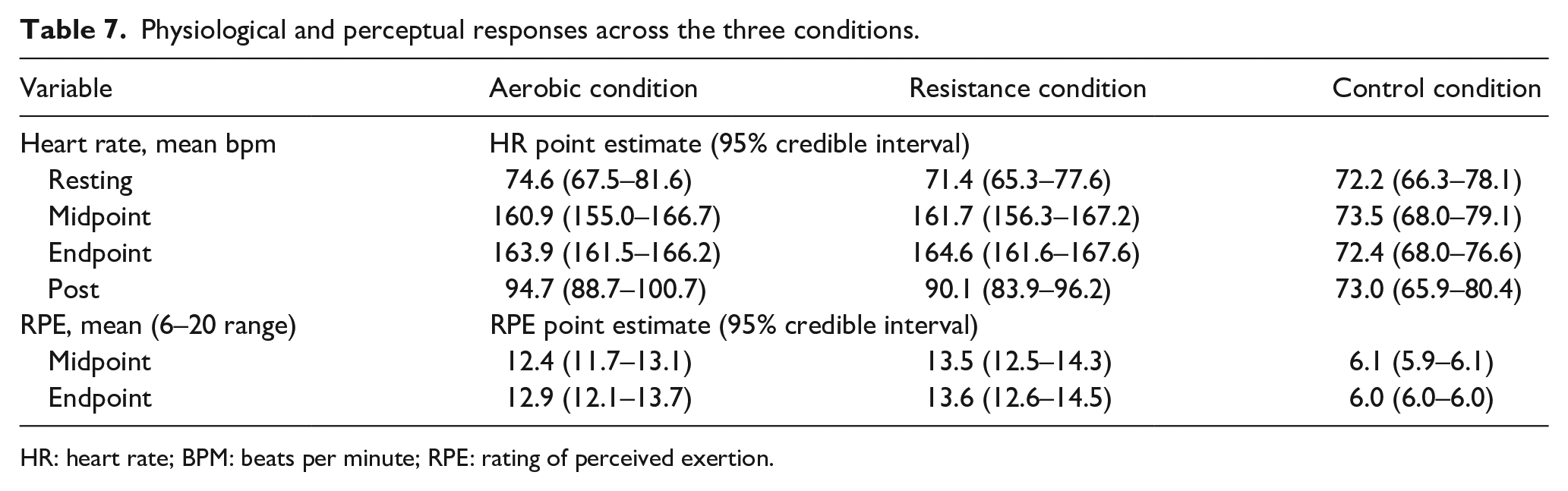
HR: heart rate; BPM: beats per minute; RPE: rating of perceived exertion.
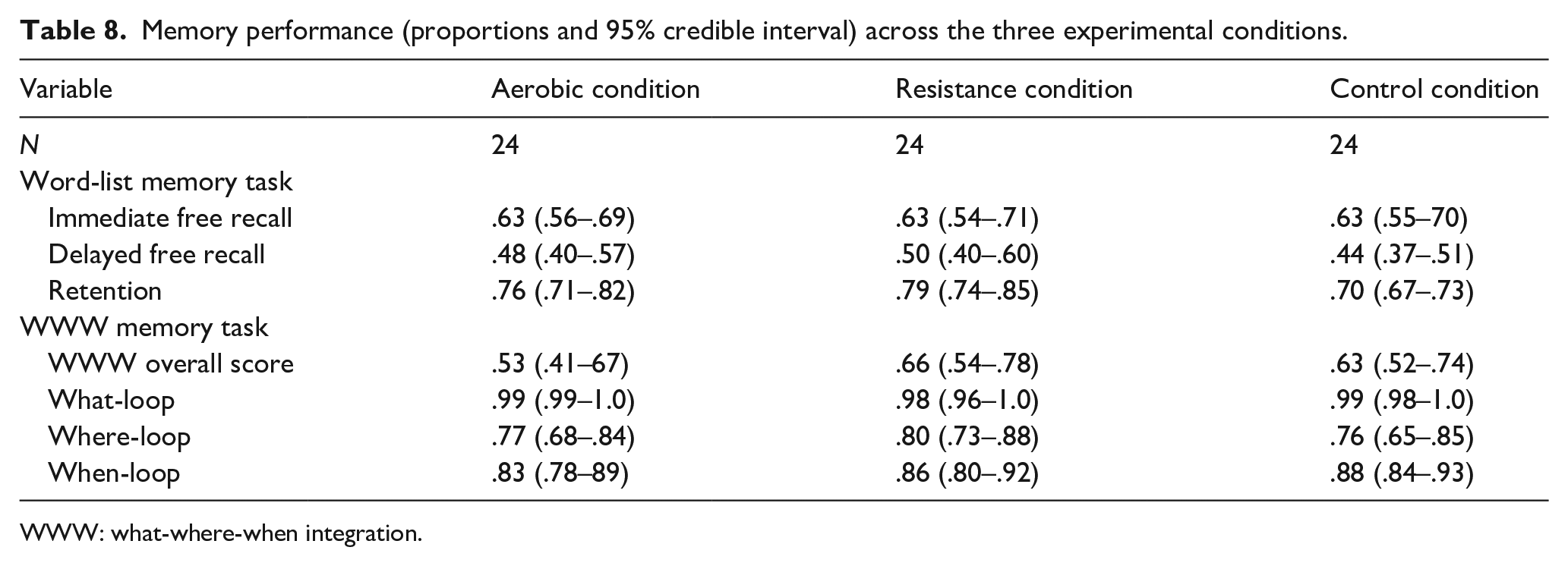
Table 8 displays the memory performance scores across the three conditions. For the 2 (immediate and delay) by 3 (aerobic, resistance and control) RM-ANOVA analysis for the word-list memory task, and for the main effect for time (immediate vs. delay), there was evidence for the alternative hypothesis (BF10 = 1.11e + 9), but no evidence in favour of the alternative hypothesis for the main effect of condition (BF10 = 0.10). Similarly, there was no evidence in favour of the alternative hypothesis for the time by condition interaction (BF10 = 0.19) or the percentage retention score (BF10 = 0.27).
Memory performance (proportions and 95% credible interval) across the three experimental conditions.
WWW: what-where-when integration.
Results were similar for the WWW memory outcomes, overall WWW score (BF10 = 0.85; BF01 = 1.16), what-loop (BF10 = 0.32; BF01 = 3.10), where-loop (BF10 = 0.40; BF01 = 2.45), and when-loop (BF10 = 0.41; BF01 = 2.46). Generally, and similar to Experiment 1, these findings suggest that there is evidence to support the null hypothesis.
Sensitivity analyses also demonstrated evidence in support of the null hypothesis regarding main effects of being a current resistance exerciser (BF10 = .44; BF01 = 2.24), along with condition by resistance exercise experience interaction (BF10 = .13; BF01 = 2.27). Similarly, there was evidence in support of the null hypothesis regarding main effects of self-reported physical activity (BF10 = .48; BF01 = 2.05), along with condition by self-reported physical activity interaction (BF10 = .13; BF01 = 7.42).
Discussion—Experiment 2
The main finding from Experiment 2 is that acute exercise, either aerobic or resistance, did not influence memory when compared with the control condition. In contrast to Experiment 1, for Experiment 2, we applied an external load (weighted vest) for the resistance exercise protocol. This methodological change resulted in a different physiological (heart rate) response in the resistance exercise protocols between the two experiments, potentially involving different energy systems and hormonal responses between protocols. Despite this, perhaps further alterations in the resistance exercise protocol would be useful to consider in future research. For example, past work has demonstrated a positive correlation between the total volume of completed resistance exercise and the release of key memory-related neurotrophins, such as brain-derived neurotrophic factor (Pereira et al., 2018).
Despite differences in participant characteristics (all female in Experiment 1; mixed-gender in Experiment 2), aerobic exercise protocol (based on perceived exertion in Experiment 1 and heart rate in Experiment 2), resistance exercise protocol (body weight in Experiment 1 and external weight in Experiment 2), retention interval (10 min in Experiment 1 and 20 min in Experiment 2), and design (between-subject in Experiment 1 and within-subject in Experiment 2) characteristics between Experiments 1 and 2, results were similar between the two experiments. To further evaluate the reliability of these null findings, Experiment 3 made additional alterations to the study design to provide more conclusive inferences regarding the potential (or lack thereof) effects of acute exercise modality on memory.
Introduction—Experiment 3
To extend the findings from Experiments 1 and 2, Experiment 3 was conducted in a way that specifically modified the study design, but, importantly, attempted to answer the same research question. For Experiment 3, we implemented a within-subject counterbalanced pretest posttest comparison design to evaluate the association between aerobic and resistance acute exercise on episodic memory function.
Thus far, Experiments 1 and 2 failed to demonstrate any beneficial or differential effect of acute aerobic and resistance exercise on episodic memory function. Results from Experiments 1 and 2 both demonstrate moderate evidence in favour of the null hypothesis. If results from Experiment 3 align with that of Experiments 1 and 2, then this will provide additional evidence that acute aerobic and resistance exercise do not have a beneficial or differential effect on episodic memory, at least within our evaluated samples.
Methods—Experiment 3
The methodology for Experiment 3 was identical to that of Experiment 2, with the exception of the following: (1) Experiment 3 employed a within-subject, counterbalanced, pretest posttest comparison design; that is, participants came into the lab for three conditions (control, aerobic, resistance) and completed the memory tasks both before and after exercise; and (2) for the WWW episodic memory task, the pre- and post-exercise assessments employed a different contextual version of the WWW task (i.e., different objects, different scenarios), but, of course, used the same difficulty level. This specific study design for Experiment 3 was implemented because without a pretest posttest comparison, it is difficult to infer any potential results in the outcome (memory) to the exercise stimulus. Furthermore, this design may help to minimise any error variance that may be attributed to between-day variability in the outcome (memory).
Thus, for Experiment 3, participants completed three conditions (control, aerobic and resistance), and for each of these three conditions, they completed the protocol shown in Table 9.
Schematic of the protocol for Experiment 3.

WWW: what-where-when integration.
Results—Experiment 3
Table 10 displays the characteristics of the sample. The mean (SD) age was 20.0 years (1.5).
Characteristics (mean [SD]) of the sample.

MVPA: moderate to vigorous physical activity.
Table 11 displays the physiological (heart rate) and perceptual (RPE) responses to the exercise and control conditions. Regarding the condition (aerobic, resistance, control) by time (resting, midpoint, endpoint, post) interaction effect for heart rate, there was evidence for the alternative hypothesis (BF10 = 6.27e + 20). Similar results were observed for RPE (visit by time interaction: BF10 = 1.72e + 38). Both heart rate and RPE were substantively higher in the two exercise conditions when compared with the control condition, but there was no evidence for the alternative hypothesis when comparing the two exercise conditions to each other.
Physiological and perceptual responses across the three conditions.
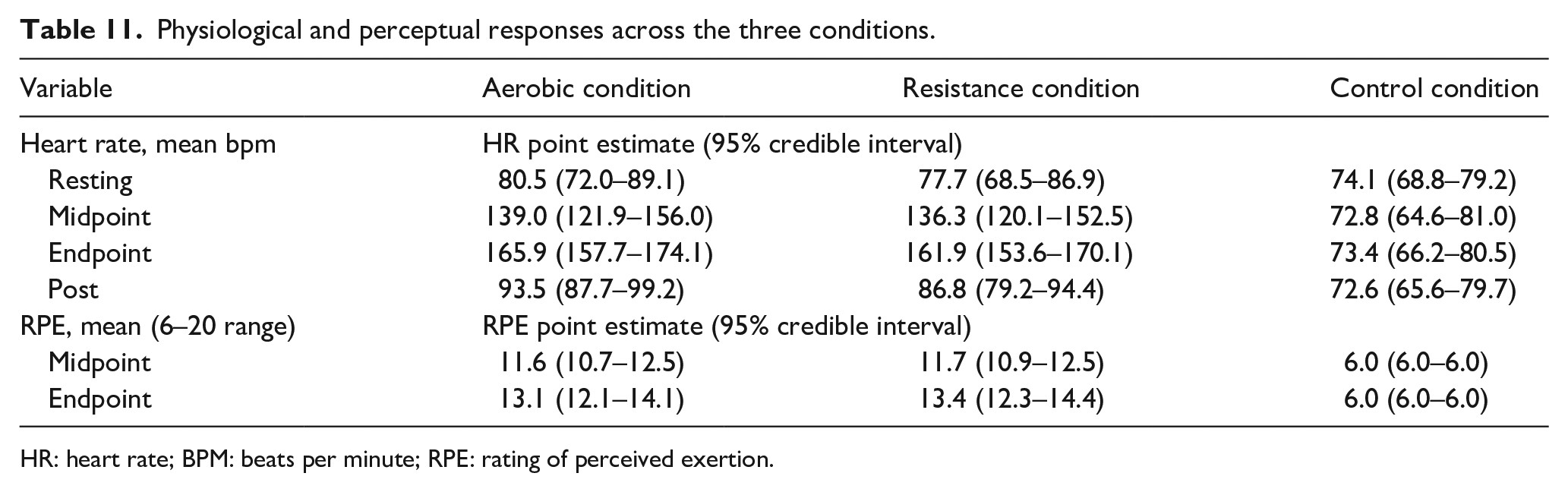
HR: heart rate; BPM: beats per minute; RPE: rating of perceived exertion.
Table 12 displays the memory performance scores across the three conditions. In the Bayesian analysis, for the word-list memory task, we compared the difference (immediate-delay) at the pre-assessment to the difference (immediate-delay) at the post-assessment (i.e., ∆ pre - ∆ post). In a 2 (pre vs. post) by 3 (aerobic, resistance and control) RM-ANOVA analysis for the word-list memory task, and for the main effect for time (pre vs. post), there was evidence for the null hypothesis (BF01 = 4.93). For the main effect for condition (BF01 = 11.32) and time by condition interaction (BF01 = 4.78), we observed evidence in favour of the null hypothesis.
Memory performance (proportions and 95% credible interval) across the three conditions.

WWW: what-where-when integration.
Results were similar for the WWW memory outcomes. For the overall WWW score, the main effect for time was (BF10 = 0.61; BF01 = 1.64), main effect for condition (BF10 = 0.07; BF01 = 13.61), and time by condition (BF10 = 0.17; BF01 = 6.57). For the what-loop score, the main effect for time was (BF10 = 0.19; BF01 = 5.25), main effect for condition (BF10 = 0.33; BF01 = 3.02), and time by condition was (BF10 = 15.9; BF01 = 0.06). For the where-loop score, the main effect for time was (BF10 = 0.36; BF01 = 2.75), main effect for condition (BF10 = 0.24; BF01 = 4.08), and time by condition was (BF10 = 0.15; BF01 = 6.68). For the when-loop score, the main effect for time was (BF10 = 58.2; BF01 = 0.02), main effect for condition (BF10 = 0.09; BF01 = 10.59), and time by condition was (BF10 = 0.15; BF01 = 6.86).
Sensitivity analyses also demonstrated evidence in support of the null hypothesis regarding main effects of being a current resistance exerciser (BF10 = .32; BF01 = 3.12), along with condition by resistance exercise experience interaction (BF10 = .25; BF01 = 3.96). Similarly, there was evidence in support of the null hypothesis regarding main effects of self-reported physical activity (BF10 = .36; BF01 = 2.78), along with condition by self-reported physical activity interaction (BF10 = .17; BF01 = 5.89).
Discussion—Experiment 3
Across the three previous experiments, which varied by study design (e.g., between vs. within-subject), response from the exercise stimuli (e.g., similar or different physiological and perceptual response to the exercise stimuli), and participant characteristics (e.g., predominately female vs. mixed-sex sample), we observed evidence in favour of the null hypothesis. That is, memory function did not vary as a function of the imposed, isolated condition (i.e., control, aerobic exercise, or resistance exercise). In addition to providing the results separately for each individual experiment, and as suggested by Cumming (2014), we also performed a meta-analysis of the three experiments to evaluate the global effect of acute exercise modality on memory function.
Summary of results—meta-analysis
See Figures 2 and 3 for a forest plot of the Bayesian meta-analyses. These meta-analyses consist of effect size estimates from all three experiments, evaluating each memory outcome, with comparisons between aerobic exercise and control (Figure 2), resistance exercise and control (Figure 2), and aerobic exercise and resistance exercise (Figure 3). Cohen’s d effect size estimates with their corresponding standard error (SE) values were calculated; SE values were converted to 95% CI by multiplying SE by 1.96. Across the 18 effect size estimates comparing exercise (aerobic or resistance) to control (Figure 2), the mean effect was .07 (–.07, .22), with evidence in support of the null hypothesis (BF10 = 0.13; BF01 = 7.55). Across the 9 effect size estimates comparing aerobic to resistance exercise (Figure 3), the mean effect was –.04 (–.26, .18), with evidence in support of the null hypothesis (BF10 = 0.13; BF01 = 7.62).
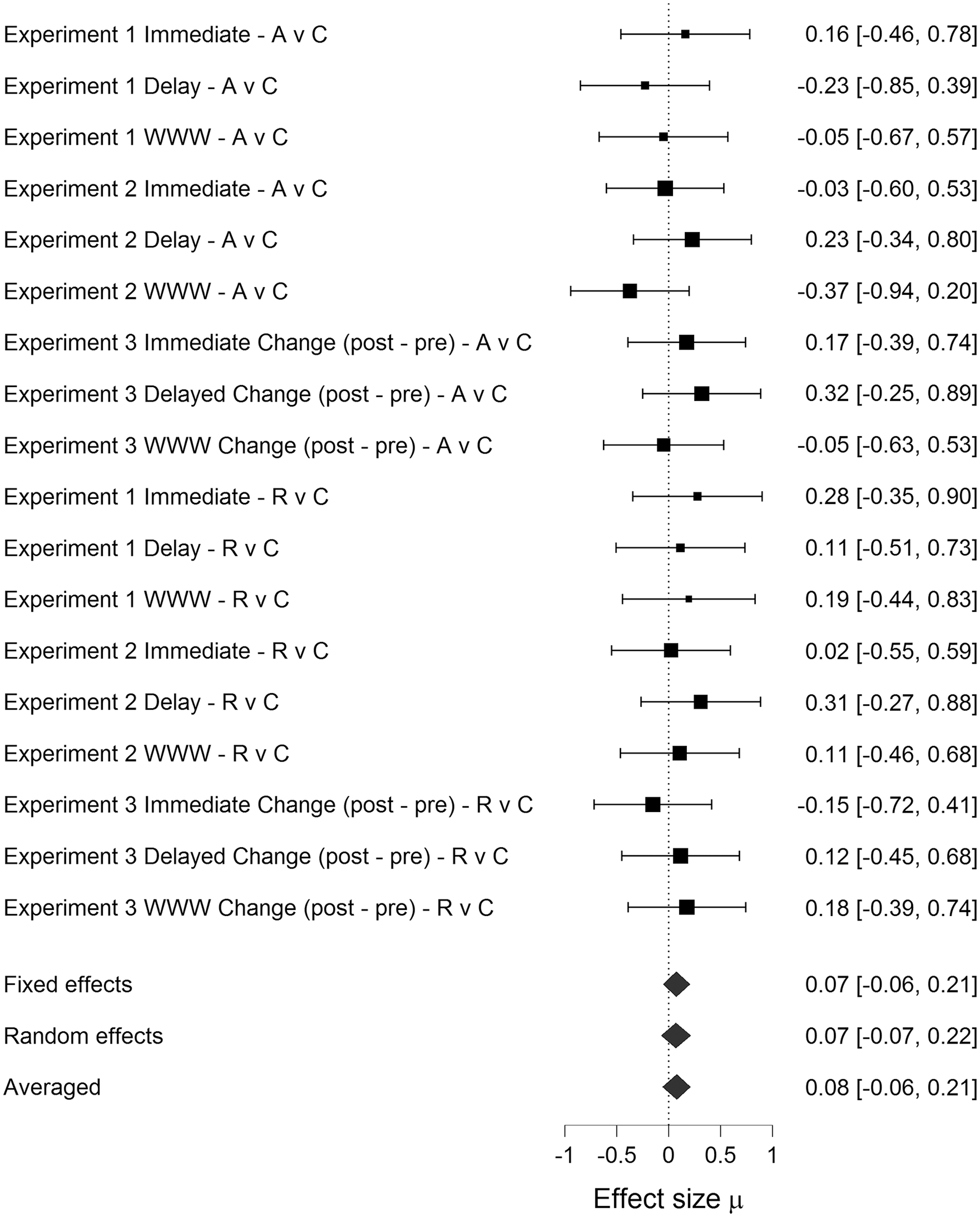
Forest plot of the Bayesian meta-analysis comparing exercise (aerobic and resistance) to control.
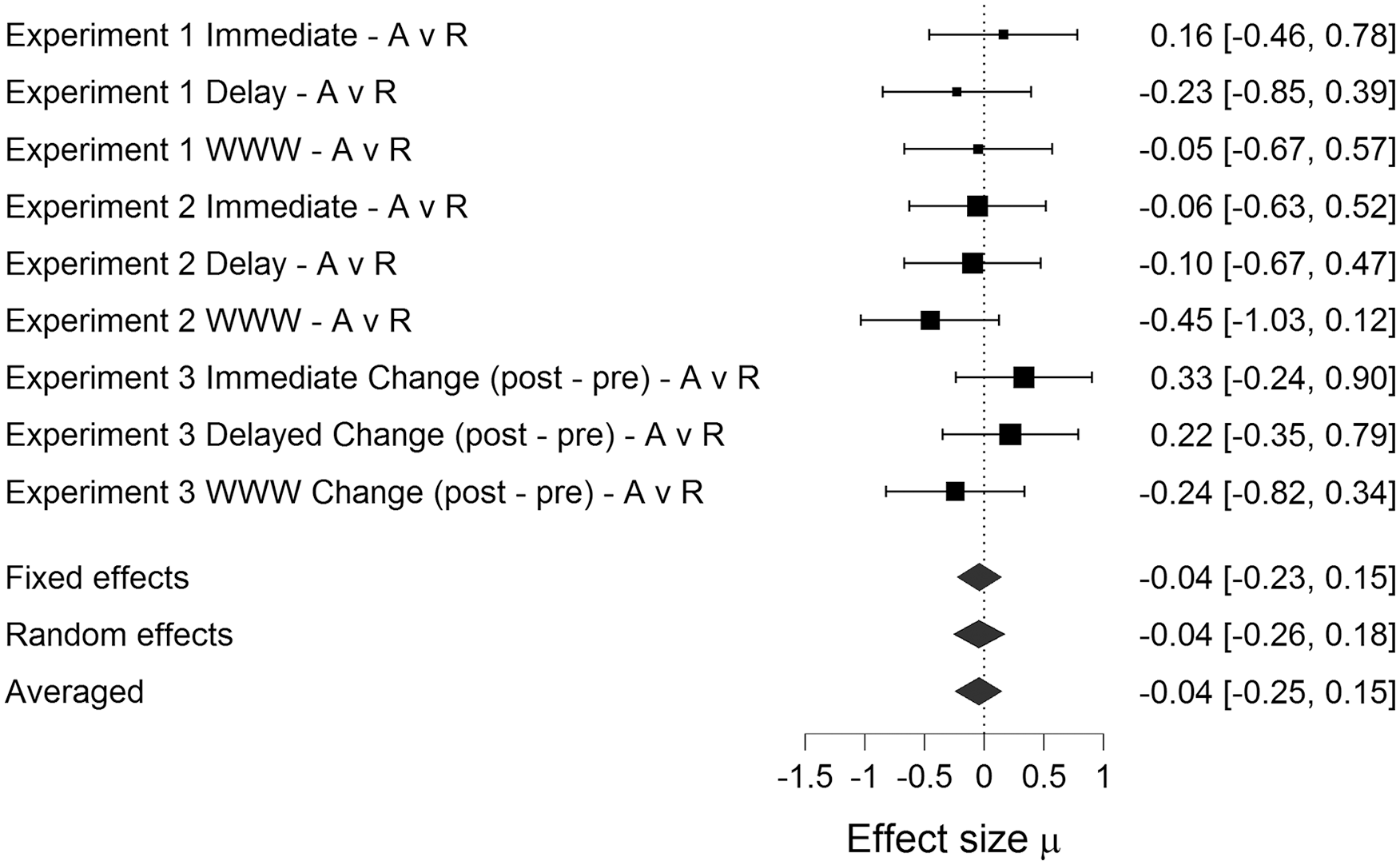
Forest plot of the Bayesian meta-analysis comparing aerobic to resistance exercise.
General discussion
Our experiments implemented herein failed to provide evidence that acute aerobic and resistance exercise have a differential effect on episodic memory function. Furthermore, acute aerobic and resistance exercise did not improve episodic memory when compared with a control condition. We observed consistent and relatively strong evidence in support of the null hypothesis across the three experiments.
As indicated in the Introduction section of our article, chronic exercise studies (in animal models) demonstrate that the mechanisms (and possibly the outcome) through which exercise influences memory may be unique for aerobic and resistance exercise (Cassilhas et al., 2012, 2016; Lee et al., 2012; Tang et al., 2017; Vilela et al., 2017). Based on our findings, however, this effect may not occur for acute exercise. Also as indicated in the Introduction section of our article, among human studies (Dunsky et al., 2017; Pontifex et al., 2009), acute aerobic and resistance exercise may have a differential effect on other cognitive outcomes, namely executive function. Two important points are worth considering. First, perhaps our null exercise effects (i.e., aerobic and resistance exercise did not affect memory when compared to the control condition) are a result of the outcome (memory) targeted in our experiments. This aligns with the meta-analysis by Chang et al. (2012) in which they demonstrated that acute exercise had a stronger effect on executive function (d [95% CI] = 0.26 [0.119, 0.401]) when compared with memory (d = 0.01 [−0.07, 0.10]). Second, as we stated earlier, the lack of a differential effect of aerobic vs. resistance exercise on memory may be from the observation that these exercise modalities did not improve memory when compared with our control scenario. An alternative explanation, however, is that perhaps the two exercise modalities (aerobic vs. resistance) employed in our experiments had a similar level of cognitive demand. It may be useful for future work to increase the cognitive demand of the resistance exercise protocol by, for example, using multi-joint resistance exercises that vary the degree of balance required to complete the task. Similarly, it may be worthwhile to also consider altering the cognitive demand of the aerobic exercise task. This aligns with a recent meta-analysis showing that cognitive function may vary as a result of open- vs. closed-chronic exercise (Gu et al., 2019). That is, chronic exercise protocols that implemented an open-skilled exercise protocol (e.g., racquetball), when compared with a closed-skilled exercise protocol (e.g., treadmill exercise), induced greater improvements in cognitive function. This, however, is in contrast to a recent experiment showing that, when considering acute exercise, closed-skilled exercise was more effective in enhancing memory when compared with open-skilled exercise (Cantrelle et al., 2020).
We believe that additional work on this topic is needed. Perhaps our null findings, regarding exercise vs. control or aerobic vs. resistance exercise, may be influenced by other exercise characteristics. For example, as demonstrated in a recent meta-analysis by Loprinzi et al. (2019), longer duration acute exercise (20–40 min vs. < 20 min) is more effective in enhancing episodic memory. Within the context of our present set of experiments, implementing longer bouts of resistance exercise (up to 40 min) may prove challenging, especially when trying to match the exercise intensity between aerobic and resistance exercise. This was the primary reason why our experiments implemented a shorter duration of exercise. Importantly, however, our employed duration of exercise (i.e., 15 min) has been shown to enhance episodic memory in other experiments focusing on aerobic exercise (Frith et al., 2017). Future work may also benefit by manipulating the exercise intensity, as prior work suggests that the intensity of acute exercise may differentially influence the type of memory assessed (Loprinzi, 2018); moderate-intensity acute exercise may benefit cognitive outcomes requiring more cognitive control (e.g., working memory), whereas high-intensity acute exercise may favour lower-order cognitive processes. In addition to aerobic and resistance exercise, and as suggested in the above paragraph, future work may wish to consider other exercise modalities (e.g., open- and closed-skilled exercise). In support of this, the meta-analyses by Loprinzi et al. (2019) and Roig et al. (2013) suggest that cycling exercise may be superior to other exercise modalities in enhancing memory. However, these conclusions should be cautiously interpreted, as relatively few studies in these meta-analyses compared cycling with other modalities of exercise. Furthermore, future work should also consider combining multiple exercise modalities into a single exercise bout. Previous meta-analytic research has shown that, when evaluating aerobic, anaerobic, muscular resistance, and a combination of exercises, combined acute exercise has the greatest positive effects on overall cognition (d = 0.371, 95% CI: .262, .480; Table 2) (Chang et al., 2012).
In addition to the cognitive outcome, exercise modality, combination of exercise modalities, and duration of exercise providing insights into our observed findings, we would be remiss if we also did not carefully consider other characteristics of our implemented protocols. For example, across our experiments, we implemented a control condition where participants played an on-line puzzle (Sudoku). We believe that it was important to have participants engage in some type of cognitive task during the control period to prevent boredom and to prevent potential differences in how participants approached the subsequent memory task. It is possible, however, that another task would have been more appropriate for controlling non-exercise factors that might have varied between the conditions (e.g., task novelty or interactions between the researcher and participant). Another important study design characteristic that is worth considering is the post-exercise duration period. We intentionally selected a 10-min post-exercise recovery period before implementing the memory task. This was primarily based off of the meta-analytic results by Chang et al. (2012), in which they demonstrated that longer duration recovery periods (10 < min < 20), such as those implemented in our experiments, were more effective in enhancing cognitive function. However, additional work in this area is needed. This recovery period moderation analysis conducted in the Chang et al. (2012) meta-analysis was for global cognition. It is uncertain as to whether different cognitive outcomes would require different post-exercise recovery periods. It seems that higher order cognitions that involve multiple cognitive processes (e.g., executive function) would require a longer exercise recovery period, when compared with other cognitions, such as memory. Furthermore, the exercise-intensity will likely play a large role in determining what the optimal post-exercise recovery period should be. It is possible that our 10-min post-exercise recovery period was too long to observe favourable effects of exercise on memory, particularly among a young, physically active sample.
Finally, and as demonstrated above, there are many factors (e.g., cognitive outcome, exercise modality, combination of exercise modalities, duration of exercise, post-exercise recovery period, control task) that may influence the relationship between acute exercise and memory function. As such, it should not be viewed as surprising or problematic if null effects are observed. In fact, as demonstrated in the meta-analysis by Roig et al. (2013), only 47.8% and 58.3% of studies have demonstrated an improvement in short-term and long-term memory, respectively, from acute exercise. Resultantly, the literature on acute exercise and memory is mixed, and the present set of experiments provide new evidence that the effects may be smaller than previously thought. It would be worthwhile for future research to evaluate whether there are individual participant differences that influence the effects of acute exercise on memory (Crush & Loprinzi, 2017; Sibley & Beilock, 2007). For example, brain-derived neurotrophic factor (BDNF) met carrier status may moderate the effects of acute exercise on memory (Piepmeier et al., 2019). In addition, although our set of experiments implemented sample sizes that are at or above the median sample size among studies on this topic (see Figure 9 in Pontifex et al., 2019), future studies that evaluate individual differences may require larger sample sizes.
In conclusion, our experiments do not provide convincing evidence of a beneficial or differential effect of acute aerobic and resistance exercise on memory. We have discussed several areas of research to help move this field forward.
Footnotes
Acknowledgements
We thank all of the research participants. We also thank the following individuals for the involvement in data collection: Briahna Dickerson, Peyton Dixon, Sarah Marable, Seungho Ryu, Hanna Stricklen, and Samantha Tedford.
Declaration of conflicting interests
The author(s) declared no potential conflicts of interest with respect to the research, authorship, and/or publication of this article.
Funding
The author(s) received no financial support for the research, authorship, and/or publication of this article.
