




Abstract
The study examines statistical learning in the spelling of Italian children with dyslexia and typically developing readers by studying their sensitivity to probabilistic cues in phoneme-grapheme mappings. In the first experiment children spelled to dictation regular words and words with unpredictable spelling that contained either a high- or a low-frequency (i.e., typical or atypical) sound-spelling mappings. Children with dyslexia were found to rely on probabilistic cues in writing stimuli with unpredictable spelling to a greater extent than typically developing children. The difficulties of children with dyslexia on words with unpredictable spelling were limited to those containing atypical mappings. In the second experiment children spelled new stimuli, that is, pseudowords, containing phonological segments with unpredictable mappings. The interaction between lexical knowledge and reliance on probabilistic cues was examined through a lexical priming paradigm in which pseudowords were primed by words containing related typical or atypical sound-to-spelling mappings. In spelling pseudowords, children with dyslexia showed sensitivity to probabilistic cues in the phoneme-to-grapheme mapping but lexical priming effects were also found, although to a smaller extent than in typically developing readers. The results suggest that children with dyslexia have a limited orthographic lexicon but are able to extract regularities from the orthographic system and rely on probabilistic cues in spelling words and pseudowords.
Introduction
Developmental dyslexia is the most common learning disorder (5%–15% of the school population; American Psychiatric Association, 2013). It is characterised by severe and persistent difficulties in learning to read fluently and correctly, despite adequate intelligence and appropriate instruction, and often is associated with a spelling deficit (e.g., Angelelli et al., 2004). Crucial in the development of reading and spelling skills is the ability to learn and automatise the associations between units of oral language and units of writing. This process benefits not only from formal instruction but also from the extraction of regularities from visual and auditory sequences (e.g., co-occurring letters and sounds) important for the building of letter and word representations (Treiman, 2018). The extraction of regularities from a quasi-regular system and the application of this statistical knowledge to predict future events are known as statistical learning, which is thought to be a form of implicit learning (Perruchet & Pacton, 2006). According to this view, children begin to learn the properties of written words on the basis of exposure to written words present in their environment, and this process of statistical learning integrates the development of lexical knowledge and more generally what children are taught during literacy instruction.
Sublexical reading and spelling processes are fostered, at least in part, by sensitivity to statistical regularities, with a greater use of more frequent than less frequent sublexical patterns. Sublexical processing in reading could be conceived as a set of probabilistic grapheme-to-phoneme mappings (phoneme-to-grapheme mappings for spelling), weighted according to their frequency, that make easier to retrieve the more frequent mapping according to statistical regularities (Barry & De Bastiani, 1997; Barry & Seymour, 1988; Folk & Rapp, 2004). This is particularly well-fitting in deeper orthographies where mappings are not univocal and often rely on positional and other contextual regularities (for reading see Arciuli, 2018; for spelling see Treiman, 2018). In a language such as English, there are several kinds of statistical regularities that people who are learning to read and spell pick up incidentally, often without being aware of it. For example, during their formal instruction in reading children are often explicitly taught to associate the letter “c” with the phoneme ⁄th (as in the word “cat”). However, the letter “c” can also be associated with another phoneme such as ⁄s⁄ (as in “circus”). Over time, even if children are not explicitly taught, they discover that most words beginning with the letter “c” followed by the letter “i” start with the initial phoneme ⁄s⁄ and become sensitive to the co-occurrence of letters (i.e., contextual cues; Arciuli & Simpson, 2012). With regard to spelling, children will implicitly extract a variety of information from text exposure that can be described as rules (e.g., English words can be spelled with double letters at the end but rarely at the beginning), letter-specific properties (e.g., the “h” is never doubled at all), or weight of the pairing of certain nonadjacent letters (e.g., “a” later followed by “e” as in “hate” rather than “hat”). During literacy acquisition the myriad combinations that the written language may present, especially in deep orthographies, would be not fully manageable through explicit learning. For this reason, statistical learning may have an important role in normal reading and spelling development (Treiman, 2018) and conversely a deficit in statistical learning may underlie or worsen dyslexia.
In the last decade, the statistical learning capabilities of children with dyslexia have been tested in a few studies, with contradictory results. Statistical learning is generally considered a domain-general computational process, evaluated by means of implicit learning tasks. Different experimental paradigms (e.g., the Artificial Grammar Learning—AGL; Reber, 1967, and the Serial Reaction Time—SRT; Nissen & Bullemer, 1987) have been used. These paradigms usually consist of two phases: an exposure phase where some complex, rule-governed situations are displayed (participants are asked to memorise or merely observe the acquisition sequences), followed by a test phase in which participants are required to perform some tasks (e.g., forced-choice tests, verbal reports) to measure their newly acquired knowledge concerning the situation.
Some studies have found an implicit learning deficit in readers with dyslexia (e.g., Menghini et al., 2006; Pavlidou & Williams, 2014). As implicit learning involves automatic learning mechanisms (e.g., Conway & Pisoni, 2008), a failure in applying implicit or probabilistic rules might account for the reading problems in dyslexia (Sperling et al., 2004), affecting learning of fluent application of grapheme-phoneme mapping and preventing to reach a high level of automaticity in reading (Howard et al., 2006; Sperling et al., 2004). However, other studies have found apparently intact implicit learning abilities in persons with dyslexia (e.g., Kelly et al., 2002; Menghini et al., 2010; Roodenrys & Dunn, 2008).
Some differences between the studies may explain the apparent discrepancies in the results. First of all, a multitude of tasks has been used to assess implicit learning across studies (note that performance on different implicit learning tasks is not always correlated) and the reliability of these tasks is not reported). Second, there are differences across studies in the inclusion criteria for the group of readers with dyslexia and in the age of participants (children vs adults). Finally, inconsistent results might depend on the publication bias (to this purpose see the systematic review by Schmalz et al., 2017, and the meta-analysis by van Witteloostuijn et al., 2017). Moreover, implicit learning is generally conceived as a domain-general computational process. However, the divergence of results may suggest that implicit learning is not a unitary construct (Nigro et al., 2015). Consequently, it might be useful to focus on which regularities individuals with dyslexia are able (or unable) to pick up through implicit mechanisms rather than hypothesising an overall implicit learning deficit in dyslexia.
Most studies that examined implicit learning in children with dyslexia have used paradigms not based on orthographic materials. A different promising approach to understand the relationship between the ability to implicitly extract regularities and literacy skills is thus to test learning of regularities within the orthographic system with more proximal tasks, rather than assessing statistical learning in general (i.e., outside the literacy domain; Treiman, 2018).
In languages with inconsistent orthographies, such as English and French, there are various types of regularities at the sublexical level, such as single-letter positional frequency or graphotactic regularities, regarding the most frequent order and arrangement of letters in written words (e.g., Pacton et al., 2002; Treiman & Cassar, 1997), which facilitate word recognition (e.g., Mason, 1975; Pacton et al., 2001), spelling (e.g., Treiman, 1993), or the recall of newly learned orthographic representations (e.g., Pacton et al., 2013). So far, very few studies have been conducted on transparent orthographies, to assess whether statistical learning, together with explicit learning, may facilitate reading and spelling. In first-grade German children (Rothe et al., 2014), sensitivity to orthographic regularities at the sublexical level (sensitivity to double consonants occurring frequently or rarely in the orthography as well as to illegal position of double consonants) explains a significant amount of unique variance in reading and spelling. This finding suggests an important role of distributional knowledge in the development of reading and spelling skills also in consistent orthographies.
The reliance on distributional knowledge of the phoneme-grapheme mappings in spelling was explored in one recent study on typically developing children learning to spell Italian, a very consistent orthography. The study examined word and pseudoword spelling of first, second, and fourth Italian graders (Angelelli et al., 2018). Results showed sensitivity to probabilistic cues in spelling already in first grade, that is, before children’s mastering of lexical processing. For both words and pseudowords, high-frequency (i.e., typical) sound-spelling mappings were spelled more correctly than low-frequency (i.e., atypical) ones. Accuracy in spelling atypical mappings emerged progressively as a function of word frequency and schooling, with a larger use of atypical mappings with progressive development of whole-word lexical representations.
Some studies were conducted also in children suffering from dyslexia and concomitant dysgraphia to investigate children’s statistical learning of Italian. Italian children with dyslexia have a marked lexical spelling deficit, with major problems in writing words with unpredictable transcriptions and a prevalent reliance on sublexical processing (e.g., Angelelli et al., 2004; Angelelli, Notarnicola, et al., 2010). Poor lexical acquisition has been ascribed not only to insufficient exposure to written words or reduced self-teaching opportunities (e.g., Cunningham & Stanovich, 1990, 1991; Griffiths & Snowling, 2002; Share, 1999) but also to the possibility that defective reading input may hamper the generation of well-formed lexical representations (e.g., Share, 1999) or to a specific difficulty in the acquisition of orthographic representations in the lexicon (see Di Betta & Romani, 2006). Deficits at the early prelexical stages of the word reading process (e.g., Zoccolotti et al., 2008, 2018) have been also described in Italian children suffering from developmental dyslexia. Phonological deficits in spelling, with a difficulty in the acquisition of mapping rules, especially for phonologically similar sounds or for double consonants, were evident in cases of children with previous language delay (Angelelli, Marinelli, Iaia, Notarnicola, et al., 2016).
However, in spite of their difficulties, Italian children with dyslexia and dysgraphia were found to be sensitive to orthographic regularities at the sublexical level, showing a certain degree of statistical learning. For example, they showed sensitivity to morpho-graphemic regularities in reading and spelling and took advantage of the presence of high-frequency morphological constituents when processing newly encountered stimuli (Angelelli et al., 2017). Probably, exposure to frequently occurring chunks of sound and meaning in speech and their corresponding orthographic patterns in writing allowed morphemes to be acquired as reading and spelling units (Perfetti, 2007; Perfetti & Hart, 2002).
In a longitudinal study (Marinelli et al., 2017), we examined sensitivity to the distribution of sound-spelling mappings in Italian children with dyslexia and dysgraphia in writing words with unpredictable, either typical or atypical, sound-spelling mappings. Children with dyslexia and dysgraphia showed higher accuracy in spelling words with unpredictable but typical sound-to-spelling mappings than atypical ones. Results were interpreted within the “simultaneous activation” hypothesis (Rapp et al., 2002), according to which both lexical and sublexical routes are simultaneously activated by a phonological stimulus and the products of the operation of both routes are integrated in the graphemic buffer, by selecting the output among candidate graphemes for spelling. In this framework, a cooperative interaction occurs when both routes agree on a given spelling, as in the case of high-frequency words with typical mappings. However, the higher accuracy in spelling unpredictable words with typical sound-to-spelling mappings could suggest both reliance on distributional knowledge at the sublexical level and a facilitated acquisition of lexical representations for words with common mappings. To further explore this issue, in this study, we sought to examine the performance of children with dyslexia in spelling not only words but also pseudowords containing unpredictable mappings because for pseudowords, differently from words, individual lexical representations are not available.
The first aim of the study was to assess if children with dyslexia are sensitive in spelling to the distributional properties of the orthography, thus showing statistical learning of most common orthographic solutions. In experiment 1, children wrote to dictation medium-high- versus low-frequency regular words and words with unpredictable spelling containing segments that occur more or less frequently in the Italian orthography (i.e., typical or atypical sound-spelling mappings). A segment frequency effect above the word frequency effect (atypical segments spelled worse than typical ones irrespective of whole-word frequency) might reveal prevalent sensitivity to the distributional properties of the orthography (with preference for the segments that occur most frequently in the language) and will thus be evidence for statistical learning of properties of the Italian orthography.
In experiment 2, pseudowords (for which lexical representations are not available) containing phonological segments with unpredictable sound-to print mapping were administered in a spelling-to-dictation task. In this experiment, we investigated the influence of lexical processing on sublexical spelling by means of a priming paradigm. We investigated the extent of lexical priming on pseudoword spelling as a function of the frequency of the prime word and the frequency (typicality) of the sublexical segment present in the prime word. As a control condition, we examined the effect of unrelated words with fully predictable spelling on spelling pseudowords containing unpredictable segments (unrelated priming condition). If children were to prefer the typical mapping in spelling the target pseudowords, irrespective of the priming condition, this could be considered as a prevalent reliance on probabilistic cues. If, by contrast, the whole-word lexical procedure interacted with the use of sublexical regularities in spelling as suggested by the “simultaneous activation” hypothesis (Rapp et al., 2002), we might expect a pattern of segment choices significantly different in the related priming conditions than in the unrelated condition. In particular, we might expect a larger adoption of atypical mappings in spelling pseudowords when they are primed by related words containing those atypical segments. Similarly, related primes containing typical mappings might maximise the use of typical mapping in pseudoword spelling, with respect to the unrelated priming condition. Finally, we might expect larger effects of lexical priming in the case of medium-high-frequency than low-frequency word primes, because of stronger lexical activation for higher frequency words, and for control children than for children with dyslexia, being lexical processing poorer in readers with dyslexia than in typically developing ones (Angelelli, Marinelli, & Zoccolotti, 2010).
Experiment 1: word spelling
Method
Participants
Participants were 25 Italian children with dyslexia (10 M, 15 F, mean age = 9.46, SD = 0.41, range = 8.7–10.4 years) and 44 age-matched typically developing children 1 (24 M, 20 F, mean age = 9.59, SD = 0.33, range = 9.1–10.6 years) of fourth grade. 2 All children had a normal performance on Raven’s Coloured Progressive Matrices (CPM): Pruneti et al., 1996). Groups did not differ for age and Raven’s CPM score (both Fs about 1) as well as for gender distribution (χ2 < 1).
None of the children had a previous diagnosis of dyslexia or had received treatment for their reading impairment. They were selected after screening in local public primary school on the basis of their actual reading performance. In particular, children who scored at least 1.65 SDs below the mean of the normative sample for reading speed or accuracy at a standard reading achievement test (see “Reading assessment” section) were considered to suffer from dyslexia. A selective failure either in speed or in accuracy was considered to satisfy the inclusion criteria, because children with reading problems may strategically modify their ability to read faster (with loss of accuracy) or more accurately (at the expense of speed) (Hendriks & Kolk, 1997). Overall, nine children (36%) displayed slow and inaccurate reading: they were below normative results (underperformed) on both reading parameters; 10 children (40%) underperformed only on accuracy and 6 children (24%) only on speed.
Typically developing children had normal spelling (Angelelli, Marinelli, Iaia, Notarnicola, et al., 2016) and reading speed and accuracy (Cornoldi & Colpo, 1998). The group of children with dyslexia had a lower performance than the group of typically developing children in all reading and spelling parameters, except in spelling pseudowords and words with context-sensitive sound-to-spelling rules (Table 1).
Performance of children with dyslexia and typically developing children on the reading, spelling, and Raven’s CPM tests, reported as z scores based on normative data.
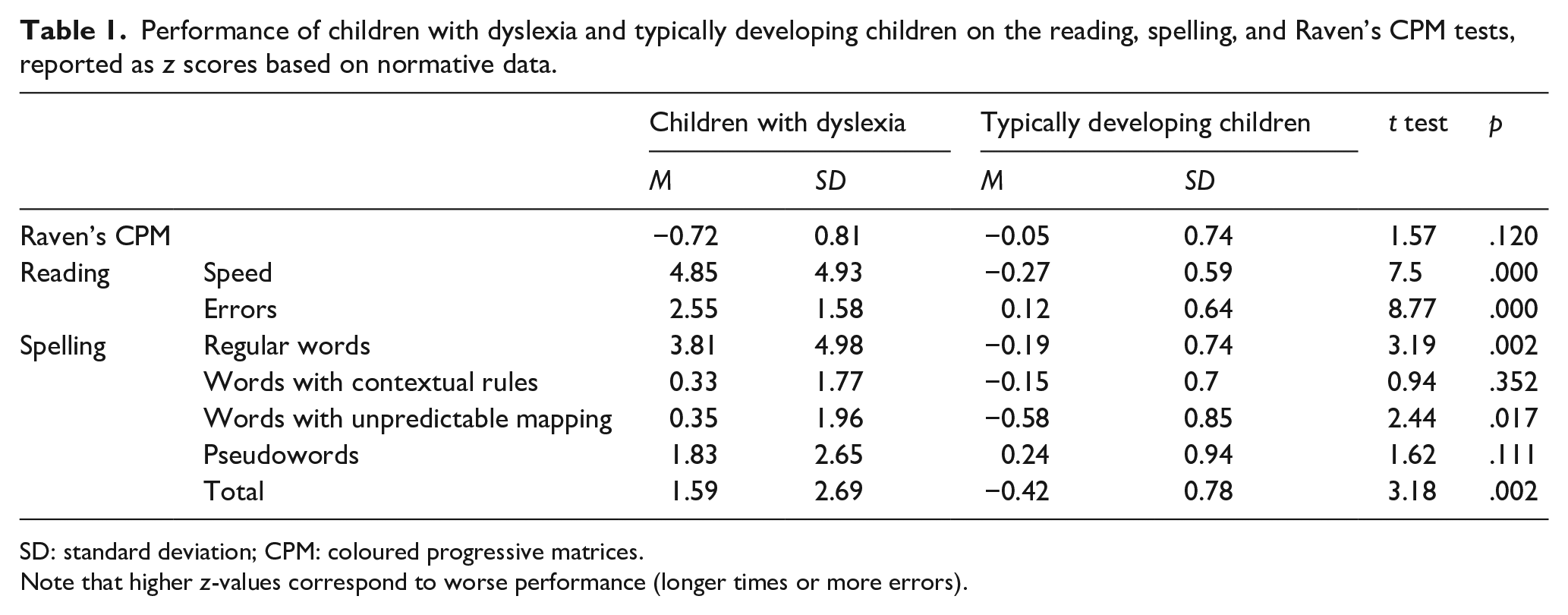
SD: standard deviation; CPM: coloured progressive matrices.
Note that higher z-values correspond to worse performance (longer times or more errors).
Reading assessment
Reading level was assessed using a standard reading achievement test (MT Reading test, Cornoldi & Colpo, 1998). The participant was required to read a passage aloud within a 4-min time limit; speed (time in seconds per number of syllables read) and accuracy (number of errors, adjusted for the amount of text read) were computed. Stimulus materials and related reference norms varied depending on school grade.
Spelling assessment
Participants’ spelling abilities were tested with a standard Spelling test (Diagnosis of orthographic deficits in childhood [DDO-2], Angelelli, Marinelli, Iaia, Notarnicola, et al., 2016) composed of four sections:
Section A (N = 70): Words with full one-sound-to-one-letter correspondence.
Section B: Words requiring the application of context-sensitive sound-to-spelling rules (N = 10). In Italian, context-sensitive rules are required when the orthographic transcription of a consonant depends on the following sound. For example, the phoneme [k] is spelled C when followed by a consonant, for example, in CLIMA /klima/, (climate) or by A, O, U as in CASA /kaza/, (home), CONO /kono/ (cone), and CH when followed by E or I, for example, in CHILO /kilo/, (kilogram).
Section C (N = 55): Words with unpredictable phonology-to-orthography mapping (e.g., /kwo/ in /kwota/, share): QUOTA and not *CUOTA.
Section D (N = 25): Pseudowords with one-sound-to-one-letter correspondence.
The number of items spelled correctly in each section was computed. Performance below the fifth percentile of the normative sample in the total score or the different subset scores was considered as problematic. For fourth grade, norms are based on 140 typically developing children (Angelelli, Marinelli, Iaia, Notarnicola, et al., 2016).
Procedure and material
The experimental stimuli included 30 words, half of medium-high and half of low frequency. Words were selected from the frequency dictionary for children based on a corpus of 1 million occurrences (Marconi et al., 1993). Medium-high-frequency words had a frequency higher than 40 and low-frequency words a frequency lower than 25 (Marconi et al., 1993).
Twenty words had unpredictable spellings because they included one of the following unpredictably spelled segments: (1) The phonemic group [kw] sometimes transcoded as CU, and other times as QU: for example, CUOCO /ˈkwɔko/, (cook) versus QUOTA /ˈkwɔta/, (share); (2) the syllables [t∫e]; [∫e] that are written as CIE, SCIE in some words and CE, SCE in other words: for example, CIECO /ˈtʃɛko/, (blind) versus CECO /ˈtʃɛko/, (Czech), SCIENZA /ˈʃɛntsa/, (science) versus ADOLESCENZA /adoleʃˈʃɛntsa/, (adolescence); (3) The plosive phoneme [b], which, when followed by the liquid consonants [r] and [l], is a homophone to its doubled pair, thus rendering uncertain the transcription of words such as /ˈlibro/, (book), spelled LIBRO and not LIBBRO; /ˈfɛbbre/ (fever), spelled FEBBRE and not FEBRE. Each segment was considered either high or low frequency depending on its occurrence in two frequency dictionaries (De Mauro, 1989; Marconi et al., 1993). Accordingly, the orthographic segments CE, SCE, QU, BL, and BR were considered as high frequency because overall they appeared in 77.2% (Marconi et al., 1993) and 82.8% (De Mauro, 1989) of words including the corresponding ambiguous phoneme. By contrast, CIE, SCIE, CU, BBL, and BBR were considered as low-frequency segments because they appeared in 22.8% and 17.2% of cases in the two databases, respectively. High-frequency segments and low-frequency ones were considered as typical and atypical, respectively. Ten of the selected words had consistent spellings. In sum, the 30 words were subdivided as follows:
10 medium-high-frequency words with unpredictable spelling: 5 had the typical (more frequent) mapping for the critical segment, for example, SCELTA /ˈʃɛlta/, (choice) and 5 had the atypical (less frequent) one, for example, SCIENZA /ˈʃɛntsa/, (science);
10 low-frequency words with unpredictable spelling: 5 had the typical mapping for the critical segment, for example, QUOTA /ˈkwɔta/, (quote) and 5 the atypical one, for example, CUOIO /ˈkwɔio/ (leather);
10 words with regular sound-spelling correspondence: 5 had a high word-frequency, for example, FRASE (sentence) and 5 a low word-frequency, for example, DIETA (diet).
The sets were matched for number of letters, grammatical class (all nouns), word frequency and bigram frequency (in both the children’s and the adult’s word frequency corpora: Marconi et al., 1993; Bertinetto et al., 2005, respectively), N-size (according to the Colfis database, Bertinetto et al., 2005; http://dpss.psy.unipd.it/claudio/vicini2.php), and the position of the critical segment in the word (in the case of words with unpredictable spelling).
A total of 30 filler words (with regular sound-spelling correspondence) were added to the experimental list to prevent participants from understanding the aim of the experiment and to limit the effects of repeating the same grapho-motor patterns in spelling the ambiguous segments. Filler words were roughly matched to the experimental words for frequency: 15 had a medium-high frequency, for example, LEONE (lion), and 15 had a low frequency, for example, SUORA (nun), grammatical class (all nouns), and number of letters (5–10 letters).
Overall, the entire list included a total of 30 experimental stimuli and 30 filler words. Words were presented in random order and given to children in a spelling to dictation task (for further details, see Angelelli et al., 2018).
The experimenter read aloud each stimulus in the list without emphasising the possible source of ambiguity and the children were required to write each stimulus in either capital or lower case letters (as they preferred). No feedback was provided about the accuracy of the written response. In case of self-corrections, final responses were considered.
Children were tested individually in a quiet room. The experimental session lasted about 20 min. If required, breaks were allowed.
Data analysis
Regarding unpredictable word spellings, only errors consisting in transcribing the critical segment with the complementary (either typical or atypical) erroneous transcription were taken into account, for example, SCIENZA (science) spelled *SCENZA, or SCELTA (choice) spelled *SCIELTA. Errors regarding the critical segment that were different in nature, for example, SCIENZA (= science) spelled *SIENZA or SENZA, were not included in the error analyses. Similarly, errors occurring in other parts of the word, for example, SCIENZA (science) spelled *SCIENSA, in the presence of correct transcription of the critical segment of the word, were not included in the analyses of spelling errors because they were considered not relevant to the purpose of the study. These cases were generally few, that is, only 2.27% and 0.20% in children with dyslexia and typically developing children (t = 2.55, p < .01), respectively. After discarding the latter error cases, the following proportions of errors consisting in complementary erroneous transcriptions were left for analysis: 24.6% for children with dyslexia and 14.6% for typically developing children.
Accuracy percentages on words with unpredictable spellings were analysed by means of logistic mixed effect model (LMEM). The analysis of accuracy (1 error, 0 passed) by means of logistic distribution allows to control for the high number of correct responses, as it is the case for spelling. Moreover, the mixed effect model also allows to control for items and participants variability.
In the LMEM, group (readers with dyslexia and typical readers), word frequency (medium-high, low), and orthographic consistency (regular words; unpredictable words with typical mapping; unpredictable words with atypical mappings) entered as fixed effects and item and participant as random effects.
Results
The main effects of group, F(1, 2088) = 12.65, p < .0001, word frequency, F(1, 2088) = 26.18, p < .0001, and orthographic consistency, F(2, 2088) = 66.16, p < .0001, were significant, with lower accuracy for children with dyslexia than typical readers (82.8% vs 91.7%, respectively), and for low frequency than medium-high frequency words (82.9% vs 91.6%, respectively). Highest accuracy was found for regular words (97.8%) followed by accuracy on words with unpredictable spellings and typical mapping (92%, p < .05), which in turn was higher than accuracy for words with unpredictable spelling and atypical mappings (75.6%, at least p < .0001 in both comparisons).
Group interacted with orthographic consistency, F(2, 2088) = 3.23, p < .05 (see Figure 1): Children with dyslexia differed from typical readers only in spelling unpredictable words with atypical mappings (63.6% vs 82.5% accuracy in the two groups, respectively, p < .05), while groups had similar performances in spelling words with unpredictable spelling but typical mapping (89.2% vs 93.6%, respectively) and in spelling regular words (95.6% vs 99.1%, respectively). As it is possible to note from Figure 1, a regularity effect was evident when regular words were compared to words with unpredictable spelling and atypical mappings in both groups (at least p < .0001), but the effect was larger in readers with dyslexia than in typical readers (p < .01). The difference between regular words and words with unpredictable spelling and typical mapping was significant in both groups (at least p < .001), and this effect was similar in the two groups. Both groups had a lower performance in spelling unpredictable words with atypical mappings than typical ones (at least p < .001), but the negative effect due to the presence of atypical mappings with respect to a typical one was larger for children with dyslexia compared to control readers (p < .01).
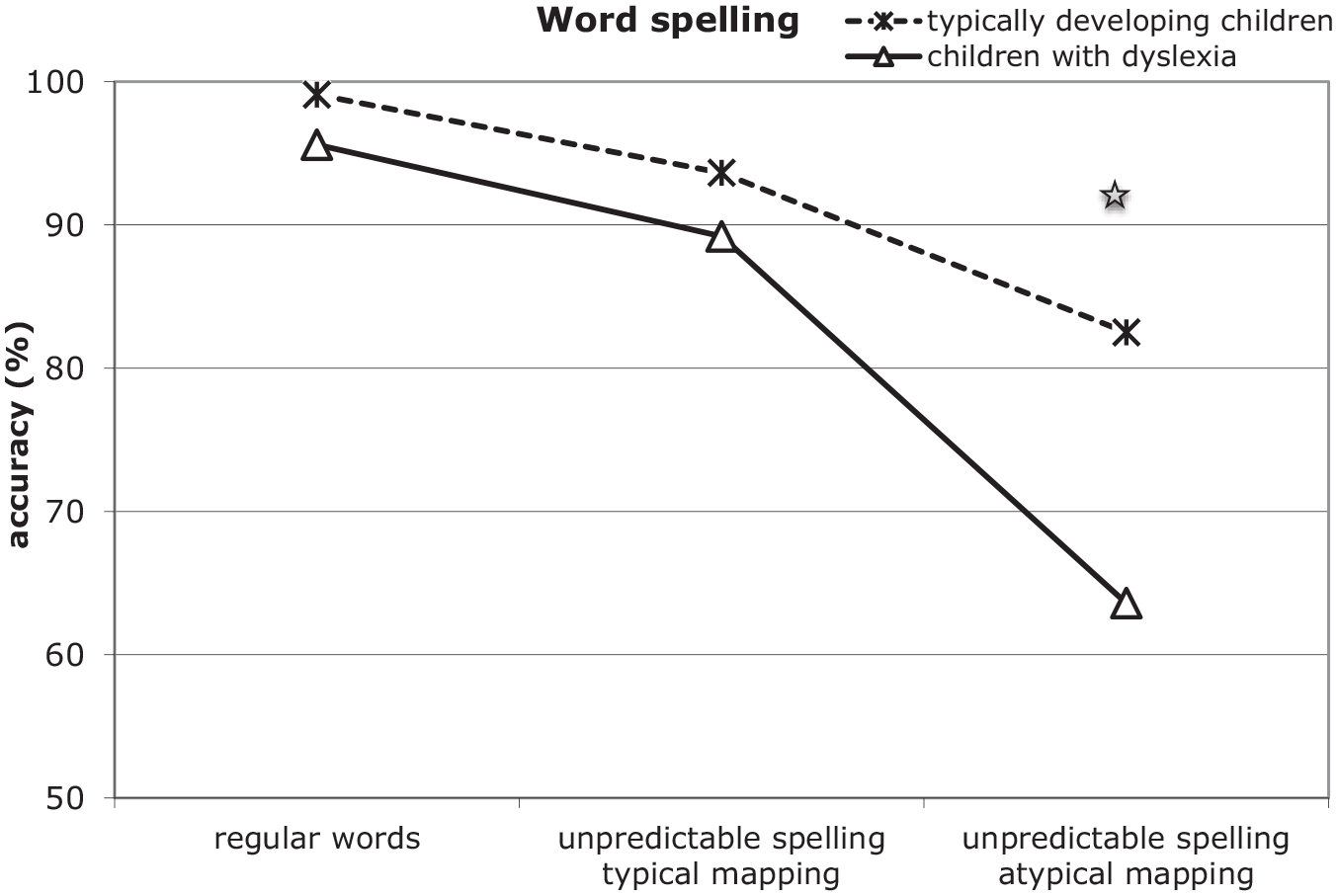
Percentages of accuracy in spelling words as a function of group and orthographic consistency.
The word frequency by orthographic consistency interaction was significant, F(2, 2088) = 3.50, p < .05. A frequency effect was evident only for words with unpredictable spelling (at least p < .0001): the frequency effect was larger (p < .01) for unpredictable words containing atypical mappings than for unpredictable words containing typical mappings (difference between medium-high- and low-frequency words = 16.8% and 8.0% for atypical and typical mappings, respectively, at least p < .0001). The frequency effect was not significant for regular words (difference = 1.2%, ns). Words with unpredictable spelling and atypical mappings were spelled with a lower accuracy than all the other stimuli (at least p < .0001) and the difficulty in spelling these stimuli compared to other words was larger (at least p < .01) for low-frequency words than for words with a medium-high frequency. When regular words were compared to unpredictable words containing typical mappings, the regularity effect was smaller (p < .01) for medium-high-frequency words (difference = 2.5% accuracy, p < .05) than low-frequency words (difference = 9.3% accuracy, p < .0001).
The group × word frequency × orthographic consistency interaction was not significant, F(2, 2088) = 0.15, p = .86, as well as the group × word frequency interaction, F(2, 2088) = 0.03, p = .88. No random effect reached significance (Zs < 1).
Summary of results
Data showed a lower spelling performance and larger regularity effects in children with dyslexia than controls. In particular, children with dyslexia had more difficulties than controls in writing unpredictable words with atypical mappings, while both groups had a comparable performance in writing unpredictable words if they contained a typical mapping. Note that writing unpredictable words with atypical mappings requires reliance on lexical processing, while a good accuracy on unpredictable words with typical mappings might be obtained by relying on statistical knowledge of the orthography. Thus, it seems that children with dyslexia are capable of statistical learning, but have a restricted orthographic lexicon. Note that children had greater difficulties in spelling atypical unpredictable words and low-frequency words, but this finding did not interact with group: The performance of both children with dyslexia and typically developing children was modulated in a similar way by word frequency in spelling.
Experiment 2: lexical priming of pseudoword spelling
In the first experiment, children with dyslexia overall spelled correctly words with typical mappings, that is, those words that can be spelled correctly by relying on statistical knowledge of phonology-to-orthography mappings. However, words could also be spelled through the lexical procedure. In experiment 2, we aimed at maximising the contribution to spelling of statistical orthographic knowledge at the sublexical level. Thus, we tested spelling of pseudowords (i.e., stimuli for which lexical representations are not available). In the second experiment, we also investigated the influence of lexical processing on sublexical spelling by using the paradigm of lexical priming.
Method
Participants
Participants were the same as in experiment 1.
Procedure and material
For this experiment, the words tested in experiment 1 (online Supplementary Material, left columns) were used as primes. For each of the 30 words constituting the experimental list, a target pseudoword containing a phonological segment that could be spelled in two different ways was created (Supplementary Material, right columns). Target pseudowords were comparable to prime words for length (number of letters), type and position of the critical segment, and orthographic complexity (presence of geminates or consonant clusters). For example, for the prime word SCELTA, /ˈʃ
In total, the list consisted of 60 word primes and 60 paired pseudowords. Thirty pseudowords contained a segment with unpredictable transcription: 10 were preceded by a related prime (i.e., a word containing the same phonological segment) with typical mapping; 10 had a related prime word with atypical mappings; and 10 had an unrelated prime word (i.e., a word containing a different phonological segment with predictable mapping). These 30 pairs of word primes and pseudoword targets constituted the experimental list. The remaining 30 pairs of word primes and pseudoword targets were fillers. In this latter case, word primes and pseudoword targets did not include any ambiguous segment and were not analysed. The entire list of stimuli is reported in the online Supplementary Material.
The experiment of lexical priming on pseudowords was run at a distance of 1 week from the word spelling experiment. The 120 stimuli (the same for each participant) were presented in random order, with each prime word being followed by its paired target pseudoword. The experimenter read each item aloud in a neutral tone and the children were instructed to spell the pseudowords only and to write a hyphen for words. Children had to spell pseudowords only, disregarding prime words, to reduce repetition effects in participants’ spelling productions (i.e., to limit the use of the same spelling pattern for repeated sounds; Barry & Seymour, 1988). Children could write in capital or lower case letters and only final responses were considered. A brief practice session preceded the experiment and the stimuli were divided into three blocks. Each experimental session lasted about 20 min. If required, breaks were allowed. The order of presentation of the three blocks was balanced across participants. No detectable differences in accuracy were found among the three groups who performed the blocks in different orders (Fs < 1).
Data analysis
First, we counted the times children chose the typical versus atypical mappings for the transcription of the critical segment in pseudoword spelling, for each priming condition (unrelated, related atypical prime, related typical prime). In the related prime conditions, we excluded the target pseudoword if the corresponding prime word had been misspelled in experiment 1. The cases that were excluded (i.e., missing values) were 6.9% in children with dyslexia and 2.1% in control children (t = 2.76, p < .01).
The lexical priming effect was examined by comparing the occurrence of typical versus atypical mappings of the critical (unpredictable) phoneme in spelling a pseudoword that followed either an unrelated or a related prime word. Higher percentages of atypical mappings in spelling a pseudoword preceded by a prime word with the same atypical mappings were considered an effect of lexical influence. In fact in this case, children did not rely on probabilistic cues, but were influenced in pseudoword spelling by the activation of the previously heard word (Barry & Seymour, 1988). For example, the pseudoword /ʃɛlpo/ was generally spelled with the graphemes that occur more frequently in Italian (i.e.,
Note that also in this second experiment, as in experiment 1, unexpected errors (i.e., errors on the critical segment that were different in nature or errors that occurred in other parts of the pseudoword, but with a correct transcription of the critical segment) were discarded and not further analysed. These discarded cases were 5.5% and 2.0% in children with dyslexia and typically developing children, respectively (t = 2.14, p < .05).
An LMEM was performed on the type of pseudoword transcription (i.e., with atypical or typical mapping), with group (children with dyslexia and typically developing children), priming condition (unrelated primes, related typical primes, and related atypical primes), and word frequency of the prime (medium-high, low) as fixed effects and item and participant as random effects.
Results
The effect of group, F(1, 2088) = 2.07, p = .13, was not significant, while the effect of priming condition, F(2, 2088) = 65.02; p < .0001, was significant, as well as the group × priming condition interaction, F(2, 2088) = 3.13; p < .05. Figure 2 represents this interaction: the percentages of cases in which children chose the typical or the atypical mappings in each experimental condition are reported. The exploration of the interaction showed that groups differed in the lexical priming effect. With unrelated primes, both groups similarly chose in about 75% of cases the typical mapping in spelling the target pseudoword. With related typical primes, the two groups similarly increased the use of typical mappings and decreased that of atypical ones if compared to the unrelated (control) condition (at least p < .001). Groups did not differ in the priming effect induced by related typical primes. In contrast, the priming effect induced by the atypical prime was larger (p < .05) for typically developing readers than children with dyslexia. In the presence of a related atypical prime, typically developing children inverted their response trend with respect to the unrelated priming condition: in spelling the target pseudowords, the choices of the atypical mappings largely increased, while the use of typical mappings considerably decreased (p < .0001). A smaller but significant effect (p < .05) was present in children with dyslexia, who also increased the use of atypical mappings and decreased the use of typical ones with respect to the unrelated condition (p < .001). However, contrary to their typically developing peers, children with dyslexia still preferred to use typical mappings.
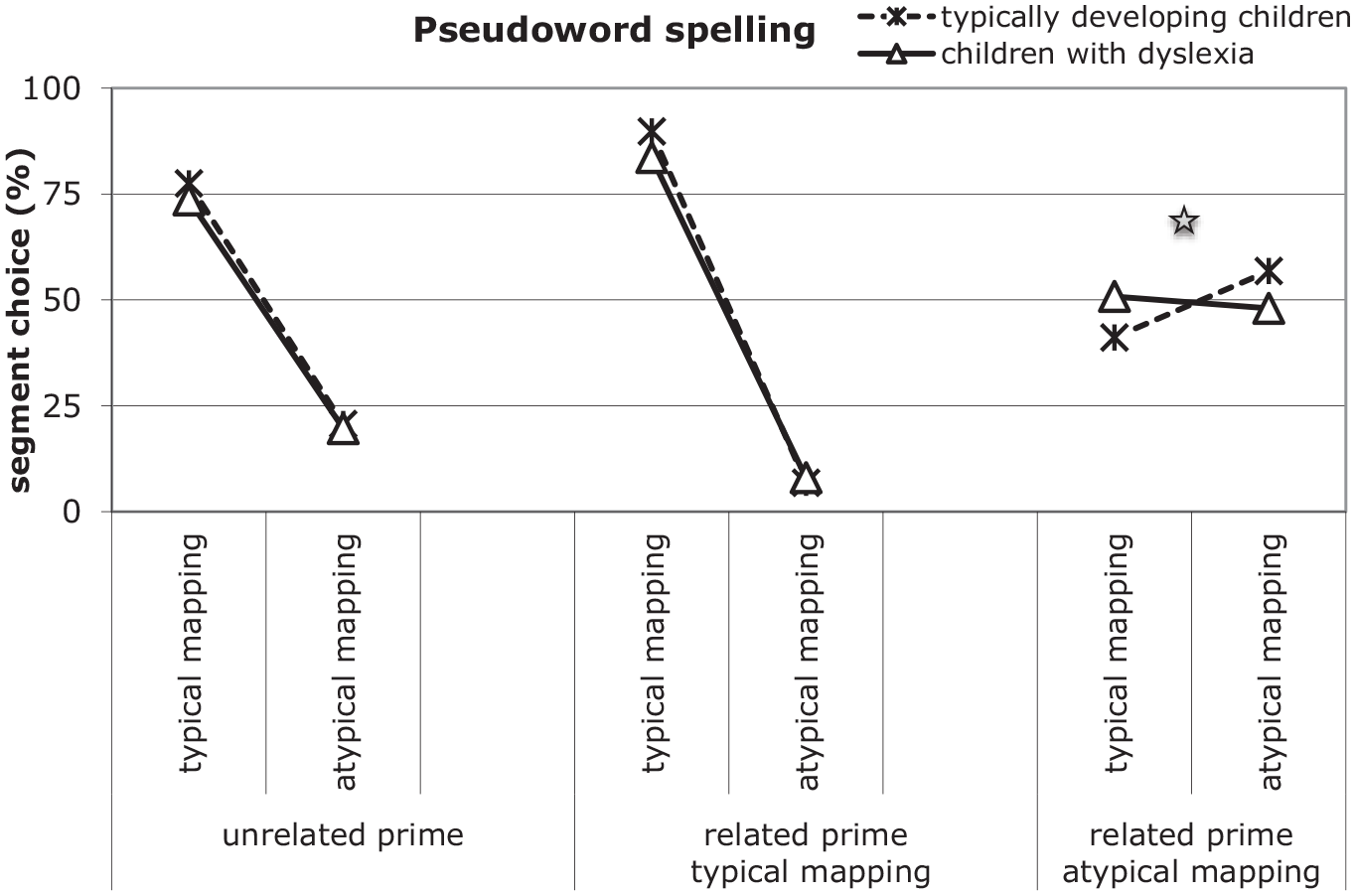
Percentages of use of typical versus atypical sound-spelling mappings in pseudoword spelling as a function of group and priming condition.
The main effect of word frequency was significant, F(1, 2088) = 5.77; p < .05, and interacted with priming condition, F(2, 2088) = 3.06; p < .05: the frequency of the prime word influenced the choice of typical versus atypical mappings only when the target pseudoword was preceded by a related atypical prime. Children used atypical mappings more frequently after a medium-high-frequency atypical prime than a low-frequency one (p < .0001). In contrast, the frequency of related typical primes or unrelated primes did not affect the spelling performance of the target pseudowords.
The group × word frequency interaction was not significant, F(2, 2088) = 0.61, p = .55, neither the group × word frequency × priming condition interaction, F(4, 2088) = 0.64, p = .64. No random effect reached significance (Zs < 1).
Summary of results
Children with dyslexia, as well as typically developing children, mostly spelled pseudowords (in unrelated prime condition) using the most frequent (typical) mapping in the Italian orthography. They relied on probabilistic cues to spell not only words (experiment 1) but also pseudowords (experiment 2), similar to typically developing readers. Children with dyslexia showed evidence of lexical activation: The use of atypical mappings in pseudoword spelling increased if the pseudoword was preceded by a word containing the same atypical mapping. However, this lexical priming was smaller than that shown by typically developing children: children with dyslexia continued to use probabilistic cues in spelling new stimuli more than typically developing children. Note that in both children with dyslexia and typically developing children, the priming effect for related atypical primes was larger in the case of a higher frequency word prime than a lower frequency one, and this effect did not interact with group.
Discussion
The aim of this study was to investigate statistical learning in the spelling of Italian children, with and without dyslexia. We assessed the sensitivity of children to probabilistic cues in phoneme-grapheme mapping in interaction with lexical processing. To the best of our knowledge, only one study had explored in children with dyslexia the use of probabilistic orthographic information in word and pseudoword spelling (Marinelli et al., 2017). The other studies that examined statistical learning in dyslexia have typically used implicit learning paradigms to explore the extraction of rules through passive experience with sequences of letters, symbols, speech and/or non speech sounds, or through visual-motor procedural learning tasks (e.g., Menghini et al., 2006; Pavlidou et al., 2009; Pavlidou & Williams, 2014; Stoodley et al., 2006). By contrast, this study did not adopt a learning task, but examined the actual spelling behaviour of children with dyslexia and their capability of statistical learning in spelling. We assessed children’s use of sound-spelling mappings as a function of their frequency of occurrence in the Italian orthography. Statistical learning in spelling was examined by manipulating not only the frequency of occurrence of phoneme-to-grapheme mappings but also the frequency of the words in which they were embedded, to explore the potential interaction of lexical processing and use of orthographic distributional information. We were interested in studying if reliance on probabilistic cues might interact with lexical processing in Italian children with dyslexia, a population that suffers predominantly of a deficit in lexical processing in reading and spelling, that is, surface dyslexia and dysgraphia (e.g., Angelelli et al., 2004; Marinelli et al., 2009).
In word spelling, children with dyslexia showed a particularly low accuracy in spelling phonemes with atypical sound-spelling mappings than typical ones, especially when they were present in low-frequency words. Consistent with our previous study (Marinelli et al., 2017), Italian children with dyslexia, similar to typically developing children, were sensitive to the distributional properties of the orthography: they spelled more accurately words with typical mappings than words with atypical ones. In the case of words with unpredictable but typical sound-spelling mappings, the reliance on distributional knowledge allowed children with dyslexia to compensate for their lexical deficit and to obtain the same level of accuracy as typically developing children (with a performance comparable to that shown in spelling regular words). Children with dyslexia showed a larger regularity effect (with worse performance on words with unpredictable mappings) than typical readers only in spelling words with atypical mappings.
This study highlighted that also when lexical representations are not available, that is, in pseudoword spelling, the performance of children with dyslexia was modulated by the frequency of sound-spelling mappings, comparably to typically developing readers. When pseudowords contained phonemes with unpredictable mapping, children with dyslexia chose the typical (most common) mapping in about 75% of cases in which target pseudowords were preceded by unrelated word primes, consistently with the distribution in the Italian orthography. Overall, their performance in pseudoword spelling was affected by distributional knowledge at the sublexical level.
It is worth noting that the frequency of sound-spelling mappings modulated the performance of children with dyslexia to a greater extent than typically developing children, probably because the reduced orthographic lexicon of children with dyslexia led them to over-rely on the distributional properties of the orthography. The low reliance on lexical processing of children with dyslexia was also indicated by the smaller effect of lexical priming they showed compared to typical readers. Both groups increased the use of atypical mappings in spelling pseudowords when pseudowords were primed by words (especially high-frequency ones) that contained the same atypical mappings and further increased the use of typical mappings following high-frequency primes that contained the same typical segments. These findings indicate that lexical and sublexical processes were both active and interacted in pseudoword spelling, also among children with dyslexia. However, the priming effect was smaller for children with dyslexia than for typically developing children and could be considered as an index of lower lexical activation in children with dyslexia. In the related atypical prime condition, only control children wrote pseudowords using atypical mappings more that typical ones, while children with dyslexia, although increased the use of atypical mappings, still preferred typical ones. Overall, the spelling performance of children with dyslexia showed evidence of lexical activation (as indicated by the priming effect), but to a smaller extent than typically developing children. The smaller lexical priming effect might reflect a limited recourse to the orthographic lexicon in children with dyslexia with a consequent lower inclination to rely on word-specific orthographic knowledge to spell pseudowords. The results of experiment 1, in which children with dyslexia showed a larger regularity effect when they spelled words with unpredictable transcription and atypical mappings than typical ones, corroborate our general interpretation: in words with atypical mappings, statistical cues could not compensate for their poor lexical processing.
The present findings are consistent with the limitations in the orthographic lexicon documented in Italian children with dyslexia (Angelelli, Marinelli, & Zoccolotti, 2010). However, they also suggest a spared ability, in Italian children with dyslexia, to acquire the distributional properties of the orthography and to extract regularities. Note that crucial in the development of reading and spelling skills and in particular for the formation of word representations is the ability to extract regularities present in the orthography (Treiman, 2018; see also Marinelli et al., 2017, for reading). The difficulty in acquiring lexical representations (Pontillo et al., 2014) and the consequent limited lexical expansion in children with dyslexia (Angelelli, Marinelli, & Zoccolotti, 2010; Marinelli et al., 2009, 2017; see also Bergman & Wimmer, 2008; Hanley et al., 1992, for similar findings in the German and the English orthographies, respectively) may have a different source that needs to be investigated in further studies.
Finally, in this study, the effect of word frequency interacted with orthographic consistency in word spelling and with priming condition in pseudoword spelling, indicating greater reliance on distributional properties of the orthography in the case of low-frequency words, that is, those stimuli for which lexical processing is less effective. It is worth noting that both interactions held for both typically developing children and children with dyslexia, showing that all developing readers similarly make recourse to orthographic statistical knowledge when lexical processing is less probable. It should be observed that word frequency did not interact with group, in contrast to previous studies showing a larger frequency effect in Italian children with dyslexia than controls (Barca et al., 2006; Marinelli et al., 2013, 2014), probably due to the small manipulation of word frequency in stimuli selection. In this study, we used medium-high frequency words, with a small frequency difference (at least in some cases), with respect to low-frequency words. Note that the interaction was not significant also in another study using the same stimuli (Angelelli et al., 2018). Then, further studies maximising word frequency differences are needed to confirm this finding. However, it must be noted that in this study, children with dyslexia did not have difficulties in spelling all low-frequency words, but only in spelling low-frequency words with unpredictable transcription and atypical mappings for which the reliance on orthographic distributional information could not compensate for their difficulty. In spelling these types of stimuli, the frequency effect was larger in children with dyslexia than in control children.
The present results are consistent with current theoretical frameworks. According to the “simultaneous activation” hypothesis (Rapp et al., 2002), both lexical and sublexical routines are simultaneously activated by a phonological stimulus and the products of the operation of both routines are integrated in the graphemic buffer, by selecting the output among candidate graphemes for spelling. In this framework, a cooperative interaction occurs when both routines agree on a given spelling, as in the case of high-frequency words with typical mappings or pseudowords preceded by a related prime. When the outputs of the two procedures are different (do not agree), a competition between candidate graphemes occurs, with final selection of the spelling of the most strongly activated candidate. Italian children with dyslexia have poor lexical spelling, especially for low-frequency words, and this makes the lexical procedure less competitive in the simultaneous activation of the two procedures engaged for the spelling output, with consequent selection of the output indicated by orthographic distributional knowledge. For this reason, children with dyslexia in spelling low-frequency words may be prone to use typical mappings, with consequent difficulties in spelling low-frequency words with unpredictable transcription and atypical mappings.
In sum, this study shows that Italian children with dyslexia may acquire distributional properties of the orthography and use this statistical knowledge to predict future events in word and pseudoword spelling, an index of a good ability of statistical learning (e.g., Perruchet & Pacton, 2006). Based on our findings, children with dyslexia can be considered as able as typically developing children to implicitly extract regularities from the orthographic spelling system, despite their reading impairment. Our data are in line with a recent study on Italian children with developmental dyslexia that documents the effectiveness of an implicit learning treatment, based on modelling connections between word sound and multiletter spelling units, to improve children’s spelling (Arfé et al., 2018). Both our study and the study by Arfé and colleagues (2018) support the view that children with dyslexia possess the same statistical learning mechanisms as typical children (Treiman, 2018).
The present data are not consistent with the hypothesis that an implicit learning deficit is at the basis of a deficit in learning grapheme-to-phoneme associations in children with dyslexia and in turn in reading automaticity (Sperling et al., 2004) and in learning orthographic-phonological representations (Howard et al., 2006). Note that in this study we investigated statistical learning by means of a spelling task, that is, a familiar task very different from the experimental procedures used in the literature (i.e., AGL and SRT tasks). It is possible that being spelling one of the most common and meaningful activities in which children are engaged, the frequency of exposure to orthographic materials and the importance perceived by the learner may favour statistical learning mechanisms. That is to say, statistical learning may not operate for all events and items present in the environment, but for stimuli significant for the learners (Treiman, 2018).
Our findings may have implications for rehabilitation procedures and for instruction interventions in general. Italian children with dyslexia may not have difficulties in spelling all words with unpredictable mapping, but only in spelling unpredictable words with atypical sound-spelling mappings (for which sublexical knowledge does not allow a high level of accuracy to be reached). Accordingly, their spared statistical learning ability could be considered as a precious resource to be exploited. The specific training of phoneme-to-grapheme mappings might reinforce even more this skill to allow children with dyslexia to compensate for their poor lexical processing (see, for example, Arfé et al., 2018). More in general, rehabilitation trainings of children with surface dyslexia and dysgraphia might be more parsimonious if they specifically focus on the acquisition of orthographic representations (see Fornasier et al., 2017), especially representations of words with unpredictable and atypical mappings, and if in parallel they aim to strengthen the use of distributional knowledge.
The present findings were drawn from children with dyslexia of a language with a consistent orthography and may not be easily generalised to more inconsistent orthographies, in which learners generally use larger units of processing respect to Italian children (Marinelli et al., 2015, 2016). The high consistency of Italian sound-spelling mappings may favour the acquisition of distributional properties of the orthography in children with dyslexia more than in more inconsistent orthographies. Then, a note of caution in generalising the present findings to orthographies with less consistent mappings is necessary. At the same time, further studies are necessary to examine lexical processing and statistical learning among children with a selective deficit in spelling or reading. Up to now, we have investigated these mechanisms in spelling (in this study and in Marinelli et al., 2017) and in reading (Marinelli et al., 2017), but only in children selected for the presence of dyslexia. In both our studies, most children with dyslexia suffered also from dysgraphia, due to the frequent association between reading and spelling disorders (Zoccolotti et al., 2020). However, it might be interesting to investigate if present findings would be confirmed also in children with a pure reading or spelling disorder. Unfortunately, the small size of the sample in this study does not allow such a comparison between subtypes of learning disorders.
In conclusion, this study shows that Italian children with dyslexia are sensitive to the statistical distribution of sound-spelling mappings, and this sensitivity to sublexical properties of the orthography may contribute to compensate for their poor lexical spelling abilities.
Supplemental Material
sj-docx-1-qjp-10.1177_1747021821998925 – Supplemental material for Sensitivity to distributional properties of the orthography in the spelling of Italian children with dyslexia
Supplemental material, sj-docx-1-qjp-10.1177_1747021821998925 for Sensitivity to distributional properties of the orthography in the spelling of Italian children with dyslexia by Chiara Valeria Marinelli, Marika Iaia, Cristina Burani and Paola Angelelli in Quarterly Journal of Experimental Psychology
Footnotes
Declaration of conflicting interests
The author(s) declared no potential conflicts of interest with respect to the research, authorship, and/or publication of this article.
Funding
The author(s) received no financial support for the research, authorship, and/or publication of this article.

Notes
References
Supplementary Material
Please find the following supplemental material available below.
For Open Access articles published under a Creative Commons License, all supplemental material carries the same license as the article it is associated with.
For non-Open Access articles published, all supplemental material carries a non-exclusive license, and permission requests for re-use of supplemental material or any part of supplemental material shall be sent directly to the copyright owner as specified in the copyright notice associated with the article.
