



Abstract
General conditionals, if p then q, can be used to make assertions about sets of objects. Previous studies have generally found that people judge the probability of one these conditionals to be the conditional probability of q given p, P(q|p). Two experiments investigated the qualitative relation between the exhaustive possibilities, p & q, p & ¬q, ¬p & q, and ¬p & ¬q, and truth and possibility judgements about general conditionals. In Experiment 1, for truth judgements, people evaluated a general conditional as “true” in sets containing p & q cases but no p & ¬q, and “true” judgements depended only on P(q|p). In Experiment 2, for possibility judgements, people’s responses implied that only p & q cases have to be possible in a set for a general conditional to be true of the set. Our results add to earlier findings against representing a general conditional as the material conditional of extensional logic, and they provide novel disconfirmation of two recent proposals: the modal semantics of revised mental model theory and certain inferentialist accounts of conditionals. They supply new support for suppositional theories of conditionals.
Conditionals, in the form if p then q, are used extensively in everyday life and in science. The study of them has been central to the psychology of reasoning from its beginnings in Wason (1966) to the development of the new Bayesian paradigm in the field (Elqayam et al., 2013; Oaksford & Chater, 2007, 2020). There are many uses of conditionals in natural language, but a prominent one that we will focus on in this article is to make assertions about sets of objects (Cruz & Oberauer, 2014): (1) If a soybean from a box is sufficiently watered, then it will sprout within a week.
How do people understand an assertion that a conditional like (1) is “true”? As we will see, different accounts of conditionals give different answers to this question. For the purposes of this article and controlled experiments, we will focus here on simple basic conditionals (Johnson-Laird & Byrne, 2002). Consider this assertion about a specific pack of cards that might be described for participants in an experiment: (2) If a card is round, then it is red.
We will call a conditional like (2) “basic” as its interpretation depends only on its semantic content and any frequency information given with it about the pack of cards in question. Its interpretation does not depend on background knowledge about the relationship between the antecedent and consequent. For example, background causal beliefs could lead us to infer from the non-basic conditional (1) it is not causally possible for a dry soybean to sprout. But understanding the basic conditional (2) depends only on its core semantic meaning and frequency information given with it about the round and red cards in the pack referred to.
Evans et al. (2003: p. 333) distinguished conditionals like (2) from those like the following: (3) If the card is round then it is red.
Evans et al. asked their participants for probability judgements about conditionals like (3), when “the card” referred to the result of a specific random draw from a pack, given a frequency distribution of the different cards. Evans et al. distinguished (p. 333), in the terms we will use, between a singular conditional like (3) and general conditionals like (1) and (2). They investigated only singular conditionals in their experiments. They found that most of their participants thought of the probability of a singular conditional, P(if p then q), as the conditional probability of q given p, P(q|p). In fact, experimental research has found that a general conditional tends to be interpreted as being about, to continue with (2) as our example, a random card from the pack, and to have as its probability the conditional probability that the random card is red given that it is round (Collins et al., 2020; Cruz & Oberauer, 2014 ; Wang & Yao, 2018).
A “general conditional” is defined, for us here, as one in which the indefinite description “a card” is used, rather than the definite description “the card,” for making an assertion about a set of objects. By this stipulation, a “general conditional” in this article is simply a basic conditional containing an indefinite description, like “a card” as opposed to “the card.” There is a long history of studying such general conditionals in the psychology of reasoning. We recall the very large number of studies of Wason’s selection task (Evans, 1972; Evans & Over, 2004; Wason, 1966). In these tasks, many of the conditionals used are “general” in our sense, such as the following basic conditional about four cards placed on a table: If a card has a 6 on the front, then it has an E on the back.
Notice that it would be infelicitous to use a definite description, “the card,” in the above conditional, since nothing has been said, in the task, about choosing one card from the set of four. It would also be infelicitous to use “the card,” rather than “a card,” to refer to a pack of cards in our experiments. Although there have been many studies of general conditionals in the psychology of reasoning, we will take a novel step forward here in the specific questions we ask about general, rather than singular, conditionals referring to exhaustive sets of objects. We will ask whether general conditionals are “true,” “false,” or “neither true nor false” of these sets of objects and also modal questions about them, to do with possibility and impossibility. Our questions will have significant implications for prominent accounts of conditionals, as we will explain.
In contrast to our qualitative questions in this article, much recent research has focused instead on quantitative questions about the probability of a conditional. The proposal that the probability of a natural language conditional, P(if p then q), is the conditional probability of q given p, P(q|p), has been called “the Equation” in philosophy (Edgington, 1995) and the conditional probability hypothesis in psychology (Over & Cruz, 2018). It is a fundamental hypothesis of the new Bayesian approaches to the psychology of reasoning (Elqayam et al., 2013; Oaksford & Chater, 2020), and it has been highly confirmed for a wide range of conditionals (Baratgin et al., 2013; Cruz & Oberauer, 2014; Evans et al., 2003; Fugard et al., 2011; Kleiter et al., 2018; Oberauer & Wilhelm, 2003; Over et al., 2007). Some studies focusing on conditionals with causal content have found that people’s judgements of P(if p then q) corresponded to P(q|p) when there was a positive correlation between p and q, that is, P(q|p) > P(q|not-p), but was lower than P(q|p) when the probabilities of p and of q were independent, P(q|p) = P(q), or negatively correlated, P(q|p) < P(q|not-p) (Skovgaard-Olsen et al., 2016a, 2016b). Other studies, however, have found evidence against the claim that a positive correlation between p and q is necessary for judging P(if p then q) = P(q|p) in causal scenarios (Oberauer et al., 2007; Over et al., 2007; Singmann et al., 2014). But the difference between these studies of causal contexts is not relevant to our work here on basic conditionals, which are not used in such contexts.
In a traditional course on binary extensional logic (Quine, 1952), (1) would be represented using the quantifier all and the material conditional, p ⊃ q, logically equivalent to not-p or q: (4) For all x in the box, x is not a soybean that will be watered or x will sprout within a week.
The conditions under which a material conditional is true and false are shown in Table 1.
Truth tables for singular indicative conditionals.
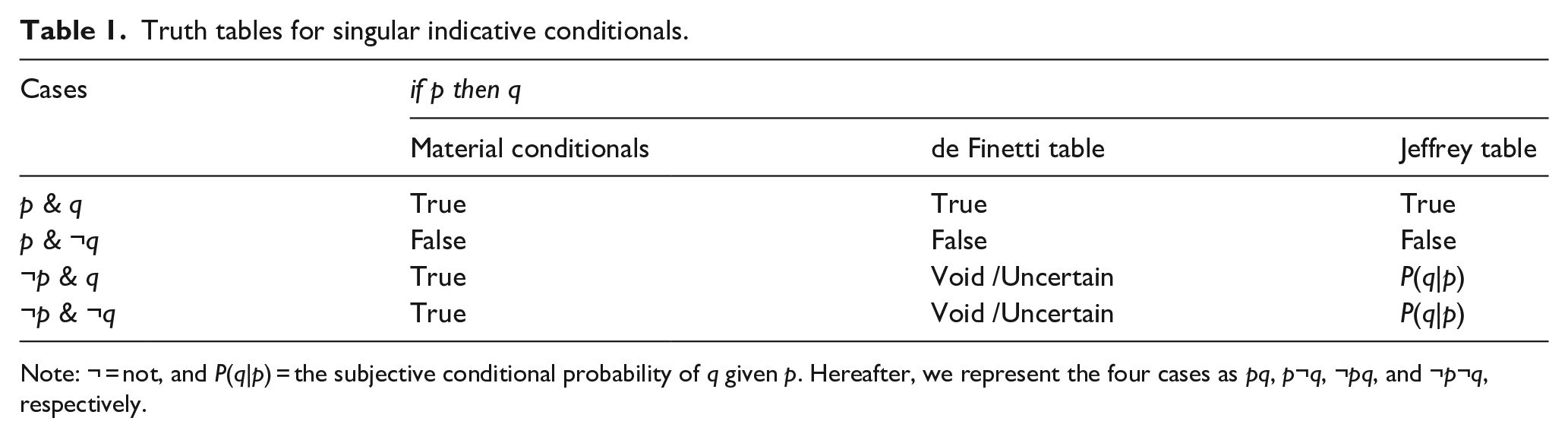
Note: ¬ = not, and P(q|p) = the subjective conditional probability of q given p. Hereafter, we represent the four cases as pq, p¬q, ¬pq, and ¬p¬q, respectively.
The material conditional interpretation (MCI) is the claim that natural language conditionals are material conditionals. A material conditional, if p then q, is truth functional, and so extensional, because its truth or falsity is totally determined by the truth or falsity of p and q. MCI implies the paradoxes of the material conditional (Edgington, 1995; Elqayam et al.; Evans & Over, 2004). When if p then q is interpreted as a material conditional, it is logically equivalent to not-p or q, which validly follows from not-p and from q. If (1) is a material conditional, and so is equivalent to (4), (1) will “paradoxically” be “true” when all the soybeans in the box are far too old to germinate and would not be watered for that very reason. In MCI, the probability of a conditional, P(if p then q), is P(not-p or q), which is the sum of P(p & q), P(¬p & q), and P(¬p & ¬q). Thus MCI is disconfirmed by all the results (from Evans et al., 2003, to Kleiter et al., 2018) supporting the conditional probability hypothesis that P(if p then q) = P(q|p). As a response to these findings, MCI has been rejected in the psychology of reasoning, and non-extensional accounts, which we will come to below, have been proposed to replace it.
In contrast to MCI, suppositional theories (ST) imply that P(if p then q) = P(q|p). They are supported by all the results confirming the conditional probability hypothesis. In particular, the probability of (1), for ST, is the conditional probability that a random soybean from the box will sprout given that it is watered. This probability is 0 for us when we know that the soybeans in the box are too old to germinate, even if none of these soybeans are ever watered. In suppositional accounts, the probability of a conditional, P(if p then q), is assessed using the Ramsey test (Ramsey, 1929/1990). In our interpretation of this “test” (Evans & Over, 2004; Stalnaker, 1968), we would hypothetically suppose p while making minimal changes to preserve consistency in our beliefs and then assess our degree of belief in q under this supposition of p, giving us the subjective conditional probability of q given p, P(q|p). One can make use of the ratio P(pq)/P(p) in a Ramsey test, where it exists, or consider some causal or epistemic relation between p and q, when one exists, or simply assess P(q) when q is independent of p (Oberauer et al., 2007). But however the test, interpreted in this way, is implemented, it leads to the Equation: P(if p then q) = P(q|p). Applying the test to (1), we do not have to worry that no soybean in the box is going to be watered, because they are too old. We can suppose hypothetically that a random soybean from the box is watered, and infer that it will not sprout, using our causal beliefs about soybeans that are too old to sprout (see Oaksford & Chater, 2020; Over, 2020; Over & Cruz, 2018).
Suppositional accounts can distinguish between different uses of “true” and “false.” Imagine that a random card is selected from the pack referred to in (2). By the analysis of de Finetti (1995), (2) will be true when this card is round and red, and false when this card is round and not red. When the card is not round, de Finetti would describe (2) as “void,” for we would not use (2) when we could see that the card was, say, square and so not round. In a further analysis of de Finetti’s position, Jeffrey (1991) proved that the “void” value must become the conditional probability, P(q|p), itself (see also Kleiter et al., 2018; Over, 2020; Over & Baratgin, 2016; Over & Cruz, 2018; Pfeifer & Kleiter, 2009; Sanfilippo et al., 2020). That is, if p then q is true when p and q hold, is false when p and not-q hold, and has the value P(q|p) when not-p holds. All these evaluations are displayed in the de Finetti and Jeffrey tables of Table 1 (and see also Wang & Zhu, 2019).
When a card is selected from a pack, and we can see that it is round and red, or that it is round and not red, we can say that (3) is “objectively” true, or “objectively” false. But there are also pragmatic and subjective uses of “true” and “false” (Adams, 1998; Edgington, 2003; Over et al., 2007; Skovgaard-Olsen, 2020). In these pragmatic and subjective uses, we can, for example, say that (1) is “true,” although no soybean is ever taken from the box and watered, depending on how confident we are that the soybeans are viable. In suppositional accounts, a speaker’s assertion that if p then q is “true” can convey that P(q|p) is high in that context, and there is a quantitative pragmatic threshold for the use of “true” by a speaker that varies from context to context (Over, 2020; Over & Cruz, 2018; Wang & Yao, 2018). In an extreme case, P(q|p) = 1, and then P(if p then q) will have probability 1 by the Jeffrey table, and we would predict that everyone would judge if p then q “true.” However, our question in this article is not the quantitative one of how high P(if p then q) must be for people to judge that if p then q is “true.” Our focus here is on the qualitative question of which cases must be possible for a speaker to assert that if p then q is “true.” This question about the relation between the “truth” of conditionals and relevant possibilities is of fundamental interest, and different accounts of conditionals give different answers to it.
For suppositional accounts, the assertion that if p then q is “true” depends on a high P(q|p). In the present experimental materials using basic conditionals like (2), a high P(q|p) implied that the pq case is possible, regardless of whether any of the other cases are possible. For P(q|p) to be high then, pq cases had to be possible, but ¬pq or ¬p¬q cases are irrelevant and do not have to be possible. In particular, (2) will be judged “true” if the pack contains some round red cards and no round non-red cards, as the conditional probability will then be 1 that a random card in the pack is red given that it is round. It will not matter whether non-rounds cards are possible in the pack.
In our experiments, we will ask whether suppositional accounts, ST, based on the Jeffrey table, give a better account of the qualitative relation between truth and possibility than other accounts of conditionals in psychology.
There are other non-extensional accounts that strongly reject MCI. One is truth condition inferentialism (TCI). This is the hypothesis that a conditional, if p then q, is true if and only if there is a deductive, or a sufficiently strong inductive (or statistical) or abductive, inferential connection between p and q (Douven et al., 2018, 2020). There do appear to be examples of acceptable conditionals if p then q, sometimes equivalent to “even if” uses, without such a connection between p and q. Some researchers have called these “non-standard” conditionals or “unconditionals,” and some supporters of TCI state that their account is intended only “. . . as a semantics for standard conditionals, not for unconditionals” (Douven et al., 2020). But a “standard” conditional cannot, without circularity, be defined as one that TCI applies to, and some critics have argued that these supporters of TCI are in danger of decreasing the testability of their account (Cruz et al., 2016; Cruz & Over, 2021; Lassiter, forthcoming). For example, Skovgaard-Olsen et al. (2017) present evidence against TCI, but TCI supporters might try to argue that some of the conditionals in that article could be interpreted as “non-standard.” However, such an interpretation depends on a content and context that our basic conditionals do not have, and so they cannot be called “non-standard.” They could not be easier for people to understand as conditionals, and TCI should apply to them.
A conditional cannot be TCI “true” merely because p and q are true: there has to be a relevant connection, deductive or non-deductive, between p and q. If there is no such connection, if p then q is a so-called missing-link conditional (Krzyżanowska & Douven, 2018) and cannot be true. Accordingly, if p then q cannot be true when q is independent of p, even if P(q|p) is very high or at 1. For example, TCI implies that (2) is “not true” when every card in a pack of round and square cards is red. Note that this case is classified differently by a supposition account, ST, which implies that (2) is judged “true” when P(red|round) = 1, whether P(red) = 1 or not.
Krzyżanowska and Douven (2018) formulated the complete, necessary, and sufficient truth conditions for if p then q in TCI in the following way (see also Douven et al., 2020). The conditional is true in a conversational context C if and only if, relative to the set Σ of background premises accepted in C, (a) there is a compelling argument from Σ∪{p} to q; (b) there is no argument, or no equally compelling argument, from Σ alone to q.
Clause (a) ensures that there is a “compelling” or “sufficiently strong” deductive, inductive, or abductive relation between p and q, and clause (b) ensures that this connection is not redundant, because q follows from the background context alone. When one of these two requirements is not met, the conditional cannot be TCI true. Douven et al. (2020) suggested that if p then q could be false when there is a compelling argument from p to not-q and neither true nor false when there is no compelling argument from p to q or from p to not-q.
ST is also sharply different from the mental model approach in the study of reasoning. The first mental model theory was proposed by Johnson-Laird and Byrne (1991, 2002) and the second one by Johnson-Laird et al. (2015) and Khemlani et al. (2018). In the first theory (MMT1), the full mental models of if p then q were those for the extensional disjunction of the cases in which the material conditional, equivalent to not-p or q, is true: pq or ¬pq or ¬p¬q (see Table 1). This extensional disjunction was presented as a list of the cases:
p q
not-p q not-p not-q
In MMT1, if p then q is “true” if and only of one of the three cases in the above list holds (Goodwin & Johnson-Laird, 2018). Each conjunction in the list is sufficient for the truth of if p then q and is possible given the truth of if p then q, but no specific case, out of the three, is required to hold for the truth of if p then q. The full mental models of MMT1 thus imply a core semantic analysis of if p then q as equivalent to the material conditional. MMT1 has been abandoned by its creators, as all the experimental results that falsify MCI also falsify MMT1(from Evans et al., 2003, to Kleiter et al., 2018).
In the mental model framework, MMT1 has consequently been replaced by MMT2. In MMT2, the core meaning of a conditional if p then q is represented, not by an extensional disjunction, but by an explicit non-extensional, or modal, conjunction about possibility: possible pq & possible ¬pq & possible ¬p¬q. This step from an extensional to an explicitly modal interpretation of conditionals marks a radical revision of the mental model approach, and the results in the past that disconfirmed MMT1 do not necessarily disconfirm MMT2. The explicit modal conjunction of the three possibilities in MMT2 is supposed to be exhaustive and so to imply that the p¬q case is impossible. Khemlani et al. (2018) present the modal conjunction as this list:
possible pq
& possible ¬pq & possible ¬p¬q.
According to MMT2 (using its symbols), “. . .a basic conditional, if A then C, is true only if all three situations in its fully explicit models are possible: possibly(A & C) & possibly(not-A & not-C) & possibly(not-A & C) and A & not-C is impossible” (Johnson-Laird et al., 2015, p. 206). The truth of a basic conditional (if p then q), without background knowledge or “modulation,” requires that all the three modal conjuncts hold. As Khemlani et al. (2018) state, when comparing the earlier MMT1 with the later MMT2, The previous version of the model theory postulated that people understand compound assertions by constructing models representing the disjunctive alternatives to which they refer. The new theory postulates instead that compounds refer to conjunctions of possibilities that each hold in default of information to the contrary. (p. 4)
In MMT1, if p then q is “true” if and only if pq or ¬pq or ¬p¬q holds. Each of these cases is a sufficient condition, but not a necessary condition, for if p then q to be true. One of these cases has to be possible, but no more than one, for if p then q to be true, given MMT1 (see Elqayam et al., 2013, and Evans & Over, 2004, for critical comments on MMT1). In contrast, for MMT2, if p then q is “true” if and only if possible pq & possible ¬pq & possible ¬p¬q holds, and so all of these possibilities must hold for if p then q to be true (for critical comments on MMT2, see Baratgin et al., 2015; Oaksford et al., 2019; Over, 2020; Over & Cruz, 2018).
We can further illustrate the differences between the suppositional ST approach, TCI, MMT1, and MMT2 by referring to materials that we used in our experiments. General conditionals like (1) and (2) refer to sets of elements, where each element must fall under one of the four cases: pq, p¬q, ¬pq, and ¬p¬q. Excluding the empty set, there are then 15 possible sets of elements distinguished in this way. All theories of conditionals must specify the relation between if p then q and these exhaustive possibilities. Table 2 lists all these 15 sets in its columns, C1 to C15. For example, there are the 15 different packs of cards that (2) might refer to. One type of pack has only round red cards in it (represented by set C4 of Table 2), another type has only round non-red cards (set C15), and another type of pack has all the possible cards in it (set C8). We used all 15 of these sets in our studies of people’s understanding of general conditionals.
The predictions for truth and possibility judgements in the 15 sets, C1 to C15.
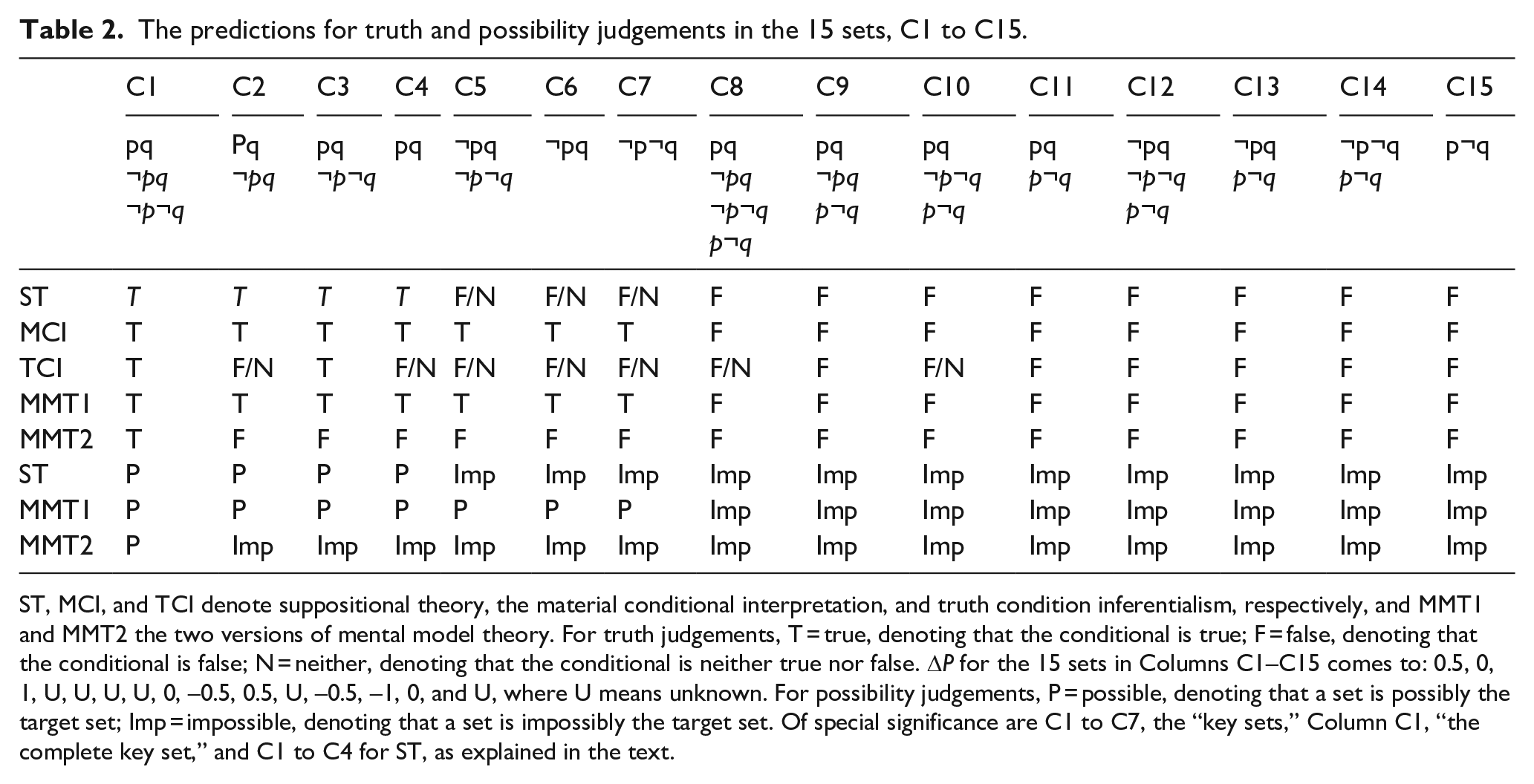
ST, MCI, and TCI denote suppositional theory, the material conditional interpretation, and truth condition inferentialism, respectively, and MMT1 and MMT2 the two versions of mental model theory. For truth judgements, T = true, denoting that the conditional is true; F = false, denoting that the conditional is false; N = neither, denoting that the conditional is neither true nor false. ΔP for the 15 sets in Columns C1–C15 comes to: 0.5, 0, 1, U, U, U, U, 0, –0.5, 0.5, U, –0.5, –1, 0, and U, where U means unknown. For possibility judgements, P = possible, denoting that a set is possibly the target set; Imp = impossible, denoting that a set is impossibly the target set. Of special significance are C1 to C7, the “key sets,” Column C1, “the complete key set,” and C1 to C4 for ST, as explained in the text.
Experiment 1 was a set-based truth judgement task, in which the participants were asked to judge whether a general conditional was “true,” “false,” or “neither” for each of the 15 possible sets. Experiment 2 was a set-based possibility judgement task, in which a general conditional was first stated to be “true” of an unknown set of objects, and then participants were asked to judge whether it was “possible,” or “impossible,” for each of the 15 sets to be that unknown set, that is, the target set. To determine which possibilities were qualitatively required for the truth of a general conditional, it was necessary to control for the possible effects of frequency differences among different cases. We kept the different cases in a set equiprobable by setting the number of each type at 10 in Experiment 1: 10 pq cases, 10 p¬q cases, and so on. In Experiment 2, we did not give frequency information about the types of cases in a set, and so these were equiprobable by default.
For Experiment 1, the truth judgement task, we asked participants whether a general conditional if p then q was “true,” “false,” or “neither” for each of the C1 to C15 sets listed in Table 2, using packs of cards and boxes of balls as alternative materials. In each pack of cards, for example, the number of cards in each case was given as 10. Thus, for instance, in a pack of pq and p¬q cards, there were said to be 10 pq cards and 10 p¬q cards. See Online Appendix A for the complete questionnaire.
In MMT1/MCI, (2) is “true” for any pack without p¬q cards, but “false” for any pack with p¬q cards. These predictions follow directly from the fact that MMT1 fully models (2) using the above extensional disjunction so that (2) is true if and only if pq or ¬pq or ¬p¬q holds. In Table 2, MCI and MMTI show the same predictions for truth judgements.
Unlike MMT1/MCI, MMT2 is an explicitly modal account. In MMT2, (2) is true if and only if the above modal conjunction holds, possible pq & possible ¬pq & possible ¬p¬q, with impossible p¬q implicit. In this theory, (2) is no longer “true” in a pack consisting of only 10 pq cards: (2) is “false” for this pack. This is because, in a pack of only pq cards, it is not possible for there to be ¬pq cards and ¬p¬q cards, and so possible ¬pq and possible ¬p¬q do not hold. This makes the modal conjunction as a whole false. But in a pack made up of 10 pq cards, 10 ¬pq cards, and 10 ¬p¬q cards, if p then q is “true” by MMT2, as all three possibilities for this pack hold, making the modal conjunction true. In general, MMT2 implies that if p then q is “true” of sets having all of pq, ¬pq, and ¬p¬q as members, and no p¬q members. Table 2 also lists all the predictions derived from MMT2.
In the suppositional approach, (2) is “true,” in the pragmatic and subjective use, when P(q|p) = 1, and thus when there are pq cards and no p¬q cards. In a Ramsey test, we can rely on the ratio formula when P(p) > 0: P(q|p) = P(pq)/P(p) = P(pq)/(P(pq) + P(p¬q)) = F(pq)/(F(pq) + F(p¬q)) where F denotes frequency. When there are 10 pq cards and no p¬q cards in a set, P(if p then q) = P(q|p) = 10/10 = 1, and so if p then q will be “true” in suppositional approaches. When there are 10 p¬q cards and no pq cards, P(q|p) = 0, and if p then q will be “false.” When there are 10 pq cards and 10 p¬q cards in a set, P(if p then q) = P(q|p) = 10/20 = 0.5, and if p then q will not meet any reasonable threshold for “true.” Whether 0.5 is low enough to meet the threshold for “false” in the context of our experiment is a more subjective question, but we predict that most participants will judge 0.5 is low enough for “false” to be used, rather than “neither true nor false.” It is intuitively false that, if a fair coin is tossed, it will come up heads.
In those conditional probability calculations, the presence or absence of any ¬p case is totally irrelevant. But for sets C5 to C7, containing only ¬pq or ¬p¬q cases, P(p) = 0. As shown in Table 2, MMT1 and MMT2 imply that there should no problem at all making true or false, or possible or impossible, judgements about if p then q when P(p) = 0, and so when P(pq)/P(p) is undefined. But in our abstract materials, there is no way to calculate P(q|p) when P(pq)/P(p) is undefined. For a non-basic conditional, say, about soybeans that are definitely not going to be watered, we could use causal knowledge to infer what would probably happen under the counterfactual supposition that they were watered (Over, 2020). But this cannot be done with our basic conditionals in sets C5 to C7. In ST, the pragmatic use of “true,” in our materials, depends on a high number of pq cases with a low number of p¬q cases. If there are no pq cases at all, as in sets C5 to C7, then ST implies that the pragmatic “true” cannot be used. The response could randomly be “neither true nor false” or “false.” The individual differences in responses beyond this could not be predicted by ST as currently developed, but the important point is that for these sets, C5 to C7, ST implies that “true” will not be used.
In TCI, the truth conditions for basic conditionals depend on a “sufficiently strong” inductive (statistical) connection between p and q. Some researchers have used the ΔP rule, ΔP = P(q|p)—P(q|¬p), to measure probabilistic relevance between p and q in singular conditionals without frequency information (Krzyżanowska et al., 2017; Skovgaard-Olsen et al., 2016a, 2016b). Probabilistic relevance means that p either raises or lowers the probability of q, and in this sense, Δp > 0 indicates positive relevance, Δp = 0 indicates irrelevance, and Δp < 0 indicates negative relevance. To operationalise an inductive connection in our materials, we also used ΔP, derived from our frequencies, to measure such a connection between p and q.
For our basic conditionals with frequency information, when ΔP = 0, it could be said that if p then q is a missing-link conditional. In contrast, in set C3, {pq, ¬p¬q}, we have P(q|p) = 1 and P(q|¬p) = 0, ΔP = 1, and there is the strongest argument from p to q, and if p then q would be “true” for this set by the TCI truth conditions. In set C2, {pq, ¬pq}, we find only pq and ¬pq possibilities, making ΔP = 0 and violating the TCI truth conditions. There is no compelling argument here from p to q, nor from p to ¬q, and if p then q cannot be true by TCI, that is, if p then q is then either “false” or “neither true or false,” by what Douven et al. (2020) say. In set C4, {pq}, there are no ¬p possibilities, and so P(q|¬p) and ΔP are undefined in our materials. But in this set, P(q|p) = P(q) = 1, q is independent of p. That must violate clause (b) of the TCI truth conditions and imply that if p then q is false in C4. In set C1, {pq, ¬pq, ¬p¬q}, where ΔP = 0.5, the argument from p to q is of medium strength. In TCI, for sets C2, C1, and C3, “true” judgements of if p then q will increase as ΔP increases from 0 to 0.5 and then 1. That is, in TCI, set C1 with ΔP = 0.5 will elicit more “true” judgements than set C2 with ΔP = 0, but fewer “true” judgements than set C3 with ΔP = 1. This is the unique prediction of TCI. Table 2 summarises all the TCI predictions, as far as these can be made precise for our materials.
In summary for Experiment 1, the five accounts make different predictions for truth judgements about sets C1 to C7 in Table 2, containing no p¬q cases. We will term these seven sets the key sets. MMT1/MCI implies that if p then q is “true” of all these key sets. MMT2 implies that if p then q is “true” only in set C1, which we will call the complete key set, as it contains pq, ¬pq, and ¬p¬q. The suppositional approach ST implies that if p then q will be evaluated as “true” for a set if and only if that is one of the four key sets with pq cases, key sets C1 to C4. Also, according to TCI, for key sets C2, C1, and C3, “true” judgements of if p then q will increase as ΔP increases from 0 to 0.5 and then 1.
Experiment 2 was a possibility judgement task. In it, a general conditional if p then q was stated to be “true” of an unspecified target set, and participants were asked whether each of the 15 sets, C1 to C15, was “possibly” the target set. See Online Appendix B for the questionnaire. For example, (2) could be said to be “true” of an unspecified pack of cards, and then the question might be asked whether a pack consisting of only round not-red cards could be that pack. But it is not possible for conditional if p then q to be “true” of a set that contains only p¬q cases, C15, according to MMT1/MCI, MMT2, and ST. However, these theories differ in their implications for the seven key sets, and these differences parallel those for the truth judgement task of Experiment 1. See again the first seven sets of Table 2, C1 to C7. When if p then q is “true” of a set, it is possible for that set, according to MMT1/MCI, to be any one of the seven key sets, as a material conditional is true if and only if there are no p¬q cases. According to MMT2, it is only possible for that set to be the complete key set, as only this set contains all the possibilities. According to ST, it is only possible for that set to be one with pq cases and no p¬q cases, that is, one of the sets C1 to C4 in Table 2.
In Experiment 2, no explicit frequency information was given to the participants, and so ΔP cannot be calculated, in general, for this study. TCI is not fully applicable to possibility judgement tasks about basic conditionals without frequency information. Even so, we can look at two sets about which TCI can make certain predictions, no matter what the frequencies would be. For TCI, if p then q could not possibly be “true” in set C2, where there are only pq and ¬pq possibilities. In set C2, no matter what the frequencies are, P(q|p) = P(q) = 1, and so q is independent of p. This must violate the TCI truth conditions, because when q is independent of p, there cannot be compelling argument from p to q. However, if p then q is TCI “true” in set C3, where there are only pq and ¬p¬q cases. For set C3, ΔP = 1, no matter what the frequencies of these possibilities might be, and so there is the strongest connection between p and q. A “true” conditional for TCI implies that set C3 is always possible. Overall, TCI makes the unique prediction that, given a “true” conditional, set C3 will elicit more “possible” judgements than set C2.
Experiment 1
Method
Participants
A total of 120 college students (56 men, 64 women) from Shaanxi Normal University in China participated in the experiment. They had not yet taken any logic course. Both experiments received ethical approval from the Shaanxi Normal University Human Research Ethics Committee, and all of the participants signed a written consent form.
Design and materials
Experiment 1 was a paper-and-pencil questionnaire study based on a set-based truth judgement task. In this task, participants were asked to judge whether a general conditional was “true,” “false,” or “neither true nor false” for each of the 15 given sets, C1 to C15. There were two problems corresponding to two kinds of problem materials, sets of cards and sets of balls, with two different conditionals: if a card is round then it is red and if a ball is blue then it is plastic. Notice that it would be, at least, pragmatically infelicitous to use a singular conditional in this experiment, for example, if the card is round then it is red, as a unique card was not selected for “the card” to refer to. The two problems were between-subjects. Each problem contained 15 items, corresponding to the 15 sets in Table 2, which were counterbalanced in the order of presentation. See the complete task (translated from the original Chinese version) in Online Appendix A with one order. The other was the reversed version of the former.
The purpose of Experiment 1 was to test whether set-based truth judgements would accord with the predictions of MCI/MMT1, MMT2, the suppositional approach, or TCI. Their predictions are presented in Table 2.
Procedure
Participants completed the questionnaires in a group in a quiet classroom. Every participant received one of the two versions of questionnaires and a pen to fill it out. They took about 10 min to complete the questionnaire.
Results and discussion
The two problems with different materials, cards and balls, showed no obvious differences in truth judgements. Thus, the results were collapsed across the two problems. The overall results are shown in Table 3 and Figure 1. Most participants judged the conditional “true” in each key set containing pq cases and “false” in each set containing p¬q cases. For the three key sets containing only ¬pq or ¬p¬q cases, participants showed a similar response pattern. In each of these key sets, about 50% of participants judged the conditionals false, and about 40% of participants judged the conditionals neither true nor false, and so in these sets, participants showed individual differences. The “false” judgement was the modal response. More importantly, more than 80% of participants’ judgements were “not true,” that is, either “false” or “neither true or false,” in the key sets without pq cases. In these key cases without p¬q cases, P(q|p) cannot be defined in our materials, as we have explained above. This suggests that the pq possibility is required for judging conditionals true in the present materials. For the seven key sets, the predominant response pattern confirms the predictions of the suppositional approach rather than those of MMT1 and MMT2: participants tend to judge if p then q true in these materials if and only if P(q|p) = 1.

Probability (proportion) of each type of responses as the function of set in Experiment 1.
The overall results (percentages) in Experiments 1 and 2 for sets C1 to C15.

We analysed these data using a Bayesian mixed ordinal regression with a random intercept for participants using the brms package 1 in R (Kruschke, 2015, p. 672). Set was the independent variable, and the response variable was ordinal. The belief in the conditional was increasing from response “false” to “neither” to “true.” It is natural to treat “true” as 1 and “false” as 0, and also natural to interpret “neither” as a number between 1 and 0, for “neither” is not as good as “true” or as bad as “false.” In formal accounts of de Finetti’s system, ½ is used for “neither” (Egré et al., 2021).
We calculated Bayes Factors for all the comparisons of interest and report the relevant Bayes factor for the null hypothesis, BF01, or against it, BF10. Our data analysis strategy has two advantages. First, once the posterior distribution is computed, we can conduct as many hypothesis tests as we choose, without employing any corrections for multiple tests (Kruschke, 2015). Second, these analyses allow us to quantify the evidence for the null. This is important because MMT2 predicts differences between the complete key set and the other key sets that MMT1/MCI and ST accounts do not. See the R scripts of Bayesian analyses of the two experiments in the uploaded supplements.
We first compared each of the seven key sets with the corresponding set containing p¬q cases, for example, set C4 containing only pq cases with set C11 containing only pq and p¬q cases. For the seven paired comparisons, there was decisive evidence that each key set containing pq cases elicited higher truth judgements than the corresponding set containing p¬q cases (an interval summary of the seven Bayes factors was 5.08 × 10⁵ < BF10 < 1.19 × 10²¹). Overall, participants generally judged the conditionals false in any set containing p¬q cases.
We compared next the complete key set, C1, with each of the six remaining key sets, sets C2 to C7. We found very strong evidence that the complete key set elicited higher truth judgements than each key set containing no pq cases, sets C5 to C7 (5.19 × 10¹² < BF10 < 1.69 × 10¹⁴), and positive evidence that truth judgements did not differ between the complete key set and the other three key sets containing pq (5.3 < BF01 < 14.7). Moreover, there was strong evidence that truth judgements did not differ between set C2 with ΔP = 0, and set C1 with ΔP = .5 and set C3 with ΔP = 1 (30 < BF01 < 37). This finding is inconsistent with the unique pattern predicted by TCI. Overall, for the seven key sets, participants more often accepted the conditionals in the four key sets containing pq cases, than in the other key sets without pq cases, and most participants equally often accepted the conditionals in those four key sets containing pq cases. This finding also disconfirms TCI, by demonstrating that a “sufficiently strong” connection between p and q is not necessary for a conditional to be judged “true.”
In summary, the overall response pattern showed that people judge a general conditional as “true” in sets containing pq cases but no p¬q cases, and that truth judgements depended on P(q|p), independent of ΔP. These findings favour the ST suppositional approach over the other accounts. Suppositional accounts alone imply that a general conditional will be judged “true” for a set in these materials if and only if that set has pq cases and no p¬q cases.
Experiment 2
Method
Participants
The participants were 100 college students (42 men, 48 women) from Shaanxi Normal University in China. They had not yet studied logic.
Design and materials
Experiment 2 was a paper-and-pencil study using a set-based possibility judgement task. We here stated that a basic conditional if p then q was “true” of an unspecified set, and then we asked the participants, for each of the sets in the list C1 to C15, whether it was “possibly” that unspecified set, which we are here calling the target set. As we have outlined above, the three accounts of if p then q make different predictions about the answers to this possibility question. Such possibility questions have become important recently because, as we have explained above, MMT2 has been formulated as an explicitly modal account of conditionals. See Table 2 for our predictions. Experiment 2 had a similar design and materials to Experiment 1, except of course that the possibility judgement task replaced the truth judgement task in Experiment 1. The complete task can be found in Online Appendix B.
Procedure
The procedure was identical to that in Experiment 1.
Results
The two problems with different materials showed no obvious differences in possibility judgements, and thus the results were collapsed across the two problems. The overall results are shown in Table 3 and Figure 2. For the three key sets containing only ¬pq or ¬p¬q cases, sets C5 to C7, about half of the participants judged these three sets as “possible” for the target set. This finding might seem to support MMT1. However, the other half of the participants did not judge these sets as “possible” for the target set, and this finding goes against MMT1. For each of the remaining 12 sets, most participants judged that key sets containing pq were “possibly” the target set and the sets containing p¬q cases were not. For the seven key sets, the overall response pattern favours ST over both MMT1 and MMT2.

Probability (proportion) of “possible” judgements as the function of set in Experiment 2.
We analysed these binomial data using a Bayesian mixed logistic regression with a random intercept for participants using the brms package 2 (Bürkner, 2017) in R, in which the set was the independent variable. For the prior, we used a standard weakly informative scaled t-distribution, t(df = 7, M = 0, SD = 2.5) (the standard prior for such analyses recommended in the rstanarm package in R).
We first compared each of the seven key sets with the corresponding set containing p¬q cases, for example, set C4 containing only pq cases versus set C11 containing only pq and p¬q cases. For all seven comparisons there was decisive evidence that each key set was more likely to be the target set than the corresponding set containing p¬q cases (6.71 × 10⁴ < BF10 < 2.27 × 10¹¹). This result showed that participants generally judged sets containing p¬q cases as “impossible” for the target set. Next, we compared the complete key set, set C1, with each of the six remaining key sets, C2 to C7. We found very strong evidence that the three key sets containing no pq cases, sets C5 to C7, received fewer “possible” judgements than the complete key set with pq cases (1.15 × 10⁶ < BF10 < 1.20 × 10⁷), and no evidence that possibility judgements differed between the complete key set and the other key sets containing pq cases in columns C2 to C4 (0.12 < BF10 < 1.34). Unlike sets C1 and C3, there is not a strong connection between p and q in set C2, where q is independent of p. Yet most participants still judged set C2 possible for the target set. This finding is inconsistent with the unique prediction of TCI. For the seven key sets, most participants equally often accepted as “possible” the four key sets containing pq cases, and more often accepted these four sets as “possible” than the other key sets without pq cases. Thus, the truth of a conditional does not imply the existence of a “sufficiently strong” connection between p and q. This finding goes against TCI.
In summary, the overall response pattern showed that it is possible for a “true” conditional to refer to sets containing pq cases but no p¬q cases. Sets containing pq are required for a true general conditional, and the complete key set, containing pq, ¬pq, ¬p¬q, is not required, against the direct implication of MMT2. Hence these findings favour suppositional accounts over MMT1/MCI and MMT2. It is possible for a true general conditional to refer to a set in our materials if and only if that set has pq cases and no p¬q cases.
General discussion
Experiment 1 investigated set-based truth judgements, and Experiment 2 investigated explicitly modal possibility judgements, about general basic conditionals. The judgements in both experiments showed a parallel response pattern. In the truth judgements task, a conditional tended to be judged “true” in the key sets, C1 to C4, containing pq cases, but not “true,” that is, either “false” or “neither true nor false,” in the key sets not containing pq cases, C5 to C7. In the possibility judgements task, where a conditional was true of an unspecified target set, the key sets containing pq cases were more often judged to be “possible” as the target set than the key sets without pq cases. In these set tasks, where the cases in a set were equiprobable, the sets that rendered a conditional “true” were also the sets judged “possible” when a conditional was stated to be true. These results add to the disconfirmation of extensional MMT1/MCI, found in studies from Evans et al. (2003) to Kleiter et al. (2018). But they also disconfirm the new, explicitly modal MMT2.
These findings show, as is implied by suppositional theory and its Jeffrey table, that the truth of a general basic conditional is consistent with the key sets containing pq cases, but not with the key sets without pq cases. Against TCI, a “sufficiently strong” or “compelling” relation between p and q is not required for the truth of a basic conditional in our materials. Only the pq possibility is required for the truth of if p then q, and in summary, our findings support suppositional theory over the other four accounts, MMT1/MCI, MMT2, TCI.
It should also be noted that the clear importance of the pq cases in our results does not support the claim that people might have represented if p then q as the conjunction of p and q for our materials. It is true that 92% of the participants judged if p then q “true” for set C4 containing only pq cases, and that this is the highest percentage of truth judgements. But 84% of the participants, the second highest, judged if p then q “true” for set C1 containing pq, ¬pq, and ¬p¬q cases, and these participants obviously could not be representing if p then q as the conjunction pq. MMT1 (Johnson-Laird & Byrne, 2002) proposed that people have an initial pq model of if p then q, which would only sometimes be “fleshed out” into what were supposed to be the full models, pq, ¬pq, and ¬p¬q, but if our transparent materials did not cause “fleshing out,” we do not see what would.
The problems of MMT1 have caused its former supporters to replace it with MMT2, in which the extensional disjunction is replaced by a model conjunction, possible pq & possible ¬pq & possible ¬p¬q (Khemlani et al., 2018). Both logicians (Bringsjord & Govindarajulu, 2020) and psychologists (Baratgin et al., 2015) have criticised MMT2 on theoretical grounds, but we have presented here experimental evidence against it. The most pressing problem for MMT2 on the theoretical side is that its underlying system of reasoning does not have a peer-reviewed (by logicians) and published consistency proof (Oaksford et al., 2019).
To put on top of the fundamental representation of if p then q as a modal conjunction, supporters of MMT2 have referred to processes of “modulation,” which can apparently modify what the semantic core implies (Khemlani et al., 2018). In MMT2, however, a basic conditional is true if and only if the modal conjunction holds, because there is no background knowledge modulation, by definition, of a basic conditional (Johnson-Laird et al., 2015). The proposed MMT2 fundamental representation of a basic conditional, as a modal conjunction, is what was testable using our materials. These materials did not supply a context or content for modulation to block the possibility of ¬pq or ¬p¬q. According to the MMT2 modal conjunctive representation of basic conditionals, participants would only judge that if p then q was “true” for the complete key set, C1, and they would respond that it was only possible for a “true” if p then q to refer to the complete key set. These predictions were falsified by our results, as clearly seen in Table 3.
In Experiment 1, we found that most participants judged if p then q “true” in key sets containing pq members, but not with only ¬pq or ¬p¬q members. In Experiment 2, where if p then q was given as “true” of an unspecified set, most participants judged that this target set could possibly contain just pq members, or just pq and ¬pq members, or just pq and ¬p¬q members. It was not necessary for the unspecified set to contain all of pq, ¬pq, and ¬p¬q cases as members, and possible pq & possible ¬pq & possible ¬p¬q could be false when if p then q was true. Therefore, the two experiments support suppositional accounts over the extensional disjunctive interpretation of MMT1/MCI and the modal conjunctive interpretation of MMT2.
The present study on the interpretation of conditionals is an extension of Wang and Zheng (2021) on the interpretation of disjunctions. All these studies are novel in critically examining the new modal approach of MMT2, which Khemlani et al. (2018) described in the following (with our additions in brackets): “The previous version [MMT1] of the model theory postulated that people understand compound assertions by constructing models representing the disjunctive alternatives to which they refer. The new theory [MMT2] postulates instead that compounds refer to conjunctions of possibilities that each hold in default of information to the contrary.” (p. 4)
In fact, Wang and Zheng (2021) found that people interpret an inclusive disjunction, p or q, as the extensional disjunction, pq or p¬q or ¬pq, as found in MMT1, but not as the modal conjunction, possible pq & possible p¬q & possible ¬pq, as newly proposed in MMT2. In the present research, we have found evidence against the MMT2 representation of a conditional if p then q as the modal conjunction possible pq & possible ¬pq & possible ¬p¬q. If this modal conjunction is the correct representation, then only the complete key set, set C1, could render if p then q true, and be possible for the target set judged given the truth of if p then q. Table 3 shows that these implications of MMT2 are false.
In Experiment 1, we found further that truth judgements for basic conditionals depended on P(q|p), but not on ΔP. This finding supports suppositional accounts ST, and the Jeffery table, but not TCI. In particular, the results for sets C1 to C3 of Table 3 disconfirm the TCI position that if p then q is false, or neither true nor false, when there is no “sufficient strong” or “compelling” connection between p and q (Douven et al., 2020). In set C2, {pq, ¬pq}, where ΔP = 0, there is no connection between p and q, and so the conditional if p then q would be a missing-link conditional that would not be true. Yet most participants judged it “true.” This result is consistent with previous findings that if p then q is evaluated as “true” when p and q are true, whether or not there is any connection between p and q (Cruz et al., 2016; Skovgaard-Olsen et al., 2017). But our results are for basic conditionals that are easy to understand, without a “bias,” as standard conditionals (Cruz & Over, 2021; Douven et al., 2018), and Experiment 2 went beyond earlier research to study, for the first time, possibility rather than truth judgements about TCI. Most participants judged that set C2, in which q is independent of p, was “possible” for the target set when if p then q was given as true, and this is a new finding that goes against TCI.
Supporters of TCI often employ examples of missing-link conditionals that have no pragmatic context and are pragmatically infelicitous to the point of being bizarre, for example, “If raccoons have no wings they cannot breathe under water” (Krzyżanowska et al., 2017). It is understandable on pragmatic grounds that people would object to such conditionals (Cruz et al., 2016; Lassiter, forthcoming). Our experiments provided a minimal pragmatic context for our conditionals, but one that was like common card or other games, and this was enough to make the conditionals pragmatically acceptable.
Our findings on qualitative truth and possibility evaluations of conditionals supplement previous research (Evans et al., 2003; Kleiter et al., 2018; Oberauer et al., 2007), showing that quantitative probability judgements of conditionals in probabilistic truth-table tasks conform to the conditional probability hypothesis that the probability of if p then q is the conditional probability of q given p (Evans et al., 2003; Fugard et al., 2011; Kleiter et al., 2018; Oberauer et al., 2007; Oberauer & Wilhelm, 2003; Over et al., 2007; Wang & Yao, 2018). These results, and ours in this paper, decisively refute MMT1/MCI, which imply that P(if p then q) = P(not-p or q), but support suppositional theories of if p then q and the Jeffrey table. In addition, our results refute the modal analysis of if p then q in MMT2, and the requirement of inferential connections for if p then q to be true in TCI. A wide range of conditionals was investigated in previous studies, but singular and general conditionals were not always separated in this research. Our research here is the first to compare the different accounts of general conditionals, MCI/MMT1, MMT2, ST, and TCI, and their implications about both truth and explicitly modal possibility judgements.
An interesting topic for future research will be evaluations of if p then q when P(q|p) cannot be defined, because there are no pq or p¬q cases, and there is no causal or epistemic connection between p and q. This possibility corresponds in our materials to key sets C5 to C7, where there are some ¬pq or ¬p¬q cases, but no pq or p¬q cases. For these sets, C5 to C7, P(q|p) cannot be defined. According to ST, the pragmatic aspect of truth will be applied only when P(q|p) is high. When P(q|p) is not high because P(q|p) is undefined, it was possible for us to predict that “true” would not be used as a response. But given the current state of development of ST, we could not predict the result that high proportion of responses, for C5 to C7, would be “false” and a high proportion “neither true nor false.” More detailed pragmatic hypotheses will have to be developed by ST to explain these proportions.
Conclusions
In this article, we have studied the qualitative connection between the assertion of a general basic conditional as “true” and the pq, p¬q ¬pq, or ¬p¬q possibilities. The overall results confirmed that, for general basic conditionals to be judged “true,” the pq case has to be possible and is the only case required to be possible. We have found that these basic conditionals are not equivalent to explicitly modal conjunctions of possibilities, as in MMT2, and that they do not require inferential relations between their antecedents and consequents, as in TCI. Supposition theories, ST, based on the conditional probability hypothesis and the Jeffrey table, give the best account of our results, which thus supply new support for these theories.
Supplemental Material
sj-docx-1-qjp-10.1177_17470218221089331 – Supplemental material for What is required for the truth of a general conditional?
Supplemental material, sj-docx-1-qjp-10.1177_17470218221089331 for What is required for the truth of a general conditional? by Moyun Wang, David Over and Lixia Liang in Quarterly Journal of Experimental Psychology
Footnotes
Declaration of conflicting interests
The author(s) declared no potential conflicts of interest with respect to the research, authorship, and/or publication of this article.
Funding
The author(s) disclosed receipt of the following financial support for the research, authorship, and/or publication of this article: This work was supported by National Natural Science Foundation of China under General Grant Number 30170901.

Data accessibility statement
Notes
References
Supplementary Material
Please find the following supplemental material available below.
For Open Access articles published under a Creative Commons License, all supplemental material carries the same license as the article it is associated with.
For non-Open Access articles published, all supplemental material carries a non-exclusive license, and permission requests for re-use of supplemental material or any part of supplemental material shall be sent directly to the copyright owner as specified in the copyright notice associated with the article.
