



Abstract
When judging a perpetrator who harmed someone accidentally, humans rely on distinct information pertaining to the perpetrator and victim. The present study investigates how reasoning style modulates the contribution of the victim’s harm and the perpetrator’s intention to third-party judgement of accidental harm. In two pre-registered online experiments, we simultaneously manipulated harm severity and the perpetrator’s intention. Participants completed reasoning measures as well as a moral judgement task consisting of short narratives which depicted the interaction between a perpetrator and a victim. In experiment 1, we manipulated the perpetrator’s intent to harm (accidental versus intentional harm) and the victim’s harm (mild versus severe harm). In experiment 2, we aimed to manipulate intent in accidental harm scenarios exclusively, using positive or neutral intents and manipulating harm severity (mild versus severe harm). As expected, intent and harm severity moderated participants’ moral judgement of acceptability, punishment, and blame. Most importantly, in both experiments, the perpetrator’s intent not only interacted with the outcome severity but also polarised moral judgements in participants with a more deliberative reasoning style. While moral judgements of more intuitive reasoners were less sensitive to intent, more deliberative reasoners were more forgiving of accidental harm, especially following mild harm. These findings extend previous studies by showing that reasoning style interacts with intent and harm severity to shape moral judgement of accidents.
Introduction
People constantly scrutinise their own behaviour as well as the moral behaviour of others. Moral judgement indeed is a pivotal determinant of the regulation of social behaviours (Tomasello & Vaish, 2013). When someone breaks a moral rule, third parties are often involved in judging the transgressor, a process that requires the integration of multiple sources of information. Studies using behavioural, neuropsychological and neuroimaging methods have provided explanations about the way individuals combine information about the perpetrator, its causal responsibility, and the outcome to form a moral judgement. In what follows, we explain some of the most influential theories about moral judgement, and the predictions one of these theories makes about processing accidental harm. Next, we focus on cognitive factors that may be critical to moral judgement of accidental harm, namely executive functions and reasoning style. Finally, we develop our hypothesis about the role of reasoning style in judging accidental harm.
Intent and outcome as determinants of moral judgement
To determine whether an agent’s behaviour is wrong, punishable, and blameworthy, people mainly rely on two key factors: intention and outcome. First, research in moral psychology shows that judgements are harsher as the severity of harm caused to the victim increases (Bornstein, 1998; Carlsmith et al., 2002; Lowe & Medway, 1976; Robbennolt, 2000; Robinson & Darley, 1995). When participants are presented with fictitious scenarios involving a harm-doer and a victim and asked how much punishment the perpetrator deserves, their decision of punishment is mainly justified by the severity of harm inflicted to the victim (Carlsmith et al., 2002; Robbennolt, 2000). This increased judgement severity as negative outcomes get larger is in line with the retributive justice system according to which punishment of individuals should be proportional to the harm they caused.
The effect of outcome severity on moral judgement also extends to work using sacrificial moral dilemmas, where participants judge whether it is acceptable to kill someone to save many. The ratio between the deaths versus lives spared in these dilemmas orients participants’ response, in such a way that the more people to be killed by an action, the less acceptable it is judged (Costa-Lopes et al., 2021; Mata, 2019; Trémolière & Bonnefon, 2014). Besides, inflicting harm to others for the greater good is judged more acceptable if it results in mild injury as compared to death (Trémolière & De Neys, 2013). This means that participants take outcome severity into account when making their moral judgement in life-and-death situations.
Second, the intention behind an action or an action plan is of critical importance in the legal system and proves to be one of the main determinants of moral judgement (Cushman, 2008; Hauser, 2006). The notion of intentional action is based on two properties: a desire to reach and the ability to foresee an outcome (Forguson, 1989) by the means devoted to its execution (Bratman, 1989). When a moral transgression results in the same outcome, it is judged more morally wrong when the perpetrator harms intentionally as compared to accidentally (Robinson & Darley, 1995; Young et al., 2007). Even in the absence of harmful outcomes, people are sensitive to negative intentions: a failed attempt to harm is sufficient to trigger moral outrage and punishment (Hauser, 2006; Nobes et al., 2009; Russell & Giner-Sorolla, 2011; Young et al., 2007, 2011) Since Piaget’s seminal work about the progressive maturation of intent-based moral judgement (Piaget, 1965), other studies have also shown a shift from outcome-based to intent-based moral judgement in childhood (Cushman et al., 2013; Killen et al., 2011; Leslie et al., 2006; Zelazo et al., 1996). Recent work, however, suggests that intent can drive third-party moral judgement of young children, for example, when processing demands of the task are reduced (Margoni & Surian, 2020; Van de Vondervoort & Hamlin, 2018), or when the intention is more salient (Nobes et al., 2017), and even infants can recognise that a harmful action was intentional (Hamlin & Baron, 2014; Hamlin et al., 2010).
The cognitive underpinnings of third-party evaluation of moral transgressions
A few cognitive models of moral judgement have been elaborated, and we briefly mention two of the main models before elaborating more on the third one: the Culpable Control Model (CCM) (Alicke, 1992, 2000); the Path Model (Malle et al., 2014), and the two-process model (Cushman, 2008). The notions of intentionality, evaluation of outcome, and causal responsibility are incorporated to each model, although in different terms and with different connections between the concepts. The CCM posits that people first spontaneously evaluate the agent, the victim, and the action’s outcome, before determining the extent to which the agent has exerted a control over a harmful or potentially harmful event, and whether the agent could have predicted the outcome. The Path model of blame (Malle et al., 2014) posits that people assess the outcome and the agent’s causal responsibility, before determining whether the outcome was intended or not. If not, people process information about the agent’s obligation and capacity to have prevented the outcome (Malle et al., 2014; Monroe & Malle, 2017). Outcome severity is thus thought to play a limited role in blame judgements.
The two-process model of moral judgement (Cushman, 2008) suggests that two cognitive processes are involved in the evaluation of wrongness and punishment following a moral transgression. On the one hand, an “outcome-based process” focuses on the consequences of moral failures. On the other hand, an “intent-based process” is thought to focus on the agent’s intentions. Interestingly, the two-process model makes a distinction between different types of moral evaluations (Cushman, 2008). While punishment is thought to be dependent on both intent and outcome, wrongness is thought to be mainly dependent on intention. As for blame judgements, the two-process model posits that blameworthiness relies on both intent and outcome, just as punishment (Cushman, 2008), whereas recent evidence suggests that the blame may be less dependent on outcome than punishment (Kneer & Machery, 2019; Nobes & Martin, 2021). This means that manipulating factors relevant to intent or outcome should affect judgement of wrongness and punishment/blame differently. Critically, the outputs of the two processes of moral judgement are sometimes antagonistic, triggering a cognitive conflict in judges (Cushman et al., 2012; Greene et al., 2004). This is especially emblematic of accidental harms in which an agent unintentionally hurts somebody. In this case, the outcome-based process focusing on the harm inflicted to the victim would increase judgement severity, and conflicts with the intent-based process examining the agent’s innocent intention, which would decrease the judgement severity.
In brief, these models state that moral judgement is made up of a first evaluation of the action and its outcome, as well as an evaluation of the agent’s mental state, intention, or ability to have avoided the outcome. These different steps of evaluation implies that distinct cognitive factors may be involved at different stages of moral judgement. Thus, individual dispositions may differentially affect how people process information relative to the agent’s intention on the one hand, and to the outcome on the other hand. Should it be true that the differences in intent-based analysis may have to do with individual differences in reasoning and cognitive control abilities.
Cognitive control, reasoning, and the conflict triggered by accidental harm
Previous studies suggest that the reasoning and cognitive control affect moral judgement, an observation which has been largely documented in the study of sacrificial dilemmas (Greene et al., 2001). Many of these studies rely on dual-process theories (Evans, 2003; Stanovich & West, 2000), for which the generic model proposes that people can reason and judge by using either one of these two processes: Type 1 process, which is fast, intuitive and almost automatic, and emotionally-driven; Type 2 process, which is slower, deliberative, and greedy in cognitive resources. Many genuine tasks (and measures) have been designed to modulate or assess the use of each of these processes and explore individual differences in reasoning (for an overview of the dual-process toolbox [Trémolière et al., 2018]). Importantly, individual differences have been observed in the preferential use of one of these two systems of reasoning when solving problems (Stanovich & West, 2000). Individuals who preferentially use Type-1 process are said to be “intuitive” while individuals who preferentially use Type-2 process are said to be “deliberative.” In this paper, we use the terms “reasoning style” to refer to more intuitive versus more deliberative reasoning dispositions.
When deliberation is encouraged (Nichols & Mallon, 2006), or in contrast prevented by an interference task (Greene et al., 2008) or by a time limit imposed on participants (Suter & Hertwig, 2011), moral judgement is affected, in such a way that more (respectively less) deliberation is associated with more (respectively less) acceptability of inflicting harm to others. Moreover, at the individual level, contrasting participants with a more deliberative style to participants with a more intuitive style revealed greater cost-benefit analysis in more deliberative people, and ultimately higher utilitarian responses (Bartels, 2008; Patil et al., 2021). Cognitive resources and reasoning may thus be necessary to overcome the cognitive conflict triggered by sacrificial moral dilemmas.
Although the studies are scarcer, the contribution of executive functions and reasoning to third-party moral judgement has been documented. Buon and colleagues showed that completing an interference task in addition to a moral judgement task reversed the weight of intent and outcome in the judgement of accidental harm: participants were thus harsher towards the accidental transgressor (Buon et al., 2013). In a recent study, Martin and colleagues also manipulated cognitive load while participants had to judge the perpetrator of an accident. The higher cognitive load, the less “intent-based” moral judgement (Martin et al., 2021). Finally, other studies reported that reduced executive function skills in children with autism as compared to neurotypical peers (Margoni et al., 2019) and in older adults as compared to younger adults (Margoni et al., 2018) explained increased judgement severity of accidental harm in these populations. Taken together, these results suggest executive functioning is critically involved in the integration of intent into moral judgement. Similarly, there is also evidence that reasoning may play a leading part in dealing with third-party judgement of accidental moral transgressions.
In a recent study which manipulated intent and harm in a 2 x 2 design (negative intent/neutral intent x harmful outcome/no harm), Patil and Trémolière (2021) explored how reasoning impacted judgement severity. Relying on a battery of measures consisting of performance tests (e.g., Cognitive Reflection Test, Belief Bias syllogisms) and self-report questionnaires (e.g., actively open-minded thinking, rational experiential inventory) assessing reasoning, they observed that participants who favoured cognitive deliberation were more forgiving of accidental transgressors specifically. At the physiological level, judging accidental harm has been shown to recruit cortical regions known to support cognitive control (Young et al., 2007) more so than other types of harm. Conversely, individuals with executive function deficits are less sensitive to intent: patients with lesions to ventromedial prefrontal brain areas involved in cognitive control are less severe towards agents who harmed intentionally (Young, Bechara, et al. (2010)).
Altogether, this evidence shows that the engagement of cognitive resources is related to the extent of intent-based analysis, suggesting that the intent-based process is rather effortful. This is consistent with the two-process model of moral judgement which is derived from the reasoning literature and makes the distinction between Type-1, intuitive processes, and Type-2, deliberative processes (Evans, 2003; Sloman, 1996). Just as reasoning style may influence the balance between type-1 and type-2 processes when solving reasoning problems, this cognitive disposition may also modulate the balance between the intent-based and outcome-based processes when judging the perpetrator of accidental moral transgressions.
The current study
In the present study, we investigate how reasoning style modulates the contribution of intent and harm severity to third-party moral judgement. Instead of manipulating intent and outcome in a 2 × 2 design with an intent to harm (present/absent) and harmful outcome (present/absent) as in a previous study (Patil & Trémolière, 2021), we proceeded to a subtler manipulation of outcome (mild or severe harm) in scenarios involving a negative versus neutral intention towards the victim (experiment 1) or a positive versus neutral intention (experiment 2). Participants also completed reasoning measures. We thus aimed to get a more comprehensive picture of the relationship between reasoning style and moral judgement, by exploring how individual differences in reasoning are expressed as a function of the perpetrator’s intention and the severity of harm inflicted to the victim. The pre-registration of both experiments is available at the following links (experiment 1: https://osf.io/jy6ud; experiment 2: https://osf.io/27bm3).
We expected that people with more deliberative reasoning style would be more sensitive to the perpetrator’s intention, and less sensitive to the victim’s outcome, as compared to more intuitive reasoners. In line with the literature, we predicted that both harm severity and intent will influence judgement of moral transgressions, with harsher judgement of intentional relative to accidental harm, and more lenient judgement of accidental harm when the perpetrator had a positive intention towards the victim. Finally, we expected an interaction between intent and harm severity. Specifically, we reasoned that harm severity would moderate judgement more strongly in case of accidental harm as compared to intentional harm, because of a potential ceiling effect in the judgement severity following intentional harm (experiment 1). In addition, we reasoned that intention would moderate judgement of accidental harm more strongly in case of severe harm (experiment 2), because the outputs of the intent-based and outcome-based processes may be more polarised in the case of severe harm preceded by a positive intention than in the case of mild harm preceded by a positive intention.
Experiment 1: outcome severity in the judgement of intentional and accidental harm
Method
Sample size rationale
We used G*power software to estimate the minimum sample size required for this study. We ran an a priori power analysis for ANOVA (F test, fixed effects, special, main effects and interaction) with 2 predictors (intent and harm severity), with α = 0.05, Power = 0.95 (we set the power threshold above what is conventionally used to maximise our chance of detecting an effect). Given that we were interested in the effect of both intent and harm severity on moral evaluations and their interaction, we ran the power analysis on the interaction. We used a medium effect size based on a prior data set which found a medium effect of reasoning on moral judgement of accidental harms (β = –0.15); see Patil & Trémolière, 2021. We set an effect size f = 0.25 (medium effect size) with numerator df = 1 (2 predictors with 2 levels each), and number of groups = 4 (corresponding to the 4 possible combinations of intention by harm severity that were presented to each participant). The required sample size to observe such effect size under these assumptions was 210 participants.
Participants
Anticipating drop out and exclusion issues, we recruited 233 participants aged 18 or older living in the United Kingdom. Participants were invited to complete a survey on the Prolific service, provided written consent, and were paid £1 upon completion of the survey. Nine participants who were flagged as duplicates or failed attention checks were excluded from the analysis. The final sample included 224 participants (mean age = 35 +-13.3, 153 females).
Material
Moral judgement task
We used 8 short stories featuring accidental and intentional moral transgressions, adapted from Young and colleagues (2007). The stories framed an interaction between an agent and a victim in a daily-life context, ending with the perpetrator harming the victim. The perpetrator’s intention was not explicitly stated but had to be inferred by participants from the narratives (see also Patil & Trémolière, 2021). Letting participants infer intentions is indeed more in line with real-life interactions where people have to attribute mental states to others based on implicit cues. We used a 2 × 2 within-subject design with intent (present/absent) and outcome (mild/severe) as categorical factors. This led to 4 conditions: intentional severe, intentional mild, accidental severe, and accidental mild. See Table 1 for an example of a framing that could lead to 4 possible items (full description of the scenarios and conditions is displayed in Supplementary materials S1). For each scenario, participants were asked to judge the agent’s behaviour on three outcome measures, using a 7-point Visual analog scale, in the following order: (1) how acceptable the agent’s behaviour is (from “not at all acceptable” to “very acceptable”), (2) how much punishment the agent deserves (from “not at all” to “very much”), and (3) how much blame the agent deserves (from “not at all” to “very much”).
Item sample used in experiment 1.
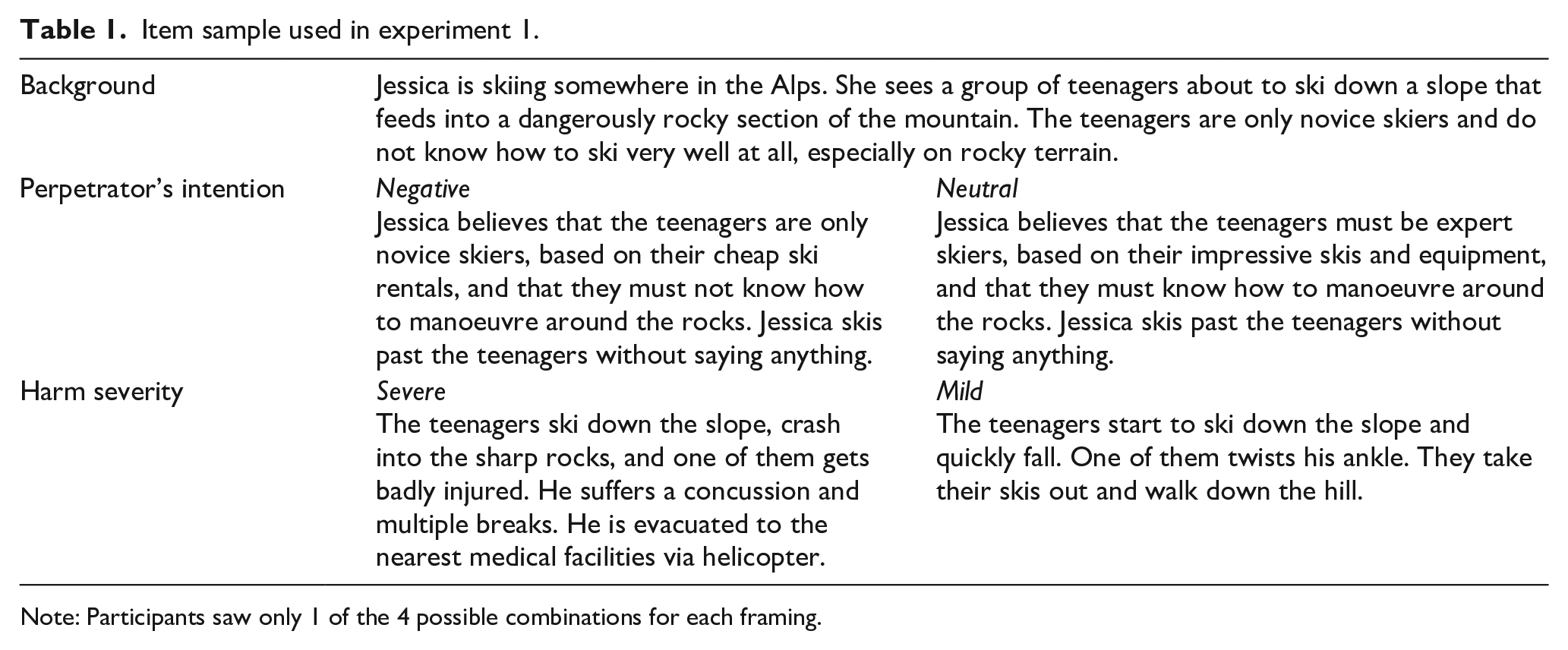
Note: Participants saw only 1 of the 4 possible combinations for each framing.
In addition, we measured participants’ reasoning style using a self-report questionnaire and a performance test. We used a short version of the Actively Open-Minded Thinking questionnaire (Baron et al., 2015) which asks participants to report on a 5-point Likert-type scale (ranging from 1, Strongly Disagree, to 5, Strongly Agree) how much they agree with 8 statements such as “changing your mind is a sign of weakness” (Cronbach’s α = 0.73). Participants also completed the Cognitive Reflection Test, which includes short problems which all have an appealing but incorrect response that participants have to inhibit to give the correct response (for example, “if it takes 5 machines 5 minutes to make 5 widgets, how long would it take 100 machines to make 100 widgets?”). We used the 3 original items (Frederick, 2005) as well as 4 additional items (Thomson & Oppenheimer, 2016). Item scores were summed up separately for each test.
Stimuli validation
A pilot experiment was run on 14 participants on the Amazon Mechanical Turk service to determine the perceived severity of harm associated with the 8 framings adapted from the literature. The pretest revealed a significant difference in judgement of harm severity between the “mild” and “severe” harm conditions across items, F(1,13) = 34, p < .001, η2 partial = 0.72. Importantly, ratings of harm severity were not influenced by intent, F(1,69) = 0.23, p = .64, η2 partial = 0.003. The descriptive statistics for the “mild” and “severe” harm conditions by item are presented in supplementary results.
Procedure
Participants completed the moral judgement task and the reasoning measures as described below. Half of the participants started with the moral judgement task (the modest impact of task order on moral judgement of intentional harm is presented in supplementary results S5). In this task, participants were presented with 2 items per condition for a total of 8 items per participant. Participants’ judgements were assessed immediately following the presentation of an item. The presentation of items was pseudo-randomised: the association between framing and condition (which defines an item) varied between subjects. For example, some participants were presented with the “sandwich” framing under the “intentional-severe” condition whereas others were presented with the “sandwich” framing under the “intentional-mild” condition. In addition, the temporal sequence of the 8 items presented to participants was fully randomised. However, question order was fixed across items and participants.
Data analysis
Statistical analysis was performed using linear mixed models using the lmerTest package (Bates et al., 2015) implemented in R. For each moral evaluation (acceptability, punishment, and blame), we build a model with intent (intentional versus accidental) and harm severity (mild versus severe) as fixed factors and we optimised the random structure. Since the variance explained by the random effects was large enough, we opted for the use of mixed models instead of an ANOVA. The full model was:
In preregistered exploratory analyses, we determined whether reasoning style interacted with intent or harm severity when making a moral judgement of acceptability, punishment or blame. We used a composite score of the AOT and CRT tests as a proxy for “reasoning style.” We first rescaled each AOT and CRT scores (range = 0 to 1) and then averaged the rescaled scores which led to a reasoning score (Internal consistency was high: α = 0.73). Higher score is indicative of a more deliberative style whereas lower score reflects a more intuitive style. We added “reasoning style” as a fixed factor to the full model while using the same random structure (no convergence issues were encountered after adding this factor).
Results and discussion
Across moral evaluations, we found a significant main effect of harm severity and intent on moral acceptability. Intentional harm was rated, as expected, as less acceptable than accidental harm (b = –2.55, SE = 0.27, p < .001) and severe harm was rated as less acceptable than mild harm (b = –0.23, SE = 0.082, p = .0046) (Figure 1, left panel). Harm severity did not significantly interact with intent (b = –0.017, SE = 0.12, p = .88).
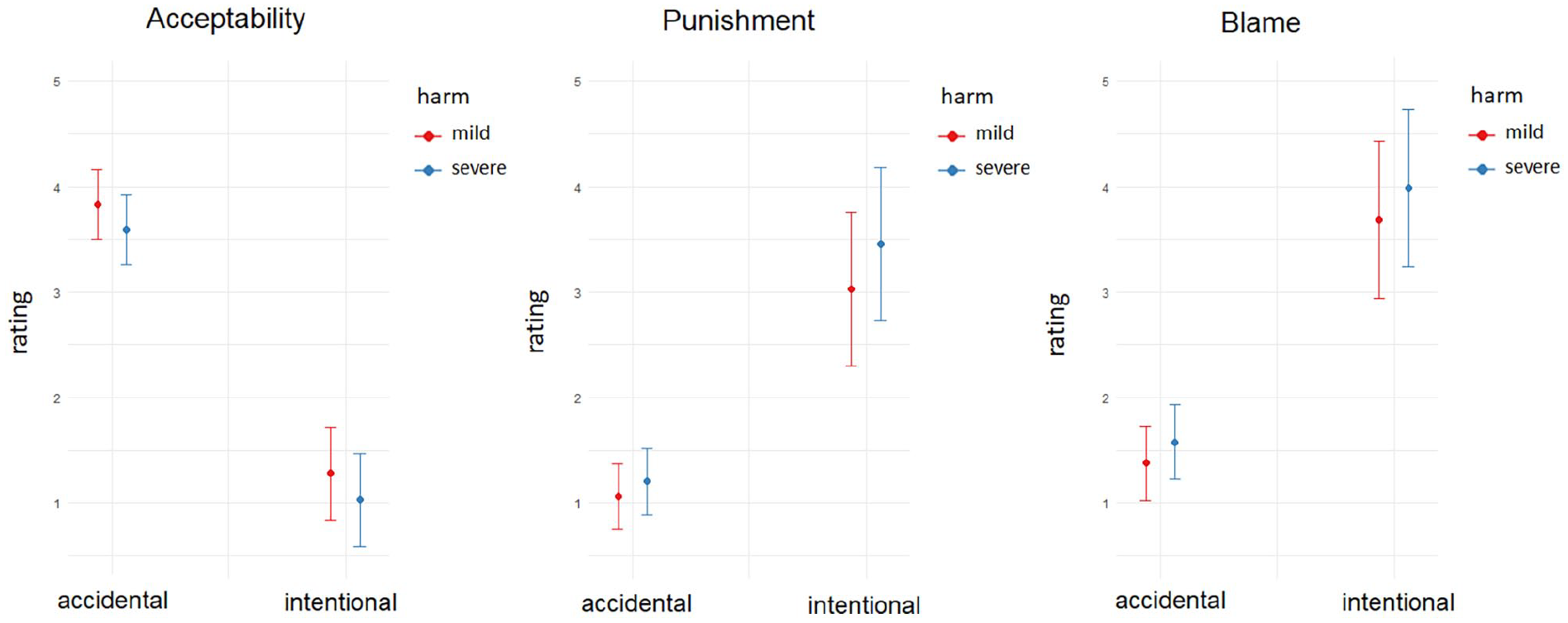
Moral judgement as a function of harm severity and intention to harm (Experiment 1). Judgements reported on a scale from 0 to 6.
Punishment decisions were also more severe for intentional harm relative to accidental harm (b = 1.97, SE = 0.30, p < .001). Harm severity was marginally significant, with greater punishment following severe as compared to mild harm (b = 0.14, SE = 0.081, p = .083) (Figure 1, central panel). Interestingly, harm severity interacted with intent (b = 0.28, SE = 0.12, p = .015). While agents were punished more severely for severe harm than for mild harm in the case of intentional transgressions, t.ratio(1330) = 5.19, p < .001, this was not the case for accidents, t.ratio(1330) = 1.74, p = .31.
Finally, judgements of blame were influenced both by intent and harm severity (Figure 1, right panel). Intentional harm was judged more blameworthy than accidental harm (b = 2.3, SE = 0.32, p < .001), and blame was higher following severe as compared to mild harm (b = 0.20, SE = 0.091, p = .030). The interaction was not significant (b = 0.092, SE = 0.13, p = .44).
Effect of reasoning style on moral judgement
In exploratory analyses (Figure 2), we found that reasoning style modulated the role of intent and harm severity in moral judgement. First, a more deliberative style was associated with (i) higher acceptability overall (b = 1.69, SE = 0.53, p = .0016), (ii) reduced punishment overall (b = –2.19, SE = 0.48, p < .001), and (iii) reduced blame overall (b = –1.60, SE = 0.52, p = .0023). Second, reasoning style interacted with intent for judgements of acceptability, with reduced acceptability of intentional harm relative to accidental harm in participants with a more deliberative style (b = –3.06, SE = 0.71, p < .001). Reasoning style further interacted with intent and harm severity for acceptability ratings (b = 1.58, SE = 0.73, p = .031). Post hoc pearson’s correlations revealed that a more deliberative style was associated with higher acceptability of accidents in case of both mild harm (r = 0.17, p < .001) and severe harm (r = 0.12, p = .012), while it was associated with reduced acceptability of intentional harm following mild harm (r = –0.16, p < .001), but not severe harm (r = –0.046, p = .33).

Contribution of reasoning style to moral judgement of intentional and accidental harm for different harm severity levels (Experiment 1). Judgements reported on a scale from 0 to 6.
In brief, the present results suggest that moral judgement was influenced by both the agent’s intent and the severity of outcome. Participants were overall harsher for severe harm, and punishment following severe harm was especially harsher when the agent had a negative intention towards the victim. Reasoning style also modulated judgements of moral wrongness and punishment. People with a more intuitive reasoning style were overall harsher than people with a more deliberative style. Importantly, judgement of acceptability in deliberative reasoners was more sensitive to the agent’s intention.
Experiment 2: outcome severity and positive intention in the judgement of accidental harm
In experiment 2, we specifically focused on accidental harm. We determined the extent to which harm severity and the perpetrator’s intention towards the victim moderated moral judgement of accidental harm. While manipulating intent in experiment 1 (negative or no intent) led to contrast accidental to intentional harm scenarios, we included a positive intent versus neutral in experiment 2. Based on the two-process model of moral judgement, we reasoned that the cognitive tension would be the strongest in case of severe accidental harm preceded by a positive intention towards the victim. In this case, the outputs of the intent-based and outcome-based processes may be most polarised, with more severe harm leading to harsher judgement, and a more positive intention leading to more forgiveness.
Method
Sample size rationale
Using the same a-priori power analysis as in experiment 1, the required sample size was 210 participants.
Participants
We recruited participants aged 18 or older living in the United Kingdom. Participants were invited to complete an online survey on the Prolific service and paid £1 upon completion. Four participants who did not complete the survey or failed attention checks were excluded from analysis. The final sample included 210 participants (mean age = 34.82 ± 13.27, 145 females).
Material
We used 4 short stories featuring accidental moral transgressions adapted from Young and colleagues (2007), and partially overlapping with these used in experiment 1. We used a 2 × 2 within-subject design with intention (positive/neutral) and outcome (mild/severe) as categorical factors. This led to 4 conditions: positive intention—severe harm; positive intention—mild harm; neutral intention—severe harm; neutral intention—mild harm (see Table 2 for an example of a framing leading to 4 possible items; full description of the scenarios and conditions is displayed in Supplementary Materials S2). We also used the same reasoning measures and generated a “reasoning style” composite score as in experiment 1.
Item sample used in experiment 2.
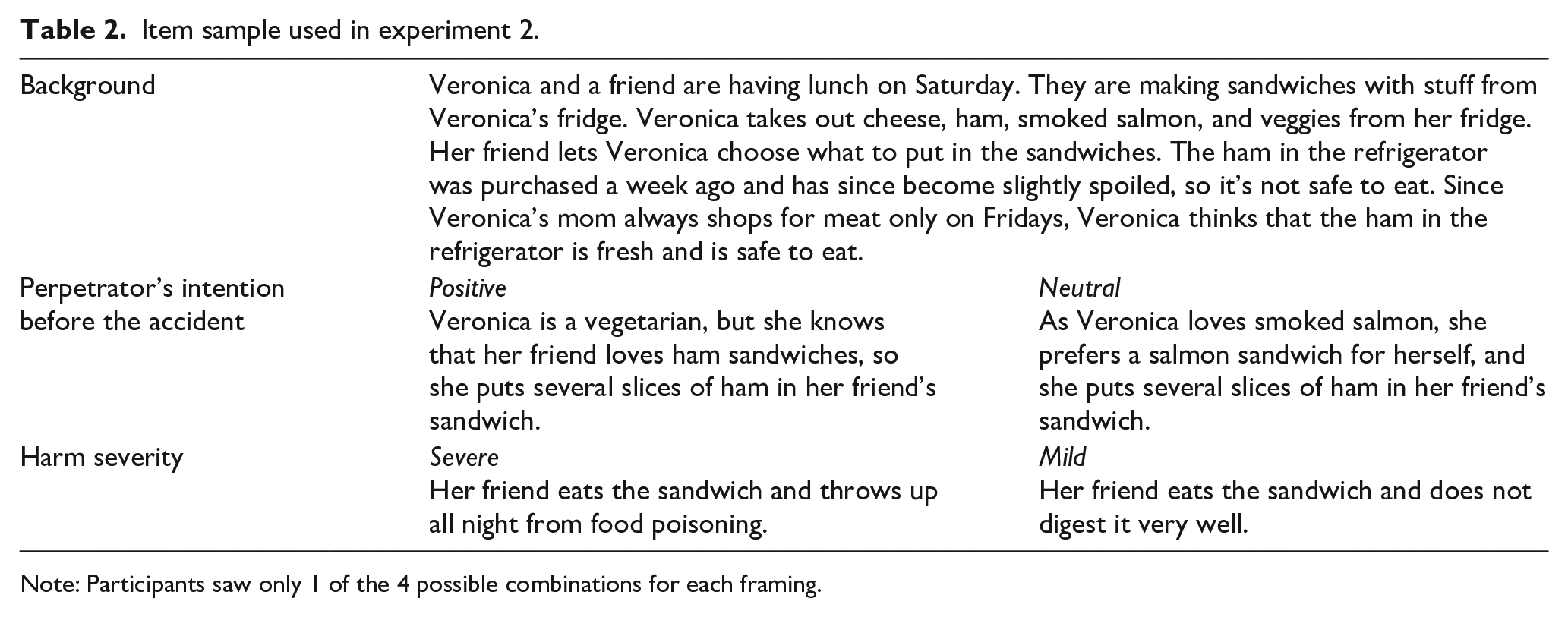
Note: Participants saw only 1 of the 4 possible combinations for each framing.
Stimuli validation
Pilot experiments were run on the Prolific platform to determine both the perceived severity of harm and the intention valence associated with each framing (descriptive statistics are included in Supplementary Tables S2 and S3). Participants were presented with one combination of intention by harm severity for each framing. We selected 4 of the 8 pretested items for the final experiment. The descriptive statistics, including mean ratings of harm severity, intention, and negligence of the perpetrator are presented in supplementary results. All selected items showed a significant difference in judgement of harm severity between the “mild” and “severe” harm conditions (all Ts > 3.2, all ps < 0.003) as well as a significant difference in judgement of intention between the neutral and positive intention conditions (all Ts > 2.27, all ps < 0.03). For the sake of completeness, we explored whether harm severity interacted with ratings of intention, and whether the intention interacted with ratings of harm severity. Intention valence influenced ratings of harm severity for one item in the mild harm condition (T = 5.16, p < .001), with harm rated as milder in the positive intention condition as compared to the neutral intention condition, and for another item in the severe harm condition (T = –2.48, p = .025), with harm rated as more severe in the positive intention condition. Finally, harm severity influenced ratings of intention for one item in the positive intention condition (T = –4.10, p < .001), with intention rated as more positive in the mild harm condition relative to the severe harm condition.
Procedure
The procedure for experiment 2 was the same as in experiment 1, except that participants were presented with 1 item per condition for the moral judgement task of experiment 2.
Data analysis
Similar to experiment 1, we implemented linear mixed models with intent (positive versus neutral) and harm severity (mild versus severe) as fixed factors and we optimised the random structure. The full model was:
We ran the same type of exploratory analyses as in experiment 1 to determine the effect of reasoning style on moral judgement. Internal consistency among items of the “reasoning style” measure was high (α = 0.75).
Results and discussion
Both intent and harm severity influenced judgements of acceptability, punishment, and blame of accidental harm. The agent’s behaviour was rated as less acceptable following severe harm relative to mild harm (b = –0.40, SE = 0.15, p = .0059), and more acceptable when the accident was preceded by a positive intention towards the victim (b = 0.50, SE = 0.13, p < .001) (Figure 3, left panel). The intent by harm interaction was marginally significant (b = –0.37, SE = 0.19, p = .050): relative to a neutral intention, a positive intention increased acceptability of mild harm, t.ratio(416) = 3.74, p = .0012, but not severe harm, t.ratio(416) = –0.97, p = .77.

Moral judgement as a function of harm severity and the agent’s intention towards the victim prior to the accident (Experiment 2). Judgements reported on a scale from 0 to 6.
Punishment and blame judgements were also harsher following severe harm as compared to mild harm (punishment: b = 0.63, SE = 0.12, p < .001; blame: b = 0.54, SE = 0.15, p < .001), and more lenient when harm was preceded by a good intention towards the victim (punishment: b = –0.43, SE = 0.12, p < .001; blame: b = –0.48, SE = 0.15, p = .0014) (Figure 3, central and right panels). The interaction of intent with harm severity was marginally significant for blame judgements (b = 0.37, SE = 0.21, p = .074). Post hoc analyses revealed that mild harm was judged less blameworthy when preceded by a good intention relative to the neutral condition, t.ratio(415) = 3.21, p = .0077, but this was not the case of severe harm, t.ratio(415) = 0.68, p = .90.
Effect of reasoning style on moral judgement
Finally, planned exploratory analyses (Figure 4) revealed that reasoning style did not modulate acceptability of the agent’s behaviour (b = 0.33, SE = 0.70, p = .64), but modulated decisions of blame and punishment. Punishment was overall less severe in participants with a more deliberative reasoning style (b = –1.71, SE = 0.62, p = .0057). In addition, reasoning style interacted with intent and harm severity to determine blame judgements. Participants with a more deliberative style judged the agent’s behaviour less blameworthy when the agent had a positive intention towards the victim relative to a neutral intention (b = –2.44, SE = 0.85, p = .0044), and the triple interaction (b = 3.40, SE = 1.20, p = .0050) revealed that this was especially the case for mild harm (r = –0.17, p = .012), but not severe harm (r = 0.022, p = .75). In absence of a positive intention towards the victim, reasoning style did not influence blame of mild harm (r = 0.063, p = .36), or severe harm (r = –0.06, p = .37).

Contribution of reasoning style to moral judgement of accidental harm (Experiment 2). Judgements reported on a scale from 0 to 6.
In sum, judgement of accidental harm was influenced both by outcome severity and the presence of a positive intention towards the victim. More specifically, more lenient judgement was observed when the agent was responsible for mild harm and when harm was preceded by a good intention towards the victim. A more deliberative style was associated with more lenient judgements of punishment overall, and more deliberative participants were especially sensitive to the agent’s intention in the case of mild harm.
General discussion
The goal of the present study was to investigate how reasoning style (i.e., whether people are generally prone to deliberation when making decisions or by contrast make fast decisions by relying on their intuition) modulates the contribution of harm severity and intention to third-party judgement of moral transgressions. In two experiments, we manipulated harm severity (mild versus severe) and intention (negative versus neutral in experiment 1; positive versus neutral in experiment 2) and determined the involvement of individual differences in reasoning style. In keeping with the literature, harm severity moderated moral judgement of intentional and accidental harm. Moreover, the behaviour of the accidental transgressor was judged more acceptable, less punishment-deserving and less blameworthy when the perpetrator had a positive intention towards the victim relative to a neutral intention. The perpetrator’s intention towards the victim further interacted with harm severity to shape moral judgements: Reduced harm severity was associated with less punishment when the perpetrator’s intention was negative, but not neutral (experiment 1). Reduced harm severity was additionally associated with higher acceptability and lower blameworthiness when the perpetrator’s intention was positive, but not neutral (experiment 2). Importantly, moral judgement was modulated by reasoning style, in the sense that a more deliberative style was associated with more forgiveness of perpetrators, especially following accidents, and even more so when mild accidental harm was preceded by a positive intention towards the victim.
Deliberative reasoners are more forgiving, especially of well-intentioned accidental transgressors
The major finding of this study is the effect of reasoning style on judgement of moral transgressions. Research using moral dilemmas has previously pointed to reasoning style as a moderator of utilitarianism (Bartels, 2008) and others have shown that taxing cognitive resources reduces utilitarianism (Greene et al., 2008; Suter & Hertwig, 2011; Trémolière et al., 2012). Here, by simultaneously manipulating intent and harm severity, we show that reasoning style influences the processing of the perpetrator’s positive and negative intentions. People with a more intuitive reasoning style were harsher than people with a more deliberative style, and the difference was more pronounced for the judgement of accidents, and when accidental harm was preceded by a positive intention. These results complement those from Patil and Trémolière (2021) by showing that the effect of reasoning style on moral judgement persists even when contextual moderators are manipulated. First, the effect of reasoning style on intent-based considerations is not limited to negative intention but applies to both positive and negative intentions. These findings are consistent with the idea that more careful deliberation is associated with more intent-based moral judgement which results in more forgiveness of accidents. It is also possible that more deliberative people are better at recognising the perpetrator’s intention implied in the scenarios. Drawing a parallel between the two-process model of moral judgement (Cushman, 2008) and dual process theories of reasoning (Evans, 2003), we could suggest from research on the psychology of reasoning (Verschueren et al., 2005) that more deliberative people may engage more in the search for alternative explanations about the occurrence of an event. In the moral judgement field, Russell & Giner-Sorolla (2011) indeed found that after reading potential explanations about the harm inflicted to a victim, participants reported less anger at agents involved in harmful moral transgressions (Russell & Giner-Sorolla, 2011). In the specific context of accidental harm, we speculate that people more prone to deliberation may engage more in the search for mitigating circumstances that can exonerate the (well-intentioned) perpetrator.
Second, the present study shows that reasoning style modulates the contribution of harm severity to moral judgement of accidental harm. We could have expected differences in reasoning style to polarise judgements of severe harm, a situation that might invoke greater cognitive tension in judges (although note that the outcome effect in the present study is smaller than in previous studies, see supplementary discussion). More specifically, more deliberative reasoners could have been more forgiving of accidental transgressors than more intuitive reasoners especially following the severe harm.
Surprisingly, in Experiment 2, the increased forgiveness of accidents in more deliberative people was more pronounced for mild accidental harm, that is, for a situation that presumably generates less cognitive tension than severe accidental harm. Speculatively, we suggest that processing harm severity might start before processing intentionality. Following mild harm, people used to engage in deliberation can do so more easily and process intentionality more extensively than following accidental harm, because the emotional load generated by severe harm might limit the intent-based analysis. In other words, there might be a “harm severity threshold” beyond which reasoning style contributes less to the judgement of accidental moral transgressions. Alternatively, mild harm could be regarded as more “avoidable” or predictable than severe harm, and thus more deliberative people may attribute more blame to the perpetrator for failing to predict the negative consequences of their behaviour. Another explanation would be that more deliberative people are more sensitive to mild harm, and thus a mild accidental harm can generate greater cognitive tension in these people as compared to more intuitive people. These hypotheses need to be explored directly in future research.
When innocent intentions are not enough to exculpate the perpetrator
This points us to one of the limitations of our study: we did not control for the perpetrator’s negligence in experiments 1 and 2, only controlling for negligence in the stimuli validation of experiment 2. The notion of negligence complements the notion of intentionality and is especially relevant for accidental harm (Cushman, 2015; Margoni et al., 2019; Mulvey et al., 2020; Shultz & Wright, 1985). The absence of negative intention towards the victim, or the presence of a positive intention preceding the accident, is not always sufficient to exculpate the perpetrator from responsibility. Higher propensity to see the perpetrator as negligent is associated with harsher punishment following accidental harm (Nobes & Martin, 2021; Shultz & Wright, 1985), and interferes with the intent-based judgement of the perpetrator. In contrast, when information is given about the carefulness of the accidental transgressor, punishment is less severe (Nobes & Martin, 2021; Nobes et al., 2017). Importantly, the victim’s negligence in case of accidental harm is also a moderator of moral judgement (Mulvey et al., 2020). Although the two-process theory does not make a clear prediction about how people attribute negligence, the path model theory of blame judgement (Malle et al., 2014) suggests that judges determine two related elements following accidental harm: the perpetrator’s obligation to foresee the negative outcome (for instance, due to its social rank) (Monroe & Malle, 2017) and the predictability of the outcome (Margoni & Surian, 2021; Monroe & Malle, 2017). Predictability of the outcome may consist in an objective probability assignment (i.e., the objective likelihood of an event) and in a subjective probability assignment (i.e., how much participants think that the agent had good reasons to believe an event would occur). Recent findings suggest that wrongness, blame, and punishment judgements of accidental harms are highly sensitive to negligence attributions (Kneer & Machery, 2019) even when the information is not explicitly stated (Nobes & Martin, 2021). An additional study revealed a more complex pattern, whereby different types of judgement were differently influenced by negligence attribution (Kneer & Skoczen, 2021). As for blame judgements, the mediating effect of negligence was found to depend on subjective probability assignment. As for punishment judgements, they were partially mediated by objective probability assignment (Kneer & Skoczen, 2021). Future studies may test whether the reasoning style has an influence on the perception of obligation and predictability, and whether the tendency of more deliberative reasoners to forgive accidental transgressors more than intuitive reasoners is maintained when information about the perpetrator’s and the victim’s negligence and objective/subjective probability is taken into account. Note that a within-subject design aimed at fostering reflective deliberation by allowing positive and negative outcome comparisons has shown that all types of judgement remain constant (Kneer & Machery, 2019).
Intention valence impacts the weight of intent-based analysis
Interestingly, the present experiments also echo past investigations showing that the valence of the perpetrator’s intention influences the weight intent has on moral judgement. It has been found that negative intentions preceding bad outcomes seem to matter more than positive intentions preceding bad outcomes (Cushman et al., 2009; Hamlin & Baron, 2014; Nobes et al., 2009). Here, information about a positive versus neutral intention seems relevant only when the accidental harm was mild, while the perpetrator’s positive intention did not matter in case of severe accidental harm. This result was not modulated by reasoning style. In contrast, information about the negative versus. neutral intention influenced judgement of both mild harm and severe harm. This result supports the idea that knowledge about a negative intention towards the victim may orient moral judgement more markedly than knowledge about a positive intention (Knobe, 2003; Nobes et al., 2009), perhaps due to a salience effect (Nobes et al., 2017). Harmful intentions may be more salient than positive intentions, presumably because individuals expect agents to behave with good intentions in a default world (Levine et al., 2018). Put differently, a positive intention may be seen as a norm, while a negative intention may be seen as deviating from this norm. A complementary explanation to this asymmetry may be that people are biased in their attribution of agency: negative intentionality is attributed more easily following negative outcomes than positive intentionality is following positive outcomes (Hamlin & Baron, 2014; Morewedge, 2009). More generally, these results further suggest a dynamic interaction between the intent-based and outcome-based processes of moral judgement, rather than a parallel functioning of these two processes.
Theory of mind ability, executive functions, and intent-based analysis
Our discussion underlines the complexity of intent-based analysis, which is also tightly related to the perpetrator’s mental state analysis. Since we did not control for theory of mind (ToM) abilities, we cannot determine whether part of the variance explained by reasoning style was mediated by ToM abilities, or whether reasoning style can modulate the engagement of ToM for the judgement of perpetrators. However, the literature suggests that mentalizing is another individual disposition that likely contributes to intent-based analysis. Deficits in ToM abilities have been to some extent associated with atypical moral judgement of accidents. For example, individuals with autism who show socio-cognitive deficits are more severe towards the perpetrator of accidental harm than neurotypical individuals (Moran et al., 2011; Patil & Silani, 2014), although this may be more related to a reduced empathic response (Patil & Silani, 2014). In this clinical population, the neural encoding of intent in one of the key ToM brain regions, namely, the right temporo-parietal junction (Molenberghs et al., 2016) further turns out to be atypical (Koster-Hale et al., 2013). However, other work in this population suggests a more nuanced view over the ability to make intent-based moral judgements (Dempsey et al., 2020). Another type of evidence highlighting the involvement of ToM mechanisms in moral judgement comes from brain stimulation studies in neurotypical individuals: an artificial disruption of the right temporo-parietal junction interferes with intent-based moral judgement (Young, Camprodon, et al., 2010). In addition, individual differences in the activation of the right temporo-parietal junction are associated with the attenuation of accidental harm judgement severity (Young & Saxe, 2009), suggesting that accidental harm judgement stem from integration of the reasoning on agent’s innocent thoughts, beliefs, and desires about the current action.
In parallel, another line research suggests that the difficulty to integrate the agent’s intention to moral judgement of accidental harm, as reported in different populations, may actually be due to executive function deficits. For example, the decline of executive functions in older adults seems to lead to less intent-based moral judgement and greater severity towards the perpetrator of accidental harm as compared to younger adults (Margoni et al., 2018; Moran et al., 2012). In addition, the more “outcome-based” moral judgement of accidental harm in children with autism may be explained by deficits in executive function skills (Margoni et al., 2019). An increase in outcome-based moral judgement of accidental harm has also been evidenced when taxing participants’ cognitive resources (Buon et al., 2013; Martin et al., 2021). This set of studies highlight the contribution of executive functions, or at least cognitive resources, to intent-based moral judgement. Since the contribution of executive functions to ToM development has been evidenced (Wade et al., 2018; Zelazo et al., 1996), future studies may test whether executive function skills independently of ToM skills, or in synergy with ToM skills, allow to reach and maintain mature intent-based moral judgement.
Reasoning style and types of moral evaluations
It has been proposed that distinct moral evaluations are based on different processes. According to the two-process model, judgements of wrongness are based on intent, while judgements of blame and punishment are based on intent and outcome (Cushman, 2008). While the two-process model does not make a distinction between blame and punishment, some authors have suggested that the punishment is a “social function” that is based on blame judgement (Malle, 2021). Others have found that blame judgements are less sensitive to outcome than punishment judgements (Kneer & Machery, 2019; Nobes & Martin, 2021). The present study reveals similar patterns of evaluations for acceptability (or wrongness) of the agent’s behaviour, punishment, and blame. In experiment 1 contrasting intentional to accidental harm, all three moral evaluations were largely influenced by intent, and less so by harm severity. In experiment 2, all three moral evaluations were influenced as much by intent (positive versus neutral) as by harm severity. Therefore, our results do not seem to support the prediction made by the two-process model that judgements of wrongness are mostly intent-based and as such differ from blame and punishment judgements (Cushman, 2008). However, the finding of a similarity across types of moral evaluations is in line with other studies (Barbosa & Jimenez-Leal, 2017; Gino et al., 2010). For example, Gino et al. (2010) found that the presence of a positive outcome reduces the perceived wrongness of an action, thus showing that wrongness judgement is not exclusively based on intent. Yet, we should mention a limitation with that regard: the order of moral evaluations was not manipulated between subjects, and participants always reported their rating of acceptability before punishment and blame. Since question order was not counterbalanced, we were not able to fully test the predictions made by the two-process model. It is possible that thinking about moral acceptability increases the focus on intent, thus biasing participants’ reports of punishment and blame. Similarly, thinking about deserved punishment before blame may increase the focus on outcome at the time participants are making blame judgement.
Investigating the role of reasoning style on moral judgement did not support the idea of a dissociation between wrongness judgement and judgements of blame or punishment. Given that more deliberative reasoners were overall more sensitive to intent, the two-process model would have predicted a stronger effect of reasoning style on acceptability judgement as compared to blame and punishment judgements. It is true that in experiment 1, judgements of acceptability were more dependent upon intent in more deliberative reasoners, while this was not the case for punishment and blame judgement, for which deliberative reasoners were overall more forgiving regardless of intent. Experiment 1 alone may have to some extent supported the two-process view. However, this did not hold in experiment 2: reasoning style modulated the effect of intent on blame (more deliberative reasoners attributed less blame to a well-intentioned perpetrator only), but reasoning style did not affect the weight of intent on acceptability judgements. Based on the present findings and its limitation regarding question order, we refrain from concluding that some moral evaluations are more based on intent or on outcome than others.
Some of the inconsistencies between studies regarding the (di) similarities between moral evaluations might be attributed to the social relationship between the agent and victim. Indeed, permissibility and obligations vary depending on the agent’s and victim’s identity and relationship to one another, and this might differentially influence moral evaluations. For example, it was found that wrongness judgements are more dependent upon the social relationship than punishment (Linke, 2012). The present study did not manipulate the relationship between the protagonists, which in some cases knew each other (neighbours, classmates, friends) and in some cases not (client and customer, anonymous driver and pedestrian). Future studies can inform the impact of reasoning style on distinct moral evaluations depending on contextual factors such as the protagonists’ social relationship to one another. Finally, similarities or differences between the types of moral evaluations may also be influenced by outcome valence: in the present study, the outcome was always negative. Are wrongness judgements influenced by intent to the same extent as punishment judgement following a positive outcome? Future studies may test whether reasoning dispositions modulate praise judgements as much as blame or punishment judgements.
Conclusion
The present study complements the two-process view of moral judgement by providing an insight on how individuals deal with the cognitive tension triggered by accidental harm. The findings indeed demonstrate that reasoning style interacts with intent and harm severity to influence judgement of accidents. Because research on third-party moral judgement may have implications for the justice system, it seems crucial that professionals of the justice system and members of juries are aware of the potential influence of reasoning style on verdict preferences.
Supplemental Material
sj-docx-3-qjp-10.1177_17470218221089964 – Supplemental material for Judging accidental harm: Reasoning style modulates the weight of intention and harm severity
Supplemental material, sj-docx-3-qjp-10.1177_17470218221089964 for Judging accidental harm: Reasoning style modulates the weight of intention and harm severity by Flora Schwartz, Hakim Djeriouat and Bastien Trémolière in Quarterly Journal of Experimental Psychology
Supplemental Material
sj-docx-4-qjp-10.1177_17470218221089964 – Supplemental material for Judging accidental harm: Reasoning style modulates the weight of intention and harm severity
Supplemental material, sj-docx-4-qjp-10.1177_17470218221089964 for Judging accidental harm: Reasoning style modulates the weight of intention and harm severity by Flora Schwartz, Hakim Djeriouat and Bastien Trémolière in Quarterly Journal of Experimental Psychology
Supplemental Material
sj-docx-5-qjp-10.1177_17470218221089964 – Supplemental material for Judging accidental harm: Reasoning style modulates the weight of intention and harm severity
Supplemental material, sj-docx-5-qjp-10.1177_17470218221089964 for Judging accidental harm: Reasoning style modulates the weight of intention and harm severity by Flora Schwartz, Hakim Djeriouat and Bastien Trémolière in Quarterly Journal of Experimental Psychology
Research Data
sj-R-6-qjp-10.1177_17470218221089964 – Supplemental material for Judging accidental harm: Reasoning style modulates the weight of intention and harm severity
Supplemental material, sj-R-6-qjp-10.1177_17470218221089964 for Judging accidental harm: Reasoning style modulates the weight of intention and harm severity by Flora Schwartz, Hakim Djeriouat and Bastien Trémolière in Quarterly Journal of Experimental Psychology
Research Data
sj-R-7-qjp-10.1177_17470218221089964 – Supplemental material for Judging accidental harm: Reasoning style modulates the weight of intention and harm severity
Supplemental material, sj-R-7-qjp-10.1177_17470218221089964 for Judging accidental harm: Reasoning style modulates the weight of intention and harm severity by Flora Schwartz, Hakim Djeriouat and Bastien Trémolière in Quarterly Journal of Experimental Psychology
Research Data
sj-xlsx-1-qjp-10.1177_17470218221089964 – Supplemental material for Judging accidental harm: Reasoning style modulates the weight of intention and harm severity
Supplemental material, sj-xlsx-1-qjp-10.1177_17470218221089964 for Judging accidental harm: Reasoning style modulates the weight of intention and harm severity by Flora Schwartz, Hakim Djeriouat and Bastien Trémolière in Quarterly Journal of Experimental Psychology
Supplemental Material
sj-xlsx-2-qjp-10.1177_17470218221089964 – Supplemental material for Judging accidental harm: Reasoning style modulates the weight of intention and harm severity
Supplemental material, sj-xlsx-2-qjp-10.1177_17470218221089964 for Judging accidental harm: Reasoning style modulates the weight of intention and harm severity by Flora Schwartz, Hakim Djeriouat and Bastien Trémolière in Quarterly Journal of Experimental Psychology
Footnotes
Acknowledgements
The authors thank Indrajeet Patil for his feedback on a previous version of this manuscript.
Declaration of conflicting interests
The author(s) declared no potential conflicts of interest with respect to the research, authorship, and/or publication of this article.
Funding
The author(s) disclosed receipt of the following financial support for the research, authorship, and/or publication of this article: This work was supported by an ANR grant to B.T. (ANR-19-CE28-0002).
Data accessibility statement
The data and materials from the present experiment are publicly available at the Open Science Framework website: experiment 1: https://osf.io/jy6ud, experiment 2: 
References
Supplementary Material
Please find the following supplemental material available below.
For Open Access articles published under a Creative Commons License, all supplemental material carries the same license as the article it is associated with.
For non-Open Access articles published, all supplemental material carries a non-exclusive license, and permission requests for re-use of supplemental material or any part of supplemental material shall be sent directly to the copyright owner as specified in the copyright notice associated with the article.
