



Abstract
In two written sentence completion experiments, I tested whether the choice of nominative and topic markers is subserved by the same mechanisms as anaphor choice and referent choice in Korean. I found that morphological marker choice was sensitive to various factors including connective, grammatical role, and verb semantics, whereas anaphor choice was sensitive only to grammatical role. I also found that morphological marker choice did not systematically vary with verb semantics unlike referent choice. These findings reveal two important properties of referential form production. One is that morphological marker choice relies on different mechanisms than underlie anaphor choice and referent choice. Another is that connective plays a significant role in determining referential form. Despite its role in referent choice and pronoun comprehension, connective has received little attention in current models of referential form production. The current study is the first to systematically test the effect of connective on referential form choice and to demonstrate its effect on morphological marker choice. By revealing how morphological marker choice is related to anaphor choice and referent choice, and identifying the factors that influence morphological marker choice, the results of the study improve our theoretical understanding of morphological marker production and reference production.
Language use typically involves repeated references to previously mentioned referents. When a speaker has decided to mention a certain referent, how does he or she refer to the referent? For example, to refer back to Ana in Ana cleaned up with Liz, the speaker can use the proper name Ana or the pronoun she. This question is further complicated in languages like Japanese and Korean, which employ not only different anaphoric expressions but also different morphological markers on a noun phrase (pronominal or not). The proper name Ana in subject position can occur with a topic marker (nun in Korean, wa in Japanese) or a nominative marker (ka in Korean, ga in Japanese). Although the choice of morphological marker is an important aspect of reference production in languages such as Japanese and Korean, it has received little attention in the psycholinguistic literature. The present study aims to shed light on how the choice of morphological marker, namely the choice between nominative and topic markers, fits into reference production by investigating how it is related to anaphor choice and referent choice.
There are different views on how the choice of morphological marker is related to anaphor choice in Japanese and Korean. 1 One view is that speakers choose a morphological marker using the same mechanisms they use for choosing an anaphoric expression. In particular, Hinds (1983) suggests that both anaphor choice and morphological marker choice are driven by referent continuity or identifiability in Japanese. Following Givón (1983), he measured referent continuity using the number of clauses intervening between two mentions of a referent (referential distance) and the number of consecutive clauses in which a referent was maintained in subsequent discourse (referential persistence). He then analysed how anaphor choice and morphological marker choice were correlated with the two measurements. He found that zero pronouns were used for the most continuous referent with the minimum distance and the highest persistence, whereas full noun phrases were used for the least continuous referent with the maximum distance and the lowest persistence (see Clancy, 1980; Givón, 1983; M. O. Hwang, 1983, for similar findings). Similar to anaphor choice, the choice of nominative and topic markers was correlated with referent continuity. The nominative marker ga was used for the least continuous referent, while the topic marker wa was used for a more continuous referent.
Consistent with Hinds’ (1983) findings for referential distance, much research shows that speakers tend to use reduced anaphoric expressions when the referent has been mentioned in the preceding sentence (e.g., Ariel, 1990; Arnold, 1998; Arnold et al., 2009; C. Brown, 1983). When the referent was mentioned in the preceding sentence, the use of reduced expressions is also sensitive to grammatical role (e.g., Brennan et al., 1987; Fukumura & van Gompel, 2010; Gordon et al., 1993; Kehler et al., 2008; Stevenson et al., 1994). For example, in (1a) a pronoun is the most natural way to refer to the subject referent Ana, while a name is more acceptable for the non-subject referent Liz.
(1) a. Ana sent a postcard to Liz, so . . . b. Liz received a postcard from Ana, so . . .
In line with the findings in English, recent evidence suggests that zero pronouns in languages such as Korean and Mandarin are also primarily used to refer to subject referents (e.g., H. Hwang, in press; H. Hwang et al., under revision).
Findings about referential persistence are mixed, however. It is well established that speakers tend to mention entities in certain thematic roles again. For example, in (1a) and (1b) which depict transfer events, speakers are more likely to continue with the goal referent Liz than the source referent Ana. Similarly, in (2a) and (2b) in which the stimulus referent is the assumed cause of the events (i.e., implicit causality), speakers are more likely to continue with the stimulus referent Ana than the experiencer referent Liz (e.g., Au, 1986; R. Brown & Fish, 1983; Crinean & Garnham, 2006; Ferstl et al., 2011; Hartshorne et al., 2015; Stevenson et al., 1994).
(2) a. Ana scared Liz, because . . . b. Liz feared Ana, because . . .
These biases towards certain thematic roles are closely tied to inter-sentential connectives or the coherence relations between the sentences (e.g., Au, 1986; Ehrlich, 1980; Garnham et al., 2021; Stevenson et al., 1994, 2000). The expectations of the goal reference in (1) and the stimulus reference in (2) are generated by the connective so in (1) and the connective because in (2) respectively. If the sentences in (1) continue with because, the preference for the goal is reduced. In (2), the experiencer is preferred when the sentences continue with so.
Yet there are mixed findings in the literature about whether referential persistence or the predictability of certain thematic roles (henceforth referential predictability) affects speakers’ choices of anaphors. For example, Rosa and Arnold (2017) found that English speakers used more pronouns when referring to the goal referent than the source referent in (1) (see also Arnold, 2001; Weatherford & Arnold, 2021). There are, however, numerous studies that found that referential predictability was unrelated to anaphor choice. For example, Fukumura and van Gompel (2010) found that English speakers did not use more pronouns for the stimulus referent than the experiencer referent in (2). Using both transfer and implicit causality (IC) verbs, H. Hwang et al. (under revision) found that predictability did not have a significant effect on overt and zero pronouns in Mandarin. These findings suggest that referential predictability may affect anaphor choice, but not as a single or consistent mechanism.
In contrast to the extensive literature on anaphor choice, morphological marker choice has received little attention in the psycholinguistic literature. To the best of my knowledge, there is no work that experimentally investigated how the factors that are suggested to affect anaphor choice, such as grammatical role and referential predictability, contribute to speakers’ decisions to use a nominative versus a topic marker in reference production. Thus, there is no direct evidence in the literature to support Hind’s (1983) claim that the choice of nominative and topic markers is guided by the same factors that guide anaphor choice.
In contrast to the view of Hinds (1983), another view is that anaphor choice and morphological marker choice are subserved by different mechanisms. Similar to Hinds (1983), Clancy and Downing (1987) assume that anaphor choice is sensitive to referent continuity or identifiability. In particular, they suggest that subject continuity (switch reference) plays an important role in determining the form of anaphoric expression. Speakers are more likely to use reduced forms when they maintain the same subject in an upcoming sentence than when they switch to a different subject. The frequent use of reduced forms to subject reference is in accordance with the grammatical role effect (e.g., Brennan et al., 1987; Fukumura & van Gompel, 2010; Gordon et al., 1993; Kehler et al., 2008; Stevenson et al., 1994). Clancy and Downing, however, suggest that important discourse characters tend to be mentioned with reduced forms even when they are not the subject of the preceding sentence. They assume that this is in part because important characters are likely to be re-mentioned and easily identifiable. This is in keeping with the predictability effect (e.g., Arnold, 2001; Rosa & Arnold, 2017; Weatherford & Arnold, 2021).
In contrast to anaphor choice, Clancy and Downing (1987) argue that morphological marker choice is not driven by referent continuity or identifiability. They analysed Japanese speakers’ use of nominative and topic markers in spoken narratives. They, however, did not find any evidence that referent continuity or identifiability played a role in morphological marker choice. For example, referents marked by wa were not more likely to be re-mentioned (predictable) than referents marked by ga, contrary to Hinds (1983).
Clancy and Downing (1987) instead suggest that morphological marker choice is sensitive to a relation between two or more discourse elements. This view fits well with the relational nature of morphological markers. They argue that wa is used to indicate a contrastive relation between the wa-bearing element and some other element (henceforth contrast account). It appears in varying degrees of contrastive contexts including those that describe parallel activities or states of two characters (3a), actions or states occurring in reaction to the preceding event or state (3b), events or states that contrast with the assumptions of the preceding event or state (3c), and transitions from one unit of discourse to another in (3d) (adapted from Clancy & Downing, 1987). Usages of Wa are underlined in (3) (3) a. Parallel activities/states Yuki and Sachi of snowman TOP nicely was-done but Taroo of snowman TOP be-destroyed-ended-up “ ruined.” b. Action/state reaction Hiroshikun no oshiro ga sugoku yoku dekita mon da kara, Hiroshi of castle NOM very well made because Taroo TOP that ACC kicking smash-end-up “Because Hiroshi’s castle is so nice, c. Indirect contrast (between a happy state of “play” and an unhappy state of “let go”) Yukichan wa suberidai de asondemashita kedo, Yuki TOP slide with was-playing but Yuki TOP sliding while balloon let-go-end-up “Yuki was playing on the slide. But while balloon.” d. Transitions of discourse (from description to opinion) Michi de ne, Hiroshikun ga asondeimasu kedo ne, de road on Hiroshi NOM playing is but and Hiroshi TOP there up-to probably tricycle on riding came is “Hiroshi is playing in the street, and
Among these uses of wa, Clancy and Downing suggest that parallel activities/states (3a) and action/state reaction (3b) exhibit a direct contrast between a wa-marked entity and another entity and account for most instances of was in their data. Parallel activities/states enumerates the opposing activities or states of two entities (e.g., Yuki and Sachi’s snowman vs. Taroo’s snowman in (3a)), which are often connected by an adversative connective such as “but.” This pattern typically involves wa-marking on both of the entities involved. Action/state reaction describes successive activities involving two different entities such as a cause-effect sequence, in which the action or state of the wa-marked entity is caused by the action of another entity (e.g., Hiroshi vs. Taroo in (3b)). Importantly, both patterns commonly involve a switch in subjects and switched subjects carry wa.
In sum, the contrast account suggests not only that morphological marker choice is subserved by different mechanisms from anaphor choice, but that a contrast relation between discourse elements plays an important role in determining the form of morphological marker.
The goal of the current study is to test the two competing accounts of morphological marker choice in two written story completion experiments. Morphological marker choice has not been experimentally investigated and evidence in support of either account comes from the analysis of spoken discourse that provides only correlational information. Thus, there is no conclusive evidence that could distinguish between the two accounts. Here, I aim to assess the validity of the two accounts by investigating how morphological marker choice is influenced by a contrast relation and the factors that are claimed to affect anaphor choice, namely, grammatical role and predictability. If speakers employ the same mechanisms for morphological marker choice and anaphor choice as suggested by Hinds (1983), I aim to determine whether morphological marker choice is sensitive to both grammatical role and predictability. If morphological marker choice is subserved by different mechanisms, I aim to establish whether the patterns of morphological marker choice can be accounted for by the contrast account as proposed by Clancy and Downing (1987).
Experiment 1
Experiment 1 tests the two accounts of morphological marker choice in contexts in which transfer verbs and IC verbs are followed by different connectives, namely, kulayse “so” and waynyahamyen “because” (4).
(4) a. Transfer verb item Minhuy-ka Sena-eykey yengswucung-ul cwuessta. Kulayse/Waynyahamyen Minhee-NOM Sunah-DAT receipt-ACC gave so/because “Minhee gave the receipt to Sunah. So/This was because” b. IC verb item Mihuy-ka Sena-lul mwusewuhayssta. Kulayse/Waynyahamyen Minhee-NOM Sunah-ACC feared so/because “Minhee feared Sunah. So/This was because”
These contexts provide a good testing ground for evaluating the validity of the two accounts for several reasons. First, these contexts include two characters that differ in not only grammatical role but also predictability depending on the connective (see the pretest below and Experiment 2). Cwuta “give” in (4a) is a source-goal transfer verb, which places the source referent (e.g., Sunah) in subject position and the goal referent (e.g., Minhee) in non-subject position. When these verbs are combined with the connective kulayse “so,” the goal referent is more predictable than the source referent (see Experiment 2). The preference for the goal referent is moderated by the connective waynyahamyen “because.” When the verbs are combined with “because,” the goal referent is not more predictable than the source referent (see pretest). Similarly, mwusewuhata “fear” in (4b) is an experiencer-stimulus verb, which places the experiencer referent (e.g., Minhee) in subject position and the stimulus referent (e.g., Sunah) in non-subject position. When experiencer-stimulus verbs are followed by waynyahamyen “because,” the stimulus referent is more predictable than the experiencer referent (see Experiment 2, see also H. Kim & Grüter, 2019; K. S. Park, 2009). But when the verbs are followed by kulayse “so,” the preference for the stimulus is reversed and the experiencer referent is more predictable than the stimulus referent (see pretest). Thus, these contexts allow for a test of whether morphological marker choice is sensitive to grammatical role and predictability, the two factors that are claimed to affect anaphor choice.
Second, speakers’ choices of nominative and topic markers following “so” and “because” provide a good test case for the contrast account. Clancy and Downing (1987) suggest that a switch in subject in successive events such as a cause-effect sequence provides contrast between the subject of the first and second event, and the switched subject carries a topic marker to mark its opposition to the first subject. According to this view, only sentences with reference to the non-subject following “so” exhibit a contrast relation and are conducive to topic markers. “Because” sentences, in which cause and effect are not sequentially ordered, do not conform to the action/state reaction pattern or any other contrastive patterns described in Clancy and Downing (1987). Yet the analysis of Clancy and Downing (1987) is correlational and does not exclude the possibility that a topic marker is associated with either switch subject or sequential ordering of events. The manipulation of the connective between “so” and “because” offers an opportunity to investigate this possibility, while controlling for the cause/effect semantic relation between sentences.
Note that the manipulation of a cause-effect sequence using “so” and “because” is only possible in intra-sentential contexts (4). Although Korean allows inter-sentential coreference (1), it does not allow a result clause to precede a causal clause in inter-sentential contexts. That is, sentences such as Ana admired Liz, because . . . are not possible in Korean. Thus, only intra-sentential contexts allow flexibility suitable for evaluating the validity of the two accounts.
Another advantage of intra-sentential contexts is that they increase the number of observations of nominative and topic markers necessary for testing the two accounts, by promoting the use of explicit expressions on which nominative and topic markers can occur. Kim (1989) suggests that anaphor choice in Korean primarily involves the choice between zero pronouns and full NPs, and zero pronouns are primarily used to refer to the subject referent within a sentence boundary. Consistent with Kim (1989), H. Kim and Grüter (2019) found that names were the most common anaphoric expression for intra-sentential coreference using IC verbs. The common use of explicit expressions such as names in intra-sentential contexts increases the likelihood of using nominative and topic markers, and consequently the chance of finding any potential effects of interest (grammatical role, predictability, and contrast relation) on morphological marker choice. Given the mixed evidence for the predictability effects in the literature on anaphor choice, the experiment also employs both transfer and IC verbs to make it easier to detect potential predictability effects on morphological marker choice.
If morphological marker choice relies on the same mechanisms that underlie anaphor choice as suggested by Hinds (1983), I predict that the choice between nominative and topic markers should be influenced by the grammatical role of the referent. Korean speakers should use topic markers more for subject referents than non-subject referents. Such grammatical role effect might be modulated by the predictability of the referent. For sentences containing transfer verbs (4a), the source (subject) referent is relatively more predictable following “because” than “so,” and the goal (non-subject) referent is relatively more predictable following “so” than “because.” For sentences containing IC verbs (4b), the experiencer (subject) referent is more predictable following “so” than “because,” and the stimulus (non-subject) referent is more predictable following “because” than “so.” If Korean speakers use more topic markers when referring to a relatively more predictable referent, this should result in an interaction between grammatical role and connective for both transfer verb and IC verb items.
If morphological marker choice does not use the same mechanisms as anaphor choice but is primarily driven by a contrast relation as suggested by Clancy and Downing (1987), Korean speakers should use topic markers primarily to refer to non-subject referents in “so” continuations. If the use of a topic marker is linked to switch subject, however, Korean speakers are expected to use topic markers when referring to non-subjects as compared with the subjects regardless of the connective. If the use of a topic marker is rather associated with a sequential ordering of event or a cause-effect sequence, “so” should result in more topic markers than “because” regardless of the grammatical role of the referent.
Pretest
Experiment 2 will demonstrate that Korean speakers tend to refer to the goal referent more than the source referent for source-goal transfer verbs following “so,” and the stimulus referent more than the experiencer referent for experiencer-stimulus IC verbs following “because.” To see if Korean speakers refer to the goal as often as the source for source-goal transfer verbs following “because,” and the experiencer more than the stimulus for experiencer-stimulus IC verbs following “so” (e.g., Stevenson et al., 1994), I conducted a pretest using the same transfer and IC verbs from Experiment 1, except for four transfer verbs (see the online Supplementary Material B). There were 24 experimental items: 12 source-goal transfer verb items were combined with “because” (4a) and 12 experiencer-stimulus IC verb items with “so” (4b). The experimental items were combined with 48 filler items.
A total of 37 participants completed an online survey via Qualtrics. They were instructed to provide a plausible continuation to each sentence fragment. None of them took part in the main experiment or Experiment 2. The procedures and criteria for coding were identical to those used in Experiment 2. About 8.4% of trials (75 out of 888 trials) were excluded from the analysis.
The results showed that for source-goal transfer verbs following “because,” the goal referent was somewhat more likely to be mentioned than the source referent (53.7%, 216/402) (see online Supplementary Material B). The proportion of source references was numerically more frequent than the goal references, but it did not differ significantly from chance (one-sample t-test, t1(36) = 0.88, p = .38; t2(11) = 0.70, p = .50). For experiencer-stimulus IC verb items following “so,” the proportion of experiencer references was significantly higher than chance (70.8%, 291/411) (t1(36) = 5.17, p < .001; t2(11) = 3.86, p = .002). These findings are consistent with the existing results in the literature (e.g., Arnold, 2001; Ferstl et al., 2011; Fukumura & van Gompel, 2010; Garnham et al., 2021; Rohde & Kehler, 2014; Simpson et al., 2016; Stevenson et al., 1994).
Method
Participants
A total of 57 participants were included in the analysis. Participants were not compensated for their participation.
Materials and procedure
There were 24 experimental items (see online Supplementary Material A): 12 items were designed with transfer verbs and 12 with IC verbs. Transfer verb items described a transfer event with the source role in subject position and the goal role in non-subject position. IC verb items contained the experiencer role in subject position and the stimulus role in non-subject position. Many of the transfer verbs and IC verbs were taken from Yun and Hong (2014) and H. Kim and Grüter (2019), respectively. Transfer and IC verb items consisted of the two characters of the same gender, counterbalanced between male and female characters. There were two female (Minhee, Sunah) and two male characters (Minsu, Hyunwoo). Each of the four characters occurred in subject and non-subject position an equal number of times.
Each item was followed by kulayse “so” in one condition and waynyahamyen “because” in the other condition. Participants were instructed to provide a plausible continuation about the character that was underlined in the first sentence (e.g., Fukumura & van Gompel, 2010; Rosa & Arnold, 2017). This was to prevent the analysis of references to less predictable characters from being based on a small number of observations. This resulted in four conditions: referent (subject vs. non-subject) × connective (so vs. because).
In addition to the 24 target items, 48 filler items were constructed using verbs other than transfer verbs and IC verbs (e.g., intransitive verbs). The fillers described an event involving a single character or two characters using the same characters as the targets. Half of the items were followed by kulayse “so” and half by waynyahamyen “because.”
I created four lists using a Latin Square design, in which each participant was exposed to each item in only one condition but encountered all conditions across different items. Participants were randomly assigned to one of the four lists. The study was administered as an online survey using Qualtrics. Before proceeding to the main experiment, participants were presented with two example trials and four practice trials.
Scoring
Korean allows both subject-predicate (5a) and topic-comment relations (5b) (Huang, 1984; Li & Thompson, 1976).
(5) a. Subject-predicate relation Minhuy-ka/nun papputa. Minhee-NOM/TOP busy “Minhee is busy.” b. Topic-comment relation Minhuy-ka/nun kipwun-i cohta. Minhee-NOM/TOP mood-NOM good “Speaking of Minhee, (her) mood is good.”
Thus, I coded the first element of each response, which was either the grammatical subject (in subject-predicate relation) or the sentence topic (in topic-comment relation). Responses were coded for (a) anaphor choice (zero pronoun, overt pronoun, or name) and (b) morphological marker choice (nominative marker or topic marker).
Responses were excluded from the analysis if (a) participants referred to entities other than the underlined character (e.g., Minswuuy ttali aphasski ttaymwunita. “Minsu’s daughter was sick.”) or (b) they produced an erroneous response in which the referent did not match the meaning of the continuation (e.g., Minswuka Hyenwulul kekcenghakey hayssta. Waynyahamyen Hyenwuka aphuki ttaymwunita. “Minsu worried Hyunwoo. This was because Hyunwoo was sick.”). About 8.7% of trials (119 out of 1,368 trials) were removed for one of the reasons, resulting in 1,249 trials. For the analysis of morphological marker choice, I additionally excluded responses containing zero pronouns or markers other than nominative and topic markers (e.g., eykey “to” or to “also”). Responses beginning with relative clauses were also excluded because they do not allow the alternation between nominative and topic markers (e.g., Heycock, 2008; Kuno, 1972). This left 1,146 trials in the analysis of morphological marker choice.
Analysis
Although the focus of the study was morphological marker choice, I analysed both anaphor choice and morphological marker choice to provide a stronger test of the two accounts. I analysed anaphor choice and morphological marker choice as a function of grammatical role (subject vs. non-subject) and connective (because vs. so) using logit mixed effects models. These models are well suited for analysing categorical data and unbalanced data sets (Baayen et al., 2008; Jaeger, 2008), although models including maximal or near-maximal random effects structures may fail to converge in the presence of unbalanced data (e.g., Eager & Roy, 2017).
I performed separate analyses for transfer and IC verb items. Although anaphor choice is not dichotomous in Korean (Korean speakers can choose between zero pronouns, overt pronouns, and names), responses were categorised into zero pronouns and others (overt pronouns and names). This was because (a) zero pronouns are default reduced forms in Korean (e.g., H. Kim (1990)); (b) overt pronouns were too rare to warrant a separate category; and (c) overt pronouns behave more like NPs in their behaviour (e.g., K. Choi, 2013). I fitted maximal random effects structure, including main effects and the interaction. If the fully maximal model did not converge, I simplified models until convergence was achieved (Barr et al., 2013). I report the coefficient for each independent variable and its level of significance for the final model. Coefficients are given in log-odds.
Results
Anaphor choice
Figure 1 shows percentages of anaphoric expressions by grammatical role and connective for transfer verb items (a) and IC verb items (b). Consistent with H. Kim and Grüter (2019), participants overwhelmingly used names to refer to both subject and non-subject of the preceding sentence. Nonetheless, zero pronouns were more common for subject referents than non-subject referents for both transfer verbs (6.62% [20/302] vs. 0.63% [2/319]) and IC verbs (10.5% [33/315] vs. 0.3% [1/313]). In terms of connective, the rate of zero pronouns following “so” and “because” was similar for transfer verbs (3.5% [11/310] vs. 3.5% [11/311]) and IC verbs (6.6% [21/316] vs. 4.2% [13/312]).
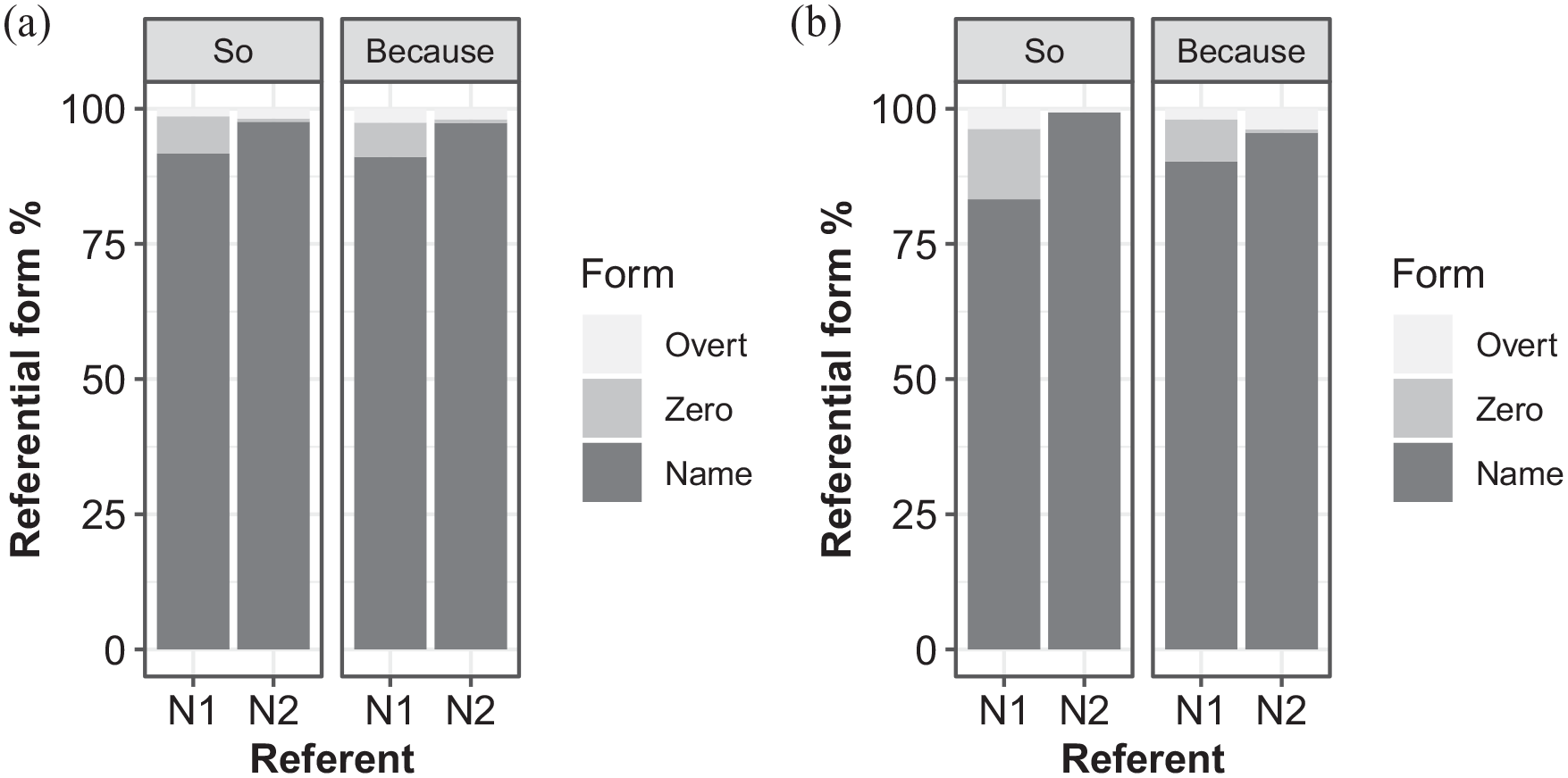
Percentages of anaphoric expressions by grammatical role and connective for (a) transfer verb items and (b) IC verb items in Experiment 1.
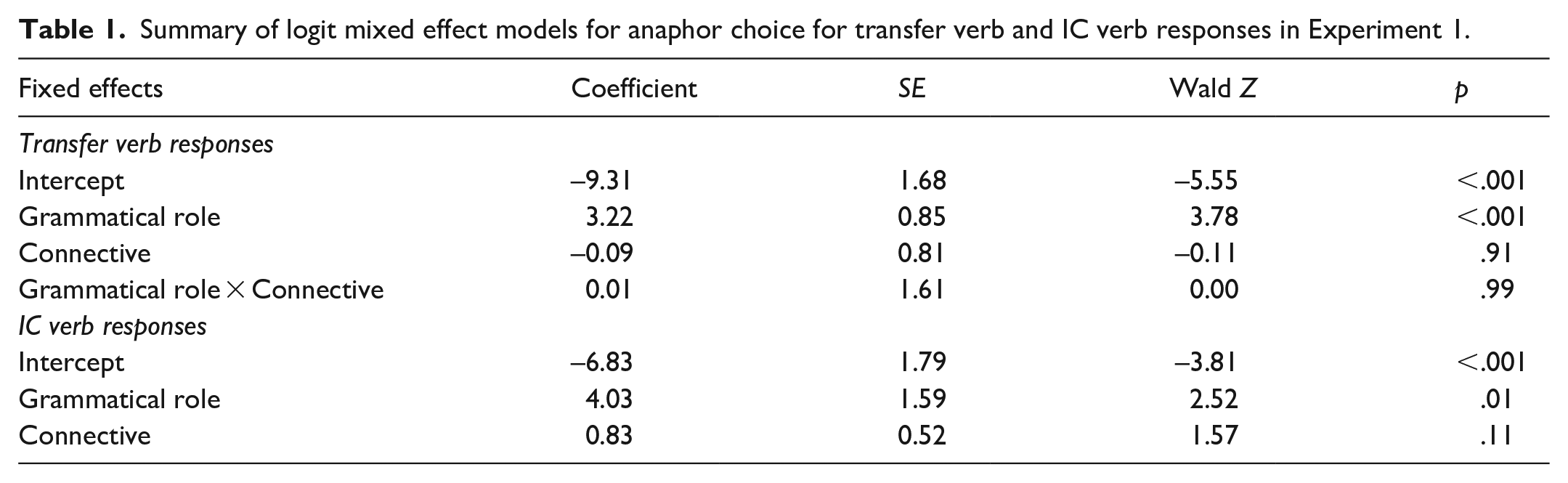
I analysed response frequencies of zero pronouns and other forms (overt pronouns and names) (Zero = 1, Other = 0) as a function of grammatical role (sum-coded: Subject = .5, Non-subject = –.5) and connective (sum-coded: So = .5 Because = –.5). For transfer verb responses, the most maximal model to converge included grammatical role, connective, and the interaction between the two as fixed effects and random intercepts for participants and items. For IC verb responses, the most maximal model to converge included grammatical role and connective as fixed effects, random intercepts for participants and items, and a random slope for grammatical role by participants.
The results revealed that grammatical role had a significant effect on anaphor choice for both transfer verbs and IC verbs (Table 1). Participants produced more zero pronouns for subject referents than non-subject referents. However, there was no significant effect of connective or an interaction between grammatical role and connective indicative of the predictability effect. These findings suggest that the use of zero pronouns was influenced by grammatical role, but not by predictability, which is consistent with the findings of H. Hwang et al. (under revision).
Summary of logit mixed effect models for anaphor choice for transfer verb and IC verb responses in Experiment 1.
Morphological marker choice
Figure 2 plots percentages of nominative and topic markers by grammatical role and connective for transfer verb items (a) and IC verb items (b). As can be seen, participants produced more topic markers following “so” than “because” for both verb types (Transfer verbs: 92.3% [274/297] vs. 48.7% [136/279]; IC verbs: 93.2% [262/281] vs. 68.8% [199/289]). Topic markers were also more frequent for subject referents than non-subject referents for both transfer verbs and IC verbs (Transfer verbs: 80.5% [215/267] vs. 63.1% [195/309]; IC verbs: 90.5% [248/274] vs. 71.9% [213/296]).
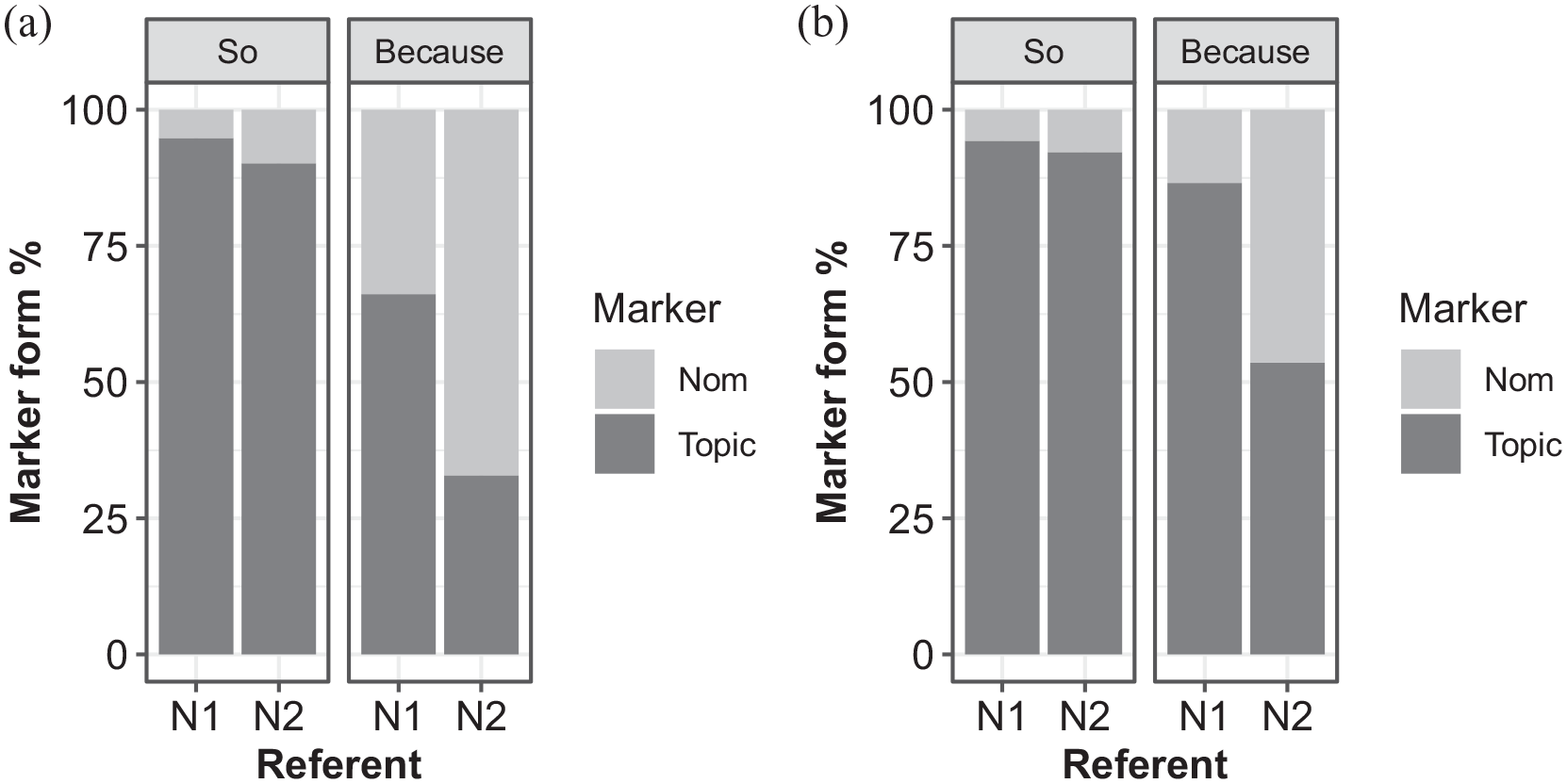
Percentages of nominative and topic markers by grammatical role and connective for (a) transfer verb items and (b) IC verb items in Experiment 1.
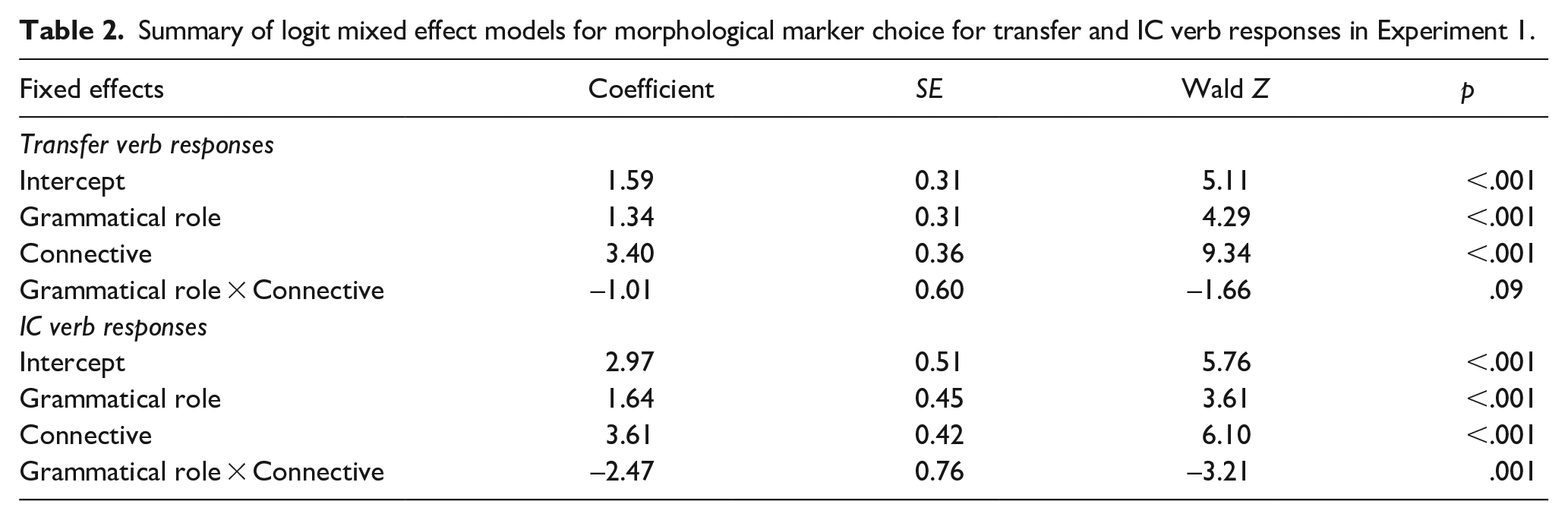
I analysed response frequencies of nominative and topic markers (Topic = 1, Nominative = 0) as a function of grammatical role (sum-coded: Subject = .5, Non-subject = –.5) and connective type (sum-coded: So = .5, Because = –.5). For transfer verb items, the most maximal model to converge included grammatical role, connective, and their interaction as fixed effects and random intercepts for participants and items. For IC verb items, the most maximal model to converge included grammatical role, connective, and their interaction as fixed effects, random intercepts for participants and items, and a random slope for grammatical role for participants.
For both transfer and IC verb responses, I found significant main effects of grammatical role and connective on morphological marker choice (Table 2). Korean speakers used topic markers more for subject referents than non-subject referents, and following “so” than “because.” The interaction between grammatical role and connective was significant for IC verb responses only. Contrasts revealed that the grammatical role had a significant effect for “because” continuations (β = 13.70, SE = 5.51, z = 2.48, p = .01), but not for “so” continuations (β = 0.35, SE = 0.81, z = 0.44, p = .65). Although the interaction was marginal for transfer verb responses, the grammatical role effect was also significant for “because” continuations (β = 1.96, SE = 0.36, z = 5.45, p < .001), but not for “so” continuations (β = 0.68, SE = 0.55, z = 1.24, p = .21). These results suggest that the patterns of morphological choice are similar between transfer and IC verb items, but different between “so” and “because.”
Summary of logit mixed effect models for morphological marker choice for transfer and IC verb responses in Experiment 1.
Discussion
Experiment 1 showed that morphological marker choice was sensitive to both grammatical role and connective, while anaphor choice exhibited sensitivity only to grammatical role. Although zero pronouns were not frequent, there was no indication that the use of zero pronouns was sensitive to connective. These results are compatible with Clancy and Downing (1987) that suggest that morphological marker choice and anaphor choice are subserved by different mechanisms, but not compatible with Hinds (1983) that assume the same mechanisms.
Yet the patterns of morphological marker choice did not follow the predictions of the contrast account proposed by Clancy and Downing (1987). Although the contrast account predicts that participants should use more topic markers for non-subject referents following “so,” the rate of topic markers did not differ between subject and non-subject referents in “so” continuations. If anything, the rate of topic markers was numerically higher for subject referents. The effects of grammatical role and connective on morphological marker choice are not also compatible with the possibility that morphological marker choice is linked with either switch reference or cause-effect sequence.
Note, however, that both grammatical role and connective could influence referent choice. It is well established that verb semantics and connective affect referent choice (e.g., Stevenson et al., 1994). In addition to verb semantics and connective, some scholars suggest that speakers are more likely to refer to (talk about) subject referents than non-subject referents (Arnold, 1998, 2001; Brennan, 1995). This then raises the possibility that morphological marker choice is subject to the same constraints as referent choice. Experiment 2 tests this possibility by examining whether morphological marker choice is sensitive to verb semantics, a factor known to affect referent choice, while controlling for the connective for transfer and IC verbs.
Experiment 2
It is well known that verb semantics influences speakers’ choices of referent. Transfer verbs create a bias to re-mention the goal referent in an upcoming sentence when it describes a subsequent event or result (e.g., Arnold, 2001; Simpson et al., 2016; Stevenson et al., 1994, 2000). Goal-source transfer verbs such as “receive” (6a) are subject-biased (N1-biased), because the goal referent is realised in subject position. Source-goal verbs such as “give” (6b) are object-biased (N2-biased), because the goal referent appears as a prepositional object.
(6) a. N1-biased transfer verbs Minswu-ka Hyenwu-eykey pocungkum-ul tollyepatassta. Kulayse . . . Minsu-NOM Hyunwoo-DAT deposit-ACC received so “Minsu received the deposit from Hyunwoo. So . . .” b. N2-biased transfer verbs Minhuy-ka Sena-eykey yengswucung-ul cwuessta. Kulayse . . . Minhee-NOM Sunah-DAT receipt-ACC gave so “Minhee gave the receipt to Sunah. So . . . ”
Similarly, IC verbs are known to create a bias to re-mention the stimulus referent in an upcoming sentence that provides a cause or reason (e.g., Au, 1986; R. Brown & Fish, 1983; Caramazza et al., 1977; Crinean & Garnham, 2006; Ferstl et al., 2011; Fukumura & van Gompel, 2010; Garvey & Caramazza, 1974; Garvey et al., 1975; Rohde & Kehler, 2014; Stevenson et al., 1994, 2000). Stimulus-experiencer IC verbs such as “worry” (7a) place the stimulus referent in subject position (N1-biased), while experiencer-stimulus IC verbs such as “fear” in (7b) place the stimulus referent in object position (N2-biased).
(7) a. N1-biased IC verbs Minswu-ka Hyenwu-lul kekcenghakeyhayssta. Waynyahamyen . . . Minsu-NOM Hyunwoo-ACC worried because . . . “Minsu worried Hyunwoo. This was because . . . ” b. N2-biased IC verbs Sena-ka Mihuy-lul mwusewehayssta. Waynyahamyen . . . Sunah-NOM Minhee-ACC feared because . . . “Sunah feared Minhee. This was because . . .”
To test whether morphological marker choice is sensitive to verb semantics, Experiment 2 manipulated verb semantics of transfer and IC verbs. Prompt sentences containing transfer verbs were always followed by the connective kulayse “so” and sentences containing IC verbs were followed by waynyahamyen “because.” These connectives support the goal bias for transfer verbs and the stimulus bias for IC verbs (Arnold, 2001; Au, 1986; R. Brown & Fish, 1983; Crinean & Garnham, 2006; Rohde & Kehler, 2014; Stevenson et al., 1994). If morphological marker choice is sensitive to the factors that affect referent choice, the patterns of morphological marker choice are expected to systematically vary between N1-biased and N2-biased verbs for both verb types.
Method
Participants
A total of 65 participants were included in the analysis. Participants were not compensated for their participation.
Materials and procedure
I constructed 48 experimental items (see online Supplementary Material A). Twenty-four items were designed with transfer verbs. Each item described a transfer event involving two human characters in the roles of goal and source followed by the inter-sentential connective kulayse “so” (6). The goal role was in subject position for half the items (6a) (N1-biased) and in prepositional object position for the other half (6b) (N2-biased). The characters were of the same gender, counterbalanced between two male and two female characters. Each of the four characters occurred in subject and non-subject position an equal number of times.
Twenty-four items were designed with IC verbs. As in (7), each item included two human characters in the roles of stimulus and experiencer followed by the inter-sentential connective waynyahamyen “because.” The stimulus role was in subject position for half the items (7a) (N1-biased) and in object position for the other half (7b) (N2-biased). The two male and female characters of the same gender occurred in subject and non-subject position an equal number of times.
The 48 target items were combined with 48 filler items. The fillers described an event involving a single character or two characters using verbs other than transfer and IC verbs (e.g., intransitive verbs). All items used the structure X did something (with Y). Half of the items were followed by kulayse “so” and half by waynyahamyen “because.”
The study was administered as an online survey using Qualtrics. Participants were instructed to provide a plausible continuation to each sentence fragment. Unlike in Experiment 1, participants had the freedom to choose which referent to mention in their continuation. Before proceeding to the main experiment, participants were presented with two example trials and four practice trials.
Scoring
I coded the grammatical subject or the sentence topic of the first clause of each response. Responses were coded for (a) anaphor choice (zero pronoun, overt pronoun, or name), (b) morphological marker choice (nominative marker or topic marker), and (c) grammatical role of the referent in the first sentence (subject or non-subject).
Responses were excluded from the analysis if (a) participants referred to more than one character at once (e.g., Senawa Minhuynun kongpwuhayssta “Sunah and Minhee studied”); (b) they referred to entities other than the characters in the first sentence (e.g., Minswuuy ttali aphasski ttaymwunita “Minsu’s daughter was sick”); (c) they produced an erroneous response in which the referent did not match the meaning of the continuation (e.g., Minswuka Hyenwulul kekcenghakey hayssta. Waynyahamyen Hyenwuka aphuki ttaymwunita. “Minsu worried Hyunwoo. This was because Hyunwoo was sick.”); or (d) they produced an ambiguous utterance in which the intended referent could not be determined by semantic context (e.g., Hyenswuka Minswueykey chalul sassta. Kulayse Ø kamsaphyencilul patassta. “Hyunwoo bought a car from Minsoo. So Ø received a thank-you letter.”). About 5.6% of trials (175 out of 3,120 trials) were removed for one of the above reasons, resulting in 2,945 trials in the analysis of anaphor choice. For the analysis of morphological marker choice, I further excluded responses containing relative clauses, zero pronouns, and markers other than a nominative marker and a topic marker. This left 2,793 trials in the analysis of morphological marker choice.
Analysis
I performed separate analyses for transfer and IC verb items. I first analysed referent choice as a function of verb semantics (N1-biased vs. N2-biased). I then analysed anaphor choice and morphological marker choice as a function of grammatical role (subject vs. non-subject) and verb semantics (N1-biased vs. N2-biased). The results were analysed using logit mixed effects models (Baayen et al., 2008; Jaeger, 2008). As in Experiment 1, overt pronouns and names were classified into a single category. I fitted maximal random effects structure, including main effects and the interaction. If the fully maximal model did not converge, I simplified models until convergence was achieved (Barr et al., 2013). I report the coefficient for each independent variable and its level of significance for the final model. Coefficients are given in log-odds.
Results
Referent choice
I first analysed whether verb semantics influenced participants’ referent choices for transfer and IC verbs. For both verb types, participants referred to subjects more following N1-biased verbs (Transfer verbs: 90.5% [648/716]; IC verbs: 86.7% [638/736]) and non-subjects more following N2-biased verbs (Transfer verbs: 85% [635/747]; IC verbs: 89.8% [670/746]) (see online Supplementary Material B). This indicates that participants referred to the goal referent more than the source referent for transfer verbs items (87.7%, 1,283/1,463) and the stimulus referent more than the experiencer referent for IC verb items (88.2%, 1,308/1,482). These patterns of reference are consistent with the results in the literature (e.g., Ferstl et al., 2011; Fukumura & van Gompel, 2010; Garnham et al., 2021; Stevenson et al., 1994, 2000).
I analysed response frequencies of subject and non-subject continuations (Subject = 1, Non-subject = 0) as a function of verb semantics (sum-coded: N1-biased = .5, N2-biased = –.5). For transfer verb responses, the most maximal model to converge included verb semantics as a fixed effect and random intercepts for participants and items. For IC verb responses, the most maximal model included verb semantics as a fixed effect, random intercepts for participants and items and a random slope for verb semantics by participants. As expected, the analyses showed that verb semantics had a significant effect on referent choice for both transfer verb responses (β = 7.08, SE = 0.85, z = 8.28, p < .001) and IC verb responses (β = 5.16, SE = 0.35, z = 14.53, p < .001).
Anaphor choice
Figure 3 plots percentages of anaphoric expressions by grammatical role and verb semantics for transfer verb items (a) and IC verb items (b).
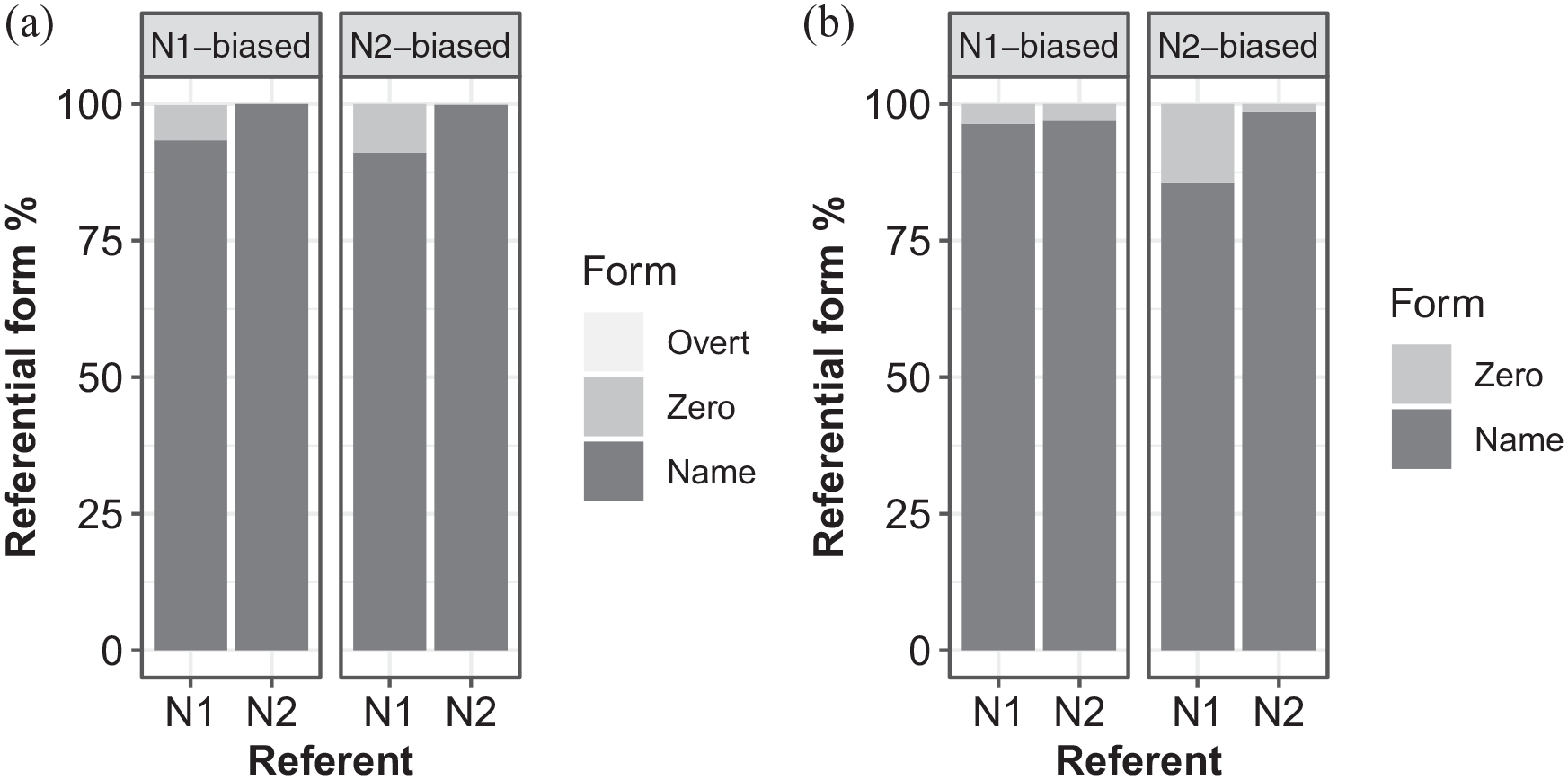
Percentages of anaphoric expressions by grammatical role and verb semantics for (a) transfer verb items and (b) IC verb items in Experiment 2.
Participants produced zero pronouns more for subject referents than non-subject referents for both transfer verbs (6.8% [52/760] vs. 0.1% [1/703]) and IC verbs (4.7% [34/714] vs. 1.7% [13/768]). In terms of verb semantics, zero pronouns were more common for N1-biased verbs than N2-biased verbs for both verb types (Transfer verbs: 5.9% [42/716] vs. 1.5% [11/747], IC verbs: 3.5% [26/736] vs. 2.8% [21/746]).
I analysed response frequencies of zero pronouns and other forms (overt pronouns and names) (Zero = 1, Other = 0) as a function of grammatical role (sum-coded: Subject = .5, Non-subject = –.5) and verb semantics (sum-coded: N1-biased = .5, N2-biased = –.5). For transfer verb responses, the most maximal model to converge included grammatical role and verb semantics as fixed effects and a random intercept for participants. For IC verb responses, the most maximal model included grammatical role, verb semantics, and the interaction between the two as fixed effects, random intercepts for participants and items, and random slopes for grammatical role and verb semantics by participants.
For both transfer and IC verb responses, grammatical role had a significant effect on anaphor choice as was observed in Experiment 1 (Table 3). Participants used more zero pronouns for subject referents than non-subject referents. However, there was no significant effect of verb semantics for both verb types.
Summary of logit mixed effect models for anaphor choice for transfer verb and IC verb responses in Experiment 2.
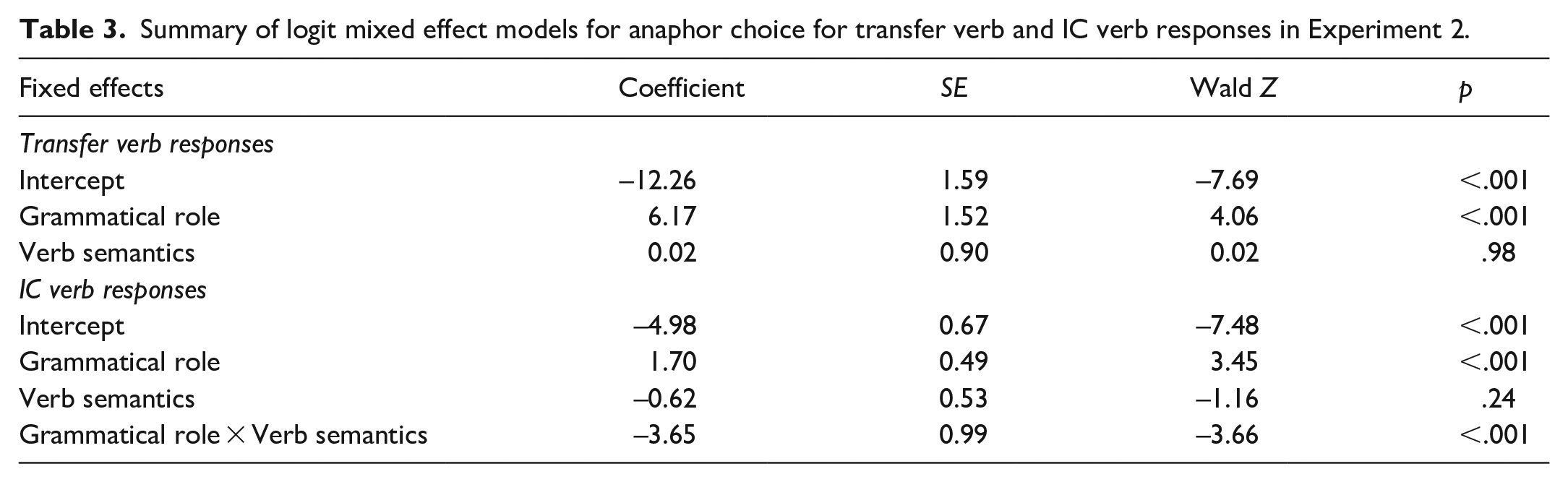
For IC verb responses, there was also a significant interaction between grammatical role and verb semantics. Contrasts revealed that the rate of zero pronouns was higher for subject referents than non-subject referents for N2-biased IC verbs (β = 3.32, SE = 0.76, z = 4.35, p < .001), but the rate of zero pronouns did not differ between subject referents and non-subject referents for N1-biased IC verbs (β = 0.07, SE = 0.79, z = 0.09, p = .93). Note that non-subject referents were more predictable than subject referents for N2-biased IC verbs, but participants used zero pronouns more for subject referents. Consistent with the results of Experiment 1, these findings suggest that zero pronoun use is sensitive to the grammatical role of the referent, but not to the predictability of the referent (see also H. Hwang et al., under revision).
Morphological marker choice
Figure 4 plots percentages of nominative and topic markers by grammatical role and verb semantics for transfer verb items with “so” (a) and IC verb items with “because” (b). As can be seen, the patterns of morphological marker choice did not systematically vary with verb semantics between N1-biased and N2-biased verbs, but rather with the connective between “so” and “because.” As found in Experiment 1, topic markers were more frequent in “so” continuations (85.5%, 1,177/1,376) than “because” continuations (30.1%, 426/1,417). For “so” continuations, the rate of topic markers was similar between subject and non-subject referents (N1-biased transfer verbs: 86.3% [517/599] vs. 85.3% [58/68], N2-biased transfer verbs: 87.9% [87/99] vs. 84.4% [515/610]). For “because” continuations, the rate of topic markers was higher for subject referents than non-subject referents for N2-biased IC verbs (70.3% [45/64] vs. 41.2% [269/653]). For N1-biased IC verbs, however, the rate of topic markers was very similar between subject and non-subject referents (16.0% [98/613] vs. 16.1% [14/87]).
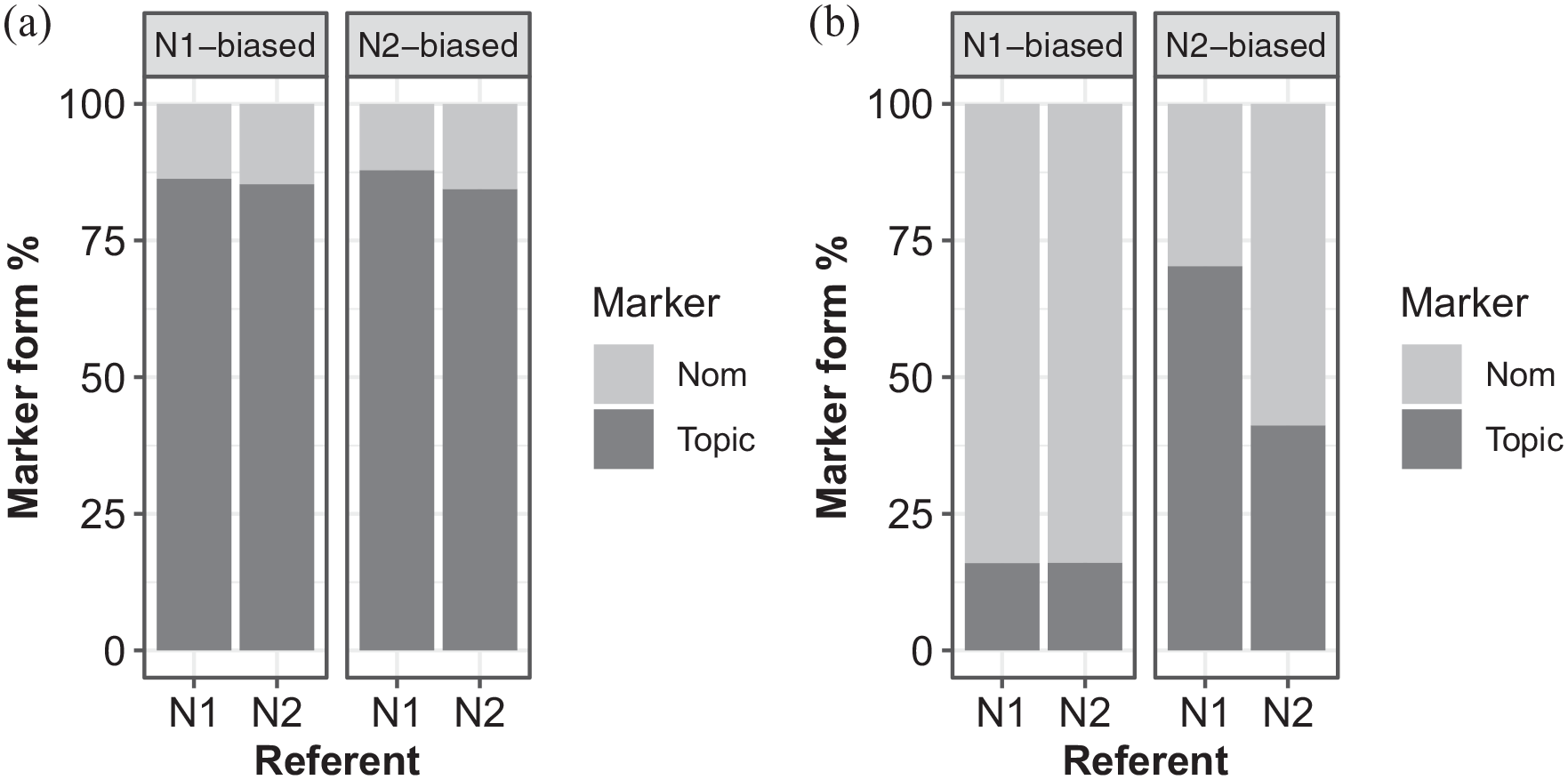
Percentages of nominative and topic markers by grammatical role and verb semantics for (a) transfer verb items and (b) IC verb items in Experiment 2.
To test whether morphological marker choice varied between the connectives, I conducted a combined analysis of transfer and IC verb items. I analysed response frequencies of nominative and topic markers (Topic = 1, Nominative = 0) as a function of connective (sum-coded: So = .5, Because = –.5), grammatical role (sum-coded: Subject = .5, Non-subject = –.5), and verb semantics (sum-coded: N1-biased = .5, N2-biased = –.5). I found a significant main effect of connective (β = 4.07, SE = 0.33, z = 12.16, p < .001), confirming that topic markers were more common following “so.” Note that although connective co-varied with verb type in Experiment 2, the result cannot be attributed to verb type. If verb type is responsible for the effect, morphological marker choice should also vary systematically with verb type in Experiment 1, but this was not the case.
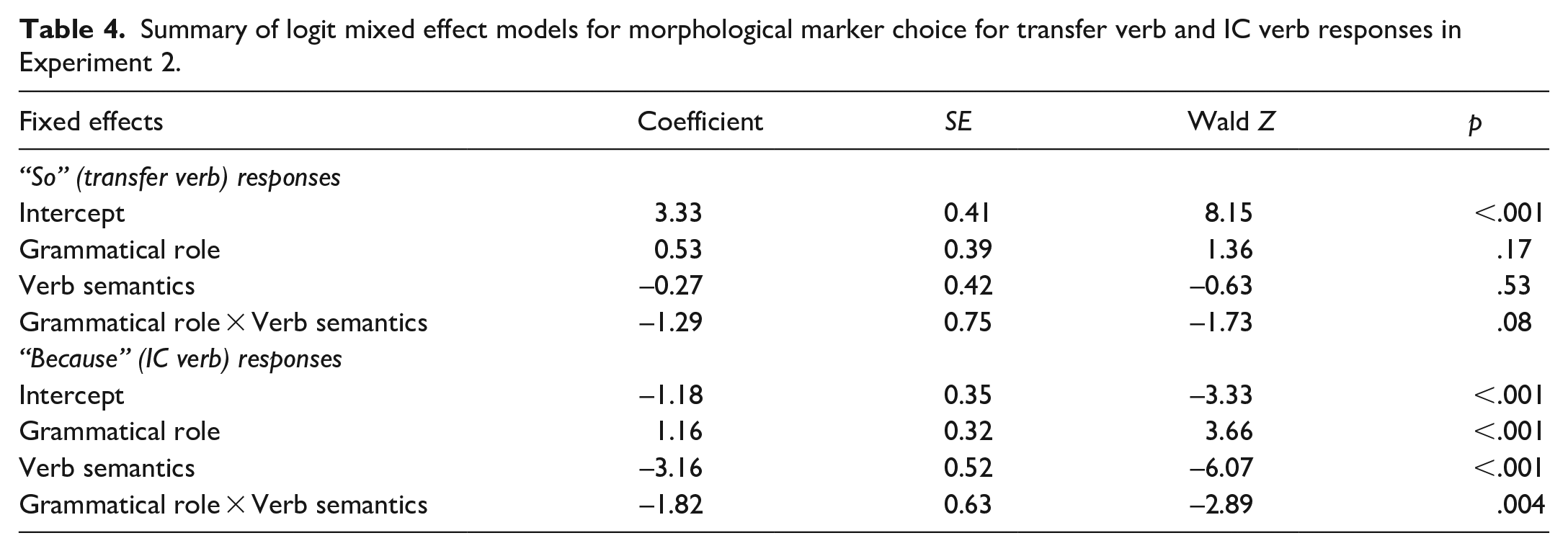
To assess the effects of grammatical role and verb semantics on morphological marker choice, I analysed response frequencies of nominative and topic markers in “so” and “because” continuations (Topic = 1, Nominative = 0) as a function of grammatical role (sum-coded: Subject = .5, Non-subject = –.5), and verb semantics (sum-coded: N1-biased = .5, N2-biased = –.5). For “so” responses, the most maximal model included grammatical role, verb semantics, and their interaction as fixed effects and random intercepts for participants and items. For “because” responses, the most maximal model included grammatical role, verb semantics, and their interaction as fixed effects and random intercepts for participants and items.
For “so” responses, I found no effect of grammatical role or verb semantics on morphological marker choice (Table 4). There was no significant interaction between grammatical role and verb semantics. For “because” responses, however, I found significant main effects of grammatical role and verb semantics. Participants produced more topic markers for subject referents than non-subject referents. They also used more topic markers for N2-biased IC verbs than N1-biased IC verbs. The interaction between grammatical role and verb semantics was also significant. Contrasts revealed that topic markers were more common for subject referents than non-subject referents for N2-biased IC verbs (β = 2.27, SE = 0.90, z = 2.51, p = .012), but the rate did not differ for N1-biased IC verbs (β = 0.13, SE = 0.46, z = 0.29, p = .77). Given that non-subject referents were more predictable than subject referents for N2-biased IC verbs, the interaction effect cannot be attributed to the predictability of referents.
Summary of logit mixed effect models for morphological marker choice for transfer verb and IC verb responses in Experiment 2.
Discussion
Experiment 2 demonstrates that morphological marker choice is not influenced by the same factors as referent choice. While referent choice systematically varied with verb semantics, morphological marker choice did not. The results also show that morphological marker choice is not subject to the same constraints as anaphor choice. Consistent with the results of Experiment 1, morphological marker choice was sensitive to both grammatical role and connective. In “because” continuations, morphological marker choice was also sensitive to verb semantics. However, I did not find any evidence that anaphor choice was sensitive to connective or verb semantics. The use of zero pronouns was sensitive only to grammatical role.
In sum, the results of Experiment 2 suggest that morphological marker choice does not rely on the same mechanisms responsible for referent choice or anaphor choice consistent with Clancy and Downing (1987). Yet the effects of connective, grammatical role, and verb semantics are not accounted for by their contrast account that expects topic markers mainly on non-subject referents in “so” continuations. Instead of the contrast relation, I suggest that these effects could be accounted for at least in part by the topic-focus status of referents in the “General discussion.”
General discussion
In two sentence completion experiments, I have investigated whether Korean speakers choose between nominative and topic markers using the same mechanisms that underlie anaphor choice or referent choice. The results of Experiments 1 and 2 showed that morphological marker choice was sensitive to connective, grammatical role, and verb semantics. Overall, Korean speakers produced more topic markers in “so” continuations than “because” continuations. Grammatical role and verb semantics effects emerged only in “because” continuations. Specifically, topic markers were more common for N2-biased verbs than N1-biased verbs. For N2-biased verbs, topic markers were more common for subject referents than non-subject referents. Such difference for grammatical role was not observed for N1-biased verbs.
Unlike morphological marker choice, I did not find any evidence that anaphor choice was sensitive to connective or verb semantics in Experiments 1 and 2. There was a robust effect of grammatical role on zero pronouns, but there was no indication that zero pronouns were influenced by connective or verb semantics. These results suggest that different mechanisms are implicated in morphological marker choice and anaphor choice. The results of Experiment 2 provide further evidence that morphological marker choice is not sensitive to the same constraints as referent choice. While verb semantics had a systematic influence on referent choice, morphological marker choice did not systematically vary with verb semantics.
Although these results are consistent with Clancy and Downing (1987) that suggest different mechanisms underlie morphological marker choice and anaphor choice, the effects of connective, grammatical role, and verb semantics on morphological marker choice are not explained by the contrast account that suggests that morphological marker choice is driven by a contrast relation. This is not to say that a contrast relation does not play any role in morphological marker choice. Indeed, it is commonly assumed that a primary function of topic markers is to encode contrast, and topic-marked entities are interpreted as highly contrastive, as exemplified in the parallel activities/states (3a) (e.g., Jun, 2015; Kuno, 1973). Yet the contrast account cannot explain the observed patterns of morphological marker choice found in Experiments 1 and 2.
I instead suggest that the patterns of morphological marker choice in the current study could be at least in part accounted for in terms of topic-focus status of referent. Some scholars argue that the choice between nominative and topic markers reflects the distinction between topic and focus status of the referent, such that nominative markers are used for focused or not presupposed elements, while topic markers are used for topical elements (i.e., what the sentence is about) (henceforth topic-focus account, for example, Heycock, 1994, 2008; Inoue, 1982; Kuno, 1972, for Japanese; Jun, 2015; C. W. Park, 1999, for Korean). For example, Hyunwoo in (8b) is the focus of the answer that corresponds to the wh-phrase in (8a) and is marked with the nominative marker ka. By contrast, in (9b) which conveys information about Hyunwoo, Hyunwoo is the topic and is marked with the topic marker nun.
(8) a. Minswu-wa Hyenwu-cwungey nwuka khuni? Minsu-and Hyunwoo-between who tall “Who is taller between Minsu and Hyunwoo?” b. Hyunwoo-NOM more tall “ (9) a. Hyenwu-ka nwukwu-lul mannassni? Hyunwoo-NOM who-ACC met “Who did Hyunwoo meet?” b. Hyunwoo-TOP Minsu-ACC met “
The topic-focus account could account for the major patterns of morphological marker choice presented in the study. First, it could explain why topic markers were much more frequent than nominative markers following “so.” A “so” sentence commonly provides an answer to “What did X do next?” or “What happened next?,” in which X can refer to either the subject or non-subject of the preceding sentence (Kehler & Rohde, 2013). When a “so” sentence is produced as an answer to the question “What happened next?,” the entire sentence is in focus, resulting in a nominative marker on the subject and non-subject. When it is produced as an answer to the question “What did X do next?,” however, only the predicate is in focus, resulting in a topic marker on the subject and non-subject. If speakers tend to assume that a “so” continuation depicts a subsequent event or consequence of the preceding event, which involves either the subject or the non-subject, a “so” sentence is more likely to be produced as an answer to “What did X do next?” and speakers may mark subject referents and non-subject referents equally frequently with topic markers in “so” responses.
Second, the topic-focus account could account for the effects of grammatical role and verb semantics in “because” responses. Given that an answer to a wh-question often corresponds to the focus and a “because” sentence provides an answer to a “why” question (Kehler & Rohde, 2013), I suggest that the difference in the grammatical role effect between N1-biased and N2-biased IC verbs in “because” responses may stem from the difference in the focus of the responses. For N2-biased IC verbs, object referents are assumed to be the more likely cause of the event. Thus, they are likely to provide an answer to a “why” question and constitute the focus of the “because” sentence. Here, “why” should take scope over object referents but they may not necessarily take scope over subject referents. If object referents tend to constitute focused information with N2-biased IC verbs, this could explain why object referents tend to carry a nominative marker more often than subject referents.
In contrast, for N1-biased IC verbs, for which subject referents are assumed to be the more likely cause of the event, “why” should take scope over subject referents. When subject referents are in focus, I assume that “why” takes scope over the entire sentence. Then, in “because” sentences with N1-biased IC verbs, both subject and object referents are likely to constitute focused information and tend to carry a nominative marker. More generally, if the scope of “why” interacts with verb semantics, this could capture the patterns of morphological marker choice for N2-biased transfer verbs in Experiment 1.
However, note that preferences for topic markers for subject referents and nominative markers for object referents for N2-biased verbs were not as strong as are expected solely on the basis of the topic-focus status of referents and somewhat variable across verb types and experiments. This may suggest that morphological marker choice does not rely solely on the topic-focus status of referents but is likely to be affected by other factors. Future research is necessary to determine how the topic-focus status of referents affects morphological marker choice and interacts with other factors that have been claimed to affect morphological choice such as contrast, the distinction between exhaustive listing and neutral description, and the distinction between individual-level and stage-level predicates (e.g., Jun, 2015; Kuno, 1973).
The results of the current study not only suggest that morphological marker choice relies on the different mechanisms than underlie anaphor choice or referent choice, but also demonstrate that connective has a significant influence on referential form production. It is well established that connective plays a central role in referent choice (e.g., Au, 1986; Fukumura & van Gompel, 2010; Grober et al., 1978; Rohde et al., 2007; Stevenson et al., 1994) and pronoun interpretation (e.g., Kehler et al., 2008; Koornneef & Sanders, 2013; Koornneef & van Berkum, 2006; Mak & Sanders, 2010; Stevenson et al., 2000). Yet the role of connective in referential form production has received little attention in existing models of reference production. To the best of my knowledge, the effect of connective on referential form production has not been directly tested except in this work.
Although some models of reference production suggest that connective indirectly affects anaphor choice by contributing to referential predictability (e.g., Arnold’s Expectancy Hypothesis, 1998, 2010), the results of the present study suggest that connective influences referential form independently of predictability. For example, object referents were more predictable following “because” than “so” for IC verb items (e.g., fear) in Experiment 1. However, Korean speakers used more topic markers following “so” than “because,” contrary to the predictability effect.
An incidental finding from Fukumura and van Gompel (2010) further suggests that connective influences referential form choice independently of predictability. Although the purpose of Fukumura and van Gompel (2010) was to examine the effect of predictability on pronoun use, they found that English speakers produced more pronouns following because than so using N1-biased IC verbs (e.g., scare). They, however, did not find any evidence that English speakers used pronouns for predictable referents. These findings suggest that the connective effect is not related to predictability (see also H. Hwang, in press). Fukumura and van Gompel (2010) suggest that the effect of connective on pronoun use stems from the different syntactic properties of the two connectives: because is a subordinating connective, whereas so is a coordinating connective. They assume that a subordinate clause is processed as a single chunk with a main clause, but a coordinate clause is processed as a separate chunk. As a result, discourse entities remain more activated in a subordinate clause than in a coordinate clause, and subsequently are referred to with more pronouns. If the connective effect on morphological marker choice arises from the topic-focus status of referents, this would provide further evidence that morphological marker choice and anaphor choice are subserved by different mechanisms.
Crucially, regardless of how connective affects morphological marker choice and anaphor choice, the results of the current study provide clear evidence that connective does play a role in determining the form of reference and that current models of reference production should take into account connective to provide a more accurate and comprehensive characterisation of reference production.
In sum, the results of the current study demonstrate that the choice of nominative and topic markers in Korean is sensitive to a number of factors including connective, grammatical role, and verb semantics and makes use of different mechanisms from anaphor choice and referent choice. By revealing how morphological marker choice is related to anaphor choice and referent choice, and identifying the factors that influence morphological marker choice, the results of the study contribute to our understanding of the mechanisms that underlie morphological marker choice and reference production.
Supplemental Material
sj-docx-1-qjp-10.1177_17470218221103544 – Supplemental material for Choice of nominative and topic markers in Korean discourse
Supplemental material, sj-docx-1-qjp-10.1177_17470218221103544 for Choice of nominative and topic markers in Korean discourse by Heeju Hwang in Quarterly Journal of Experimental Psychology
Footnotes
Acknowledgements
Many thanks to Seokwon Choi, Seong Kyun Im, YooLae Kim, Jongtaek Lee, Jeongyeup Paek, Soojin Park, Soyoung Park, Sun Hee Park, Hye-Jin Seo, Yumi Seo, Jeong-Ah Shin, Hye Won Suk, Jiyeon Son, and Gayeon Son for their help with data collection.
Declaration of conflicting interests
The author(s) declared no potential conflicts of interest with respect to the research, authorship, and/or publication of this article.
Funding
The author(s) received no financial support for the research, authorship, and/or publication of this article.

Data accessibility statement
Notes
References
Supplementary Material
Please find the following supplemental material available below.
For Open Access articles published under a Creative Commons License, all supplemental material carries the same license as the article it is associated with.
For non-Open Access articles published, all supplemental material carries a non-exclusive license, and permission requests for re-use of supplemental material or any part of supplemental material shall be sent directly to the copyright owner as specified in the copyright notice associated with the article.
