



Abstract
In immediate memory for verbal lists, recently it has been shown that participants can choose to carry out encoding that prioritises readiness for an item test at some cost to order information or, conversely, that prioritises readiness for an order test at a cost to item information. Here, we ask whether participants can control attention to items and order in a graded fashion. We examined this issue by manipulating the percentage of order or item test trials participants would receive in a block (for each type of test, 25%, 50%, 75%, or 100% of the trials in a block). Overall, the results revealed that participants were able to allocate their attention in a fine-grained manner that took into account the trial distribution within the block. However, there was a difference between the effects of allocating attention to item versus order. Divided attention, compared with full attention to one attribute, had an asymmetry, such that divided attention impaired order performance more than item performance. The exact point at which this asymmetry could be seen differed between two experiments, which included different item tests (fragment completion vs. free recall). The results suggest a common resource for item and order encoding and/or retention in working memory, which can be voluntarily allocated to different mixtures of these two attributes.
Short-term (or working) memory is a system that allows us to keep in mind a small amount of information for a few seconds and is essential to carry out our daily cognitive tasks (Cowan, 2017). One of the most important features of this memory system is the ability to recall information in order (Lashley, 1951). To be successful in recalling information in order, we need to keep in mind detailed information about the to-be-remembered items and the order in which they were presented (Crowder, 1976). Despite more than a century of research on how we recall information in order (for reviews see Hurlstone et al., 2014; Marshuetz, 2005; Oberauer et al., 2018), there are important unanswered questions about the relationship between item and order information. Here, we attempt to address one such question by examining how attention can be strategically allocated between item and order information.
How item and order information are related in short-term memory has broad, practical, and theoretical implications. In almost all aspects of our life, we must be able to recall information in order, such as when we are communicating, entering a password, and making dinner. While it is beyond doubt that item and order information play an important role in our life, what is less clear is whether we can strategically allocate our attention between item and order information. In many situations, it would be beneficial to forfeit some information from one attribute to maximise our attention to the other attribute. As an example, in a task in which participants must reconstruct fragments of just-presented words (e.g., AI ++ P + CE for AIRSPACE) it is important that they focus attention on the items rather than the order. In a more applied situation, the same can be said about when we are shopping for ingredients for a recipe. In other instances, such as in a task in which participants must reconstruct the order of just-presented words, or when we are assembling the ingredients for a recipe that are all laid on the kitchen counter, it is more important to focus our attention on the order, rather than on the items themselves.
Of course, item and order encoding cannot be considered fully independent; one logically cannot remember the order of items without remembering at least some of the information about the items being ordered (Neath, 1997). Nevertheless, it would be theoretically possible to enhance one kind of coding at the expense of the other. For example, in the extreme, one might remember only the first letter or phoneme of every word in a list (or perhaps the first two letters if there were replicates of the same first letter) so as to concentrate more on order processing. This strategy might be advantageous if one were expecting help on what the items are, but no help on putting them in order. An example might be remembering the order in which people spoke and reconstructing that order from an unordered list of the peoples’ names. Conversely, if one were trying to learn the names themselves, the order in which they were presented would not matter and need not become a burden on memory.
Despite the wealth of knowledge accumulated on how short-term memory functions (see Oberauer et al., 2018 for a review of benchmark findings), it is unclear whether participants can strategically allocate their attention between item and order information in short-term memory. Understanding this question would provide major constraints on almost all models that have attempted to capture how we can encode, maintain, and retrieve item information in order (Abrahamse et al., 2017; Anderson et al., 1998; Anderson & Matessa, 1997; Botvinick & Plaut, 2006; Brown et al., 2000, 2007; Burgess & Hitch, 1992, 1999, 2006; Farrell, 2012; Farrell & Lewandowsky, 2002, 2004; Grossberg & Pearson, 2008; Henson, 1998; Houghton, 1990; Lewandowsky & Farrell, 2008; Lewandowsky & Murdock, 1989; Majerus, 2009; Nairne, 1988, 1990; Neath & Nairne, 1995; Page & Norris, 1998, 2009; Poirier et al., 2015; for reviews see Hurlstone et al., 2014; Marshuetz, 2005).
In a recent attempt to better understand the relation between item and order in short-term memory, Guitard et al. (2021, 2022) used novel procedures in which the kind of encoding for the to-be-remembered lists was manipulated (item encoding, order encoding). With a two-list procedure, Guitard et al. (2021) found that order performance on one list was systematically more impaired when the other list was encoded with the expectation of an order test, relative to when the other list was encoded with the expectation of an item test. However, for items, it mattered very little what kind of encoding was carried out for the other list. A dual-list cost was also found for both item and order tests when compared with trials with only one list, regardless of the coding for each list. This initial investigation provides insight into how item and order information is maintained in short-term memory. It supports the notion that item and order information types are based on distinct processes, but are potentially bound by a common attentional limit that can be allocated as a function of task demands (see also Majerus, 2009, 2019).
Guitard et al. (2022) further investigated the nature of the interference between item and order information in a single-list procedure. On half of the trials, participants were to prepare for an item or order test before the presentation of the to-be-remembered list, and received a test congruent with their encoding. The test comprised fragment reconstruction for item tests and order reconstruction for order tests. On the other half of the trials, participants had to prepare for both an item test and an order test, and received either a fragment reconstruction or order reconstruction tests, but never knew in advance which test they would receive on a given trial. Overall, participants’ performance was inferior when they had to prepare for both an item and order test relative to when they had to prepare for one kind of test, order, or item. This dual-attention cost was more important for order tests. The results were accounted for by a resource-sharing hypothesis that the authors developed. In it, for both an item and an order test, there is an initial, non-discretionary processing of item and order information followed by further, discretionary item and order processes that are attentionally demanding. Based on prior research by Henderson and Matthews (1970), who have shown that a rapid presentation rate was more detrimental to the judgement of order relative to the judgement of items, Guitard et al. suggested that additional discretionary item information accumulated more quickly than did additional discretionary order information. This resource-sharing hypothesis matched the findings with both single- and dual-list procedures.
The results of Guitard et al. (2021, 2022) show that some item information and some order information are in competition with each other for the participant’s attention, with larger effects on order processing. It leaves open, though, the question of how much control participants have over the encoding process. Beyond preparing for one kind of test or both together, are participants able to allocate attention in a fine-grained manner that takes into account the rewards to be obtained for item and order memory? We know that it is possible to allocate attention to some items in a list at the expense of other items and that this allocation of attention is partly, though not entirely, under voluntary control (e.g., Hitch et al., 2020; for broader theoretical support see Cowan, 2019).
To explore this important theoretical question, we expanded on the single-list procedure developed by Guitard et al. (2022) by manipulating the incentive for remembering one attribute or the other. (For related uses of incentives to examine allocation to different kinds of information in working memory see C. C. Morey et al., 2011; Rhodes et al., 2021; Rouder et al., 2008.) Specifically, as can be seen in Table 1, we systematically manipulated the encoding instruction and the number of item or order tests on a given block of trials (similar to Rouder et al., 2008, who manipulated the proportion of change trials). Four critical conditions were used in which we varied the percentage of order and item test trials participants would receive in each block (for each attribute, 25%, 50%, 75%, 100% of the trials). In the 100–0 (or 0–100) block, participants prepared for an item (or order) test and always received a test congruent with their encoding. In the 50–50 block, participants received an item test on 50% of the trials and an order test on the other 50%, but never knew beforehand which test would occur. In the 75–25 (or 25–75) block, participants were informed that they should prepare for an item (or order) test on all trials but that, on 25% of the trials, they would receive a test of the other attribute, the one that was not being prioritised. Figure 1 illustrates the procedure.
Conditions for the study.
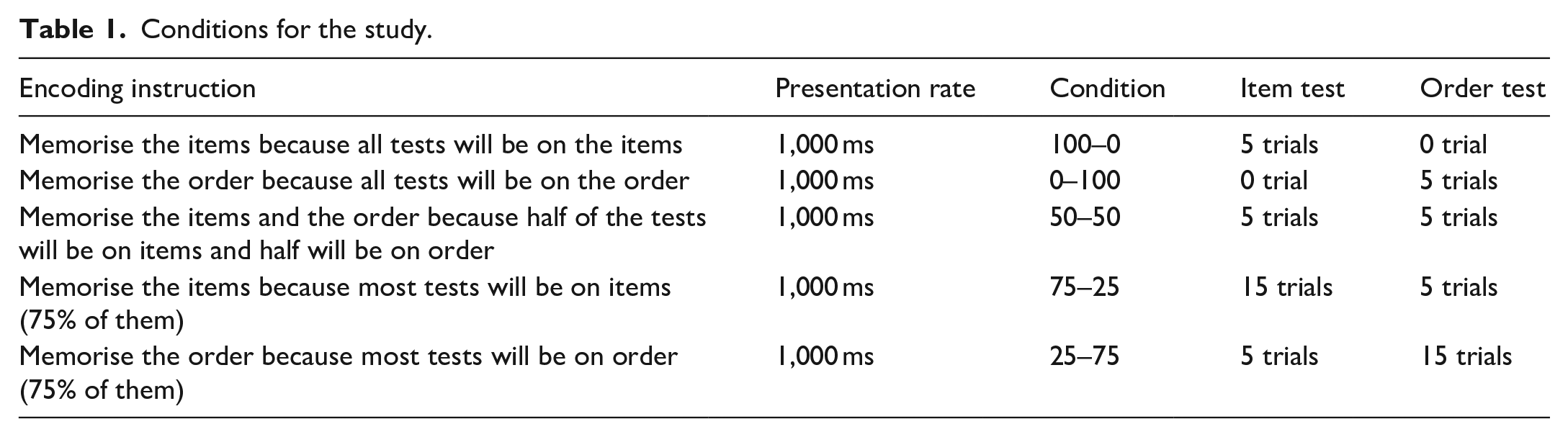

Illustration of the procedure used in Experiment 1 adapted from Guitard et al. (2022) for the (a) item test when all trials were an item test and for the (b) order test when 25% of the trials were an order test and 75% of trials were an item test.
Based on these conditions and the theoretical considerations discussed above, the following preregistered hypotheses were suggested to account for how participants could potentially allocate their attention between item and order information as a function of task demands:
H0: If attention cannot be strategically allocated as a function of the task demands, the performance between the attentional conditions should not differ one from another for either the item or the order test.
H1: If attention can be allocated in an all-or-none manner or can be split evenly, but cannot be split unevenly, we should observe the following pattern of results: 100item–0order ≈ 75item–25order > 50item–50order > 25item–75order for item proportion correct, and 75item–25order < 50item–50order < 25item–75order≈0item–100order for order proportion correct.
H2: If attention can be fully allocated as a function of task demand, we should observe the following pattern of results: 100item–0order > 75item–25order > 50item–50order > 25item–75order for item proportion correct, and 75item–25order < 50item–50order < 25item–75order < 0item–100order for order proportion correct.
H3: If attention can be fully allocated as function of task demand but discretionary processing for order information is more demanding 1 than item discretionary processing, we could observe the pattern of results described in H1 for the order test and the pattern of results for H2 for the item test.
Experiment 1
In Experiment 1, via a preregistered experiment, we examined how attention can be strategically allocated between item and order information by manipulating the percentages of item and order test trials participants would receive in each block (for each attribute, 0%, 25%, 50%, 75%, or 100% of the trials). There was, of course, no measure corresponding to the 0% condition.
Method
Necessary sample size estimation
For our sample size calculation, we first used G*Power (Faul et al., 2009) and the effect size of Experiment 2 of Guitard et al. (2022). More exactly, we used the effect size of the tradeoff for the item test, the smallest main effect size in their experiment. We used the information from Guitard et al. because the present study was modelled after their experiment. The size of their tradeoff for the item test was determined as d = .349. Using the effect size of Guitard et al., we estimated that a non-directional paired sample t-test with 100 participants would have at least a power of .90 with an alpha of .05. However, frequentist inferential statistics were not used in the study itself.
We used Bayes factors design analysis (BFDA; Schönbrodt & Stefan, 2018) with 10,000 simulations and default parameters for a non-directional Bayesian paired sample t-test to provide further information for our sample size selection. We used a Bayes factor (BF) >3 as a decision criterion and the same effect size (d = .349). The simulation for a sample size of 100 participants revealed that 2.3% of samples showed a false positive (BF < 3), 18% were inconclusive (0.3333 < BF < 3), and 79.6% showed evidence for the alternative hypothesis (BF > 3).
Additional simulations were conducted to explore our ability to detect the situation of no true effect (d = .00). For a non-directional Bayesian paired sample t-test and BF > 3 as a decision criterion, we found that with 100 participants, 0.9% of samples showed a false positive (BF > 3), 12.5% were inconclusive (0.3333 < BF < 3), and 87.7% showed evidence for the null hypothesis (BF < 0.3333). Overall, we estimated that a sample size of 100 participants is adequate for the present study. However, an initial analysis with 100 participants revealed inconclusive evidence (defined as a BF between 1/3 and 3) for the contrast between the attentional conditions 100 and 50 of the item test. Accordingly, based on a preregistered method, we increased our sample size by a step of 10 participants until we reached our predetermined maximum of 120 participants. This incremental approach is useful within a Bayesian framework inasmuch as increasing the sample size can lead either towards greater evidence of an effect or greater evidence favouring the null hypothesis. This incremental approach would not be valid within a frequentist approach. Importantly, although we included frequentist statistics for descriptive purposes, we exclusively use the Bayesian approach for inferential purposes.
Participants
Our final sample size included 120 volunteers from an online data collection agency, Prolific (https://www.prolific.co/). Three participants were excluded and replaced for not following the instructions properly. All participants were paid US$7.50. To be eligible to participate in this study, a participants had to (1) be a native speaker of English, (2) be of British, American, or Canadian nationality, (3) have normal or corrected-to-normal vision, (4) have no cognitive impairment or dementia, (5) have no language-related disorders, (6) be between 18 and 30 years old, and (7) have an approval rating of at least 90% on prior submissions at Prolific. The mean age was 23.32 (SD = 3.51, range 18–30); 101 self-identified as female, 18 as male, and 1 preferred not to specify their gender. This study was approved by the research ethics committee of the University of Missouri.
Materials
This experiment was programmed using PsyToolKit (Stoet, 2010, 2017). The stimuli were the 360 polysyllabic English words between 6 and 8 letters (M = 7.43, SD = 0.51) and their corresponding graphemic fragments (e.g., MONOGRAM, MO + O +++ M) were taken from Tulving et al. (1982) and Guitard et al. (2022). For the 336 words in which lexical frequency and contextual diversity information were available from Brysbaert and New (2009), the mean log frequency was 1.54 (SD = 0.45, range 0.30–4.06) and the mean log contextual diversity was 1.39 (SD = 0.42, range 0.30–3.69). Sixty lists of six words were created by randomly sampling without replacement from the pool of 360 polysyllabic words (see the Supplementary Material 2 for lists). For each participant, the lists were randomly allocated in each condition. All words and texts, unless otherwise mentioned, were presented in white, uppercase, 30 points Times New Roman font, at the centre of the computer screen on a black background. The stimuli for the experiment are presented in the Supplementary Material 1.
Design
A 2 × 4 repeated-measure design was implemented with memory test (order reconstruction task vs. item fragment reconstruction task) and attentional condition (100, 75, 50, 25 for the attribute) as repeated-measure factors. The experiment was divided into five blocks, with the number of trials in the block for a particular attentional condition varying from 5 to 20, depending on the type of block (see Table 1). The order of the blocks was counterbalanced across participants using a Latin square design.
Procedure
All participants were tested in one experimental session lasting approximately 50 min. There were 5 attentional condition blocks in which the percentage of order and item test trials was manipulated. In the 100% item test or 100% order test block, the encoding instruction (memorise the items or memorise the order) was always consistent with the memory test (order test or item test). More exactly, participants had to encode either item or order information and were never tested for order information on a list they had encoded for item information. Likewise, participants were never tested for item information for a list they had encoded for order information.
In the 50% item test and 50% order test block, participants had to encode both item and order information because participants were tested on either an item or an order test. Unlike the 100% blocks, participants could not anticipate the upcoming memory test type.
In the trial blocks with 75% item tests and 25% order tests, the encoding instruction was to memorise the items because most tests would be on items (see Table 1); but on 25% of the trials, after the list, an order test display appeared instead. Conversely, on blocks with 25% item tests and 75% order tests, the encoding instruction was to memorise the order because most tests would be on order; but on 25% of trials, after the list an item test appeared instead. We expected that participants would adjust their allocation of attention according to the proportions of trials in the trial block.
For all blocks, each trial was self-paced by the participant. Figure 1 illustrates the procedure for trials of two types. A trial began when the participant pressed the space bar key or after the maximum delay of 60 s. For all trials, immediately after the trial was initiated, an encoding instruction was presented. The instruction was either “MEMORIZE THE ITEMS” in yellow, “MEMORIZE THE ORDER” in green, or “MEMORIZE THE ITEMS AND THE ORDER” in blue on the centre of the screen for 2,000 ms. When participants saw the instruction “MEMORIZE THE ITEMS” they had to memorise the items for a potential upcoming fragment reconstruction test and when the participants saw the instruction “MEMORIZE THE ORDER” they had to memorise the order of the items for a potential upcoming order reconstruction test. When participants saw the instruction “MEMORIZE THE ITEMS AND THE ORDER” they had to memorise both the item and the order for either an upcoming item fragments reconstruction test or an upcoming order reconstruction test. Immediately after the encoding instruction, the six to-be-remembered words were presented at a rate of one word per second (1,000 ms on, 0 ms off) on the centre of the screen. Following the presentation of the last to-be-remembered word, the test instruction was presented on the centre of the screen for 2,000 ms. The test instruction was either “ORDER TEST” presented in green for the order reconstruction test, or “ITEM TEST” presented in yellow for the fragment reconstruction test. For both the order reconstruction and fragment reconstruction tests, participants were unable to backtrack to modify a previous response.
Item test
For the item fragment reconstruction test, the fragment of the first presented word in the trial (e.g., AI ++ P + CE for AIRSPACE) was shown under the instruction “Complete the following fragment by typing the word that was presented first,” which was presented on the upper part of the screen in red as a recall cue. Participants were instructed to reconstruct each word in turn by typing it on the keyboard and then pressing the space bar to register the response. Immediately after participants registered their response, the fragment of the second word was presented. The procedure was repeated until all of six to-be-remembered words were tested, always in their original presentation order. Consequently, the item test materials provided the order information, just as the order test materials necessarily provided the item information.
Order test
For the order reconstruction test, all words from the tested list reappeared simultaneously in alphabetical order on two lines under the instruction “Type the first word,” which was presented on the upper part of the screen in red as a recall cue. Participants were instructed to reconstruct the order by typing the words on the keyboard (see Guitard et al., 2022; Saint-Aubin et al., 2020 for a similar procedure). After typing each word, the participant pressed the space bar to register the response and the recall instruction change simultaneously from “Type the first word” to “Type the second word,” and so on until “Type the last word.” All of the words remained on the screen until the last word was registered.
Data analysis
In all data analyses, a strict criterion was adopted to score participants’ responses. For a response to be considered correct, participants had to type the words correctly. For the item test, the challenge was typing the words correctly based on the fragments presented as cues whereas, for the order test, the challenge was typing the words in their original presentation positions (given that the words themselves remained on screen, but not in order). As in Guitard et al. (2022), only exact matches of the presented word were counted as correct.
The proportion of correct responses was analysed using both frequentist and BF approaches, the former to provide descriptive information and the latter for inferential purposes. For the BF approach, the “BayesFactor” R package and the default priors were used (version 0.9.12-4.2; see R. D. Morey & Rouder, 2018; Rouder et al., 2009, 2012). More exactly, for Bayesian paired-sample t-tests, we set the Cauchy prior width to the default value r = .707 (see Rouder et al., 2009 for rationale). For BF analysis of variances (ANOVAs), we set the r scale fixed effects to the default medium wide (r = .5) and the r scale random effects to the default “nuisance” (r = 1) (see R. D. Morey & Rouder, 2018; Rouder et al., 2012) for rationale). In addition, for BF ANOVAs, we used an initial 100,000 iterations followed by 10,000 additional iterations, which was repeated until the proportional error was below 5%. For BF ANOVAs, main effects and interactions were tested by omitting these effects one at a time from the full model and comparing them with the full model. Participants were included as a random factor. We report BF10, which represents evidence in favour of an effect, and BF01 (BF01 = 1/BF10), which represents evidence against an effect. Our interpretation of BF was guided by the benchmarks taken from Kass and Raftery (1995): BF < 3 indicates weak or anecdotal evidence; 3 ⩽ BF < 20 indicates positive evidence; 20 ⩽ BF < 150 indicates strong evidence; and BF > 150 indicates very strong evidence. Although we use a categorical description to facilitate the understanding of BF analyses, we encourage readers to evaluate the strength of the evidence themselves on a continuous scale. We also report, as descriptive information only, F ratios, partial eta square (ANOVAs), and Cohen’s d (t-tests) using two R packages: “ez” (version 4.4-0; Lawrence, 2016) and “lsr” (version 0.5; Navarro, 2015). Finally, to ensure the robustness of our findings, for each experiment Bayesian generalised linear mixed models were computed. These exploratory analyses for both experiments confirmed the results reported in the article and are reported in the Supplementary Material 2.
Results
Overall accuracy
The proportions of correct responses as function of memory test and attentional condition are presented in Figure 2. As the figure shows, the performance of the participants was equivalent between the item test (M = 0.62, SD = 0.17) and the order test (M = 0.62, SD = 0.16). Overall, participants were also better when they could devote more attention to the tested attribute: the means declined from attentional condition 100 (M = 0.68, SD = 0.15) to attentional condition 75 (M = 0.63, SD = 0.16), attentional condition 50 (M = 0.59, SD = 0.18), and attentional condition 25 (M = 0.55, SD = 0.18). However, as shown in Figure 2, there were strikingly different patterns of performance for the item test and the order item test as function of attentional condition. Performance was comparable between the attentional conditions 50 and 75 for the item test, but it was comparable between the attentional conditions 25 and 50 for the order test. We now present the statistical support for this summary of the results.
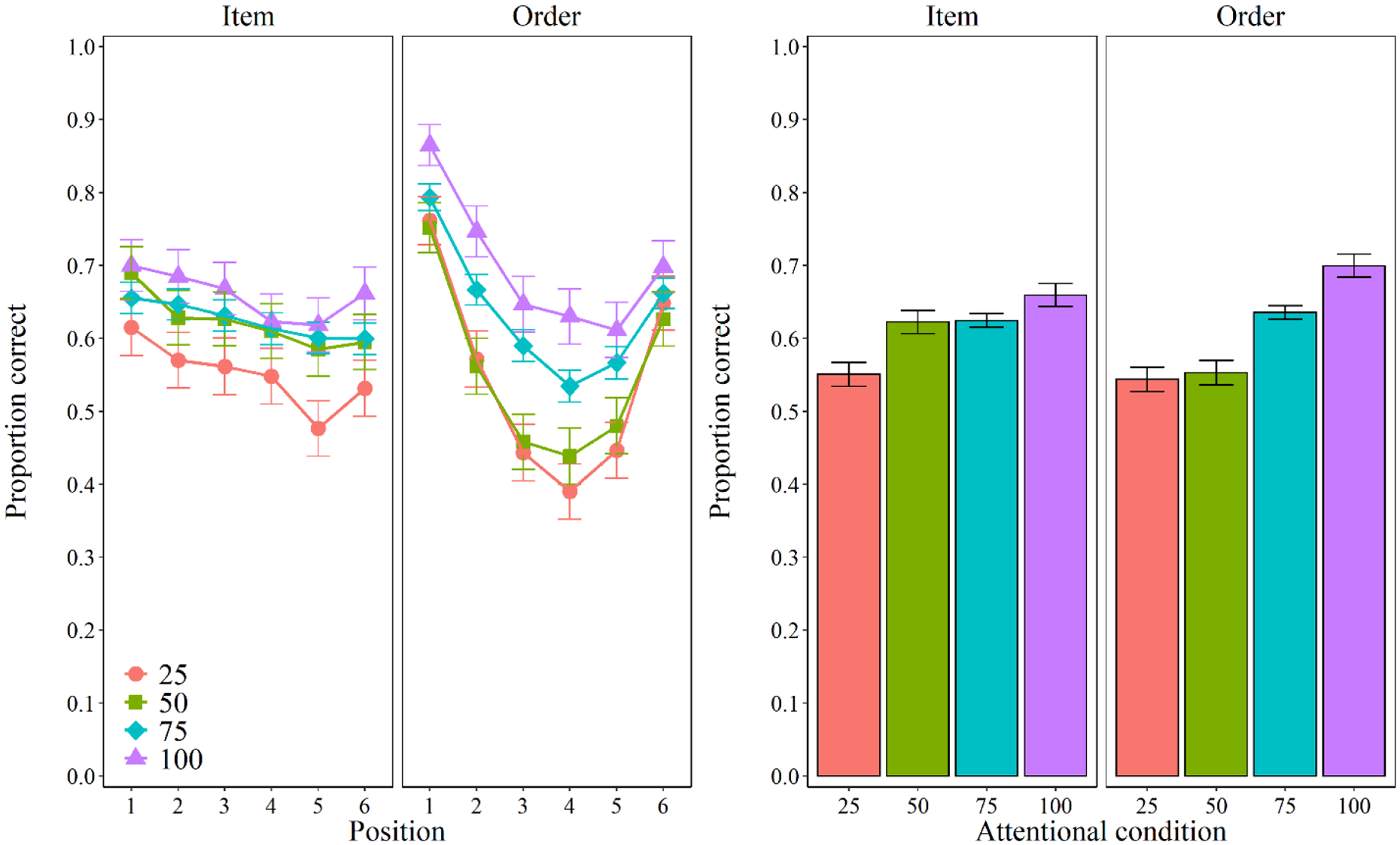
Proportion of correct response as a function of attentional condition (25, 50, 75, 100) and memory test (item test, order test) in Experiment 1.
A repeated-measures ANOVA with 2 memory tests (item test vs. order test) and 4 attentional conditions for each memory test (25 vs. 50 vs. 75 vs. 100) confirmed these trends. Results from the analysis revealed very strong evidence in favour of a main effect of attentional condition, F(3,357) = 42.03,
Effects of attentional condition for the item test
For the item test, we conducted an ANOVA with attentional condition as a fixed factor. The results support the variation between the attentional conditions, F(3,357) = 19.99,
These results from the item information test can be summarised for comparisons of adjacent positions with a notation in which “>” corresponds to a BF10 > 3 and “=” corresponds to a BF01 > 3. For adjacent conditions of item information, the result is 100 > 75 = 50 > 25. Thus, the item test shows equivalence for the 75 and 50 conditions.
Effects of attentional condition for the order test
As for the item test, an ANOVA with attentional condition as a fixed factor further supports the variation between the attentional conditions, F(3,357) = 38.25,
The result for adjacent conditions for order is thus 100 > 75 > 50 = 25. The 50 and 25 conditions were equivalent, in contrast to the item task in which it was the 75 and 50 conditions that were equivalent. It may be that the (75 item, 25 order) condition is actually processed with allocations of attention to item and order that are no different than in the 50–50 condition, perhaps because too slight an allocation of attention to order would be ineffective.
Finally, all our analyses based on the proportion of correct responses in this experiment were replicated with probability of knowing (pr[know]), as shown in the Supplementary Material 2. Pr (know) corresponds to a measure adjusting for guesses (see Guitard et al., 2022). The results were consistent with those reported in the article, suggesting that our results cannot be attributed to the level of guesses or the availability of retrieval cues at the response stage.
Exploratory analyses
Performance operating characteristic
In order to illustrate further the nature of the tradeoff between item and order information, we present in Figure 3, a performance operating characteristic. In such a figure, if there were no tradeoff then item performance would be fixed regardless of the order performance, and vice versa. Instead, the finding was that shared attention results in decreases in both the item and the order tasks. In line with the results of Guitard et al. (2022), there is also an indication of the asymmetry in attention-sharing. More specifically, the difference between the 100% and 50% allocation conditions is notably greater for order (difference between vertical lines; M = 0.15, SD = 0.20) than for items (difference between horizontal lines; M = 0.04, SD = 0.16), Cohen’s d = .48, BF10 > 1,000.
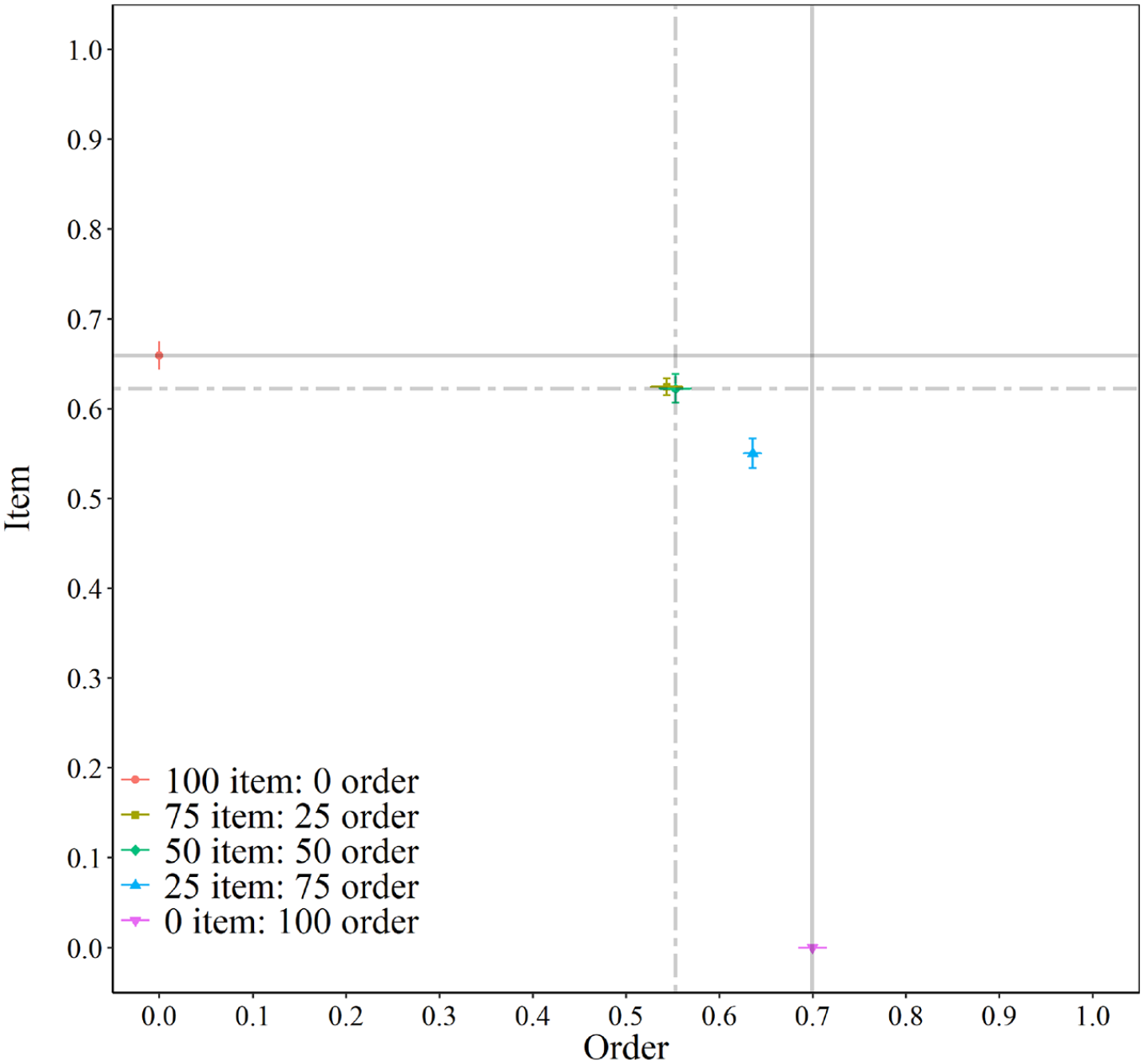
Performance operating characteristic for order versus item test proportions correct as a function of the attentional allocation condition (from left to right, 100–0, 75–25, 50–50, 25–75, and 0–100 conditions) in Experiment 1.
Individual differences
Until this point, we have focused on the overall group performance rather than the individual participant performance patterns, but it is also of interest to discuss individual variation in the allocation of attention. Therefore, in Figure 4, we show the difference in accuracy between the extreme, 100% versus 25% conditions for items (x axis) and order (y axis), that is, the maximum tradeoff for each attribute. The figure shows that, although there is some variation of the magnitude of the tradeoff, the majority of the participants showed a larger tradeoff for order performance than for item performance. Specifically, more participants fell in the upper-left quadrant (against expectations for the tradeoff on item performance but with the expected effects on order performance) than in the lower-right quadrant (against expectations of a tradeoff for order, but with the expected effects on item performance), though most participants showed effects of attention allocation on performance for items and order (upper-right quadrant).
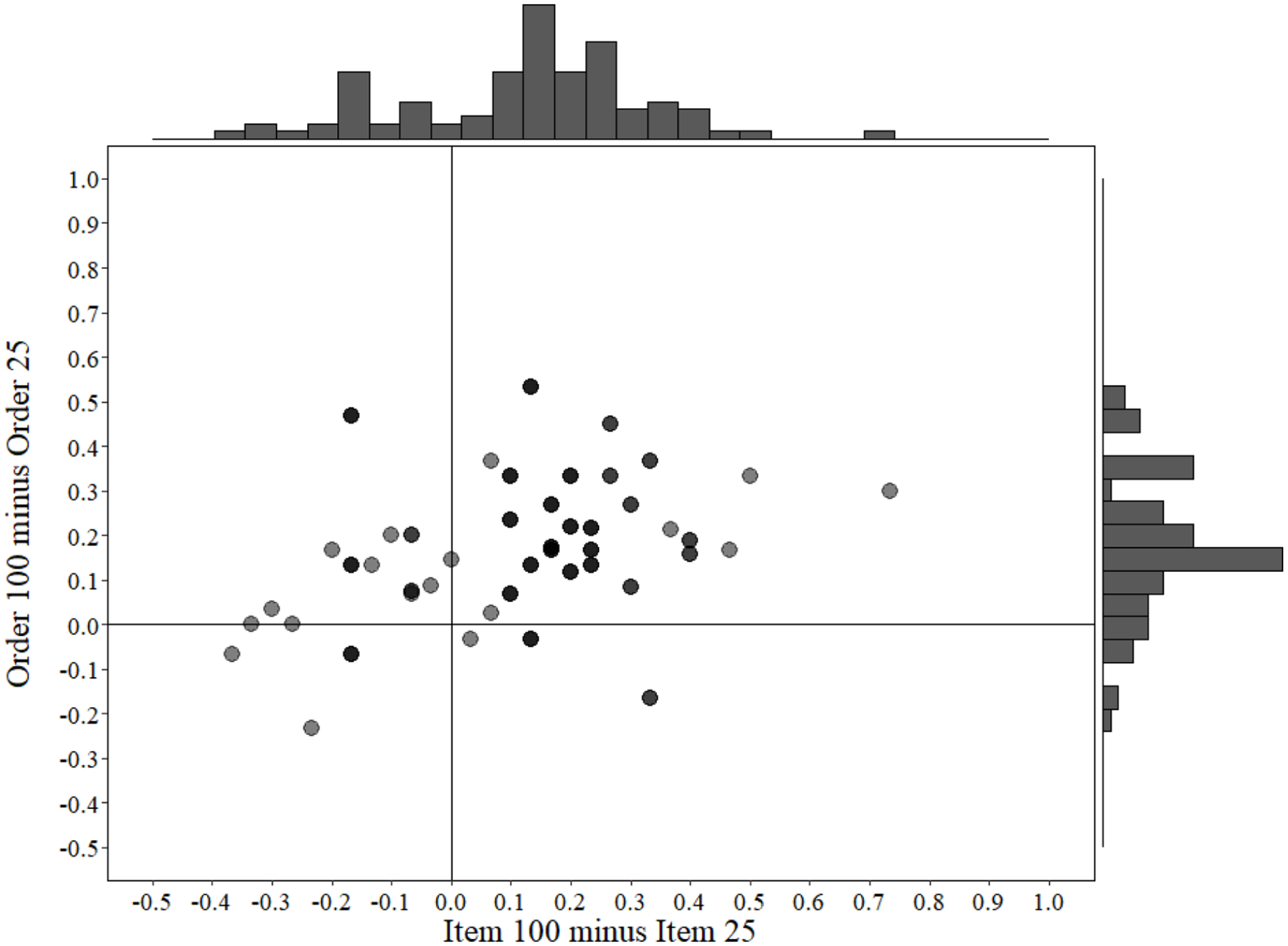
Order and item attentional tradeoff (difference between attentional condition 100 and attentional condition 25) for each participant in Experiment 1.
Discussion
Overall, the results of Experiment 1 were clear and provide further evidence that participants can prioritise encoding for an item or an order test as a function of task demands (Figures 2 and 3). They do so in a manner that includes an asymmetry, with undivided versus evenly divided attention making more of a difference for order (as illustrated by the difference between vertical lines in Figure 3) than for items (as illustrated by the difference between horizontal lines in Figure 3). Individual difference exploration (Figure 4) revealed that the magnitude of the tradeoff varied between participants, possibly reflecting differences in the ability to prioritise encoding for an item versus an order test. However, most of the participants had an attentional tradeoff consistent with the ability to prioritise encoding for an item or an order test.
The results did not, however, match any of the preregistered hypotheses. In particular, as Figure 3 shows, the results of a (75% item, 25% order) allocation were nearly identical to the results of a 50–50 allocation, presenting an instance in which attention allocation apparently cannot be finely adjusted.
A limitation of this experiment is that the fragments may serve as a cue to items, in contrast to the order reconstruction task that includes no cue to order. The existence of this item cue potentially could be the reason why there was an asymmetry between the effects of attention division between item and order tasks. The fragment reconstruction task was used because it was found to minimise performance differences between item and order tests. Although this performance matching effort was successful, the nature of the fragment reconstruction task would allow participants to limit the quantity of item information needed for that test. Experiment 2 addresses this potential concern by replacing fragment completion with a free recall task.
To determine whether the fragment cues caused the asymmetry between item and order performance and/or caused the incomplete separation of attention conditions shown in Figure 3, we conducted a second experiment in which the item task was free recall. If all asymmetry disappears, we will learn that item and order types of information have equal roles in dual-task performance. If it persists, they will be shown to have unequal roles, with order being more of a discretionary type of processing that requires full attention for best performance.
Experiment 2
Experiment 2 was identical to the first experiment except that the item test (previously fragment reconstruction) was replaced by a free recall task in which participants had to recall the items in any order they remembered. Unlike the first experiment, in which participants had retrieval cues for item information in the item test (words fragments: AI ++ P + CE for AIRSPACE), but no retrieval cues for order in the order test, in the present experiment neither the item test nor the order test provided retrieval cues. This experiment ensures that participants needed detailed item and order information to carry out the corresponding tasks.
Method
Participants
In Experiment 2, we used the same final sample size as in the first experiment. Therefore, another 120 volunteers from the online data collection agency, Prolific (https://www.prolific.co/), participated in this study. The inclusion criteria and the monetary compensation were the same. The mean age was 23.99 (SD = 3.47, range 18–30); 84 self-identified as female, 30 as male, and 6 preferred not to specify their gender. This study was also approved by the research ethics committee of the University of Missouri.
Materials, design, procedure and data analysis
The material, design, procedure, and data analyses were identical to Experiment 1 except for the following changes. First, the item fragment reconstruction task was replaced by a free recall task. For the item test, after the presentation of the last to-be-remembered word, participants had to follow the instruction to “Type all the words you remember in any order you would like.” That instruction was presented on the upper part of the screen in red as a recall cue. As before, participants were instructed to type the words on the keyboard and press the space bar to register their response after typing each word. In the order test, as in the first experiment, all the words from the list to be remembered were displayed on the screen, but not in the presented order, until the last word was typed and registered with the space bar.
For the data analysis, a free recall criterion was used for the item test. With that criterion, a response was considered correct if a word was recalled, independently of its recall position. In the order task, a word was counted correct only if it was correctly typed in the correct position.
Results
Overall accuracy
The proportions of correct responses as function of memory test and attentional condition are shown in Figure 5. As the figure illustrates, participants’ performance was superior in the order test (M = 0.63, SD = 0.16) relative to the item test (M = 0.44, SD = 0.16). In line with the results of Experiment 1, participants’ performance declined with reduced attention to the tested attribute: attentional condition 100 (M = 0.59, SD = 0.15), attentional condition 75 (M = 0.55, SD = 0.15), attentional condition 50 (M = 0.51, SD = 0.17), and attentional condition 25 (M = 0.45, SD = 0.18). The pattern of performance as function of attention condition was again different between the item and order tests. In this experiment, participants’ performance was equivalent for the attentional conditions 75 and 100 for the item test, whereas performance was equivalent between the attentional conditions 50 and 75 for the order test. The statistical support for this summary of the results is presented in the following section.
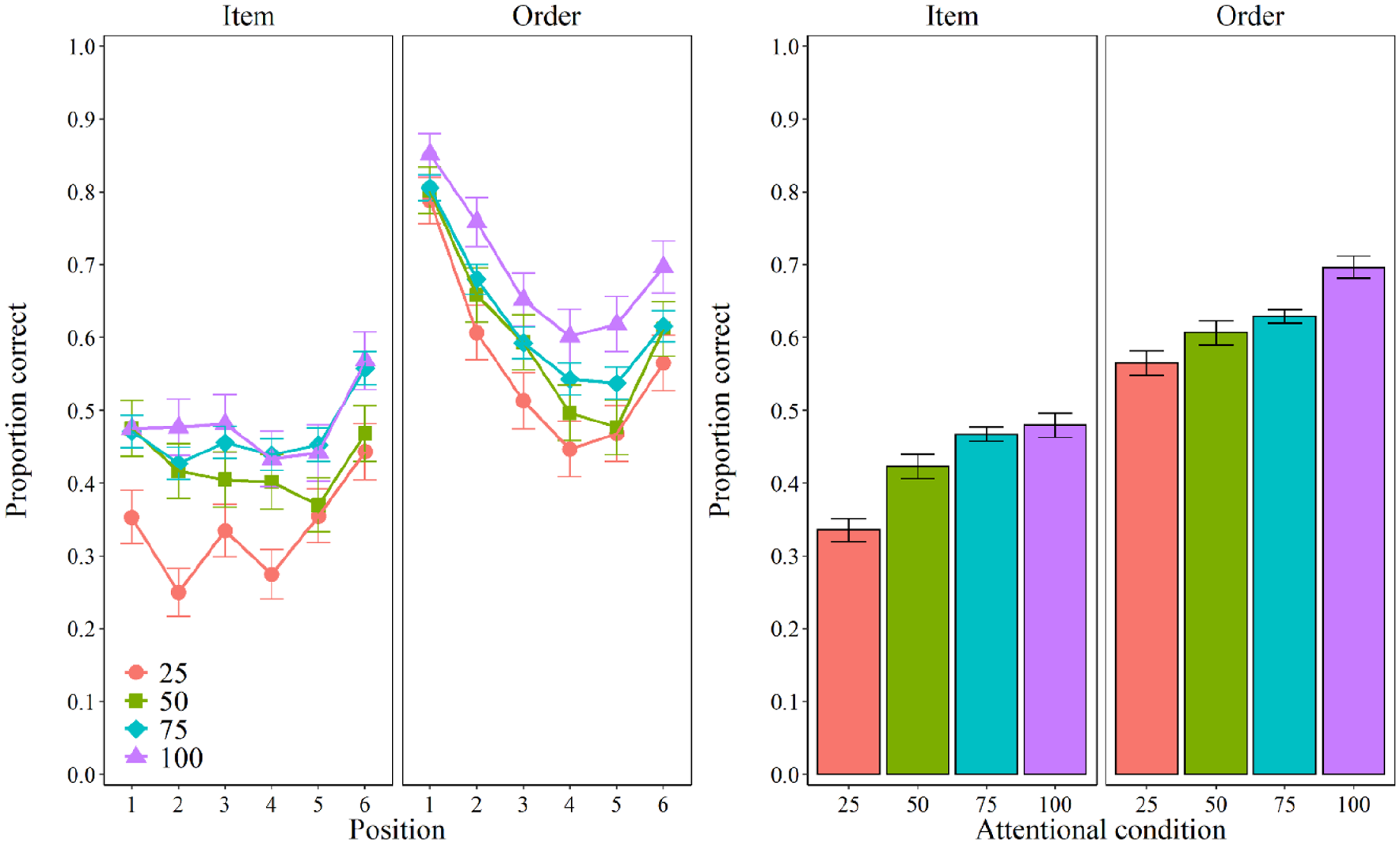
Proportion of correct response as a function of attentional condition (25, 50, 75, 100) and memory test (item test, order test) in Experiment 2.
These descriptive trends were confirmed via a repeated measures ANOVA with 2 memory tests (order test vs. item test) and 4 attentional conditions for each test (25 vs. 50 vs. 75 vs. 100). The results from the analysis revealed very strong evidence in favour of a main effect of the memory test, F(1,119) = 297.83,
Effects of attentional condition for the item test
For the item test, the one-way ANOVA with attentional condition as a fixed factor confirmed the variation between the attentional conditions, F(3,357) = 61.08,
As in the first experiment, these results from the item information test can be summarised for comparisons of adjacent positions with a notation in which “>” corresponds to a BF10 > 3 and “=” corresponds to a BF01 > 3. For adjacent conditions of item information, the result is 100 = 75 > 50 > 25.
Effects of attentional condition for the order test
For the order test, the one-way ANOVA with attentional condition as a fixed factor further confirmed the variation between the attentional conditions, F(3,357) = 24.14,
For order, the result for adjacent conditions is 100 > 75 = 50 > 25. Thus, whereas the item test shows comparable performance between the 100 and 75 conditions, the order test shows comparable performance between the 75 and 50 conditions. As the following section indicates, there are similarities and differences from the first experiment.
Exploratory analyses
Performance operating characteristic
As in the first experiment, we present a performance operating characteristic function (Figure 6) of the results. Unlike the first experiment, the present one shows performance that changes systematically between all attention allocation conditions, a psychometrically more regular outcome. Despite this more systematic result, an asymmetry between item and order performance remains, namely in the finding that the difference between 75% and 100% allocation was much larger for order (difference between vertical lines; M = 0.07, SD = 0.16) than for items (difference between horizontal lines; M = 0.01, SD = 0.10), Cohen’s d = .28, BF10 = 8.84. An opposing asymmetry is seen, however, in the finding that the difference between 75% and 25% is larger for items (difference between horizontal lines; M = 0.13, SD = 0.14), than for order (difference between vertical lines; M = 0.06, SD = 0.16), Cohen’s d = .33, BF10 = 47.79.

Performance operating characteristic for order versus item test proportions correct as a function of the attentional allocation condition (from left to right, 100–0, 75–25, 50–50, 25–75, and 0–100 conditions) in Experiment 2.
Individual differences
As in the first experiment, we examined individual performance variation in the allocation of attention between participants in Figure 7. The figure shows that, despite variation in the magnitude of the tradeoff, almost all participants show an attentional tradeoff for item and order tests. The figure shows that the asymmetry of Experiment 1 is no longer the case, inasmuch as the failure to show a tradeoff is more equally distributed across items and order (upper-left vs. lower-right quadrants). Bear in mind, though, that there was still an asymmetry of attention allocation as shown in Figure 6. The individual-difference results provide further evidence that most participants can optimise encoding for one attribute at the expense of another.
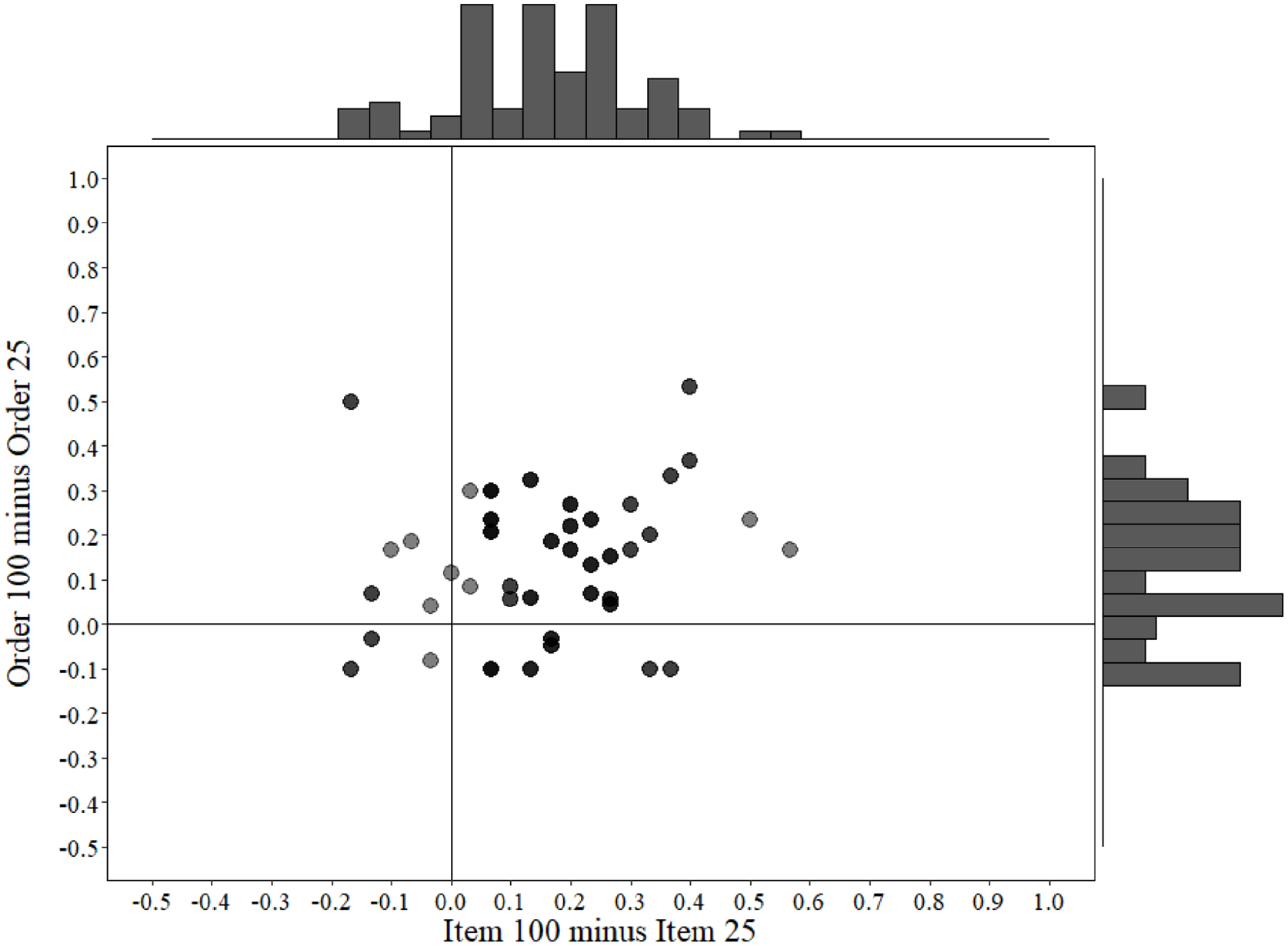
Order and item attentional tradeoff (difference between attentional condition 100 and attentional condition 25) for each participant in Experiment 2.
Discussion
In this experiment, in which we used a free recall task in place of the fragment reconstruction task of the first experiment, performance changed systematically between all attention allocation conditions (see Figures 4 and 5). Participants were able to prioritise encoding for an item or an order test as a function of the task demands. Once again, most participants show that attentional tradeoff for both the item and the order test, indicating that preparing for one attribute comes at the expense of performance on the other attribute. Moreover, once again there was an asymmetry between item and order information. There was a larger difference between attention allocation conditions 75 and 100 for order than for items. This result suggests that the need to be prepared for the item task, free recall, inevitably detracted from the kind of encoding that assists in order performance (compared with order-alone processing: compare the vertical lines in Figure 6), whereas in the opposite case, it was possible to prepare to some extent for order with almost no effect on item performance (compared with item-alone processing: compare the horizontal lines in Figure 6).
General discussion
In this study, our aim was to better understand how much control participants have over the encoding process of item and order information in short-term memory via two experiments. We have explored this important theoretical question by manipulating the distribution in each trial block of an item task (a fragment reconstruction task in Experiment 1; a free recall task in Experiment 2) versus an order task (order reconstruction in both experiments). Each attribute was tested in 25%, 50%, 75%, or 100% of the trials in a given trial block (e.g., 25% item tests and 75% order tests in a particular block). Overall, our results are clear. Participants were able to allocate their attention in a manner that takes into account the task demands, and there was a larger dual-attention cost for order information than for item information when the 100% item and 100% order conditions are compared with particular levels of divided attention (Figures 4 and 7). This latter finding replicates and extends the asymmetry observed by Guitard et al. (2021, 2022). Importantly, an asymmetrical dual-attention tradeoff was observed in Experiment 1, where performance between the item and order test was equivalent, and in Experiment 2 where the clues to items were removed and performance to the item test was largely inferior. This pattern across experiments rules out an alternative account based on task difficulty (see also Guitard et al., 2022 for additional converging evidence). Nevertheless, we have obtained the patterns of results for item and order information that were difficult to reconcile with our very specific preregistered hypotheses.
In Experiment 1, participants’ item performance can be described as follows: 100% > 75% = 50% > 25%; and their order performance can be described as follows: 100% > 75% > 50% = 25%. This means that there was no difference for either task between the 25 item, 75 order condition and the 50–50 condition. Apparently, participants allocated attention in essentially the same way in these two conditions.
In Experiment 2, participants’ performance can be described as follows: for items, 100% = 75% > 50% > 25% and for order, 100% > 75% = 50% > 25%. Interestingly, these results do not correspond to a particular equivalence between two different allocations, as was the case in Experiment 1. For the order task, dividing attention at all is harmful. For items, attention can be divided with the order task, albeit unevenly (75 item, 25 order condition) with no loss of item performance. However, larger shifts of attention to the order task do impact item performance severely. In those cases, perhaps participants use only a partial description of each word, such as the first letter of each word, to maintain the order of words, and therefore lack detailed item information in working memory.
Although these patterns differ by experiment (Figures 3 vs. 5), they both show an asymmetry in which more attention is needed generally for the maximal performance in order tasks, with less severe consequences of dividing attention for the item tasks. However, the exact pattern is shown to be dependent on task demands. In Experiment 2, between the 75–25 and 25–75 conditions, the allocation actually changes item performance more than order performance (see Figure 6), an exception to the overall direction of the asymmetries we have described.
In what follows, we discuss the implications of the findings for our preregistered hypotheses, some of which have merit, but none of which anticipated all aspects of the results. We then go on to consider the relation to previous work, the manner in which we believe that attention allocation could underlie the present results and, finally, priorities for future research.
Implications for a priori hypotheses
No one hypothesis that we preregistered can explain all of our results, though there are aspects of the hypotheses that were confirmed. The implications of the results for the three hypotheses are as follows:
H1 stated that attention can be allocated in an all-or-none manner or can be split evenly, but cannot be split unevenly. Although this hypothesis was not generally confirmed, it is consistent with the equivalence in Experiment 1 between the 75 item, 25 order condition and 50–50 condition.
H2 stated that attention can be fully allocated as a function of the task demands. Although there were many differences between the allocation conditions, there were equivalences too, so this hypothesis was not entirely confirmed, though it works for Experiment 2.
H3 stated that attention can be fully allocated as a function of task demands, but that discretionary processing for order information is more demanding than item discretionary processing. Mostly, the results support this hypothesis, as shown in Figures 3 and 5 by the horizontal and vertical lines, though there is an exception: the finding that the shift in allocation between the 75–25 and 25–75 conditions in Experiment 2 had a larger effect on item performance than on order performance.
Relation to previous work
Our results are in line with the findings of Guitard et al. (2021, 2022), showing that instructions to prepare for either an item or an order test affect order performance more than item performance. Our results are also consistent with the numerous behavioural and neurological dissociation between item and order information (see Majerus, 2019 for a review). Similar results were also obtained by Hockley and Cristi (1996) in an incidental memory test in which participants sometimes prepared for and immediately took an associative test of a list, but later had to carry out an unexpected test of items in the same list, or vice versa (i.e., an immediate item test followed by an unexpected associative test). Performance on an unexpected associative test for a list was relatively poor, whereas performance on an unexpected item test was relatively good, even when it was associations that had been studied and recalled previously. Apparently, considerable item information is saved along with associative information. A limitation in their procedure for the present purposes, however, is that the item encoding task was one that would have discouraged the use of associative information (forming separate images or sentences for each word), whereas the associative encoding task was one that might have encouraged the use of item information (learning pairs of words). In line with the current study and the results of Hockley and Cristi, the results of Duncan and Murdock (2000) have also shown that, when participants were 10 to 30 times more likely to receive an item test (recognition), performance in serial recall was greatly affected. Overall, these studies further highlight the participants’ ability to allocate their attention as a function of task demands.
It is also important to note that it remains unclear under what conditions associations between items, or between items and positions, might be used as retrieval cues for the items (e.g., Bhatarah et al., 2008; Henson et al., 1996; Logan & Cox, 2022; Osth & Hurlstone, 2022; von Wright, 1977; von Wright & Meretoja, 1975). If some order information was helpful for items, and if it happened to be some of the same order information that is useful for an order task, this could explain how attention could be divided between item and order tasks without a noticeable cost to item performance (e.g., in Experiment 2, the similarity in item performance with 100% vs. 75% attention allocation to items). However, further work is needed to confirm this interpretation of the results.
Accounting for strategic attentional allocation
Although none of our preregistered hypotheses can fully predict the patterns of results observed, the results provide valuable insight into how participants can allocate their attention between item and order information as a function of task demands. In this section, we describe how we can account for the pattern of strategic attention allocation by calling upon simple assumptions and the resource-sharing hypothesis of Guitard et al. (2022). In this section, we discuss first the distinction between non-discretionary and discretionary encoding of information and then the types of discretionary encoding and maintenance that may occur, with the tradeoff between item and order information residing in the discretionary stage.
Non-discretionary and discretionary encoding
We adopt a dual-process view that includes both a non-discretionary encoding of a certain amount of information about items and order and an additional, discretionary amount that trades off between item and order in a manner depending on task demands. Participants, for both item and order tasks, presumably first encode and maintain non-discretionary, rudimentary information about both items and their order. This non-discretionary process is important as it allows us to account for the limited dual-task cost for the item test in a dual-list procedure (Guitard et al., 2021), and for the limited magnitude of the dual-task costs generally: doubling the number of items that must be processed by presenting two lists does not cut the item or order capacity for each list in half, so additional information must be processed and saved without consuming that capacity. There are also numerous findings showing that item test performance is based on some order information, such as in free recall (e.g., Bhatarah et al., 2008), so it appears that some item and order information are encoded for both tasks, with some amount of discretionary processing added on top of that, depending on the task.
Then, resources must be used to encode and maintain additional, discretionary item and order information according to the task. The attention devoted to a given attribute (e.g., order) increases the likelihood of performing well on a subsequent test of the same attribute (e.g., an order test). This resource-sharing view can account for the current set of findings by suggesting that the amount of attention devoted to discretionary coding of a certain attribute (order or item) is proportional to the percentage of trials of a given attribute in a block (e.g., 50% order test = 50% order encoding and 50% item encoding; 75% item test = 75% item encoding and 25% order encoding). In addition, it is suggested that the attention devoted to discretionary coding of a certain attribute (item or order) increases the performance to the more attended attribute. In addition, accumulation and maintenance of discretionary information would be more attentionally demanding for order information relative to item information (Guitard et al., 2021, 2022; for a related idea see Henderson & Matthews, 1970).
Encoding and maintenance discretionary processes
According to the resource-sharing hypothesis of Guitard et al. (2022), in discretionary processing, item and order types of information are based on distinct processes, but they share a common attentional resource that must be allocated as a function of task demands. The locus of the common attentional resource has not yet been fully identified, but we can postulate the presence of attentional resources shared between items and order that can limit the encoding and maintenance of item and order discretionary information.
In an attentional encoding limit, encoding discretionary information into memory requires attention and that additional attention can improve the quality of the memory representation. So, for example, when 100% of trials in a block are order tests, more attention is paid to order information at encoding than when item and order trials are mixed together in the same trial block, resulting in a superior order memory performance for the 100% condition. In an attentional maintenance limit, keeping discretionary information in an active state requires attention and if the level of the attention needed exceeds what is available, some information will be lost. In the present case, foreknowledge that one kind of attribute is to be prioritised can alter both the encoding and maintenance of the list. For example, in the 100% order condition the participant might both encode order more attentively and rehearse or refresh (Barrouillet & Camos, 2015) order more vigorously than in other conditions. It will take additional research to separate these two potential mechanisms.
A third potential limit that may come to mind is in the storage of item and order information. For example, Guitard et al. (2021) showed that preparing for one kind of test for two lists (both lists for item tests or both lists for order tests) impaired performance compared with a situation in which one list was encoded with the expectation of an item test and the other list was encoded with the expectation of an order test. It is unclear whether this effect is based on limited, partly separate storage mechanisms for item and order or on increased interference between lists when the same attribute is emphasised during encoding and maintenance for both lists. In any case, these storage limits cannot contribute to the tradeoff between items and order that we found because any such limit would reduce, not increase, the effects of attention allocation. For example, if one could not retain more than four position cues on a trial, then attending to all six positions carefully would lose its effectiveness when the storage limit was reached. The tradeoffs we have obtained therefore must occur in spite of, not because of, attribute-specific storage limits or interference observed by Guitard et al. (2021).
In sum, we have asked, “what are the processing assumptions needed to account for the relation between item and order information?” As we progress towards a better understanding of the relationship between item and order information in short-term memory, the series of processing assumptions needed will become clearer. However, our results in combination with our recent demonstrations (Guitard et al., 2021, 2022) allow us to make initial recommendations: (1) item and order information are based on distinct processes (Majerus, 2009, 2019), but are not fully independent; (2) there are non-discretionary and discretionary types of processing of order and item information; (3) for the discretionary information, item and order information share a limited attentional resource that must be divided as a function of task demand, at encoding and maintenance; and (4) order information is more attentionally demanding than item information.
Priorities for future research
In future work, one high priority is to understand the cognitive mechanisms by which the graduated allotment of attention affects item and order processing. For example, in the recent and present studies, it is not yet clear whether a proportion of attentional allotment translates to a proportion of time on task, or whether there are certain critical phases of processing in which attention is needed for best performance, without the ability to compensate for a degree of inattention after that. Another priority is to learn what participants do explicitly to improve item encoding (e.g., attending to the exact spelling of a word or its meaning) or order encoding (e.g., attending to item-to-item transitions or item-to-position associations). Yet another priority is to delineate the locus (encoding, maintenance, or both) of the common resource between encoding and maintenance of item and order information. Future studies could also examine other factors that might have contributed to the particularity of our results, such as perceived task difficulty. It is possible that participants prepare as a function of the task they perceived to be more difficult rather than following the encoding instruction. However, this factor seems unlikely to account for all our results, as we have found again a larger dual-attention cost at higher attentional allocation conditions for order information than for items in Experiment 2, despite a largely inferior performance for the item test, presumably perceived as a more difficult task. Future studies could also examine more closely which factor can better account for the individual variation in magnitude of the dual-attention cost between item and order information.
It is important to note that the current results provide further constraints on short-term memory models. As highlighted in Guitard et al. (2022), the systematic presence of a tradeoff between item and order information is difficult to reconcile with computational and theoretical models that do not have distinct mechanisms for item versus order processing (see, for example, Farrell & Lewandowsky, 2002; Lee & Estes, 1981; Page & Norris, 1998; Poirier et al., 2015). Without a mechanism to optimise order information at the expense of item information or vice versa, a strict prediction of these models is an absence of tradeoffs between item and order information. Therefore, without some modification, these models are unable to account for our current and past results (Guitard et al., 2021, 2022).
Conversely, our current results provide additional evidence in favour of computational and theoretical models with distinct mechanisms for item and order information (see, for example, Brown et al., 2007; Estes, 1997; Majerus, 2009; Murdock, 1997). Within these models, distinct mechanisms are used for item and order information that are linked by a shared attentional system or limit. In these models, optimising encoding for one attribute at the expense of the other is possible because additional attention to one attribute results in less attention available for the other attribute. By adjusting the allocation of attention between item and order information, these models might account for our results and those in recent research (Guitard et al., 2021, 2022).
None of the models have directly attempted to explain the tradeoff between item and order information within a list observed in a gross form by Guitard et al. (2022) and a finer-grained form here. Nevertheless, many of our assumptions are present in, or could be accommodated by, theoretical models (e.g., Cowan, 2019; Majerus, 2009, 2019) and computational models (e.g., Brown et al., 2007; Murdock, 1997). To explore such models is a priority for future work.
The exact function of the allocation of attention across conditions might also depend on the combination of the distribution of trials in a block and the instructions given to participants. For example, in our Experiment 1 we found near-equivalent performance levels for (50% item, 50% order) and (75% item, 25% order) conditions, suggesting the same allocation of attention in both instances. In future work, if participants were instructed explicitly to distribution attention according to the distribution of trials in the block, perhaps equivalencies like this could be eliminated.
An important direction for future research might be to examine whether the roles of attention in item and order memory observed in the current study at the list level can also occur at the word level. Our results are consistent with numerous letter position coding theories of visual word recognition that have shown that letter position and letter identity are two distinct kinds of information that contribute to the identification of a word (e.g., Estes, 1975; Gomez et al., 2008; Lee & Estes, 1977; Logan, 1996; Ratcliff, 1981). In line with our results, the position of the letters is essential to account for key findings in visual word recognition (see, for example, Perea & Lupker, 2004) and it is inadequate to assume that letter order is perfectly encoded with the presentation of a word, just as it is inadequate to assume that word order is perfectly encoded when a series of words are presented (Gomez et al., 2008). Some evidence has also been shown that attention is especially important for encoding the positions of letters, compared with the identity of the letters (Davis & Coltheart, 2002), in keeping with our results at the level of word list memory.
Finally, another important direction is to ensure that our results are not specific to the intrinsic characteristics of the tasks that we used for item and order tests. As noted in the introduction, pure item and order tasks are unlikely to exist (Neath, 1997). For instance, although participants are not required to recall items in order in a free recall task, careful analyses of output order often suggest that order information is also involved to some level in this task (Healey et al., 2019; Kahana, 1996) and order information is included in many models of free recall to account for benchmark findings (e.g., Howard & Kahana, 2002; Sirotin et al., 2005). Therefore, in future work we plan to further investigate the allocation of attention between item and order information by developing tasks that maximise the necessity of prioritising one attribute over the other.
Conclusion
We have recently shown that studying the relationship between item and order information in short-term memory has important practical and theoretical ramifications (Guitard et al., 2021, 2022). Here, we further our understanding of this complex relationship between item and order information by systematically manipulating the percentage of trials in which participants received an order test or an item test. Overall, we have found that participants have control over their allocation of attention and can strategically allocate it as a function of task demands. These results can be accounted for by a series of simple processing assumptions implemented in the resource-sharing hypothesis. The present results provide further evidence against a class of models that assume that order information is a result of item encoding (e.g., Farrell & Lewandowsky, 2002; Lee & Estes, 1981; Page & Norris, 1998; Poirier et al., 2015). The results provide evidence in favour of a class of models that assume that item and order information are based on distinct processes but linked by a common, limited attentional resource (e.g., Brown et al., 2007; Majerus, 2009).
Footnotes
Declaration of conflicting interests
The author(s) declared no potential conflicts of interest with respect to the research, authorship, and/or publication of this article.
Funding
The author(s) disclosed receipt of the following financial support for the research, authorship, and/or publication of this article: This research was supported by NIH Grant R01-HD21338 to N.C. and while working on this article, D.G. was supported by a postdoctoral fellowship from the Natural Sciences and Engineering Research Council of Canada.
