




Abstract
Research on the gender-congruency effect in speech production across languages suggests that access to grammatical gender during production is modulated by language-specific properties. The present study extends this line of research by seeking evidence for linguistic idiosyncratic influence on gender processing, however, from a within language comparison. Accordingly, it investigated the processing of gender information of Hebrew inanimate nouns from a foreign origin that do not have the typical morphologically complex Semitic structure of Hebrew nouns. The findings were evaluated in relation to previous findings derived from typical native Hebrew nouns. Gender processing was studied through the picture-word-interference (PWI) paradigm for estimating the gender-congruency effect induced by presenting a spoken distractor word of the same or of a different gender of the picture to be named. Across two experiments naming latency, for bare nouns (Exp. 1) and noun phrases (Exp. 2) revealed a different pattern of results from the pattern previously found for typical native inanimate Hebrew nouns—an inhibitory gender-congruency effect for feminine nouns only, but no congruency effect for masculine nouns. The unique pattern observed for this group of words reflects the high sensitivity of the linguistic system, in terms of gender processing, to the basic morphological structure of words. Thus, even within a language, the linguistic processor accommodates itself to item-specific properties. It is suggested that the specific pattern of the results reflects the attempt of the system to assimilate deviant forms within existing procedures on the basis of a flexible criterion of similarity.
Keywords
Introduction
A common notion in models of psycholinguistics is that various linguistic processes are shaped and modulated by language-specific properties (e.g., Franck et al., 2008). One of the domains in which linguistic processing exhibits sensitivity to idiosyncratic properties of language is the processing of grammatical gender and the assignment of grammatical gender agreement during language production. (e.g., findings in Germanic languages like Dutch, e.g., Schriefers, 1993, and German, e.g., Schriefers & Teruel, 2000, versus findings in Romance languages like European Portuguese, Sá-Leite et al., 2021, Italian, Cubelli et al., 2005, and Spanish, Paolieri et al., 2010. (See Jescheniak et al., 2014, for a review and Sá-Leite et al., 2022, for a meta-analysis.) Previous research on accessing gender information and the production of gender agreement in Hebrew accords with this notion. In particular, comparison between different types of Hebrew words, which share a typical Semitic structure but differ in terms of the morpho-phonological instantiation of their gender feature, revealed different behaviours with respect to gender processing, thus demonstrating the influence of language-specific properties on the general linguistic principle of gender agreement (Dank & Deutsch, 2015; Deutsch & Dank, 2019). The present study extends this line of research by examining the processing of words that do not have the typical Semitic morphological structure of Hebrew, mostly words of foreign linguistic origin. In line with previous findings (detailed below), we predicted that this type of word would expose a different behavioural pattern during the processing of gender information due to the difference in their basic linguistic structures. The idea that Hebrew speakers’ linguistic system developed a unique procedure for words with non-typical Semitic structure has been previously demonstrated in other examples of language processing, particularly in the domain of visual word recognition (Velan et al., 2013; Velan & Frost, 2011) and recently also in the domain of spoken word recognition (Lador-Weizman & Deutsch, 2022). Thus, obtaining evidence from the domain of language production is an important step towards generalising this operational principle of the linguistic system. The case of gender in Hebrew is intriguing, as the non-typical, non-native Hebrew words are phonologically similar to native Hebrew words with respect to gender ending, but not in their formal internal structure. The discovery of a different processing algorithm for this type of word will exemplify speakers’ high sensitivity to the presumed structural morphological characteristics of words, thus demonstrating the central role of morphology in governing the process of grammatical gender assignment during language production.
Grammatical gender is an abstract feature that is assigned to nouns in many languages of various linguistic families and forms syntactic agreement between the noun and other elements in its phrasal and/or sentential context. However, languages differ in the way in which gender is morphologically and syntactically instantiated; it might be morphologically instantiated in the morpho-phonological form of a word. This is the case, e.g., in Italian, where masculine and feminine forms are usually marked by the suffix /o/ or /a/, respectively, as in the words “castell
A common way of studying the process of gender representation and the implementation of gender agreement is via the gender congruency effect. Gender congruency refers to the influence of the gender feature of a content word on the production of a target word. This effect is frequently researched using the picture-word interference paradigm (hereafter: PWI), in which participants are asked to name a picture, which serves as the target stimulus while ignoring a word (written or spoken), which serves as a distractor stimulus. The distractor appears close in time to the target’s appearance (before, simultaneously with or after the target). This paradigm is usually implemented in the context of single words or phrases in which gender agreement is required, such as when participants are required to produce an adjective + noun phrase or a determiner + noun phrase (e.g., La Heij et al., 1998; Schriefers et al., 2002). Although the paradigm reveals a clear gender congruency effect in various languages from different linguistic families—Indo-European languages including Romance (e.g., European Portuguese, Italian, Spanish, French), Germanic (e.g., Dutch, German), and Slavic (e.g., Czech and Croatian), and Semitic languages (Hebrew)—cumulative evidence seems to indicate that the manifestation of the effect depends on language-specific characteristics (for reviews, see Jescheniak et al., 2014; Sá-Leite et al., 2022; Wang & Schiller, 2019). The effect varies between a facilitative congruency effect—i.e., gender congruency between target and distractor facilitates target naming relative to an incongruent distractor, as is typical under certain conditions in Germanic languages (La Heij et al., 1998; Schiller & Caramazza, 2003; Schriefers, 1993; Schriefers & Teruel, 2000; Starreveld & La Heij, 2004, but see Sá-Leite et al., 2021, for a facilitatory effect in a Roman language)—and an inhibitory effect, as seen under certain conditions in Romance languages (e.g., Cubelli et al., 2005; Paolieri et al., 2010; but see Finocchiaro et al., 2011). Apparently, the emergence of the gender effect and specifically its direction (facilitative or inhibitory), as well as the influence of contextual factors on its emergence (whether it is evident only when syntactic gender agreement is required or only for bare nouns) is equivocal. A meta-analysis conducted on previous findings in European languages (Sá-Leite et al., 2022) revealed a moderately significant facilitatory effect for Germanic languages and a less stable inhibition effect for Romance languages. In accordance with this line of research, findings on the gender congruency effect in Hebrew using the PWI paradigm provided a unique pattern of results, as detailed below.
Inspection of the way in which grammatical gender is marked in Hebrew leads to the hypothesis that Hebrew uses its rich morphological system to denote conceptual distinctions of gender marking for animate and inanimate entities. In particular, it has been hypothesised that Hebrew utilises the distinction between inflectional and derivational morphological systems to convey the conceptual difference between an arbitrary grammatical feature of gender that characterises the gender feature of inanimate nouns and a conceptual notion of natural gender that is assimilated in the gender feature of animate nouns. In particular, the gender feature of animate nouns is morphologically instantiated by the morphological inflectional system, similarly to the common way in which grammatical gender (across animacy types) is expressed in Romance languages (Deutsch & Dank, 2019), whereas the gender of inanimate nouns is denoted via the derivational system. This suggestion has been examined by predicting different manifestations of the gender congruency effect induced by animate and inanimate nouns in Hebrew. We will now continue with a brief explanation of the typical Semitic structure of native Hebrew words and of the marking of animate and inanimate nouns for grammatical gender.
A brief description of the typical structure of Hebrew words with Semitic origin and the manifestation of the gender congruency effect for typical native Hebrew nouns
Hebrew nouns (as well as verbs) are typically morphologically complex structures consisting of two basic derivational morphemes: a consonantal root and a word-pattern (nominal or verbal). Roots usually consist of three consonants, whereas word-patterns consist of a cluster of vowels, or both consonants and vowels. These two morphemes are interwoven into a non-concatenated structure to produce words. This structure is common to most nouns and adjectives and to all verbs. For example, the word /matslema/ (“a camera”) consists of the root ts.l.m embedded in the nominal-pattern maCCeCa (the capital letter C represents the location of the root consonants). This complex structure constitutes the basic form (i.e., the stem) to which additional inflectional (and/or derivational) morphemes—prefixes and suffixes—can be attached. The roots carry the core meaning of the words, whereas the word-patterns have only global semantic characteristics, which usually modify the core meaning of the root. The main information carried by the pattern, however, is morpho-syntactic data (such as part of speech and verb sub-categorisation), as well as the specific prosodic and vocalic structure of the word.
Hebrew nouns are divided into two grammatical gender classes: feminine and masculine. For most feminine inanimate nouns and almost all animate nouns, feminine forms tend to end with a limited set of phonological elements: /a/, /et/, or /it/, whereas masculine forms have no distinctive ending elements. However, although these phonological elements may look superficially like inflectional markers shared by all nominal forms (animate and inanimate), this is not the case. In fact, most inanimate nouns in Hebrew do not have “masculine” and “feminine” counterparts. Thus, deleting the feminine phonological ending from an inanimate feminine form often does not lead to an existing word (like in the above example – */matslem/ is not a word). Animate nouns, however, are essentially different. Most words in this group frequently have masculine and feminine counterparts, both denoting the same conceptual entity, as in the pair of words /mazkir/ (masc., “a male secretary”) and /mazkira/ (fem., “a female secretary”). In the case of animate nouns, the construction of the animate feminine form might be described as the inflected form of the masculine base form. Thus, whereas the ending /a/ in the above example of /matslema/ (“a camera”) is an integral part of the nominal-pattern /maCCeCa/, the apparently identical ending of the word /mazkira/ is actually an inflectional suffix attached to the masculine unmarked stem composed of the pattern /maCCiC/ and the root z.k.r. 2 In other words, masculine-feminine pairs of animate nouns share the same word-pattern, which is inflected to produce the feminine marked counterpart (Schwarzwald, 2002). In contrast, masculine and feminine inanimate forms are derived from different nominal-patterns. Nonetheless, an important feature of all nominal word-patterns of inanimate nouns is the high correlation between word-patterns and grammatical gender, so that words derived from a particular pattern usually have the same grammatical gender. In other words, word-patterns can be a reliable cue for the gender specification of inanimate words. (For a more comprehensive description, see Dank & Deutsch, 2015.)
Application of the gender congruency effect on these two types of nouns in Hebrew, animate and inanimate, using the PWI paradigm revealed a different pattern of results for these two groups of nouns. In line with previous findings in Italian and Spanish in which the noun itself is inflected for gender, naming latency for animate nouns was longer in the presence of a spoken distractor of the same gender than in the presence of a control distractor that did not match the picture in its grammatical gender. This inhibitory gender congruency effect was observed for animate feminine nouns that are grammatically marked forms, as well as for animate masculine nouns that are grammatically unmarked forms. Furthermore, the inhibitory effect of the feminine marked forms did not depend on whether the distractor-target pair of words used the same feminine inflectional suffix (/a/, /it/ or /et/) or a different feminine suffix. In line with the competition account for inhibitory effects in the PWI paradigm, the observed inhibition was ascribed to a competitive process on a gender node shared by two nouns (distractor and target) of the same gender. In accordance with the common conceptualisation of the gender feature as an abstract grammatical feature, and in light of the insensitivity of the inhibitory effect to the morpho-phonological instantiation of the gender feature, it has been suggested that the assumed competition takes place at an abstract level of word presentation, commonly termed the “lemma” level of word presentation. Note that unlike previous findings in Romance languages, in which the inhibitory effect was mainly observed for bare nouns, but not when participants had to name the picture embedded within a gender-marked noun phrase, the inhibitory effect in Hebrew was present for animate bare nouns as well as for the production of animate nouns embedded within a gender-marked pronoun + noun phrase (see Deutsch & Dank, 2019, for more details). However, as predicted, no gender congruency was observed for inanimate nouns in Hebrew, neither for bare nor for gender-marked phrases (Dank & Deutsch, 2015). It has been suggested that in the case of inanimate Hebrew nouns, the gender feature is nested within the word-pattern morpheme, which is highly correlated with grammatical gender. In other words, gender information for inanimate nouns in Hebrew is cued by the derivational grammatical structure. Thus, the only congruency effect predicted for two inanimate nouns in the PWI paradigm is a word-pattern effect, but not a gender congruency effect, as has indeed been supported by previous studies in Hebrew (Dank & Deutsch, 2015; Deutsch & Malinovitch, 2016). This suggested architecture exemplifies how common conceptual distinctions are morphologically realised in a language-specific manner, leading to distinctive psycholinguistic behaviour.
Although the typical regular structure of Hebrew words is the one described above—a non-concatenated derivational structure of a root + word pattern—the Hebrew lexicon also contains inanimate nouns which do not have the root and word pattern structure described above, usually words that are not of Semitic origin. 3 However, being part of the lexicon of the Hebrew language, they are all assigned to one of two gender classes (masculine or feminine) and obey the gender agreement rules. Interestingly, these words, when specified as feminine, have the ending of the phoneme /a/, apparently the most typical of the three feminine suffixes that characterise nominal word-patterns, which are highly correlated with the feminine gender, as in the above example of the word /matslema/, “a camera,” conjugated with the word-pattern /maCCeCa/. This is, however, also one of the inflectional suffixes used to denote a feminine animate form, as in the above example /mazkira/, the female form of /mazkir/, “a secretary.” Thus, e.g., non-native Hebrew words, such as [rafsoda], meaning “a ferry,” and [nargila], meaning “narghileh,” are classified as feminine, whereas words classified as masculine do not have the typical /a/ ending, nor any other typical ending, such as in the examples of [Ɂotobus] meaning “a bus,” or [ʃokolad], meaning “chocolate.” This group of nouns includes words of varied origins. A common feature of all these words is that one cannot identify a nominal word-pattern in their structure, which presumably cues the gender of inanimate native Hebrew words. In the following, we will refer to this group of words as “morphologically simple” (in contrast to “morphologically complex” words, which refer to native Hebrew words), as they cannot be decomposed into a root and a word-pattern. Consequently, they do not seem to fit with the presentation and gender processing models assumed for native Hebrew words. An interesting question is how the system treats this group of words, among them very frequent words. 4
Seemingly, one may predict that the linguistic system treats the morphologically simple inanimate words exactly as it treats the morphologically complex, native inanimate Hebrew nouns, and subjects them to a single processing algorithm. This is because they both share the same semantic category of inanimate nouns. If this were the case, similar behaviour in the PWI paradigm would be expected both for inanimate, morphologically simple, foreign nouns and for inanimate, morphologically complex, typical native Hebrew nouns, i.e., no gender congruency effect between two inanimate nouns. However, this suggestion might be computationally inapplicable since the simple nouns do not contain a word-pattern and, consequently, cannot undergo the complete derivational procedure taking place in the production of complex, native inanimate nouns.
On the contrary, one may predict that because of the overt phonological form similarity—that is, /a/ ending for feminine forms and no overt suffix for masculine forms—the system might subject the foreign forms to the same algorithm applied to animate native Hebrew nouns. If this were the case, an inhibitory congruency effect for feminine as well as for masculine forms would be expected for inanimate foreign Hebrew nouns. However, the foreign nouns differ from the native Hebrew animate nouns both in the sense that they lack any conceptual meaning of natural sex that highly correlates with the grammatical gender and in the sense that their superficial seemingly form similarity is merely phonological, restricted only to the feminine forms. These nouns do not reveal the paradigmatic pairs of “unmarked masculine” nouns vs. “marked (by an ending /a/) feminine” noun.
An alternative third prediction might posit that this group of inanimate nouns of foreign origin, which in terms of their word form is morphologically simple, might exhibit a unique pattern of behaviour that would fit its grammatical structure. In particular, the foreign words seem to resemble the way in which grammatical gender is expressed in Romance languages like Italian, where the gender of inanimate words (as well as animate ones) is overtly marked on the word itself by a suffix. However, in Hebrew, unlike in Italian (and some other Romance languages), only the feminine forms are marked by distinctive endings. Accordingly, in line with previous findings in Italian (as well as in Spanish), we might expect a gender congruency effect for the marked forms, i.e., feminine words with the typical /a/ ending, but not for the unmarked forms, i.e., masculine words that lack a typical ending. The direction of the congruency influence might be inhibitory, in line with previous findings in Hebrew for feminine animate forms, as well as previous findings for marked nouns in Roman languages like Italian and Spanish. However, given recent results in European Portuguese (Sá-Leite et al., 2021), the marked form may reveal a facilitatory effect. Importantly, pursuing this line of thought, the allegedly unique behavioural pattern predicted for this group of words would be an asymmetry of the congruency effect for feminine versus masculine forms. Such a pattern of results in the gender congruency effect for these words would reveal the high sensitivity of the linguistic system, in terms of gender processing, to the basic morphological structure of words.
In the current study, we applied the same procedure used in our previous studies (Dank & Deutsch, 2015, 2018), but yet to feminine and masculine inanimate simple words, namely words that are not of Hebrew origin. In line with our previous investigation of native inanimate and animate Hebrew nouns with typical Semitic structure, in the present study we explore the gender-congruency effect in the context of the production of bare nouns (Experiment 1) and noun phrases (Experiment 2). In addition to our intention to follow the same line of research design that was used for native Hebrew complex nouns, the inclusion of these two variations—bare nouns and noun phrases—is of particular interest in the current study. This is because the expected inhibitory gender congruency effect for feminine nouns, similar to the inhibition effect that was observed in the Romance languages of Italian and Spanish, was found in these languages only in the production of bare nouns but not in the production of noun phrases (Costa et al., 1999; Cubelli et al., 2005; Miozzo & Caramazza, 1999).
General method for Experiments 1 and 2
Participants
Fifty participants took part in Experiment 1 (29 females), and another 50 different participants (28 females) took part in Experiment 2. All participants were native Hebrew speakers, graduate students in the age range of 20 to 25 years old. Participants were recruited for the experiments via a designated university website for registration to participate in experiments carried out by researchers at the Hebrew University. All students participated in the experiments for course credit or payment.
Stimuli and design
The stimuli consisted of 28 line drawings, each 10 cm × 10 cm. The descriptive name of each picture (hereafter, the targets) was a morphologically simple, non-derived nominal form. All the words denote concrete, inanimate objects. Half of the target words were singular masculine and the other half were singular feminine (hereinafter, target gender). Each target word was coupled with two different distractor words (hereinafter, congruency), creating two congruency conditions: (1) Congruent—both target and distractor were of the same gender; (2) Incongruent—the target and the distractor were of different genders.
All the distractors were singular nominal forms and were, like the targets, inanimate morphologically simple non-derived forms. No target rhymed or shared a first onset with any of its distractors. There was no semantic relatedness between any of the targets and their distractors. The frequency of the distractors was estimated via the word-frequency database for printed Hebrew (Frost & Plaut, 2005). The mean frequency (out of 1,000,000 words) for each of the distractors was 29.23, 30.86, 23.93, and 44.83, respectively. Due to the number of items, a non-parametric Kruskal–Wallis test was conducted to examine potential differences in frequency between the four conditions; however, no such effect was found: χ 2 (3) = 1.40, p > .1.
The distractors were recorded by a female, native Hebrew speaker. One set of stimuli is depicted in Table 1. The complete list of picture names and distractors is presented in the “Appendix” file in the online Supplementary Materials.
Examples of one set of stimuli used in Experiments 1 and 2, including phonological transcription in diagonal brackets and English translation in round brackets.
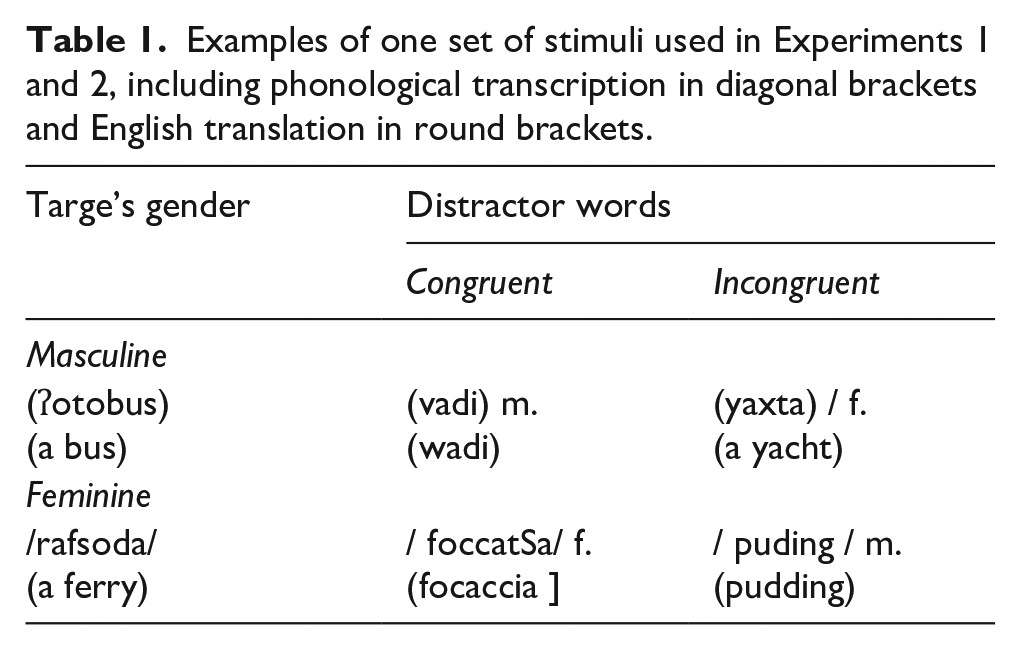
Each picture was coupled with two distractor words—a congruent distractor and an incongruent distractor—creating 56 couples, 28 in a congruent condition and 28 in an incongruent condition. The 56 target–distractor couples were divided into two blocks, with each block including all 28 target pictures in one of the congruency conditions. Half of the targets (14) within each block were in the congruent condition and the other half were in the incongruent condition. The target pictures within one block were randomly preordered. The same order was kept for the two blocks. The two blocks were combined to create two experimental lists which differ from each other in the order in which the two blocks appear in the list (List 1—block 1 followed by block 2, and vice versa for List 2). A within-subject design was used, so that each participant saw all the target pictures in each of the two congruency conditions. Half of the participants were tested in List 1 and half of the participants were tested in List 2. Thus, the order in which each picture appeared in each of the two congruency conditions was counterbalanced across subjects.
Experiment 1: production of Bare Nouns
Procedure and apparatus
The pictures were presented on a MicroScan 4GP/ADI monitor. The spoken distractors were presented via Microsoft LifeChatLX-300 headphones connected to an Intel Celeron computer. Each trial consisted of the presentation of a spoken distractor and a picture to be named. Each picture remained on the screen for 800 ms. The spoken distractor and the target picture were presented simultaneously.
There was an ISI of 4000 ms between the onsets of the pictures. The participants were instructed to ignore the spoken word and name the picture. Naming latencies were monitored via a voice key. Response accuracy was monitored manually by the experimenter. After reading the instructions and before starting the experiment, participants provided written informed consent.
The experiment started with a practice session in which the participants were given a booklet with all the drawings (for the experiment and the practice sessions) and their descriptive names. Each participant was tested individually by the experimenter after studying the names of the pictures. Then the participants were asked to go over the booklet again if necessary, and only after they had named all the pictures correctly did the experiment start.
There were six practice trials. The experimental session lasted approximately 10 min. (Ethics approval was provided by Ethics Committee of the School of Education of the Hebrew University, #2021Y1104.)
Results and discussion
Three items (#3, #20, and #26) were omitted from the analyses due to high error rates of 25% or more. After the item removal, 3 participants (#2, #507, and #517) were excluded from the analyses due to an unusually high percentage of errors, above 40% (46%, 44%, and 48%, respectively). Thus, the subsequent data reports and analyses of Experiment 1 are based on 47 participants.
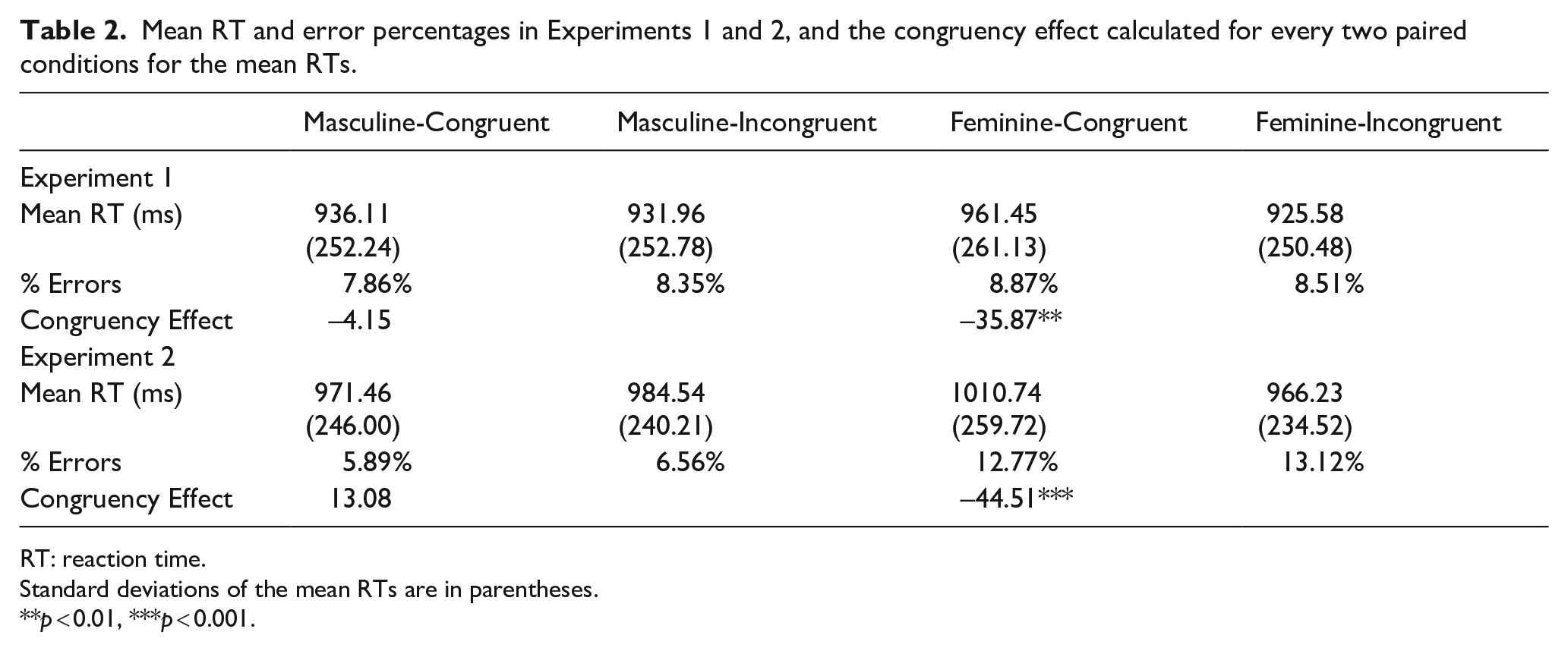
There were 198 trials in which participants misnamed the picture. These trials were coded as errors and discarded from the reaction time (RT) analyses. The percentages of errors are reported in Table 2. After omitting the erroneous trials, RTs data were checked for trials with very short (less than 300 ms) or very long (greater than 2,000 ms) reaction times. Thirty-two such deviant data points were omitted from the analysis. The total number of omitted trials due to errors and extremely short/long RTs (after the exclusion of 3 participants and 3 items) constituted 9.79% of the experimental trials.
Mean RT and error percentages in Experiments 1 and 2, and the congruency effect calculated for every two paired conditions for the mean RTs.
RT: reaction time.
Standard deviations of the mean RTs are in parentheses.
RTs were log transformed (log(RT)) to better meet the mathematical assumptions of normality and homoscedasticity of the data (Baayen & Milin, 2010; Schmidt, 2020). Log RTs were submitted to a linear mixed-effects analysis using the “lmerTest” (Kuznetsova et al., 2017) supplement to the “lme4” package (Bates, Maechler, et al., 2015) and the “emmeans” package (Lenth, 2016) for computing the paired comparisons. Effect sizes were approximated with the “effectsize” package (Ben-Shachar et al., 2020), and are reported in terms of partial eta square.
Fixed effects were gender congruency (congruent; incongruent), target’s grammatical gender (masculine, feminine), and their interaction. The variables were coded in a sum-contrast scheme.
Random intercepts were included for participants and items. Inclusion of random slopes for participants and/or items for the factors of congruency and/or target’s grammatical gender usually did not allow the model to converge or caused it to converge to a boundary solution where the correlation matrix of the random effects was singular. Following the recommendations of Matuschek et al. (2017) and Bates, Kliegl, et al. (2015) for a “maximal-parsimonious” random effect structure to balance between type 1 error and power concerns, within those models that did converge, we have chosen the model (specified above) whose random structure has passed the likelihood ratio criterion to guarantee a random effect structure that is supported by the data. (More specifically, this model was compared with an alternative model that included in its random structure congruency slope by item.)
After fitting the model, extreme outliers with a standardised residual at a distance greater than 2.5 SD were removed from the data, and the same model was refitted. This resulted in the exclusion of 55 more trials. The RTs for the correct responses in the congruent and incongruent conditions for masculine and feminine targets were then re-calculated. For presentation considerations, the new means were then re-transformed into row values and are reported in Table 2. The means indicate that gender congruency between the feminine target and the spoken distractor induced a prominent slowdown in picture naming (36 ms) relative to the incongruent target-distractor condition. However, no influence of gender congruency was observed for the masculine nouns (–4 ms).
To better assess the overall effect of each of the fixed variables, an analysis of variance (ANOVA)-like analysis was conducted, using the Satterthwaite method for estimating the degrees of freedom. The Kenward–Roger method was also employed, but due to the consistently extremely close similarity resemblance in the results, only the former is reported. In line with the observation above, a significant congruency effect was revealed: F(1, 1,992.2) = 4.79, MSE = .139, p < .05, partial η 2 = .002. However, no target’s grammatical gender effect was revealed: F < 1. More importantly, a reliable interaction effect of the target’s grammatical gender by congruency was observed: F(1, 1,992.2) = 6.06, MSE = .175, p < .05, partial η 2 = .003. Pairwise comparisons to elucidate the interaction effect revealed a significant inhibitory influence of gender congruency on picture naming latency within the feminine target words: t(1,992.2) = 3.29, p < .01, partial η 2 = .005, with no significant difference within masculine target words: t < 1. The absence of a congruency effect for the masculine forms was further verified by a Bayesian analysis within the masculine targets. Specifically, no congruency effect was observed: χ 2 < 1. The current Bayesian analysis, as well as the following analyses, was performed using the blme function of the BLME package (http://cran.nexr.com/web/packages/blme/index.html).
A post hoc power analysis with the simR package (Green & MacLeod, 2016), given the observed effect size for the interaction effect, revealed a power of 72.50%.
The error trials were coded in a binary manner, and were assessed by generalised linear mixed analyses, with the same fixed variables used in the reaction time analysis, subjects’ and items’ random intercepts, as well as the target’s gender by subject slope. The “car” package (Fox & Weisberg, 2019) was used to assess the effects. However, no such effects were found — neither for congruency (χ 2 < 1), target’s grammatical gender, χ 2 (1) = 1.29, p > .1, nor for the interaction effect between the two variables (χ 2 < 1).
The data files, the code, and the tables of the linear mixed model results of Exp. 1 are provided in the supplementary materials (Supplementary Tables 1 and 2).
In sum, the results reveal an asymmetry regarding the appearance of the gender congruency effect for feminine versus masculine morphologically simple nouns. This asymmetry is evident by a reliable interaction effect, which reflects a statistically significant slowdown in producing the names of feminine nouns accompanied by a gender-congruent distractor word, but with no such effect for masculine forms. Experiment 2 replicated Experiment 1, with the only difference being that picture names were to be produced within the context of a noun phrase, as detailed in the following.
Experiment 2: production of noun phrases
In this experiment, we tested the gender congruency effect in a gender sensitive context. Thus, in this experiment participants were asked to name the target objects by producing noun phrase. Following our previous studies, participants were instructed to use proximal demonstrative to denote target pictures. Hebrew has two such demonstratives for singular nouns, one for each grammatical gender (/ze/ and /zo/ for masculine and feminine words, respectively). Within a noun phrase, the proximal demonstrative precedes the noun.
The stimuli, design, and apparatus were the same as in Experiment 1, except for the variation in the instruction.
Results and discussion
To allow close comparison between Experiments 1 and 2, the same 3 items that were omitted from the analysis of Experiment 1 were also omitted from Experiment 2. After the exclusion of the items, 3 participants (#607, #612, #615) were excluded from the analyses due to an unusually high percentage of errors (40%, 52%, and 48%, respectively). Thus, the subsequent data reports and analyses of Experiment 2 are based on 47 participants.
There were 222 trials in which participants misnamed the picture and/or the voice-key was incorrectly triggered. As in Experiment 1, these trials were coded as errors and discarded from the reaction time (RT) analyses. The percentages of errors are reported in Table 2. The results were then checked for trials with very short (less than 300 ms) or very long (greater than 2,000 ms) reaction times. Forty-nine results were discarded from the analysis. The omitted trials (errors and extremely short or long RTs) constituted (after the exclusion of three participants and three items) 11.54% of the experimental trials.
Log transformed RTs were submitted to the same model that was used in Experiment 1, i.e., with congruency and the target’s grammatical gender together with their interaction as fixed effects, as well as random intercepts for participants and items. 5 Extreme outliers with a standardised residual at a distance greater than 2.5 SD were removed from the data, and the same model was refitted. This resulted in the exclusion of 45 more trials. The RTs for the correct responses and the percentage of errors in the four experimental conditions were then re-calculated and are reported in Table 2.
The means reveal a similar pattern of results that was observed in Experiment 1, i.e., a noticeable inhibition effect of about 45 ms (like the inhibition effect observed in Exp.1) for the feminine targets, whereas in the masculine nouns there was a notably smaller difference (13 ms) between congruent and incongruent distractors, and in the opposite direction.
In spite of the similar pattern to Experiment 1, the difference between the congruent and incongruent conditions was unreliable: F(1, 1,960.12) = 2.48, MSE = .062, p < .1 . As in Experiment 1, a target’s grammatical gender did not result in a significant effect: F < 1. However, and most importantly, a reliable interaction effect between gender congruency and target gender was observed: F(1, 1,960.11) = 12.22, MSE = .304, p < .001, partial η 2 = .006. A post hoc power analysis with the simR package (Green & MacLeod, 2016), given the observed effect size for the interaction effect, revealed a power of 95.5%.
As in Experiment 1, planned comparisons revealed that the source of the congruency effect was the difference between the two congruency conditions within the feminine targets: t(1,960.4) = 3.64, p < .001, partial η 2 = .007, but not within the masculine ones: t(1,960.2) = –1.21, p > .1.
The absence of a congruency effect for the masculine forms was further verified by a Bayesian analysis within the masculine targets. Specifically, no congruency effect was observed: χ 2 (1) = 1.53, p > .1.
There were more errors in the feminine conditions compared with the masculine ones. As in Experiment 1, they were coded in a binary manner (errors vs. correct response) and were assessed by generalised linear mixed analyses, with the same fixed variables used in the reaction time analysis, subjects’ and items’ random intercepts, as well as target’s gender by subject slope. The analysis (using a Wald chi-square test) revealed a reliable target’s gender main effect, χ 2 (1) = 5.75 p < .05, but neither a congruency effect nor an interaction effect (χ 2 < 1). Pairwise comparisons with the Tukey correction revealed a marginally significant effect within the congruent conditions: z = 2.33, p = .09. The effect did not reach significance within the incongruent conditions: z = 2.14, p > .1.
The data files, the code, and the tables of the linear mixed model results of Exp. 2 are provided in the supplementary materials (Supplementary Tables 3 and 4).
A combined analysis of Exp. 1 and Exp. 2
To directly compare between the patterns of the influence of the congruency factor in both experiments, we combined the data from Experiments 1 and 2 and repeated the analysis, this time with the inclusion of the context factor, i.e., a bare noun (Exp. 1) or nominal phrase (Exp. 2). Items and participants omitted from the previous analyses were also omitted from the current combined analysis.
Log-transformed RTs were submitted to a linear mixed-effects model, with the fixed effects of congruency, gender, and context (i.e., experiment), together with their interactions, as well as a random intercept for participants and a random intercept together with random context slope by items. 6 Extreme data points were removed from the data according to the same procedure applied in Exp. 1.
The combined analysis revealed a significant congruency effect: F(1, 3,960.9) = 7.56, MSE = .203, p > .01, partial η 2 = .002, and in line with the previous findings, no target gender effect was observed (F < 1). No context effect was found either: F(1, 99.5) = 1.73, MSE = .046, p > .1. However, and as expected, the analysis revealed a significant interaction effect between a target’s gender and congruency: F(1, 3,950.9) = 15.95, MSE = .427, p < .0001, partial η 2 = .004. A post hoc power analysis with the simR package (Green & MacLeod, 2016), given the observed effect size for the interaction effect across the two experiments, revealed a power of 95.50%.
The source of the congruency effect was within the feminine targets: t(3,951.3) = 4.81, p < .0001, partial η 2 = .006, but not within the masculine ones: t < 1. The context factor did not interact with either of the other factors of congruency or targets’ gender, Fs < 1. The absence of a congruency effect for the masculine forms in the combined dataset was further verified by a Bayesian analysis within the masculine targets. Specifically, no congruency effect was observed: χ 2 < 1.
The code and the tables of the linear mixed model results of the combined analysis of Exp. 1 + Exp. 2 are provided in the supplementary materials (Supplementary Table 5).
General discussion
The present study investigated the gender congruency effect for a specific group of words, words which are of foreign origin and therefore are not structured according to the regular typical Semitic morphological structure of other nouns in the language. Specifically, it focused on the manifestation of gender congruency effects within non-native, morphologically simple, inanimate nouns in Hebrew, which do not have the typical complex Semitic morphological structure of a consonantal root morpheme embedded within a vowel (or vowel + consonants) nominal-pattern morpheme. The study continued previous studies in Hebrew where the gender effect for typical animate and inanimate native Hebrew nouns was examined using the PWI paradigm to manipulate the grammatical gender congruency between target names and their spoken distractors while measuring naming latency (and accuracy) for naming the pictures. Using exactly the same paradigm, the results of the present study revealed an inhibitory gender congruency effect for feminine inanimate nouns, but no congruency effect for masculine nouns. Thus, the naming latency of pictures representing inanimate entities denoted by grammatically feminine nouns accompanied by a spoken animate distractor of the same gender was longer than for a control distractor that did not match the picture name in grammatical gender. However, distractor-target congruency did not affect the picture naming of entities denoted by grammatically masculine nouns. The same pattern of results was replicated across two experiments in which pictures were produced as bare nouns (Exp. 1) or in the context of a noun phrase of a proximal demonstrative + noun (Exp. 2). The power of the results varies between 73% (Exp. 1) and 96% (Exp. 2 and for the combined analysis of Experiments 1 and 2).
The inhibitory effect observed for the feminine words resembles the inhibitory effect observed for native animate (feminine and masculine) Hebrew nouns (Deutsch & Dank, 2019), whereas the absence of any influence of distractor-target gender congruency for masculine forms resembles the results for the gender congruency effect of complex inanimate Hebrew nouns, feminine and masculine (Dank & Deutsch, 2015). This observation is supported by two post hoc analyses. In these analyses, we compared: (1) the influence of the congruency factor on targets’ naming latency that was observed in the current study for feminine, inanimate, simple words with the influence that was observed on the naming latency of feminine, animate, complex native Hebrew words in our former study (Deutsch & Dank, 2019); and (2) the influence of the congruency factor on targets’ naming latency observed in the current study for masculine, inanimate, simple words and the influence observed on the naming latency of masculine, inanimate, complex words native to Hebrew words in our former study (Deutsch & Dank, 2019). Indeed, these analyses revealed (1) a significant inhibitory congruency effect for feminine words of 34.68 ms, F(1, 1,946) = 21.33, MSE = .596 p < .001, with no interaction between the factor of congruency and type of words (F < 1); and (2) no congruency effect for masculine forms (a difference of 0 ms, F < 1), with no interaction between the factor of congruency and type of words (F < 1).
Thus, the present results seem to accord with our “third” alternative delineated in the introduction, whereby feminine and masculine simple words will show a different pattern because of differences in their form: Only simple inanimate feminine nouns which resemble in their form the marked feminine inflected native Hebrew animate forms were expected to reveal a congruency effect (an inhibitory one), but no congruency effect was predicted for simple masculine forms. In any case, the deviating pattern of behaviour of this simple inanimate group of words from the pattern observed for complex inanimate nouns reveals the high sensitivity of the linguistic system, in terms of gender processing, to the basic morphological structure of words. These results add to previous findings (mentioned in the introduction), revealing a different behaviour of processing Hebrew words that do not have the typical Semitic structure, thus demonstrating the sensitivity of the linguistic processor to the internal structure of words.
Our interpretation of the results adopts the postulated architecture common to central models of production (Levelt et al., 1999, the WEAVER++; see also Dell, 1986, 1988, and Roelofs, 1992, 1997), according to which word production entails two phases: (1) a lemma retrieval, that is an abstract representation of a word’s grammatical characteristics which is connected to a higher level of the notional meaning; and (2) a word-form retrieval, that is the translation of the lemma into a morpho-phonological form. We would like to suggest that the system of native Hebrew speakers develops a distinct route for processing the gender feature of foreign words within the phase of word-form retrieval. Whereas the system ascribes the lemmas of typical Hebrew nouns to one of two different processing routes—a derivational or an inflection-based route—on the basis of the conceptual distinction of animacy, the third, a distinct route for foreign words, treats these words on a form-based principle. If the system would have ascribed this group of lemmas to a conceptual criterion, as is the case with complex native Hebrew nouns, these nouns would not have shown a gender congruency effect, similarly to inanimate complex native Hebrew nouns.
The absence of gender congruency effects for inanimate complex nouns in Hebrew was previously explained on the basis of their derivational complex morphological internal structure, so that the gender feature of these words is assimilated into the specific word-pattern of any specific word. Since each single word-pattern is typically highly correlated with one of two grammatical genders, the abstract gender specification of any inanimate, complex Hebrew noun is overtly cued via its word-pattern (Dank & Deutsch, 2015). This procedure is apparently not applicable to the inanimate simple nouns (i.e., the inanimate words of foreign origin in the present study), since they do not go through this derivational compositional process. Thus, their abstract gender features must be phonologically mapped differently.
We would like to suggest that this route, devoting priority to words with form peculiarities, continues to treat these words on the basis of their form. Accordingly, the feminine lemmas of this group of simple nouns are subjected to the inflectional procedure of the animate native Hebrew words. This is due to their phonological ending with the phoneme /a/, which is a very frequent feminine marker of the vast majority of Hebrew complex words—animate (for which /a/ is one of the most typical feminine inflectional suffix), as well as inanimate (for which /a/ is one of the most common endings of nominal patterns that usually constitute feminine nouns). As the derivational route is not applicable to these simple nouns, the system probably diverts these feminine lemmas to the inflectional procedure which normally serves the typical animate native Hebrew words. In line with the explanation of the inhibitory gender congruency effect observed in some other Romance languages in which nominal forms are gender inflected (Cubelli et al., 2005; Paolieri et al., 2010), the inhibitory congruency effect for typical animate native Hebrew nouns was previously explained as a result of a competitive process between the distractor and the target on a gender feature. The competition was ascribed to the lemma level rather than to a competition for a specific phonological segment at the form-word level, as the same inhibitory gender congruency effect was found irrespective of the phonological similarity between the feminine suffix of the target and the distractor. (Note that for feminine animate native Hebrew nouns there are three different feminine suffixes.) Furthermore, if the locus of the congruency effect had been on the phonological instantiation of the abstract gender feature, we would have expected even a facilitatory effect, as phonological similarity in the PWI paradigm usually results in a facilitation of target naming by a phonologically related distractor (e.g., Damian & Martin, 1999; Meyer, 1996; Schriefers et al., 1990; for findings in Hebrew, Deutsch & Meir, 2011). Clearly, the present case of the inanimate morphologically simple words is not a genuine inflectional process analogous to the case for animate native Hebrew nouns, where each inflected noun has its counterpart form which is derived from the same lemma. Thus, the applicability of the inflectional route developed for animate native Hebrew nouns is only partial and does not hold for masculine inanimate simple nouns. These lemmas are probably not ascribed to this procedure, as there is presumably no cue—neither conceptual nor phonological—that diverts them along this route. We suggest that these forms are treated by the system as “lexical atoms,” as it is suggested in the case of Dutch, where gender instantiation takes place only via agreement rules of the determiner or adjectival nouns (La Heij et al., 1998; Schriefers, 1993). 7 To summarise, we suggest that non-typical, simple forms of foreign origin are addressed by a third route integrating two procedures: in the case of feminine nouns, a competitive procedure on an abstract gender feature which in turn is mapped into an inflectional morpheme (similar to the procedure observed in other inflected languages) is applied; and in the case of masculine nouns—the abstract gender feature is explicitly manifested indirectly only via agreement rules, as is the case in some Germanic languages, where no morpho-phonological form process is applied through the word-form base. Apparently, the motivating power of this specific route specially devoted to non-typical words is anchored in the peculiarity of these words within the context of typical Hebrew words.
The inanimate non-native nouns in Hebrew represent, in fact, a substantial group of irregular words with respect to their structure. Irregularity is a common phenomenon in many languages of the world, and this example might exemplify how linguistic systems handle irregularity. The suggested architecture may allegedly look like a drawback of the system, like having a “patch” added to the regular procedure, thus harming its elegance. However, we believe that the ability of the linguistic processor to adapt to changes (as in our example, the Hebrew language evolved, and speakers incorporated new words with atypical structures into their language) and converge into a distinct computational solution for a structurally different group of words may reveal the system’s sensitivity as well as flexibility—an advantageous characteristic (and one may argue, even essential) of the linguistic system.
In this regard, we will mention an interesting finding that was observed consistently across all manifestations of the gender congruency effect in Hebrew: in all studies in Hebrew, a similar pattern of behaviour is observed, whether gender congruency is manipulated in the context of bare nouns or in the context of gender-marked noun phrases. This behaviour deviates from common findings in Indo-European languages, where the gender congruency effect revealed in the PWI paradigm commonly interacts with the production context: that is, a free agreeing element (such as a pronoun or determiner) used in the production of a noun phrase affects the observed effect induced by the distractor-target gender congruency. The direction of this interaction varies between languages just as the manifestation of the gender congruency effect itself varies across languages, as was described in the introduction. In general, the facilitative gender congruency effect observed in some Germanic languages seems to diminish in the context of bare nouns (La Heij et al., 1998; Schiller & Caramazza, 2003; Schriefers, 1993; Starreveld & La Heij, 2004) whereas the inhibiting congruity effect observed in some Romance languages seems to hold for bare nouns only, but diminishes in the context of gender-marked phrases (e.g., Cubelli et al., 2005; Miozzo & Caramazza, 1999; Miozzo et al., 2002, but see Sá-Leite et al., 2021, for a facilitative effect). This documented interaction motivated various modifications of the theoretical models devoted to explaining gender marking and the production of gender agreement, up to the relatively radical view that the gender congruency effect is in fact a determiner-selection effect (Caramazza et al., 2001; Schiller & Caramaza, 2003; Schiller & Costa, 2006), given that the effect is observed only for gender-marked determiner + noun phrase in some Indo-European languages (but see Jescheniak & Schriefers, 1999; Schriefers et al., 2002; Schriefers & Teruel, 1998). However, at least in Hebrew, there is no indication of this type of interaction, so that the influence of gender congruity between a distractor and a target word is not affected by a pre-activated free agreement element used by the speaker to produce a noun phrase. In our previous studies examining the gender congruency effect for typical morphologically complex native Hebrew words (Dank & Deutsch, 2015; Deutsch & Dank, 2019), we hypothesised that, given the prominent role of morphological structure in the organisation and accessing of the mental lexicon of Hebrew, the gender congruency effect is mainly governed by morphological processes taking place at the form level, which may mask any other, probably weaker effects (Deutsch & Dank, 2019). Although the morpho-phonological process applied to the gender manifestation of simple, non- native Hebrewl words is different from the procedures assumed for typical native Hebrew words, as described above, the strategy where morphological factors govern the process of gender manifestation during production seems to be generalised also for non-native, simple words, thus revealing no effect of contextual factors on the manifestation of the gender congruency effect.
How sensitive and adaptive is the linguistic processor? The unique pattern observed for this group of words strengthens the general claim that the linguistic algorithm for gender processing is modulated by language specific properties, as suggested by cross-linguistic comparisons, including data from Hebrew. However, the results of the present study show even greater sensitivity that is at the item level within the language, as the linguistic processor accommodates itself to item-specific properties. A similar pattern of behaviour was recently reported in Maltese, a language with a mixed vocabulary that includes both words of Semitic origin (Arabic) and words of Indo-European origin (Sicilian Italian). These two groups of words differ in the way in which diminutive forms are constructed, using a templatic structure for Semitic-originated words and an inflectional suffix for Indo-European-originated words. Using a production task, where participants had to produce a diminutive form for pseudo-words that resembled in their structure Maltese words from either a Semitic or Indo-European origin, Drake (2018) demonstrated that the way in which participants chose to produce the diminutive form reflected their sensitivity to the pseudo-word structure.
The observed different patterns for feminine and masculine inanimate simple nouns may reflect the system’s attempt to assimilate structurally deviant forms into existing common procedures on the basis of similarity (in this specific case, a phonological similarity among the feminine nouns). This manner of operation releases the system from the need to rely on memory-stored, idiosyncratic information for specific words. This operation is apparently impossible for the masculine non-native inanimate simple words, as it seems there is no common feature between this group of words and the “regular” typical complex native Hebrew nouns that can allow the accommodation of the non-native group within existing procedures. Although we do not have data to give us an accurate characterisation of this group of nouns with respect to its exact size and age of acquisition, as a group, these words undoubtedly represent a small group of words (less than 10%–15% as detailed above) relative to the vast majority of regular, native Hebrew nouns. Given this asymmetry in group size, it is very probable that the system has learned to identify these nouns and channel them to a unique route for the process of phonologically instantiating their abstract gender feature.
Supplemental Material
sj-pdf-1-qjp-10.1177_17470218221125156 – Supplemental material for Phonological instantiation of grammatical gender in the course of production is sensitive to words’ internal structure
Supplemental material, sj-pdf-1-qjp-10.1177_17470218221125156 for Phonological instantiation of grammatical gender in the course of production is sensitive to words’ internal structure by Maya Dank and Avital Deutsch in Quarterly Journal of Experimental Psychology
Footnotes
Declaration of conflicting interests
The author(s) declared the following potential conflicts of interest with respect to the research, authorship, and/or publication of this article: Avital Deutsch is supported by The Barbara and Morton Mandel Cathedra in Education.
Funding
The author(s) received no financial support for the research, authorship, and/or publication of this article.
Supplementary material
The supplementary material is available at qjep.sagepub.com

Notes
References
Supplementary Material
Please find the following supplemental material available below.
For Open Access articles published under a Creative Commons License, all supplemental material carries the same license as the article it is associated with.
For non-Open Access articles published, all supplemental material carries a non-exclusive license, and permission requests for re-use of supplemental material or any part of supplemental material shall be sent directly to the copyright owner as specified in the copyright notice associated with the article.
