




Abstract
In a series of five experiments, we provided evidence that evoking the market mindset negatively affects trust. We found that the market mindset reduces trust compared with the communal mindset (Experiment 1) and a neutral condition (Experiment 2). Next, we examined the psychological mechanisms behind the detrimental effect of the market mindset on trust and found that this effect was mediated by enhanced proportional thinking (Experiments 3 and 4) and reduced state empathy (Experiments 4 and 5). Finally, in a preregistered Experiment 5, we showed that these two psychological mechanisms are relatively independent.
Keywords
Introduction
People’s relationships vary with respect to characteristics such as intimacy, closeness, degree of interdependence, strength of emotions, and expectations (Berscheid, 1994; Berscheid & Regan, 2016). One of the most widely cited typologies of social relationships was introduced by Fiske (1991, 2004) and Fiske and Haslam (2005), who proposed that people might represent relationships with others as communal sharing, equality matching, authority ranking, or market pricing. Specific relational context is associated with the norms that govern behaviour insofar as how people respond to each other and regulate their actions depends on the type of relationship (Fiske, 1992). In other words, different types of relationships invoke different mental inclinations that we define here as mindsets (e.g., the market mindset is invoked by people’s exposure to market relationships) which, in turn, can influence the way people think, feel, and behave.
We propose that one of the elements of our social life that can be sensitive to the mindset evoked by a specific relationship is trust. We explore how people’s willingness to trust others depends on their exposure to market-pricing relationships. Our results suggest that interpreting social reality through the prism of the market mindset—an archetype of rationality and self-efficiency (Fiske & Haslam, 2005; Persky, 1995; Zaki et al., 2021)—has a hampering effect on interpersonal trust in line with some common-sense predictions. We also investigate the psychological mechanisms behind this effect. First, we demonstrate that the detrimental effect of the market mindset on trust may result from market cognition being based on proportionality, which means that it is directed towards calculating and acting in accordance with ratios and rates (Fiske, 2004; Rai & Fiske, 2011; Zaleskiewicz et al., 2020). Second, we show that the effect we examine may also be driven by the fact that the market mindset reduces people’s empathy (Wang et al., 2021).
Although we are interested in the effect of market pricing sociality on interpersonal trust, we do not claim that other relational models described in Fiske’s theory—communal sharing, equality matching, and authority ranking—are not involved in regulating people’s trusting decisions. We principally focus on the specific role of market relationships because one of the common characteristics of the contemporary world is the increasing commonness of market-like practices that have an impact on a broad spectrum of social interactions, even if these interactions extend beyond the realm of market transactions (Bauman, 2007; Kasser, 2016; Kasser et al., 2007; Sandel, 2013; Stanfield & Stanfield, 1997).
Market relationships and their expected effect on trust
The contemporary consumer reality causes people to repeatedly establish relationships that are referred to as “market relations” (Fiske, 1991, 2004; Kasser et al., 2007; Sandel, 2013; Stanfield & Stanfield, 1997). As Fiske (1992) proposed almost 30 years ago, Market pricing is so pervasive in Western society and so important in the Western cultural conceptions of human nature and society that many theorists have postulated that all human social behavior is based on more or less rational calculations of cost-benefit ratios in self-interested exchange. (p. 706)
When people engage in market relationships, they use a distinctive “mental grammar” that could be denominated as “market cognition” (Zaki et al., 2021). In the present work, we use the term “market mindset” to describe mental attributes people use to cognise, evaluate, and coordinate with each other and suggest that those with such a mindset primarily care about how much they get out of their investment and whether the repayment would be of comparable value. 1
Market relationships are often interpreted as being in opposition to communal relationships in which people focus more on commonalities than on distinct features and individual goals (Fiske, 1992; McGraw & Tetlock, 2005). As Fiske (1992) suggested, the fact that people in a communal relationship recognise a shared identity makes them “think that it is natural to be relatively kind and altruistic to people of their own kind” (p. 691). The psychological characteristics that are typical of communal sharing are caring, kindness, altruism, and selfless generosity (Fiske, 1992, Table 1). In contrast, thinking in terms of the market mindset emphasises independence, individualistic efficiency, and self-control. Prior evidence indicates that market relationships do not allow for intimacy and emotional connectedness (Jiang et al., 2014; Mead & Stuppy, 2014; Vohs, 2015)—the qualities which could be considered as indispensable for showing trust (Mikulincer, 1998; Rempel et al., 1985). For example, Ma-Kellams and Blascovich (2013) found that when financial incentives were involved in a relationship, people tended to reveal reduced empathic accuracy. Furthermore, Molinsky et al. (2012) showed in a series of experiments that activating economic schemas had a negative effect on the compassion that people extended to others.
Trust involves having positive expectations of others and relying on their actions, despite uncertainty and a lack of control over their intentions and behaviour (Rousseau et al., 1998). This suggests that being trustful might facilitate and accelerate the building and regulating of relationships not only in a communal context but also in a transactional, market-related environment. As suggested by Arrow (1972) in one of his classical papers, “Virtually every commercial transaction has within itself an element of trust” (p. 357). Fukuyama (1995) indicated that trust is good for the economy because it significantly reduces transaction costs. Yet a careful analysis of some psychological features of market relationships suggests that trust might not function in concert with thinking in terms of the market mindset. For example, when someone lends a car to their friend (communal relationship), they trust it will be returned on time and in good condition. If a car is rented from a car rental business (market relationship), the salesperson will not rely on trust but will require a renter to sign a formal contract. Similarly, if consumers purchase different products (market relationship), they probably would prefer a formal guarantee that these products will be repaired quickly in the case of a defect rather than relying on the seller’s trustworthiness. On the contrary, in an intimate relationship, people prefer to trust one another to be faithful rather than signing a written contract clearly stating what would happen in the case of cheating (e.g., by introducing a system of fines and regulations). Therefore, even if trust may facilitate some transactions (Choi & Storr, 2020), we suggest that the market mindset does not make people spontaneously ready to trust others, especially when the situation goes beyond the strict market-related context.
Prior research that was not directly aimed at testing Fiske’s Relational models’ theory has shown that the market mindset signifies not only a preference for efficiency and structure but also the individualistic orientation towards effective but self-interested exchange (Caruso et al., 2013; Zaleskiewicz & Gasiorowska, 2017). In a similar vein, numerous studies using the money-priming paradigm have indicated that exposure to money—a prototypical medium of market pricing relations (Fiske, 1992)—and feelings of self-efficacy and self-sufficiency (Gasiorowska et al., 2016; Mukherjee et al., 2013; Vohs et al., 2006) strengthen the focus on self and impair a person’s propensity to take the perspective of others (Caruso et al., 2009), which may have a detrimental effect on decision-makers’ readiness to trust. If people with a salient market-type thinking believe that others are strongly motivated to endorse their own profits even at the cost of the interaction partners, they might be reluctant to show trust. Moreover, people can even suspect that if money is involved in social relations, trusting is highly risky because others would be eager to cheat to gain more. Indeed, prior evidence suggests that money primes (or wealth primes) unethical activities, such as lying to interaction partners to obtain higher profits or fraudulently overstating performance to receive better earnings (Gino & Pierce, 2009; Kouchaki et al., 2013; Piff et al., 2012). Connecting the market mindset with a reduced willingness to trust others also seems consistent with a common eagerness to associate money with greed, distrust, selfishness, suspiciousness, or evil (Furnham et al., 2014; Tang, 1992; Vohs, 2015; Wernimont & Fitzpatrick, 1972; Yang et al., 2013). Taking all this into account, we propose that the exposure to market relationships will cause people to show less trust compared with the exposure to nonmarket stimuli.
Although some evidence suggests a detrimental effect of market cognition on trust (e.g., Xin & Liu, 2013), the detailed mechanisms behind this effect have surprisingly never been explored. In this project, we propose two psychological mechanisms that could explain why the market mindset hampers trust: amplified proportional thinking and a reduced state empathy—both inevitably related to market cognition (Zaki et al., 2021; Zaleskiewicz et al., 2017, 2020). In the following section, we elaborate more on these two processes that might operate when an individual with the market mindset considers whether to trust another person or not.
Proportional thinking
Market relationships are based on clear, comprehensible rules which give people insight into the situation (Fiske, 1992, 2004). Market pricing ideology “presupposes a rationally calculating person operating in a predictable world of formally expressed expediential and moral rules; the conditions of action must be knowable, and outcome expectations must be calculable” (Fiske, 1992, p. 708). As previously noted, the core element present within market relationships is proportional thinking “directed toward calculating and acting in accord with ratios or rates for otherwise distinct goods to ensure that rewards or punishments for each party are proportional to their costs, contributions, effort, merit, or guilt” (Rai & Fiske, 2011, p. 64). All these characteristics may suggest that involvement in market relationships leaves little space for trust in the sense of both trusting and being trusted. On the one hand, thinking in terms of the market mindset is associated with the search for and orientation toward explicitly known and formally stated rules and proportions (Fiske, 2004; Gasiorowska & Zaleskiewicz, 2021; Zaleskiewicz et al., 2020). On the other hand, everyday encounters that require trust are rarely well-structured or predictable and do not supply clearly defined proportions between gains and losses that are highly valued in market exchanges. What is more, as the intentions of others are typically vague and hard to recognise, it is difficult or even impossible to directly calculate the proportions of costs and benefits resulting from the exhibition of trust in a relationship. We thus predicted that having a market mindset would increase one’s proportional thinking and, as a result, decrease one’s trust of others.
Reduced state empathy
As some authors propose, empathy, understood as an affective insight into the feeling state of another person (Spreng et al., 2009), might be an important factor in trust formation (Feng et al., 2004; Nooteboom, 2007). Studies investigating the effects of intranasal administration of oxytocin demonstrated that it facilitates human affiliation by increasing not only empathy (e.g., Hurlemann et al., 2010; Rodrigues et al., 2009) and social connection (Bosch & Young, 2017) but also the perceived facial trustworthiness of unfamiliar others (Theodoridou et al., 2009) as well as trusting behaviour (Baumgartner et al., 2008; Kosfeld et al., 2005; Mikolajczak et al., 2010). Empathy also plays an important social role because it is positively related to cooperation and social connectedness (de Vignemont & Singer, 2006), with the latter associated with trust (Glaeser et al., 2000; Sturgis et al., 2015). Therefore, we may conclude that trust formation is related to empathising, understood here as sensitivity to other people’s feelings (Cuff et al., 2016). Such a conclusion is important for our reasoning because the adoption of the market mindset may result in one’s situationally diminished sensitivity to affective cues (Caruso et al., 2013; Ma-Kellams & Blascovich, 2013; Molinsky et al., 2012; Zaleskiewicz et al., 2017), a reduced focus on others (e.g., Genschow et al., 2019), and a lower willingness to take the perspective of others (van Laer et al., 2013). All these characteristics may finally be associated with a diminished readiness to trust others.
If we propose that the negative relation between the market mindset and trust may be mediated by a reduced state empathy, we do not claim that the involvement in market relationships is inextricably linked with the absence of any emotional reactions. For example, when making their financial decisions, people may be affected by fear, anger, regret, and so on (Zaleskiewicz & Traczyk, 2020). What we instead suggest is that feelings associated with empathy which are inherently present in communal relationships (Zickfeld et al., 2017), reinforce social connectedness (de Vignemont & Singer, 2006), and can be linked to trust (Dunn & Schweitzer, 2005; Salazar, 2015) are not at the centre of market relationships. Therefore, we also predicted in our theoretical model that the market mindset may lessen people’s willingness to trust because it can situationally reduce empathy or, more specifically, sensitivity to others’ feelings.
The predictions we intended to investigate in this project refer not only to specific mediating effects of the two psychological mechanisms (i.e., increased proportional thinking and reduced empathy) but also to the configuration in which they are involved in the association between the market mindset and trust. Based on the extant literature, we proposed two competing hypotheses related to this issue.
The first hypothesis was that proportional thinking and state empathy operate in parallel as two relatively independent mechanisms. The rationale behind such a hypothesis may be the fact that brain regions associated with either emotional processing or cognition are characterised by a high degree of interconnectivity and operate by continuously feeding each other with relevant information (e.g., Ochsner et al., 2012; Pessoa, 2008). However, we also proposed an alternative hypothesis in which we assumed that the market mindset influences trust in a sequential manner via proportional thinking and state empathy. According to this prediction, people primed with a market mindset demonstrate elevated proportional thinking, which in turn reduces their state empathy and, consequently, lowers their trust. Such a sequential model would be consistent with evidence indicating that when an individual’s behaviour follows a certain pattern of thinking (in our case, proportional thinking; Zaleskiewicz et al., 2020), limited space remains for affect to influence their judgements (Forgas, 1995). In other words, when a given preference is salient, people are likely to “engage in highly selective, guided, and targeted information search and integration strategies designed to support a preexisting motivational objective” (Forgas, 1995, p. 47).
Overview of the present research
In the current project, we conducted a series of six experiments (including one presented in supplementary online materials [SOM]) to investigate how the market mindset affects people’s trust and the psychological mechanisms behind this effect. The main objective of the research was to investigate both the consequences of the market mindset for interpersonal trust and the psychological mechanisms behind this effect. We demonstrated that (a) participants’ exposure to market relations hindered their interpersonal trust (Experiments 1–2); (b) this effect was specific to the market but not to the communal mindset (Experiments 2–5); and (c) this effect was also observable for trust towards smiling people (Experiment 5). We excluded alternative explanations by demonstrating that the market mindset negatively affects trust but not caution or cynicism (Experiment S3 in SOM). In the next experiments, we examined the psychological mechanisms behind the detrimental effects of the market mindset on trust and found that these effects were mediated by enhanced proportional thinking (Experiments 3 and 5) and lowered state empathy (Experiments 4 and 5) for those in the market mindset. Finally, in a preregistered Experiment 5, we showed that these two psychological mechanisms operated relatively independently of each other.
We confirm that this project adheres to ethical guidelines specified in the APA Code of Conduct and that it was approved by the Ethics Committee for Human Research of the Robert B. Zajonc Institute for Social Studies, University of Warsaw, Poland (approval of 10 December 2012). All measures, manipulations, and exclusions as well as the method of determining the final sample size in the experiments in this project are disclosed in the respective “Method” sections.
Experiment 1
In Experiment 1, we tested the hypothesis that the exposure to market relationships would negatively affect participants’ declared trust towards others as compared with the exposure to communal relationships. We manipulated the salience of the market versus communal relationship mode and measured trust with a three-item scale originally introduced by Rosenberg (1956). This scale is one of the most widely used measures of trust in both social science research (e.g., Brehm & Rahn, 1997; Zmerli & Newton, 2008) and large-scale social surveys, such as the General Social Survey or the European Social Survey (e.g., European Social Survey ERIC, 2015; National Opinion Research Center, 2019). We decided to use this measure of generalised trust in our initial experiments mainly due to its high level of ambiguity: it provides no cues as to the context, type of relationship, or rules of interaction. Recent research has demonstrated considerable variability in trust across situations and has shown that everyday trust is shaped by relational closeness with the other person and the perception of that person, among other things, as well as some important features of the situation, such as the level of interdependence (Weiss et al., 2021). In a range of studies, generalised trust was shown to change over time (even in the same sample) and be influenced by situational factors (e.g., Brandt et al., 2015; Glanville et al., 2013; Glanville & Paxton, 2007). In our view, this may be because people who are asked about the degree to which other people can be trusted need to envision those others and the context in which trust occurs as the judgement is made on the spot, which makes the generalised trust measure potentially sensitive even to momentary experimental manipulations.
Method
Participants and design
To calculate the minimum acceptable sample size for Experiments 1 and 2, we conducted a meta-analysis of the money priming manipulation studies by Vohs et al. (2006), which revealed a medium effect of such a manipulation (Hedges’ g = 0.75). An a priori power analyses using G*Power (Faul et al., 2007) revealed that given an alpha of .05 and a conventionally assumed power of .80, a sample of 29 participants per condition would be required to detect the effect of a similar size. We decided to increase that number and recruit at least 50 people per condition.
A total of 125 Polish participants were recruited from an online panel to complete an experiment in exchange for points which could further be exchanged for material rewards. Participants were randomly assigned to one of the two experimental conditions (market mindset vs. communal mindset). We discarded data from 17 participants who did not provide valid answers in the attention check. The final sample consisted of 108 participants (55 women, 53 men, Mage = 48.16 years, SD = 15.56). The collection of data was not continued after data analysis.
Procedure
After giving written informed consent and providing demographic information, participants were randomly assigned to one of the two experimental conditions: market mindset (n = 57) versus communal mindset (n = 51). To prime either market or communal mindset, we used the method that was successfully applied in earlier research in which the two mindsets were also activated (Gasiorowska & Zaleskiewicz, 2021; Zaleskiewicz et al., 2020). Participants were shown a picture presenting two black cartoon silhouettes facing each other on a white background, with the character on the left handing a paper bag with groceries to the character on the right (Figure 1). The picture was accompanied by a prepared description which was based on the interpretations provided by participants in other studies. Half of the participants received the following text describing the communal relationship: “The person on the left has gone to the store for an elderly neighbor and they brought them groceries. The elderly neighbor on the right is collecting the groceries and thanking them for their help.” The rest of the participants received the text describing the market relationship: “The person on the left is delivering groceries to the person on the right who ordered them online. The person on the right is buying the groceries online because their car broke down.”

Picture used in Experiment 1.
Participants were then asked to think about the interpretation of the picture that had been provided to them on the previous page and to answer four questions measuring market orientation and communal orientation (Bohns et al., 2016; Gasiorowska & Zaleskiewicz, 2021). The two items used to measure market orientation were: “To what extent does this situation feel like a business transaction?” and “To what extent do you think one person is concerned about getting something from the other in this situation?” (M = 4.43, SD = 1.43, r = .35). The two items measuring communal orientation were: “To what extent does this situation feel like interacting with a close friend or family member?” and “To what extent is one person concerned about the other person’s needs in this situation?” (M = 4.83, SD = 1.73, r = .79). Participants answered these four questions in a random order using a seven-point scale (1 = not at all to 7 = very much).
Finally, participants answered three questions related to their generalised social trust: (a) “Generally speaking, would you say that most people can be trusted or that you can’t be too careful in dealing with people?” (b) “Do you think that most people would try to take advantage of you if they got the chance or would they try to be fair?” and (c) “Would you say that most of the time people try to be helpful or that they are mostly looking out for themselves?” (e.g., Rosenberg, 1956; Zmerli & Newton, 2008). Participants rated each item on an 8-point scale with endpoints that corresponded to the attitudes indicated in the question (e.g., 1 = you can’t be too careful, 8 = most people can be trusted). The three answers were averaged to form an indicator of general social trust that served as the dependent variable (DV) for this experiment (M = 4.07, SD = 1.77, Cronbach’s α = .84).
Results and discussion
The results for the manipulation check can be found in the SOM. Our main hypothesis for this experiment was that the market mindset would negatively affect the level of generalised trust compared with the communal condition. The results of one-way analysis of variance (ANOVA) showed a significant effect of mindset manipulation, F(1, 106) = 7.56, p = .007, η2 = .067. Participants in the market mindset condition declared lower generalised trust (M = 3.59, SD = 1.61) than participants in the communal mindset condition (M = 4.49, SD = 1.80). The results of Experiment 1 initially supported our prediction that priming people with the market mindset hampers their generalised trust towards others. The present experiment showed that merely exposing people to market relationships has the capacity to reduce their general social trust compared with priming them with communal relationships.
Experiment 2
In Experiment 1, we demonstrated that evoking the market mindset but not the communal mindset negatively affected participants’ declared trust of others. However, this experiment did not include a neutral condition; thus, it is unknown whether evoking the market mindset decreases generalised trust or instead, whether evoking the communal mindset increases it. Although the latter interpretation seems unlikely in light of previous research showing that the communal condition does not differ from a neutral condition (e.g., Gasiorowska & Zaleskiewicz, 2021; Zaleskiewicz et al., 2020), the results of studies on intranasal administration of oxytocin indirectly suggested that evoking a communal mindset can enhance trust (Kosfeld et al., 2005; Lane et al., 2013; Pfundmair et al., 2017). Therefore, in Experiment 2, we decided to add a neutral third condition to investigate the predicted direction of effects.
Another reason behind the addition of a neutral condition was to try to partially remedy the potential alternative explanations of the outcomes of Experiment 1 as mood induction or demand characteristics. First, it is possible that reading about a helpful neighbour could have evoked the feelings of warm glow and, as a result, increased declared trust. Second, such a “prosocial” scenario could have led to participants figuring out the purpose of the study and responding accordingly. As the neutral condition used in Experiment 2 was ambiguous enough to be unlikely to elicit either of these consequences, it might further support the interpretation that the effects found in Experiment 1 were indeed due to the salience of the market mindset. Even if the effect of the communal mindset manipulation might be explained by the positive mood (communal relationships are naturally linked to positive affect; Fiske, 1992), it is not probable that the effect of the market mindset (compared with the neutral condition) would be explained by negative mood (e.g., Y. M. Li et al., 2016; Ma et al., 2015). In addition, the results of Experiment S3 presented in SOM have not revealed differences in mood among the three experimental conditions (communal, market, and neutral). Altogether, we aimed to again demonstrate that evoking the market mindset dampens the willingness to trust others relative to the neutral state and to test the potential alternative explanation that having a communal mindset enhances trust. We also used different methods of the mindset manipulation and of the manipulation check and conducted this experiment in the United States using the Amazon Mechanical Turk (MTurk) platform to allow for better generalisability of the results.
Method
Participants and design
We relied on the same power analysis as in Experiment 1 and aimed to recruit at least 50 participants per condition. In all, 152 U.S. participants were recruited from Amazon’s Mechanical Turk using the TurkPrime platform to complete an experiment in exchange for US$0.20. Participants were randomly assigned to one of the three experimental conditions (market mindset vs. communal mindset vs. neutral condition). We discarded data from two participants who did not provide valid answers in the manipulation task. The final sample consisted of 150 participants (86 women, 64 men, Mage = 34.35 years, SD = 11.31). The collection of data was not continued after data analysis.
Procedure
After giving written informed consent and providing demographic information, participants were randomly assigned to one of the three experimental conditions: market mindset (n = 40) versus communal mindset (n = 50) versus neutral condition (n = 60). We used the method that was successfully applied in earlier research in which these two mindsets were also activated (Gasiorowska & Zaleskiewicz, 2021; Zaleskiewicz et al., 2020) to prime either market or communal mindset. Depending on the experimental condition, participants were shown one of the three pictures which represented two black cartoon silhouettes facing each other (labelled A, B, or C in Figure 2). In the market mindset condition, one of the characters in the picture was holding a cardboard pizza box, while the other character was holding money (panel (a) in Figure 2). This picture was intended to prime a market relationship situation, in which one person uses money to pay for a certain product. In the communal mindset condition, one of the characters was holding a box wrapped like a gift, while the other character’s hands were empty (panel (b) in Figure 2). This picture primes close communal relationships, in which one person selflessly hands over goods to another person. In the neutral condition, the two hands of the two characters were empty in order not to cue any specific type of relationship mode (panel (c) in Figure 2). Participants were asked to take a careful look at the picture and imagine a real-life situation similar to the one presented in the picture. They were then asked to describe this situation in as much detail as they could. To sustain the manipulation, the respective picture was then present at the top of each of the subsequent screens. Following this manipulation task, participants were asked to answer three questions about the interpretation of the picture they had provided: (a) whether their interpretation of the picture was related to close relations between two people (e.g., between friends, family members); (b) whether their interpretation of the picture reflected commercial relations between two people (e.g., as in business or trade); and (c) whether in their opinion the two characters involved in the situation were close to each other. The questions were presented in a random order and used a 7-point response scale (from 1 = definitely not to 7 = definitely yes). The first two questions served as a manipulation check. The third question served as a control question to test whether the characters in the market and communal conditions were perceived as not closer to each other because their hands were extended in each other’s direction in comparison with the characters in the neutral condition whose hands were not extended. Finally, as in Experiment 1, participants answered three questions related to their general social trust. Participants rated each item on an 8-point scale on which the endpoints corresponded to the attitudes indicated in the question (e.g., 1 = you can’t be too careful, 8 = most people can be trusted). The three answers were averaged to form an indicator of general social trust that served as the DV for this experiment (M = 4.50, SD = 1.51, Cronbach’s α = .90).
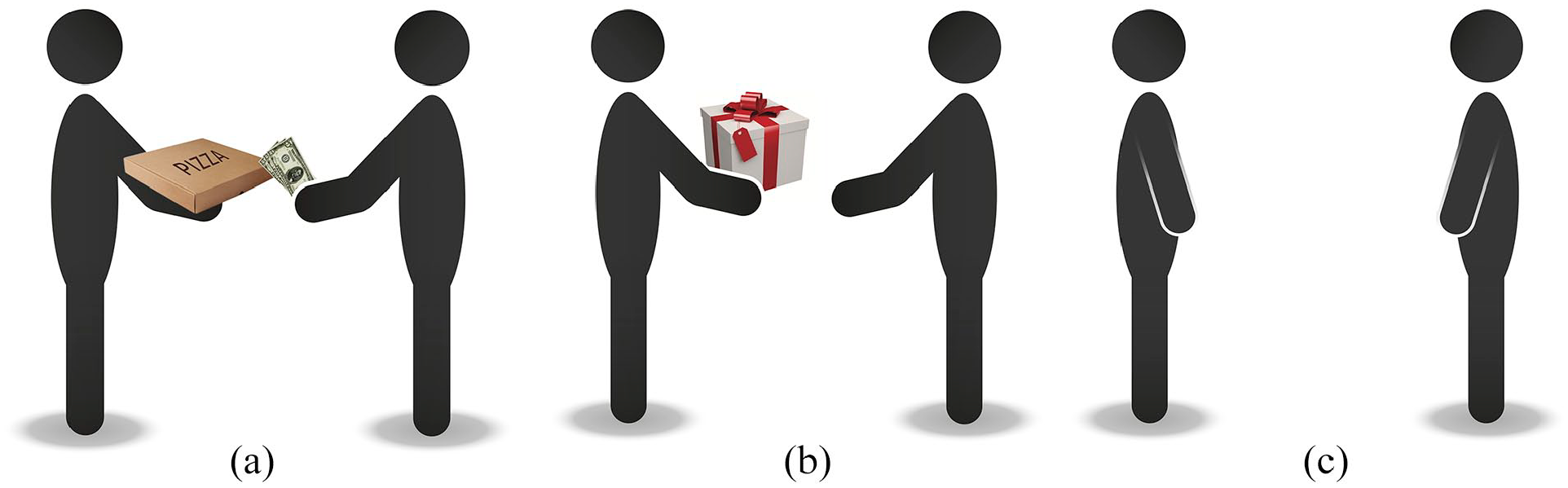
Pictures used to induce either market mindset (a) or communal mindset (b) in Experiments 2–6. Picture in (c) was shown in the neutral condition.
Results and discussion
The results for the manipulation check can be found in the SOM. Our main hypothesis for this experiment was that the market mindset would negatively affect the level of generalised trust compared not only with the communal mindset condition but also with the neutral condition. The results of one-way ANOVA showed a significant effect of mindset manipulation, F(2, 147) = 5.26, p = .006, η2 = .067. Further planned contrasts revealed that participants in the market mindset condition declared lower generalised trust (M = 3.96, SD = 1.26) than participants in the communal mindset condition (M = 4.98, SD = 1.48), F(1, 147) = 10.48, p = .001, partial η2 = .067. The difference between the market mindset and the neutral condition (M = 4.47, SD = 1.57) was not significant, F(1, 147) = 2.94, p = .088, partial η2 = .020. Similarly, the difference between the communal mindset and neutral condition was not significant, F(1, 147) = 3.09, p = .081, partial η2 = .021.
The results of Experiment 2 provided additional support for our prediction that priming people with the market mindset causes them to demonstrate lower generalised trust towards others compared with priming them with communal relationships. However, the results concerning the comparison of the two experimental conditions with the neutral condition were inconclusive.
Experiment 3
Experiments 1, 2, and S3 (described in detail in SOM) supported our prediction that the market mindset hinders interpersonal trust. In Experiment 3, we investigated one of the potential mechanisms behind this effect, namely proportional thinking. As previously stated, the relational models theory proposed by Fiske (1991, 1992, 2004) assumes that the core element within market relationships is proportionality associated with direct calculations of gains and losses. Conversely, trust is based on an acceptance of vulnerability and a willingness to rely on another person based merely on one’s positive expectations of the intentions or behaviour of that person (Doney et al., 1998; Rousseau et al., 1998). Other people’s intentions are rarely transparent; thus, it is impossible to directly calculate the proportions of costs and benefits from exhibiting trust in a relationship. The inability to use a preferred source of information might, in turn, reduce the willingness to declare trust towards the unknown other. Hence, in Experiment 3, we expected that activating the market mindset would increase proportional thinking and, as a result, decrease a person’s declared trust. Importantly, however, we expected this effect to occur because the induced mindset predisposes people to use proportional thinking, however, the trust questions asked don’t allow them to employ this type of thinking. In other words, the rules or the context of a situation requiring trust are not specified, similarly to the information about required inputs and potential outputs.
In this experiment, we aimed to provide further support for our main prediction that the market mindset reduces interpersonal trust using another—more specific—operationalisation of trust which was free of the drawbacks described earlier. Specifically, unlike in Experiments 1, 2, and S3 in which we asked general questions about trusting undefined others, in Experiment 3, we requested participants to declare how much they would trust eight individuals presented in pictures. We chose photos presenting neutral facial expressions due to an awareness that expressing positive emotions might itself trigger cooperation and trustworthiness (Scharlemann et al., 2001). We also conducted this experiment in the United Kingdom using the Prolific Academic platform to increase the generalisability of the results.
Method
Participants and design
As the effects in Experiments 1 and 2 were weaker than expected, we decided to conduct a small meta-analysis of the previous experiments using the mindset manipulation employed in Experiment 3 (Zaleskiewicz et al., 2020). The analysis showed a weak effect of the mindset manipulation (Hedges’ g = 0.456). An a priori power analyses using G*Power (Faul et al., 2007) revealed that given an alpha of .05 and a conventionally assumed power of 0.80, a sample of 61 participants per condition would be required to detect the effect of a similar size. As we planned to test the mediation, we aimed to double this number and to recruit at least 122 participants to each experimental condition in Experiments 3 and 4.
We recruited 367 participants from the United Kingdom on Prolific Academic in exchange for 1 GBP (252 women, 111 men, and four participants who chose the answer “prefer not to say/other”; Mage = 37.63 years, SD = 14.25). Participants were randomly assigned to one of the three experimental conditions (market mindset vs. communal mindset vs. neutral condition). The collection of data was not continued after data analysis. No data were discarded.
Procedure
After providing a written informed consent and demographic information, participants were randomly assigned to one of the three experimental conditions: market mindset (n = 113) versus communal mindset (n = 128) versus neutral condition (n = 126). The experimental manipulation was almost identical to that used in Experiment 2. Depending on the condition, participants were shown one of the three pictures of two silhouettes facing each other (see Figure 2). However, before the participants were allowed to provide their interpretation of the picture, they were asked to spend at least 30 s imagining a real-life situation of this kind as vividly as possible. After 30 s had passed, participants were able to move on to the next page and write their interpretation. Following the manipulation, participants were presented with the items measuring the DV (trust) and the mediator (proportional thinking) in a randomised order.
We created a measure of participants’ trust towards others using a set of eight pictures presenting neutral facial expressions sampled from the Chicago Face Database (CFD; Ma et al., 2015). Selection of the stimuli was based on the subjective ratings of a face’s trustworthiness, which was available for all the CFD targets. We standardised the trustworthiness ratings and chose one target representing each of the genders and racial/ethnic groups available in CFD (Black, Hispanic/Latino, Asian, and White) for whom the standardised scores were the closest to zero. For each photograph, participants were asked: “Would you trust this person?” (response scale ranging from 0 = not at all to 10 = very much). The order of the photographs was randomised for each participant. An average of the eight ratings served as a DV (M = 5.57, SD = 1.46, Cronbach’s α = .91).
Next, participants answered seven questions related to situations in which they can rely on a variety of information from external sources. The aim of these questions was to measure the motivation to use numbers and proportions (Zaleskiewicz et al., 2020). For each situation, we asked participants to decide between an option presenting anecdotal arguments (e.g., the opinion of a friend) and an option based on ratios, proportions, or/and numbers (e.g., the proportion of positive to negative opinions of former users). This is the exact wording of one of these items: You are due for a maintenance checkup of your car. Unfortunately, you recently moved to a different city and don’t know any of the car mechanics around. How would you prefer to make the decision on which mechanic to go to? (a) Ask a colleague at work who has a similar type of car to yours for their recommendation. (b) Check the ratio of positive to negative reviews of the mechanics that are close to you.
We used the number of items for which participants chose the option based on ratios and numbers as the mediator variable (M = 3.04, SD = 1.38, range from 0 to 7), with higher scores indicating amplified proportional thinking (see SOM for the reliability analysis of the proportional thinking scale).
Finally, to check the manipulation, participants were asked to answer three questions about the interpretation of the picture that had been provided to them (for details, see procedure in Experiment 2).
We embedded two attention checks within the experimental procedure to confirm that the responses were not random. Participants were asked to (a) enter the year in which we are currently living on the page with demographic data and (b) answer “definitely yes” to one of the items presented on the manipulation check screen. All the participants provided valid answers to both attention checks.
Results and discussion
The results for the manipulation check can be found in the SOM. We conducted a mediation analysis using Process 3.5 (Hayes, 2018) Model 4 with 10,000 bootstrapping samples (Figure 3) to test our research hypotheses that the market mindset hinders trust because it also triggers a preference for using proportions and numbers. We used effect coding with the neutral mindset as a reference category (Hayes & Preacher, 2014), with one dummy variable representing the market mindset versus neutral condition comparison and a second dummy variable representing the communal mindset versus neutral condition comparison. The effect-coded mindset manipulation served as an independent variable, level of trust as a DV, and indicator of proportional thinking as a mediator. The continuous variables were z-scored before analysis to allow for standardised coefficients.
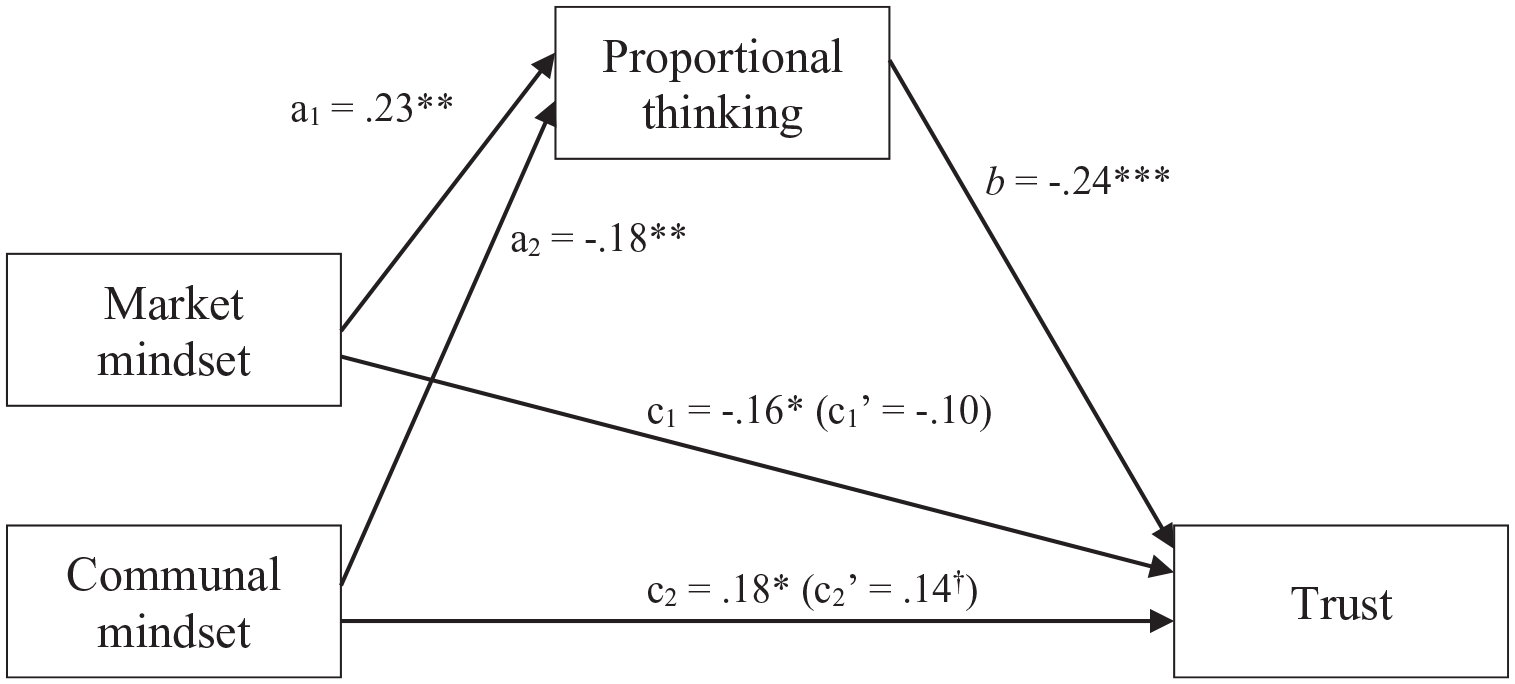
Mediation effect of communal and market relationships through proportional thinking on trust (Experiment 3).
The total effect that the market mindset versus neutral condition had on trust was significant and negative, path c1: β = −.16, SE = .07, t = −2.09, p = .037, while the total effect of the communal versus neutral condition was significant and positive, path c2: β = .18, SE = .07, t = 2.49, p = .013. People primed with the market mindset were less prone to declare that they would trust the people presented in the photos (M = 5.33, SD = 1.57) than those primed with either the neutral mindset (M = 5.52, SD = 1.46) or the communal mindset (M = 5.82, SD = 1.30).
The exposure to the market mindset manipulation (vs. neutral condition) had a significant and positive effect on proportional thinking, path a1: β = .23, SE = .07, t = 3.07, p = .002, while the exposure to the communal manipulation (vs. neutral condition) had a significant and negative effect on proportional thinking, path a2: β = −.18, SE = .07, t = −2.53, p = .012. Participants in the market mindset condition declared the highest motivation to rely on proportions and numbers (M = 3.36, SD = 1.38) compared with participants from the two other conditions (respectively, M = 2.79, SD = 1.24 for the communal mindset condition and M = 2.98, SD = 1.46 for the neutral condition). Proportional thinking was negatively related to the level of trust, path b: β = −.24, SE = .05, t = −4.74, p < .001. While controlling for the mediator, the direct effect of priming the market mindset versus the neutral mindset on trust was not significant,
The present study not only replicated our previous results which showed the association between the exposure to market relationships and diminished trust but also demonstrated that this association is mediated by proportional thinking. In line with the argumentation that we presented in the Introduction, market-type interactions trigger a preference for using proportions and numbers that are not explicitly available in many social situations, and this is the reason the market mindset has a detrimental effect on trust. Unlike in our previous experiments, we also found a positive effect of the communal mindset on interpersonal trust. We believe this is due to the different operationalisation of our DV: while we used context-free measures of generalised trust in Experiments 1 and 2, we employed a measure involving social cues, such as human, faces in Experiment 3. Nevertheless, exposure to market-type cues diminished trust no matter if the trust was measured as generalised trust of other people or as trust of specific, identifiable strangers.
Experiment 4
In Experiment 3, we showed that proportional thinking was involved in people becoming less trusting when they interpreted their social environment consistently with the market mindset as compared with both the communal mindset and the neutral condition. In Experiment 4, we aimed to investigate another potential mechanism behind the detrimental effect of the market mindset on trust—reduced empathy. In line with the theoretical argumentation provided earlier in this article, empathy may be considered as a precursor of trust because it is related to a cooperative orientation and social connectedness (de Vignemont & Singer, 2006) that, in turn, reinforce trusting decisions (Glaeser et al., 2000; Sturgis et al., 2015). The market mindset has been repeatedly found to negatively correlate with empathy (Caruso et al., 2013; Molinsky et al., 2012; Wang et al., 2018), other focus (Genschow et al., 2019), and perspective taking (van Laer et al., 2013), and we thus expected that market mindset priming (vs. neutral and communal conditions) would situationally decrease participants’ empathy and, in turn, lower their declarations of trust.
Method
Participants and design
We relied on the same power analysis that we conducted in Experiment 3 and aimed to recruit at least 122 participants per condition. In all, 366 U.K. participants were recruited on Prolific Academic to complete the study in exchange for 1 GBP (241 women, 123 men, with 2 participants who chose the answer “prefer not to say/other”; Mage = 37.66 years, SD = 12.06). Participants were randomly assigned to one of the three experimental conditions (market mindset vs. communal mindset vs. neutral condition). The collection of data was not continued after data analysis. No data were discarded.
Procedure
After providing a written informed consent and demographic information, participants were randomly assigned to one of the three experimental conditions: market mindset (n = 117) versus communal mindset (n = 118) versus neutral condition (n = 131). The experimental manipulation was identical to the one used in Experiment 3. Following the manipulation, participants filled in the items measuring our DV (trust) and the mediator (state empathy) in randomised order. We measured participants’ trust towards others using the same method as in Experiment 3. For each of the eight human photographs presented in a random order, participants were asked to declare whether they would trust the person in the picture based on a scale ranging from 0 = not at all to 10 = very much. The answers were averaged to form an indicator of trust (M = 5.66, SD = 1.44, Cronbach’s α = .94).
To measure state empathy, we used five items adapted from the Toronto Empathy Questionnaire (Spreng et al., 2009) with the response scale ranging from 1 = strongly disagree to 5 = strongly agree. Items were selected from the full scale based on the possibility to rephrase them in a way that would measure situationally induced differences in empathy (“If someone else was feeling excited, I would get excited too”; “It would upset me to see someone being treated disrespectfully”; I would remain unaffected if someone close to “me was happy”; “I would become irritated if someone cried”; “If I saw someone being treated unfairly, I would not feel very much pity for them”). The instructions were also modified to emphasise that we were asking about participants’ current feelings. Responses to these five items were averaged to form the measure of a mediator (M = 3.96, SD = 0.58, Cronbach’s α = .59; see SOM for further reliability analysis of the scale), with higher scores indicating a higher state empathy. Finally, as in Experiments 2 and 3, a manipulation check was used in which participants were requested to answer three questions about the interpretation of the picture that had been provided to them.
As in Experiment 3, we embedded two attention checks within the experimental procedure to confirm that participants’ responses were not random. All the participants provided valid answers to both attention checks.
Results and discussion
The results of the manipulation check for this experiment can be found in the SOM. To test our research hypotheses, we performed linear regression with mindset manipulation as the predictor, state empathy as the mediator, and the level of trust as the DV. For the multicategorical independent variable, we again used effect coding with the neutral condition as a reference category (Hayes & Preacher, 2014), with one dummy variable representing the market mindset versus neutral condition comparison and a second dummy variable representing the communal mindset versus neutral condition comparison (Figure 4). The total effect of the market mindset versus the neutral condition was significant and negative, path c1: β = −.19, SE = .07, t = –2.57, p = .011, while the total effect of the communal mindset versus the neutral condition was significant and positive, path c2: β = .19, SE = .07, t = 2.52, p = .012. Participants primed with the market mindset were less prone to declare that they would trust people presented in the photos (M = 5.39, SD = 1.28) than were participants in the neutral condition (M = 5.67, SD = 1.53) and those primed with the communal mindset (M = 5.93, SD = 1.47).
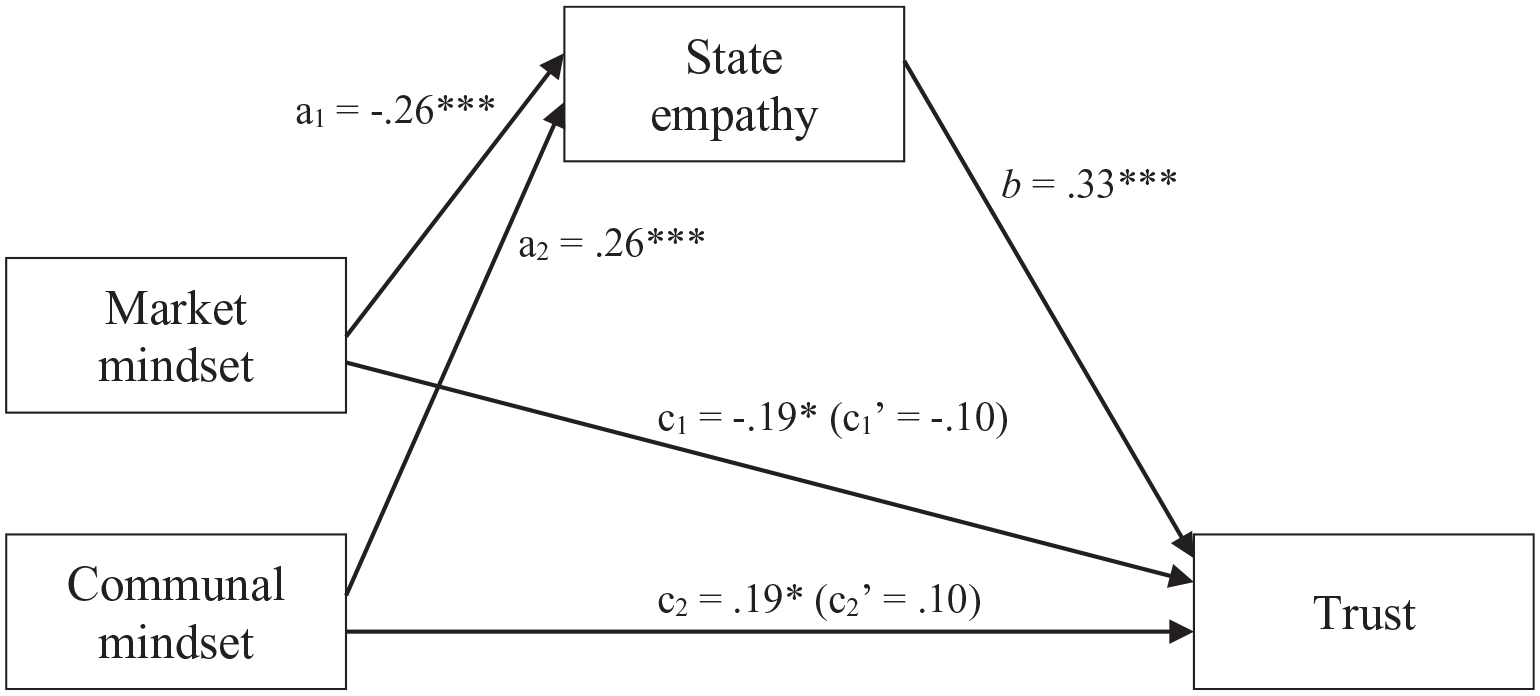
Mediation effect of market and communal relationships through state empathy on trust (Experiment 4).
The exposure to market relationships (vs. neutral condition) had a significant and negative effect on state empathy, path a1: β = −.26, SE = .07, t = –3.62, p < .001, while the exposure to communal relationships (vs. neutral condition) had a significant and positive effect on state empathy, path a2: β = .26, SE = .07, t = 3.60, p < .001. Participants in the market mindset condition declared the lowest state empathy (M = 3.81, SD = 0.67) compared with participants from the two other conditions (respectively, M = 4.11, SD = 0.45 for the communal mindset condition and M = 3.98, SD = 0.57 for the neutral condition). State empathy was positively related to the level of trust, path b: β = .33, SE = .05, t = 6.59, p < .001. While controlling for the mediator, the direct effect of priming the market mindset versus the neutral condition on trust was not significant,
The present study corroborated our previous results which showed that people’s exposure to market relationships has a detrimental effect on interpersonal trust. Furthermore, it demonstrated that this association is mediated by the presence of a lower state empathy when the market pricing mode is salient. In line with the argumentation that we presented in the Introduction, market-type interactions tend to decrease state empathy, which might be another reason the exposure to market relationships has a harmful effect on trust.
Experiment 5
The results of the experiments presented thus far have demonstrated that elevated proportional thinking and reduced state empathy, both resulting from the activation of the market mindset, decrease people’s propensity to trust others. The aim of this final study was to confront these two psychological mechanisms in one experimental design.
In the preregistered Experiment 5, 2 we predicted that people primed with the market mindset would demonstrate a lower level of trust than people in both the neutral condition and the communal mindset condition and that this effect would be mediated by enhanced proportional thinking and a lower state empathy. We had two competing hypotheses concerning the structure of these indirect effects. First, we tested a model in which we assumed that proportional thinking and state empathy would operate as parallel mediators, constituting two independent mechanisms explaining the effect of the market mindset on trust. According to this model, people primed with the market mindset demonstrate amplified proportional thinking and a parallel lower state empathy, with these two variables predicting a reduced level of trust. Second, we tested an alternative model in which we assumed that proportional thinking and state empathy would operate as two sequential mediators, constituting one complex mechanism explaining the effect of the market mindset on trust. In this model, we proposed that people primed with the market mindset tend to use proportional thinking, which results in a diminished state empathy and, consequently, a lower level of trust.
In this part of the project, we not only tested hypotheses related to how the two psychological mechanisms explain the effect of the market mindset on interpersonal trust but also used another operationalisation of the DV to ascertain that the effects we found were not due to the specific procedures but were robust across various methodological approaches. We again presented participants with a series of human faces, but this time we employed a Smiling Faces Task (Kesebir et al., 2021). In this task, participants were confronted with 16 photos presenting diverse human faces with open-mouthed smiles and asked about their level of liking of these faces. Previous research documented a high level of correlation between trust and liking ratings (Tanner & Maeng, 2012). The rationale behind this effect is that people’s initial impressions of strangers are coloured by how they tend to perceive and respond to the generalised other. A person who has a more positive, trusting, benevolent view of the generalised other would presumably exhibit greater initial liking of strangers (especially if they are smiling, which indicates positive, affiliative intent). On the contrary, a more cold and mistrustful person would have more negative initial judgements of a stranger. Such a change in Experiment 5 was due to the fact that the neutral faces we used in Experiments 3 and 4 did not reveal much information about a person’s trustworthiness or benevolence; therefore it might be relatively easy to affect trust towards such people by evoking the market mindset. If the salience of the market mindset could also hinder trust towards an apparently nice, benevolent person, that would be strong support for our theoretical model because positive emotional expressions have previously been shown to trigger trust and cooperation (Scharlemann et al., 2001).
Method
Participants and design
In this study, we based sample size on the results of the same power analysis that we conducted for Experiment 3. However, as Experiment 5 tested a different structure of mediators, we aimed to triple the sample size calculated in power analysis and to recruit at least 183 participants to each experimental condition.
In all, 552 U.S. participants were recruited on Prolific Academic to complete the study in exchange for 1.50 GBP. Participants were randomly assigned to one of the three experimental conditions (market mindset vs. communal mindset vs. neutral condition). We discarded data from 18 participants who did not provide valid answers to attention checks. The final sample consisted of 534 participants (194 women, 332 men, 8 other, Mage = 33.52 years, SD = 10.67). The collection of data was not continued after data analysis.
Procedure
After providing a written informed consent and demographic information, participants were randomly assigned to one of the three experimental conditions: market mindset (n = 194) versus communal mindset (n = 177) versus neutral condition (n = 163). The experimental manipulation was identical to the one used in Experiments 3 and 4. Following the manipulation, participants filled in the items measuring the mediators (state empathy and proportional thinking), and our DV (trust), in a randomised order. We measured participants’ propensity to rely on proportions and numbers using the same seven items as in Experiment 3, with the only exception that the answers were presented as option A and option B and participants were asked to give their answer using a 4-point scale ranging from 1 = definitely A to 4 = definitely B. The order of options as well as the order of items was randomised. The answers were averaged to form an indicator of propensity to rely on proportions (M = 2.59, SD = 0.50, range 1–4). State empathy was measured using the same method as in Experiment 4. Responses to the five items were averaged to form the measure of the mediator (M = 4.06, SD = 0.58, Cronbach’s α = .45), with higher scores indicating a higher state empathy.
To measure trust, we employed the Smiling Faces Task consisting of 16 face images with open-mouthed smiles equally balanced across four ethnicities (African American, Asian, Latinx, and White) and two genders (female and male). This task showed good validity, as it has consistently demonstrated high correlations with generalised trust as measured by the method developed by Yamagishi and Yamagishi (1994) and Kesebir et al. (2021). In this task, participants indicated their liking of the faces on a scale ranging from 1 = dislike a great deal to 7 = like a great deal, with the midpoint being labelled neither like nor dislike. The average rating of the 16 faces we presented to our participants constituted the trust score (M = 4.94, SD = 0.87, Cronbach’s α = .91).
Finally, as a manipulation check, participants were requested to answer four questions about the interpretation of the picture that had been provided to them, measuring communal orientation (M = 4.24, SD = 1.69, r = .48) and market orientation (M = 4.58, SD = 1.83, r = .49) as in Experiment 1.
As in Experiments 3 and 4, we embedded two attention checks within the experimental procedure to confirm that the responses were not random.
Results and discussion
The results concerning the manipulation check can be found in the SOM. To test our research hypotheses, we conducted two types of mediation analysis (both preregistered) aimed at testing the configuration in which participants’ proportional thinking and their state empathy mediated the relation between market mindset priming and declared trust towards smiling people: (a) a mediation model in which the propensity to rely on proportions and empathy were parallel, uncorrelated mediators; and (b) a mediation model in which the propensity to rely on proportions and empathy were tested in a sequential order. For the multicategorical independent variable, we again used effect coding with the neutral condition as a reference category (Hayes & Preacher, 2014), with one dummy variable representing the market mindset versus neutral condition comparison and a second dummy variable representing the communal mindset versus neutral condition comparison. Continuous variables were z-scored prior to analysis.
The mediation analysis was conducted using MPlus (Muthén et al., 2017). We employed a path analysis to examine the hypothesised relationships among variables. Given that some variables were not distributed normally (e.g., high kurtosis and skewness), we used the robust full information maximum likelihood estimation method to estimate the model. We examined goodness of fit using multiple indices: the root mean square error of approximation (RMSEA) and its 90% CI, the standardised root mean square residual (SRMR), the comparative fit index (CFI), and the Tucker–Lewis index (TLI). We used multiple fit indices because they assess different types of model fit (e.g., model parsimony, absolute fit) and provide a more reliable, conservative evaluation when used together (Brown, 2015). The model was evaluated with criteria proposed by Hu and Bentler (1999). The lower bound for an acceptable fit for CFI and TLI was .90, while the upper bound for an acceptable fit for RMSEA and SRMR was .08. Indirect effects were tested by examining bootstrap CIs for the indirect effects using a bootstrap procedure with 10,000 samples.
The first regression analysis demonstrated that the market mindset had a significant and negative effect on participants’ trust, β = −.13, SE = .06, Z = −2.25, p = .025, while the effect of the communal mindset was not significant, β = .03, SE = .06, Z = 0.56, p = .577 (RMSEA = 0, SRMR = 0, TLI = 1, CFI = 1). After introducing proportional thinking and state empathy operating as parallel independent mediators, the model did not reach conventional thresholds for acceptable fit (RMSEA = .105, 90% CI = [.042, .184], SRMR = .042, CFI = 0.854, TLI = −0.318). All the hypothesised path coefficients were significant, except for the direct paths between the market mindset manipulation and the communal mindset manipulation and the DV (controlling for indirect effects). After excluding them,, the model fit the data well in the light of some but not all examined indices (RMSEA = .068, 90% CI = [.026, .115], SRMR = .037, CFI = 0.816, TLI = 0.447). The results (standardised path coefficients) for the two models are presented in Figure 5. The manipulations and mediators accounted for R2 = .034 of the variance of participants’ declared trust.
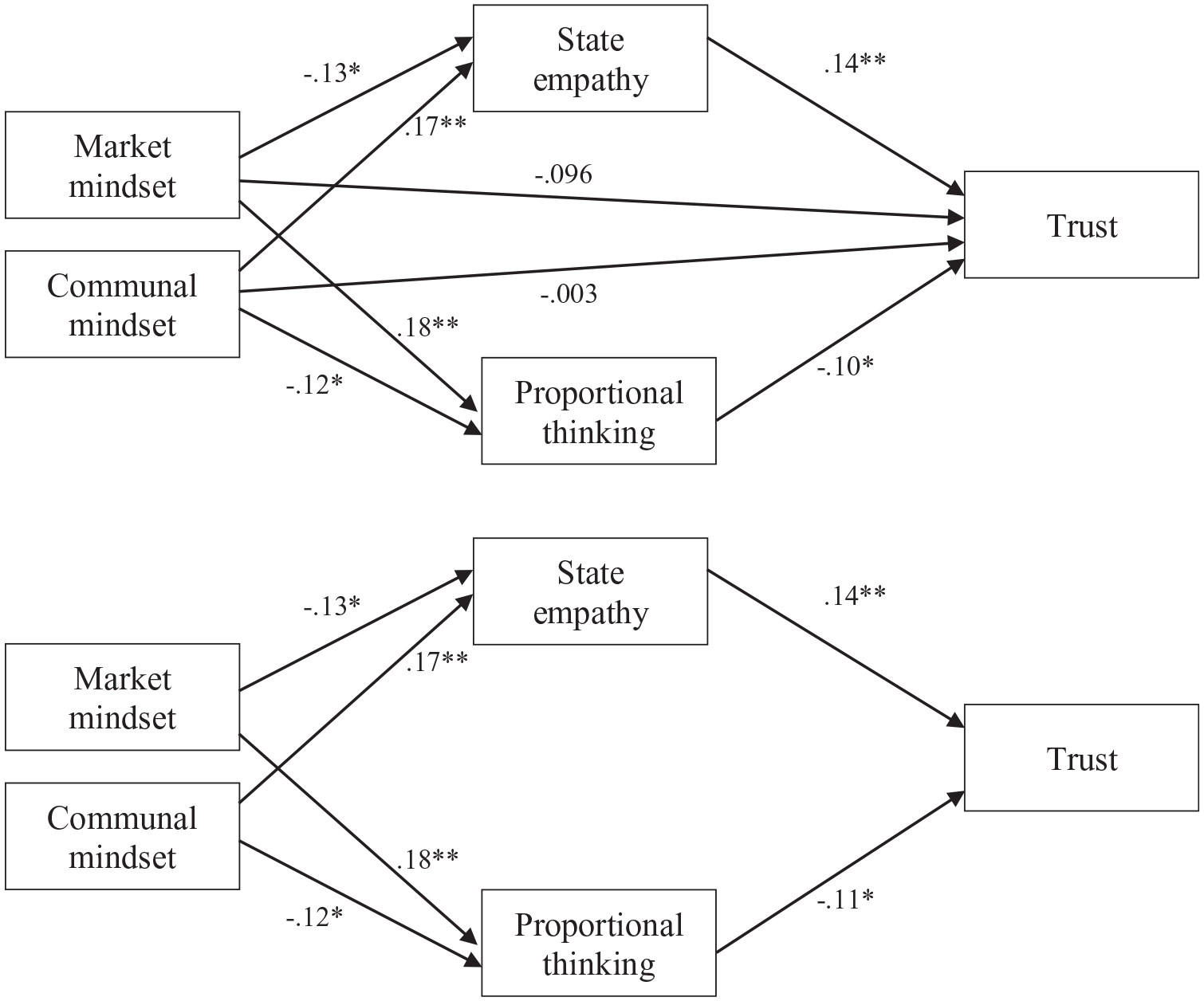
Path analysis for the effect of communal and market relationships on trust through a state empathy and proportional thinking as parallel mediators (Experiment 5).
We also examined total, direct, and indirect effects of the market and communal mindset manipulations on the DV in a more parsimonious model. The total indirect effect of the market mindset manipulation on trust via both mediators was significant and negative (β = −.04, boot SE = .02, 95% boot CI = [−.085, −.011]). Further investigation of the specific indirect effects revealed that both indirect effects from the market mindset manipulation on trust were significant, respectively β = –.02, boot SE = .01, 95% boot CI = [−.054, −.003] for the indirect effect via proportional thinking and β = −.02, boot SE = .01, 95% boot CI = [−.053, −.003] for the indirect effect via state empathy. In addition, the total indirect effect of the communal mindset manipulation on trust via both mediators was significant and positive (β = −.04, boot SE = 0.02, 95% boot CI = [−.085, −.011]), as both relative indirect effects from the communal mindset manipulation, respectively β = .01, boot SE = 0.01, 95% boot CI = [.001, .047] for the indirect effect via proportional thinking and β = .02, boot SE = 0.01, 95% boot CI = [.007, .055] for the indirect effect via state empathy.
Second, we tested an alternative preregistered model with proportional thinking and state empathy operating in a sequential order (RMSEA = 0, SRMR = 0, CFI = 1, TLI = 1). As in the first model, direct paths from the market mindset manipulation and the communal mindset manipulation to the DV (controlling for indirect effects) were not significant and, therefore, were excluded from the model. The resultant model fit the data well in the light of the most examined indices (RMSEA = .038, 90% CI = [.001, .101], SRMR = .023, CFI = .962, TLI = .830). The results (i.e., standardised path coefficients) for the two models are presented in Figure 6. The manipulations and mediators accounted for R2 = .038 of the variance of participants’ declared trust, which indicates a small effect.
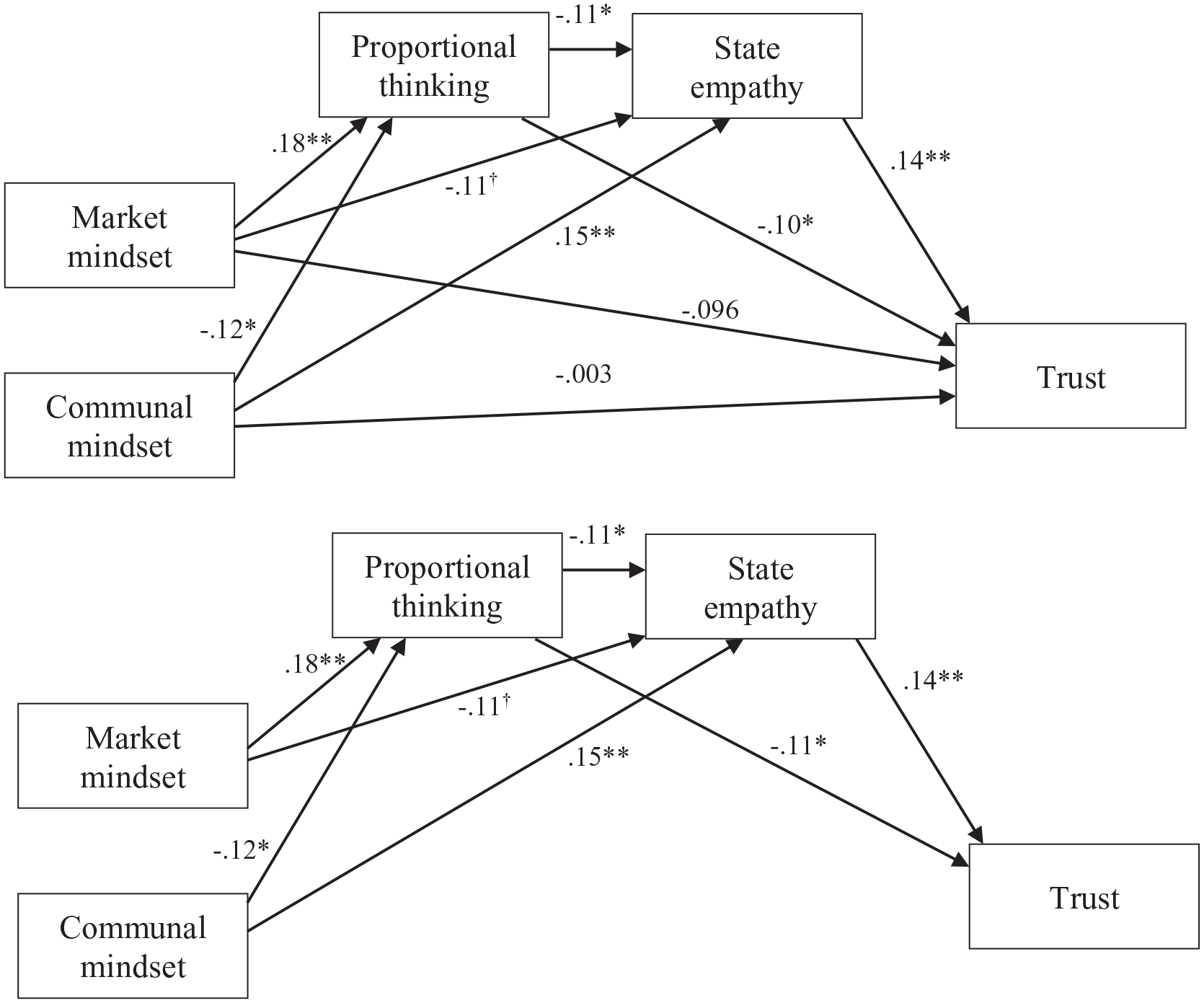
Path analysis for the effect of the communal and market mindsets on trust through state empathy and proportional thinking as serial mediators (Experiment 5).
We examined total, direct, and indirect effects of the market and communal mindset manipulations on the DV in a more parsimonious alternative model. The total indirect effect of the market mindset manipulation on trust was negative and significant (β = −.04, boot SE = .02, 95% boot CI = [−.085, −.011]). Further investigation of the specific indirect effects revealed that the sequential indirect effect from the market mindset via proportional thinking and empathy on trust was not significant (β = −.003, boot SE = .002, 95% boot CI = [−.011, 0]). The indirect effect via only proportional thinking was significant and negative (β = −.020, boot SE = .012, 95% boot CI = [−.054, −.003]), as was the indirect effect via state empathy only (β = −.017, boot SE = .012, 95% boot CI = [−.048, −.001]). The two indirect effects via single mediators were of similar strength, 95% boot CI = [−.037, .029] for the effects comparison.
In addition, the total indirect effect of the communal mindset manipulation on trust via both mediators was significant (β = .04, boot SE = .02, 95% boot CI = [.014, .077]). The sequential indirect effect via proportional thinking and empathy was not significant (β = .002, boot SE = .002, 95% boot CI = [0, .008]), while both relative indirect effects via single mediators were significant and positive, respectively β = .01, boot SE = 0.01, 95% boot CI = [.001, .041] for the indirect effect via proportional thinking and β = .02, boot SE = .01, 95% boot CI = [.006, .051] for the indirect effect via state empathy. The two indirect effects via single mediators were of a similar strength, 95% boot CI = [−.040, .014] for the effects comparison.
In this experiment, we demonstrated that the salience of the market mindset priming had a detrimental effect on trust expressed towards smiling faces, which in our view provides strong support for our theoretical reasoning. We also examined two preregistered models of the link between the market and communal mindset manipulations, trust towards smiling persons and mediators—state empathy and proportional thinking. Although we did find that the model which assumed sequential mediation was a better fit to the data than the model which assumed independent parallel mediators, we did not find support for sequential mediation from the market mindset manipulation via enhanced proportional thinking and lowered state empathy on trust. Rather, our results suggest that although related to each other, the two mechanisms behind the detrimental effect of the market mindset on trust operate independently.
General discussion
Summary of the results
In the present project, we examined the general hypothesis that when people’s thinking is determined by the market mindset, which is activated because of exposure to market relationship cues, they tend to trust others less. In addition, we proposed that merely making market relationships salient may be enough to negatively affect interpersonal trust and that two psychological mechanisms—hindered state empathy and enhanced proportional thinking—account for these effects.
We conducted a series of six experiments (including one presented in SOM) to test this hypothesis. In Experiment 1, we investigated two relational mode conditions—market relations and communal relations—and found that people with the market mindset revealed lower generalised trust than those with the communal mindset. In the following experiments, we also included a neutral condition to demonstrate that the difference between market and communal mindset conditions was caused by the detrimental effect of the market mindset rather than the beneficial effect of the communal mindset. We also excluded alternative explanations by demonstrating that the market mindset negatively affects trust but not caution or cynicism (Experiment S3). In further experiments, we examined two psychological mechanisms responsible for the detrimental effects on trust of the market mindset and found that these effects were mediated by enhanced proportional thinking (Experiments 3 and 5) and a reduced state empathy (Experiments 4 and 5). Finally, in a preregistered Experiment 5, we showed that these two psychological mechanisms are relatively independent of each other.
In the experiments conducted within this project, we employed different manipulation methods, DV measurements, and manipulation checks to avoid incidental results and to ascertain that the effects we found were not due to the specific procedures we used but are robust across various methodological approaches. By systematically modifying our experiments, that is, by changing manipulations, manipulation checks, and operationalisations of DVs, we were able to demonstrate high reliability (repeatability) of the effects, maximise internal and external validity, eliminate alternative explanations, and test for mediators that explain the psychological mechanisms behind the effects.
Does the market mindset inevitably reduce trust?
The direct effect observed in all the experiments presented in this article was that the market mindset significantly hampers declared trust towards others. The recurrent presence of such an effect in our experimental project might seem puzzling because theoretical considerations along with evidence found in research indicate that trust is both necessary and present in market settings as it catalyzes transactions and sustains the economic system as a whole (Aghion et al., 2010; Akerlof, 1970; Cohen, 2020; Fukuyama, 1995; Zak & Knack, 2001). Although business-type interactions are typically regulated by various written agreements, they rarely reduce uncertainty entirely as a complete substitute for trust (McCannon et al., 2018). For example, an economic entity may trust that the other party will comply with the terms of the formal contract and restrain from the temptation to cheat when an unfair action is accessible and hard to detect. If, in such a case, trust is reciprocated, both transaction sides avoid lengthy and costly litigation. We might even say that the economic system would be paralysed if everybody on the market strictly followed the principle of limited trust or did not trust others at all (Akerlof, 1970). One more example which supports the reasoning that trust is inevitably involved in the economic system is the Trust Game (Berg et al., 1995), which has been widely used to study trusting decisions in various financial contexts. If players participating in the Trust Game were extremely suspicious of each other, no money would be transferred between them and, consequently, no economic exchange would occur. Interestingly, studies using the Trust Game have consistently shown that people do, in fact, trust others even when they have no information about the partner that could suggest their decision will turn out to be profitable (Johnson & Mislin, 2011). In the context of the above argumentation and examples, can the results of our present project be considered as evidence of a paradox?
In our view, the results of Experiments 3–5, which had the aim of investigating the psychological mechanisms behind the negative effect of the market mindset on trust, seem to offer a solution to the puzzle. Based on these results, we propose that people may differently interpret trust depending on whether they make their decisions in the market or communal contexts. The market mindset increases people’s readiness to perceive reality in a market-consistent manner—by a tendency to use cost-benefit analysis (manifested through the motivation to use proportions and numbers) and the reluctance to focus on others’ emotions (as evidenced by diminished empathy). Unlike the communal context, people in the market-related context may be willing to reveal trust only if they have a chance to calculate whether and how much it pays off. In our experiments, we asked participants to answer general questions about trusting unknown others, providing them either with no contextual cues or a clearly communal cue—a smiling face in Experiment 5. In other words, participants could not engage in any calculations, but they could potentially base their decisions on their empathetic reactions. As Experiments 3–5 indicate, making the market mindset salient increases a person’s orientation towards proportional analysis but decreases empathy. Therefore, it is not surprising that those participants for whom the market mindset had been made salient declared reduced trust when faced with general questions related to trust in others. It is possible that more positive effects on trust would be observed as a result of the market mindset by introducing participants to a more market-relevant and information-rich situation. Indeed, a study by Al-Ubaydli et al. (2013) in which exposure to market cues positively affected trust towards others as measured by a decision in the Trust Game—the simulation of a situation that is well-structured and offers a chance to calculate how much it pays to trust the other party—provides initial support for this thesis. Similarly, Henrich et al. (2005) showed that the higher level of market integration predicted greater prosocial choices as measured by the use of different economic games.
Different types of trust
Although trust is a necessary component of well-functioning relationships in both market and communal spheres that share a number of commonalities from the perspective of trusting decisions (e.g., the presence of both a trustor and a trustee, the willingness to be vulnerable, and positive expectations regarding a trustee’s behaviour), the reasoning we have thus far proposed in this section suggests that trust could serve different purposes and be supported by different mechanisms depending on the specific relationship. In market relationships, people trust that others will complete tasks competently and on time, that they will receive fair remuneration, and that the other party will comply with the terms of the contract (Rousseau et al., 1998). In communal relationships, people trust that their partners or friends will not betray them and expect no tangible reward for their trust (Rempel et al., 1985). Trust in such relationships emerges through the pro-relationship behaviour of partners as a result of their departures from immediate self-interest and their provision of other-benefitting acts (Rusbult et al., 1998).
Some previous theorising does support the distinction we have introduced between psychological characteristics of trust in market relationships and in communal relationships. For example, Lewicki and Bunker (1995) differentiated between “calculus-based” or “calculative trust” and “relational trust” (also known as “cognition-based” and “affect-based trust”; see McAllister, 1995). Calculus-based trust is more aligned with the characteristics of market relationships—it occurs in economic exchanges and is based on rational considerations of the other party’s intentions as derived from the existence of deterrence (costly sanctions associated with breach of trust) and/or some credible information about the intentions, motives, and competence of the trustee (e.g., reputation, certification; Lewicki & Bunker, 1995). Relational trust seems to be closer to the definitional characteristics of communal relationships. It forms over time due to repeated informal interactions between two parties and is based on the experience of positive outcomes from those interactions as well as the care and attachment that arises within the relationship (McAllister, 1995). A particularly strong form of relational trust is that of “identification-based trust,” which forms between parties that identify with each other’s intentions and desires and in which “mutual understanding is developed to the point that each can effectively act for the other” (Lewicki & Bunker, 1995, p. 122). No deterrence or monitoring is necessary because both parties are certain that their interests will not be intentionally compromised (Lewicki et al., 1998). As calculus-based and relational trust seem to rely on distinct information, it is possible that they are differentially affected by the salience of the market mindset. It is also possible that while proportional thinking is more important for trust experienced in market relationships (such as calculus trust), emotional cues might be more predictive of trust experienced in communal relationships. This hypothesis seems to be indirectly supported by a recent study (Weiss et al., 2021) which showed that behaviour in the lab-based Trust Game (which contains more detailed information about potential returns) was predictive of only everyday trust with regards to more distant others (strangers, professional contacts, superordinates, and acquaintances) with whom people are more likely to have market-pricing relationships. Everyday trust towards closer others was not related to participants’ behaviour in the Trust Game.
To summarise, it is likely that people who are prompted to interpret reality through the lenses of the market mindset will have a significant drop in their general willingness to trust others because they spontaneously connect their thinking with communal (relational) trust which requires sensitivity to other people’s emotions and is not saturated with information about inputs and outputs. However, people who have the market mindset might be ready to reveal trust when they feel they are participating in a well-structured, business-type interaction that enables cost-benefit analysis. Such a divergent influence of the market mindset on trust seems to be an important issue to be addressed in future research.
The current research also offers possible directions for exploring interventions to enhance trust in different relational contexts. This is especially important given the possibility that the progressing process of marketisation in modern society might negatively affect people’s trust in others (Xin & Xin, 2017) and people may start to introduce market-pricing rules into communal relationships. While trust might increase in the communal context by amplifying emotional engagement, for example, by increasing the likeability of the trustee (in Experiment 3, communal mindset was shown to positively affect the state empathy and—as a result—trust), such intervention seems unlikely to be successful in the market context. We showed that the market mindset negatively affects trust by situationally blocking empathic concern; thus, the attempts to increase trust through affective cues might prove ineffective or even backfire. A more effective strategy oriented towards elevating trust in a transactional context could rely on the provision of information consistent with market rules, for example, a rule that is consistent with the preference for using proportions and numbers. In addition, specific information about the reputation of the transaction partner or the probabilities of gaining or losing on an investment could potentially boost trust in a market context. Further research should explore whether it is possible to nudge people to express more trust by framing a situation in a manner that is consistent with the active mindset or by providing information that satisfies the motivations that are active in the market or communal context.
Limitations and further research directions
Our findings should be interpreted with certain limitations and future research directions in mind. First, although we used various measures for our dependent and independent variables, we are aware that we did not cover a wide range of situations in which people might form trust towards another person. For that reason, even if we found consistent and robust effects, we still see the need to conceptually replicate our results using other behavioural measures of trust in externally valid contexts, most preferably in field experiments conducted in natural social environments. Second, we acknowledge that the obtained effects are rather small, which is probably due to the difficulty of experimentally manipulating and measuring mental states. Future research should address this issue and investigate whether other manipulation methods could produce larger effects.
Another limitation of this research is that most studies were conducted with Western samples (United States, United Kingdom, and Poland), including both student samples and online labour markets. Although the quality of data obtained from online labour markets has been questioned, different analyses have suggested that data collected on MTurk and Prolific Academic are valid and comparable to data collected via traditional methods (Buhrmester et al., 2011; Mason & Suri, 2012; Peer et al., 2017). Nevertheless, we believe that our theoretical ideas should be further tested with other non-Western samples. One prediction is that the effect that we found in the present project examining market relationships on trust might be weaker or even completely absent in cultures such as Japan in which market relationships are regulated by strict social norms and where formation of close social bonds is essential to maintain business relationships (De Mente, 1993; Lohtia et al., 2009).
In the set of experiments presented in this article, we used simple pictures to activate thinking about either market or communal relationships. To prime the latter, we presented participants with a situation in which one individual was giving a gift to another individual. Even if gift-giving most often occurs in the communal-sharing context, it can also sometimes happen in other social modes (e.g., equality matching). Although we excluded the alternative explanation that the gift-giving picture triggered relational modes other than communal sharing (see auxiliary studies in SOM), we see a need for further experimental research to investigate the psychological consequences of the activation of different modes of sociality which use other methods of inducing market or communal mindsets to avoid inaccurate interpretations of the manipulation effects.
Finally, in our experiments, we focused solely on situations in which a lack of clear-cut rules of interaction and sufficient information on costs and benefits does not allow people to use proportional thinking, which translates into reduced willingness to trust others. Therefore, we cannot (and do not) conclude that the market mindset reduces trust in all circumstances. Further research should address this issue and investigate potential interactions between the active mindset and the situational cues in predicting trust.
Conclusion
The current project bridges two separate theoretical domains—the interdisciplinary literature on market relationships and the interdisciplinary literature on trust—to offer new insights into how people build trust towards others depending on the social context. To the best of our knowledge, our work is the first to systematically demonstrate the negative impact of the exposure to market relationships on trust. Although the connection between money or economic schema and trust has already been postulated and investigated in the literature (Al-Ubaydli et al., 2013; Camera et al., 2013; Desmet et al., 2011; Xin & Liu, 2013), the psychological mechanisms explaining effect of market relationships on trust has not been explored to date. Our research project aspires to fill this gap.
Footnotes
Acknowledgements
The authors thank Kathleen D. Vohs and two anonymous reviewers for their invaluable comments on the previous version of the manuscript.
Correction (July 2023):
The title of the paper has been corrected in the online version.
Declaration of conflicting interests
The author(s) declared no potential conflicts of interest with respect to the research, authorship, and/or publication of this article.
Funding
The author(s) disclosed receipt of the following financial support for the research, authorship, and/or publication of this article: The National Science Center in Poland supported this work (Grant Numbers: 2012/07/N/HS6/02252, 2013/11/B/HS6/01316, and 2016/21/B/HS6/01188). This funding source was not involved in study design; in the collection, analysis, and interpretation of data; in the writing of the report; and in the decision to submit the article for publication.

Data accessibility statement
Supplementary material
The Supplementary Material is available at qjep.sagepub.com.