



Abstract
People tend to perceive a virtual body standing in front of them as their own if it is either stroked or moving synchronously with their own real body—the out-of-body experience (OBE). We combined synchrony manipulation with two other factors of theoretical interest: the kind of stimulation, visuotactile stimuli or visuomotor correlations, being synchronised and the interoceptive accuracy (IA) of participants, assessed by means of the heartbeat counting task. Results showed that explicit measures of embodiment were systematically affected by synchrony, and this synchrony effect was more pronounced for visuomotor than for visuotactile conditions. The walking drift was affected by IA: In visuotactile conditions, the synchrony effect was pronounced in individuals with low IA, presumably reflecting a stronger impact of the visual information. In visuomotor conditions, however, the synchrony effect was stronger in individuals with high IA, presumably reflecting a stronger impact of re-afferent information generated by the participants’ own movements.
Introduction
The human sense of embodiment refers to the sensations that arise from being inside, having and controlling a body (Kilteni et al., 2012). In daily life, we usually embody ourselves by having a sense of ownership, agency, and self-location (Dobricki & de la Rosa, 2013; Longo et al., 2008; Serino et al., 2013). Sense of ownership refers to self-attribution: I perceive my body as belonging to myself, it is my own body (Gallagher, 2000); sense of agency refers to the feeling that I am the one who is causing or generating an action, including the subjective experience of action, control, intention, and motor selection, as well as the conscious experience of will (Blanke & Metzinger, 2009; Debarba et al., 2022); while sense of self-location refers to the perception that I am located inside a body, which defines where in space I feel to be located (Kilteni et al., 2012).
The various senses of embodiment have been investigated using various kinds of body-related illusions, such as the rubber hand illusion (RHI, Botvinick & Cohen, 1998), the enfacement illusion (Tajadura-Jiménez & Tsakiris, 2014), the out-of-body experience (OBE) illusion (Ehrsson, 2007; Lenggenhager et al., 2007), and the first-person perspective body illusion (Mello et al., 2022; Petkova & Ehrsson, 2008; Slater et al., 2009). Notably, the two kinds of body illusions proposed in Ehrsson (2007) and Lenggenhager et al. (2007) are different: in the former participants own an invisible illusory body; while in latter participants own a virtual avatar body, even though they are both referred to as OBE (Maselli & Slater, 2013). In these full body or body-part illusion paradigms, participants see an artificial body/body-part placed before them and receive synchronous or asynchronous multisensory stimulation of both real and artificial body/body-part. With synchronous stimulation (such as when the participant’s felt real hand and a seen artificial hand move in synchrony, or when participants receive synchronous visual and tactile stimulation), participants commonly feel that the artificial body/body-part belongs to them (ownership), that they can control this body/body-part (agency), and that the perceived position of real body/body-part is drifting towards the artificial body/body-part (self-location), or they show more pronounced emotional (skin conductance) responses when the illusory body is threatened (Guterstam et al., 2013; Ma & Hommel, 2013).
The various body/body-part illusion paradigms also have interesting differences. First, there is no perceived self-location change in the enfacement and first-person perspective paradigm, because the use of a mirror renders seen and felt locations identical (Blanke & Metzinger, 2009). Second, in RHI paradigms, perceived ownership and location actually refer to the rubber hand—a body part, which may be perceived differently from the entire body (Kondo et al., 2018; O’Kane & Ehrsson, 2021). Third, in contrast to other paradigms, OBE paradigms (Ehrsson, 2007) in some sense reverse the question: which is not so much whether participants learn to own a novel body/body-part but whether they can in some sense “leave” their body by perceiving themselves as standing behind their actual body (Guterstam & Ehrsson, 2012). Hence, the OBE paradigm is a kind of third-person perspective paradigm, which refers to the sensations of being located outside one’s physical body (i.e., disembodied self-location) and of seeing and perceiving the world and oneself from a location outside of this body (Blanke & Mohr, 2005). Given that most research efforts have been devoted to the first-person paradigms studying RHI, facial, and whole-body illusions, we devoted this study to test whether the findings obtained in these paradigms also generalise to OBE.
One factor that we were interested to generalise, if possible, refers to the sources of the information that is presented in or out of sync to generate the illusion (which is expressed by showing more ownership, agency, and self-location in synchronous conditions). Most studies are using visual information about the artificial body/body-part, which in some studies relates to tactile information about one’s real body/body-part, thus creating visuotactile (VT) correlations (Botvinick & Cohen, 1998), and in other studies to motor activity of the participant, thus creating visuomotor (VM) correlations (Ma & Hommel, 2015). While both conditions have been demonstrated to affect perceived ownership, agency, and self-location, their impact has often, but not always been found to differ in strength. Most of the studies comparing the two conditions investigated the RHI, in which VT correlations were usually manipulated by brushing both an unseen real finger and a seen rubber finger. VM correlations, in turn, were usually manipulated by varying the correlation between the participant’s active lifting movement of an unseen real finger and a visible movement of a rubber finger. While Kalckert and Ehrsson (2014) reported no difference for ownership (also see Riemer et al., 2013); several other studies found stronger illusions for VT than VM (Dummer et al., 2009; Walsh et al., 2011); while yet other studies showed stronger ownership following VM than VT conditions (Longo & Haggard, 2009), suggesting that voluntary movement is a powerful cue to ownership (Tsakiris et al., 2006, 2010). Importantly, one study using a first-person perspective body illusion paradigm observed stronger effects on virtual leg ownership for VM than VT (Kokkinara & Slater, 2014). A possible account for this diversity of findings might be the artificial nature of RHI paradigms. In more natural paradigms using the virtual-hand illusion, in which participants can freely move or rotate their real hand and each finger, VM has also been found to produce systematically stronger illusions than VT, possibly because of the richer sensory feedback associated with movement (Kalckert & Ehrsson, 2014; Ma & Hommel, 2015). Given the comparatively more natural kind of manipulation in the present study, we thus expected a stronger synchrony effect for VM than for VT.
A second factor we were interested in studying in the context of OBE was the accuracy to which participants can perceive interoceptive information. It has been suggested that interoceptive information is essential for the maintenance of one’s sense of self (Tsakiris, 2017) and for the construction and update of self-awareness (Aspell et al., 2013; Filippetti & Tsakiris, 2017; Suzuki et al., 2013). However, while the integration of exteroceptive multimodal stimuli has been studied extensively, research on the integration of exteroceptive and interoceptive multimodal stimuli is lacking (Quigley et al., 2021).
People are known to show substantial interindividual variability in the accuracy to which they can perceive internal signals (Schachter, 1971), such as cardiac activity, hunger, and distension of bladder and other visceral organs (Craig, 2009). As previously predicted, IA measures are typically limited to heartbeat perception (Hodossy et al., 2021), including two widely used methods: the Heartbeat Counting Task (HCT, Schandry, 1981), in which participants need to count their own heartbeats in preset time intervals; and the Heartbeat Discrimination Task (HDT, Whitehead et al., 1977), in which participants are asked to judge whether tones are in synchrony with their own heartbeats. Of them, the HCT is the most commonly used measure of objective IA and was used in our current study.
Notably, these two tasks have been both heavily criticised recently (for a summary, see Paulus et al., 2019), because many unrelated factors were found to influence participants’ task performance, such as prior knowledge of one’s heart rate (Ring et al., 2015), time interval estimation and other cognitive strategies (Desmedt et al., 2018). However, findings from some other studies seem to support the use of HCT for measuring IA. For example, it was shown that HCT has face validity (Critchley & Garfinkel, 2017) and predictive validity in studies of interoception, emotional processing, and empathy (Pollatos et al., 2005; Shah et al., 2017). While the correlation between time interval estimation and HCT performance was low (see Desmedt et al., 2020), the associations among various tasks also seem to support its validity. For example, studies showed that the HCT scores were significantly and positively associated with HDT scores (Hickman et al., 2020; Körmendi et al., 2022); and correlated with other interoceptive tasks performance across modalities (Herbert et al., 2012). Furthermore, some authors (e.g., Murphy et al., 2020) considered the possibility that some studies criticising on HCT did not properly control measures according to Murphy et al. (2018), which is why they obtained problematic results. Hence, properly controlling the conditions under which the HCT is used is essential (see Murphy et al., 2018, for further discussion).
Moreover, the HCT was chosen in our current study as it is the preferred measure of objective IA in highly-related studies investigating the relationship between IA and body ownership (Badoud & Tsakiris, 2017), which renders the comparison of our results with previous related findings more meaningful. For example, Tsakiris et al. (2011) observed a negative correlation between IA and strength of the RHI, as indicated by perceived ownership and proprioceptive drift. According to these authors, this finding suggests that poor IA might shift perception towards exteroception, which in turn would increase the dominance of the visual information about the artificial body extension and, thus, increase the size of the synchrony effect. Comparable findings were reported for the enfacement illusion (Tajadura-Jiménez & Tsakiris, 2014). Similarly, one study (Eshkevari et al., 2012) compared ownership plasticity between individuals with eating disorder and healthy controls using RHI. The authors assessed interoceptive deficits by means of questionnaires and found that deficits were positively associated with a more pronounced ownership illusion. However, this correlation has not been replicated in some other studies investigating the relationship between bodily illusions and interoception (Critchley et al., 2021; Crucianelli et al., 2018; Horváth et al., 2020). Accordingly, we aimed to study the relationship between OBE and IA to add new evidence and shed some new light on this topic.
We were particularly interested in the way IA might interact with the stimulus type (VT vs. VM). VT stimulation of OBE depends on exteroceptive modalities, as participants receive visual and tactile stimulation through contact of a stick with the virtual body and the real body. VM manipulation of OBE, in turn, depends on both exteroceptive and interoceptive modalities, as registering VM correlations requires the integration of visual feedback about the virtual body movement and, possibly, efference copies of motor commands, with vestibular and proprioceptive information from real body movement. As in our study, the interoceptive information mainly came from efference copies of the body movement, vestibular and proprioceptive receptors—so that the accuracy, to which this information can be processed, should depend on IA, one would expect differences between VT and VM conditions to the degree that such interoceptive information is indeed processed. In other words, possible interactions between stimulus type and IA were considered to be diagnostic for the contribution of interoceptive processing to the various senses of embodiment.
To summarise, our key expectations were threefold. First, we expected effects of synchrony on our explicit and implicit measures of ownership, agency, and self-location, that is, higher ratings in synchronous than in asynchronous conditions. Second, given the active nature of our VM condition, we expected stronger synchrony effects (i.e., OBEs) with VM than with VT. Third, while we had no specific hypotheses regarding IA, we used IA, and especially interactions between stimulus type and IA, as an index of a role of interoceptive processing for the respective sense of embodiment.
Method
Participants
We conducted an experimental mixed-design study with 72 participants (14 males, mean age = 20.60, range = 18–23; SD = 1.53), all of them students from the Southwest University in China. Participants served in two sessions. This sample size was chosen to exceed sample sizes of comparable previous studies assessing OBE (Lenggenhager et al., 2007, who tested 14 participants) and IA (Tsakiris et al., 2011, who tested 46 participants), but we also carried out a post hoc power analysis, see below. All participants had normal or corrected-to-normal vision and none of them had a history of neurological or psychiatric disorder. Participants were naïve as to the purpose of the study. They gave informed consent and were paid for their participation. The experimental protocol was approved by the ethics committee of Southwest University.
Experimental setup
As shown in Figure 1, the experimental stimuli were created with the virtual reality software Vizard and presented through a head-mounted display (brand HTC Vive, 1080×1200 pixel per eye, refresh rate 90 Hz).

In the virtual reality environment participants could see a same-sex virtual body through a HMD, standing in front of themselves. In VT conditions (the upper two panels), participants could not make any movements, while they were touched at their back by the experimenter using the HTC handle, and watched the resulting touch on their virtual avatar’s back by a virtual stick. In VM conditions (the lower two panels), participants could make unconstrained head and limb movements, and watched the resulting movement of their virtual avatar. The two left panels show the real scenario and the right two panels the scenario as participants saw it in the virtual environment.
In the VM phase, participants wore five motion trackers (HTC vive Tracker; spatial resolution: within 1 mm; sampling rate: better than 60 Hz; delay: less than 44 ms) on their chest, two wrist and two ankles. Our experimental setup allowed participants to freely move their limbs to control the movement of the virtual body for the synchronous condition; while in the asynchronous condition, the movement of the virtual body was delayed by 3 s.
In the VT stimuli phase, a Vive controller was used as handle, which was hold by the experimenter. The experimenter stroke the back of participants with this controller while participants stood still and watched a virtual stick stroking the back of the virtual body. The movement of the virtual stick was synchronous with the movements of the controller in the synchronous condition, but delayed by 3 s in the asynchronous condition.
In total, each participant was tested in four conditions: VM synchronous, VM asynchronous, VT synchronous, and VT asynchronous.
Design
The experiment comprised of three independent variables. Two were manipulated within participants: stimulus type and synchrony; and one varied between participants: IA. This variable was created by a median split (Filippetti & Tsakiris, 2017), see below. The sequence of the two synchrony conditions was counterbalanced, so that one half of the participants experienced the synchronous condition before the asynchronous condition, and the other half the asynchronous condition before the synchronous condition. To avoid confusion between different multisensory stimuli, we had the participants come to the laboratory twice (for a VT and a VM session), separated by at least 1 week.
Heartbeat perception
This study adopted the HCT (Schandry, 1981) to measure participants’ IA. This task is often used as a measure of IA as it is very quick, cheap, and easy to administer. Following suggestions to properly control the task (Desmedt et al., 2020), we provided participants with clear instructions, stating that they should not count time intervals but estimate their heart rate, and only report heartbeats that they felt.
All participants needed to complete the test of individual IA before they started with the actual experiment. Heart rate was monitored by means of a pulse transducer attached to the participant’s index finger of their hand. As is typical during the HCT, participants were asked to silently count their own heartbeats since an audio start signal until they received a stop signal. They were provided with standard instructions to count their heartbeats simply by sensing their body without touching their pulse. No feedback was given at the end of each trial. Four trials (25, 35, 45, and 100 s) were presented, in which real counts and report counts were recorded (Tsakiris et al., 2011).
Procedure
Upon arrival at the laboratory, participants were seated in front of the desk and asked to sit still for about several minutes to calm down. They were then asked to perform the HCT. Then, the OBE illusion paradigm started. Each of the four conditions consisted of four phases: First, participants carried out the walking task (Lenggenhager et al., 2007) pretest as described below; then, they experienced VT or VM synchronously or asynchronously for 2 min; after that, they carried out the walking task posttest; and finally, they filled in the questionnaire ratings. Importantly, to control the amount of sensory input to be similar for all participants in the VM conditions, the experimenter would encourage the participants to move when participants stopped moving. There was a 2-min resting phase between each of two conditions. The sequence of conditions was fully counterbalanced.
Embodiment questionnaire
At the end of each condition, participants were to complete the nine-item questionnaire on their experience. This embodiment questionnaire was adopted from previous studies (Guterstam & Ehrsson, 2012; Lenggenhager et al., 2007; Longo et al., 2008; Maselli & Slater, 2014). Participants were required to evaluate their agreement in relation to each statement, using a 7-point Likert-type scale (from 1 “ strongly disagree” to 7 “strongly agree”). The questionnaire’s scales assess three dimensions of embodiment: direct ownership (Q1), aggregated ownership (the mean of Q1-2), self-location (Question 5), and aggregated agency (the mean of Q8-9). Questions 3, 4, 6, and 7 are commonly considered control questions. However, given that they can also be taken to capture aspects of the impact of the illusion on self-location, which renders their theoretical status questionable, we will report the means obtained for these questions for the interested reader, but did not analyse them any further. The questions are as follows:
Q1. It felt as if the virtual body was my body.
Q2. I had the feeling that I was looking at myself.
Q3. I was not aware that my physical body was different from the virtual body.
Q4. It seemed as if I had two bodies.
Q5. I had the feeling that I was standing on the same location as the virtual body.
Q6. It felt as if my physical body was drifting towards the virtual body.
Q7. It appeared as if the virtual body were drifting towards my physical body.
Q8. I could have moved the virtual body, as if I wanted to.
Q9. I had control over the virtual body.
The walking task
In the walking task assessment, participants were guided to stand on a fixed position as the initial position. In the pretest, they closed their eyes and wore an eye patch; in the posttest, they took off the HMD display, with their eye closed and they wore an eye patch. The experimenter helped participants to walk in small steps to 1 m backward and then they were guided to walk back to the initial position with normal-sized steps (Kondo et al., 2018; Lenggenhager et al., 2007; Shaqiri et al., 2018). The experimenter measured the distance between their initial position and the position participants walked back to. The subtraction of the pre- from post-position resulted in the walking drift measure, with positive numbers indicating drift towards the virtual body.
Results
Separate repeated-measures ANOVAs were conducted on self-reported illusion strength from the embodiment questionnaire and the walking task, with IA as a between-group variable, and stimuli type (VM or VT) and synchrony (synchronous or asynchronous) as within-subject variables. We also ran 2 × 2 ANOVAs with the continuous IA scores as concomitant variable, but the results were comparable with those reported here.
Heartbeat perception
IA was calculated as the mean score of four heartbeat perception intervals according to the following transformation (Tsakiris et al., 2011): Interoceptive accuracy score = 1/4 (|recorded heartbeats-counted heartbeats|/recorded heartbeats).
Accordingly, IA values ranged from 1, signifying perfect accuracy, to 0 (Schandry, 1981; Tsakiris et al., 2011). The median score of all participants’ IA (Median = 0.6013, SD = 0.1995) was used to split participants into two groups (Tsakiris et al., 2011), with high IA (High group, M = 0.814, SD = 0.107, N = 36) and Low-IA (Low group, M = 0.473, SD = 0.096, N = 36) group. The gender and age information for the high IA group were: 9 male, mean age = 20.56, range = 18–23, SD = 1.647; for the low IA group: 8 male, mean age = 20.64, range = 18-23, SD = 1.417.
Questionnaire
Table 1 and Figure 2 show means and variability for all questions, respectively. We analysed all except the four control questions with mixed 2(IA group: high vs low) × 2 (stimulus type: VM vs VT) × 2 (Synchrony: synchronous vs asynchronous) repeated-measures ANOVAs (see Table 2), and focused on the direct ownership question Q1, the aggregated ownership (Q1-2) and agency scores (Q8-9), and the self-location item Q5.
Mean and standard deviation values of the eight conditions for all the questionnaire items ratings.
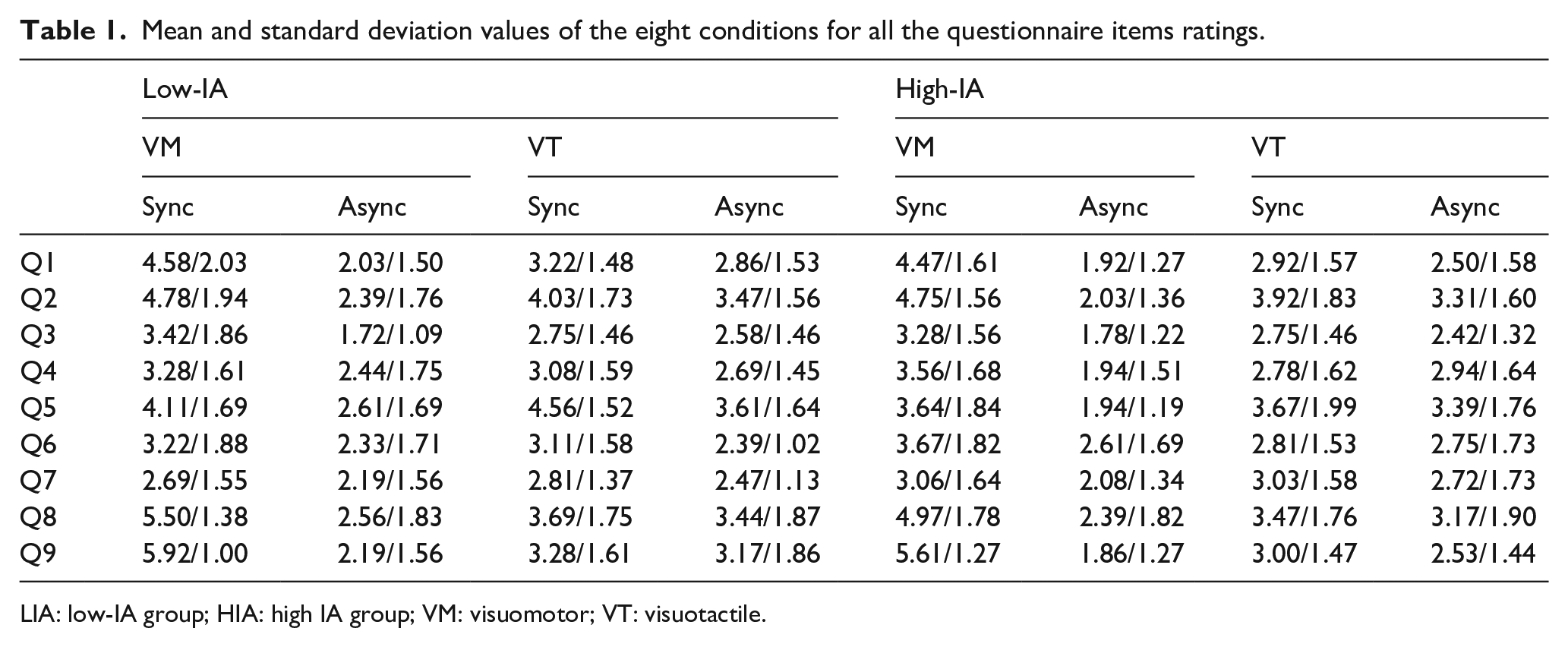
LIA: low-IA group; HIA: high IA group; VM: visuomotor; VT: visuotactile.

Results of the aggregated questionnaire resting of (left panel) ownership (Q1-2) and (right panel) agency (Q8-9), with error bars represent ±1 standard error.
F, p and effect size (ηp2)-values for the effects for all the questionnaire item ratings, with df = 70.
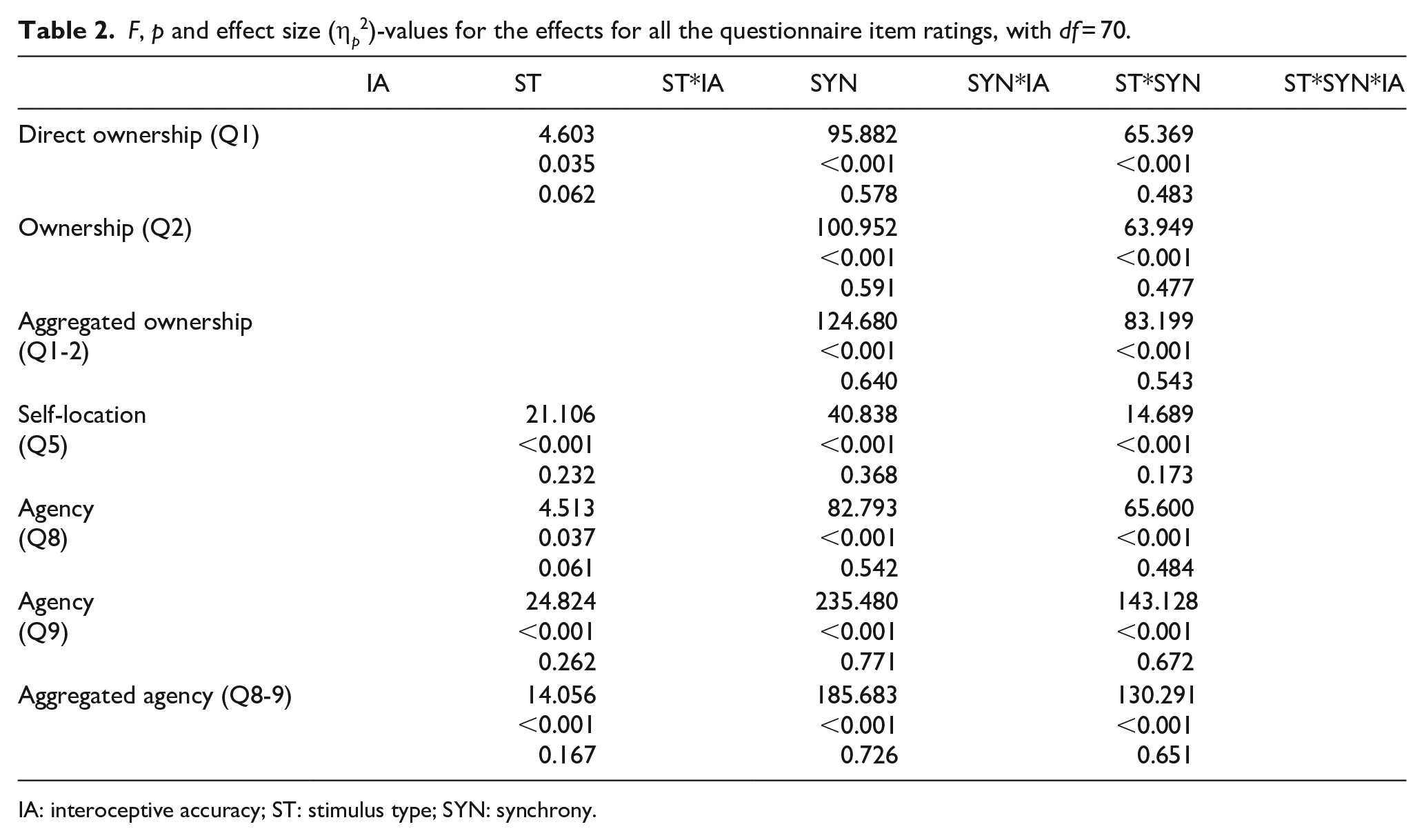
IA: interoceptive accuracy; ST: stimulus type; SYN: synchrony.
For the direct ownership question (Q1), the significant main effect of stimulus type and synchrony showed that VM led to more ownership than VT and that ownership was stronger in synchronous than asynchronous conditions—the classical embodiment effect. With two-tailed paired t-tests, we further analysed the two-way interaction effect between stimulus type and synchrony. The synchrony effect was significant for both VM, t(71) = 10.885, p < .001, d = 1.594; and VT, t(71) = 2.466, p = .016, d = 0.253; but it was more pronounced in VM. For aggregated ownership (Q1-2), ratings were also more pronounced under synchrony. Again, the synchrony effect was significant for both VM, t(71) = 12.482, p < .001, d = 1.690; and VT, t(71) = 3.425, p = .001, d = 0.324; but the synchrony effect was more pronounced for VM than for VT, t(71) = 9.182, p < .001, d = 1.407.
Agency (Q8-9) showed significant main effects of stimulus type (higher ratings with VM than VT) and synchrony (higher ratings for synchronous than asynchronous conditions). T-tests revealed that the significant two-way interaction was due to that the synchrony effect was significant for VM, t(71) = 16.073, p < .001, d = 2.411; but not for VT, p = .081.
The self-location question Q5 showed significant main effects of stimulus type (higher ratings with VT than VM) and synchrony (higher ratings for synchronous than asynchronous conditions). The two-way interaction was due to that the synchrony effect was significant for both VM, t(71) = 6.691, p < .001, d = 0.979; and VT, t(71) = 3.211, p = .002, d = 0.349; but the synchrony effect was more pronounced for VM than for VT, t(71) = 3.785, p < .001, d = 0.542.
Of particular interest, there was no significant effect involving IA Group. We then analysed the correlations between questionnaire ratings and IA scores. Following Tsakiris et al. (2011), we first computed the illusion strength by subtracting asynchronous from synchronous Q1 ratings and then computed correlations between the ownership illusion strength and the IA for VM and VT conditions separately. However, no significant correlations were found, rs ⩽ 0.053, ps ⩾ 0.330.
The walking task
The mixed 2 (Synchrony)×2 (Stimulus Type)×2 (IA Group) repeated-measures ANOVA yielded no significant main effect of stimulus type and synchrony, with ps > 0.113; but a significant two-way interaction between stimulus type and IA group, F(1, 70) = 4.184, p = .045, ηp2 = 0.056; and a three-way interaction, F(1, 70) = 7.065, p = .010, ηp2 = 0.092 (see Figure 3).
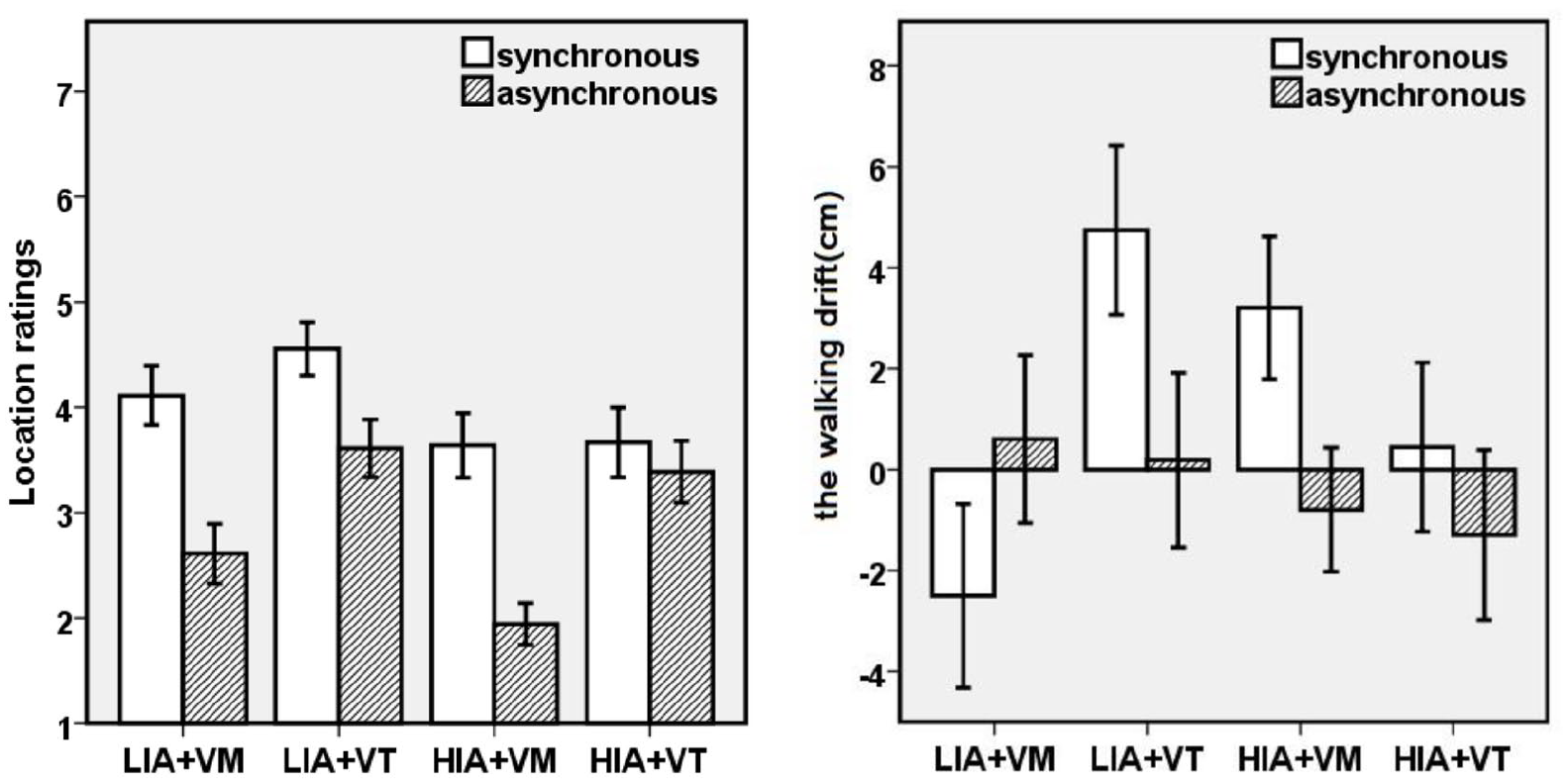
Results of (left panel) self-location perception (Q5) and (right panel) walking drift (cm), with error bars represent ± 1 standard error.
We further analysed the walking drift with two-tailed paired t-tests. The synchrony effect itself was significant for the VT condition in the Low-IA group, t(35) = 2.192, p = .035, d = 0.446, and the VM condition in the High-IA group, t(35) = 2.168, p = .037, d = 0.505, but not in the other two conditions, ps > 0.21.
Of particular interest, there was no significant effect involving IA Group. We also computed the walking drift strength (Tsakiris et al., 2011) by subtracting asynchronous from synchronous walking drift results and then analysed the correlations between the walking drift strength and the IA scores. A significant positive correlation was found in the VM condition, r = 0.295, p = .006; but not in the VT condition, r = −0.059, p = .310.
Post hoc power analysis
Effect sizes (ηp2) for IA, stimulus type or synchrony manipulations in all measures, including questionnaire results, and the walking task, were higher than or equal to 0.056 for within factor main effects and interactions. A power analysis using G*Power 3 (Faul et al., 2009), with α = 0.05, showed that power (1 − β) was higher than 0.99, suggesting that the sample size was sufficient to detect the sought-for differences.
Discussion
In this study, with OBE illusion paradigm, we investigated the interplay of exteroceptive and interoceptive information on perceived ownership, agency, self-location and walking drift, and the role of IA in the OBE. Our findings have the following five major implications.
First, the significant synchrony effect of both direct ownership (Q1) and the aggregated ownership (Q1-2) ratings is consistent with previous findings (Kilteni et al., 2012; Lenggenhager et al., 2007), indicating that we successfully induced the OBE illusion in the synchronous VT and VM conditions. We also found that VM has a greater impact on ownership than VT, as indicated by the significant interaction between stimulation type and synchrony. This observation extends comparable previous findings in a study on first-person perspective full body illusion (Kokkinara & Slater, 2014) to OBE, suggesting that in more ecological paradigms, such as with virtual-hand or first- and third-person perspective full body illusions, the richer visuoproprioceptive feedback associated with voluntary movement in VM as compared to VT contributes to a stronger ownership illusion. Of particular interest for our purposes, however, we found no indication whatsoever of any role of IA on ownership perception in OBE—irrespective of the stimulus condition and, thus, irrespective of whether the synchronous sensory information was (as in VM) or was not (as in VT) likely to involve interoception. On one hand, this is also consistent with previous body illusion studies. By using the RHI, Tsakiris et al. (2011) found that IA affected proprioceptive drift as a proxy of ownership, but not the ownership ratings proper. Similarly, in the enfacement illusion paradigm, Tajadura-Jiménez and Tsakiris (2014) reported an effect of IA on skin conductance response as a proxy of ownership, but again no impact on ownership ratings. On the other hand, however, these findings suggest that the accuracy of people’s interoception, as far as it is reflected in the HCT, is of no or less relevance for the integration of information that underlies explicit ownership perception.
Notably, the ownership questionnaire ratings were relatively low, which suggests that the induced ownership illusion was weak. Specifically, for VM and synchronous conditions, the ratings were higher than 4.5, while for VT and synchronous conditions, the ratings were lower than middle score 4. Considering the experimental setup, it seems that cognitive knowledge about real body (i.e., the appearance of the virtual body) matters (Lenggenhager et al., 2007). In Lenggenhager et al. (2007), for the most direct ownership question “It felt as if the virtual body was my body,” the ratings were higher than 6 in the scale of 1–7 when the virtual body was the same as participant’s real body, around 4.5 when it was a fake body, and 3.5 when it was an object. Petkova et al. (2011) compared first- and third-person perspective conditions, where the ownership ratings towards a naked mannequin were around 5.5 in the scale of 1–7 in first-person perspective conditions, and lower than 4 for the third-person perspective condition. Similarly, in our current experiment, the virtual blond-hair body (imported from Vizard software) may also have created a notable appearance difference to our Chinese participants, and thus, the overall ratings were comparatively lower. Petkova et al. (2011) proposed that with VT, the OBE induced with the alien virtual body may not result in the illusion as the scores were low. Our current results in VM conditions may verify the induction of ownership illusion with our current experimental setup, as significant differences between the synchronous and asynchronous conditions were found.
Second, the findings for perceived agency perfectly mirror those obtained for ownership. Again, our observations are consistent with comparable findings from studies with other kinds of ownership illusions. The significant synchrony effect on agency (Q8-9) fits with observations from a study on first-person perspective full body illusion (Kokkinara & Slater, 2014). Our finding that the synchrony effect on agency is more pronounced with VM than with VT is consistent with observations from RHI and VHI studies (e.g., Haggard, 2017; Kalckert & Ehrsson, 2014; Ma & Hommel, 2015). Finally, the lack of IA effects on agency fits with observations from a study on the perception of task intentions (Penton et al., 2014), where individual differences in IA did not predict subjective awareness of action intentions.
Third, the findings for the self-location perception question (Q5) looked similar to patterns obtained for ownership and agency questions, but the main effect of stimulus type suggested that VT might have a stronger impact on self-location than VM—which seems contrary to our findings for ownership and agency ratings. However, further analysis revealed that the stronger impact of VT was restricted to asynchronous conditions. If we consider these conditions as a kind of baseline (Perez-Marcos et al., 2018; Tsakiris et al., 2011), the main effect may reflect theoretically less important basic differences between the two conditions, such as a greater salience of stimulation in VT. Importantly, however, the pattern of the interaction between stimulus type and synchrony was comparable with our findings for ownership and agency.
Fourth and importantly, the walking drift strongly depended on IA. Of particular interest, the two stimulus conditions were affected in exactly opposite ways. The findings for the VT conditions results are consistent with previous RHI (Tsakiris et al., 2011) and enfacement (Tajadura-Jiménez & Tsakiris, 2014) studies, which also found synchrony effects on proprioceptive drift or skin conductance responses in participants with low, but not with high IA. According to Tsakiris et al. (2011), limited IA makes people more susceptible to exteroceptive stimulation, which in turn would explain the greater impact of synchrony between bottom-up stimulus sources and, as a consequence, the more pronounced illusion. But how could we account for the observed reversal of this outcome pattern in the VM condition?
We suggest that the key to explaining this reversal is the fact that interoceptive cues play very different roles in VT and VM conditions. In VT, the participants do not move and do not actively generate the informational streams that are in sync or out of sync. Accordingly, any interoceptive information that they may process while being exposed to the experimentally induced exteroceptive (visual and tactile) information is unlikely to be correlated with this information. This would not matter much for people that are inaccurate in processing interoceptive information, but the more accurate people are, the more they will notice this lack of correlation, which in turn would work against the impact of synchrony and, hence, the illusion. In VM, however, participants do move and their movement generates proprioceptive information that is strongly correlated with the experimentally manipulated exteroceptive (visual) information. Accordingly, the more accurate people would be in processing interoceptive information, the more sensitive they are to the proprioceptive, vestibular, or motor signals associated with voluntary self-actions (Herbert et al., 2007) or when viewing movement of another person (Ainley et al., 2014), and thus, the more they would realise the difference between synchrony and asynchrony and, hence, the stronger their illusion would be. This interpretation fits with findings reported by Suzuki et al. (2013). In an RHI paradigm, these authors made the usually interoceptive information about one’s heartbeat exteroceptive by measuring peoples pulse in real-time and using it to control the pulsing of the colour of a virtual hand. Even though their proprioceptive drift result was still higher with synchronous cardio-visual information, this effect no longer depended on IA.
Finally, the fact that IA had an impact on walking drift but not on explicit judgements of ownership, agency, or self-location adds to the increasing evidence that what is commonly considered: explicit and implicit measures of embodiment do not always measure the same thing (e.g., Ma et al., 2021; Qu et al., 2021). As various authors have suggested, these measures seem to rely on informational sources, some are the same while some others are either independent or only partially overlapping (Abdulkarim & Ehrsson, 2016; Rohde et al., 2011). In particular for the current study, implicit information like drift is likely to rely more on “unfiltered” bottom-up information, such as provided by VT or VM manipulations, while explicit judgements more strongly integrated bottom-up and top-down information, such as expectations, beliefs, and contextual cues (Maselli & Slater, 2014; Synofzik et al., 2008).
The methodological concern regarding the use of the HCT to assess IA needs further discussion. Even though we explained why we eventually did chose the HCT, we are aware of the recent questions with respect to its validity, in particular regarding a possibly worrying role of time interval estimation and prior knowledge about heart rate (Desmedt et al., 2020; for further discussion, see Ainley et al., 2020; Corneille et al., 2020; Zamariola et al., 2018; Zimprich et al., 2020). Even though we doubt that these factors can account for our findings, we agree that there is a need for a new method (Herman et al., 2021; Hodossy et al., 2021; Legrand et al., 2022; Von Mohr et al., 2021) and/or for further studies improving the validity of the HCT in assessing IA.
Another methodological issue that demands discussion is the rationale underlying the walking drift task, during which participants walk backward and back to the starting point while being blinded. At first sight, it would seem easier for participants to walk nearer to the illusorily owned virtual body, and thus showing more drift, if they can see the virtual body as reference. However, two considerations prevent us from following this line of thinking, at least partly. First, in traditional RHI studies, where participants judge the proprioceptive drift of the real hand when both the real and rubber hand were unseen; even the rubber hand was not always necessary: for example, several RHI studies showed that participants can experience an empty space as their own illusory hand or body part (Darnai et al., 2017; Guterstam et al., 2013), showing more drift in synchronous as compared with asynchronous VT conditions. Note that, as the empty space itself cannot provide any reference, it seems that the prior position of synchronous VT stimulation can already dominate over proprioception and contribute to stronger proprioceptive drift without any current reference when performing the proprioceptive drift task. Similarly, it is possible that prior stored visual information through VT or VM experience may help participants to walk back closer to the virtual body. However, one may then argue that participants may focus on the somatosensory information associated with their steps to solve the task, that is, to use strategies and ignore the illusion. To avoid this potential concern, as stated in the procedure, when moving backward, the experimenter gently helped participants to walk in small shuffling steps and then asked them to walk back with normal-sized steps (Shaqiri et al., 2018). Second, in the current OBE experimental setup, if the virtual body was always visible during the walking drift task, how should we design the movement of the virtual body? If the virtual body stays static, the incongruence of real walking and seen static virtual body will eliminate the illusion; if the virtual body follows the same walking movement, then in VT conditions, VM correlations were also involved. Thus, it is virtually impossible to investigate the difference of VT and VM manipulations and their possible interaction effect with IA. However, it would still be interesting to run future experiments in which only the VM correlations were effective, so to see whether blinded or not-blinded participants show significant walking drift results for illusorily owned virtual body.
Footnotes
Author contributions
K.M. and L.Y. developed the study concept. All authors contributed to the study design. Testing and data collection were performed by L.Y. Data analysis and manuscript drafting was performed by K.M., and B.H. provided critical revisions. All authors approved the final version of the manuscript for submission.
Declaration of conflicting interests
The author(s) declared no potential conflicts of interest with respect to the research, authorship, and/or publication of this article.
Ethical approval
All procedures performed in this study were in accordance with the ethical standards of ethics committee in Southwest University and with the 1964 Helsinki declaration and its later amendments.
Funding
The author(s) disclosed receipt of the following financial support for the research, authorship, and/or publication of this article: This work was funded by the National Education Science Planning of China (CBA210236) to K.M. in China.
Informed consent
Informed consents were obtained from all participants included in this study.
