



Abstract
Age differences in emotion perception are now well documented. However, a key limitation of many studies in this literature is the reliance on highly artificial tasks that lack context and consequently have poor ecological validity. This study reports two separate experiments that investigated age differences in emotion perception abilities using a highly contextualised film-based assessment along with a traditional emotion perception task. Experiment 2 additionally included a middle-aged sample and an assessment of eye-gaze patterns to the emotional films. The inclusion of eye-tracking in Experiment 2 was motivated by the fact that older adults consistently show visual biases to static emotion stimuli, yet it remains unclear whether biases also emerge in response to dynamic contextualised emotion stimuli. Experiment 1 identified age effects recognising displays of anger in the traditional emotion perception task but no age differences emerged on the film-based task. This finding was replicated in Experiment 2 with significant group differences on the traditional emotion perception task but no age differences on the film-based task. Experiment 2 also showed that there were no age differences in gaze patterns to these stimuli, showing for the first time that age-related visual biases to emotion stimuli may be task dependent. These findings highlight the fact that task-related features play a key role in the evaluation of age effects in emotion perception.
The ability to correctly recognise others’ emotional states is critical in order to successfully engage with them interpersonally. During a social interaction, cues to emotional states are typically provided via a number of different channels, including changes in facial expressions, prosody, and body movements. It is therefore concerning that older age is associated with a reduced ability to recognise many different types of emotional cues (Cortes et al., 2021; Hayes et al., 2020; Isaacowitz et al., 2007). Prior work has shown that relative to their younger counterparts, older adults have difficulties recognising emotions from faces (Grainger et al., 2017), bodies (Ruffman et al., 2009), and voices (Amorim et al., 2021), with these effects typically moderate in magnitude, and greatest for the specific emotions of sadness, anger, and fear (Hayes et al., 2020; Ruffman et al., 2008).
However, one limitation of the broader emotion perception and ageing literature is that many of these prior studies have used highly artificial tasks that lack ecological validity, failing to closely represent how emotions are displayed in everyday life (see Henry et al., in press). Use of such stimuli may be particularly problematic for older adults, as they have a lifetime of experience recognising dynamic emotions embedded within naturalistic social settings, which affords the opportunity to integrate multiple channels of emotional information and to draw on additional contextual cues (Kunzmann & Isaacowitz, 2017; Isaacowitz & Stanley, 2011). The presentation of emotional displays in traditional tasks—where emotion cues are presented in isolation—may therefore appear somewhat foreign to older adults and present a particular challenge. This has led to a significant shift in the field of emotion and ageing such that researchers are now using more ecologically valid assessments to measure emotion perception abilities. Indeed, prior studies have incorporated dynamic facial displays (Grainger et al., 2017; Holland et al., 2019), as well as multimodal emotional displays that include facial, auditory, and bodily emotion cues (Cortes et al., 2021; Richter et al., 2011; Schlegel et al., 2014). Although several of these studies have shown that age effects are reduced when more ecologically valid assessments are used, many have failed to completely eliminate age differences (Cortes et al., 2021; Grainger et al., 2017; Holland et al., 2019; Richter et al., 2011; Schlegel et al., 2014; Wieck & Kunzmann, 2015; although see Sze et al., 2013; Wieck & Kunzmann, 2017). Importantly though, a key limitation of all these prior studies is that they have failed to include stimuli that have rich and meaningful background contextual information. Instead, most stimuli typically include a single person facing towards a camera expressing an emotion or telling an emotional story (Cortes et al., 2021; Grainger et al., 2017; Richter et al., 2011; Schlegel et al., 2014; Wieck & Kunzmann, 2015, 2017). This is a particular concern in the context of ageing because prior work has shown that relative to their younger counterparts, older adults benefit more from relevant contextual information when decoding emotions. Noh and Isaacowitz (2013) showed that when static emotional facial displays were accompanied by a congruent contextual cue (e.g., a fist accompanying an angry facial display), older adults were more accurate than younger adults in recognising the emotional expression. This study also incorporated eye-tracking and showed that older adults gazed more at the contextual cues relative to younger adults, indicating greater prioritisation of these cues. In another study, Ngo and Isaacowitz (2015) showed that older adults were more influenced by contextual information than younger adults when categorising emotions. Specifically, they showed that when explicitly instructed to ignore irrelevant context, older adults made more context-dependent errors than their younger counterparts, again suggesting that context may be relied on by older adults to a greater extent than young. Given that older adults have had a lifetime of experience decoding others’ emotions in situations where they have been able to draw on contextual cues from their environment, the presentation of emotions devoid of context may particularly disadvantage older adults. Therefore, an important next step in this literature will involve testing whether older adults continue to experience difficulties decoding emotions when they have rich background contextual information to draw on when making their judgements. Another limitation of traditional emotion perception tasks is that they focus exclusively on the six basic emotions (e.g., sadness, fear, anger, surprise, happiness, disgust) and typically present emotional displays at very high intensities. However, in everyday life we are often exposed to a much wider range of emotions that are often subtle and fleeting. Another concern with using only the basic emotions in traditional tasks is that only one of these emotions is unambiguously positive (i.e., happiness), and this makes the single positive emotion easy to differentiate from the negative emotions, often resulting in ceiling effects for this emotion (Isaacowitz et al., 2007). Self-conscious emotions (e.g., embarrassment, pride) are more complex “social emotions” that require self-evaluation, self-awareness, and concern about how others are evaluating the self (Tangney, 2012). However, these are also rarely included in ageing and emotion perception studies. Thus, in addition to including more contextually rich stimuli, incorporating a wider range of emotional displays that extend beyond the six basic emotions is also needed to broaden our understanding of age effects in emotion perception.
From a theoretical perspective, there are grounds to expect reduced age effects in tasks that are more ecologically valid. Motivational models of ageing suggest that older adults are more motivated to engage with tasks that are meaningful and relevant to them (see Hess, 2014). Therefore, it might be expected that compared with their younger counterparts, older adults would be more motivated to engage with tasks that are familiar and closely resemble socio-emotional information as they experience it in the real world (i.e., embedded within rich background context). Experiment 1 was therefore designed to provide the first direct test of whether age effects in emotion perception emerge when a highly contextualised film-based task is used, which includes people interacting in a range of social contexts, and where the background information is rich and dynamic. Another key strength of this film-based task is that it extends beyond the six basic emotions, and also includes displays of other positive emotions (e.g., affection), as well as self-conscious emotions (e.g., embarrassment).
For Experiment 1, in line with prior work (Hayes et al., 2020), we expected to find age differences on the traditional emotion perception task, such that older adults would perform more poorly than younger adults, with the greatest age effects evident for anger, fear, and sadness. Because the film-based task presents emotional displays embedded within context, and because emotionally relevant context has been shown to be particularly helpful to older adults, we expected to find no age differences on the film-based task. With respect to accuracy in detecting different types of emotion, we expected the self-conscious emotions to be more poorly identified than the positive and negative emotions.
Experiment 1
Method
Participants
Two prior studies that used multimodal stimuli to assess age effects in emotion perception identified moderate- to large-sized age effects (Richter et al., 2011; Wieck & Kunzmann, 2015). Therefore, we conducted a power analysis to determine the minimum sample size required to detect a moderate- to large-sized age effect (f = .30) with 80% power. This revealed that we required a minimum of 62 participants. The final sample included a total of 84 participants, including 45 younger (Mage = 19.69, SD = 3.49, range: 17–33 years, 51% female) and 39 older (Mage = 71.51, SD = 5.88, range: 60–82 years, 51% female) adults. Younger adults were recruited from a first-year psychology pool and were compensated with course credit for their time. Older adults were recruited from the local Brisbane community using a variety of sources, including an older adult research register and advertisements in community organisations. Exclusion criteria included the presence or history of a major psychiatric or neurological condition, and not having English as a first language. All older adults were compensated with $40 AUD, and all adults scored above the cutoff for potential dementia (83/100) on a validated cognitive screen, the Addenbrooke’s Cognitive Examination-Revised (ACE-R, Mioshi et al., 2006). As can be seen in Table 1, relative to their younger counterparts, older adults had more years of full-time education and higher predicted full-scale IQ as indexed by the National Adult Reading Test (NART, Nelson, 1982). Consistent with prior emotion perception and ageing studies (Grainger et al., 2017; Murphy & Isaacowitz, 2010; Seungyoun et al., 2015), younger adults reported poorer psychological well-being compared with older adults (indexed by the Hospital Anxiety and Depression Scale, Zigmond & Snaith, 1983). There were no differences in self-rated health.
Background demographic information for participants in Experiment 1.
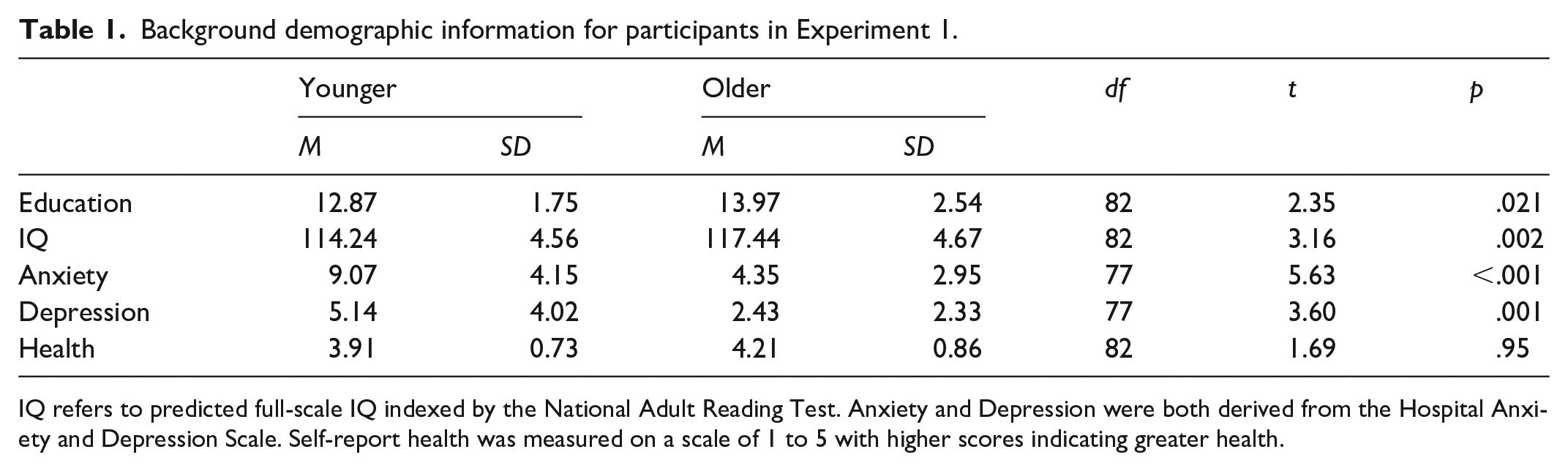
IQ refers to predicted full-scale IQ indexed by the National Adult Reading Test. Anxiety and Depression were both derived from the Hospital Anxiety and Depression Scale. Self-report health was measured on a scale of 1 to 5 with higher scores indicating greater health.
Measures
Traditional emotion perception task
The stimuli for this task were drawn from the FACES database (Ebner et al., 2010) and included static facial displays of the following emotions: happiness, sadness, fear, anger, disgust, and a neutral expression. Eight trials per emotion were used in this task and the targets were balanced by age and gender. Participants completed this task on a laptop and each image was presented along with the six possible emotional labels listed under each image. Participants selected their responses using the keyboard and were given as much time as they needed to complete the task. Participants received a total score out of 48, which was then converted to a percentage.
Emotional film-based task
This task was originally reported in Goodkind et al. (2015) and includes 11 emotional film clips each approximately 37 s in length. The film clips are excerpts from popular movies, such as “Patch Adams”, “My Best Friend’s Wedding”, and “Pirates of the Caribbean” (see Goodkind et al., 2015, for a list of all the movies used in the creation of this set). The set includes four positive emotions (i.e., affection, amusement, calmness, enthusiasm), four negative emotions (i.e., anger, disgust, fear, sadness), and three self-conscious emotions (i.e., embarrassment, shame, pride). We were unable to access the film depicting sadness (from the movie “Playing by Heart”), and consequently the present study included 10 film clips in the final set. The experiment was programmed using the iMotions software. All trials were preceded by a fixation cross, followed by an image of the target character displaying a neutral expression. This image was presented so that participants knew who they needed to focus on during the film clip. After viewing each clip, participants were presented with a list of all 10 possible emotions and were asked to state which emotion they thought best described how the target character was feeling. All responses were made verbally to the experimenter who recorded their response on a spreadsheet.
Procedure
All participants were provided with a study information sheet and asked to provide informed consent. Participants first completed some basic background demographic information, and the older adults completed the ACER. Next, participants completed the following tasks in a counterbalanced order: the film-based task, the traditional emotion perception test, standard cognitive assessments, and self-report questionnaires (some of which are not reported here). This experiment received ethics approval from the University of Queensland Human Research Ethics Committee.
Results and discussion
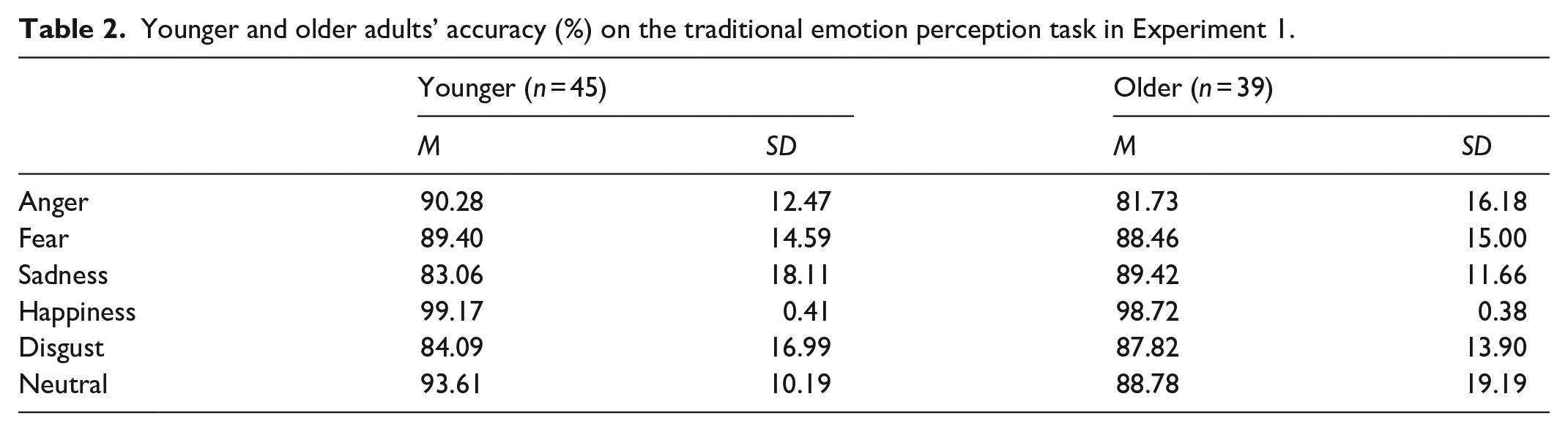
Traditional emotion perception task
Scores on the traditional emotion perception task were analysed using a 6 × 2 mixed analysis of variance (ANOVA), with emotion type as the within-groups factor (anger, sadness, fear, happiness, disgust, neutral) and age group as the between-groups factor (young, older).
1
This revealed a main effect of emotion type, F(5, 410) = 11.95, p < .001,
Younger and older adults’ accuracy (%) on the traditional emotion perception task in Experiment 1.
Emotional film-based task
Scores on the emotional film-based task were analysed with a 3 × 2 mixed ANOVA with emotion type (positive, negative, self-conscious) as the within-groups factor and age group (younger, older) as the between-groups factor.
3
This revealed a main effect of emotion type, F(2, 164) = 10.87, p < .001,

Younger and older adults performance on the film-based task in Experiment 1, presented separately for emotion category.
Experiment 2
Experiment 1 identified no significant age differences on the film-based task but also failed to identify an overall effect of age group on the traditional emotion perception task. Because we only partially replicated the typical age effects that are often seen on traditional emotion perception tasks, we conducted a second experiment, with a new participant sample. In addition to testing whether the null effect of age group identified for the film-based task in Experiment 1 was robust, Experiment 2 was also designed to improve our current understanding of how emotion perception ability is affected in the middle stages of the lifespan. This is because one key limitation of the emotion perception and ageing literature is a reliance on extreme age group comparisons (i.e., comparisons of younger and older adults, see Freund & Isaacowitz, 2013). There is a handful of studies that have examined emotion perception abilities using lifespan samples, and the findings are mixed, with some studies showing that the capacity to detect at least some emotions declines from young adulthood and others showing that this capacity is preserved until older adulthood (Calder et al., 2003; Grainger et al., in press; Horning et al., 2012; Mill et al., 2009; Richoz et al., 2018; West et al., 2012). However, all of these studies have included emotions presented in isolation without rich background contextual information; therefore, it is unclear how middle-aged adults perform when provided with emotions embedded in contextually rich scenes.
Another important addition in Experiment 2 was the inclusion of eye-tracking to examine whether the three age groups differed in their visual attention to the emotional films. Prior studies have identified age-related visual biases to social and emotional stimuli, such that older adults look less at the most socially relevant aspects of stimuli compared with younger adults (including the eyes, Chaby et al., 2017; Grainger & Henry, 2020; Murphy & Isaacowitz, 2010; and faces, Grainger et al., 2019; Vicaria et al., 2015). However, no study has examined whether visual biases emerge during more naturalistic and contextually rich emotion perception tasks. As noted earlier, older adults have been shown to look more at contextual information when recognising emotions from static images (Noh & Isaacowitz, 2013), which suggests that they may seek out context to facilitate their emotional judgements. Therefore, when presented with stimuli that includes rich background scene information, it might be expected that older adults may spend more time looking at this compared with their younger counterparts. Experiment 2 will therefore provide the first assessment of how young, middle-aged and older adults visually inspect contextually rich dynamic emotional scenes. Because we expect older adults to use the background scene context to facilitate their emotion understanding, it was predicted that they would look less at the targets and more at the background relative to younger adults. There have been no studies to date that have examined gaze patterns to dynamic emotional scenes in a middle-aged sample; therefore, we had no predictions for this age group.
Method
Participants
We conducted a power analysis to determine the minimum number of participants required to replicate the age group effect size identified in Experiment 1 (
Background demographic information for participants in Experiment 2.
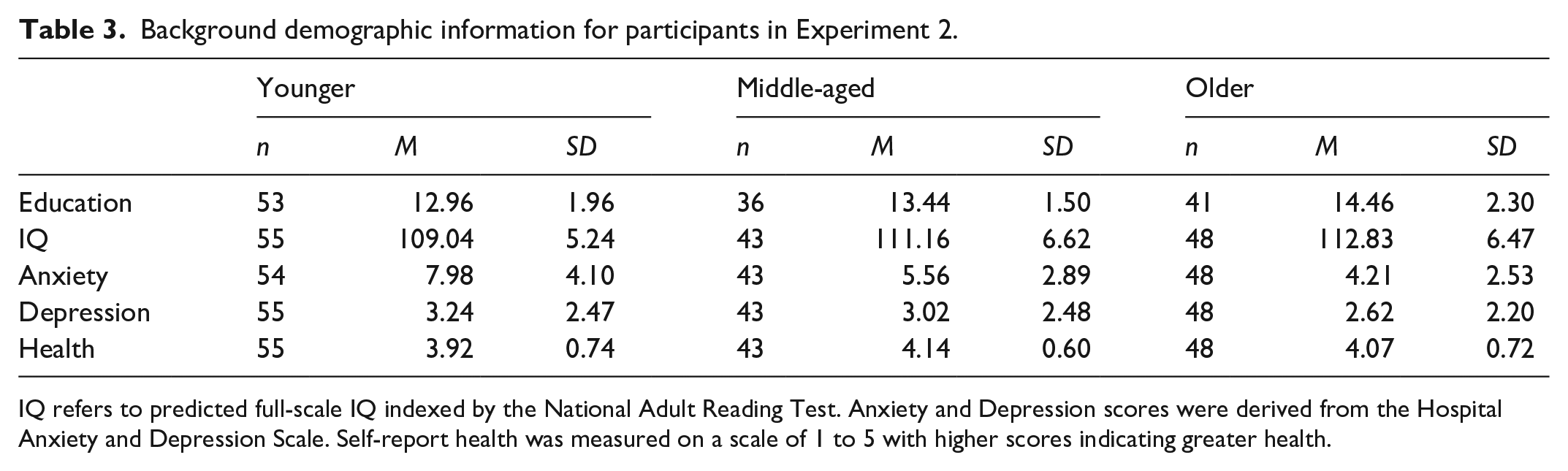
IQ refers to predicted full-scale IQ indexed by the National Adult Reading Test. Anxiety and Depression scores were derived from the Hospital Anxiety and Depression Scale. Self-report health was measured on a scale of 1 to 5 with higher scores indicating greater health.
Measures
This experiment was part of a larger research programme that included other measures (e.g., self-report questionnaires) that are not relevant to the present study and are therefore not reported here.
Traditional emotion perception task
The same stimuli set used in Experiment 1 was used in Experiment 2. This included a total of 48 images of younger and older protagonists displaying the following emotions: happiness, sadness, fear, anger, disgust, and a neutral expression. This task was completed on a desktop computer and each image was presented for 4 s, followed by a screen listing the six possible emotional labels. Participants made all responses verbally to the experimenter, and accuracy on the task was calculated as a percentage. The data from this task are also reported in Grainger and Henry (2020).
Emotional film-based task
This task was identical to the task reported in Study 1 (Goodkind et al., 2015) and included 10 film clips depicting positive, negative, and self-conscious emotional displays. The task was presented on a desktop computer, and all responses were made verbally to the experimenter. Responses were scored as correct or incorrect, and total scores on each emotion category were converted into a percentage.
Apparatus
Eye-gaze data were collected using an SMI RED500 remote eye-tracker that was tracking at approximately 250 Hz. The eye-tracker was placed under the computer monitor where the stimuli were presented, and all participants completed a nine point calibration and validation prior to commencing the task. Fixation time (%) was used to index gaze behaviour, which referred to the amount of time spent fixating in an area of interest (AOI) relative to the total amount of time spent fixating on the computer screen during the trial. Once data collection was finalised, two key AOIs were created for each film. Because we were particularly interested in whether there were age differences in visual attention to the background contextual information, AOIs were created that captured the target character (including the face and body) and the background. There were some difficulties calibrating and tracking participants’ eyes; therefore, the final sample of eye-tracking data included 52 younger, 32 middle-aged, and 32 older adults. This rate of attrition is in line with prior eye-tracking and ageing studies (Murphy & Isaacowitz, 2010; Vicaria et al., 2015).
Procedure
Participants were provided with a study information sheet and were then asked to give informed consent. Next, participants completed questionnaires that assessed background demographic information. After completing these measures, all older adults were screened for abnormal cognitive decline. The experimental tasks were organised into two blocks and were presented to participants in a randomised order within each block. The presentation of the blocks was counterbalanced such that participants were randomly assigned to complete Block 1 followed by Block 2 or vice versa. The testing session took approximately 90 min to complete including brief breaks where required. This study received ethics approval from the University of Queensland Human Research Ethics Committee.
Results
Behavioural ratings
Traditional emotion perception task
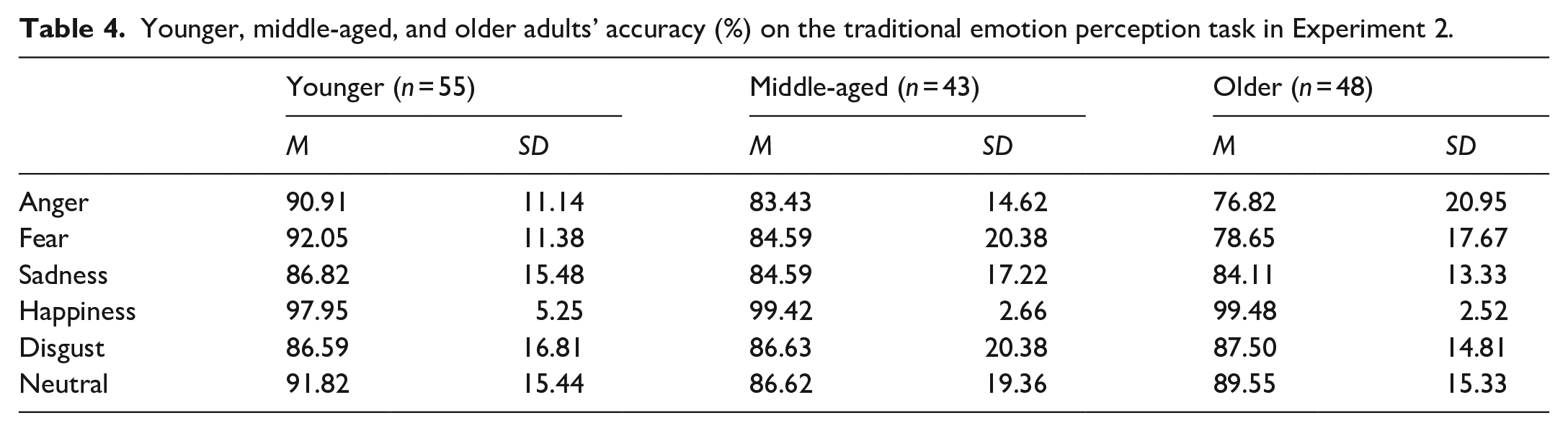
Participants’ scores on the emotion perception task were analysed using a 3 × 6 mixed ANOVA with emotion type (anger, sadness, fear, happiness, disgust, neutral) as the within-subjects factor and age group (young, middle-aged, older) as the between-subjects factor.
4
This revealed a main effect of age group, F(2, 143) = 4.96, p = .008,
The two-way interaction was followed up by examining the effect of age group at each level of emotion. The effect of age group was significant for anger, F(2, 143) = 10.07, p < .001,
Younger, middle-aged, and older adults’ accuracy (%) on the traditional emotion perception task in Experiment 2.
Emotional film-based task
Participants’ scores on the film-based task were analysed using a 3 × 3 mixed ANOVA with emotion type (positive, negative, self-conscious) as the within-groups factors and age group (young, middle-aged, older) as the between-groups factor.
5
Consistent with Experiment 1, this revealed a main effect of emotion, F(4, 286) = 42.21, p < .001,
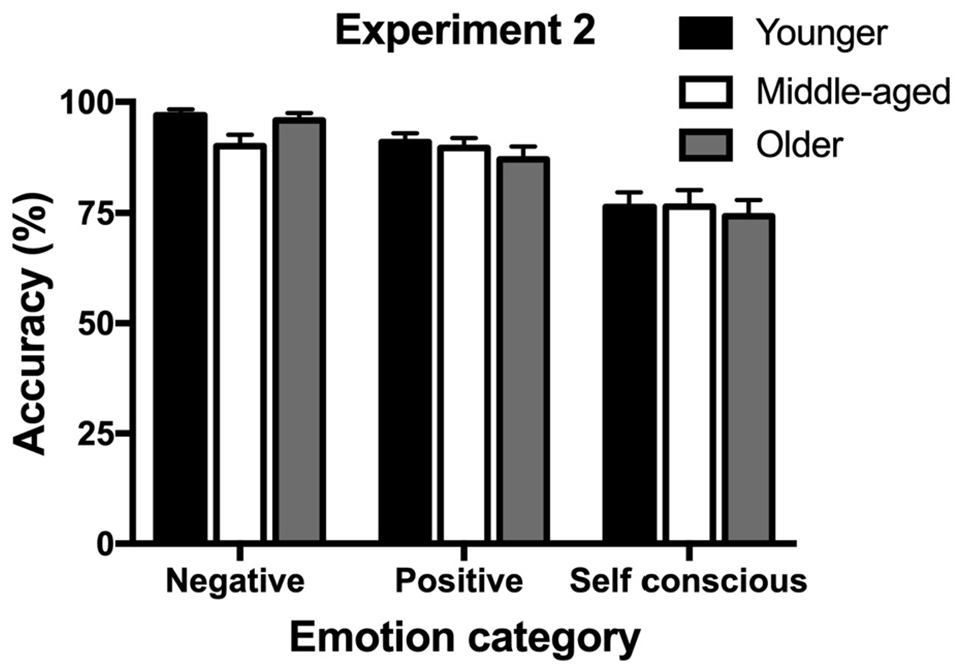
Younger, middle-aged, and older adults’ accuracy on the film-based task in Experiment 2, presented separately by emotion category.
Eye-tracking
The eye-tracking data were analysed using a 3 × 2 × 3 mixed ANOVA with emotion type (positive, negative, self-conscious) and AOI (target, background) as the within-groups factors and age group (young, middle-aged, older) as the between-groups factor. This revealed main effects of emotion, F(2, 226) = 23.76, p < .001,
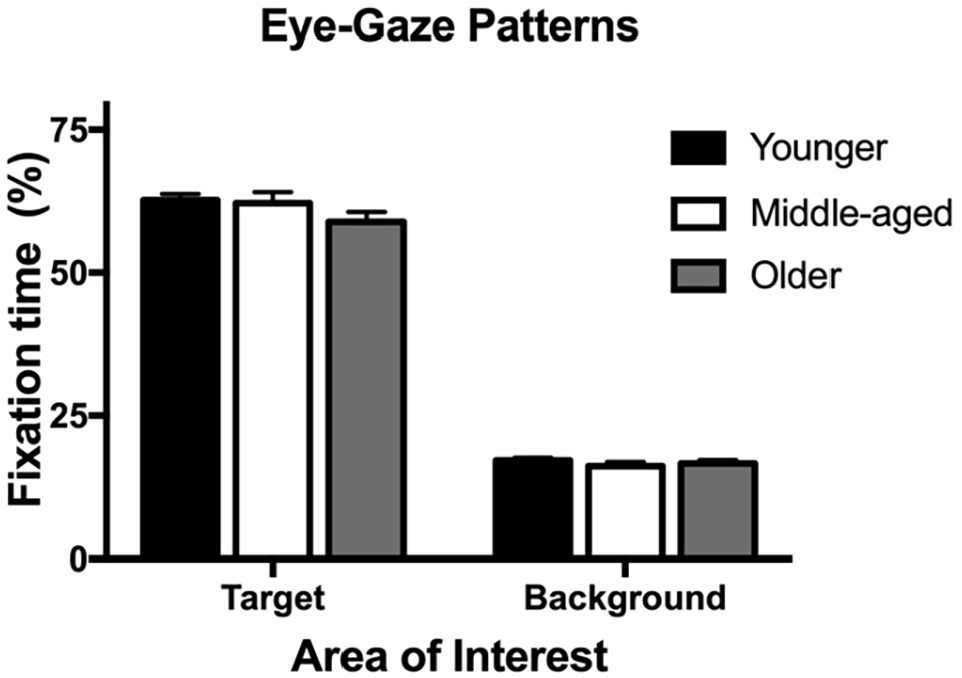
Young, middle-aged, and older adults’ eye-gaze patterns to the target and background in the film-based task in Experiment 2, collapsed across emotion category.
General discussion
Together, the results from these two experiments extend our understanding of how the capacity for emotion perception changes across the adult lifespan. The first key finding to emerge, across both experiments, was that older adults did not experience any difficulties on the film-based emotion perception task relative to their younger counterparts, despite displaying some difficulties on the traditional measure of this construct. This study was the first to use emotional film stimuli with contextually rich background scene information, and the findings suggest that when older adults are presented with a task which affords the opportunity to draw on the types of contextual information that occur in everyday life, they are just as capable as younger adults at recognising emotional displays. These findings align with prior research that have shown that age effects are reduced and sometimes even eliminated when more ecologically valid tasks are used (Richter et al., 2011; Wieck & Kunzmann, 2017) and further highlight the important role that task-related factors can play in the evaluation of older adults’ emotion perception capacities. We therefore encourage researchers moving forward to continue using more ecologically valid assessments—that include rich contextual information—when measuring emotion perception abilities in older adult samples. More studies that systematically manipulate the level of context available during a scene would be helpful in furthering our understanding of the specific types of context that are particularly useful for older adults.
Also important was the novel finding that middle-aged adults did not differ from younger or older adults in their capacity to recognise emotional displays in the film-based task. However, middle-aged adults did perform more poorly than young in recognising displays of anger on the traditional emotion perception task. This latter finding is consistent with three prior studies that showed that the ability to recognise displays of anger declines from early adulthood in a linear fashion (Calder et al., 2003; Mill et al., 2009; Richoz et al., 2018). However, most critically, when a more ecologically valid, contextualised assessment is used, emotion perception abilities appear to remain stable across the adult lifespan. These data therefore provide further evidence that specific methodological features can heavily influence lifespan ageing effects in emotion perception ability.
Another novel feature of Experiment 2 was the inclusion of eye-tracking, which allowed us to objectively assess participants’ visual inspection of the emotional films. This was important because prior work has established that older age is associated with visual biases to social and emotional stimuli (Grainger et al., 2019; Grainger & Henry, 2020; Murphy & Isaacowitz, 2010; Vicaria et al., 2015), and these age-related visual biases have been previously suggested to be a potential mechanism for explaining older adults’ poorer emotion perception ability (Wong et al., 2005, although see Grainger & Henry, 2020). Although we expected older adults to look more at the background compared with their younger counterparts, no age differences in gaze patterns were identified in the film-based task. Instead, all three age groups spent comparable amounts of time gazing at the target character and background of the films. These findings are interesting, particularly in light of broader literature which has shown that older adults are more likely to visually attend to and use contextual information during static emotion perception tasks (Noh & Isaacowitz, 2013).
However, it is important to note that the AOIs used to capture gaze behaviour in the present study were different from those used in prior studies in this literature. Specifically, Experiment 2 included two AOIs that captured the target character (including the face and body) and the background, whereas the two prior studies that have used dynamic social scene stimuli have included AOIs that capture the faces and bodies of protagonists, and did not include an AOI for the background (Grainger et al., 2019; Vicaria et al., 2015). It is important to note that although we did measure participants’ gazing to the background contextual information, we did not measure which specific aspects of the background that participants were gazing at. Therefore, the current findings cannot speak to whether there are age effects in the types of background cues that are attended to. Another aspect of our study design that may have influenced older adults’ gaze patterns was the brief presentation of an image of the target character prior to the film clip. This was done to reduce any confusion about who to focus on while watching the video, which was important because traditional emotion perception tasks only have a single target and thus it is clear who the emotion judgements should be based on. It is possible that instructing participants who to focus on during the video resulted in a more focused gaze approach by older adults and as a result the typical age-related visual biases did not emerge. However, prior work has shown that older adults continue to use context even when instructed to ignore it, suggesting that older adults’ reliance on context might reflect a more spontaneous as opposed to a controlled process (Ngo & Isaacowitz, 2015). Nevertheless, although it is possible that methodological factors may have contributed to the comparable gaze patterns across the age groups, the key point to acknowledge is that when older adults are provided with a dynamic and highly contextualised emotion perception task, they perform just as well as young in terms of their objective accuracy—and also visually inspect these stimuli in a similar manner—to their younger and middle-aged counterparts.
The final key finding to emerge across both experiments was that negative emotions were consistently recognised more accurately than both positive and self-conscious emotions in the film-based task for all age groups. Although we expected self-conscious emotions to be the most difficult to recognise because they are more complex “social emotions,” the higher accuracy on negative emotions was somewhat surprising. This is because previous studies using traditional assessments have shown that older and middle-aged adults find the recognition of negative emotions particularly challenging (Calder et al., 2003; Hayes et al., 2020; Mill et al., 2009). It is unclear why negative emotions were the best recognised in the film-based task. The original validation study for this stimuli set showed no differences in accuracy across the different emotion types (Goodkind et al., 2015). However, as noted earlier, we were unable to source one negatively valenced video (i.e., depicting sadness), which meant that our stimuli set included three negative emotions instead of four. Therefore, it is possible that participants found the negative emotions easier to categorise because there were fewer negative emotion labels to choose from (i.e., three labels instead of four). Indeed, prior work has shown that the number of labels presented in an emotion perception task can influence age effects in accuracy (Orgeta, 2010). It is also important to acknowledge that traditional emotion perception tasks typically only ever include one positive emotion (i.e., happiness), which makes this emotion very salient and easy to recognise among negative emotions. However, the current findings show that when happiness is not the only positive emotional display included in the task, positive emotions are more difficult to identify. The current data therefore reinforce the need for future studies to extend beyond the basic emotions and include more than a single positive emotion, as well as more complex self-conscious emotions to provide a more nuanced understanding of how the recognition of differently valenced emotions is affected in normal adult ageing.
Limitations
The current study was strengthened by the inclusion of two separate experiments with independent samples, including a lifespan sample and an assessment of social attention (indexed via eye-tracking) in Experiment 2. However, there are limitations that need to be acknowledged. First, we did not test whether the age groups differed with respect to their level of familiarity for the film clips in the film-based task. The film clips were taken from well-known movies that most people should be familiar with, but most of these movies were released more 20 years ago so they may have been more familiar to the older relative to younger adults. Therefore, it is not possible to rule out differences in task familiarity contributing to older adults’ better performance on the film-based task relative to the traditional task. Second, the age groups differed with respect to how they were recruited. In both experiments, the younger adults were recruited from a first-year psychology research participation pool and compensated with course credits, whereas the older adults (and middle-aged adults in Experiment 2) were recruited from the general community and paid in gift vouchers. Although this recruitment strategy is very common across ageing studies, it is not ideal because the age groups often differ on sociodemographic characteristics and with respect to their motivation to participate in the research.
Conclusion
To conclude, across two experiments involving independent samples, older adults were just as capable as younger and middle-aged adults in recognising emotions in a highly contextualised film-based task. This study also showed for the first time that older adults did not differ from either their younger or middle-aged counterparts in their visual inspection of these stimuli. Taken together, these data point to relative stability in emotion perception and social attention across the adult lifespan when more ecologically valid tasks are used and highlight the need to include more contextually rich assessments in future studies. Studies that assess emotion perception and social attention in naturalistic settings (i.e., outside of the laboratory) would be particularly useful moving forward. These findings suggest that the age effects identified in prior literature may overstate the difficulties older adults experience with emotion perception in their everyday lives, and align with other recent evidence which show that task features are an important determinant of age effects in this literature (Hayes et al., 2020).
Footnotes
Acknowledgements
We thank Laura Magnusson, Lena Fang, and Edward Ford for their assistance with data collection.
Declaration of conflicting interests
The author(s) declared no potential conflicts of interest with respect to the research, authorship, and/or publication of this article.
Funding
The author(s) disclosed receipt of the following financial support for the research, authorship, and/or publication of this article: Professor Henry is the recipient of an Australian Research Council Future Fellowship (FT170100096). Dr. Grainger is the recipient of an Australian Research Council Discovery Early Career Researcher Award (DE220100561).

Data accessibility statement
All data and materials reported in this manuscript are available on request by contacting S. A. Grainger via email.