



Abstract
Transcoding is the process of translating between spoken and written numbers, and it is correlated with other mathematical skills. In the present study, we investigated the link between French number writing of 49 students in the third grade (aged 7–9 years) and their language skills. Transcoding in French is of particular interest because the spoken number language system does not completely correspond to that of the written digits (e.g., quatre-vingt-dix [four-twenty-ten] and 90). We hypothesised that the complex linguistic structure of spoken numbers in French would be challenging for students who are learning to transcode. First and second French-language learners’ accuracy and errors were recorded during a writing task of 3- to 7-digit numbers. Children also completed linguistic tests (e.g., receptive vocabulary, receptive syntax). Results showed that first- and second-language learners did not differ in their transcoding accuracy. Number size, decade complexity of stimulus number words in French (i.e., numbers containing a complex decade, operationalized as a number between soixante-dix, 70, and quatre-vingt-dix-neuf, 99), and receptive vocabulary predicted children’s French transcoding skills. Students were more likely to produce errors (e.g., 68 or 6018 for 78) when they transcoded complex decade numbers compared with simple decade numbers. When an error was made on the complex decade portion of a number, it was likely a lexical error. In conclusion, third graders, both first- and second-language learners, found complex decade numbers challenging and their performance was related to their general vocabulary skills.
Educational impact and implications statement
The presence of complex decades (i.e., numbers between 70 and 99) are challenging for third graders when writing French numbers. First and second French-language learners are similarly affected. Vocabulary skills in the instructional language are strongly related to French number writing. Teachers should consider instruction that emphasises children’s associations between complex decade numbers and their spoken format in long-term memory to reduce the cognitive load of number writing.
Every day, children and adults are exposed to numbers in three different forms: spoken words, written number words, such as “twenty-five,” and written numerals, such as “25.” They often must shift or transcode among these notations. Transcoding performance is related to general mathematics achievement (Geary et al., 1999, 2000; Moeller et al., 2011). Moreover, although transcoding appears to be a simple task, it is difficult for children, particularly those who have learning disabilities in mathematics (Moura et al., 2013) or reading (De Clercq-Quaegebeur et al., 2018). Transcoding is also more challenging in languages in which the spoken form does not correspond directly to the written form, such as transcriptions with numeral to number word inversions (e.g., in German and in Dutch, 21 is said einundzwanzig, or one-and-twenty: (Imbo et al., 2014; Poncin et al., 2020; Steiner et al., 2021; Zuber et al., 2009; in Arabic: Ganayim & Dowker, 2021) or complex vocabulary conventions (e.g., in French, 71 is soixante-et-onze, or sixty-and-eleven; Seron et al., 1992; Seron & Fayol, 1994). These languages compare with those such as Chinese, where the mapping between spoken and written forms translates directly to place-value conventions (e.g., 71 is qi shi yi, or seven-ten-one).
The goal of the present research was to investigate the role of language in the transcoding skills of francophone children and to explore the transcoding performance of these children to better understand how transcoding skills develop. More specifically, we studied the writing of French verbal numbers in first and second French-language learners to investigate the link between language and number transcoding and, ultimately, provide insight into the challenges that francophone children experience while learning about numbers at school. A goal was to determine whether having a strong grasp of the French language (first-language speakers) was helpful for knowing about the structure of the number sequence compared with those learning French as a second language.
Number words and the Arabic number system
Transcoding among the different forms of number words is most often done in one of two directions: Number writing, which is transcoding from spoken number words to numerals, and number reading, which is transcoding from numerals to spoken number words. The Arabic number system is regular. It includes only 10 digits (0, 1, 2, 3, 4, 5, 6, 7, 8, and 9) and a positional notation as its central principle (Fuson et al., 1997). Children are exposed to the system as they experience their world, but eventually acquire formal number system knowledge in school. Students learn most of the basic number words early, but it takes children time to understand the place-value principles of the Arabic number system as they are exposed to increasingly complex numbers (Osana & Lafay, 2019; Lafay et al., 2020; Lafay et al., 2023; Cheung & Ansari, 2021; Gervasoni & Sullivan, 2007).
The spoken number words in many languages do not correspond directly to the written numerals in that language. Spoken number systems contain some basic number words (i.e., primitives; ADAPT model, Barrouillet et al., 2004) that are combined using specific syntactic rules to express additive (e.g., one hundred and four) or multiplicative relations (e.g., four hundred), thereby reducing the quantity of number words used. Whereas numerals use only relative position to denote units of different magnitudes, number words use morphemes (e.g., “-ty,” “hundred”). In some languages, spoken numbers correspond closely to numerals. For example, in Chinese, the number 12 is spoken as the equivalent of “ten two” which directly reflects the base-10 structure in the Arabic number system. Other languages vary in how close the correspondence is between the spoken and written number forms (LeFevre et al., 2018).
In French, there are some discrepancies between the verbal number system and the Arabic number system. In particular, the French verbal number system to a billion contains 25 number word primitives: Units from un (one) to neuf (nine), decades from dix (ten) to soixante (sixty), particulars from onze (eleven) to seize (sixteen), cent (hundred), mille (thousand), million (million), and milliard (billion). These words can be combined according to two syntactic rules for verbal-to-digits relations. For example, deux cents (two hundred) is combined according to a multiplicative rule that means the number value “two times one hundred,” whereas cent deux (one hundred and two) reflects an additive relation and refers to the number value “one hundred plus two” (see Barrouillet et al., 2004; Camos, 2008; LeFevre et al., 2002).
Some French number words are particularly complicated. In contrast to some languages, such as English, the number words for the decade values from 70 to 90 in French are partially based on a vigesimal (i.e., base-20) system. The name for seventy, soixante-dix, means sixty-ten; seventy-one is soixante-et-onze, which means sixty-and-eleven; seventy-two is soixante-douze, which means sixty-twelve, and so on. Furthermore, eighty is quatre-vingt, which means four-twenty; eighty-one is quatre-vingt-un, which means four-twenty-one. Finally, ninety is quatre-vingt-dix, which means four-twenty-ten, and ninety-one is quatre-vingt-onze, which means four-twenty-eleven. Because of their spoken form, these numbers are structurally complex for children. This complexity results in children making many transcoding errors when learning to transcode between French spoken and written forms (Camos, 2008; Saad, 2010; Seron et al., 1992; Seron & Fayol, 1994). Even if the numbers involve a combination of primitives, they do not follow the logic of the base-10 number system and may ultimately be stored as units in long-term memory. This complexity makes the French verbal number system non-transparent with regards to the regular and positional Arabic number system.
French number transcoding processes and errors
Barrouillet et al. (2004) developed a developmental, asemantic, and procedural model of number transcoding (i.e., the ADAPT model). According to the ADAPT model, when individuals transcode from spoken to written numbers, they first attempt direct retrieval of digital forms from long-term memory. For example, if children know the association between the spoken number word “eight” and the Arabic symbol “8,” they can retrieve the symbol when presented with the number word. There is no requirement to retrieve any information about quantity, and a number word can simply be retrieved from long-term memory. If there is no association stored in memory, the model uses a procedural strategy to construct the corresponding written symbol. For example, for the spoken number “one hundred and forty-two,” the system retrieves the rule that the numeral must contain three digits if the number words include “hundred,” and sets up a “number frame” with three slots in working memory that will be filled in using the other information in the spoken form. Subsequent processing stages assign the digits to the slots according to an iterative retrieval–procedural process that populates the frame in working memory with number words retrieved from long-term memory (Barrouillet et al., 2004; Imbo et al., 2014). In this sense, the use of procedural rules makes the model asemantic. In general, the ADAPT model includes the assumption that children acquire a basic set of number words and the rules to combine them to produce compound number words (Skwarchuk & Anglin, 2002). The model is developmental because new number words are stored in long-term memory, and new rules are gradually acquired as children learn about larger numbers.
The ADAPT model is useful because it can be used to make predictions about the type of transcoding errors that children will make, depending on their knowledge of both the spoken and written number systems. Very broadly, children may retrieve the wrong number word, such as writing “4” when they hear “five.” These errors are called lexical errors (Barrouillet et al., 2004; see also Steiner et al., 2021) or vocabulary errors (Skwarchuk & Betts, 2006) and involve the substitution of digit(s) (e.g., “soixante-cinq,” or sixty-five, written as “45”). Lexical errors are assumed to reflect difficulties in retrieving the basic number words from long-term memory. Furthermore, children may apply rules incorrectly or incompletely, resulting in syntactic errors. Syntactic errors (Barrouillet et al., 2004; Steiner et al., 2021) are typically identified as responses that have an incorrect number of digits (e.g., “three hundred and twenty-one” to “30021”; “six thousand and fifty-four” to “654”). Syntactic errors often include mistakes in the insertion or omission of 0 during number writing. Because the Arabic symbol “0” has no direct one-to-one translation with a number word during transcoding, it plays an important role as a placeholder in the written number structure. For example, the number “four hundred six” (or “four hundred and six”) might be incorrectly written as 4006 or 46 if the writer does not fully understand how zeros are used to preserve number syntax. The ADAPT model captures syntactic errors in several ways, including incorrect or incomplete procedures during number processing.
According to the ADAPT model (Barrouillet et al., 2004), by third grade, children directly retrieve the 2-digit Arabic forms from long-term memory. For example, when children hear cinquante-trois (fifty-three), they can recognise the whole chunk and easily retrieve the Arabic symbols associated with it (i.e., 53). Note that they also can recognise the radical cinq- and easily retrieve the Arabic symbol associated with the word cinq (i.e., “5”). The “complex decades” (i.e., numbers from 70 to 99) also need to be memorised and retrieved from long-term memory (Barrouillet et al., 2004). The retrieval process is more complicated, however, because the spoken form is not transparently connected to the Arabic symbols. For example, when children hear soixante-dix-huit (i.e., sixty-ten-eight, 78), they may retrieve the written forms for soixante (60), for dix (10), for huit (8), or for dix-huit (18) and write either 60108, 6018, or 68 (if they ignore the dix). The first two errors are syntactic, or literal transcoding errors (Seron & Fayol, 1994), because children decompose what they hear and write the digits that correspond to these components, rather than retrieving a symbol from long-term memory. Similarly, children may write 4203 instead of 83 (quatre-vingt-trois, which is four-twenty-three) and 42017 instead of 97 (quatre-vingt-dix-sept, which is four-twenty-seventeen), also syntactic errors. In contrast, errors such as writing 68 for 78 or 93 for 83 are considered lexical errors. Thus, it is possible that these syntactic errors on complex decade numbers do not exist independently of knowledge of basic number words (Skwarchuk & Anglin, 2002).
Consistent with the linguistic complexity of the French complex decades (i.e., from 70 to 99), French-speaking children have difficulty learning number writing. Saad (2010), for example, found that 90% of errors made by French first graders on two-digit numbers were on complex decades. Camos (2008) found that French second graders made errors on 63% of four-digit numbers with complex decades, but on only 47% of four-digit numbers that did not contain complex decades. Seron et al. (1992) found that, for Belgian French-speaking third graders, 23% of lexical errors in two- to six-digit numbers were on complex decades in the 1980s. Finally, even French-speaking fifth graders in Luxembourg still struggled to transcode numbers with complex decades into the 1980s number sequence (Van Rinsveld & Schiltz, 2016). Despite differences in the stimuli and the populations assessed in these studies, the general findings support the view that complex decades may be particularly challenging for francophone students in the early grades. Much of the research reporting these findings tested francophone children in France and Belgium, but none has investigated francophone children in the province of Quebec in Canada. There are many children across Canada receiving instruction in French as a second language (approximately 430,000 students in Canada enrolled in French Immersion programmes; Statistics Canada, 2021). Furthermore, the vast majority of children in Quebec are francophone, anglophone, or allophone (respectively, 77%, 7%, and 13%; Statistics Canada, 2016). Francophones and allophones are all required by law to go to French schools, and thus do not have a choice about whether to learn their numbers in a second language.
Link between transcoding and specific language skills
Transcoding clearly involves language skills, but language and mathematics are related in many other ways (Peng et al., 2020). For example, second graders’ oral language skills were a strong predictor of word-problem solving at both the beginning and end of the school year (Fuchs et al., 2018). Moreover, children with developmental language disorders consistently performed worse than their typically developing peers on tasks with high verbal demands, such as number transcoding, counting, and word-problem solving (Cross et al., 2019; Donlan et al., 2007; Fazio, 1996; Rodríguez et al., 2020). Further evidence of the relation between language and mathematics comes from students learning mathematics in a second language. For example, young second-language learners showed poorer performance in early numeracy skills that were dependent on language, such as counting (Bonifacci et al., 2016; Kleemans et al., 2011; Méndez et al., 2019) and word-problem solving (Xu et al., 2021; Banks et al., 2016), compared with tasks that were not language-dependent, such as arithmetic. Indeed, various linguistic skills are related to children’s ability to understand and solve word problems, including phonological awareness (Bonifacci et al., 2016), and expressive vocabulary and receptive syntax (i.e., sentence understanding; (Chow & Ekholm, 2019; Méndez et al., 2019). With respect to transcoding more specifically, Lopes-Silva et al. (2014) found that phonemic awareness directly predicted number transcoding and mediated the influence of verbal working memory on number transcoding in children from the second to fourth grade. Research on the relations between transcoding performance and various linguistic skills, such as phonological awareness, receptive vocabulary, syntactic skills, and word reading, for first and second French-language learners, on the other hand, has not received much attention. Studying the relation between number transcoding and specific language skills (e.g., receptive vocabulary) will provide a better understanding of the cognitive developmental processes of French number transcoding in first- and second-language learners and will be helpful to all the francophone and allophone children who are required to attend French schools.
Objectives
In the present study, we investigated the relation between language and transcoding skills (i.e., number writing) in children learning math in French, including both first and second French-language learners. To this end, we studied transcoding accuracy and the error patterns of children in the third grade (8- to 9-year-olds) in relation to number decade complexity and children’s linguistic skills (e.g., receptive vocabulary) for children who were learning mathematics in either their first (i.e., home/school language) or second language (i.e., school language). We compared children’s performance on items with complex decade numbers—that is, those between 70 and 99—with their performance on items without complex decades. We hypothesised that children would make more transcoding errors on items that contain a complex decade number (e.g.,
Next, to further understand the cognitive processes behind the development of transcoding in French and the relation between transcoding and language, we investigated the relations between transcoding accuracy (i.e., overall error frequency) and four linguistic skills: receptive vocabulary, phonological awareness, receptive syntax, and word reading. We chose these four linguistic skills because previous studies have found links between each skill and mathematics (Peng et al., 2020): vocabulary (Chow & Ekholm, 2019; Habermann et al., 2020; Méndez et al., 2019), syntax (Chow & Ekholm, 2019; Méndez et al., 2019), phonological awareness (Bonifacci et al., 2016; Lopes-Silva et al., 2014), and word reading (Bailey et al., 2020). We expected that individual differences in the four linguistic skills would be positively correlated with children’s number transcoding performance. More specifically related to transcoding skills, we chose to include a vocabulary measure because children retrieve number-words from long-term memory, and a syntax measure because syntactic rules are required when children write numbers from dictation. Because the French verbal number system is not transparent, and children need to memorise many number words (e.g., quinze, 15; quatre-vingt-dix, 90), we expected that receptive vocabulary will predict transcoding accuracy (Hypothesis 2a). Finally, because children must apply syntactic rules to generate numbers, we expected that receptive syntax knowledge will also predict number transcoding accuracy (Hypothesis 2b).
The French verbal number word system is quite different from other number word systems. Therefore, children who have learned a first language other than French may not necessarily know the relation between the spoken number words and the Arabic format of the complex decades (e.g., 90, quatre-vingt-dix, ninety). Thus, we predicted that second-language learners would be less accurate than first-language learners in transcoding numbers, especially those that include a complex decade, because of weaker skills in the language of instruction (Hypothesis 3a); that second-language learners would produce more lexical and syntactic errors than first-language learners, especially for complex decade numbers (Hypothesis 3b); and that second-language learners would produce more errors on the complex decade portion of these numbers than first-language learners (Hypothesis 3c). In any event, studying the differences in number transcoding skills between first and second French language speakers will help to inform instructional processes in early mathematics classrooms.
Method
Participants
Participants were 49 third-grade Canadian children (Mage = 8:10 years: months, SDage = 0:6 years: months; age range from 8:2 to 10:10 years: months; 65% female). Parents provided written consent for their children’s participation and children provided verbal assent. The participants were recruited from six francophone public schools in the province of Quebec in Canada and were receiving mathematics instruction in French. Two language groups were created according to parental reports of languages spoken at home. If the language reported matched the language of instruction at the child’s school (i.e., French), children were classified as first-language learners. Otherwise, the children were classified as second-language learners. More specifically, parents indicated they always (n = 8), often (n = 4), or half of the time (n = 1) used their home language to speak with their child.
The first-language learners were 33 children who spoke French at home. Sixteen children were second-language learners speaking a language other than French at home (English: 56.3%; Spanish: 18.8%; Arabic: 18.8%; Chinese: 6.3%; Polish: 6.3%). First- and second-language learners did not differ in age (Mage = 105.29 vs. 106.93 months), F(1,43) = 0.79, p = .38 or in gender, χ2(1, 49) = .12, p = .72. The socioeconomic status (SES) index (Indice de milieu socio-économique, Ministère de l’Éducation et de l’Enseignement Supérieur, 2018), which is based on mother’s education and parents’ work, was used to assess school SES. This index showed that 49% of the students were from low-SES schools, 34% were from middle-SES schools, and 16% were from high-SES schools. First- and second-language learners were similarly distributed across the low-, medium-, and high-SES schools, χ2(2, N = 49) = 1.74, p = .42.
Measures
The data were collected as part of a larger project, and only measures that are relevant to the present article are reported here, including number transcoding and linguistic skills. The complete list of measures is available at https://osf.io/428hp/. Children were tested at school during one or two individual sessions (depending on the school’s schedule) for a total of 75 min. The presentation order of the experimental tasks was randomised across children (https://www.randomizer.org/). The study received ethics approval from the University Human Research Ethics Committee of Concordia University.
Number transcoding
Children heard a number presented orally in French, and they were asked to write the corresponding numeral. For example, for cinq cent trois (i.e., five hundred and three), the correct response would be “503.” For each trial, the experimenter played a pre-recorded audio file of the number words to the children. Children had the option to hear the audio recording of each number twice.
There were two practice trials (numerals 45 and 36) and 30 experimental trials (see Table 1). The experimental trials consisted of five blocks, with each block corresponding to a number length (i.e., three to seven digits, representing quantities from the hundreds to the low millions up to ten million) and six trials in each block. Altogether, there were 16 trials that included complex decades—that is, numbers between 70 and 99, spoken with number words from soixante-dix to quatre-vingt-dix-neuf. Complex decades were in the decades of the ones period (e.g., 3072) or in the decades of the thousands period (e.g., 581000). The three-digit stimuli were presented first (in the order shown in Table 1), followed by the four-digit stimuli, and so on. Complex decades are bolded in the table. With three exceptions that had two complex decades (e.g.,
Stimuli used in the transcoding task (complex decades are bolded).
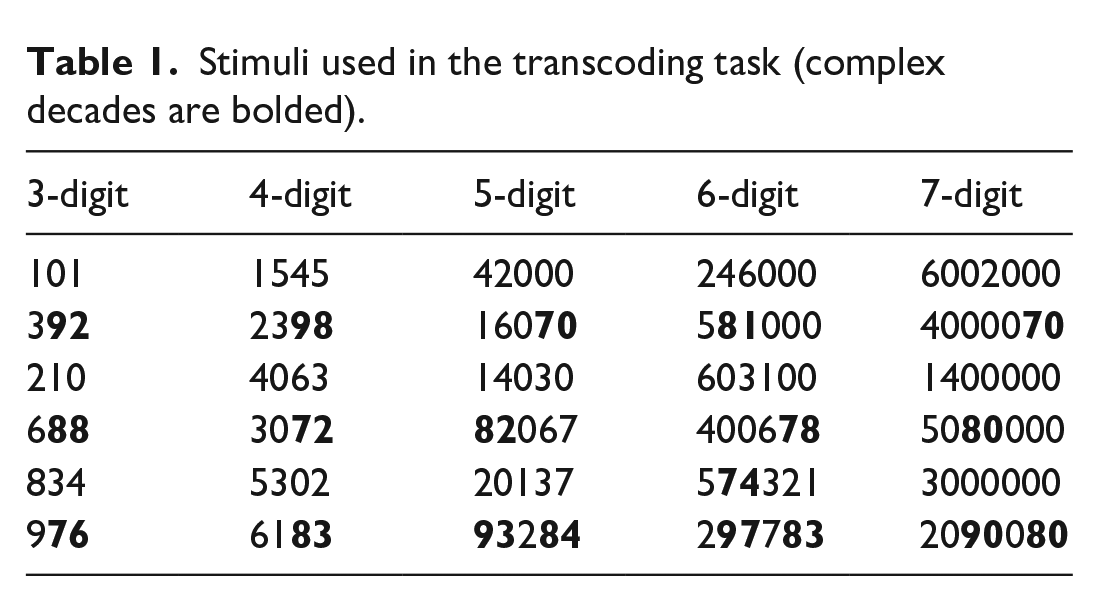
Testing stopped when children failed to correctly write down at least three numbers in one block. All 49 children were administered the three-, four-, and five-digit numbers; 24 children were administered the six-digit numbers, and 10 children were administered the seven-digit numbers. The internal reliability (Cronbach’s α) was .91.
Coding
For each item, a score of 0 was assigned to any number that was incorrectly written or not administered because of the stop criterion. A score of 1 was assigned when all parts of the numeral were transcribed correctly. The total accuracy score was the mean number of correctly written numbers for each child.
An error analysis was conducted using a coding scheme based on that used by Seron et al. (1992) and Barrouillet et al. (2004). Each child’s error was classified either as a lexical error or a syntactic error. Lexical errors were identified by numbers that have the correct number of digits with at least one incorrect digit (i.e., substitutions of primitives). Syntactic errors were errors that affected the order of magnitude of the number because the number of digits was either smaller or larger than in the target number. They were identified when digits were inserted or omitted. If a child produced both types of errors when writing one number, both error types were counted in each category. Excluding trials that children did not write, the proportion of lexical errors and syntactic errors was computed as (a) a lexical error score by dividing the number of lexical errors by the total number of errors and (b) a syntactic error score by dividing the number of syntactic errors by the total number of errors.
Also, errors on complex decade numbers could have been committed on either the complex decade or on another part of the number. For example, 2398 could have an error on the complex decade (e.g., written as 23
Linguistic measures
Receptive vocabulary
An adapted form of the Échelle de vocabulaire en images Peabody, Form A (EVIP; Dunn et al., 1993) was administered to assess children’s receptive vocabulary. Children heard a French word while looking at four pictures and were asked to choose the picture that best corresponded to the word. They were asked to complete 105 experimental trials that were age appropriate (i.e., items # 65 to # 170). The test was discontinued when children made eight or more errors in a set. The dependent variable was the total number of correct items. The internal reliability (Cronbach’s α) was .92.
Receptive syntax
An adapted form of the test ECOSSE (Lecocq, 1996) was administered to assess children’s receptive syntax (i.e., sentence understanding). Children heard a sentence and were asked to choose the picture (among four choices) that best corresponded to the sentence. The 44 sentences assessed various grammar concepts, such as negation and relative clauses. The test was developed for 4- to 11-year-old children. It started with simple sentences such as “the boy runs,” which were assumed to be acquired early, and the items increased in complexity throughout to include more complex syntactic structures that are assumed to be acquired later such as “the dog chases the horse that turns.” The test was discontinued when children made eight consecutive errors. The dependent variable was the total number of correct items. The internal reliability (Cronbach’s α) was .86.
Phonological awareness and word reading
A task was administered to assess children’s phonological awareness and word reading. An adapted form of the Lecture de mots from the Test de rendement individuel de Wechsler, deuxième édition (WIAT-II CDN-f; Wechsler, 2005) was administered. The task required children to answer 14 questions that assessed phonological awareness, such as the identification of common phonemes, and to read 36 words that corresponded to their grade level (i.e., third grade) to assess word reading. The two dependent variables were the total number of correct items for each part: the phonological awareness score and the word reading score. The internal reliability (Cronbach’s α) was .34 for phonological awareness and .74 for word reading. The data revealed ceiling effects (with M of 12.58 on 14 and 35.18 on 36 and SD of 1.12 and 1.70, respectively).
Working memory measures
Children’s working memory was assessed through digit span tasks, forward and backward. In the Digit Span Forward (WISC-V; Wechsler, 2014), children heard a series of numbers (e.g., 3-8-2) and were asked to repeat the numbers back in order (e.g., 3-8-2). There were two trials for each span. Children started with a span length of two digits. If children correctly repeated all the numbers in the correct order for at least one of the two sequences per span, then the span length increased by one digit. Testing was discontinued when children were incorrect on both spans of a given length. The total score was the number of sequences that each child repeated correctly. The procedure for the Digit Span Backward (WISC-5; Wechsler, 2014) was identical to the Digit Span Forward, except that children heard a series of numbers (e.g., 3-8-2) and were asked to repeat the numbers they heard in the reverse order (i.e., 2-8-3; for reliability see Authors, 2022).
Results
Performance analysis
Descriptive statistics for the transcoding and four linguistic measures as a function of language group are shown in Table 2. Because phonological awareness and word reading showed ceiling effects, these variables were not included in further analyses. The other two linguistic measures (i.e., receptive vocabulary and receptive syntax) were analysed in a one-way MANOVA with group (first-language learners, second-language learners) as the between-groups factor. The main effect of group was not significant, F(1, 48) = 0.83, Wilks lambda = 0.96, p = .44, which could be explained because all the second-language learners recruited in the study had lived in Canada for at least 3 years.
Scores on linguistic, working memory, and transcoding tasks (Proportion correct (SD)) as a function of language group.

As predicted, there was a significant correlation between transcoding and receptive vocabulary (r = .42, p < .01), but the correlation between transcoding and receptive syntax was not significant (r = .25, p = .25). The correlations between transcoding and working memory were not significant (r = .07, p = .65 for the Digit Span Forward and r = .10, p = .50 for the Digit Span Backward).
To investigate if accuracy differences in transcoding depended on the decade complexity of numbers in French (Hypothesis 1a), on the linguistic skills of children (i.e., receptive vocabulary and receptive syntax; Hypotheses 2a and 2b), or on the children’s language group (first vs. second language learners; Hypothesis 3a), performance on each trial (correct or incorrect) for each child was analysed using a logistic mixed-effects (LMM) model. Trials with no response (i.e., the child was stopped because of the stop criterion) were not included in the analysis. No trials were removed for blocks of three- and four-digit numbers; 32 trials out of 294 were removed in the block of five-digit numbers; 143 trials out of 294 were removed in the block of six-digit numbers; finally, 195 trials out of 294 were removed in the block of seven-digit numbers. The transcoding data were normally distributed for first-language learners (Kolmogorov–Smirnov = .09) and for second-language learners (Kolmogorov–Smirnov = .06).
A logistic mixed-effect model containing participants and individual trials as random effects was fit to the data in a stepwise forward selection procedure to predict the probability of correctly transcoding a number. With a stepwise forward selection procedure, an empty model (i.e., intercept only) is fit and then predictors and interactions are added one at a time to see if the model improves. In the present analysis, Level 1 predictors (i.e., the number of digits and the decade complexity of the numbers) were added first, followed by Level 2 predictors (i.e., language group, receptive vocabulary, and receptive syntax). At each step, the models were tested: Akaike information criterion (AIC) values were compared, with lower values indicating an improved model fit, and a likelihood ratio test was conducted between the previous model and the current model. When the model no longer improved, the process ended and the model with the best fit was selected (Baayen et al., 2008; Schweinberger, 2019). Although it did not improve the model, language group was included to show that there were no significant differences between first- and second-language learners.
The final minimal adequate model is presented in Table 3. This model was significantly better than the intercept-only baseline model,
Mixed effects model for transcoding accuracy (0 = incorrect, 1 = correct).
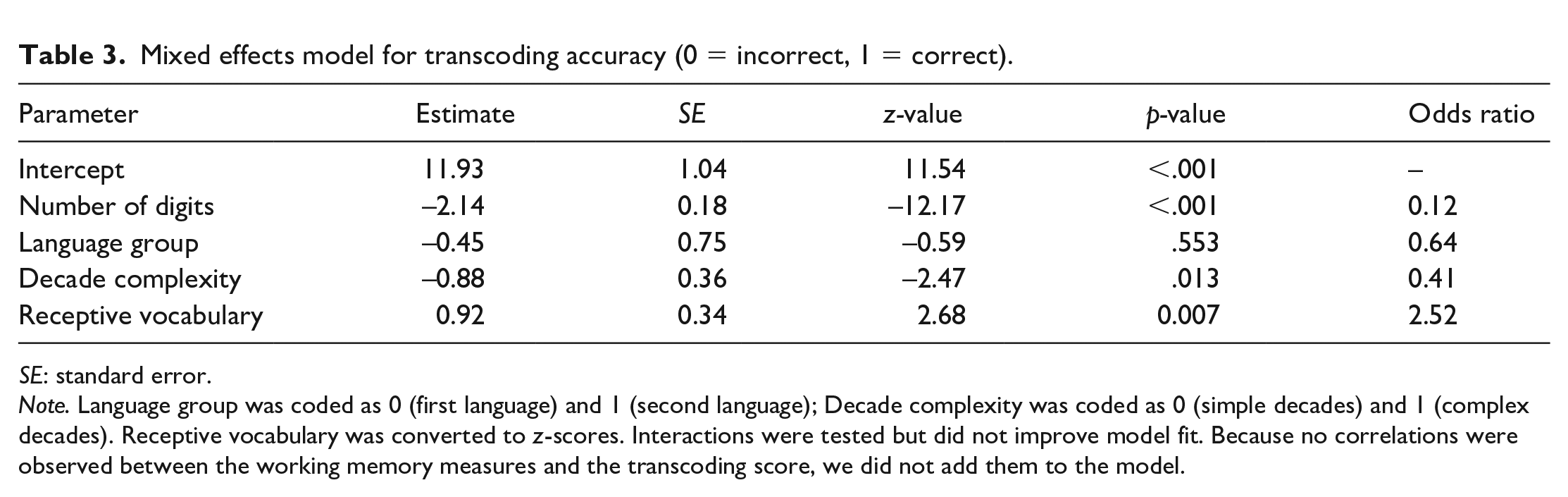
SE: standard error.
Note. Language group was coded as 0 (first language) and 1 (second language); Decade complexity was coded as 0 (simple decades) and 1 (complex decades). Receptive vocabulary was converted to z-scores. Interactions were tested but did not improve model fit. Because no correlations were observed between the working memory measures and the transcoding score, we did not add them to the model.

Scatterplot for the relation between receptive vocabulary and transcoding.
In summary, the analyses of transcoding accuracy show that students were less likely to transcode numbers correctly if they had more digits and complex decades. Students with higher receptive vocabulary were more likely to transcode correctly than those with lower receptive vocabulary, but first-language learners were not more accurate on transcoding than second-language learners. In the following section, we explore the types of errors that students made as a function of the stimulus characteristics and language groups.
Error analysis
Descriptive statistics for the lexical and syntactic error scores can be found in Table 4. There were a few cases (5.6% of all errors) where the responses could not be coded as either lexical or syntactic. These errors were not included in further analyses. To investigate if lexical and syntactic error differences in transcoding depended on decade complexity (Hypothesis 1b) or on language group (Hypothesis 3b), the percentage of lexical errors and syntactic errors were analysed in separate 2(group: first-language learners, second-language learners) × 2(decade complexity: simple, complex) mixed ANOVAs. 1
Lexical and syntactic error scores (i.e., proportion of total errors) on number transcoding according to language group and decade complexity of numbers.
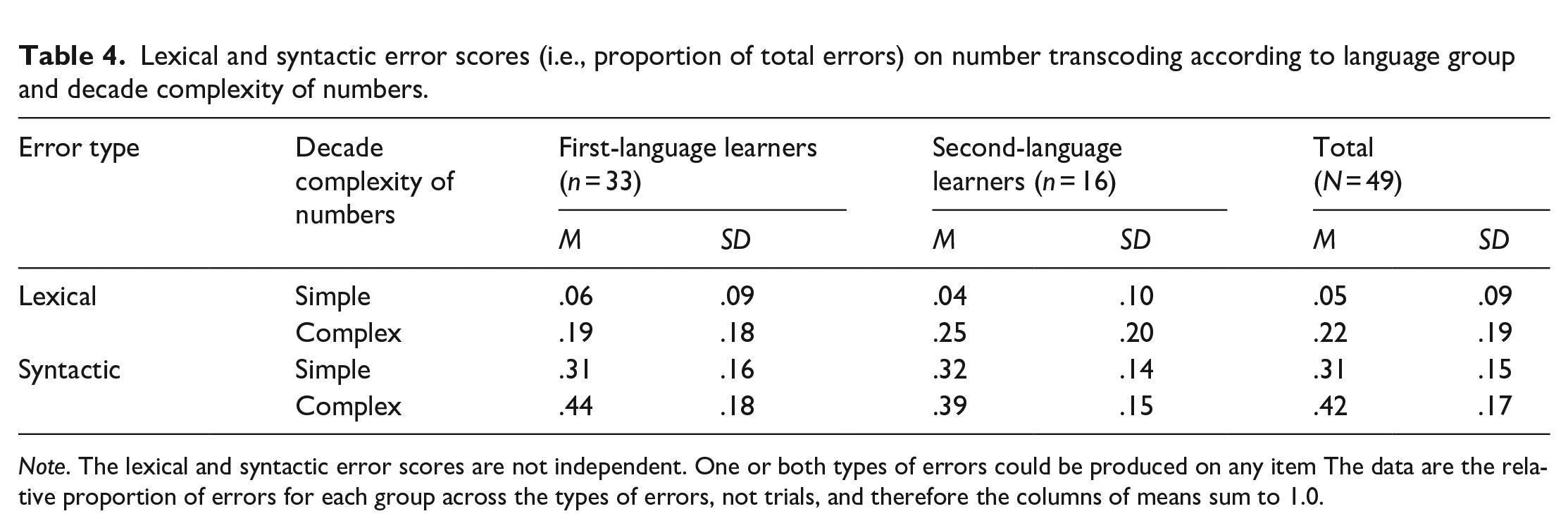
Note. The lexical and syntactic error scores are not independent. One or both types of errors could be produced on any item The data are the relative proportion of errors for each group across the types of errors, not trials, and therefore the columns of means sum to 1.0.
For the lexical error score, there was a significant effect of decade complexity, F(1, 46) = 33.35, p < .001, ηp2 = .42. The effects of language group, F(1, 46) = 0.40, p = .53, and the interaction, F(1, 46) = 1.38, p = .25, were not significant. As shown in Table 4, students made a higher proportion of lexical errors on complex decade numbers than on simple decade numbers (M = .22 vs. M = .05). In summary, there were very few lexical errors on simple decade numbers, indicating that students were familiar with the lexical codes for these items.
Similarly, for the syntactic error score, there was a significant effect of decade complexity, F(1, 46) = 6.94, p = .01, ηp2 = .13. However, the effects of language group, F(1, 46) = 0.40, p = .53, and the interaction, F(1, 46) = 1.01, p = .32, were not significant. As shown in Table 4, students made a higher proportion of syntactic errors on complex decade numbers than on simple decade numbers (.42 vs. .31) regardless of language group. Thus, decade complexity was related to both types of errors, partially supporting Hypothesis 1b.
Because the lexical and syntactic error percentages are not independent, that is, a given trial could contribute both a lexical and a syntactic error, we could not directly compare them statistically. It is clear, however, that children made more syntactic than lexical errors, and that the ratio of syntactic to lexical errors was higher for the simple decade numbers, at about 6:1, than for the complex decade numbers, at about 2:1. The higher proportion of syntactic errors compared to lexical errors is similar to that found in other studies. For example, in Barrouillet et al. (2004), the overall ratio of errors was also about 6:1 for syntactic versus lexical errors, for 92 stimuli (i.e., 2, 3, or 4 digits in length).
2
However, if we consider only the complex decade component in the complex decade numbers (e.g., the “98” in 23
Finally, to investigate if children’s errors on items with complex decades would occur on the complex decade portion of these numbers (Hypothesis 1c) and if second-language learners would produce more errors on the complex decade portion of these numbers than first-language learners (Hypothesis 3c), we analysed the errors specifically made on the complex decade portion of the complex decade numbers. Our results, however, showed that children (whatever the language group) produced 25% of their errors on the complex decade portion of the complex decade numbers. The pattern of more lexical than syntactic errors occurred regardless of the specific decade of the complex number. Because the complex decade numbers do not have exactly the same linguistic structure, we also conducted an error analysis for the numbers 70–79 (with a tens + teen structure; n = 6; e.g., 976), 80–89 (with a four-twenty structure; n = 8; e.g., 688), and for 90–99 (with a four-twenty + teen structure; n = 5; e.g., 392). On complex decade numbers containing 70–79, 64% of errors were lexical and 36% were syntactic, on complex decade numbers containing 80–89, 62% of errors were lexical and 38% were syntactic, and on complex decade numbers containing 90–99, 83% of errors were lexical and 17% were syntactic. Thus, the proportion of lexical to syntactic errors were similar for each type of complex decade numbers, with children producing relatively more lexical than syntactic errors.
Discussion
The current study was designed to explore the transcoding performance of children who are learning numbers in French to better understand how their transcoding skills develop. We documented the performance and error patterns of children in the third grade when they transcoded two kinds of numbers: those with complex decades (i.e., a number with a component between 70 and 99) compared with those without complex decades.
Our first hypothesis was supported: children made more errors when transcoding numbers with complex decades than those without complex decades (Hypothesis 1a). Moreover, the relative frequency of the types of errors varied with stimulus type—the proportion of lexical errors was higher on the complex decade numbers (partially supporting hypothesis 1b), even if the errors were not on the complex decade portion (not supporting hypothesis 1c). This finding is different from that reported by Barrouillet et al. (2004), who found a majority of syntactic errors (73%). Several studies have been conducted since that of Barrouillet et al., however, that could account for this difference. First, Barrouillet et al. (2004) tested second- and third graders and combined grades for their analyses. It is possible that the second graders produced more syntactic errors than the third graders. Second, the proportion of complex decade numbers included in their stimuli was lower (i.e., 25%) than in the present study (53%). Third, Barrouillet et al. (2004) included up to 4-digit numbers, but not 5- and 6-digit numbers, limiting the complex decades to the ones period (e.g., 380, 3190). The design of the present study was thus better suited to studying the effects of complex decades on patterns of transcoding errors. In summary, our results suggest that transcoding complex decade numbers is a challenge for third graders learning mathematics in French, regardless of whether French is spoken at home or not.
Second, we found that receptive vocabulary knowledge was related to children’s number transcoding (Hypothesis 2a). This finding is consistent with the view that, because the French number system is not transparent and contains complex number words that do not correspond directly to Arabic symbols, children need to retrieve the symbols associated to the number words from long-term memory. Our findings align with previous research that uncovered relations between vocabulary skill and number naming (e.g., LeFevre et al., 2010) and number writing (Habermann et al., 2020). Prior studies (e.g., Lin et al., 2021) have also shown that vocabulary is related to performance in mathematical tasks such as word-problem solving that, like transcoding, require language skills (Xu et al., 2022). Other language skills may also be related to transcoding performance, but the measures of syntax and phonological awareness used in the present study did not have sufficient variability or reliability to test this hypothesis in this age group.
Third, we expected that transcoding, especially for numbers with complex decades (e.g., 160
These results do not align with previous studies showing that young second-language learners have weaker early numeracy skills than first-language learners, such as counting (Bonifacci et al., 2016; Kleemans et al., 2011; Méndez et al., 2019) and word-problem solving (Authors, 2021; Banks et al., 2016). One explanation could be linked to the familiarity of the second-language learners with the French language. In our sample, some parents indicated that as little as only half of the time spent talking with their child was in the home language, meaning that our sample may have been more familiar with the school language than the children in previous studies. Another possibility is that by grade 3, children may have had enough language exposure to think and process number words as efficiently in French as first language speakers. In line with these speculations, our data revealed no difference between first-language learners and second-language learners on any of the linguistic measures in French, the language of instruction used at school. Although the first-language learners may have been more exposed to French numbers at home than the second-language learners, school is the primary source of information for mapping across spoken and written numbers, which could explain why the two groups did not differ in their number transcoding skills. Indeed, all the second-language learners recruited in this study had been living in Canada for at least 3 years, presumably affording considerable exposure to French number words in school and in the community.
Taken together, our results suggest that transcoding complex decade numbers is a challenge for first- and second-language learners receiving mathematics instruction in French in the third grade. Moreover, the only linguistic skill that was related to transcoding was receptive vocabulary. These results have at least two theoretical implications. First, the current study highlights the importance of retrieval processes in long-term memory in the context of the French language. Children likely retrieve two-digit Arabic forms from long-term memory directly (Barrouillet et al., 2004), but third graders were less accurate when transcoding numbers containing complex decades compared with those without complex decades. Note that our results were obtained for French speakers in Quebec, where the number words are identical to those used by French speakers in France. In Belgium and Switzerland, however, the number-word system is more regular (e.g., in Quebec and France 75 is soixante-quinze, which is sixty-fifteen, 84 is quatre-vingt-quatre, which is four-twenty-four, and 96 is quatre-vingt-seize, which is four-twenty-sixteen, whereas in Switzerland 75 is septante-cinq, which is seventy-five, 84 is huitante-quatre, which is eighty-four, and 96 is nonante-six, which is ninety-six. In Belgium, the system is more regular than in Quebec and France, but less regular than in Switzerland. Because Belgian and Swiss numbers use more regular syntactic rules and fewer or no complex decades, it is possible that results would be different for the French numbers used in these countries This hypothesis should be investigated in future studies.
In the present study, the larger number of lexical errors on complex decade stimuli was directly linked to lexical errors on the complex decade portion of the number. It is possible that the complex decades created higher processing loads for the participants, thus producing errors on other parts of the numbers. We have no data to support this speculation, pointing to an area for future research. Second, our results more generally highlight the importance of vocabulary skills in children’s number transcoding (see also Habermann et al., 2020; LeFevre et al., 2010). It is possible that both number transcoding and vocabulary are correlated with a third factor, such as general intelligence, however. This possibility remains an open research question.
The results of the current study suggest that attention to the vocabulary of number words may be helpful for students who are learning to transcode. Students learning number words in languages like French, which are syntactically complex, may need training to strengthen their long-term memory associations between the numeral form of complex decades and their spoken verbal format. They may also wish to make comparisons with their first language. Attention to learning these words would reduce the cognitive load of the transcoding process. We speculate that children might benefit from receiving intensive training in the early grades and repetitive and distributed training in the later grades (from the third grade onwards). For example, teachers could create a cognitive alert (e.g., using colours) for the complex decades to make children aware they are reading or writing a complex number. Online tutorials are available to support number transcoding in French (e.g., Language Education Access Foundation, 2012). Research on the potential effects of such trainings would provide greater insight into the educational implications of the present research.
Limitations
The present study has some limitations. The first limitation is the modest sample size. Children were recruited from a larger project when they were in the second grade. Attrition prevented us from testing all children the following year when they were in the third grade. Second, the current study assessed transcoding abilities of third graders only. In the future, researchers should thus investigate the development of transcoding skills of first- and second-language learners in earlier grades (1 and 2) and later grades (4, 5, and 6) 3 to characterise a broad trajectory of transcoding development. Other measures of transcoding, including response times, would be useful in assessing the automaticity of the transcoding process. Also, a larger sample in future research would provide the opportunity to better examine the relations between transcoding, linguistic competence in French, and exposure to other languages.
Another limitation of the present study is that we only manipulated the number of digits and whether the numbers included a complex decade, but we did not control for other variables, such as the presence of zeros or the specific position of the complex decade in each number. It could be possible, for example, that the 92 in 392 would be easier to write than the 92 in 400392 or in 392004. If children are not able to retrieve the digit combination directly (i.e., retrieve “92” when they hear quatre-vingt-douze), they may need more rules to parse the number string, as suggested by Barrouillet et al. (2004).
In the present study, there was no relation between individual differences in working memory (forward or backward digit spans) and number transcoding (cf. Barrouillet et al., 2004). In the transcoding literature more generally, the relation between individual differences in working memory has varied across studies. For example, for Portuguese speakers in grades 2 to 4, only phonemic awareness was a significant unique predictor in a multiple regression that included several working memory measures (Lopes-Silva et al., 2014). In contrast, for Dutch- and French-speaking Belgian students in grade 2, phonological loop and backward letter span were related to transcoding performance (Imbo et al., 2014). Zuber et al. (2009) also found a significant relation between a composite backward span measure and transcoding for German-speaking students in grade 1. These findings for German speakers suggest that inversion (e.g., 45 named as “four and twenty”) may be a key factor in whether working memory is related to transcoding performance for numbers in the ranges used in these studies. In the present study, the complex decade structure of French number words seemed to influence retrieval processes (i.e., long-term memory) and thus may not have involved working memory. In further research, the specific language under examination, and the potential working memory requirements of the transcoding process for that language, need to be considered.
Fourth, our measures of phonological awareness and word reading showed ceiling effects, which is why these variables were not included in the analyses. Theoretical reasons remain, however, for hypothesising that these skills are related to number transcoding in French: Future studies should use tasks that are more sensitive to the aspects of phonological awareness and word reading that are predictive of number transcoding (Lopes-Silva et al., 2014). Finally, because some number words are morphologically structured (e.g., the “-ty” morpheme that means tens in English such in “thirty,” three tens; or the “-ze” morpheme that means ten in French, such as in treize, ten plus three), future studies should investigate the link between number transcoding and morphology skills.
Finally, our manipulation of language group was based on the language that parents reported as the primary language—that is, the language they always or mostly spoke at home with their children. Parents reported varying levels of home language use (i.e., always, often, half of the time). Although no parent in our sample reported only sometimes speaking the home language, the variability in the frequency of speaking the home language could result in corresponding differences in the familiarity of second-language learners with French. Familiarity with the second language is an important variable to control, as children more adept in the language may show less or no difficulty in transcoding skills. Furthermore, our sample of second-language learners was diverse and spoke several different languages at home (e.g., Arabic, Chinese, English, Spanish). It is possible that the characteristics of the specific language(s) children speak at home, or the culture underlying a specific language spoken, may be an important factor in understanding how mathematics learning proceeds for second-language learners. The transparency of the reported home languages indeed varied in our sample: For example, Chinese (e.g., 71 is said seven-ten-one) has a more transparent number-word system than English (e.g., 71 is said seventy-one) or Arabic (e.g., 71 is said one-and-seventy). Nevertheless, our sample reflected a reality in educational environments in Canada and around the world. In previous research, complex decade transcoding was also found to be difficult for children in France and Belgium, where French is the language used at home and in school (Seron & Fayol, 1994). In sum, learning to transcode in French is difficult, and would presumably develop over a longer period of time than transcoding in other languages with less complex number-word structures.
Conclusion
The results of the current study show that French number words remain a challenge for children in the third grade, for both first- and second-language learners. Children were less successful at transcoding numbers that included a complex decade component (e.g., 3
Footnotes
Acknowledgements
The authors thank the following research assistants for their help with the data collection, data entry, and error coding: Annlaurie Lavigne, Arielle Angbole, Candice Collet, Cassandra Karam, Catherine Villeneuve, Jessica Serio, Julie Robidoux, Kiera Vaccaro, Maeva Naulleau, Maï-Ly Plas, Marianne Majerska, Marie Benêteau, and Marion Valat.
Authors’ note
The study was conducted when A.L. was a Banting Postdoctoral Fellow in the Department of Education at Concordia University, Montreal, Canada. She is now Assistant Professor in the Department of Psychology and at the Laboratoire de Psychologie et Neurocognition at the Université Savoie Mont Blanc.
Declaration of conflicting interests
The author(s) declared no potential conflicts of interest with respect to the research, authorship, and/or publication of this article.
Funding
The author(s) disclosed receipt of the following financial support for the research, authorship, and/or publication of this article: Support for the project was provided by the Social Sciences and Humanities Research Council (SSHRC) of Canada through an Insight Grant to J.A.L., E. A.M., H.P.O., and S.L.S. This research was also supported by a grant to the first author from Concordia University.
