



Abstract
The approach/avoidance (AA) compatibility effect refers to the fact that individuals respond faster by an approach movement to positive than to negative stimuli, whereas they respond faster by an avoidance movement to negative than to positive stimuli. Although this effect has been observed in many studies, the underlying mechanisms remain still unclear. On the basis of recent studies suggesting a key role of sensorimotor information in the emergence of the AA compatibility effect, the present study aimed to investigate the specific role of visual information, operationalised through word imageability, in the production of the AA compatibility effect. We orthogonally manipulated the emotional valence (positive/negative) and the imageability (low/high) of words in an incidental online-AA task (i.e., in the absence of valence processing goals) using a stimulus onset asynchrony (SOA) of 300 ms. In line with previous studies, Experiment 1 revealed an AA compatibility effect in the absence of valence processing goals. However, this effect was not moderated by word imageability. In Experiment 2, we examined whether the absence of influence of word imageability could be due to the short SOA (300 ms) used in this experiment. We used the same design as in Experiment 1 and manipulated the SOA (400 vs 600 ms). We again observed an AA compatibility effect which was not moderated by word imageability, whatever the SOA used. The results of both experiments suggest the absence of any influence of sensorimotor information in the AA compatibility effect, at least when provided by the to-be-approached/avoided stimulus.
Numerous theoretical positions assume the existence of a close link between evaluation and action tendencies (e.g., Arnold, 1960; Frijda, 1988, 2016; Plutchik, 1980; Scherer & Moors, 2019; Zajonc, 1980; Zeelenberg et al., 2008). For instance, appraisals of the valence of an object are assumed to be closely associated with one of the most basic action tendencies, that is, to approach or to avoid objects in our environment. Consistently, many studies have shown that individuals respond faster with an approach movement to positive than to negative stimuli, while they respond faster to negative stimuli with an avoidance movement than to positive stimuli (e.g., Aubé et al., 2019; Chen & Bargh, 1999; Krieglmeyer & Deutsch, 2010; Rougier et al., 2018). This so-called approach/avoidance (AA) compatibility effect has given rise to several theoretical explanations (e.g., Chen & Bargh, 1999; Eder & Rothermund, 2008; Krieglmeyer & Deutsch, 2010), which notably differ in the particular importance they attach to sensorimotor processes in producing this effect. Among others, Rougier and colleagues (2018; Aubé et al., 2019; see also Eder et al., 2021) argued that the appearance of the AA compatibility effect would be contingent of the presence of sensorimotor inputs. With the AA task (i.e., visual approach/avoidance by the self-task [VAAST]), these authors indeed found that providing visual information consistent with what is expected when approaching or avoiding an object can facilitate the execution of the corresponding movement. To go further in the understanding of the role of visual information in the appearance of such compatibility effects, one can wonder whether the amount of sensorimotor information carried by the stimuli could amplify the AA compatibility effect. This is precisely what we tested in the present experiments by varying word imageability, referring to the ease with which the stimulus evokes a mental image or elicits visual imagery.
AA compatibility effect and grounded cognition
The existence of the AA compatibility effect is supported by numerous studies (see, for meta-analyses, Laham et al., 2015; Phaf et al., 2014). However, the processes underlying this effect are still a matter of debate. Three main accounts of the AA compatibility effect have been proposed in the literature. A first explanation proposes the existence of a direct link between evaluation and AA tendencies (Cacioppo et al., 1993; Chen & Bargh, 1999). According to this “muscle activation hypothesis,” the perception of an object leads to its automatic evaluation. In turn, this evaluation activates the specific motor responses with which it is associated in memory (e.g., arm flexion for a positive stimulus vs arm extension for a negative stimulus). However, this interpretation of the AA compatibility effect has been challenged by studies showing that the link between perception and muscle activation is much more malleable than proposed by this account (e.g., Eder & Rothermund, 2008; Markman & Brendl, 2005). The second explanation proposes that the evaluation of an object motivates individuals to either increase (if the object is negative) or decrease (if the object is positive) the distance between themselves and the object (e.g., Krieglmeyer & Deutsch, 2010; Strack & Deutsch, 2004). As a result, positive stimuli would facilitate any movement leading to a decrease in the distance between the self and the object. On the contrary, negative stimuli would facilitate any movement that would increase this distance (e.g., Krieglmeyer & Deutsch, 2010; Markman & Brendl, 2005). Finally, a third position proposes to explain the AA compatibility effect in terms of action coding (Eder & Rothermund, 2008). Actions as well as stimuli would be coded according to their valence. Approach would be coded positively whereas avoidance would be coded negatively. On the basis of a stimulus–response compatibility principle, actions that share the same code as the stimulus should be facilitated (Hommel et al., 2001). This would explain why individuals respond typically faster by an approach movement to positive stimuli and by an avoidance movement to negative stimuli. Whereas the first two explanations (i.e., muscle activation and distance regulation hypotheses) suggest that sensorimotor processes could be involved in the production of the AA compatibility effect, this is not the case for the evaluative coding account. Indeed, both the distance regulation hypothesis and the muscle activation hypothesis emphasise the production of movements (i.e., arm movement or simulation of an avatar approaching/avoiding from a word). Conversely, the event coding theory proposes that the AA compatibility effect is only related to the valence codes of the response labels (i.e., approach and avoid). Although there is still no definitive answer as to whether the distance regulation or the evaluative coding explanation should be favoured, a recent study by Rougier and collaborators (2018) suggests that sensorimotor processes could play an important role in the AA compatibility effects.
Rougier and colleagues’ approach was based on embodied cognition models according to which representations of objects in memory are acquired through sensorimotor experiences with these objects (Barsalou, 2008; Versace et al., 2014). In turn, the perception of an object would lead to the reactivation of sensorimotor information experienced during the perception and actions associated with it. As a result, the perception of a frequently approached stimulus would lead to the reactivation of both the valence of this stimulus and the behavioural tendencies associated with it. As individuals tend to approach stimuli they evaluate as positive while they tend to avoid stimuli they evaluate as negative, positive stimuli should reactivate approach movements whereas negative stimuli should reactivate avoidance movements. In that sense, this position proposes a broader approach than just the specific activation of a muscle, since several actions can be associated with an object. The action that will be performed then depends on the situation, which is itself associated in memory with specific actions (e.g., a car is not approached by arm flexion but by a movement of the whole body). This would allow individuals to select the most relevant action in the current context. Although the relevant actions to approach or avoid may vary depending on the situation, Rougier and colleagues (2018) proposed that whole-self movements characterise the most prototypical experiences of approach and avoidance behaviours. In comparison, the extension or flexion of the arms is either ambiguous (e.g., one can flex the arm to approach good food to one’s mouth but also to avoid being bitten by a snarling dog) or irrelevant (e.g., arm flexion/extension cannot be used to approach/avoid a house or even a person). These authors further argued that the most relevant sensorimotor information for approach and avoidance is provided through the visual modality. Based on these principles, they developed the VAAST that simulates the visual flow individuals receive when they actually approach and avoid an object. With this task, Rougier and collaborators (2018) found an AA compatibility effect when the task simulated the movement of the body, that is, when the visual flow was conforming to what participants typically experience in an approach movement (i.e., enlargement or shrinkage of the stimulus and of the background). However, the AA compatibility effect was not observed when a movement of the target stimulus was simulated (i.e., enlargement or shrinkage of the stimulus only; Exp. 2). Furthermore, the effect only appeared when the illusion of movement (i.e., visual flow) was present in the task (Exp. 6). Finally, the compatibility effect was stronger for the VAAST than for other AA tasks, such as the Manikin task (Exp. 1), that does not imply sensorimotor processes to the same extent.
These findings are consistent with the proposals of embodied cognition models (Barsalou, 1999; Barsalou et al., 2003, 2008; Barsalou & Wiemer-Hastings, 2005; Damasio, 1989; Niedenthal, 2007; Niedenthal et al., 2005; Versace et al., 2014). If sensorimotor information about an object is stored in memory as it has been experienced during action with it, memory should contain the perceptual inputs associated with the movement of the body approaching or moving away from this object. When the task simulates the movement of the stimulus (enlargement/shrinking of the stimulus only), the simulated action is not compatible with the perceptual inputs stored in memory during past experiences, since positive (vs negative) objects typically do not move towards or away from the individuals. The more a task recreates the perceptual experience as stored in memory, the larger the effect should be (Versace et al., 2014).
The results by Rougier et al. (2018; see also Eder et al., 2021 for a similar task relying on virtual reality) support a key role of sensorimotor information, and in particular of visual information, in the production of the AA compatibility effect. Interestingly, these results are difficult to reconcile with the distance regulation hypothesis (e.g., Krieglmeyer & Deutsch, 2010), according to which the AA compatibility effects are linked to a motivation to regulate the distance between the self and the stimuli. From this point of view, the effects should be similar, whatever the source of the movement (i.e., self vs object). In sum, these results suggest that the reactivation of sensorimotor information is a key element in the appearance of the AA compatibility effect. However, although of great importance, the evidence is still scarce. Moreover, the evidence accumulated so far can be considered to be rather indirect, since sensorimotor information provided by the stimulus has not been directly manipulated.
Word imageability and grounded cognition
A growing body of studies have shown that word processing is influenced by lexical characteristics such as word concreteness (e.g., Bonin et al., 2018), body–object sensorimotor experience (e.g., Pexman et al., 2019), and word imageability (e.g., Cortese & Fugett, 2004), suggesting that words convey sensory information. Embodied approaches emphasise that upon the presentation of a word, associated sensorimotor information stored in memory is activated, influencing lexical processing. Among these variables, word imageability (i.e., the ease with which a word elicits a mental image, Ballot et al., 2022a; Desrochers & Thompson, 2009) appears to be particularly relevant to the study of the sensory information embedded in the word. Paivio et al. (1968) initially proposed a broad definition of the concept of imageability, by referring to the way in which a word arouses a sensory experience (such as mental pictures and sounds). In recent years, imageability has been considered as a construct that particularly reflects the visual information associated with the word (Bonin et al., 2015; Hinojosa et al., 2016), because it tends to focus on visual and auditory images (e.g., Desrochers & Thompson, 2009; Juhasz & Yap, 2013). As previously mentioned, the sensorimotor information elicited during approach or avoidance would preferentially rely on the visual aspect of sensory information (Rougier et al., 2018). Manipulating word imageability could therefore appear to be particularly relevant to specify the role of sensorimotor information, especially visual information, in the AA compatibility effect.
Moreover, there is some evidence for a role of word imageability in the processing of affective information, as studied in the AA compatibility effect. Kanske and Kotz (2007) measured event-related potentials (ERPs) during a lexical decision task, and found an interaction between the emotional valence and the concreteness of the words, a concept close to imageability (Reilly & Kean, 2007), on the amplitude of the late positive component (LPC), which would result in an increase of attentional resources towards concrete emotional words in visual word recognition (Kissler et al., 2006), and the involvement of mental imagery processes (West & Holcomb, 2000). No difference was found in the processing of neutral and emotional words on the LPC when considering abstract words (that convey little sensory information). According to these authors, mental imagery would be a key process during the processing of concrete emotional words. By using ERP measures, West and Holcomb (2000) have highlighted that concrete words (both emotional and neutral) would present a processing advantage over abstract words, in particular through the ERP component N700, which is sensitive to the use of mental imagery and would be mainly involved in the processing of concrete words. Concrete emotional and concrete neutral words would differ in N700 due to the mental imagery process during the late stages of processing, while no difference would be observed during the processing of abstract emotional and abstract neutral words (see also Citron, 2012). At the behavioural level, Kanske and Kotz (2007) have further shown a distinction in the processing of positive and negative information according to their concreteness. A facilitation effect of concrete positive words over concrete negative and neutral words was reported on lexical decision times, while no difference between positive and negative word latencies was observed for abstract words. Along the same line, Yao et al. (2016) found distinctions in the processing of concrete positive and negative words in the lexical decision task, resulting in a larger LPC amplitude for concrete positive words than concrete negative words. These results suggest that concrete positive words elicit more mental imagery in the reader’s mind as compared with concrete negative and abstract words. Ballot and colleagues (2022b) observed similar results in the memory field. Thus, sensorimotor aspects seem to be involved in the processing of information from our environment, which would be consistent with an embodied view of cognition. In this sense, embodied models of cognition have been proposed, such as the ACT-IN model (Versace et al., 2009, 2014). In this model, a trace in memory reflects all sensory properties of past experiences. These properties would be distributed across several neuronal systems which would be responsible for sensorimotor and emotional processing. In this framework, memory would be functional and situational, because the knowledge in memory would result from both past experiences that have shaped the neural networks and present experiences of the individual. Both emotional information and associated sensory information would be reactivated during the processing of emotional words. Therefore, the presentation of an emotional word should reactivate associated sensory information, visual in particular, and reactivate previously experienced approach or avoidance behaviours in response to this stimulus. If an embodied approach to cognition explains this phenomenon, the sensorimotor information associated with the mental images provided by emotional words (via the manipulation of imageability) should amplify the behaviours associated with these words. This is what the present research was aimed to test.
Overview of the study
The main purpose of the present research was to investigate the role of word imageability on AA tendencies. We designed two experiments to test the moderating role of imageability on the AA compatibility effect. We measured the AA tendencies towards neutral visual stimuli appearing after the visual presentation of positive versus Negative words that were either low or highly imageable by using the online-VAAST (Aubé et al., 2019) derived from the original VAAST (Rougier et al., 2018). In the second experiment, we also manipulated the time separating the presentation of the affective stimuli and the target on which behaviour tendencies were measured to clarify the potential role of word imageability in the AA compatibility effect. Indeed, the implementation of mental imagery would occur between 550 and 800 ms post-stimulus presentation (e.g., Yao et al., 2016). Therefore, the influence of imageability on the AA compatibility effect should appear only when the stimulus onset asynchrony (SOA) is in this time window. In both experiments, the affective stimuli and the targets were decoupled to prevent participants to comply with experimental demand. Based on previous theoretical and empirical work, we proposed that word imageability would amplify the effects of valence on the action tendencies. More precisely, we hypothesised that the exposure to affective stimuli would trigger AA tendencies resulting in an AA compatibility effect that would be stronger for highly imageable words than for low imageable words.
Experiment 1
Method
Participants and design
For an average effect size in psychology (dz = 0.36; Lovakov & Agadullina, 2021), we estimated a minimum sample size of N = 246 to reach 1 − β = .80 to detect the Valence × Movement × Imageability effect (as estimated with MorePower 6.0.4, Campbell & Thompson, 2012).
By the recruitment procedure, we came up with 342 participants. Participants were recruited through mailing lists and social networks. They took part in the experiment on a voluntary basis and were not compensated for. Data from four participants were excluded due to a low rate of correct responses in the main task (<70%). As the experiment was conducted with French word materials, we used two questions to evaluate participants’ skills in the French language. Participants had to indicate whether French was their native language. If it was not, they were asked to indicate in what language they learned to read and write at elementary school. We excluded participants who did not learn to read and write in French (N = 5). The analyses were conducted on the 333 remaining participants (Mage = 19.59, SD = 2.96, 124 men, 203 women, 2 participants defined themselves as neither male nor female, 4 participants did not answer). With N = 333 and dz = 0.36, the power of detecting the effect of interest was .91. For 1 − β = .80 and with N = 333, we were able to detect an effect greater than d = .30 (
Materials
Eighty words with 5–7 letters and 2–3 syllables were selected in the French lexical databases, EMA (Gobin et al., 2017) and Lexique 3.8 (New et al., 2007). Subjective frequency and imageability estimates were drawn from the lexical database of Ballot et al. (2022a). Words were selected according to the valence, arousal, imageability, and subjective frequency estimates from young adults aged 18–25 years old, to have estimates tailored to the population solicited in this study. Four conditions of 20 words each were constructed based on the emotional valence of the words (positive vs negative) and their imageability (low vs high). Only imageability and word valence differed between the four conditions (ps < .001). The other lexical characteristics were matched between the 4 conditions (ps > . 10). A pretest to collect word concreteness ratings was also conducted on 39 young adults aged 18–25 years (M = 20.62 years; SD = 2.47). Word concreteness was assessed for the 80 preselected words on a 7-point scale (1 = word that refers to an abstract concept; 7 = word that refers to a concrete concept). The presentation of the words on each page as well as the order of the pages was random. The instructions used were those proposed by Bonin et al. (2018). The main word characteristics for each condition are presented in Table 1.
Characteristics of the word materials in Experiment 1.

Note. Standard deviations are shown in parentheses. Old-20: orthographic Levenshtein distance; Pld-20: phonological Levenshtein distance.
Procedure
The study was programmed using PsyToolkit (Stoet, 2010, 2017). Participants were contacted through mailing lists and social networks. They took part in the experiment on a voluntary basis and received no compensation in exchange for their participation. They read a consent form and agreed to its terms before starting the experiment. Then, they completed the online VAAST (Aubé et al., 2019). Participants saw on their computer screen a realistic street environment in which different elements were superimposed. For each trial, their task was to move towards or away as a function of the presence of a specific geometrical shape (i.e., a square or a diamond). For each trial, the sequence was the same (see Figure 1). First, participants had to press a start key (“H” key) until the appearance of a fixation cross at the centre of the screen (between 800 and 2,000 ms). The fixation cross was immediately followed by a word that appeared for 300 ms. Then, a geometric shape appeared at the centre of the screen immediately after the presentation of the word. Participants had to move as fast and accurately as possible towards (or away) the series of geometric shapes by pressing one of the two keys (“Y” key to move towards or “N” key to move away). When participants responded, the street and stimuli were zoomed in (in the approach condition) or out (in the avoidance condition), giving the illusion of an approach or avoidance movement towards the series of geometric shapes. The words were 40 positive words and 40 negative words, each presented twice. Half of them were high-imageability words and the other half were low-imageability words.
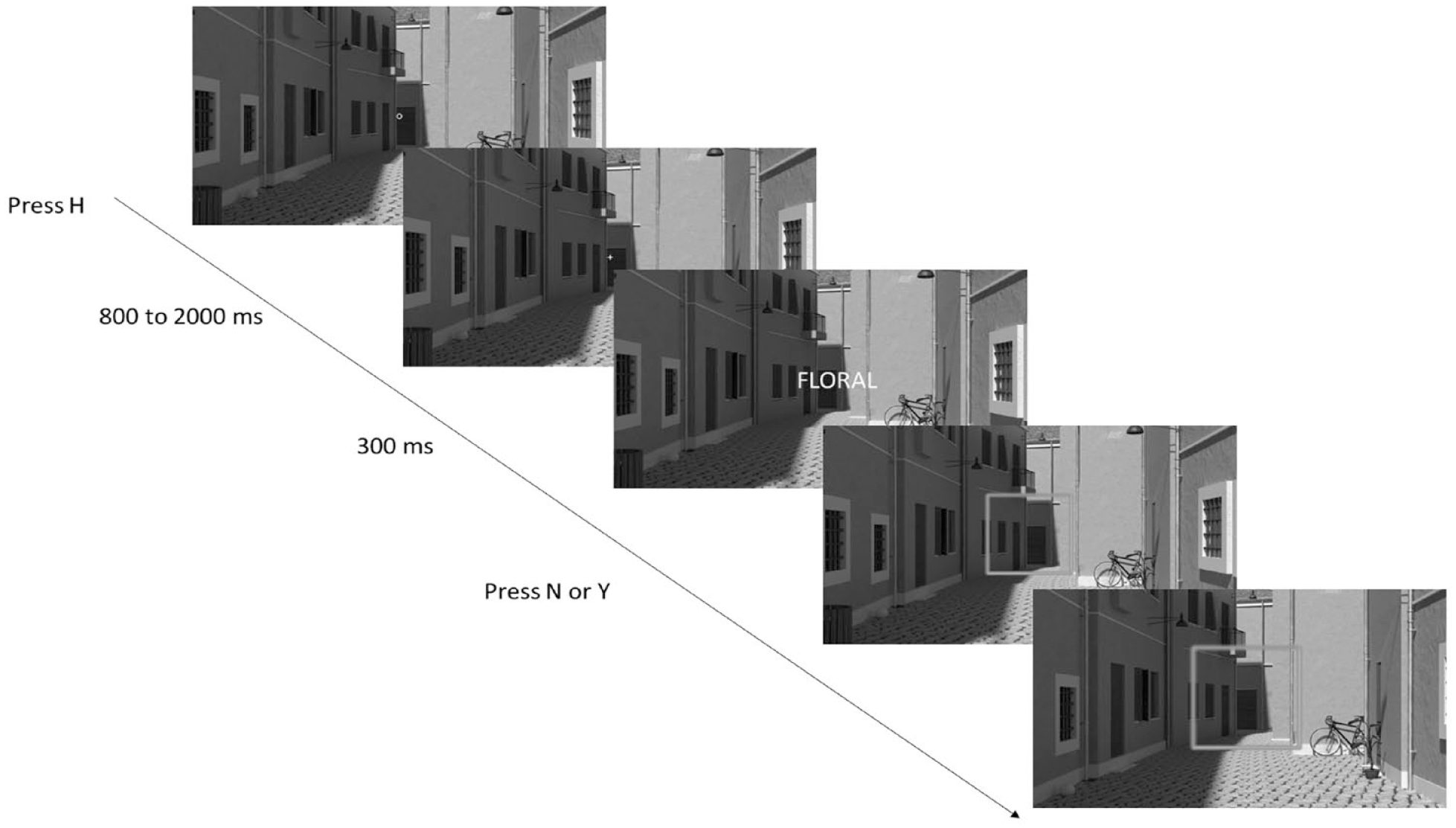
Presentation of the sequence of events in the VAAST.
Participants completed 10 practice trials followed by 160 experimental trials. The target was a square for half of the trials, and a diamond for the other half. The instructions were counterbalanced. For half of the participants, the instructions were to approach the square (and avoid the diamond) and the instructions were to approach the diamond (and avoid the square) for the other half. In all, 25% of the words presented were low imageable positive words, 25% were high imageable positive words, 25% were low imageable negative words, and 25% were high imageable negative words. Finally, participants answered sociodemographic questions, were debriefed, and thanked for their participation.
Results
Reaction times
Reaction times (RTs) for correct responses were analysed (errors = 1.49%). RTs <300 ms and >1,500 ms (see Krieglmeyer & Deutsch, 2010; Rougier et al., 2018) were excluded (4.10%). The data were then inverse-transformed (−1,000/RT) to normalise the distribution of the RTs (see Ratcliff, 1993) 2 and were analysed using mixed-model analyses (Westfall et al., 2014). We estimated a model with valence of stimuli, movement, imageability, and all the products of these variables as fixed effects, and we estimated the random intercepts and slopes for participants, stimuli, and their interaction (Bates et al., 2018; Judd et al., 2017; see Supplementary Materials, Table S1). Effect sizes (dz) were estimated based on a classical analysis of variance (ANOVA), as there is still no consensus about the calculation of effect sizes with mixed models (Rougier et al., 2018). 3 For the sake of readability, we report untransformed means in the article. The data were submitted to a 2 (Movement: approach vs avoidance) × 2 (Valence: positive vs negative) × 2 (Imageability: low vs high) mixed-model analysis. 4
The analysis revealed a main effect of movement, t(332.1) = 6.32, p < .001, CI = [0.036, 0.069],
5
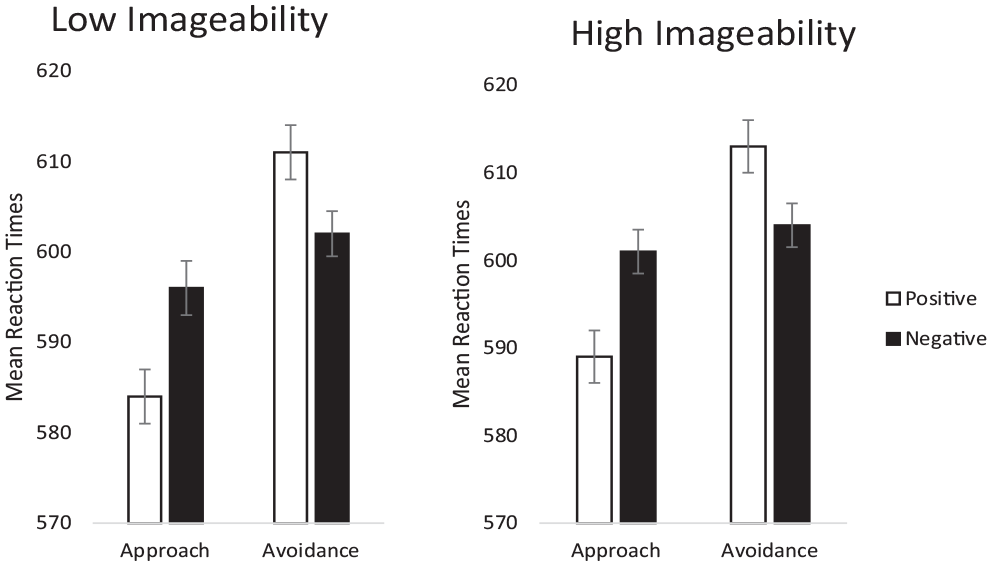
Means and standard errors of raw reaction times (in milliseconds) as a function of valence and movement, for low-imageability words (left panel), and for high-imageability words (right panel) in Experiment 1.
Accuracy
For exploratory purposes, data on accuracy were submitted to a 2 (Movement: approach vs avoidance) × 2 (Valence: positive vs negative) × 2 (Imageability: high imageable vs low) categorical regression analysis.
The Valence × Movement interaction was significant, t(332) = 6.24, p < .001, CI = [0.033, 0.063],

Means and standard error of accuracy rates (in percent) as a function of valence and movement for low-imageability words (left panel) and for high-imageability words (right panel) in Experiment 1.
Discussion
In Experiment 1, we replicated the AA compatibility effect on both RTs and accuracy. Importantly, this effect was observed here using an incidental presentation of the affective stimuli and an online-VAAST version, indicating the reliability of these effects (e.g., Aubé et al., 2019; Chen & Bargh, 1999; Krieglmeyer & Deutsch, 2010; Pillaud & Ric, 2022; Rougier et al., 2018). Based on an embodied perspective, we postulated that affect would produce the compatibility effect through the reactivation of sensorimotor information. We therefore hypothesised that word imageability would provide more sensorimotor information, and should thus amplify the AA compatibility effect. However, we did not find any evidence for a role of word imageability in the AA effect. A possible explanation is that the visuo-motor information would be mainly important in the execution of the response (i.e., performing the approach or avoidance movement) rather than at the stimulus perception level. This could explain why Rougier and colleagues (2018) observed that visual-motor information played a role in the AA compatibility effect, whereas we failed to find any evidence of its impact. More precisely, Rougier et al. (2018) manipulated sensorimotor information of the feedback, which would be located at the response execution level. That is, the effect was stronger when the feedback provided sensorimotor information compatible with the action usually done (i.e., which traces and coded in memory) than when it did not (e.g., when the object was moving towards/away from the individual). In the present case, sensorimotor information was provided directly from the prime and would have thus no direct implication at the response level.
Another possible explanation for the absence of moderation by word imageability could be related to the duration of stimulus presentation. In Exp. 1, the affective words were presented for 300 ms. According to ERP studies dealing with the combined effects of valence and concreteness, the interaction between these two factors would modulate the N400 and the LPC (Yao et al., 2016; Yao & Wang, 2014). The LPC would be a particularly important component as it would reflect the process of mental imagery (Kanske & Kotz, 2007). The implementation of mental imagery, as measured by the LPC, would occur between 550 and 800 ms post-stimulus presentation. From this perspective, if mental imagery is the process responsible for approach and avoidance movements, it is possible that in the present experiment the time separating the stimulus presentation time and the measure of the response was not long enough to observe a moderation effect of word imageability.
Experiment 2
To test for an effect of SOA, we replicated Experiment 1 with a larger SOA so that word processing falls within the LPC time window. An SOA of 600 ms (word duration of 200 ms and ISI of 400 ms) appeared to be well-adapted to that end. Indeed, a moderation of the compatibility effect by imageability could be more likely to occur with such a longer SOA that is assumed to correspond to the duration needed to involve mental imagery processes. This would thus confirm the role of sensorimotor processes in the production of the AA compatibility effect. We contrasted this condition with the condition of a shorter SOA of 400 ms, in which we should replicate the results of Experiment 1. 6 Moreover, in line with previous studies, mental imagery could play a role in processing of the words according to their imageability. In fact, the effect of word imageability/concreteness should be larger in individuals with the highest mental imagery abilities (McKelvie & Demers, 1979). Therefore, another possibility to explain the lack of moderation of imageability on the AA compatibility effect could be that the effect appears only for individuals with high mental imagery abilities. The potential benefit in terms of RTs related with the activation of sensorimotor information, particularly visual information in this study, would only appear for individuals who are able to form a mental image easily (i.e., individuals with high mental imagery abilities). So, we decided to measure mental imagery abilities on an exploratory basis to control for their potential effect. Experiment 2 (including design, materials, hypotheses, and analytic plans) was preregistered on Open Science Framework (OSF) (https://osf.io/wf38g/?view_only=feddff97a9924dc88e6c30c10bb862c5).
Method
Participants and design
We used the same protocol to measure the AA tendencies and the same words as in Experiment 1, in which we observed an effect size of dz = 0.45 (
By the recruitment procedure, we came up with 334 participants. As for Experiment 1, participants were recruited through mailing lists and social networks. They took part in the experiment on a voluntary basis and were not compensated for. Data from one participant were excluded due to a low rate of correct responses in the main task (<70%). We excluded all participants who did not learn to read and write in French (N = 5).
7
The analyses were conducted on the 328 remaining participants (Mage = 22.69, SD = 6.23, 155 men, 160 women, 8 participants who defined themselves as neither male nor female, and 5 participants who did not answer the question). With N = 328 and for dz = 0.45, we had a power of .98 to detect the effect of interest. For 1 − β = .80 and with N = 328, we were able to detect an effect greater than d = .31 (
Materials and procedure
The procedure was similar to the one used in Experiment 1, with only minor changes. AA tendencies were again measured with the online version of the VAAST (Aubé et al., 2019; Rougier et al., 2018) programmed on PsyToolkit (Stoet, 2010, 2017). However, words were presented during 200 ms and the geometric shape appeared after a delay of 200 ms (i.e., SOA = 400 ms) or a delay of 400 ms (SOA = 600 ms). The words used were the same as in Experiment 1. Participants completed 10 practice trials followed by 320 experimental trials (160 trials with SOA = 400 ms and 160 trials with SOA = 600 ms). For exploratory purposes, participants completed the Spontaneous Use of Imagery Scale (SUIS) developed by Reisberg et al. (2003) and translated in French by Ceschi and Pictet (2018) after the completion of the VAAST. The SUIS was administered to test the imagery abilities of the participants.
Results
RTs
Only RTs for correct responses were analysed (errors = 5.11%). RTs <300 and >1,500 ms (see Krieglmeyer & Deutsch, 2010; Rougier et al., 2018) were excluded (1.71%). The data were then inverse-transformed (−1,000/RT) to normalise the distribution of the RTs (see Ratcliff, 1993) 8 and were analysed using mixed-model analyses (Westfall et al., 2014). We estimated a model with valence of stimuli, movement, imageability, SOA, and all the products of these variables as fixed effects, and we estimated the random intercepts and slopes for participants, stimuli, and their interaction (see Supplementary Materials, Table S4). Effect sizes (dz) were estimated based on a classical ANOVA. The data were submitted to a 2 (Movement: approach vs avoidance) × 2 (Valence: positive vs negative) × 2 (Imageability: low vs high) × 2 (SOA: 400 vs 600 ms) mixed-model analysis. 9
The analyses revealed a main effect of movement, t(327.6) = −2.08, p = .0388, CI = [−0.036, −0.0010],
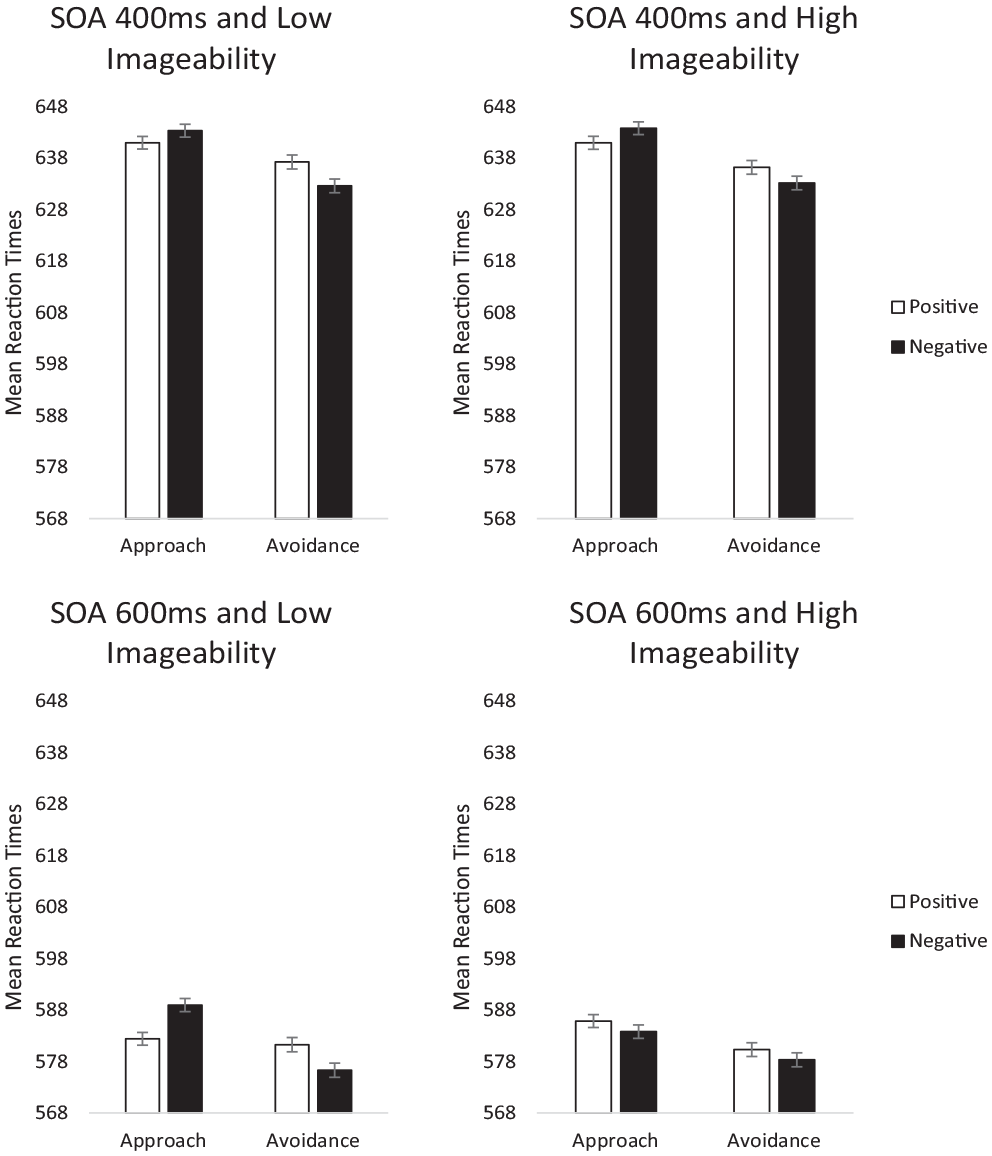
Means and standard errors of raw reaction times (in milliseconds) as a function of valence and movement in Experiment 2, for SOA = 400 ms (top panels) and SOA = 600 ms (bottom panels), words with low imageability (left panels), and words with high imageability (right panels).
However, this interaction was not moderated by imageability, t(324.8) = −0.89, p = .372, CI = [−0.023, 0.0086],
Accuracy
For exploratory purposes, we conducted the same analysis on accuracy. We performed a 2 (Movement: approach vs avoidance) × 2 (Valence: positive vs negative) × 2 (Imageability: strongly imageable vs weakly imageable) × 2 (SOA: 400 vs 600 ms) categorical regression.
The Valence × Movement interaction was not significant, t(327) = −1.80, p = .074, CI = [−0.043, 0.0020],
Exploratory analyses on the SUIS scores
We conducted another series of analyses with the SUIS entered as a continuous variable. First, we performed a factor analysis on the 12 SUIS items. The analysis revealed one factor (ω = .68). Three items did not saturate on this single dimension (>|.30|, items 1, 2, and 6) and were then removed before calculating the SUIS score per participant.
The centred SUIS score was crossed with all factors of interest and entered in the analysis on the reverse RTs. The SUIS score did not moderate the Valence × Movement × Imageability × SOA interaction, t(288.9) = −1.70, p = .089, CI = [−0.085, 0.0061],
Discussion
Experiment 2 replicated the AA compatibility effect on RTs as found in Experiment 1. Moreover, and consistent with the findings of Experiment 1, we did not observe any moderation of this effect by word imageability whatever the SOA used and participants’ mental imagery abilities. These findings confirm that the AA compatibility effect can emerge with an incidental procedure and whatever the time duration available to process the stimulus valence.
Complementary analyses on Experiments 1 and 2
To further examine through the two experiments whether word imageability had a moderating role on the AA compatibility effect, we conducted two additional analyses: a small-scale meta-analysis (see Goh et al., 2016) and a Bayesian multilevel modelling analysis (see Bürkner, 2017).
Meta-analytic approach
We conducted a mini meta-analysis on the two studies (Goh et al., 2016). We first converted our
Combined data of Experiments 1 and 2.

The fixed effect meta-analysis was not significant, M rz = −.025, Z = −0.64, p = .74. We also calculated two indexes of heterogeneity: Qwithin index and I2 index. The analysis did not reveal any heterogeneity Qwithin = 0.06, p = .81 and I2 = 0%, p ≈ 1. However, for a small-scale meta-analysis, this type of index does not capture the heterogeneity correctly between the studies (e.g., Huedo-Medina et al., 2006). Therefore, to confirm the results of the fixed-effect meta-analysis, we calculated a random-effect meta-analysis (e.g., Borenstein, 2019). This meta-analysis did not reveal significant effect, M rz = −.025, t(1) = −1.25, p = .43, CI = [−0.28, 0.23].
Bayesian approach
We also conducted a one-sided default Bayes factor hypothesis test to quantify the relative predictive adequacy of the two competing hypotheses: the null hypothesis H0 (i.e., the effect is absent) versus the alternative hypothesis H1 (i.e., the effect is present). For Experiment 1, we estimated BF10 = 0.69 and for Experiment 2, we estimated BF10 = 0.051. These Bayes factors do not provide any support against the null hypothesis H0 (Lee & Wagenmakers, 2013; i.e., BF10 > 3). In contrast, the Bayes factors in both experiments provide evidence in favour of the null hypothesis. Evidence for H0 (i.e., 1/3 < BF10 < 1) was anecdotal in Experiment 1, whereas it was strong in Experiment 2 (i.e., 1/10 < BF10 < 1/30). Taken together, the results of both fixed-effects and random-effects meta-analyses as well as Bayesian analyses offered no support for the hypothesis that word imageability moderates the effect of AA compatibility.
General discussion
The main findings can be summarised as follows. First, we replicated the typical AA compatibility effect on RTs (e.g., Aubé et al., 2019; Chen & Bargh, 1999; Rougier et al., 2018) in Experiments 1 and 2. Overall, the participants were faster to approach a neutral target (i.e., squares or diamonds) after being exposed to positive rather than negative words. In contrast, they were faster to avoid a neutral target after being exposed to negative rather than positive words. Interestingly, in both experiments, we used an incidental presentation of the affective stimuli (i.e., words), since these stimuli were decoupled from the targets to which participants were asked to respond (i.e., geometric shapes) and were not relevant for the task at hand. Our results therefore extend previous findings by showing that the AA compatibility effect can be observed not only online (e.g., Aubé et al., 2019) but also with an incidental exposure to affective stimuli (e.g., Chen & Bargh, 1999; Krieglmeyer & Deutsch, 2010; Pillaud & Ric, 2022; Rougier et al., 2018). These findings thus support the idea that affective stimuli can be influential in the absence of an evaluative goal and strongly suggest that approach and avoidance behavioural responses related to exposure to affective stimuli can be applied to any object in the focus of attention.
More importantly, we expected the effect of AA compatibility to be moderated by the imageability of the words used as affective stimuli. Specifically, we predicted the compatibility effect to be stronger for high than for low imageable words. However, we did not observe that the AA compatibility effect was influenced by word imageability in Experiment 1. Because word imageability has been considered to be processed later than word valence (Yao et al., 2016; Yao & Wang, 2014), we investigated whether the time separating the prime and the target (i.e., SOA = 300 ms) could not have been long enough for this effect to occur. We conducted a second experiment manipulating the SOA of affective words (i.e., SOA = 400 vs 600 ms). Again, we did not observe any moderation of the AA compatibility effect by either SOA or imageability. In addition, we did not find that individuals’ mental imagery abilities could play a role in the emergence of imageability moderation of the AA compatibility effect. Data from these two experiments therefore provided no evidence for any effect of word imageability on the compatibility effect, even at a late stage of processing and regardless of the mental imagery abilities of the participants. Taken together, the present findings provide no support for the involvement of sensorimotor processes, especially driven by visual information, in the AA compatibility effect, contrary to our expectations. In contrast, these results can be considered to be consistent with both the distance regulation and the evaluative coding accounts, which do not predict any moderation of the AA compatibility effect by word imageability.
How can we thus explain the discrepancy between the present findings and those of Rougier and collaborators (2018)? We propose to distinguish two stages in the AA responses in these studies: stimulus perception and response execution. It could be argued that Rougier and collaborators (2018) demonstrated the importance of sensorimotor processes in the response execution stage, that is, in the expression (and measurement) of AA tendencies. Reactivation of the sensorimotor processes associated with AA at this stage would facilitate the execution of required movement. In other words, providing visual information associated with a typical approach movement would facilitate the execution of that movement and interfere with the execution of a competitive movement (i.e., avoidance). However, this sensorimotor information would not be as important at the object perception stage. At this stage, the valence would be the most important information and could be used in different ways depending on the structure and requirements of the task to complete (e.g., AA task; evaluation task). As suggested by explanations of the AA compatibility effect in terms of distance regulation or event coding, a positive stimulus could indicate that the distance between the object and the self should be reduced or provide a valence label compatible with a positively labelled movement (e.g., approach), respectively. However, how approach and avoidance movements are operationalised would make a difference in the response execution, with greater effects when the required response is compatible with sensorimotor processes typically involved in this response. This would explain why providing more sensorimotor information to participants through the stimulus and not through the task did not increase the compatibility effect.
To conclude, it is important to note that in our experiments we used an incidental affective stimuli presentation procedure. One possibility is that valence may well be decoupled and applied, or transferred, to any object to which one has to respond (e.g., Murphy & Zajonc, 1993; Pillaud & Ric, 2022), but this could not be the case for imageability. It would be interesting in a future experiment to investigate whether an explicit AA procedure (i.e., directly evaluating the valence of the stimuli to approach or avoid) could lead imageability of the words to moderate the AA compatibility effect. Such results would suggest that imageability is not transferred to the objects we have to react to and would provide support to the idea that sensorimotor (and in particular visual) information is particularly important for the production of the approach and avoidance response. Further research is needed to specify the role of word imageability in AA compatibility effect to clarify the processes underlying the AA compatibility effect, and more broadly the mechanisms responsible for our behaviours.
Supplemental Material
sj-docx-1-qjp-10.1177_17470218231194499 – Supplemental material for Is the approach avoidance compatibility effect moderated by word imageability?
Supplemental material, sj-docx-1-qjp-10.1177_17470218231194499 for Is the approach avoidance compatibility effect moderated by word imageability? by Nicolas Pillaud, Claire Ballot, Christelle Robert, Stéphanie Mathey and François Ric in Quarterly Journal of Experimental Psychology
Footnotes
Declaration of conflicting interests
The author(s) declared no potential conflicts of interest with respect to the research, authorship, and/or publication of this article.
Funding
The author(s) received no financial support for the research, authorship, and/or publication of this article.

Data accessibility statement
Notes
References
Supplementary Material
Please find the following supplemental material available below.
For Open Access articles published under a Creative Commons License, all supplemental material carries the same license as the article it is associated with.
For non-Open Access articles published, all supplemental material carries a non-exclusive license, and permission requests for re-use of supplemental material or any part of supplemental material shall be sent directly to the copyright owner as specified in the copyright notice associated with the article.
