



Abstract
A robust left digit effect arises in number line estimation, whereby the leftmost digits of numerals have an undue influence on placements such that, for example, numbers like 298 are placed far to the left of numbers like 302. Past efforts to motivate more accurate performance using trial-by-trial and summary feedback have not led to a reduction in the left digit effect. In two experiments, we asked whether it is possible to reduce or eliminate the left digit effect in number line estimation through an instructional intervention in which one is explicitly taught about the left digit effect. In Experiment 1 (N = 134), participants completed two blocks (60 trials per block) of a self-paced 0–1,000 number line estimation task and were randomly assigned to either an instruction or a control condition. In Experiment 2 (N = 143), the procedure was enhanced with a learning check, and with additional measures to assess changes in behaviour as a result of instruction. In both experiments, a left digit effect was found in each block of each condition. Although there was evidence that instruction changed behaviour, these changes did not result in any reduction in the left digit effect relative to the control condition. These findings demonstrate that the left digit effect cannot be easily reduced by making people aware of it.
Symbolic magnitude estimation tasks are used to study numerical cognition. These tasks involve estimating the magnitudes represented by numerals (e.g., 53). One commonly used task is the number line estimation task. In a typical version of the task, one is shown a horizontal line labelled only by its endpoints (e.g., 0 and 1,000) and asked to estimate the locations of target numerals on the line. A measure of overall accuracy error, reflecting the difference between one’s placements of target numerals and the correct locations, is often used to assess individual performance. Performance on the task predicts a wide range of numerical competencies, including children’s fraction and number skills (Hansen et al., 2015; Hamdan & Gunderson, 2017; Jordan et al., 2013; Östergren & Träff, 2013), adults’ numeracy skills (Patalano et al., 2020; Peters & Bjalkebring, 2015; Schley & Peters, 2014), and math achievement test scores (Booth & Siegler, 2008; Holloway & Ansari, 2009; Schneider et al., 2009; Tosto et al., 2017).
Overall accuracy error likely reflects error from a range of cognitive sources. According to one influential account of task performance, the number line estimation task is treated by adults as one of proportion judgement, that is, the task involves judging the relationship between a part and a whole (e.g., that 250 is 25% of the space between 0 and 1,000; Barth & Paladino, 2011; Cohen & Blanc-Goldhammer, 2011; Cohen et al., 2018; Slusser & Barth, 2017; Slusser et al., 2013; Sullivan et al., 2011; Zax et al., 2019 but see Siegler et al., 2009). By this proportion judgement account, placement error may arise due to imprecision in the estimates of the magnitudes associated with numerals (e.g., Dehaene et al., 2008; Siegler & Opfer, 2003), as well as due to difficulty in judging proportional relationships between estimates (Cohen et al., 2018; Hollands & Dyre, 2000; Slusser et al., 2013). See Barth and Paladino (2011), Cohen and Blanc-Goldhammer (2011), and Slusser et al. (2013) for details regarding the application of the proportion judgement model to the number line estimation context.
A potentially distinct source of placement error is revealed by a left digit effect (or bias) in number line estimation, a phenomenon whereby the leftmost digits of numerals have an undue influence on placements. Using a 0–1,000 number line task, Lai et al. (2018) found that placements of 3-digit numerals with similar magnitudes, but different leftmost (hundreds place) digits, were systematically different from one another. For example, 298 was placed farther to the left than 302, although their placements should be indistinguishable on the number line used. In contrast, numerals surrounding fifties boundaries, such as 449 and 453, with the same leftmost (hundreds) digit but different tens place digits, were not placed in systematically different locations, suggesting that it is the leftmost digit driving the effect. The phenomenon has been replicated in speeded and non-speeded task versions (Kayton et al., 2022; Lai et al., 2018; Williams et al., 2020), across various numerical ranges (e.g., 0–100; Patalano et al., 2023; Vaidya et al., 2023; Williams et al., 2021), and with both adults (Lai et al., 2018; Savelkouls et al., 2020; Williams et al., 2020) and children (Lai et al., 2018; Williams et al., 2022), with large effect sizes (ds ≈ 1 in adults).
This left digit effect is commonly described as arising from an overweighting of the leftmost digit in the processing of numerals (e.g., Lai et al., 2018; Thomas & Morwitz, 2005). The effect is not limited to the number line estimation task and, in fact, was first observed in a consumer judgement task. Products were rated as more different in cost when their prices crossed a leftmost digit boundary (e.g., $2.99 and $3.00) than when they did not (e.g., $3.59 and $3.60; Thomas & Morwitz, 2005). The left digit effect has also now been observed in many field studies including those surrounding decisions about whether to quit smoking (based on cigarette costs; MacKillop et al., 2014), whether to take the SAT college entrance test for a second time (based on first test score; Goodman et al., 2020), how much to pay for a used car (based on odometer readings; Lacetera et al., 2012), and even whether to recommend surgery to one’s medical patient (based on patient age; Olenski et al., 2020). In the latter study, physicians were more likely to recommend heart surgery to patients who were 2 weeks below their 80th birthday versus those 2 weeks above it, despite no clinical guidelines supporting this approach, and no similar pattern for patients whose ages did not cross a decade boundary. Collectively, the findings show far-reaching consequences of the left digit effect in everyday life.
In number line estimation tasks, several interventions have been successful in reducing overall accuracy error but, to date, none have been shown to reduce the left digit effect. Williams et al. (2021; see also Eyler et al., 2018) conducted a study with three blocks of 120 trials each in which they provided trial-by-trial feedback in the middle block. Specifically, after the participant’s response was given, the target’s correct placement location was shown. Kayton et al. (2022) used a similar design but instead of using trial-by-trial feedback, they provided a summary accuracy score (that was a variation of overall accuracy error) after every 20 trials (6 times in total). The purpose was to motivate participants to improve their performance. In another study, intended to further enhance motivation, Kayton et al. (2022) added a leaderboard (an ostensible list of past top scorers), and an opportunity for high-scoring participants to earn a position on the board. Across these studies, a measure of overall accuracy error (called percent absolute error) generally decreased across blocks (in both conditions) and decreased even further in response to feedback, but the left digit effect did not show this pattern.
Motivation for the present experiments
Although feedback and motivational interventions have been unsuccessful in reducing the left digit effect, one intervention that has not yet been considered is simply telling people about the effect. It is possible that past interventions were unsuccessful because they did not make the nature of the left digit effect explicit. That is, participants were shown their placement location and the correct location on the same number line, but they were not directly informed that below-boundary and above-boundary targets (like 798 and 802, which surround the boundary of 800) are typically placed too far apart from one another. It may be that if people were directly taught about the left digit effect before being asked to try to reduce it, they might be able to reduce it. For example, perhaps simply devoting greater attention to rightward digits, or reminding oneself not to place such values too far from their closest boundary (e.g., not to place 798 too far from where 800 would be placed), is sufficient to reduce the effect. The goal of conducting the present experiments was to understand whether people can use direct instruction about the left digit effect to reduce the effect.
In the two experiments we report here, participants were split into an instruction and no-instruction condition and completed two blocks of a 0–1,000 number line estimation task. In the instruction condition, there was an intervention between the first and second blocks of trials in which participants were presented with a definition of the left digit effect and given a visual illustration of incorrect versus correct placements. In the no-instruction condition, in place of the intervention, participants were simply reminded of the task instructions. The second experiment served to replicate the first, except that we added a manipulation check to ensure that participants in the instruction condition understood the definition of the effect. In the second experiment, we also collected self-report ratings of effort and asked several other questions that allowed us to better understand whether and how participants in the instruction condition adjusted their strategies following the intervention. A greater reduction of the left digit effect following the intervention, relative to the control condition, would be taken as evidence that direct instruction is a useful tool for reducing the effect. It would motivate future work, including consideration of whether improvements extend across time and to other tasks (e.g., decision tasks). In contrast, finding no effect would suggest that people cannot readily use direct instruction about the left digit effect to reduce the effect in number line estimation.
Experiment 1: Direct instruction intervention
The goal of Experiment 1 was to assess whether telling people about the left digit effect in number line estimation reduces the effect. In this experiment, participants completed two blocks of a number line estimation task. Between the blocks, participants were either given brief instruction about the left digit effect (instruction condition) or no instruction (no-instruction condition). Dependent measures included a measure of the left digit effect called a hundreds difference score, a measure used as a control called a fifties difference score, and a measure of overall accuracy error called percent absolute error. As in past work (e.g., Kayton et al., 2022; Lai et al., 2018; Williams et al., 2021), the hundreds difference score was computed as the difference in placement of numerals above versus below a left digit boundary (e.g., 901 vs. 899), averaged over relevant pairs (see the Methods section for details). The fifties difference score was similar except that it used pairs of targets that cross tens boundaries (e.g., 451 vs. 449) rather than a leftmost digit boundary. Meanwhile, percent absolute error reflected the absolute difference between the actual placement and the correct placement of a target numeral as a percentage of the total number range, averaged over non-boundary targets (i.e., those not used in the calculation of either difference score). We predicted the hundreds difference score (but not the fifties difference score) would be greater than 0 in each condition and block, consistent with a left digit effect. More importantly, we predicted that, if being informed about the effect reduces it, the hundreds difference score should decrease across blocks in the instruction condition more than in the no-instruction condition. Otherwise, any improvement should be the same for both conditions. We also tested whether the intervention had any effect on percent absolute error (in case the intervention reduces overall accuracy error but not the left digit effect specifically).
Method
The study was preregistered at https://aspredicted.org/rz6nu.pdf and was approved by Wesleyan University’s Institutional Review Board.
Participants
Participants were 132 English-speaking adults (75 women, 54 men, 2 non-binary, and 1 other) between the ages of 18 and 74 (M = 32.38 years, SD = 12.40) who were recruited online via Prolific Academic. Participants, who gave written informed consent prior to participation, were pseudo-randomly assigned (using a computer-based random number generator) to either an instruction condition (n = 62) or a no-instruction condition (n = 70). A total sample size of N = 120 was sufficient for detecting a medium-small condition by block interaction (ηp2 = 0.02,
Materials
A 0–1,000 number line estimation task was programmed using lab.js (lab.js.org; Henninger et al., 2022) and distributed through the Open Lab platform (open-lab.online; Shevchenko, 2022). On each trial, a black horizontal number line (19.2–23.3 cm depending on the participant’s screen resolution) was presented in the centre of the screen, as shown in Figure 1(a). The horizontal line had small vertical lines at its ends (1.1–1.4 cm) and was labelled “0” on the left side and “1,000” on the right side (0.7–0.8 cm tall). A horizontally centred target numeral (0.9–1.2 cm tall) was presented 3.2–4.0 cm above the number line. Participants were instructed to use the mouse to click on the number line to indicate the correct location of the target numeral. A vertical red line (0.8–0.9 cm) then appeared in the selected location, as shown in Figure 1(b).

Example of number line estimation display (a) before and (b) after response.
Each participant completed two blocks of trials. Both blocks consisted of the same 60 target numerals: 16 numerals falling on either side of the hundreds boundaries (8 pairs: 199/202, 298/302, 398/403, 499/502, 597/601, 699/703, 798/802, and 899/901); 18 numerals falling on either side of fifties boundaries (9 pairs: 149/152, 248/252, 348/352, 449/451, 549/551, 648/653, 748/752, 849/852, and 947/951); and 26 non-boundary numerals (7, 33, 81, 108, 119, 178, 211, 244, 310, 338, 362, 425, 468, 480, 524, 567, 584, 617, 688, 735, 774, 809, 841, 870, 942, and 991) distributed across the line. The hundreds and fifties numerals were each within three units of their respective boundary, and the total distance between paired numerals was between two and five units. Hundreds and fifties numerals are described as paired here for the purpose of data analysis, but they were not paired during the presentation. Rather, target numerals were presented in a different randomised order for each participant and block.
Measures
Similar to Lai et al. (2018), for each hundreds pair, we calculated a hundreds difference score = (placement location of upper numeral—placement location of lower numeral) and then averaged across hundreds pairs. Hundreds difference scores greater than zero reflect systematically different placements for numerals in a hundreds pair and indicate a left digit effect. 2 For each fifties pair, we computed a fifties difference score = (placement location of upper numeral – placement location of lower numeral) and then averaged across fifties pairs. The purpose of these calculations is to establish that the left digit effect occurs for hundreds pairs, but not for fifties pairs (where the leftmost digit is the same). To quantify overall accuracy error, we calculated percent absolute error = (actual placement of numeral – correct location of numeral|/range of target values) * 100, using only non-boundary numerals (to have a measure of accuracy that is based on an independent set of observations).
Procedure
Participants were asked to complete the study on their personal computers in a quiet space. They were given online, written instructions to indicate the placement of each target numeral on the line, and to respond as quickly and as accurately as possible. After each response (the click on the number line), a rectangular button icon (labelled “Next”) appeared at the bottom of the screen for the participant to advance to the next trial. A blank screen was presented between trials for 0.5 s. The numeral corresponding to the clicked location on the line was recorded.
The two conditions were identical except for the intervention given between blocks in the instruction condition. In this condition, participants were given the following description of the left digit effect: “In this task, people often exhibit what is called a left digit effect. This means they tend to place numbers of similar magnitude but different leftmost digits (like 498 & 501) farther apart on the number line than they should. They do not do this for numbers of similar magnitude with the same left digit (like 501 & 503).” This description was accompanied by a visual representation of how one exhibiting the bias might place numbers on the number line (Figure 2[a]) versus the correct placement (Figure 2[b]). Participants were instructed to try their best to avoid showing a left digit effect and to pay attention to all digits of each numeral while continuing to respond as quickly and as accurately as possible. In the no-instruction condition, participants were simply reminded of the task instructions from the first block.

Illustration of the left digit effect provided in the instruction condition of Experiment 1.
Results and discussion
Exclusions
All exclusion criteria and data analyses were preregistered unless otherwise indicated. Individual estimates that were more than two standard deviations away from the group mean for a given target numeral were excluded as outliers (4.28% of trials, on average, were removed within each block). Participants were excluded from final analyses if more than three hundreds pairs within a block were missing from their data (i.e., were removed as outliers; n = 4). A participant would also have been excluded if the correlation between their responses and the target values were r < .5 (n = 0). A total of 128 participants were included in the final dataset for analysis (instruction condition: n = 59; no-instruction condition: n = 69).
Preregistered analyses
Left digit effect
One-sample t-tests (two-tailed) were conducted on the hundreds difference score and the fifties difference score to test for a left digit effect. Recall that a hundreds difference score greater than 0 is interpreted as evidence of the left digit effect. Here, hundreds difference scores were reliably greater than 0 in both blocks of the instruction condition (ts > 5, ps < .001, Cohen’s ds = 0.73–0.74) and the no-instruction condition (ts > 6, ps < .001, ds = 0.84–0.98). Fifties difference scores (which serve as a control) were not greater than 0 in either block of either condition. Specifically, they did not differ from 0 in the second block of the instruction condition or the first block of the no-instruction condition (|t|s < 0.74, ps > .460), and they were reliably less than 0 (not greater than 0) in the first block of the instruction condition and the second block of the no-instruction condition (ts < –2, ps < .050, ds = 0.26–0.44). In sum, a left digit effect was observed across conditions and blocks. See Table 1 for all summary descriptive statistics, and Figure 3 for individuals’ hundreds difference scores, by condition and block.

Hundreds difference score by condition and block in Experiment 1.
Descriptive statistics by condition and block for Experiment 1.

SDs are in parentheses. Difference scores are in units on the number line; percent absolute error reflects units on the number line as a percentage of the total number range (i.e., 1,000 units). As predicted, all hundreds difference scores (and no fifties difference scores) were reliably greater than 0 (ps < .001), consistent with a left digit effect.
Effect of intervention
To test whether the intervention led to a reduction in the left digit effect, a mixed analysis of variance (ANOVA) was conducted with condition (between-subjects) and block (within-subjects) as factors and hundreds difference score as the dependent measure. If the intervention reduces the left digit effect, a condition by block interaction should emerge. Specifically, the hundreds difference score should decrease across blocks in the instruction condition more than in the no-instruction condition. Although such a pattern was observed descriptively, the interaction was not statistically significant, F(1, 126) = 0.68, MSE = 278.92, p = .411. There was also no main effect of condition, F(1, 126) = 0.61, MSE = 780.18, p = .436, or block, F(1, 126) = 0.51, MSE = 278.92, p = .475. 3 We conducted the same analysis with percent absolute error as the dependent measure. Again, the interaction was not statistically significant, F(1, 126) = 1.19, MSE < 0.001, p = .278, and there was no main effect of condition, F(1, 126) = 2.20, MSE < 0.001, p = .140, or block, F(1, 126) = 0.85, MSE < 0.001, p = .357.
Additional analyses
Response time
Given the findings, one might ask whether participants in the instruction condition attended to and tried to adjust their behaviour following the intervention. If they did try to adjust their behaviour, they might be expected to have slower response times across all trials in the second block than those in the no-instruction condition. Conducting a mixed two-factor ANOVA, we found that this interaction was marginally significant, F(1, 126) = 3.81, MSE = 4.18, p = .053, ηp2 = 0.03. Specifically, in the instruction condition, the average response time (in seconds) increased from the first block (M = 3.65 s, SD = 2.27) to the second block (M = 4.18 s, SD = 3.87), whereas in the no-instruction condition, it decreased from the first block (M = 3.16 s, SD = 2.54) to the second block (M = 2.69 s, SD = 1.57). A main effect of condition on average response time was also found, F(1, 126) = 6.27, MSE = 9.91, p = .014, ηp2 = 0.05, but there was no main effect of block, F(1, 126) = 0.02, MSE = 4.18, p = .893.
Correlations with demographic variables
Correlational analyses were conducted to assess the relationship between several dependent measures (hundreds difference scores, percent absolute error, and response time) and demographic variables using data from the first block only (i.e., before any intervention). Pearson product–moment correlation was used with age, Spearman rank-order correlation was used with education and income, and Pearson point-biserial correlation was used with gender identity (man = 0, woman = 1; participants identifying as non-binary or another gender identity were excluded from this analysis). Pairwise deletion was used to address missing data. There was a significant, negative correlation between hundreds difference score and age, r(128) = –.33, p < .001, suggesting that the left digit effect reduces with age, whereas there were no significant correlations between the hundreds difference score and gender identity, education, or income,|r|s < .14, ps > .130. There was a significant, negative correlation between percent absolute error and education, rs(128) = –.23, p = .009, suggesting that overall accuracy error decreases as education increases from no formal education to advanced (post-bachelors) degree; there were no significant correlations with gender identity, age, or income,|r|s < .14, ps > .140. Finally, there were significant, positive correlations between response time and both gender identity, rpb(125) = .20, p = .025, and age, r(128) = .18, p = .039, suggesting that response time is longer for women than men and increases with age; but none between response time and education or income,|rs|s < .10, ps > .260.
Experiment 2: Enhanced instruction intervention
The findings of Experiment 1 suggest that the left digit effect cannot be easily reduced by telling people about the effect: the magnitude of the left digit effect was the same in both blocks of both instruction and no-instruction conditions. However, the experiment had several limitations. First, and most importantly, we did not check whether participants in the instruction condition understood the left digit effect following the intervention and thus did not know for sure that the instructions were comprehended. Second, in the instruction condition, the numerals used in the intervention example were three units apart (i.e., 498 and 501), while some of the hundreds pairs in the task itself were as far as five digits apart. It is thus possible that participants did not realise that the effect also extended to numerals as far as five digits apart. Third, in Experiment 1, the size of the number line on the screen varied across participants’ computers. It would be desirable to replicate the finding in a context in which the line is the same physical length for all participants, in case performance varies as a function of line length.
To address these limitations, in Experiment 2, we made three changes. First, in the instruction condition, we included a learning check in the form of two multiple-choice questions. The data from any participant who did not answer both questions correctly after three tries was excluded from analyses. Second, we changed the intervention instructions so that the given numerals were five digits apart rather than three (we used 497 and 502). Third, we used a screen calibration procedure to adjust the number line for each participant’s computer screen so that the line would be 20 cm long regardless of screen size and resolution. Beyond the described changes, we also added several exploratory questions (at the end of the study) to better understand how participants, especially those in the instruction condition, understood the left digit effect and tried to reduce this effect in the second block of trials.
Method
The study was preregistered at https://aspredicted.org/9pp2y.pdf and was approved by Wesleyan University’s Institutional Review Board.
Participants
Participants were 143 English-speaking adults (87 women, 54 men, and 2 non-binary) between the ages of 18 and 70 (M = 31.94 years, SD = 11.22) who were recruited online via Prolific Academic. Participants, who gave written informed consent prior to participation, were pseudo-randomly assigned to either an instruction condition (n = 76) or a no-instruction condition (n = 67). A total sample size of N = 120 was sufficient for detecting a medium-small condition by block interaction (ηp2 = 0.02,
Materials
The 0–1,000 number line estimation task (again distributed through Open Lab) was the same as in Experiment 1 (including target numbers and measures) except that the number line was displayed at a consistent physical length for all participants rather than being scaled to the display dimensions. At the start of the study, participants used a standard-sized credit card or personal ID card to calibrate their screen (see Li et al., 2020, for details). The black horizontal number line was 20 cm long, the vertical lines at each end were 1.2 cm tall, the endpoints (e.g., “0” on the left and “1,000” on the right) were 0.7 cm tall, the horizontally centred target numerals were 1.0 cm tall and placed 3.5 cm above the number line, and the vertical red line indicating the participant’s response was 0.8 cm tall. As in Experiment 1, participants were instructed to use the mouse to click on the number line to indicate the correct location of the target numeral.
Procedure
The procedure was similar to Experiment 1, including that the two conditions used the same number line task, and that the instruction and no-instruction conditions differed in whether or not the intervention was given between blocks. The only other differences from Experiment 1 were the following. First, in the instruction condition, the intervention instructions now used a more distant pair of numerals in the verbal text and figure (“497 & 502” rather than the “498 & 501” used in Experiment 1) to ensure that participants understood that the effect applies to numerals as far as five units apart. The figure was updated to reflect the correct locations of these numerals. (The vertical lines, which touched one another in Experiment 1, now had a small gap between them.) Second, participants in the instruction condition were given learning check questions to assess whether they understood the explanation of the left digit effect provided. Third, participants in both conditions were given a post-task questionnaire. See the below sections for learning check and post-task questionnaire details.
Learning check
Two multiple-choice questions served as the learning check for the instruction condition. The questions were presented immediately following the instructions (on separate screens). The first question asked for the correct definition of the left digit effect, and the second question asked for the correct placement of two boundary target values on a line (see the online Supplementary Materials for these questions). If either question was answered incorrectly, the participant was returned to the start of the instructions, to read again and repeat the learning check. Anyone who failed the learning check three times was excluded from all analyses.
Post-task questionnaire
A series of questions were given following the completion of the number line estimation task. Question 1 and Question 2 asked participants in both conditions to rate how much effort they put into each block, respectively (from 1 = minimal effort to 10 = maximum effort). In the instruction condition, Question 3 asked participants to define the left digit effect in their own words; Question 4 asked them to rate how successful they thought they were in reducing the left digit effect (from 1 = not at all successful to 10 = extremely successful); and Question 5 asked them to describe what strategies they used, if any, to try to reduce the left digit effect. In the no-instruction condition, in place of Question 3, participants read the intervention screen from the instruction condition (i.e., the definition of the left digit effect and the illustration of typical versus correct placements); Question 4 asked them to rate how likely they were to have exhibited a left digit effect (from 1 = not at all likely to 10 = extremely likely); and Question 5 asked them about what strategies they used, if any, to perform the number line estimation task.
Results and discussion
Exclusions
All exclusion criteria and data analyses were preregistered unless otherwise indicated. One participant in the instruction condition was immediately excluded from all analyses for failing the learning check after three attempts (n = 1). For all remaining participants, individual estimates that were more than two standard deviations away from the group mean for a given target numeral were excluded as outliers (4.14% of trials, on average, were removed within each block). Participants were excluded from final analyses if more than three hundreds pairs within a block were missing from their data (i.e., were removed as outliers; n = 7). A participant would also have been excluded if the correlation between their responses and the target values was less than r = .5 (n = 0). A total of 135 participants were included in the final dataset for analysis (instruction condition n = 70, no-instruction condition n = 65).
Preregistered analyses
Left digit effect
One-sample t-tests (two-tailed) were conducted on the hundreds difference score and the fifties difference score. Hundred difference scores were reliably greater than 0 in both blocks in both the instruction condition (ts > 7, ps < .001, ds = 0.89–1.06) and the no-instruction condition (ts > 8, ps < .001, ds = 1.05–1.06), consistent with a left digit effect. Meanwhile, fifties difference scores (which served as a control) were not reliably different from 0 in either block of either the instruction condition (|t|s < 1.06, ps > .290) or the no-instruction condition (ts < 0.20, ps > .840). These findings provide evidence of a left digit effect. See Table 2 for all summary descriptive statistics, and Figure 4 for individuals’ hundreds difference scores, by condition and block.
Descriptive statistics by condition and block for Experiment 2.
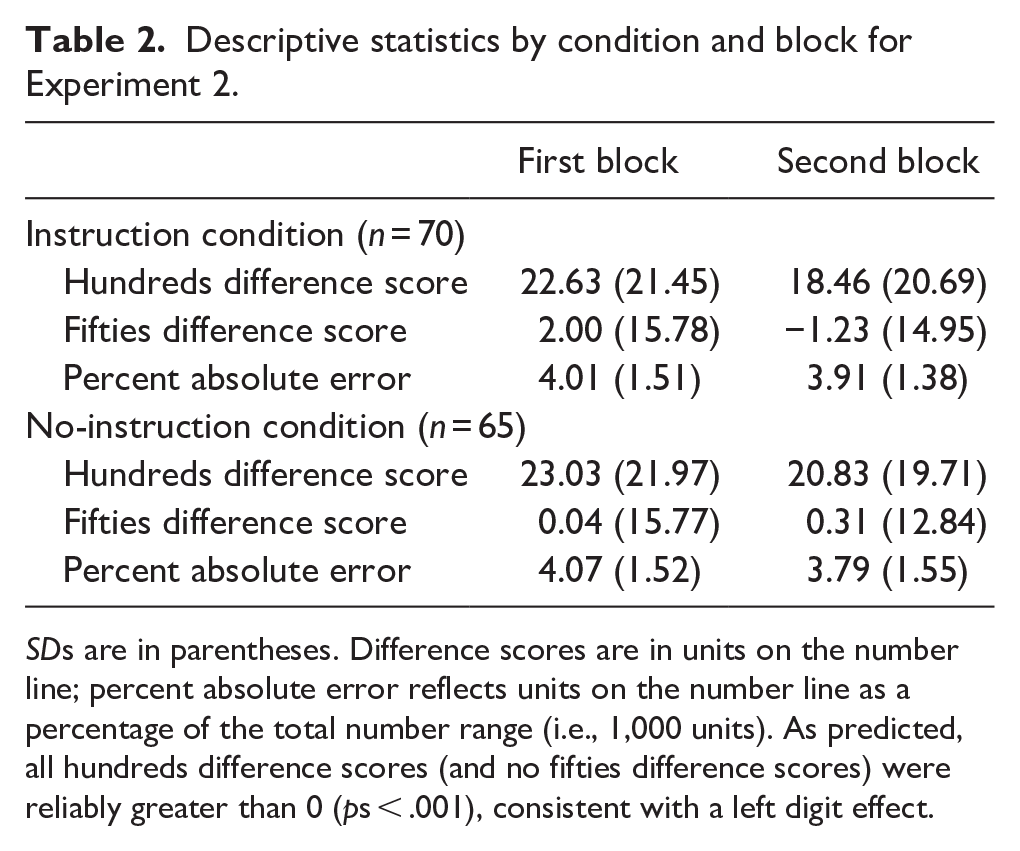
SDs are in parentheses. Difference scores are in units on the number line; percent absolute error reflects units on the number line as a percentage of the total number range (i.e., 1,000 units). As predicted, all hundreds difference scores (and no fifties difference scores) were reliably greater than 0 (ps < .001), consistent with a left digit effect.

Hundreds difference score by condition and block.
Effect of intervention
To test whether the intervention led to a reduction in the left digit effect, a mixed ANOVA was conducted with condition (between-subjects) and block (within-subjects) as factors and hundreds difference score as the dependent measure. 4 Although such a pattern was observed descriptively, the interaction was not statistically significant, F(1, 133) = 0.20, MSE = 330.76, p = .657. There was also no main effect of condition, F(1, 133) = 0.24, MSE = 549.26, p = .629, or block, F(1, 133) = 2.07, MSE = 330.76, p = .153. We conducted the same analysis with a percent absolute error as the dependent measure. Again, the interaction was not statistically significant, F(1, 133) = 1.06, MSE < 0.001, p = .306, and there was no main effect of condition, F(1, 133) = 0.01, MSE < 0.001, p = .907. There was a main effect of block, F(1, 133) = 4.42, MSE < 0.001, p = .037, ηp2 = 0.04, in that percent absolute error decreased from the first block (M = 4.04, SD = 1.51) to the second block (M = 3.85, SD = 1.46).
Exploratory analyses of quantitative data
Response time
As in Experiment 1, a mixed two-factor ANOVA was conducted on response time across all trials to assess whether participants who were exposed to the intervention changed their behaviour. If the intervention affected behaviour, a condition by block interaction should arise in response time. The interaction was statistically significant, F(1, 133) = 5.77, MSE = 0.54, p = .018, ηp2 = 0.04. Specifically, in the instruction condition, the average response time (in seconds) decreased only minimally from the first block (M = 3.24 s, SD = 1.61) to the second block (M = 3.15 s, SD = 1.50), whereas in the no-instruction condition, it decreased considerably from the first block (M = 3.32 s, SD = 1.62) to the second block (M = 2.79 s, SD = 1.53). No main effect of condition on response time was found, F(1, 133) = 0.30, MSE = 4.36, p = .588, but there was a main effect of block, F(1, 133) = 11.69, MSE = 0.54, p = .001, ηp2 = 0.08.
Effort
A mixed two-factor ANOVA was also conducted on participants’ self-reported effort across both blocks to assess whether the intervention increased perceived effort. If the intervention led to increased (perceived) effort, a condition by block interaction should arise for these ratings. The interaction was statistically significant, F(1, 133) = 21.80, MSE = 0.73, p < .001, ηp2 = 0.14. In the instruction condition, effort increased from the first block (M = 8.30, SD = 1.30) to the second block (M = 8.64, SD = 1.34). In the no-instruction condition, effort decreased from the first block (M = 8.65, SD = 1.23) to the second block (M = 8.02, SD = 1.53). There was no main effect of condition, F(1, 133) = 0.46, MSE = 2.93, p = .501, or block, F(1, 133) = 1.91, MSE = 0.73, p = .170, on effort. In the instruction condition, there was no relationship between effort and the left digit effect in the second block, r(75) = .01, p = .921.
Confidence
Participants in the instruction condition were asked how successful they thought they were in reducing left digit effect (recall that the scale ranged from 1 = not at all successful to 10 = extremely successful), and reported being moderately successful (M = 5.69, SD = 1.95). However, we found no relationship between the participant’s rating and their left digit effect in the second block, r(75) = –.02, p = .882. Participants in the no-instruction condition were asked how likely they were to have exhibited a left digit effect (from 1 = not at all likely to 10 = extremely likely) and reported that it was moderately likely (M = 6.45, SD = 1.79). We found a significant negative correlation between the participant’s rating and their left digit effect in the second block, r(67) = –.29, p = .016; unexpectedly, those who thought it more likely that they showed a left digit effect had a smaller effect. Perhaps these individuals thought they were more likely to have made errors precisely because they had a better sense of magnitude (and thus were more aware of error). Because the confidence-related questions differed across conditions, we did not conduct any analyses that compared responses across conditions.
Correlations with demographic variables
As in Experiment 1, Pearson and Spearman correlations were conducted to assess the relationship between hundreds difference scores, percent absolute error, and response time from the first block on the demographic variables. Pairwise deletion was used to address missing data. There was again a significant negative correlation between hundreds difference score and age, r(135) = –.32, p < .001, suggesting that the left digit effect reduces with age, whereas there was no significant correlation between hundreds difference score and gender identity, education, or income,|r|s < .16, ps > .07. There was also a significant negative correlation between percent absolute error and age, r(135) = –.17, p = .044, suggesting that overall accuracy error reduces with age. There were no significant correlations between percent absolute error and gender identity, education, or income,|r|s < .17, ps > .05. Finally, there were significant positive correlations between response time and both gender identity, rpb(133) = .20, p = .019, and age, r(135) = .25, p = .003, suggesting that response time is greater for women than men, and increases with age, but none between response time and education or income,|rs|s < .16, ps > .07. The findings with demographic variables replicate those of Experiment 1 except for percent absolute error: in Experiment 1, percent absolute error was correlated with education but not age.
Exploratory analyses of qualitative data
Left digit effect definition
Participants in the instruction condition were coded on the quality of the written definition of the left digit effect that they provided on the post-task questionnaire. Responses were coded as correct if they included that the bias involves both (a) numbers with similar magnitudes but different leftmost digits and (b) inaccurate placements of numerals on a number line (56% of responses coded as correct). They were coded as partially correct if they included only one of these components (21%). They were coded as incorrect if neither component was mentioned (23%). See the Supplementary Materials for examples of responses assigned to each category. We re-ran our original mixed two-factor ANOVA with condition and block as factors, this time excluding participants whose responses were incorrect in case any of these participants did not retain their understanding of the effect throughout the task. As earlier, there was no interaction of condition by block on hundreds difference score, F(1, 117) = 0.27, MSE = 287.71, p = .602. There was also no main effect of condition F(1, 117) = 0.29, MSE = 542.49, p = .593, or block, F(1, 117) = 2.31, MSE = 287.71, p = .131.
Estimation strategies
Recall that participants in the instruction condition were asked what strategies they used to try to reduce the left digit effect, whereas those in the no-instruction condition were asked what strategies they used more generally. In the no-instruction condition, most participants (88%) described using a benchmark strategy where reference points, such as the midpoint of the line, were identified and used to guide placements. In the instruction condition, participants reported a diversity of strategies to reduce the left digit effect; eight categories of responses were mentioned, as shown in Table 3. These strategies ranged from rounding the target numbers (e.g., rounding 899 to 900 before identifying a position on the line) to adjusting their initial response to the right so that the rightmost digit would essentially be given greater weight. The findings offer further evidence that participants in the instruction condition did change the way they approached the task towards reducing the left digit effect.
Change in hundreds difference score across blocks of the instruction condition as a function of the first strategy reported for reducing the left digit effect.
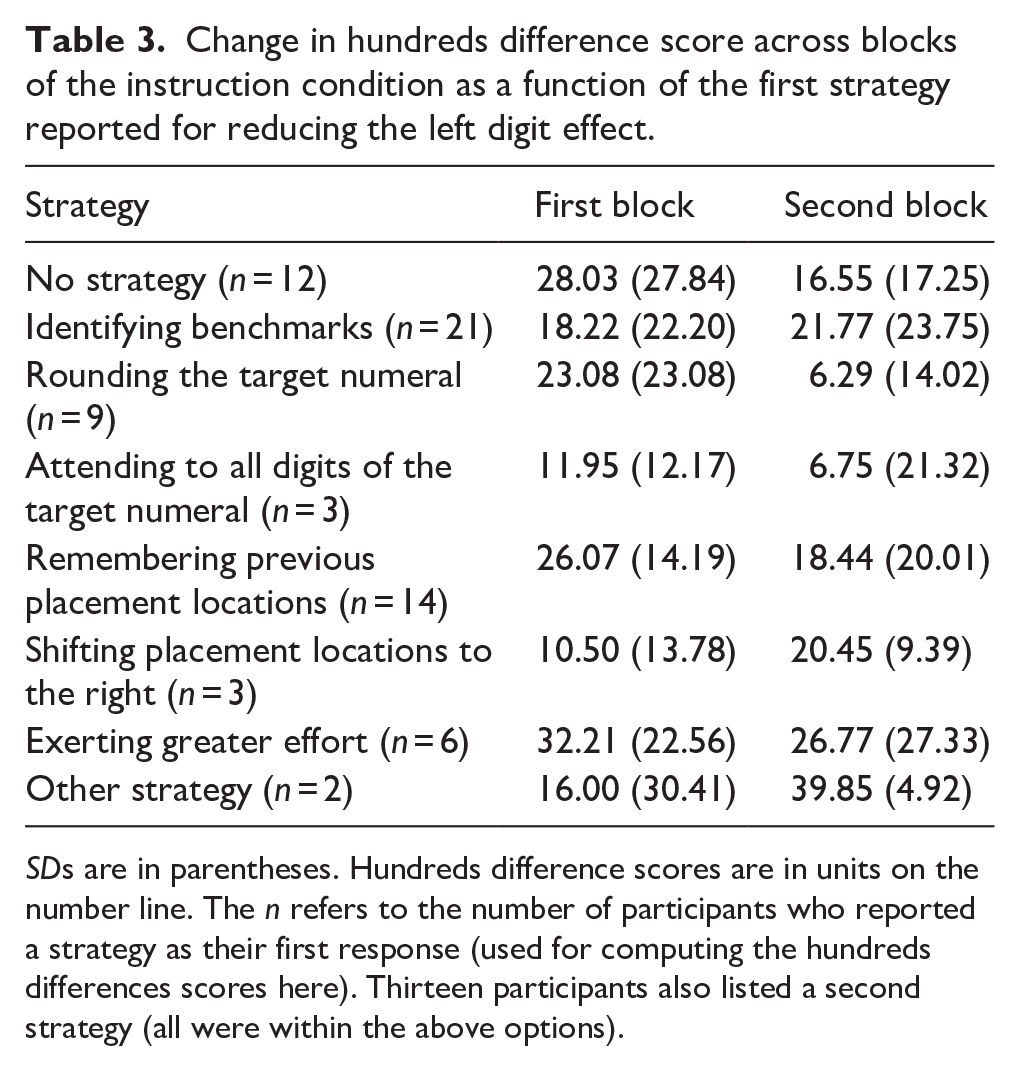
SDs are in parentheses. Hundreds difference scores are in units on the number line. The n refers to the number of participants who reported a strategy as their first response (used for computing the hundreds differences scores here). Thirteen participants also listed a second strategy (all were within the above options).
There were not sufficient participants reporting each strategy to conduct meaningful statistical assessments on the relationship between strategy and performance. However, based on the descriptive statistics in Table 3, rounding the target numeral before placing it on the number line appeared to be the most effective strategy here for reducing the left digit effect across blocks, as did (to a lesser extent) trying to remember past placements of other numerals.
In sum, the results of Experiment 2 show that, despite no significant changes in the left digit effect as a result of the instruction intervention, participants in the instruction condition did appear to understand the left digit effect, as evidenced by their performance on multiple-choice learning checks and their written definitions of the left digit effect. There is also compelling evidence that these participants tried to eliminate the bias. The latter was revealed by effort ratings across blocks, where those in the instruction condition indicated increased effort after the intervention, whereas those in the no-instruction condition did not. In addition, although there was a decrease in both conditions’ response times across blocks, response time decreased much less for those in the instruction condition. Furthermore, participants in the instruction condition reported using strategies to reduce their left digit effect that went well beyond the dominant strategy reported in the no-instruction condition (i.e., use of benchmarks). We conclude that participants in the instruction condition in both Experiments 1 and 2 generally understood and tried to reduce the left digit effect but were simply unable to do so successfully.
General discussion
In two experiments, we assessed whether directly informing participants about the left digit effect reduces the effect in a number line estimation task. We found a large left digit effect that did not change across blocks, even following an instructional intervention, illustrating that simply teaching people about the left digit effect is not an effective means of reducing it. Overall accuracy error was also not reduced. We conclude from the present studies that the left digit effect is robust and may not be easily corrected with direct knowledge of the effect.
The main finding here is consistent with past work showing no reduction of the left digit effect through trial-by-trial corrective feedback (Kayton et al., 2022) or interventions intended to increase motivation (Williams et al., 2021). What is novel here is that the present intervention was focused specifically on the left digit effect, whereas previous interventions were based on overall accuracy error (e.g., as the basis for feedback). As a result, this work was able to demonstrate that even an intervention directly targeted at the left digit effect was unsuccessful in reducing it. One difference in findings between present and past work is that, in the past, overall accuracy error did improve across blocks, especially following feedback interventions, but this was not the case here. We attribute the difference both to the use of fewer trials in the present studies (two blocks of 60 trials each rather than three blocks of 120 trials each), as well as to the fact that the intervention here was not directly related to overall accuracy error.
We also asked participants what strategy they used to do the task. We did this to assess whether the task instructions were attended to (as evidenced by differences in strategy across conditions). Although we did not otherwise place much weight on participants’ self-reports, descriptive data suggested that some strategies might be more helpful than others for reducing the left digit effect (e.g., rounding, remembering past placements, and attending to rightward digits). No previous studies on the left digit effect in number line estimation have asked participants directly about their strategies, but, in consumer judgement work, it has been proposed that the left digit effect is reduced when rounding occurs. Specifically, Sokolova et al. (2020) found that when judgements of costliness of products were made from memory, the left digit effect was reduced, compared with when prices were in view. They proposed that people rely on approximate conceptual representations in the former case, but precise perceptual representations in the latter. Given the few participants mentioning each strategy in this study, further work is needed on the effectiveness of reported strategies.
We note three limitations of the present studies. One limitation is that the intervention focused on the left digit effect as a relative placement of numerals around hundreds boundaries, while the actual task involved the placement of individual numerals on the line. This difference was intentional in the sense that, at the time the studies were conducted, the left digit effect was largely characterised in relative terms. However, it is possible that an intervention would be more effective if it and the task were more closely aligned. For example, an intervention might specifically instruct participants on how to adjust individual placements (e.g., “for below-boundary targets, adjust intended placements to the right”). A second but related limitation is that the focus here was on telling people about the effect rather than teaching strategies for reducing it. The goal was to assess whether individuals could use the knowledge to reduce the effect themselves, but it will also be important to try to train specific strategies before drawing strong conclusions about malleability. We consider such strategies shortly. A third limitation is the use of online participants in the present studies. Although there were no obvious differences in performance between the online participants here and in-person participants in past studies, it is possible that greater benefits would emerge in a face-to-face intervention.
At the time the present studies were conducted, the left digit effect had been assessed largely using paired targets surrounding key boundaries, which could not provide evidence about the presence or absence of left digit effects in other regions of the numerical range. However, the bias has more recently been found to extend to all numerals. Using a 0–100 bounded number line task, Patalano et al. (2023) found that all numerals between any two left digit boundaries were compressed towards the lower boundary (e.g., 61–69 are placed too close to where 60 was placed). They modelled overall magnitude estimation as an underweighting of the rightmost digit relative to the leftmost digit (e.g., treating 69 as 60 + 9δ with δ < 1 to accommodate underweighting). It remains an open question as to whether people might be taught to place greater weight on rightward digits, although it has been found that reminding participants to attend to all digits (done in combination with other approaches; e.g., Kayton et al., 2022) does not produce any reduction in the left digit effect. Alternatively, a strategy that extends from the modelling findings and that could be explicitly taught would involve adjusting one’s estimates upwards slightly when the rightward digit is small and increasing the amount of upwards adjustment as the rightward digit increases in size. We suspect that such a strategy might be difficult to train, but, if trainable, it would have the advantages of being focused on individual (rather than relative) placements and could improve placements of all numerals across the number line.
Although research to date has offered little evidence of the malleability of the left digit effect in the short term, there is initial evidence that some people show no (or a reduced) left digit effect. For example, no left digit effect was found among bilingual Dutch-English speakers on a 0–100 number line task, whether participants read the target numerals aloud in English or in Dutch while performing the task (Savelkouls et al., 2020). Dutch is an inverted language in which two-digit numerals are read from right to left (e.g., “eenenveertig” is one and forty in Dutch), so the order in which numerals are read might be related to the emergence of the effect. In another study, Chinese participants who self-reported being holistic thinkers (who emphasise the whole over analysis of individual parts; Choi et al., 2003) had no left digit effect in a price comparison task, whereas analytic thinkers did show the effect (Tu & Pullig, 2018). In addition, there is suggestive evidence of a relationship between the magnitude of one’s left digit effect and complex verbal skills (Williams et al., 2020). Rather than being universally present, the left digit effect may be related to individual and cultural differences in the cognitive processing of numerals, and these differences may suggest other avenues for mitigating bias.
In the domain of judgement and decision-making, where there is much work on debiasing with mixed findings (see Arkes, 1991; Larrick, 2004; Milkman et al., 2009 for reviews), the present results of the ineffective intervention are unlikely to be surprising. Perhaps most closely related to the present work is the anchoring bias (Tversky & Kahneman, 1974), a phenomenon in which initial information or “anchors” too heavily influence judgements. Directly informing participants about the anchoring bias has reduced it in some contexts, particularly when anchors are self-generated (e.g., LeBoeuf & Shafir, 2009; Morewedge et al., 2015 see also Ludolph & Schulz, 2018), but not in others (e.g., Epley & Gilovich, 2005; Wilson et al., 1996). In the work of Wilson et al. (1996), for example, participants attended to an assigned participant number before then estimating the number of physicians in a phone book. Anchoring effects emerged even when participants were forewarned about anchoring and told the direction of the bias (e.g., that overestimation would result). Wilson et al. attributed their findings to anchoring occurring (in this context) implicitly and without conscious awareness, and to it being difficult to make an adjustment when one does not know the magnitude of one’s own bias. In this work, it is possible that the leftmost digit literally acts as an anchor; however, even if this is not the case, a comparison of findings across contexts may be useful for informing future work.
Supplemental Material
sj-docx-1-qjp-10.1177_17470218231219227 – Supplemental material for Does instructional intervention reduce the left digit effect in number line estimation?
Supplemental material, sj-docx-1-qjp-10.1177_17470218231219227 for Does instructional intervention reduce the left digit effect in number line estimation? by Gina Gwiazda, Kelsey Kayton, Nicholas Alia, Charlie Bondhus, Hilary Barth and Andrea L Patalano in Quarterly Journal of Experimental Psychology
Footnotes
Declaration of conflicting interests
The author(s) declared no potential conflicts of interest with respect to the research, authorship, and/or publication of this article.
Funding
The author(s) disclosed receipt of the following financial support for the research, authorship, and/or publication of this article: This work was supported by NSF DRL-1920445 and benefitted from NSF DRL-1561214, to both HB and ALP.

Supplementary material
The Supplementary Material is available at: qjep.sagepub.com
Notes
References
Supplementary Material
Please find the following supplemental material available below.
For Open Access articles published under a Creative Commons License, all supplemental material carries the same license as the article it is associated with.
For non-Open Access articles published, all supplemental material carries a non-exclusive license, and permission requests for re-use of supplemental material or any part of supplemental material shall be sent directly to the copyright owner as specified in the copyright notice associated with the article.
