




Abstract
Background:
Transcranial direct current stimulation (tDCS) is a noninvasive neuromodulation technique used to improve post-stroke motor deficits. However, previous trials and meta-analyses have reported inconsistent findings, and its dose–response effects on upper-limb recovery remain unclear.
Objective:
To systematically evaluate the dose–response effects and safety of tDCS on post-stroke upper-limb recovery and assess potential effect modifiers.
Methods:
PubMed, EMBASE, and seven other databases, as well as ClinicalTrials.gov and the Chinese Clinical Trial Registry, were searched from inception to August 12, 2025. Randomized controlled trials (RCTs) evaluating motor cortex–targeted tDCS (⩾5 sessions) with sham control were included if extractable FMA-UE data were available, regardless of whether FMA-UE was a primary or secondary outcome. Random-effects meta-analysis, subgroup, and meta-regression analyses explored dose–response patterns and effect modifiers.
Results:
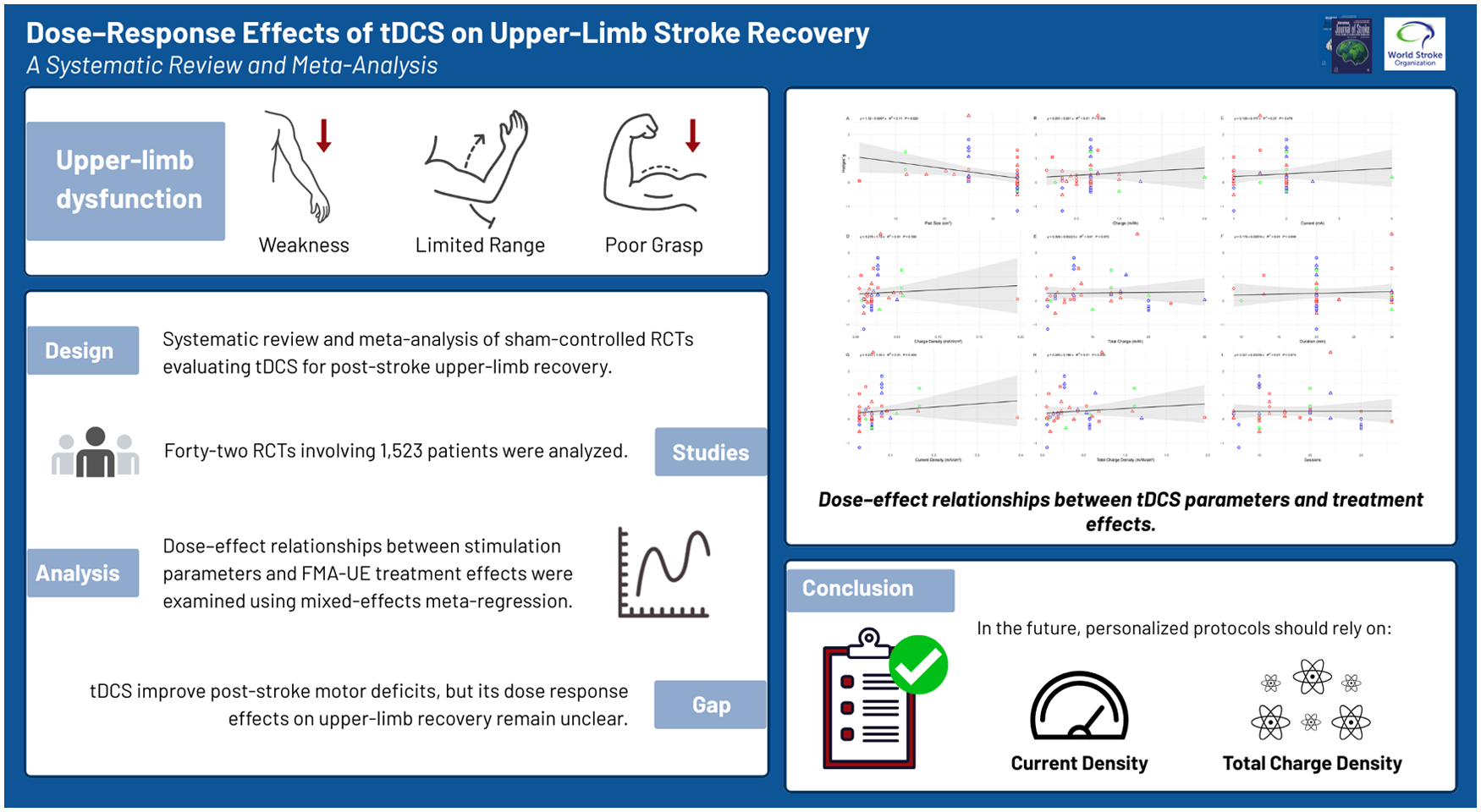
Forty-two RCTs involving 1523 patients were analyzed. tDCS significantly improved upper-limb function, with a small overall effect (SMD, 0.28; 95% confidence interval (CI), 0.12–0.43). Greater benefits were observed in severe impairment and chronic-phase stroke, and bihemispheric stimulation showed favorable pooled effects. Electrode size significantly influenced efficacy, and derived dose metrics, particularly current density and total charge density, appeared useful for characterizing dose–response patterns beyond conventional single-dose parameters. Common adverse events (AEs), including tingling, erythema, and headache, were mild and transient, and no excess risk of serious adverse events (SAEs) was detected.
Conclusion:
tDCS significantly improved post-stroke upper-limb recovery and showed no evidence of increased SAEs, although mild local AEs were more frequent. Treatment effects were not adequately explained by conventional single-dose parameters alone and appeared to be better characterized by electrode size and derived dose metrics, particularly current density and total charge density. These findings support multidimensional dose optimization and patient-stratified tDCS protocols in future trials.
Trial registration:
PROSPERO CRD420251146501.
Keywords
Get full access to this article
View all access options for this article.
References
Supplementary Material
Please find the following supplemental material available below.
For Open Access articles published under a Creative Commons License, all supplemental material carries the same license as the article it is associated with.
For non-Open Access articles published, all supplemental material carries a non-exclusive license, and permission requests for re-use of supplemental material or any part of supplemental material shall be sent directly to the copyright owner as specified in the copyright notice associated with the article.
