




Abstract
Background:
Stroke patients are prone to gastrointestinal dysfunction, with a significantly higher risk of fecal incontinence (FI), which severely affects their quality of life.
Aims:
We investigated the incidence and associated risk factors of FI in stroke patients.
Summary of review:
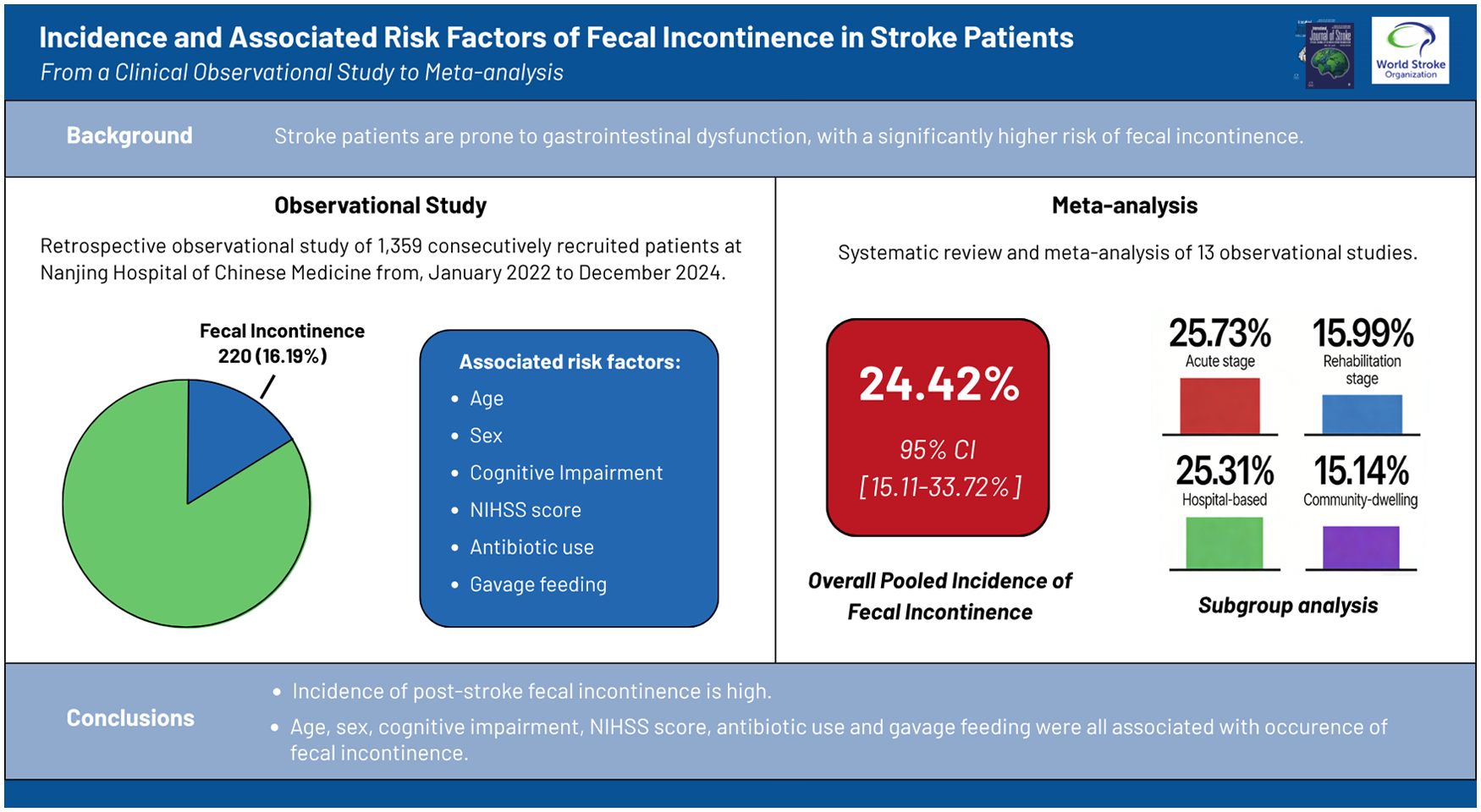
Stroke patients who met the inclusion and exclusion criteria were consecutively recruited at one university medical center from January 2022 to December 2024. FI occurred in 220 of 1359 stroke patients (16.19%). Logistic regression analysis revealed that age, gender, cognitive impairment, National Institutes of Health Stroke Scale (NIHSS) admission score, antibiotic use, and gavage feeding were closely associated with FI incidence in stroke patients. Subsequently, a systematic review and meta-analysis of observational studies followed the Meta-analysis of Observational Studies in Epidemiology (MOOSE) guidelines. Studies were included if they reported the incidence or risk factors of FI in stroke patients. Subgroup analyses were conducted according to the stage of stroke and survey site. The forest plot showed that the incidence of post-stroke FI was 24.42% (95% confidence interval (CI) = 15.11–33.72). On subgroup analysis, the incidence of FI was 25.73% (95% CI = 14.61–36.86) in the acute stage and 15.99% (95% CI = 9.32–22.67) in the rehabilitation stage. Meanwhile, the incidence of FI in the hospital-based stroke patients was 25.31% (95% CI = 11.37–39.26), which was higher than that in the community-dwelling stroke patients (15.14%, 95% CI = 2.26–28.02).
Conclusion:
The incidence of post-stroke FI is relatively high. Age, gender, cognitive impairment, NIHSS score, antibiotic use, and gavage feeding are closely associated with FI occurrence in stroke patients.
Get full access to this article
View all access options for this article.
References
Supplementary Material
Please find the following supplemental material available below.
For Open Access articles published under a Creative Commons License, all supplemental material carries the same license as the article it is associated with.
For non-Open Access articles published, all supplemental material carries a non-exclusive license, and permission requests for re-use of supplemental material or any part of supplemental material shall be sent directly to the copyright owner as specified in the copyright notice associated with the article.
