



Abstract
Background:
The HERMES-24 score has recently been proposed to estimate the 90-day outcome in patients with anterior circulation large vessel occlusion (LVO) stroke.
Aim:
We aimed to further validate the HERMES-24 score in a real-world setting of LVO patients who had received endovascular stroke treatment (EVT).
Methods:
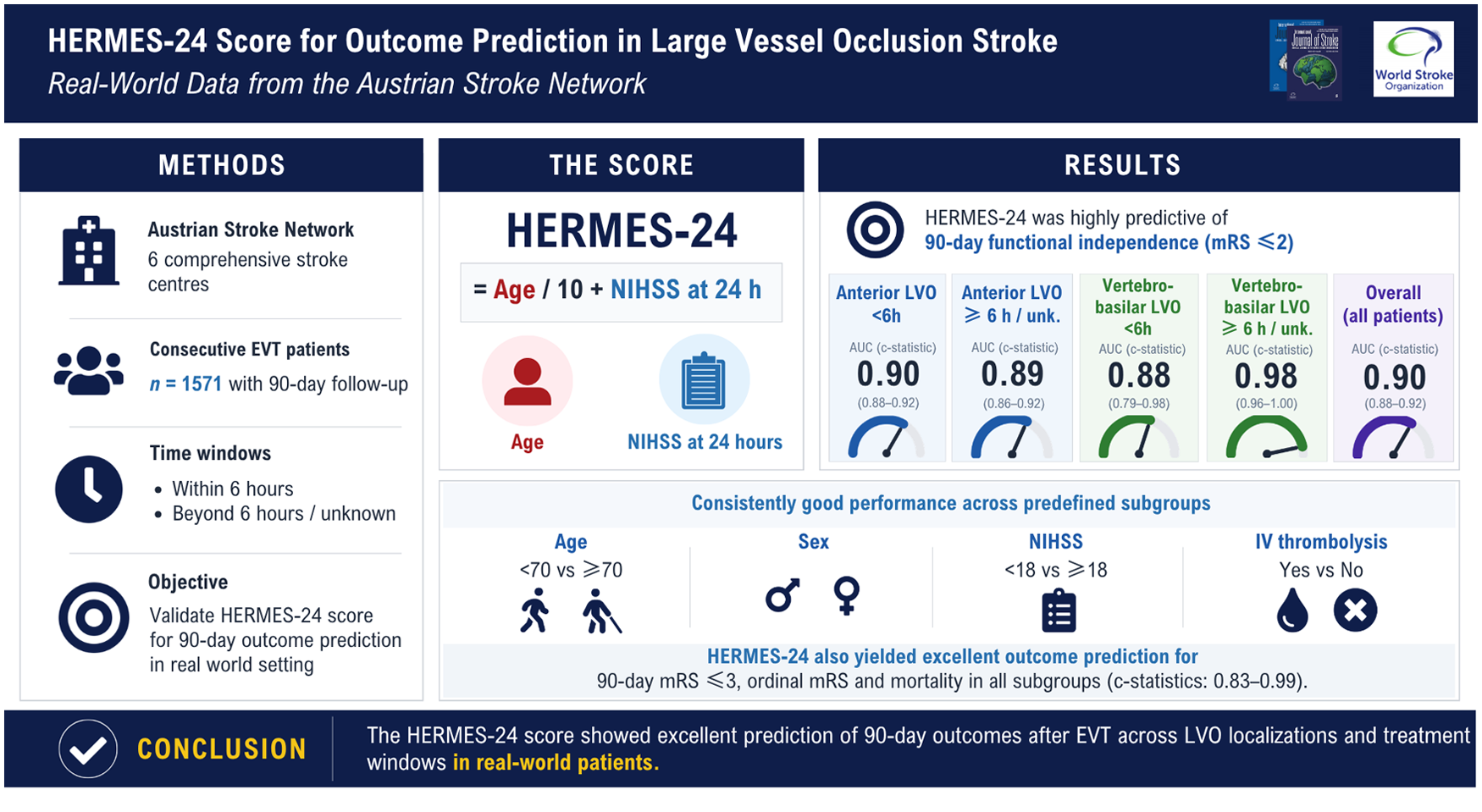
We used data of consecutive LVO patients treated with EVT in six Austrian stroke centers. The performance of the HERMES-24 score for outcome prediction at 90 days (modified Rankin Scale (mRS)) was investigated in predefined subgroups of anterior and vertebrobasilar LVO and within or beyond 6 h/unknown time windows.
Results:
We analyzed 1571 patients with available 90-day follow-up. The HERMES-24 score was predictive of 90-day mRS ⩽ 2 for the total cohort, those with anterior LVO <6 h, anterior LVO ⩾6 h/unknown, vertebrobasilar LVO < 6 h, and vertebrobasilar LVO ⩾ 6 h/unknown with c-statistics (95% confidence interval (CI)) 0.90 (0.88–0.92), 0.90 (0.88–0.92), 0.89 (0.86–0.92), 0.88 (0.79–0.98) and 0.98 (0.96–1.0), respectively. The HERMES-24 score also yielded excellent outcome prediction for 90-day mRS ⩽ 3, an ordinal mRS, and mortality in all subgroups (c-statistics: 0.83–0.99).
Conclusion:
The HERMES-24 score is highly predictive for 90-day outcome in real-world patients with LVO stroke treated with EVT regardless of LVO localization or symptom onset to treatment time.
Get full access to this article
View all access options for this article.