



Abstract
The purpose of this study was to assess an a priori model that included perceptions of coach behavior, coach–athlete relationship, stress appraisals, and coping. A total of 274 athletes from the United Kingdom, Austalia, and Hong Kong completed relevant measures that assessed each construct. Our results revealed that perceptions of coach behavior were associated with aspects of the coach–athlete relationship and stress appraisals. In particular, closeness was positively associated with challenge appraisals and negatively with threat appraisals. However, commitment was positively associated with threat, indicating that there might be some negative implications of having a highly committed coach–athlete relationship. Further, commitment was also positively associated with disengagement-oriented coping, which has previously been linked to poor performance and lower goal-attainment. Applied practitioners could monitor athlete’s perceptions of the coach–athlete relationship, particularly commitment levels, and provide training in appraising stress and coping to those who also score highly on threat and disengagement-oriented coping, but low on task-oriented coping.
Introduction
Participating in competitive sport is associated with athletes reporting a variety of stressors, such as errors, performance, and concerns about the outcome of a competition. 1 A recent meta-synthesis of the stress and sport literature 2 included a taxonomic classification of stressors encountered by athletes, which revealed that coach’s behavior and interactions along with a coach’s personality were salient stressors for athletes. Indeed, scholars revealed that a coach’s behavior influences how an athlete perceives his or her relationship with that coach, and that this relationship is associated with an athlete’s happiness. 3 Given that an athlete’s perception of his or her relationship is associated with happiness and that coaches are a source of stress, 2 it is plausible to assume that perceptions of the coach–athlete relationship would also be related to how an athlete evaluates stress and coping, given that appraisal is thought to determine the emotional responses (i.e. happiness, anxiety, or anger) and coping. 4 However, little is known about how the coach–athlete relationship may influence appraisals of stress, and whether the coach–athlete relationship is related to coping. This is surprising because researchers found a relationship between coach behavior and coping.5,6 In this study, we tested an a priori model that included coach behavior, the coach–athlete relationship, stress appraisals, and coping among a sample of athletes.
Coach behavior
How a coach behaves can influence agressive behaviors, 7 thoughts, 8 and anxiety 9 among his or her athletes. It is therefore important that coaches behave in a way that athletes perceive as being positive or supportive. Høigaard 10 identified positive coach behaviors among a sample of elite Norwegian footballers, reporting that supportive behaviors included providing positive feedback (e.g. behaviors that recognize and reward good performances), training and instruction (e.g., coach behaviors that enable an athlete to improve), and democratic behaviors (e.g., allowing team members to make decisions).
Other research distinguished between supportive and unsupportive coaching behaviors. Using Côté et al.’s Coaching Behavior Scale for Sport (CBS), 11 Nicolas 5 deemed supportive coaching behaviors as including emotional/relational and structural/instrumental components. Conversely, unsupportive coaching occurred when coaches shouted, manipulated, threatened, or upset athletes, which is likely to be perceived as the coach exerting unwanted pressure. 11 Coach behavior also is linked to athlete perceptions of the coach-athlete relationship. 3 Indeed, Lafrenière 3 found a positive relationship between autonomy supportive coach behaviors and the athlete’s relationship quality with the coach. These scholars also found a negative relationship between controlling coach behaviors and the athlete’s relationship with the coach. Although Lafrenière 3 made an important contribution to the literature regarding how coach behaviors may influence the athlete’s relationship quality with his or her coach, it could be argued the method of assessing coach behavior is limited. For example, only two forms of coach behavior were assessed (i.e. autonomy supportive behaviors and controlling behaviors), which were measured by only three and six items, respectively. The CBS 11 provides a more detailed assessment of coaching behavior.
The coach–athlete relationship
Jowett and Cockerill 12 suggested that the coach–athlete relationship refers to all situations in which a coach’s and athlete’s thoughts, feelings, and behaviors are inter-related. The affiliation between the coach and the athlete is dynamic, 12 meaning that both the coach and the athlete can influence the coach–athlete relationship. There are several conceptualizations of the coach–athlete relationship,13–15 with Jowett’s model 13 being the most widely used and the guiding framework for this current study. Jowett 13 conceptualized the coach–athlete relationship as the 3 + 1 Cs, which comprises of closeness (e.g. the extent to which value, support, and care for each other), commitment (e.g. the coach and athlete’s intent to maintain the relationship), complementarity (e.g. how the behaviors of the coach and athlete correspond to each other), and co-orientation (e.g. the coach and athlete establishing common views regarding the athlete’s progression).
The importance of the coach–athlete relationship should not be underestimated, given that successful coach–athlete relationships can result in superior coaching, 16 coach and athlete well-being, 17 and better self-concept. 18 Understanding more about the antecedents and outcomes of the coach-athlete relationship is important for the development of coaching practices. One psychological construct associated with coach–athlete relationship is happiness. 3 Happiness is an emotion that reflects a person’s positive state of their overall psychological well-being. 4 Indeed, Lazarus 4 stated that emotions are generated by appraisals. As such, although Lafrenière and colleagues 3 did not measure appraisal, their findings indicate that appraisals are related to the coach–athlete relationship, give that emotions occur as a consequence of appraisals.
Appraisal
Athletes will make judgments about their environment in relation to valued personal goals. This evaluative process is known as primary appraisal. 4 Peacock and Wong 19 identified three primary appraisals and three secondary appraisals. Primary appraisals included threat (i.e. the anticipation of future harms), challenge (i.e. the anticipation of future gains), and centrality (i.e. the perceived importance of a situation or event). Secondary appraisal refers to an evaluation of perceptions of control and coping options available to the athlete. 4 Peacock and Wong 19 identified three different types of secondary appraisal: controllable-by-self (i.e. the extent to which the athlete can control the situation), controllable-by-others (i.e. the extent to which people close to the athlete can control the situation), and uncontrollable-by-anyone (i.e. the extent to which no-one can control the situation).
Of particular relevance to the current study is the recent literature on challenge and threat states, which are similar to how Lazarus 4 conceptualized these primary appraisals. Indeed, a study by Moore and colleagues 20 found that those who experienced challenge states exhibited superior performance, felt less anxious, and engaged in less conscious processing, in addition to having longer quiet eye durations. These results were echoed by Turner and colleagues 21 who found that the cricketers exhibiting challenge states performed better than those who reported threat states. In addition to appraisals of challenge or threat states influencing performance and anxiety, they have also been theoretically 4 and empirically associated with coping, along with secondary appraisals. 22
Coping
According to Lazarus and Folkman, 23 coping refers to all conscious cognitive and behavioral efforts to manage external or internal demands that a person appraises as taxing his or her resources. Although coping can be classified into many different dimensions, the taxonomy proposed by Gaudreau and Blondin 24 is widely used in the sport literature. Gaudreau and Blondin 24 classified coping within three higher-order dimensions: task-oriented, distraction-oriented, and disengagement-oriented coping. The purpose of task-oriented strategies is to change or master a stressful situation, whereas distraction-oriented coping direct the athlete’s attention onto an unrelated aspect of the sporting task. Finally, disengagement-oriented coping strategies involve athletes stopping achieving their goals.
Summary and hypotheses
Our hypotheses are presented in Figure 1, with a unbroken line representing a positive relationship and a broken line inferring a negative relationship. We predicted that there would be positive paths between supportive coaching behavior and closeness, commitment, and complementarity, but negative paths between unsupportive coaching behaviors and these three coach–athlete relationship constructs. This is because Lafrenière
3
reported a positive relationship between autonomy coaching behaviors and athlete perceptions of the coach–athlete relationship, but a negative path between controlling coach behaviors and the coach–athlete relationship constructs. We also predicted positive paths between supportive coach behavior and challenge, and unsupportive coaching behaviors and threat, but negative paths between supportive coaching behaviors and threat and unsupportive coaching behaviors and challenge. This is hypothesis is based on Lafrenière et al.’s
3
finding that controlling behaviors were negatively associated with happiness, but autonomous coaching behaviors were positively associated, although these findings were insignificant. However, given that challenge appraisals are associated with pleasant emotions and threat appraisals with unpleasant emotions,
25
the athletes who experienced happiness in the Lafrenière
3
study are more likely to have experienced a challenge rather than a threat appraisal. Due to the lack of published research, we did not make predictions regarding the paths between the coach–athlete relationship and centrality.
Hypothesized path model for coach behavior, coach–athlete relationship, stress appraisal, and coping.
Similarly, we predicted positive paths between closeness, commitment, and complementarity with challenge appraisals, but negative paths between these three constructs and threat appraisals based on the notion that these constructs were positively related to the pleasant emotion happiness. This could imply that the situation is more likely to have been appraised as a challenge rather than a threat. 25 We also predicted that there would be positive paths from closeness, commitment, and complementarity to task-oriented coping, but negative paths from these three constructs to distraction- and disengagement-oriented coping. This is because both high scores in closeness, commitment, and complementarity are thought to be associated with athletic excellence, 26 as is task-oriented coping. 27 In accordance with Nicholls, 22 we predicted that there would be positive paths between both controllable-by-self and controllable-by-others and task-oriented coping, but that these paths would be negative to distraction- and disengagement-oriented coping. Further, the paths between both uncontrollable-by-anyone and stressfulness to distraction- and disengagement-oriented coping would be negative, where the paths from these secondary appraisal constructs to task-oriented coping would be negative. Finally, we hypothesized that there would be a positive path from challenge appraisals, controllable-by-self, and controllable-by-others to task-oriented coping and from threat appraisals, uncontrollable-by-anyone, and stressfulness to distraction- and disengagement-oriented coping. We also predicted negative paths from threat, uncontrollable-by-anyone, and stressfulness to task-oriented coping and from challenge, controllable-by-self, and controllable-by-others to both distraction- and disengagement-oriented coping, based on previous findings. 22
Method
Participants
A total of 274 athletes who resided in the United Kingdom (n = 176), Hong Kong (n = 56), and Australia (n = 42) (male n = 200, female n = 73, unspecified n = 1), aged between 16 and 45 years of age (Mage = 21.59, SD = 4.45) participated in the study. Participants were from team (n = 250) and individual sports (n = 24), including both contact sports (n = 216) and non-contact sports (n = 58). Our sample consisted of 188 Caucasian, 31 African-Caribbean, 30 Asian, and 25 athletes from other ethnic origins. The athletes in our sample competed at international (n = 81), national (n = 54), county (n = 38), club (n = 36), and beginner (n = 60) levels. Five athletes did not specify their skill level.
Measures
Coach behavior
The 47-item CBS 11 assessed the athletes’ perceptions of seven of their coach’s behaviors. Thirty-nine of the questions were classified as supportive coaching behaviors, compared to eight of the questions that were classified as unsupportive behaviors. 5 Participants responded to the stem “How frequently do you experience the following coach behaviors?” A question classified as from the supportive coaching behaviors was “The coach(es) most responsible for my physical training and conditioning provides me with structured training sessions” and “the coach(es) most responsible for my mental preparation provides advice on how to perform under pressure.” Examples of unsupportive coaching behaviors were “my head coach yells at me when angry” and “my head coach shows favoritism to others.” Questions were answered on a seven-point Likert-type scale, which ranged from 1 = never to 7 = always. Côté and colleagues 11 reported Cronbach’s alpha coefficients of between 0.85 and 0.96 from a sample of 205 athletes. Little independent research has been conducted to establish the validity of the CBS. Jurko and colleagues 28 reported that each scale of the CBS could explain substantial variance through exploratory factor analysis. They did not perform a full confirmatory factor analysis though.
Coach–athlete relationship
The 11-item Coach Athlete Relationship Questionnaire (CART-Q) 29 assessed the athletes’ perceptions of closeness (i.e. the extent to which the athlete feels close to his or her coach), commitment (i.e. the degree to which athletes intend to maintain their working relationship with their coach), and complementarity (i.e. co-operative actions) with their coach. Participants responded to the stem “This questionnaire aims to measure the quality and content of the coach–athlete relationship. Please read carefully the statements below and circle the answer that indicates whether you agree or disagree.” An example of question assessing closeness was “I trust my coach,” whereas “I am committed to coach” was from the commitment scale, and “When I am coached by my coach, I adopt a friendly stance” represents a question from the complimentary scale. Participants responded to these questions on a 7-point Likert-type scale, which ranged from 1 = strongly disagree to 7 = strongly agree. Jowett and Ntoumanis 29 found that all aspects of the coach–athlete relationship significantly predicted relationship satisfaction, which provided some support for construct validity. The same authors also reported Cronbach alpha coefficients of 0.86 for closeness, 0.83 for commitment, and 0.78 for complementarity. Similar findings were presented by Yang and Jowett, 30 who used relationship satisfaction as construct validation. Their paper also examined the factorial properties of the 11-item CART-Q, which provided a stronger model fit than the 13- and 29-item versions.
Stress appraisals
The Stress Appraisal Measure (SAM) 19 measured three primary appraisals (i.e. challenge, threat, and centrality), three secondary appraisals (controllable-by-self, controllable-by-others, and uncontrollable-by-anyone), and stressfulness (i.e. overall feeling of stress). Participants were instructed to “please respond according to how you view this situation right now.” An example of a question relating to challenge appraisals was “Is this going to have a positive impact on me?” Conversely, an example of a question measuring threat was “Will the outcome of this situation be negative?” The responses on the SAM range from 1 = not at all to 5 = extremely. Peacock and Wong 19 reported internal consistencies ranging from .65 to .90. It should be noted that the Cronbach alpha score of .65 was for threat, which was reported in one of three studies. In the other two studies within that paper, the Cronbach alphas for threat were.75 and .73. Perry 31 conducted confirmatory factor analysis and exploratory structural equation modeling on the SAM and demonstrated sound factorial validity, including measurement invariance.
Coping
We used the Coping Inventory for Competitive Sport (CICS) 32 to assess how the athletes were coping before their competition. The CICS has been successfully used to examine pre-competitive coping and assesses 10 coping subscales categorized within task-, distraction-, and disengagement-oriented coping. 33 Participants reported how their coping “corresponds to what you are doing now,” with questions answered on a 5-point scale, which ranged from 1 = not at all to 5 = very strongly. Although Gaudreau and Blondin 32 did not report the Cronbach alpha coefficients for the higher-order dimensions, the individual coping strategies ranged from .67 to .87. Perry 31 presented support for the factorial validity and measurement invariance.
Procedure
Letters were distributed to coaches and participants, which explained the purpose of the study and the requirements for those interested in participating, after ethical approval was obtained from a University Ethics Committee. Participants were asked to complete an assent form if they wished to participate in the study. Each participant received a questionnaire pack and the questionnaires were completed in the clubhouse of sports clubs in the presence of a trained research assistant, and within three hours of a competition starting. As such, each participant completed the questionnaires in the following order: CBS, 11 CART-Q, 29 challenge and threat items of the SAM, 19 and the CICS. 32
Data analysis
Preliminary data analysis screened for outliers, normality, and omega. Omega was the preferred assessment of internal consistency because it has fewer assumptions than alpha, problems associated with inflation of internal consistency are less likely, and point estimates and confidence intervals can be calculated. 34 Bivariate correlations were used to examine relationships between all variables, using the effect size (r) to make a judgment on their meaning. 35 Zhu 35 suggested using a criteria of 0–0.19 = no correlation, 0.2–0.39 = low correlation, 0.4–0.59 = moderate correlation, 0.6–0.79 = moderately high correlation, and ≥0.8 = high correlation.
To test how well the hypothesized model (Figure 1) fit our data, we performed a path analysis in Mplus 7. 36 A range of indicators of model fit was used to supplement χ2. Hu and Bentler’s recommendations of CFI close to .95, TLI close to .95, SRMR close to .08, and RMSEA close to .05 were used as guidelines for good model fit, while acknowledging the recommendations by Marsh and colleagues, 37 who encouraged researchers to avoid interpreting these as golden rules. To assess mediation, we used 5000 bootstrapped samples, which does not hold assumptions regarding sampling distribution 38 and provides standard errors and confidence intervals.
Results
Descriptive statistics, univariate normality estimates, internal consistency.

Note: Coach behavior and stress appraisal are measured on 7-point scales; stress appraisal and coping strategies are measured on 5-point scales. Omega confidence intervals could not be calculated for the stressfulness subscale, as the matrix was not-positive-definite.
Bivariate correlations for coach behavior, coach–athlete relationship, stress appraisal, and coping.

Statistically significant at p < .05.
p < .01.
The coach–athlete relationship was significantly associated with stress appraisal. Specifically, closeness and complementarity were correlated moderately positively with challenge (r = .42 and .55, p < .01), control-self (r = .45 and .53, p < .01), and control-others (r = .44 and .54, p < .01). Closeness and complementarity were negatively associated with threat (r = −.24 and −.35, p < .01) and uncontrollable (r = −.26 and −.44, p < .01). Complementarity presented the strongest relationship of the coach–athlete relationship variables with coping. Specifically, it was related to task-oriented coping (r = .38, p < .01). Relationships between stress appraisal and coping were low to moderate. The strongest correlations were between task-oriented coping with challenge (r = .47, p < .01), control-self (r = .44, p < .01), and control-others (r = .38, p < .01), distraction-oriented coping with threat (r = .41, p < .01) and stressfulness (r = .38, p < .01), and disengagement-oriented coping with threat (r = .41, p < .01) and stressfulness (r = .38, p < .01).
To guard against departure from multivariate normality, the robust maximum likelihood estimator (MLR) was used in all model testing. The path model found in Figure 1 represented a reasonable fit to the data but with a significant χ2, low TLI, and high error (RMSEA): χ2(17) = 40.86, p = .001, CFI = .973, TLI =.834, SRMR = .039, RMSEA = .080 (90% CI = .049, .112). Examination of the path estimates identified several non-significant paths (p > .05). Consequently, these paths were removed from the model. The resultant model presented improved model fit: χ2(50) = 60.75, p = .142, CFI = .988, TLI = .975, SRMR = .052, RMSEA = .031 (90% CI = .000, .056). This model is presented in Figure 2. This figure does not include direct paths between coach behavior and secondary appraisals and coping. Nor does it include paths between coach–athlete relationship variables and coping. There were, however, some significant direct paths. Specifically, unsupportive coach behaviors positively predicted centrality (β = .65, 95% CI = .50, .80, p < .001), and stressfulness (β = .36, 95% CI =.11, .60, p < .001), but negatively predicted controllable-by-self (β = −.35, 95% CI = −.50, −.20, p < .001). Supportive behaviors presented a significant positive path with uncontrollable-by-anyone (β = .22, 95% CI = .06, .38, p < .001). Of the coach–athlete relationship variables, commitment presented a significant positive path with disengagement-oriented coping (β = .24, 95% CI = .07, .40, p < .001) and complementarity negatively predicted both distraction- (β = −.21, 95% CI = −.37, −.04, p < .001) and disengagement-oriented coping (β = −.36, 95% CI = −.54, −.17, p < .001).
Revised path model showing only significant (p < .05) paths. Note: Direct paths between coach behavior and secondary appraisal, coach behavior and coping, and coach–athlete relationship and coping have been omitted for clarity.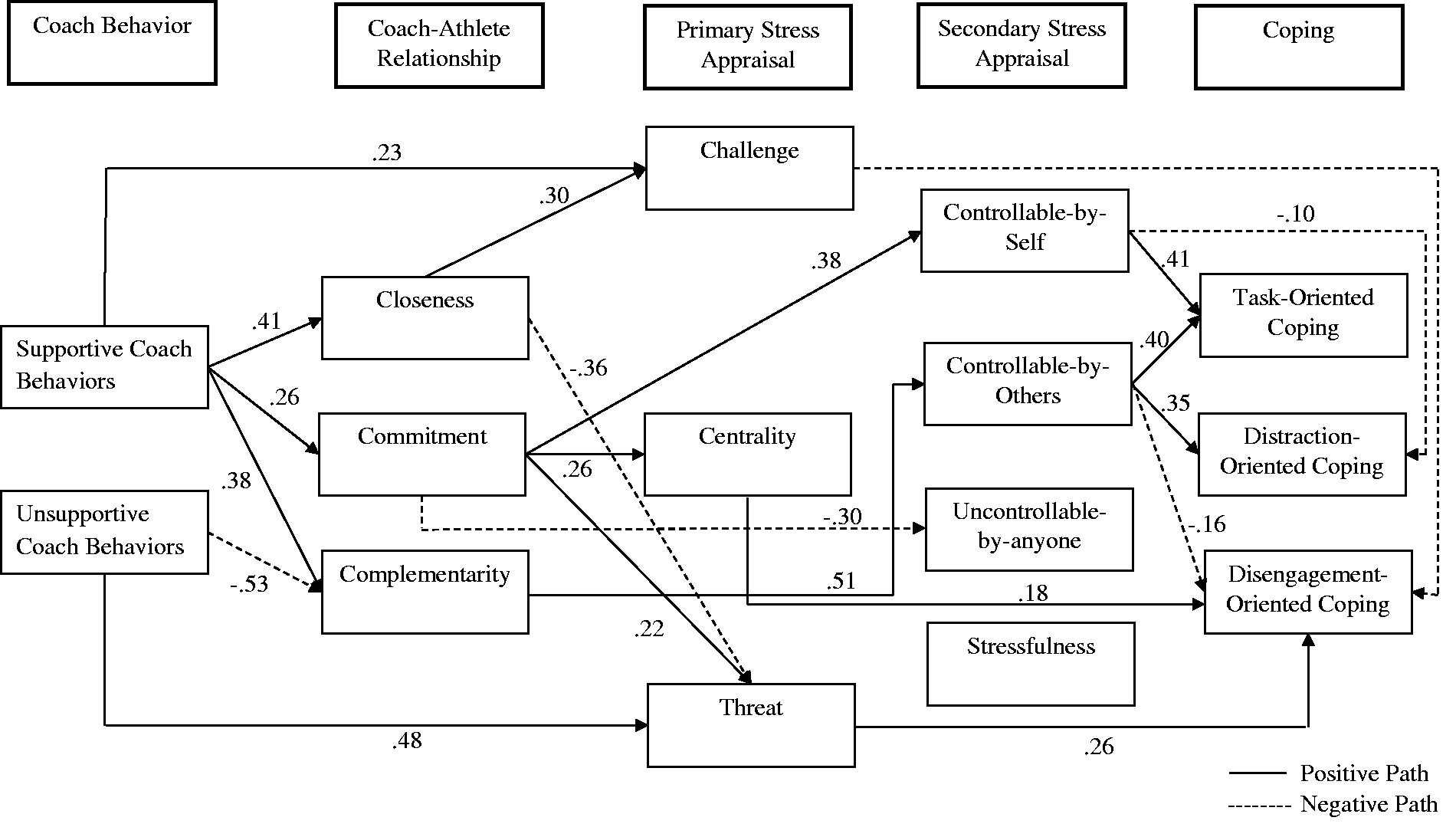
Direct, indirect, and total effects of coach–athlete relationship variables on coping in the original path model.

Discussion
We assessed the relationships between perceived coach behavior, athlete’s perceptions of closeness, commitment, and complementarity, along with stress appraisals and coping. Overall, some of the hypothesized paths were supported, indicating that some of these constructs are related, but there were also unexpected significant findings. These included the relationship between commitment and threat appraisals, along with commitment and coping (e.g. task- and disengagement-oriented coping).
There were positive paths from supportive coaching behaviors to closeness, commitment, and complementarity. This compliments the work of Lafrenière and colleagues. 3 Only one of the negative paths that we predicted from unsupportive coaching behaviors to the three coach–athlete relationship scales was significant, which was the path to complementarity. This finding is only in partial agreement with Lafrenière 3 who found a negative relationship between controlling forms of coach behaviors and athlete perceptions of the coach–athlete relationship. The insignificant paths between unsupportive perceptions of coach behavior with both closeness and commitment would imply that athletes still feel a bond with their coach and plan to continue working with the coach despite feeling the coach is unsupportive. In certain circumstances, especially team sports, athletes have little or no say on who their coach is and could only end the coach–athlete relationship by changing teams. As such, the athletes felt committed to their coach, because they had little choice regarding working with a new coach. It should be noted that the vast majority of the athletes in the present sample were from team sports, so it could be interesting to compare the effects of unsupportive coach behaviors among team versus individual sport athletes.
The path from supportive coaching behaviors to challenge appraisals and the path from unsupportive coaching behaviours were both significant and positive. Incidentally, the path weighting of unsupportive coaching behaviors to threat was higher than the weighting for supportive coaching behaviors to challenge. This finding illustrates the impact that unsupportive coaching behavior can have on athlete’s perception of a situation. Coaches should consider the impact of their behavior and the detrimental consequences of such unsupportive behavior. Threat is associated with undesirable consequences such as increased anxiety 19 and decreased performance. 20 The finding that there was a significant path between unsupportive coaching behaviors and threat could imply that coaches can generate perceptions of threat among their athletes, although given that this is a cross-sectional study, research is required to verify this. We also found a negative path between supportive coaching behaviors and perceptions of threat, implying that there is a negative association between these constructs. Although it appears that coach behavior might not generate challenge appraisals among athletes, it could be that it reduces that occurrence of threat appraisals.
Other than closeness, the hypothesized paths between the coach–athlete relationship and appraisals were not supported. These findings, however, illustrate the importance of the athlete’s perception of closeness to coach, because it was positively associated with challenge, but negatively with threat. However, commitment and complementarity were not associated with challenge, and commitment was positively associated with threat. That is, when the athlete was committed to working with his or her coach, threat levels were higher. This findings illustrates that there might be negative consequences of being in a highly committed coach–athlete relationship, which has previously been unconsidered. When athletes are in a highly committed relationship with their coach, they might be more concerned about letting their coach down and therefore experience higher levels of threat. Although not focusing on the coach–athlete relationship, Nicholls 41 reported that young golfers experienced threat in regards to letting their parents down by not performing well. Furthermore, there was also a positive path from commitment to disengagement-oriented coping and a negative path to task-oriented coping which were unexpected. Task-oriented coping has been positively associated with goal attainment, 42 superior performance,27,43 and higher coping effectiveness, 44 whereas disengagement-oriented coping is negatively associated with such constructs. These findings also illustrate the possible negative associations of a highly committed coach–athlete relationship. It should also be noted, however, that commitment was positively associated with controllable-by-self, indicating that a committed coach–athlete relationship instills a belief that the athlete can manage stressful situations on their own. Additional research is therefore warranted to explore both the positive and negative consequences of having a highly committed coach–athlete relationship.
Only some of our hypothesized paths between appraisal and coping were supported. The path between challenge and task-oriented coping was positive and the path between challenge and disengagement-oriented coping was negative. Further, the path between threat and disengagement-oriented coping was positive, which are all in agreement with Nicholls, 22 who also found that only some of the hypothesized paths were significant. The notion that challenge is associated with adaptive forms of coping, such as task-oriented coping, but is less associated with athletes using more distraction- or disengagement-oriented coping, was partially supported. Similarly, although threat appraisals are associated with athletes using more disengagement-oriented coping, it is not associated with athletes using less task-oriented coping strategies.
Limitations
This study explored perceptions of coach behavior and the association of such perceptions with the coach–athlete relationship and stress appraisals. However, it is possible that the athletes’ perceptions of such coach behaviors may be biased, so future research could assess actual coach behaviors in relation to perceptions of the coach–athlete relationship and stress appraisals. Furthermore, we employed a cross-sectional design, and the constructs we assessed are all recursive and dynamic processes.11,19,29,32 As such, we were unable to so assess how these relationships unfolded over time, which would make for an interesting and useful piece of research. While we have acknowledged the known validity of the measures used, this is largely related to the factorial validity. There is little testing of construct and criterion validity on the self-report measures used in this study. In particular, the coach behavior scale would benefit from such scrutiny.
Recommendations
The findings from this study illustrate that perceptions of coach behavior are associated with how an athlete perceives his or her relationship with the coach and the appraisal of situations. It is therefore paramount that coaches consider their behavior and maximize their level of supportive behavior, whilst minimizing unsupportive coaching behaviors. This may appear an obvious recommendation, but our data suggests that coaches were being perceived to behave in an unsupportive manner among some athletes, which suggests that this type of behavior is evident among coaches. Although it may seem appealing to want to maximize all aspects of the coach–athlete relationship, this is one of the first studies to suggest that there might be some undesirable consequences of such an approach, particularly in relation to commitment. Although it is important that both the coach and the athlete are committed to the relationship, coaches could speak to their athletes and provide re-assurances about factors that might cause threat (e.g. the outcome of competitions) in highly committed coach–athlete relationships.
Conclusion
We found support for a number of paths assessed in this study, indicating that coach behaviors are associated with the coach–athlete relationship and appraisals. Further, aspects of an athlete’s perception of the coach–athlete relationship are related to appraisals and coping. Although supportive coaching behaviors were not positively associated with challenge appraisals, they were negatively associated with threat, and unsupportive coaching behaviors were positively associated with threat appraisals. As such, coaches might be able to reduce threat levels among their athletes by monitoring their behavior and eliminating unsupportive coaching behaviors. Finally, this is one of the first studies to suggest that a strong coach–athlete relationship might have some undesirable consequences, given that commitment was positively associated with threat.
Footnotes
Author’s note
The author John L. Perry, at the time of this research was affiliated from Leeds Trinity University, UK and now he is associated with the Department of Sport, University of Hull, Health and Exercise Science, Hull, UK.
Declaration of Conflicting Interests
The author(s) declared no potential conflicts of interest with respect to the research, authorship, and/or publication of this article.
Funding
The author(s) received no financial support for the research, authorship, and/or publication of this article.