




Abstract
The aim of the study was to compare the procedural knowledge of expert and novice volleyball players, considering that the expert cognitive profile can be used as a reference in the tactical training process of players. The participants in this study included 8 experts and 11 novices. McPherson and Thomas’ verbal protocol instrument was used to access the players’ tactical knowledge. The results showed significant differences, with higher mean values in experts, in the condition and regulatory concepts, and in the hierarchies of goals related to themselves and opponents. Coaches must pay attention on increasing the amount of elements to analyse related to the environment, in order to improve players’ tactical training process in the service action. Athletes need to be taught on prioritize the most relevant elements of the environment. When training the serve, the areas of responsibility, strengths and weaknesses of each receiver must be assessed, as well as the influence of the serve on the construction of the opponent’s attack.
Introduction
Different sport research studies have shown differences between experts and novices, highlighting that experts have a greater specific knowledge of sport; they also use their knowledge more efficiently to identify, remember and handle the relevant information; they are faster, more consistent, and they have a better anticipation mechanism; they have a greater specific mastery of the sport, and are able to transfer their specific skills from one sport to another; they have greater understanding and self-control of their own mental processes.1–5
These differences can be explained within the framework of the Adaptive Control of Thought model (ACT), Anderson6,7 suggests that human cognition is based on a series of condition-action connections called productions. A production is what McPherson and Thomas 8 called propositions or ‘if-then’ conditional sentences between the specific conditions of the environment and the execution of the action in this situation: ‘if X happens, then I do Y’.9–11 These productions are responsible for carrying out the appropriate actions under specific conditions. It is thus understood, based on naturalistic decision-making (NDM), that in a certain game situation, an athlete compares this situation with a typical situation that is stored in his/her memory and that is associated with a certain action. If the specific game situation is similar to the typical situation that is stored in the memory, the athlete will know what to do and the action he/she has to carry out. 12
A production system under the ACT model is comprised of three different kinds of memory: declarative, procedural and working. Declarative memory deals with the information about ‘what to do’, while procedural memory contains the knowledge about ‘how to do it’. The working memory contains the updated information about the systems that can be accessed. This consists in recovering information from the long-term declarative memory and possible accumulated information via coding processes and production actions.
The creation of complex condition profiles, action plan profiles (APP) and current event profiles (CEP), which are specialized adaptations in the long-term memory (LTM), are a characteristic aspect of expert players.13–15 Likewise an additional mechanism of LTM helps experts access the relevant tactical information of a game context. 13 Thus, the information is continuously updated and stored in the athlete’s memory, thus configuring his/her knowledge base for a specific sport. 16 This knowledge, stored in the memory, is an essential mechanism that drives sport expertise. 13
Along these lines, according to the Sport Paradigm,8,14 procedural knowledge is identified with ‘knowing how’,11,15,17,18 and it includes the appropriate response selection within a game context. 19 However, it is necessary to explain the difference between response selection procedures and motor procedures.9,15,18,20 Consequently, an athlete may have a knowledge about how to perform a skill (cognitive component), but might not be able to execute it motorically (execution component). From cognitive psychology, different models have been developed in an attempt to explain the importance of these cognitive and decisional processes during sporting actions, and how these favour a more efficient response execution. 21 Depending on the level of expertise, this knowledge will be greater or less, which is a key aspect in the athlete’s performance.1,8,22,23
The variability between each action features in different sport had led to develop research studies in each specific game action. Verbal reports have been frequently used as instruments to access players’ knowledge. Thus, in volleyball, we can highlight the studies on blocking,24,25 setting, 26 reception, 27 attack28,29 and serving. 30
In this study, we paid attention specifically to the service action. Unlike all the other game actions that take place in volleyball, serving has some specific characteristics that affect the decision-making in such an action. The serve starts play and it is executed after the server holds the ball.31,32
Serving in today’s volleyball is basic. It is the first chance for a team to score, 33 an action with an offensive purpose, 34 which is why it is considered as the first attack element in an elite team. 35 Together with attacking and blocking, as success indicators in competition, the number of failed serves and the percentage of serves that score points, are associated with success in volleyball.36–39
Despite the data shown, the importance of serving in volleyball not only lies in direct points that could be obtained by that action, 40 and which tend to decrease the closer we get to higher levels,41,42 but also in its influence on later game actions.43,44 Serving determines the reception quality and, as a result, may have an influence on setting and on subsequent construction of the attack.45–47 Likewise, if, by means of the serve, a team manages to neutralize a powerful attack by the opponent, the possibilities of success in blocking increase.48–50
The aim of this research was to compare procedural knowledge, in both expert and novice players, selecting serving in volleyball as the variable. We consider that experts will refer significantly more than novices to the conditions in which the service action takes place, adapting them in agreement with the game situation, as occurred in previous studies.10,13,18,51,52 They will also pay priority attention to the opponent’s characteristics.12,53 Likewise, we consider that experts will express verbalizations that are more complex (listing more characteristics of the different game actions and conditions) and more structured than novices, as occurred in previous studies.13,23,25,52,54,55
Method
Participants
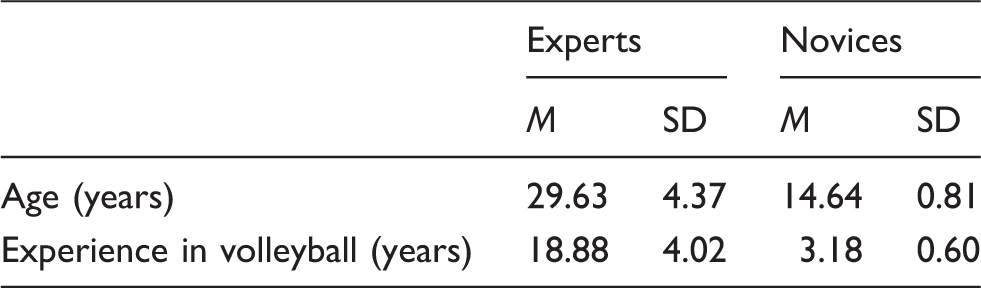
Descriptive statistics of the participants’ characteristics.
Apparatus and procedure
The variable of this study was procedural knowledge. Procedural knowledge is defined at two levels: problem representation, 8 related to the players’ thoughts about already executed actions, and planning strategies, 56 related to the thoughts about execution possibilities in later moments. This research focused on the analysis of procedural knowledge related to problem representation.
Interview procedures
Verbal reports have been used in order to access the knowledge representation of volleyball players, as done in previous tennis8,51,52,56 and volleyball studies.24,25,27 Players were interviewed in a 6vs6 situation when training. They had to answer the following question: What were you thinking about while serving? Originally, this question was developed by McPherson and Thomas, 8 and requires players to remember their thoughts about the previous point.
Players were interviewed after serving, having to leave the court before going back to defend. Players did not have any time pressure to answer. Previously, players were instructed to answer these questions as accurately as possible. No technical problems occurred during recording. Ten interviews were conducted for each player. During the interview process, the same player was ensured not to be interviewed consecutively about more than two service actions. The aim with this was to know the problem representation of the servers in a greater variety of contexts and moments of the game.
Coding verbal responses
After recording, interviews were transcribed for further analysis. A coding instrument developed by McPherson8,56 was used, where three different levels of analysis were established: a first level about concept content, a second level about concept sophistication and a third level of analysis about concept structure.
Concept content
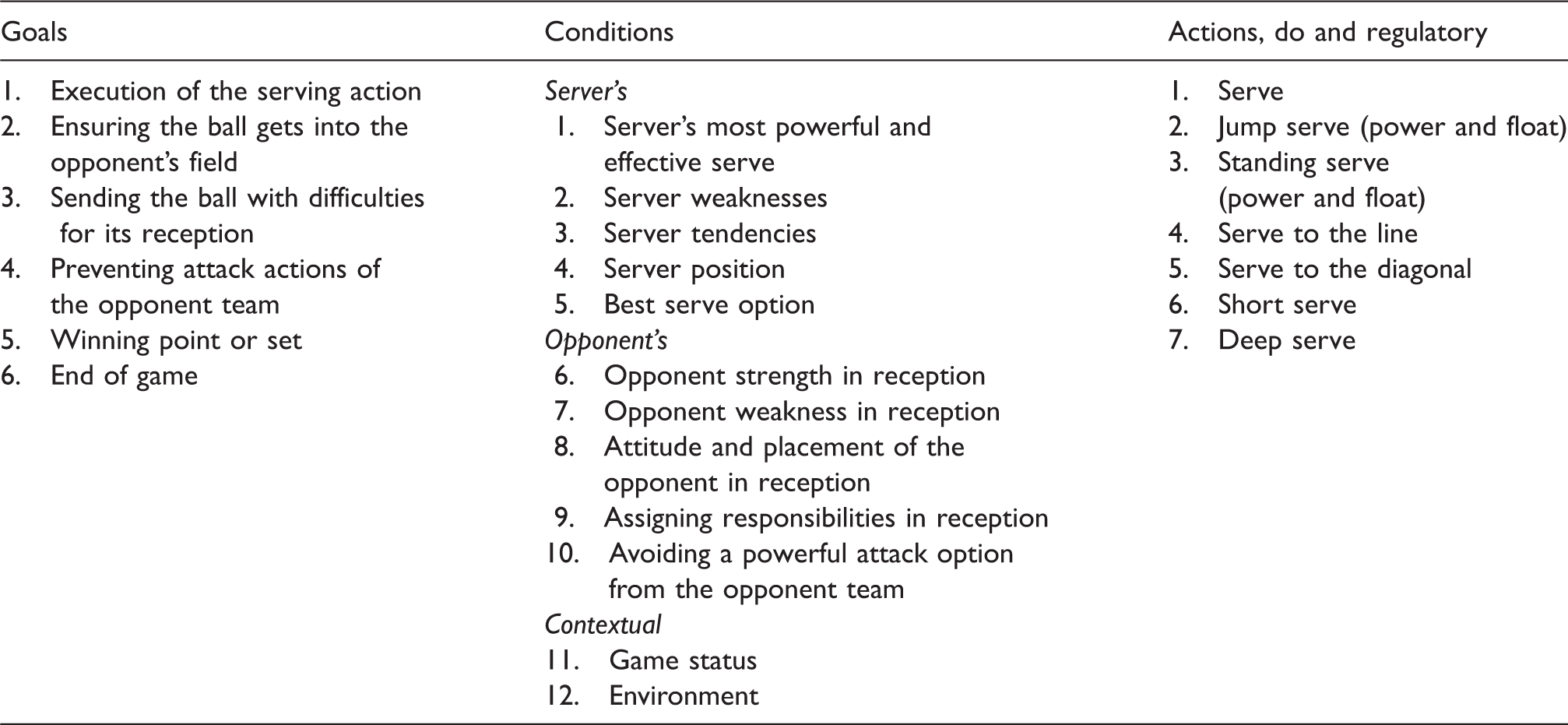
Sub-concepts for coding verbal responses (adapted from McPherson and Thomas 8 ).
Concept sophistication
Analysis level 2, concept sophistication, was applied only to major concept categories of goal, condition and action.
In this research were used the four hierarchical levels of goal, adapted to the current panorama in volleyball, and established in previous researches. 26 (a) hierarchical level 0, concepts related to skill and themselves; (b) hierarchical level 1, concepts related to themselves and the team members; (c) hierarchical level 2, concepts related to themselves and opponents; (d) hierarchical level 3, concepts related to win (the point, the game or the match). The concept sophistication of each condition and action concept was classified by quality of sophistication: (a) quality level 0, inappropriate or weak concept; (b) quality level 1, appropriate concept without any details or features; (c) quality level 2, appropriate concept with one detail or feature; (d) level 3, appropriate with two or more features.10,56
Concept structure
Analysis level 3 coded concept structure or links between concepts.10,56 Concept structure analysed the number of linkages of concepts observed in each phrase, classifying phrases into 3 levels: single concepts (only one concept), double-concept linkages (two linked concepts) and triple-concept linkages (with three or more linked concepts).
Reliability of coding system
Data analysis was performed by two volleyball experts. A total number of 11 training sessions were held, coded samples chosen randomly from thirty of the 190 interviews. Carrying out the same coding on two occasions, with a time difference of 10 days, gave us intercoder reliability values of Cohen’s Kappa 0.85 and 0.86 respectively, and intracoder reliability of 0.88 and 0.87. According to Landis and Koch (1977), 57 the values achieved represent almost very high reliability (between 0.81 and 1).
Statistics analysis
Descriptive and inferential analyses of data were performed. The average values and standard deviations were used for descriptive analysis. The average values corresponded to the mean of the absolute values obtained by the individuals of each group in all the interviews conducted with each one of them (10 interviews). Inferential analysis was performed by non-parametrical statistics, specifically, the Mann–Whitney U test (p ≤ 0.05), justified by the reduced size of the sample and by the results achieved in the Shapiro–Wilks normality test. Effect size (r) was calculated separately for every sub-variable (r = Z/√N). 58
Results
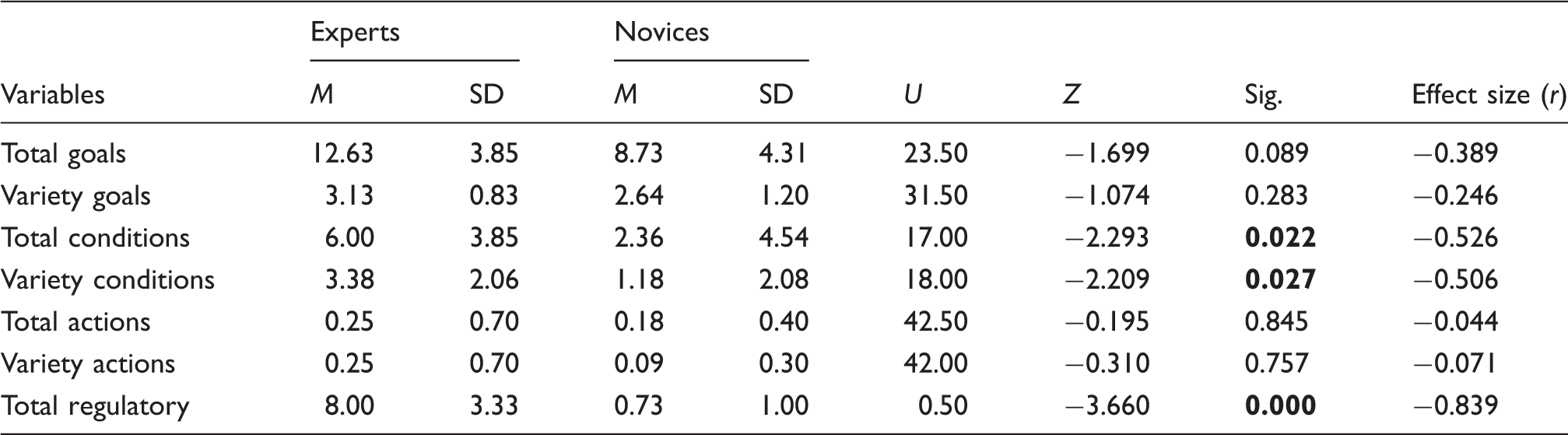
Frequency scores and U values for measures of concept content for level of expertise in problem representation.
Frequency scores and U values for measures of sub-concepts content for level of expertise in problem representation.

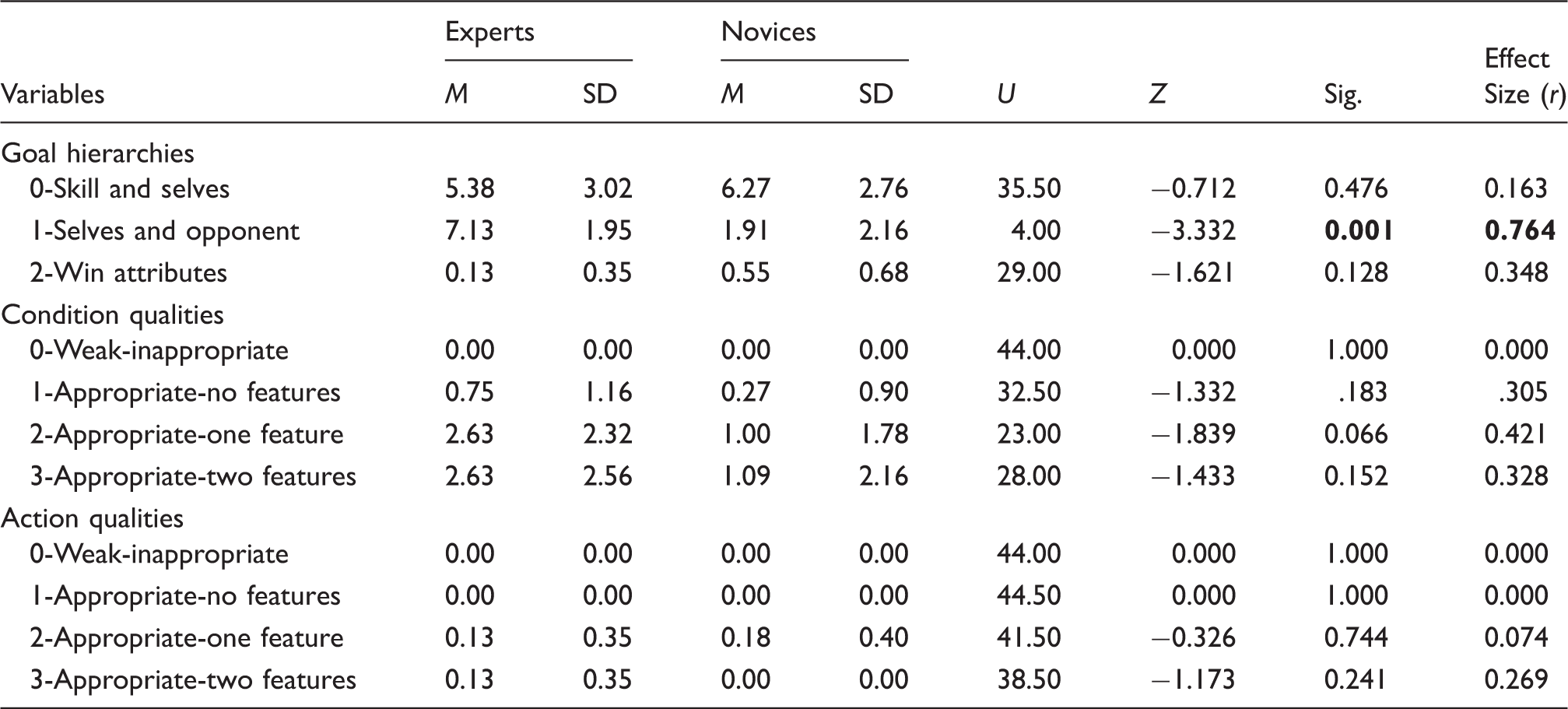
Frequency scores and U values for measures of concept sophistication for level of expertise in problem representation.
Frequency scores and U values for measures of concept structure for level of expertise in problem representation.

Discussion
In this investigation, according to the expert-novice paradigm, results showed differences in problem representation depending on the level of experience. Expert players had a higher verbalization quality and a more tactical and in-depth representation of action plans than novices. We must consider that both groups of players participating in our study (novices and experts) have a different level of experience, apart from different ages. The athletes’ age variable was considered to affect the players’ procedural and declarative knowledge, insofar as this increased with age.22,51,59 However, recent studies60,61 show that the level of practice in training and competition is a more relevant factor than age in the development of the specific knowledge of the sport.
Results achieved showed that expert players, in comparison with novice players, had significantly higher values in the total and variety of conditions and regulatory concepts. This determined a higher quality in experts’ verbalizations. As an example of this, one of the experts indicated in the interview: ‘I wanted to serve to 6, in the conflict zone between 6 and 5, so that the 5 player would have to receive on his worse side, and make it difficult for him to enter and make the attack. The serve was good, to the zone that I had aimed at, but perhaps it was too short’.
These results agreed with the fundamental indicators of the expert profile, characterized by a higher number in all the condition, action and regulatory concepts and in the variety of conditions and actions.56,62,63
Players showing a higher number of condition concepts were able to adapt and modify their interpretations of every game action in sport, in such a way that they were able to update their ‘APPs’ (tactical prototypes of execution in explicit conditions) and the ‘CEPs’ (tactical prototypes of conditions used for decision-making), referring to them in a more complex way.10,13,18,51,52,63 Specifically, a volleyball study determined that expert setters generated a higher number of condition concepts than setters with less experience. 25
The significantly greater frequency of regulatory concepts by the experts shows their tendency to assess or evaluate their action with relation to the service action. Thus, experts often used final expressions, such as: ‘… well, it has gone well.’, ‘… what has happened is that I served more to 3 than 4, but well.’, ‘… and I have achieved it.’, ‘… and, luckily it touched the net and dropped into the opposite court.’ This high self-evaluation capacity is typical of athletes with a high level of expertise,51,64 who understand the factors that mainly affect their performance.13,65
If we pay attention to the goal, condition and action sub-concepts, expert players in this investigation exhibited significantly higher values than novices in the goal sub-concepts of sending the ball with difficulty for its reception and prevention of attack actions by the opponent team, and in the condition sub-concepts of opponent’s strength in reception and distribution of responsibilities in reception. Specific bibliography in volleyball, which coincides with these results, gives priority, among the basic objectives achieved by serving, to hindering the reception and the creation of the attack by the opponent team.31,40,44,48,50,66
Likewise, the players’ areas of responsibility in reception are aspects that are commonly considered in volleyball with a view to creating service reception difficulties. It also produced problems in the reception player’s attack, reducing possibilities to attack effectively, or slowing the attack down. 48 Thus, some pieces of advice for serving included moving the attacker towards the centre of the field; directing the serve towards zones 4 or 5 of the playing field; serving toward the reception player’s right side or left side depending on his possible laterality problems; performing a short serve or a deep serve in the zone assigned to a reception player; serving near the game field lines.50,66,67
Experts who participated in this study referred considerably more than the novices to the strength in reception of the opponent team. They showed a more complex tactical intentionality than novices. The experts, rather than considering the reception weakness, took into account strong reception players and tried to avoid their participation. This priority attention by expert volleyball players to questions related to the opponent is in line with the results obtained in previous studies on volleyball. 12
Thus, in our study, expressions such as: ‘I don’t want to serve to the libero’, ‘I tried to prevent the zone 5 player from receiving, as he is the best receiver of all’, ‘Juan is their strongest receiver, so I wanted to prevent him from intervening’, are significantly more frequent in expert players than in novice players.
With regard to the second level of analysis, referring to conceptual sophistication, this study revealed significant differences in goal hierarchies. In this case, the experts referred mostly to the opponent, as also occurred in previous studies on volleyball.12,53 This aspect is an essential indicator of expertise, in such a way that expert players, when focusing, identifying and reading the opponent’s actions, accessed a more tactical content than novices. Novices prioritized lower quality aspects, such as field position, ball placement, getting the point or winning the match.20,68 So, whilst the experts referred mainly to aims such as: ‘I did my utmost to seek out forward 4, to cut off his movement’, ‘I tried to get Pedro to receive, if possible with fingers’, ‘I wanted to serve to him so that the centre couldn’t attack’, the novices gave priority to the following type of aims: ‘The last thing I wanted to do was to lose the point’, ‘I didn’t want to take risks in the service’,I was thinking about serving’, ‘I tried to get it in.’
Likewise, greater quality was achieved, both in conditions and actions, in expert players’ verbalizations, although this was not significant. Several studies in this area had related higher levels in conceptual sophistication to the expert players’ capacity to represent situations in a more complex and structured way.8,13,51,52,55,56,69
In volleyball literature, similar results have been found, where experts generated a more sophisticated analysis, in different game actions, in blocking 23 and setting. 25
Expert players used concepts with 1, 2 or more details while novice players mainly used concepts without features. This fact reaffirms the idea of a change from surface processing of the environment in initial stages, towards in-depth information processing, with more tactical levels in expert players.9,63,70
Finally, when dealing with the concept structure, experts showed higher mean values than novices, although not significantly, in double and triple structures. Similar results were found in other studies, where expert players showed more complex semantic structures than novices. Experts are able to go deeper and more appropriately into their actions and to propose possible action plans in a complete and more structured way.13,20,23,25,52,54
Conclusion
This study corroborated the results achieved in previous studies, going deeper into the characterization and quality indicators of the expert profile, and contribute to the knowledge of mental models 71 used by expert volleyball players in the service action.
Expert volleyball players have a more in-depth, complex and higher quality representation of problems than novice players, adapting and modifying the interpretations they make in each service situation. Expert players in this investigation exhibited significantly higher values than novices in sub-concepts relating to the opponent (reception and attack), more specifically, goal sub-concepts of sending the ball to make its reception difficult and prevent attack actions by the opponent team, and condition sub-concepts of opponent’s strength in reception and distribution of responsibilities in reception.
During the sport training process, the cognitive profile of experts must become a benchmark for the development of young players. It is recommended that during the tactical training process of players and to improve the service action, the coach should place emphases on increasing the analysis elements of the game action environment, teaching athletes to give priority to the most relevant elements. Likewise, when players are learning to serve they must be taught to assess the areas of responsibility, the strengths and weakness of each receiver, as well as the influence of the serve on later game actions of the opponent.
Linked to this, the use of different tools, of which we can highlight video feedback,72–74 can contribute considerably to optimizing the tactical training of athletes.
Footnotes
Declaration of Conflicting Interests
The author(s) declared no potential conflicts of interest with respect to the research, authorship, and/or publication of this article.
Funding
The author(s) received no financial support for the research, authorship, and/or publication of this article.