




Abstract
Emotional abuse has been highlighted as a key issue within the youth sport context. The present study investigated how perceptions of emotional abuse are influenced by situational factors. Two hundred and eight participants (107 athletes and 101 coaches) were shown a series of vignettes depicting emotionally abusive behaviour by a coach towards a 14-year-old athlete. Differences in perceptions were explored in relation to the level of competition (elite, county and club) and performance outcome (successful/unsuccessful) depicted in the vignette. Participants rated each vignette on a 5-point scale in terms of the extent to which the coach’s behaviour had an impact on the athlete’s performance and well-being as well as the perceived commonality and acceptability of the behaviour. Two-way ANOVAs revealed that competitive level and performance outcome, both as main effects and as an interaction, significantly influenced perceptions. These findings can inform policy and practice to change attitudes and behaviours which support and justify emotionally abusive behaviours in youth sport contexts.
Introduction
Within youth sport, a coach holds a significant position of power which can leave young people vulnerable to relational abuse.1,2 Relational abuse in youth sport can take various forms: sexual abuse, physical abuse, emotional abuse and neglect. Emotional abuse within the sporting context has been defined as: A pattern of deliberate non-contact behaviours by a person within a critical relationship role that has the potential to be harmful. Acts of emotional abuse include physical behaviours, verbal behaviours, and acts of denying attention and support. These acts have the potential to be spurning, terrorizing, isolating, exploiting/corrupting, or deny emotional responsiveness, and may be harmful to an individual’s affective, behavioural, cognitive or physical well-being. (Stirling and Kerr,
3
p. 182)
In a recent survey of over 6000 young people (aged between 18 and 24) in the United Kingdom, 75% of participants reported having experienced emotional abuse as a child within the context of youth sport. 5 Indeed, it was highlighted as being perceived to be normalized within this setting. For the purposes of this research, youth sport refers to organized sport in which the participants are under the age of 18. In the UK, organized sport broadly takes place at the club level (e.g. competing with other clubs at the local level), the county level (e.g. competing at a higher level than club athletes against the best in the county) and elite level (e.g. competing against the best in the country).
Previous research on emotional abuse of athletes in the coach–athlete relationship has reported these harmful experiences as common practice in the sport environment and an accepted method of athlete development.4,6 Although normalized in the context of youth sport, experience of emotional abuse can lead to a number of negative outcomes for athlete well-being.7,8 Given that the first step in preventing emotional abuse may be the recognition of such behaviours as problematic, research is merited to explore how people perceive such behaviour and the factors which influence such perceptions.
The theoretical process model of emotional abuse proposes that the precursor to the development of any emotional problems would be a negative emotional response to the coach behaviour. 7 If an athlete is constantly experiencing negative emotional responses this would render him/her more vulnerable to developing emotional problem symptoms. The model also suggests that there is a link between both negative emotional responses and emotional problem symptoms to an athlete’s perception of his/her own performance. Consequently, an athlete will report that frequent negative coach behaviour has a perceived detrimental effect on their sporting performance and their well-being. 7
The existing research on emotional abuse in sport has employed qualitative techniques to interview victims.2,4,8,9 For example, Stirling and Kerr 10 interviewed 14 retired athletes from a range of different sports regarding their experiences of emotional abuse. The athletes described perceived psychological effects (e.g. low mood, anger and anxiety), training effects (e.g. increased or decreased motivation, reduced enjoyment) and performance effects (e.g. both decrements and enhancements).
Stirling and Kerr 9 conducted further qualitative research with 18 athletes who had experienced emotional abuse to identify the ways in which it was initiated and sustained. Stirling and Kerr 9 reported that emotional abuse was perpetuated by a perception of it being necessary to facilitate athletic success, the benevolence of the coach, exposure to other athletes’ emotionally abusive experiences, a lack of intervention from third-party observers and culturally accepted violence in the sport environment. This body of work has highlighted the significance of emotional abuse as an issue for athletes in youth sport.
Perceptions of abuse
The desire to achieve sporting excellence can result in young athletes being pushed physiologically and psychologically to their limits and beyond. 11 This consequently makes the difference between training and abuse difficult to distinguish. 3 This ensures that perceptions of emotional abuse are likely to be on a continuum with many grey areas. 12 Such perceptions are likely to be influenced by a range of factors.
Previous studies outside of sport have revealed that the perception of abuse is influenced by several important factors related to the situation and the individuals involved.13–15 For example, in Bornstein et al.’s 13 (2007) study, a sample of 199 young adults was presented with a series of vignettes which described sexually abusive behaviour between an adult and a child. Participants rated each vignette on a series of variables including the degree of trauma as well as the severity and believability of the event. Perceptions were found to be influenced by the gender of the victim and the perpetrator, type of abuse (physical, relatively mild sexual and relatively severe sexual) and relationship type (parental or baby sitter).
The limited research in sport which has investigated the factors which influence perceptions has focused on sexual harassment. For example, a survey study was conducted to explore perceptions of ambiguous coaching behaviours. 16 The research investigated the factors which influenced participant’s perceptions. This study found that perceptions of sexual harassment in the coach–athlete relationship were influenced by factors such as age, gender, power and role. There remains a lack of research which has explored influencing factors in relation to emotional abuse in sport.
The present study
The existing research on emotional abuse in youth sport has focused on experiences. The present study makes a significant contribution through investigating the factors which may influence perceptions. In the present study, an exploratory design was employed using vignettes to explore how perceptions may be shaped by the competitive level and performance outcome depicted in the scenario. First, the influence of competitive level will be investigated as emotional abuse has been found to be experienced more by those involved at the more elite level. 5 Second, the influence on perceptions was explored with respect to whether the performance outcome was portrayed as successful or unsuccessful. This was selected as it has been argued that ‘the ends can justify the means’ in relation to the use of emotional abuse in youth sport. 7
We explored perceptions of the fictitious emotional abuse in terms of how common it is perceived to be (RQ1), the perceived impact that it is having on performance (RQ2), the perceived impact it is having on well-being (RQ3) and the perceived acceptability of the behaviour (RQ4). It is hypothesized that the situational factors will have a significant influence for each of these variables. It is important to note that performance and well-being are not being directly measured. Instead, the vignettes used different depictions of the competitive level and performance outcome. Such research is important as it can inform education programmes and interventions designed to problematize the issue of emotional abuse in sport and enhance the experience of young people within the sporting context. This is particularly important in light of the potential impact of abuse.17–19 It is now acknowledged that key stakeholders (e.g. coaches, parents, administrators) have a responsibility to promote and protect the psychological well-being of young athletes. 20 This can be facilitated through developing an understanding as to how abusive behaviours are perceived within the sporting context as this can then inform associated policies and education programmes.
Method
Vignette development
Ethical approval was obtained for this research from the University’s ethical advisory committee prior to data collection. A series of vignettes were developed based on real accounts in previous research2,4 which described a coach’s emotionally abusive behaviour from the perspective of a 14-year-old athlete. The athlete was described as 14 years old across all vignettes such that another variable of athlete age was not introduced. This helped to limit the overall number of vignettes viewed by the participants. This pool of possible vignettes was administered to a sample of 15 coaches (6 females and 9 males; M age = 32.7 years; M experience = 7.4 years) and 15 athletes (8 females and 7 males; M age = 19.2; M experience = 4.8 years) along with Stirling and Kerr’s
3
(p. 182) definition of emotional abuse: A pattern of deliberate non-contact behaviours by a person within a critical relationship role that has the potential to be harmful. Acts of emotional abuse include physical behaviours, verbal behaviours, and acts of denying attention and support. These acts have the potential to be spurning, terrorizing, isolating, exploiting/corrupting, or deny emotional responsiveness, and may be harmful to an individual’s affective, behavioural, cognitive or physical well-being.
Subsequently, contextual information was added to enhance the realism of the stories and to explore how perceptions may change based on the two situational variables. The first of these was competition which was described as being at one of three levels: club level (e.g. competing with other clubs at the local level), the county level (e.g. competing at a higher level than club athletes against the best in the county) and elite level (e.g. competing against the best in the country). The performance outcome was given as successful (i.e. in relation to a performance outcome such as winning a competition) or unsuccessful (i.e. in relation to underperformance and not achieving goals). Again the final scenarios were shown to the 15 coaches and 15 athletes. After reading each vignette they were asked to indicate the competitive level depicted and whether there was a successful or unsuccessful performance outcome achieved. All responses were 100% accurate. The gender of the coach and athlete was counter-balanced to remove any gender effect. Dummy scenarios were also included to disguise the purpose of the study. These depicted acceptable coaching behaviour as well as other forms of abuse.
Participants
Participants were recruited through making announcements in lectures. In order to participate, an individual had to be over 18 and currently involved in sport as either a coach or an athlete. All participants also had to have experience of youth sport involving 14-year-old athletes (either as an athlete aged 14 or as the coach of a 14-year-old athlete). A convenience sample of 208 (106 males and 102 females) undergraduate university students were recruited to take part in the study. Of these, 107 were currently athletes and 101 were coaches. Participants were involved in both team (N = 107) and individual (N = 101) sports. They represented the full range of competitive levels: international (n = 24; 11.54%), national (n = 35; 16.83%), county (n = 75; 36.05%, club (n = 44; 21.15%) and recreational (n = 16; 7.69%), with n = 14; 6.73% not reporting their competitive level. Similar samples have been employed to examine perceptions of sexual abuse in sport. 16 Participants were invited to one of eight different data collection sessions which took place in a classroom.
Data collection
At the start of each session, the aims and nature of the study were iterated and then a demonstration of the data collection process was provided. Participants indicated their responses via a personal response system (PRS), operating with Interwrite Response software (Version 1.0.0, Banxia software Ltd, Kendal). Participants’ responses to each of the questions were transmitted with their unique radio ID and automatically recorded by the PRS receiver. The participants’ informed consent and demographic information were obtained via questions each presented on separate slides of a PowerPoint presentation. The demographic information included gender, current sporting involvement (e.g. coach or athlete), sport type and competitive level.
The series of vignettes was then displayed. Participants were given 1 min to read each vignette. Each vignette was followed by four questions which asked participants to give ratings on a 5-point scale regarding: 1. How common is this coach’s behaviour in youth sport? (1 = very common, 2 = common, 3 = likely to happen, 4 = rare, 5 = very rare), 2. What impact is the coach’s behaviour having on the athlete’s performance? (1 = very positive, 2 = positive, 3 =neutral, 4 = negative, 5 = very negative), 3. What impact is the coach’s behaviour having on the athlete’s well-being? (1 = very positive, 2 = positive, 3 = neutral, 4 = negative, 5 = very negative) and 4. How acceptable is this coach’s behaviour? (1 = very acceptable, 2 =acceptable, 3 = neutral, 4 = negative, 5 = very unacceptable). Participants were given 15 s to respond to each question. They simply pressed the button which corresponded to their perception. There was then a 1 min break and hence the data collection for each vignette took a total of 3 min.
Overall there were 16 vignettes (i.e. 2 × club-successful, 2 × club-unsuccessful, 2 × county-successful, 2 × county-unsuccessful, 2 × elite-successful, 2 × elite-unsuccessful, 2 × dummy scenarios and 2 × scenarios depicting physical abuse). The dummy scenarios depicted a supportive coach who was communicating with the athlete in an encouraging manner. The physical abuse vignettes described a coach hitting an athlete. These dummy and physical abuse scenarios were included to add some diversity. Data collection took approximately 60 min. After completion, all participants were verbally debriefed regarding the specific purpose of the study in terms of the variables of interest and thanked for their participation.
Data analysis
A series of four two-way ANOVAs were conducted. In each case, the two independent variables were competitive level (i.e. elite versus county versus club) and performance outcome (i.e. successful versus unsuccessful). The four dependent variables were the ratings given for each vignette regarding: 1. How common is the behaviour in youth sport, 2. What impact the coach’s behaviour had on the athlete’s performance, 3. What impact the coach’s behaviour had on the athlete’s well-being and 4. How acceptable was the coach’s behaviour.
Results
The perceived commonality of the behaviour.
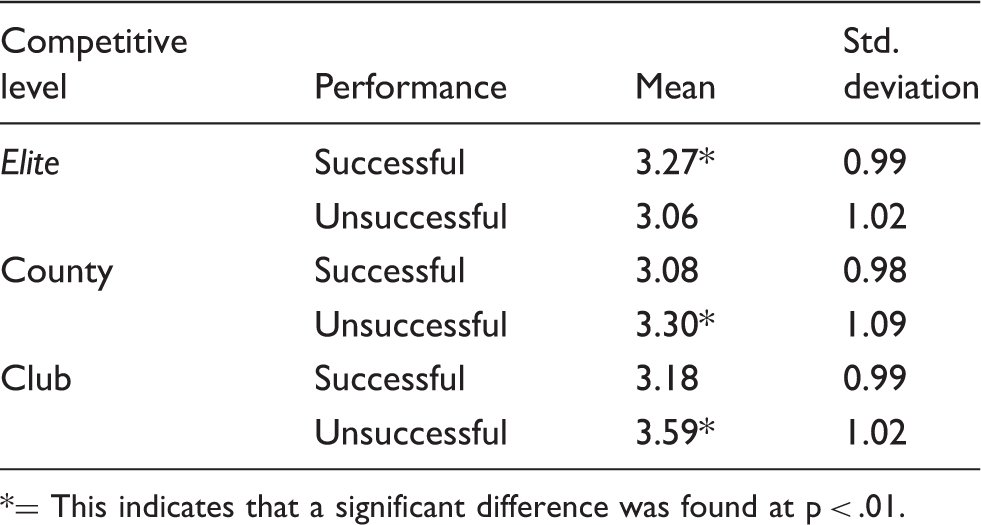
= This indicates that a significant difference was found at p < .01.
The perceived impact on performance.

= This indicates that a significant difference was found at p < .01.
The perceived impact on well-being.

= This indicates that a significant difference was found at p < .01.
The perceived acceptability of the behaviour.
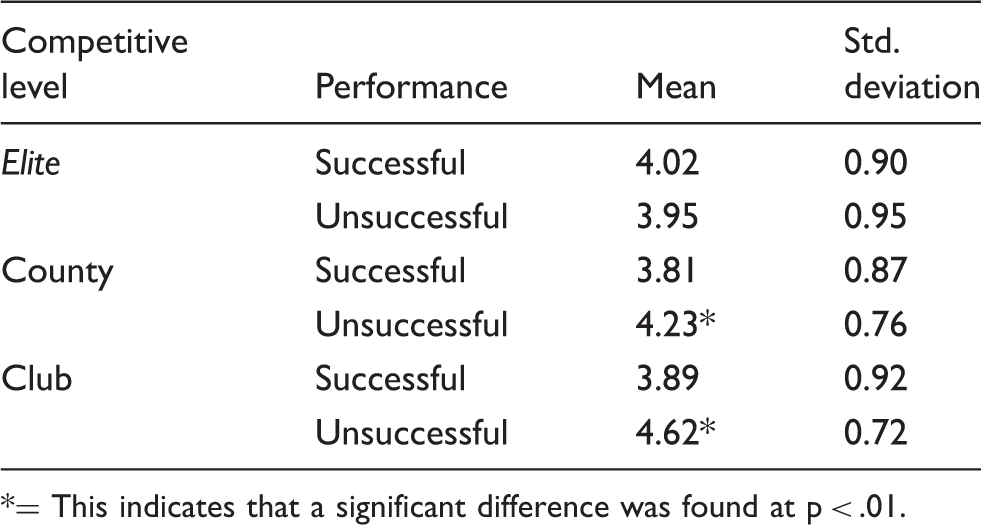
= This indicates that a significant difference was found at p < .01.
Perceived commonality
On a scale of 1 (very common) to 5 (very rare) on average the scenarios were rated as having a mean of 3.25 (SD = 1.02). This means that it is ‘likely to happen’. The behaviour was viewed as being most common when associated with an unsuccessful elite athlete and least common for unsuccessful club athletes. There was a significant interaction effect between competitive level and performance outcome, F(2) = 3.717, p < .01. For the elite scenario, the behaviour was viewed as being more common in the unsuccessful condition (M = 3.06) relative to the successful condition (M = 3.27). For the county and club scenarios the reverse was found with behaviour being perceived as more common for the successful performance outcome (County M = 3.08; Club M = 3.18) compared to the unsuccessful performance outcome (County M = 3.30; Club M = 3.59).
Perceived impact on performance
On a scale of 1 (very positive) to 5 (very negative) on average the scenarios were rated as having a mean of 3.54 (SD = 0.96). Therefore, the behaviour was perceived as having a negative impact on performance. The behaviour was perceived to have the most positive impact on the performance of successful club athletes and the most negative impact on the performance of unsuccessful club athletes. A two-way ANOVA showed main effects for both competitive level, F(2) = 7.12, P < .05 and performance outcome, F(1) 91.46, p < .01. These effects are better explained by a significant interaction between competitive level and performance outcome, F(2) = 5.37, p < .05. When there was a successful performance outcome, the behaviour was perceived to have a significantly more positive impact on performance for the club athlete (M = 2.61) compared to both the county (M = 2.96) and the elite (M = 2.82) athletes. In contrast, when the outcome was unsuccessful, the impact on performance was significantly more negative for both the county (M = 4.45) and the club athlete (M = 4.59) relative to the elite athlete (M = 3.82). Thus, performance outcome appeared to influence the perceived impact on performance more at the club and county levels relative to those at the elite level.
Perceived impact on well-being
On a scale of 1 (very positive) to 5 (very negative) on average the scenarios were rated as having a mean of 4.22 (SD = 0.72). Therefore, the behaviour was perceived as having a negative impact on well-being. The impact was the most negative for the unsuccessful club athlete and least negative for the successful club athlete. A two-way ANOVA showed a main effect for competitive level, F(2) = 9.14, p < .05. However, performance outcome did not have a significant effect. There was a significant interaction effect between competitive level and outcome, F(2) = 11.41, p < .01. Specifically, competitive level had a significant effect when the performance outcome was unsuccessful. The impact on well-being was perceived to be significantly more negative for club athletes (M = 4.72) than county athletes (M = 4.26) which in turn was significantly more negative than the elite athletes (M = 4.00). In contrast, competitive level had no effect for a successful outcome (club M = 4.14, county M = 3.96 and elite M = 4.02).
Perceived acceptability
On a scale of 1 (very acceptable) to 5 (very unacceptable) on average the scenarios were rated as having a mean of 4.09 (SD = 0.86). Therefore, the behaviour was perceived as being unacceptable. The behaviour was most unacceptable for the unsuccessful club athlete and most acceptable for the successful club athlete. A two-way ANOVA showed a main effect for performance outcome, F(1) 21.46, p < .01. However, competitive level did not have a significant effect. There was a significant interaction effect between competitive level and outcome, F(2) 11.22, p < .01. Further analysis revealed that at both the county level (successful M = 3.81; unsuccessful M = 4.23) and at the club level (successful M = 3.89; unsuccessful M = 4.62), the behaviour was viewed as significantly more unacceptable in the unsuccessful condition. However, for the elite scenario, the manipulation of the performance outcome had no significant effect (successful M = 4.02; unsuccessful M = 3.95).
Discussion
The aim of the present study was to explore how situational factors depicted in a fictitious scenario influence perceptions of emotional abuse in relation to how common it is perceived to be (RQ1), the perceived impact that it is having on performance (RQ2), the perceived impact it is having on well-being (RQ3) and the perceived acceptability of the behaviour (RQ4). Overall, competitive level and performance outcome were both found to significantly influence participants’ perceptions. This supports previous research through illustrating that an abusive scenario is judged based on the context as a whole rather than simply considering the specific behaviours being enacted.16,17
In terms of RQ1, the emotionally abusive behaviour was perceived to be more common in the unsuccessful condition as one progressed through the competitive levels. As a result, it was perceived to be most common for the unsuccessful elite athlete. Perhaps it is the case that emotionally abusive coaching is viewed as what is required to achieve peak performance at this level. For the successful condition, the behaviour was viewed as being most common for the county athlete. Brackenridge has suggested that athletes may be most vulnerable when reaching the stage of imminent achievement, which may explain this finding. 21 When these results are combined with research which has highlighted how emotional abuse can become normalized in elite youth sport, 9 one can argue that protecting potential and current elite young athletes within such contexts is a key challenge for policy makers and practitioners. These findings support previous research that has indicated that emotionally abusive behaviour is experienced more by those competing at the higher competitive levels. 5
For RQ2, the behaviour was perceived to have a positive impact on performance in the successful condition for all athletes. Interestingly, the most positive ratings were associated with the club athlete which suggests that emotional abuse is viewed as beneficial for performance, even at the more recreational levels. In contrast, the behaviour was viewed to be having a negative impact on performance in the unsuccessful condition, particularly for the county and club athletes. Therefore, the performance outcome appeared to be particularly important when participants were judging the impact of the behaviour on performance.
Athletes and coaches can succumb to the traditional sporting adage ‘no pain, no gain’. 12 It may be that the emotionally abusive coaching, when associated with a successful outcome, is interpreted as a justification for the behaviour. Sporting success is often determined by the performance outcome and therefore the notion of ‘the ends justify the means’ is often instilled in the beliefs of many coaches and athletes. Consequently, emotional abuse is ‘legalized’ by sport and hidden behind sporting success. 4 Particularly in elite sport, it is the performance which is acknowledged and the methods in achieving such performances are often disregarded. 4
In terms of RQ3, the emotionally abusive behaviour was perceived to have a negative impact on well-being in all conditions. However, there were some interesting differences. In the unsuccessful condition, the impact became increasingly less negative as one progressed up through the competitive levels. As a result, it was perceived to be least negative for the unsuccessful elite athlete. For the successful condition, the behaviour was viewed as being least negative for the county athlete, which echoes the findings for RQ1 above. Again this supports Brackenridge’s 21 argument that athletes may be most vulnerable at this stage. Stirling and Kerr 10 have identified that athletes report a range of negative outcomes for their well-being as a result of emotional abuse. Whilst the participants in this research did perceive the behaviour as having a negative impact on well-being, the extent of this negativity did vary which may result in certain athletes being more vulnerable.
For RQ4, the emotionally abusive behaviour was perceived to be unacceptable in all conditions. However, as with RQ3, there were some interesting differences. In the unsuccessful condition, the behaviour became increasingly more acceptable as one progressed up through the competitive levels. As a result, it was perceived to be less unacceptable for the unsuccessful elite athlete. For the club and county athletes, the behaviour was viewed as being more acceptable when associated with a successful outcome. Interestingly, the performance outcome did not influence perceptions of acceptability for the elite scenario. It may be that the elite athlete is viewed as having achieved success due to competing at this high level. This may override any influence of an unsuccessful event.
A possible explanation for many of these findings may come from Bandura’s concept of moral disengagement. 22 This concerns the process of convincing oneself that ethical standards do not apply in given circumstances. This helps to circumvent the negative emotions of perpetrating or witnessing behaviours which would normally be viewed as immoral. These mechanisms can focus on the outcome of the behaviour, such as moral justification (e.g. the ends justify the means). In other words, the emotional abuse is justified if it is perceived to have enhanced performance and contributed to the winning of a competition. Other mechanisms of moral disengagement focus on responsibility. For instance, diffusion of responsibility concerns a perception that everyone is coaching this way and hence it is acceptable. Finally, moral disengagement can focus on the victim of the abuse. For example, a perceiver may argue that the child athlete chooses to attend the training and to continue participation and hence it cannot be abusive if the athlete maintains their involvement. Providing information regarding the competitive level or performance outcome may facilitate a disengagement on the part of the participant from the moral aspect of their ratings. Fundamentally, an adult emotionally abusing a young person is not ethical. However, sport may provide a context within which people can morally disengage when they view behaviour which would be viewed as immoral in many other contexts. This explanation is purely an assertion at this stage which merits further empirical investigation.
The present study also opens up many avenues for further research. There is clear potential to employ the approach used in this study to explore the role of other factors in shaping perceptions of abuse (e.g. the gender and age of the coach and athlete being described). Perceptions of other forms of abuse could also be studied including sexual harassment and abuse as well as physical abuse. 1 This method could also be replicated with other key stakeholders such as parents and sports administrators.
There are a number of limitations to the present research which must be acknowledged. Although all efforts were taken to ensure the realism of the scenarios, they remained written stories on a slide. Perceptions may have been different if the same behaviour had been witnessed in reality and the participant was actually involved in the situation. Furthermore, the impact on performance and well-being was only assessed as a perception and no actual measures were taken. Thus, the findings are limited to perceived impacts as opposed to any actual effects. The fictitious scenarios may have contributed to moral disengagement in the sense that no one is really being abused and hence there is no actual victim. Furthermore, due to the nature of data collection, only quantitative ratings were recorded. The underlying rationale behind these perceptions can only be inferred and merit investigation in further research. Participants were also university students who were involved in sport as a coach or an athlete and hence the findings cannot be confidently generalized beyond this group. Due to their involvement in sport, they may well have received training which could have contributed to socially desirable ratings. Replications of this study using different samples are required to assess the reliability of these findings in different groups.
Conclusion
This study makes an important contribution through considering perceptions of emotional abuse within the youth sport context. In the drive towards increasing performance and participation, it is key that the sport community advocates safe performance and safe participation. Through understanding the situational factors that influence coaches’ and athletes’ perceptions of emotional abuse, the sports community should be better equipped to develop future initiatives for abuse prevention in this environment.
Footnotes
Declaration of Conflicting Interests
The author(s) declared no potential conflicts of interest with respect to the research, authorship, and/or publication of this article.
Funding
The author(s) received no financial support for the research, authorship, and/or publication of this article.