




Abstract
The purpose of this study was to analyze whether the same shooting technical components determining performance in testing situation also affect performance in competition situation and how the technical skill level of these components changes from training to competition. Thirteen Finnish national (10) and junior national (3) rifle team members participated in the study. Participants were measured in competition and training situation within a five-day period. Shooting score, aiming point trajectory and postural balance were measured from both situations. Shooting performance decreased from training to competition situation (10.31 ± 0.13 vs. 10.14 ± 0.17, p < 0.05), accompanied by a decrease in holding ability, aiming accuracy, cleanness of triggering and postural balance. A multiple regression equation based on holding ability, aiming accuracy, cleanness of triggering and timing of triggering correlated with the competition situation shooting results (R = 0.76, p < 0.01). Changes in shooting performance from training to competition situation were most strongly related to the changes in horizontal holding ability (R = − 0.71, p < 0.01). Athletes and coaches should develop competition strategies and psychological training interventions in order to be able to maintain the horizontal holding ability in competition at training situation level.
Introduction
Air rifle shooting technical components have been identified previously in training situations.1,2 The stability of hold has been shown to be the most important aspect of shooting technique, accounting for 54% of the variance in shooting score. Other identified shooting technical components affecting air rifle shooting performance have been aiming at accuracy, cleanness of triggering, timing of triggering, and postural balance.1,3–5 Postural balance has been shown to affect performance both directly and indirectly through a more stable holding ability.1,4,5
To the best of our knowledge, there are no studies reporting air rifle shooting technique measures obtained from a competition situation. Shooting technique measures obtained from the training situation have been shown to correlate with the shooting results in competitions, although the correlations between the test measures and competition results were not as strong as between the test measures and the test shooting scores. 4 Also postural balance measured before the competition was shown to differ between the national and elite level shooters, but had no statistically significant relation to the competition shooting scores. 6
Air rifle competitions are psychologically stressful situations for the shooters. Anticipation of performance has been shown to increase anxiety, heart rate and blood pressure in musicians. 7 Relationships between state anxiety, heart rate, blood pressure and postural balance7,8 are possible reasons why state anxiety has been shown to be related to shooting performance in competition situation. 9 Solberg et al. 10 showed that a relaxation meditation training program was able to increase performance level in shooting competitions, even without concurrent increase in training situation shooting performance. In a single subject case study, a cognitive–behavioral intervention was able to reduce state anxiety and increase competition shooting performance. 11
Competition situation clearly has an effect on shooting performance, but the mechanisms leading to performance decrement remain unknown. It would be of great value to acquire the same technique variables from the competition situation and compare these with the training situation variables. Therefore, the aim of this study was to investigate whether the same shooting technical components determining performance in testing situation also affect performance in competition situation. The second objective was to analyze how the technical skill level changes from training to competition situation, and how these changes relate to changes in shooting performance.
Materials and methods
Participants
Thirteen Finnish national (10) and junior national (3) rifle team members participated in the study. Athletes’ personal best competition results were 622.5 ± 5.0 points out of 60 shots for men (n = 5) and 414.0 ± 2.1 points out of 40 shots for women (n = 8), corresponding to 10.38 ± 0.08 points per shot for men and 10.35 ± 0.05 points per shot for women. The measurements in the current study were part of athletes’ normal shooting technique testing conducted on two national team training camps (January 2015 and 2016) and two Grand prix of Leppä.fi competitions (January 2015 and 2016). All the athletes participating in this study have been tested in the training situation and on training camps for many years as well as have several years of experience in competition shooting. Testing complied with current Finnish laws regarding the testing of human subjects.
Experimental task
Variables describing shooting performance, shooting technique and postural balance.
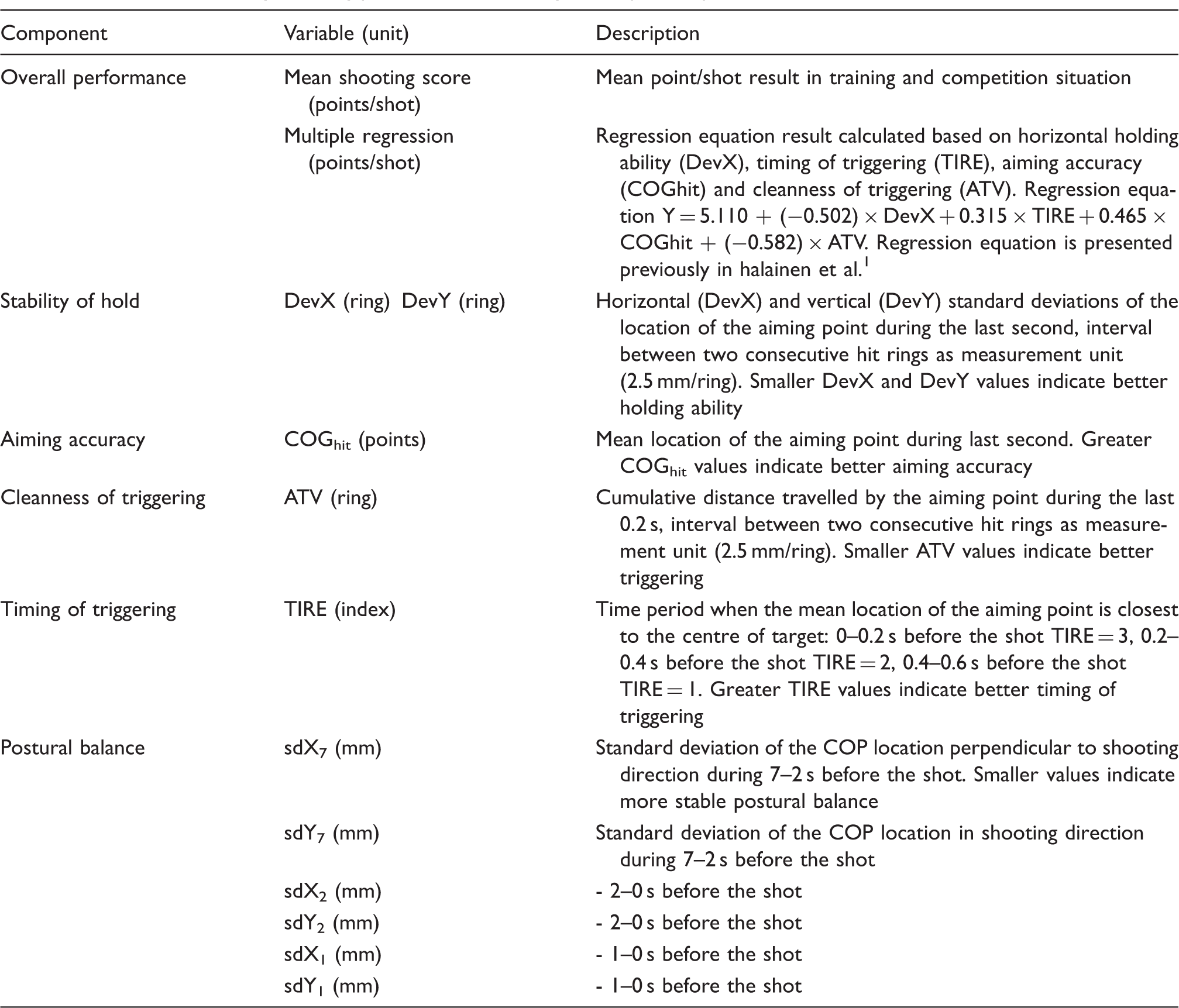
Note: Variable abbreviations have been selected according to the Noptel manufacturer abbreviations in order to ease the application of results in practice. Variables DevX and ATV can be converted into SI units (meters) by multiplying the variables by 0.0025.
The competition measurements were conducted at Grand Prix of Leppä.fi. Participation in the competition was open for all shooters, but the athletes had to pay an entry fee in order to participate. Three best shooters were rewarded with money prizes. The competition consisted of five elimination rounds and a final. On each of these rounds, athletes were randomly paired with an opponent and the winner of a 10-shot competition series qualified for the next round. Shooting time for the 10 shot series was 14 min, so shooters had 84 s per shot in the competition situation, and 75 s per shot in the training situation. In the competition situation, the same measuring setup was used to obtain the shooting score, aiming point trajectory variables, and postural balance variables as in the training situation. All shooters used their own shooting equipment both in training and competition situations. An additional Noptel ST 2000 measuring unit was used to measure the shooting score and aiming point trajectory variables so that two athletes were measured at the same time (pair competing against each other). The first measured competition series (including postural balance measurement) from each athlete was used in this study. Five athletes were measured only with Noptel ST 2000 measuring unit, so the results for shooting score and aiming point trajectory variables are based on all 13 measured shooters, and the results for postural balance are based on eight measured shooters.
Statistical methods
Shapiro-Wilk’s test was used to test the normality of the data. As there were violations of normality assumption in five of the measured variables, non-parametric tests were used to analyze the data. Independent-samples Mann–Whitney U test was used to analyze the differences in training and competition situation shooting scores between the national and junior national team shooters. Mann–Whitney U test was also used to analyze the differences in training and competition situation shooting scores between men and women. As no statistically significant differences were found between national and junior team, nor between men and women, the whole subject group was pooled and analyzed as one.
Wilcoxon signed rank test was used to test whether there were any differences in the mean values between the training situation in first 10 shots and the last 30 shots. No statistically significant differences were found, so the mean values from all 40 training situation shots were used for subsequent analysis. Mean values were also computed from the 10 competition shots and used for the subsequent analysis. Wilcoxon signed rank test was used to analyze the differences in all measured variables between the training and competition situation in the whole subject group. Two-tailed Spearman correlation coefficients were computed to examine the relationship between the same variables measured in training and competition situation. Spearman correlation coefficients were also calculated between the shooting score and all measured variables both in training and competition situation. Lastly, Spearman correlation coefficients were calculated between the absolute change in shooting score and absolute change in all measured shooting technical variables from training to competition situation. The level of statistical significance was set at 0.05. Statistical analysis was conducted with IBM SPSS statistics software (IBM Co., Armonk, NY, USA) (version 22.0).
Results
Shooting performance, shooting technique and postural balance in training and competition situations.
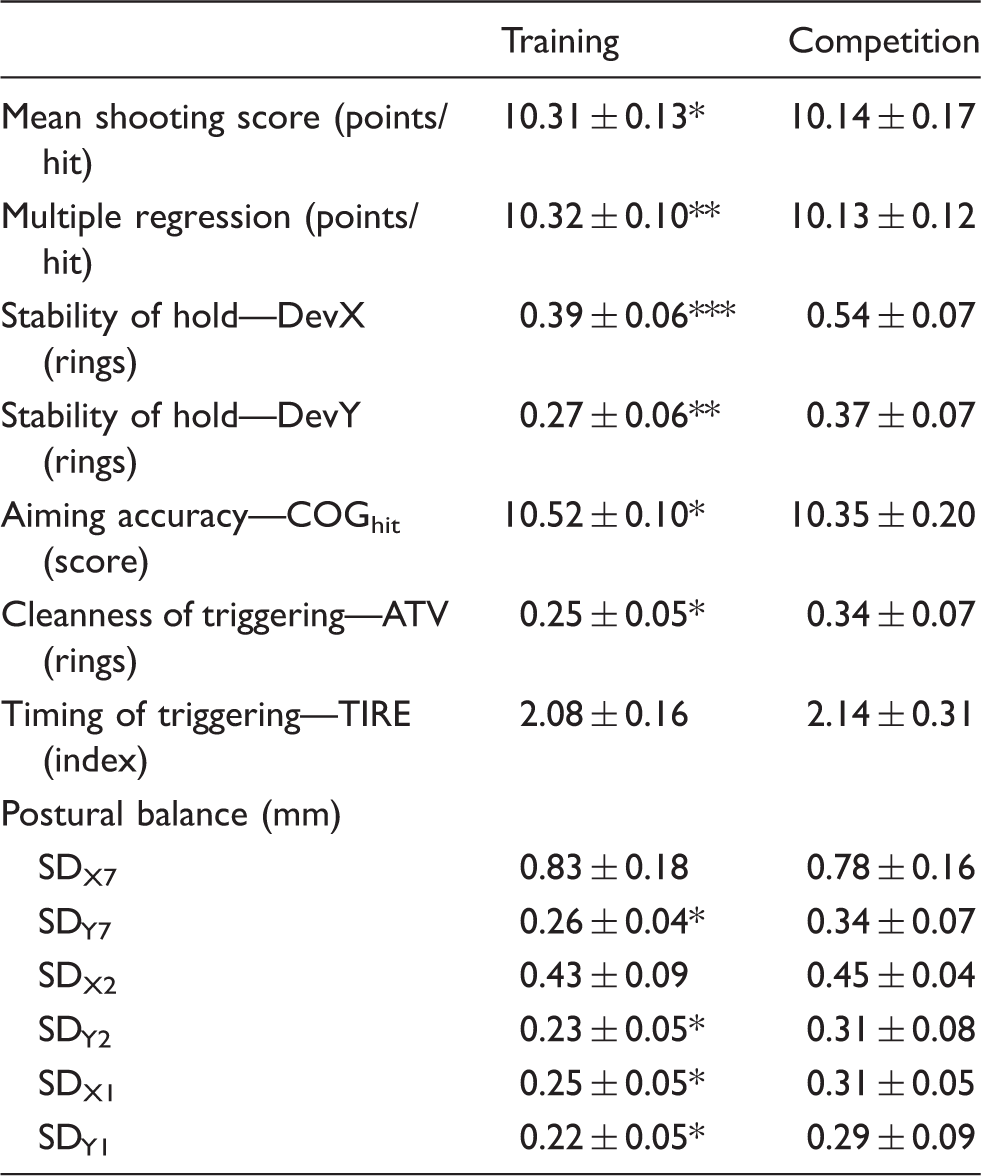
Note: Statistically significant difference between training and competition situation.
p < 0.05.
p < 0.01.
p < 0.001.
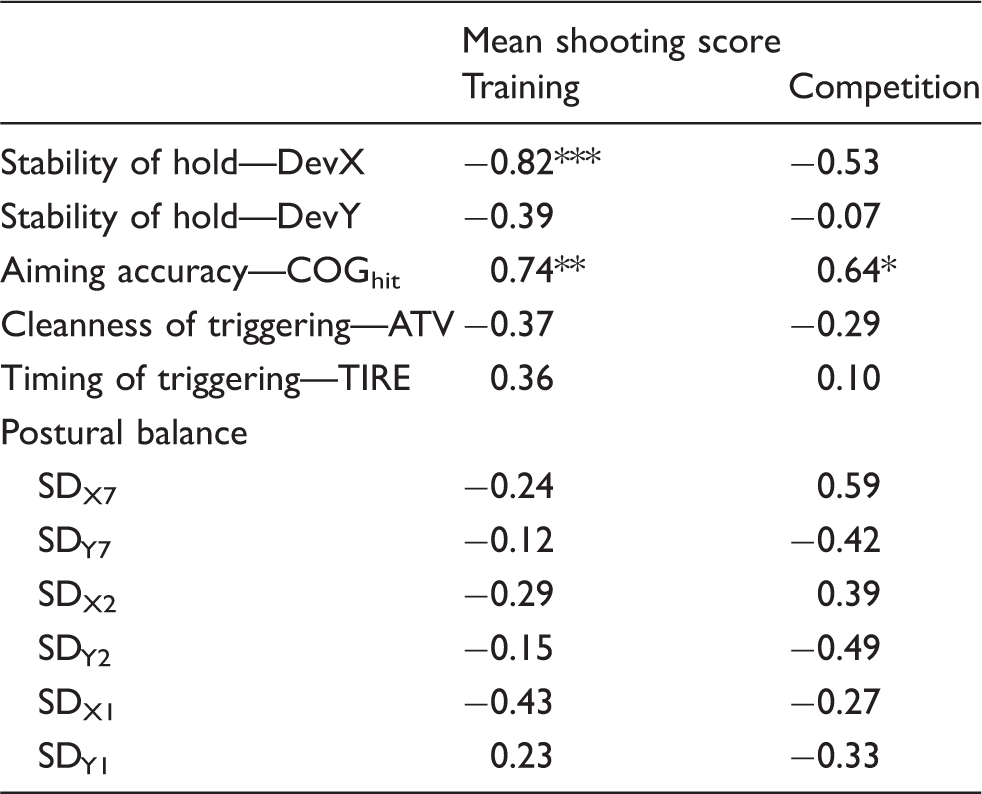
Multiple regression result calculated based on four shooting technical components (horizontal holding ability, aiming accuracy, cleanness of triggering and timing of triggering) correlated significantly with the actual shooting scores both in training and competition situations (Figure 1). When examining the shooting technical components individually, only aiming accuracy correlated significantly with the shooting scores both in training and competition situations (Table 3).
Relationship between mean shooting score and multiple regression equation result based on four measured shooting technical variables describing horizontal holding ability (DevX), timing of triggering (TIRE), aiming accuracy (COGhit) and cleanness of triggering (ATV). Regression equation Y = 5.110 +(−0.502) × DevX + 0.315 × TIRE + 0.465 × COGhit + (−0.582) × ATV. Two-tailed Spearman correlation coefficient r values between mean shooting score and shooting technical variables in training and competition situations. Note: Statistically significant correlation. p < 0.05. p < 0.01. ***p < 0.001.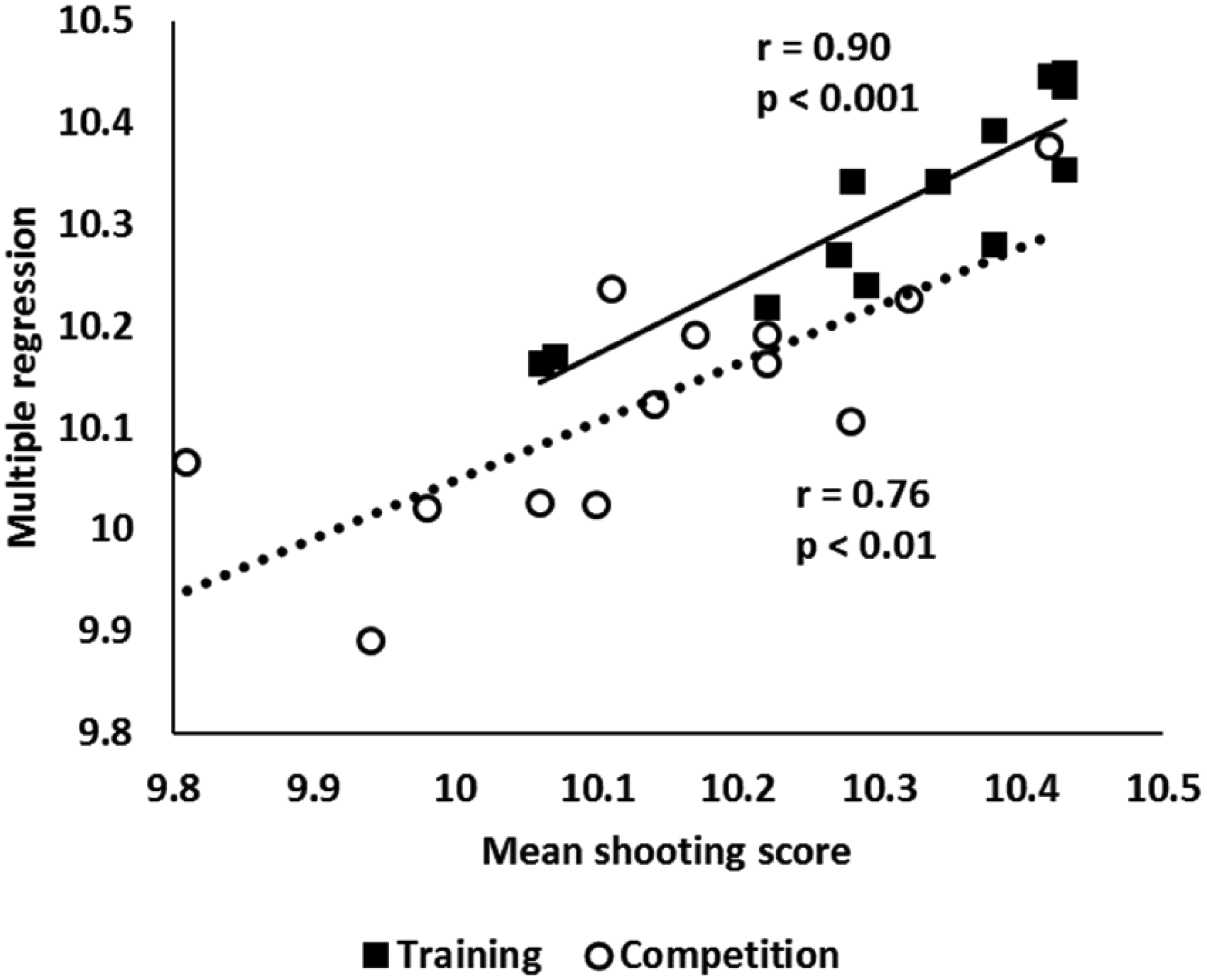
Absolute changes in mean shooting score from training to competition situation were related to the absolute changes in horizontal holding ability (Figure 2), absolute changes in cleanness of triggering (ATV, r = −0.56, p < 0.05) and absolute changes in aiming accuracy (COGhit, r = 0.66, p < 0.05). Closer look at the absolute changes in horizontal holding ability revealed a statistically significant relation to the absolute change in postural balance in shooting direction during the last second before the shot (SDY1, r = 0.74, p < 0.05).
Relationship between absolute change in mean shooting score and absolute change in horizontal holding ability (DevX).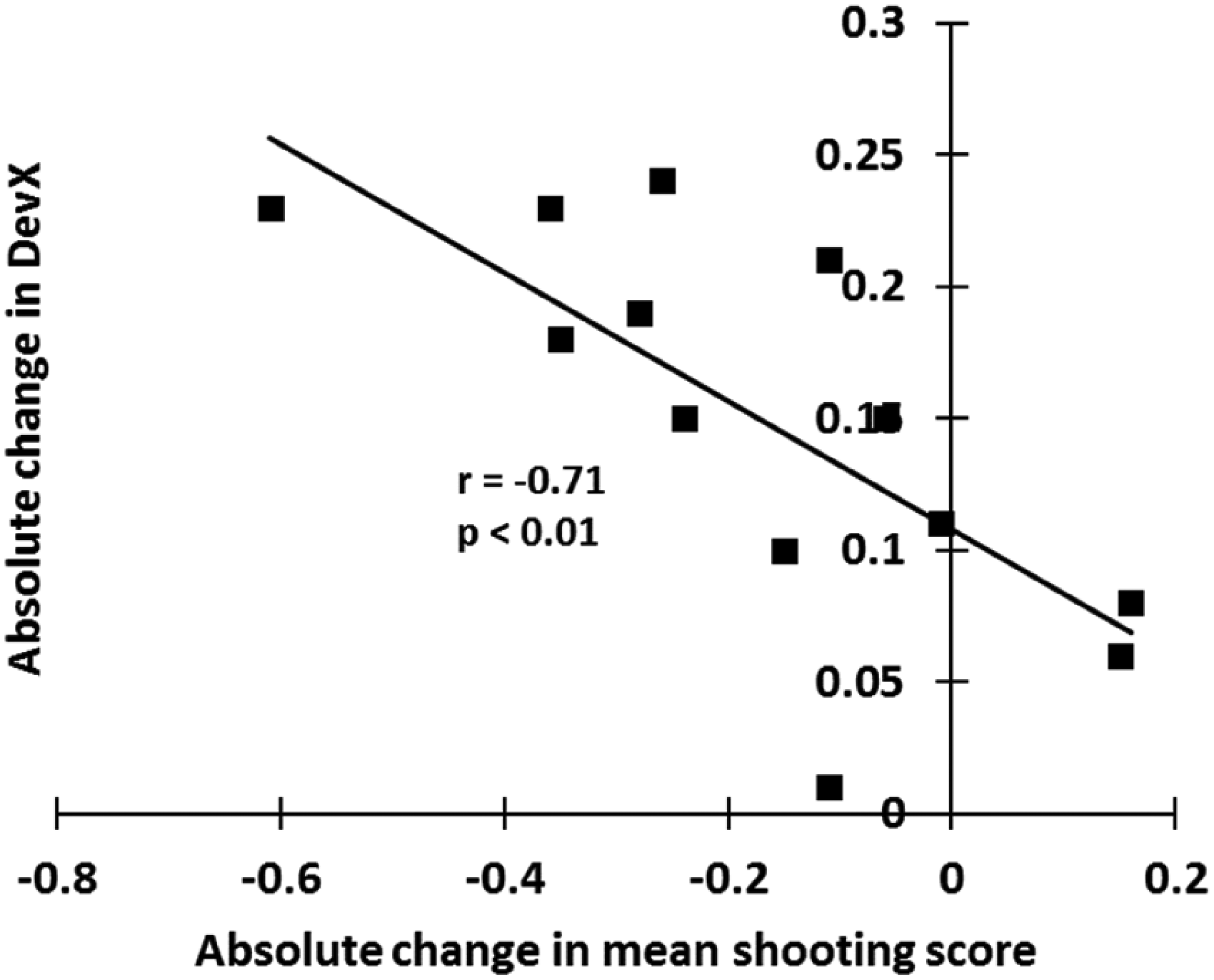
Discussion
The aim of this study was to analyze whether the same shooting technical components determining performance in testing situation also affect performance in competition situation. The second objective was to analyze the changes in shooting technical variables caused by competition situation psychological stress and how these changes relate to shooting performance. This study showed a decrease in shooting performance from training to competition situation in the whole subject group, accompanied by a decrease in holding ability, aiming accuracy, cleanness of triggering and postural balance. This decrease in performance is highly individual, since the training situation shooting scores and technical variables correlated with the corresponding competition situation variables only in one measured postural balance variable (SDY1). Shooting performance in competition seems to be related to the same shooting technical components as in the training situation, since the previously published multiple regression equation1 based on training situation measurements was also valid in competition situation. Horizontal holding ability plays a key role in maintaining competition shooting performance at the same level as in the training situation, since changes in this technical component from training to competition situation had the strongest correlation to the changes in shooting performance.
Shooting performance decreased from training to competition situation. The decrease in shooting performance was accompanied by a decrease in holding ability (DevX and DevY), aiming accuracy (COGhit), cleanness of triggering (ATV) and postural balance in shooting direction (all analyzed time periods SDY7, SDY2, and SDY1). Only timing of triggering (TIRE) remained at training situation level. Postural balance in cross shooting direction decreased only during the last second before the shot (SDX1). The decrease in shooting technical variables was highly individual, since only the postural balance in shooting direction during the last second (SDY1) correlated between the training and competition situation measurements. This means that even though the shooting performance and shooting technical variables decreased from training to competition situation in the whole subject group, this decrease was not similar in all shooters and some athletes were able to maintain the training situation shooting level better than others. State anxiety has been shown to be related to competition shooting performance, 9 and a meditation training program has been shown to be able to increase performance level in shooting competitions, even without concurrent increase in training situation shooting performance. 10 In biathlon, a 10-week training program consisting of both relaxation and specific shooting training was able to increase shooting results. 13 In a case study, a cognitive–behavioral intervention was able to reduce state anxiety and increase competition shooting performance. 11 These results highlight the fact that high performance in competition requires psychological skills and coping mechanisms, and that athletes are able to improve these psychological factors through training. The comparison between training and competition situation shooting performance conducted in this study could be a valuable tool in order to target psychological training interventions to under-performing shooters.
Even though the competition situation measured in this study had a significant impairing effect on the shooting performance and shooting technical components, the same aspects of shooting technique seem to be important for shooting performance in competition as in the training situation. Previously published multiple regression equation1 based on training situation measurements was valid also in the competition situation. The multiple regression equation takes into account horizontal holding ability, aiming accuracy, cleanness of triggering and timing of triggering. The correlation between the regression equation result and actual measured shooting result was stronger in the training situation than in the competition (R = 0.89 vs. R = 0.76, respectively). Previously it has been shown that stability of hold, aiming accuracy, cleanness of triggering, and postural balance are related to shooting performance in training situation. 1 These shooting technical components measured in the training situation have also been shown to correlate with the actual competition shooting results achieved during the season. 4 In the present study, only aiming accuracy correlated significantly with the shooting score in the competition situation, and only stability of hold and aiming accuracy in the training situation. The differences in these results could be related to the smaller sample size used in the present study, which decreases the statistical power of the current analysis. Also the competition measurement situation resembled air rifle final shooting more than qualification round shooting, which could affect the relationship between shooting performance and the shooting technical variables. Larger sample sizes and qualification round type competition measurements are needed to confirm or reject stability of hold, cleanness of triggering and postural balance as performance determining factors in competitions.
As stated before, the decrease in shooting performance and the decrease in shooting technical variables were highly individual. The change in the shooting score from training to competition situation was related to the changes in horizontal holding ability, aiming accuracy and cleanness of triggering. Out of these shooting technical components, horizontal holding ability had the strongest relation to the changes in mean shooting score. Closer look at the changes in horizontal holding ability revealed a correlation to the changes in shooting direction postural balance. Similar relation between postural balance and holding ability has been described previously also in air pistol shooting. 14 These relationships between the shooting score and holding ability, and between the holding ability and postural balance, provide one possible explanation for the decrease in competition situation shooting performance. The competition situation psychological stress could elevate heart rate as in the case with performing musicians 7 and the increased heart rate could influence postural balance, 8 leading to decreased holding ability and ultimately decreased shooting performance. This assumption cannot be verified based on the measurements in this study, but requires simultaneous heart rate measurements along with postural balance and holding ability measures in training and competition situations to answer whether this assumption holds true. Heart rate and postural balance are not likely to be the only components affected by state anxiety, but other shooting performance-related factors probably exist, which contribute to performance changes in competitions. For example, fear of executing the shot at the right moment, resulting in overly long aiming times, is frequently reported by the athletes as a reason for poor performance in competition.
In this study, the decrease in shooting performance from training to competition situation was substantial. Mean shooting score in competition decreased by 0.17 points per shot compared to the training situation in the whole subject group. This 1.6% decrease in shooting score corresponds to 10.2 points in men’s and 6.8 points in women’s competition. In Rio 2016 Olympic Games, 10.2 point difference in the men’s qualification round result was the difference between qualifying for the final (8th place) and placing 7th last in the competition (44th place).
15
On the other hand, the competition measurement used in the present study resembles more the final stage of the competition and the training situation measurement resembles more the qualification round. In this context, the eight finalists in men’s Rio 2016 Olympic Games fired 10.45 ± 0.02 points per shot in the qualification round and 10.17 ± 0.11 points per shot in the final stage. On average, the Olympic finalists’ shooting performance decreased by 0.28 points per shot (2.7%) in men’s and 0.21 points per shot (2.0%) in women’s competition from qualification to final round. This decrease in Olympic final shooting performance is similar to the performance decrement seen in this study, suggesting that the same mechanisms could be affecting performance even in the absolute elite rifle shooting level. In fact, both in men’s and women’s final competitions in Rio 2016, the ability to maintain shooting performance at the qualification round level was more closely related to the placement in the final than the qualification round result was (Figure 3). These results highlight the fact that small variations in the shooting results greatly influence performance outcomes and placements in the elite level air rifle shooting competitions, as was previously demonstrated in air pistol shooting.16,17
Rio 2016 Olympic Games final placement, qualification round result and difference in shooting performance from qualification to final round in women’s and men’s competitions.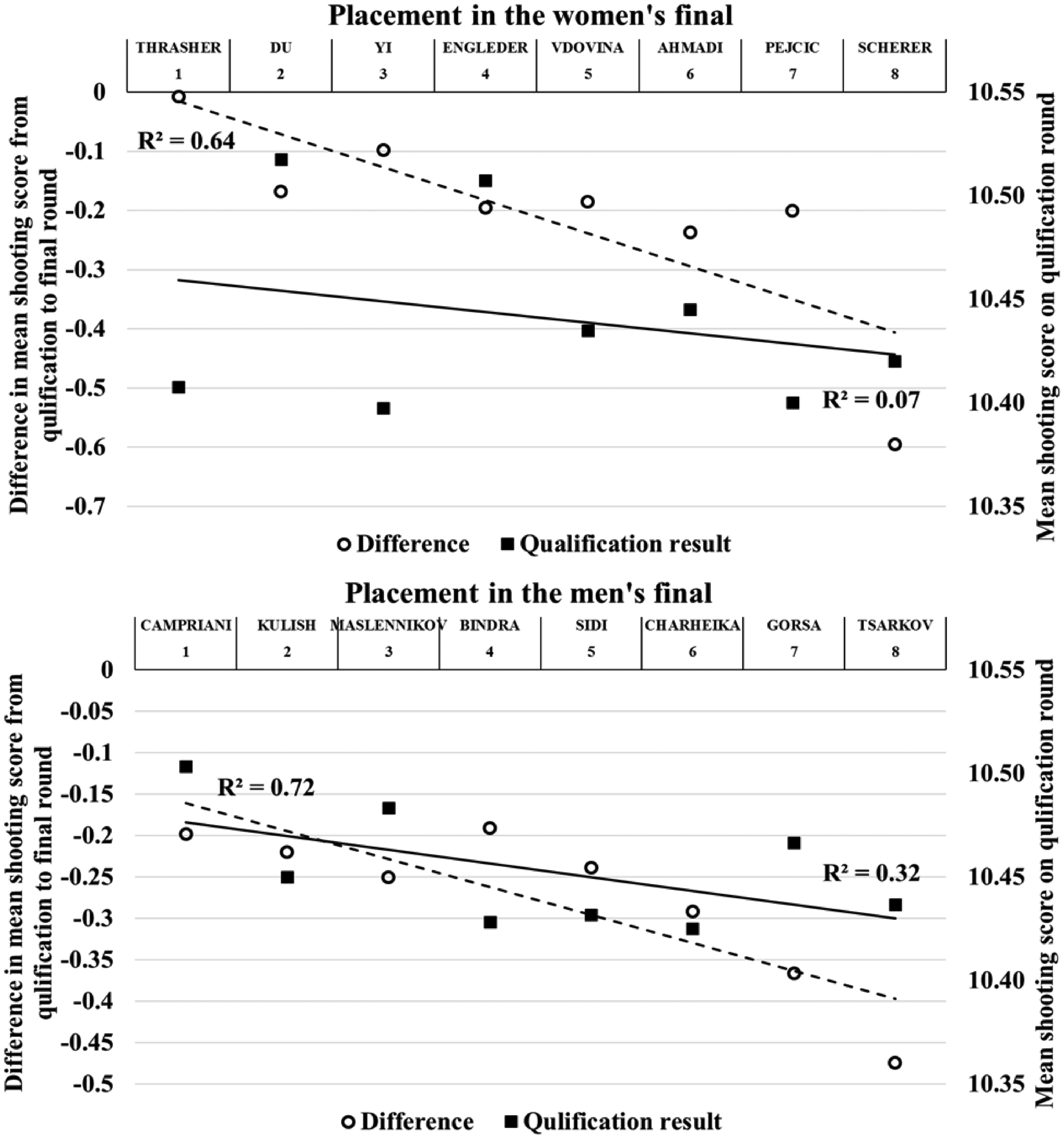
In conclusion, the results of the current study showed that shooting performance in competition seems to be related to the same shooting technical components as in the training situation. The decrease in shooting performance from training to competition situation was most strongly related to the decrease in horizontal holding ability. The decrease in shooting performance was highly individual, and specific psychological training interventions should be targeted to the under-performing athletes in order to maintain the shooting performance at the training situation level. Both in scientific studies and in practice, psychological and technical aspects should be measured at the same time in order to acquire more comprehensive view of the components affecting performance in competitions.
Footnotes
Acknowledgements
The authors would like to acknowledge Mr Sami Vierola for his valuable assistance in data collection, Mr Marko Leppä for the possibility to conduct the competition measurements and Finnish air rifle shooting team coaches and athletes for their participation in the measurements.
Declaration of Conflicting Interests
The author(s) declared no potential conflicts of interest with respect to the research, authorship, and/or publication of this article.
Funding
The author(s) received no financial support for the research, authorship, and/or publication of this article.