




Abstract
The purpose of this study was to examine how leader communication inspires athletes in a team sport context. Footage of elite rugby coaches and athlete leaders delivering genuine speeches were used as a stimulus. Team sport athletes (n = 20) watched this footage and identified which aspects of the communication inspired them. Follow-up interviews were conducted to explore what the participants were inspired by and why. Thematic analyses revealed six main dimensions of what was inspiring within the content of the speech, including showing how the team can be successful, embracing and reinforcing the underdog status, and creating pride and unity within the team. In addition, a number of features of effective delivery were identified, including the tone of voice, fluency of speech, and the way key ideas were emphasised.
Introduction
This is your f****** Everest, boys. Very few ever get a chance in rugby terms to get for Everest, the top of Everest. You have the chance today. Being picked is the easy bit. To win for the Lions in a Test match is the ultimate, but you’ll not do it unless you put your bodies on the line. Every one jack of you for 80 minutes.
The above quote is from Jim Telfer’s speech to members of the British and Irish Lions rugby side from their tour of South Africa in 1997. Speeches from this tour were captured and published in a commercial DVD (‘Living with the Lions’), and provide us with an insight into the communication of elite leaders in a team sport environment. Such a speech has been anecdotally described as ‘iconic’ and ‘the king of inspirational speeches’; 1 however, no specific research has examined the qualities of such authentic speeches from the elite sport environment. Furthermore, while researchers have examined leader communication in team sport contexts,2–6research has yet to explicitly explore how sporting leaders communicate (i.e. what they say and how they say it) to inspire their athletes.
In a sporting context, research findings have provided coaches with some evidence regarding athletes’ perceptions of effective leader communication (for a review, see Smith et al. 7 ). For example, Vargas-Tonsing and Bartholomew 2 asked participants to imagine they were participating in a championship game, and then exposed them to one of three audio recorded speeches created by the authors. The results showed speech containing emotional messages enhanced the participants’ feelings of team efficacy. Vargas-Tonsing and Guan 3 found athletes preferred more emotional speeches before a championship game, when competing against an opponent who was higher ranked, and when considered an underdog. Furthermore, Vargas-Tonsing 4 found coaches’ pre-match speeches heightened feelings of emotion and self-efficacy, with a greater amount of informational content linked to higher self-efficacy. Using qualitative methods to investigate leader communication, Breakey et al. 5 revealed athletes favoured the manager conveying genuine emotion in their voice, when they used short, meaningful messages, and when they made reference to team values. Vargas and Short 6 reported positive perceptions of speech that included greater focus, arousal levels, and performance. These studies provide evidence of aspects of pre-match communication that athletes prefer from their leaders.
While researchers have examined leader communication in sport, limited research has examined the concept of inspirational communication. In the domain of social psychology, research8,9 has focussed on the conceptualization of inspiration as a distinct psychological process. Inspiration has been associated with ‘illumination’ or ‘insight’, 9 which suggests that one is inspired if they hear or apprehend something that is deeply important. Such transmission of inspiration involves first an illuminating trigger object, and second a target object towards which the inspiring qualities are extended. Using this description in a team sport context, a coach might provide the illuminating trigger ahead of an important match or competition (e.g. through pre-match communication) which leads to the athlete being inspired to action (e.g., exerting more effort within the competition). Furthermore, the two component processes of being inspired are described as being ‘inspired by’, which in this case would involve athletes appreciating and accommodating the value of the words or actions of the coach, and being ‘inspired to’ which would refer to the players’ motivation to transmit the qualities exemplified by the coach. 9
Numerous studies have advanced our understanding of the process of inspiration in the social psychology literature, and the positive outcomes that inspiration has on followers.10,11 However, limited research has examined inspiration within the sporting domain. Using an experimental approach, Gonzalez et al. 12 found participants watching a film clip showed increased levels of inspiration to compete, play, and perform well, and participants also reported greater emotional dominance. Poynor et al. 13 focussed their research on coaches as a source of inspiration, and interviewed five elite soccer coaches. The results revealed seven themes that the coaches considered to have an inspirational impact on their athletes, which were vision, communicating the vision, charisma, need for change, follower empowerment, risk taking and leader reliability (which included providing protection and pressure relief). Figgins et al. 14 aimed to further understand the experiences of followers who have been inspired in a sporting event. Figgins et al. interviewed 17 elite athletes who reported being inspired by a range of coach behaviors and actions such as demonstrations of belief (e.g. outlining an athlete’s long-term potential), providing an example to follow (e.g. displaying exceptional effort), providing opportunities to be inspired (e.g. setting up meetings with higher-level athletes), and showing the way forward (e.g. providing technical or tactical instruction to enable an athlete to understand how to improve).
The aforementioned studies examining leader communication and team-talks in sport, as well as those investigating inspiration, are not without their limitations. For example, research in mainstream leadership literature has investigated leader communication in much greater depth. One approach involved researchers examining the specific rhetoric of presidents’ speeches,15,16 but limited research has examined leader communication in this depth in sport. In addition, researchers using qualitative approaches to examine leader speech in a sporting context5,6 have utilized retrospective interviews, and it is possible that participants struggled to fully and accurately recall specific elements of leader speech retrospectively. Furthermore, there were limitations concerning the stimulus materials used to investigate leader communication, as Vargas-Tonsing and Bartholomew 2 developed audio speeches for their study, and Gonzalez et al. 12 used a speech from a fictional film. Consequently, the materials used in both studies lacked authenticity in terms of using genuine footage from leaders communicating in a natural setting. Finally, limited research in sport has investigated leader communication at an elite level, which would allow us to learn from sporting leaders and the way they interact with their teams. The present study aims to address these limitations, and thus, aims to further extend our understanding of leader communication and inspiration in sport.
Purpose and research design
The purpose of this study was to examine the communication of leaders in an elite sporting environment, and to investigate how club level team athletes responded when watching this communication. The footage used is from leaders in an elite rugby team (British and Irish Lions). Our study aims to extend our understanding of leader communication in three specific ways. First, we aimed to extend the leadership literature by understanding more fully how leaders communicate in an inspirational manner. Second, we used authentic footage of elite leaders in a real-life environment, to allow us to understand more about how leaders communicate at this level, and thus, what we can learn from them. Third, by using video footage of team-talks to stimulate data collection, participants can comment more fully on aspects of leaders’ speeches. From an applied perspective, we aimed to provide more nuanced information (e.g., specific words used, distinct elements of body language) that impact on players’ perceptions of such speeches.
This study used a form of embedded mixed method design. 17 This approach involves the collection of both qualitative and quantitative data within an overall quantitative or qualitative research design. 18 In the current study, we principally used a qualitative design, which was enhanced with the initial collection of quantitative data. The quantitative stage involved measures of inspiration being taken to assess participants’ responses to a variety of speeches from sporting leaders. These results were used to stimulate the principal element of the data collection, which were the interviews conducted to investigate why participants responded to aspects of a leader’s communication in the way they did. 17
Context of the study and stimulus used
The focus of the current study was on the communication of leaders within an elite sporting team. The stimuli chosen were leaders from the British and Irish Lions rugby union team (from herein referred to as ‘the Lions’). In 1997, the Lions toured South Africa, playing 10 games against provincial teams, and three test matches against South Africa (at the time, the holders of the rugby world cup). The Lions ultimately won the 3-match test series 2–1. A DVD entitled ‘Living with Lions - The Complete Story, 1997’ was created to document the tour. Journalist Boris Starling 19 reflected on the DVD, saying that: ‘Its cameras went into dressing rooms, treatment rooms, hotel rooms and even bathrooms. It was access all areas like we’d never seen before’. This access resulted in a range of authentic footage including numerous clips where leaders (e.g. coaches, captain, senior players) communicated very naturally to players. Furthermore, such situations (i.e., in the changing room before the first test) are likely to be times where the leaders communicated as they would normally, due to the importance of the games (i.e. they would not compromise or alter their communication just because a camera crew were there). Thus, this footage was used in the current study due to the availability of a range of clips that allow us real insight into communication of leaders in an elite environment.
Method
Participants
The initial criterion for inclusion was that participants should play team sports at club level. Initially, club rugby players were recruited, as the stimulus footage was specific to rugby. Following this, we recruited a further group of non-rugby players, to also allow us to examine which aspects of leader communication were found inspirational, and whether any aspects were specifically impactful to the sample of rugby players. Thus, 20 male participants were recruited for this study (Mage = 22.45, SD = 4.14). Participants were club standard team sport players, with 10 participants being rugby players (Mage = 21.80, SD = 3.29) and 10 participants from a range of other team sports (Mage = 23.10, SD = 4.93) which included football, basketball, hockey and cricket. All participants reported themselves to be British.
Stimulus materials
The ‘Living with Lions’ DVD was reviewed for appropriate clips. The criteria for selection were that the videos were at least one minute in duration, focused on a particular theme concerning an upcoming game, and did not feature a topic that would only be relevant to those in the touring party (e.g. one extended clip with a leader speaking was not used as it focussed on addressing a particular discipline issue that arose on the tour). Seven videos of leader communication were selected, which included three team meetings, and four from the changing room either pre-match or half time. The seven scenarios were: (i) team meeting before the first tour game (Ian McGeechan); (ii) pre-match talk before first tour game (principally Jason Leonard); (iii) forwards meeting before first test (Jim Telfer); (iv) pre-match talk before first test (principally Keith Wood/Martin Johnson); (v) team meeting before second test (McGeechan); (vi) pre-match talk before second test (principally Keith Wood); and (vii) half-time talk in second test (various). A transcript of the speeches can be viewed in supplementary file A. In addition, information about the leaders in the footage is in supplementary file B.
Procedure
Data collection was conducted in individual sessions. Participants were told to imagine themselves preparing for an extremely important match in their sport, and to consider how they would respond if their own leaders were to give such speeches. Following this, participants watched the series of video clips from the 1997 Lions DVD. Before each video, participants were provided with an overview of the scenario and circumstances surrounding each video. One item from the state version of the inspiration scale (‘I feel inspired’) 8 was placed in front of participants, along with a response scale. Response options ranged from 1 (not at all inspired) to 7 (very strongly inspired). During each video, participants were instructed to point to a number on the scale at any point when they felt inspired. An experimenter manually recorded participant responses, along with the segment of the video during which the participant responded (Note: A preliminary analysis by the lead author had previously identified a number of segments within each video, based on discrete stopping points, for example, when the speaker paused. These segments are specified within supplementary file A.). After watching the seven video clips, participants were the seven video clips, participants were interviewed about their perceptions of the videos. The videos were played again, and the researcher stopped the video at the points where the participants had self-reported being inspired (if they had recorded a minimum level of four on the inspiration scale, which is the median point). Each video clip was stopped by each person on average 3.3 times (SD = 1.82). At each point, the participants were asked questions such as: ‘You reported being inspired by this clip; can you explain why you responded in this way? Tell us about specific elements of the communication that provoked this response’. Interviews lasted between 45 and 64 min (Mminutes = 53.97, SD = 5.67) and were transcribed verbatim. Due to the depth and richness of data collected, we were confident that saturation had been reached. 20
Data analysis
Inspiration data
When data collection was completed, the mean scores of (i) the rugby players; and (ii) the non-rugby players were averaged and plotted on scatter-graphs (these graphs are included as part of supplementary file A). A series of inferential tests were used to identify whether there were differences between the levels of inspiration reported between these groups. Due to non-normal distribution of the data, a series of non-parametric tests using Mann–Whitney U were conducted.
Qualitative data
The first author listened to the audio interview files, and read the interview transcriptions numerous times to immerse himself in the data concerning elements of the speeches that participants perceived to be inspirational. Following this, a thematic content analysis was conducted, in which themes were identified in the data, and quotes were extracted and classified into categories. Analytic memos were also written throughout this process, which allowed connections to be made to theoretical concepts that related to themes that were identified from the participants’ responses. These memos and the thematic coding shaped the categories developed, and the final stage of analysis involved the second and third researchers acting as ‘critical friends’ 21 who encouraged reflection upon and questioned the emerging interpretations of the data.
Trustworthiness
A number of steps were taken to enhance the trustworthiness of the data and the analysis. The use of critical friends was used, which is a process that Smith and McGannon 21 describe as ‘a critical dialogue between people, with researchers giving voice to their interpretations in relation to other people who listen and offer critical feedback’ (p.13). In the current study, the first author conducted the analysis, and then met with the second and third author at several stages. For example, the first author presented initially developed themes, and the other researchers questioned various elements of raw data allocation within these themes. Smith and McGannon propose that exploring alternative explanations and interpretations in this reflective process means researchers are able to defend decisions made in relation to the analysis, and thus, increases the rigor of the analysis process. The first author also reflected upon his own approach throughout the research process by writing memos to consider the interview process and thematic ideas emerging. For example, these memos helped ensure he did not unduly impose his own experiences on the participants, by monitoring questions asked in the interview process. This memo writing further added to the rigor of the data collection and analysis, as these reflections were routinely presented and discussed with the research team. Finally, the findings of the study are presented with contextually rich, direct quotations from a range of individuals in the sample. Consequently, we encourage the reader themselves to decide the extent to which the data might inform their own communication.
Results
Six main themes emerged from our analysis: (i) expressing the challenge and rewards of success; (ii) creating and enhancing belief, (iii) embracing and reinforcing the underdog status, (iv) showing how the team can be successful, (v) empowering the athlete to take personal responsibility, and (vi) creating pride and unity within the team (see Figure 1). Also, a further section is included which illustrates the features of delivery that participants identified as contributing to the inspirational impact. These findings are accompanied by examples of leader speech which inspired participants’ responses, and participant quotations are used to illustrate why specific elements were perceived to be inspirational and challenging. The mean inspiration scores for each segment of video are shown in supplementary file A. Mann–Whitney U tests revealed that two sections of footage (video 2, part 2; video 7, part 4) were rated significantly more inspirational for the team sport players (compared to the rugby players), and two sections were rated significantly higher by rugby players (video 5, part 5; video 5, part 9). These key differences between rugby players and other team players are considered further when discussing the qualitative results.
Thematic representation of effective/inspirational aspects of leader communication.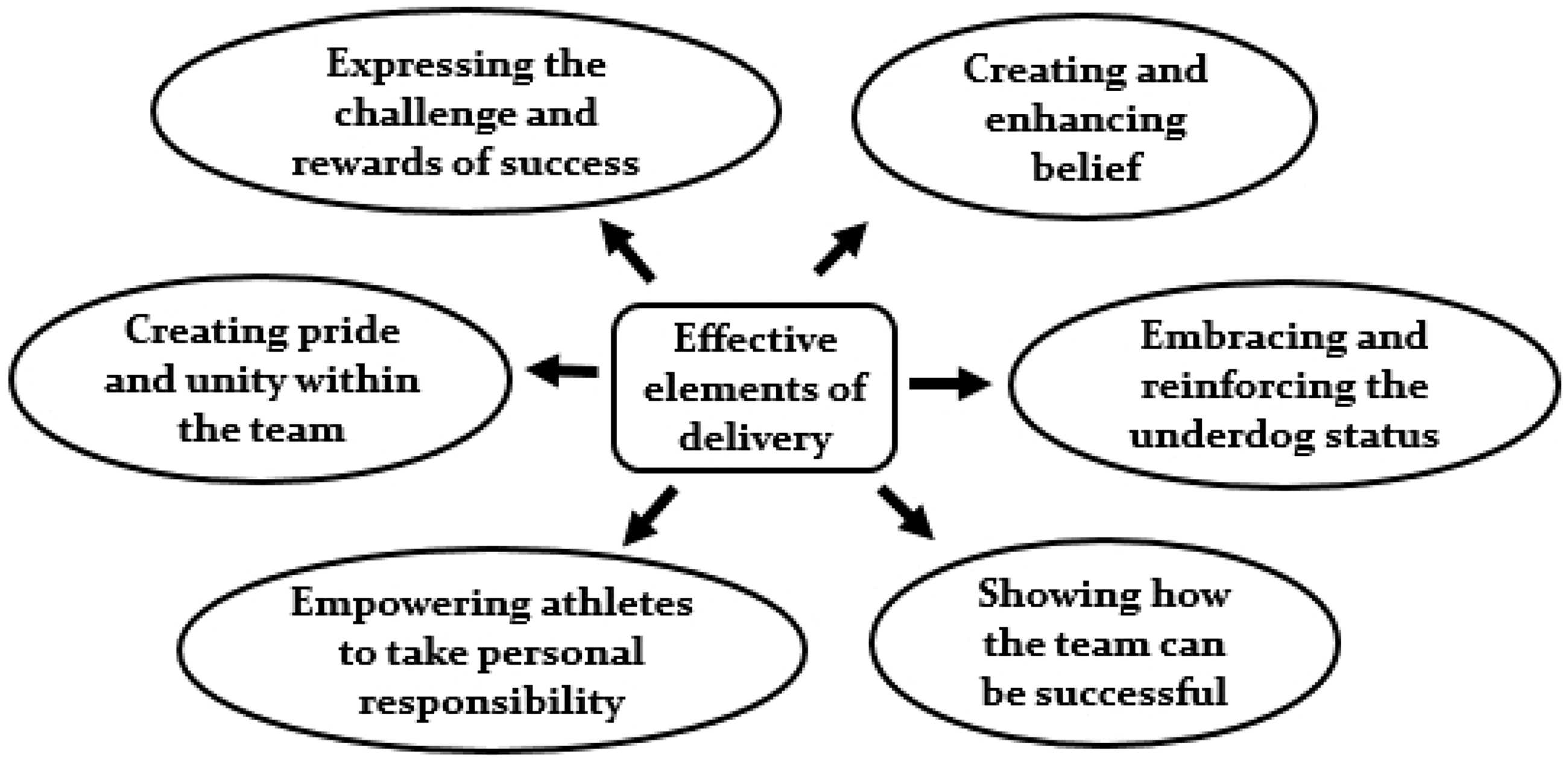
Expressing the challenge and rewards of success
To win for the Lions in a Test match is the ultimate … the moment’s arrived for the greatest game of your f****** life (Telfer: video 3, part 12).
The metaphor of getting ‘to the top of Everest’ and the words that followed, inspired participants by reinforcing the magnitude of the task the Lions faced. Participants were inspired by the desire to test themselves and make the most of such an opportunity. For example, one participant said: ‘If you’re ambitious enough you always want to play against the best or better players than yourself … that’s how I test myself … it’s like finding out what you’re capable of’. Participants also reported being inspired by the idea of needing to take such an opportunity in a big game. For example, McGeechan reminds the team that the upcoming match provides players with a ‘special’ opportunity that some never experience (video 5, part 1 & 2); in response one participant said: ‘It just reminds you to make the most of it … it’s similar to a big tournament that you’re selected for, you might not get the chance again’. Furthermore, Wood (in video 4) outlines the ‘pleasure and pain’ that the players will feel if they meet the challenge and are successful which participants were inspired by. One participant illustrated how they would feel in response to such words: It’s inspiring to think about how you would feel at the end of the match. Take the pleasure at the end so put in the hard work now so hopefully win at the end so like striving at the end to get the feeling of the win.
Creating and enhancing belief
I think Jim and I both feel privileged and to a certain extent humbled, about coming together with the most talented players in the British Isles (McGeechan; video 1, part 2).
Participants reported McGeechan’s speech being inspirational due to the feeling that being in such a select group of players would give them. Participants responded to the idea of the belief the coaches showed in players, with one saying: ‘it would make you think they [the coaches] obviously believe in me’. In turn, this belief might impact on participants’ perceptions of their own confidence, with one participant stating: ‘It makes you confident about yourself and your own ability’. Furthermore, Telfer’s reference to ‘Everest’ (video 3, part 2) was seen as inspiring due to the coach highlighting the achievement of representing the Lions. One participant expressed this by saying: You are one of the few special ones that has climbed to the top of Everest in terms of rugby … in terms of the Lions, it is the ultimate thing you can do in your career … you have reached the peak of where you can be.
While some participants highlighted the communication that included the word ‘privileged’ as being inspiring, a small number reported not being inspired by this due to a different interpretation of this word. One participant explained this by saying: ‘I didn’t like the privileged bit … I think it should be like you’ve earnt it. I suppose the word privileged to me is a bit like you’ve been given it as opposed to you’ve earned it’.
Embracing and reinforcing the underdog status
They f****** underestimate us, they’re going to get it rammed down their throats today, it’s what they’re going to get for the next six weeks … 47 of us against f****** all of South Africa (Leonard; video 2, part 1).
The narrative of needing to overcome the odds stacked against them was a common theme throughout the speeches. Indeed, McGeehan had already set this up in the first team meeting by saying ‘We’re underestimated, I’m convinced of that’ (Video 1). Participants suggested that this would inspire them to put in more effort because it would motivate them to prove their doubters wrong. For example, one participant expressed: ‘I always like that, I think to myself: ‘They’re going into this game thinking it’s going to be a walk in the park’ … it gives you that extra incentive to go out and prove them wrong’. Participants proposed that the extra motivation might also be a result of not identifying with the underdog status, suggesting that such status would ‘make you stand up and go “well that’s not fair” as you don’t class yourself as an underdog’. Participants also expressed feeling inspired by the challenge of being an underdog against a supposedly stronger side, with one participant highlighting: Again, it’s that underdog feeling that is coming back … watching it, I can feel the hairs standing on end now because of those overwhelming odds of 47 lions … going against the away crowd and knowing it’s going to be tough.
While being considered an underdog inspired individuals to anticipate success, participants suggested that when coaches focussed on weaknesses highlighted by the opposition and the strengths of the opposition, it would have a negative effect on them. An example of this was when Telfer outlined some of the supposed weaknesses highlighted by the media and opposition (see video 3, part 7). One participant commented how this would lead to self-doubt: It’s making you think about them … I think for me that’s a real negative cause then I start to question my own ability. It’s nice to be told that you know … you’re not the favourite but internally you know that’s not true … as soon as someone in your close circle starts reemphasising that I think it really detracts from the game.
Showing how the team can be successful
… get right up in their faces and turn them back, knock them back. Outdo what they can do. Outjump them, out scrum them, out ruck them, outdrive them, out-tackle them, until they’re f****** sick of you (Telfer: video 3, parts 5 & 6).
A key source of inspiration for participants was when leaders provided instructions that informed them of how to be successful. For example, the words of Telfer (above) were perceived as highly inspirational overall, but particularly by the rugby participants with one participant commenting: It was another simple way of just sort of saying anything they do, you’ve just got to do better … if they jump a certain height to win a ball, you jump higher. You need to match them for every tactical or physical thing that they do.
Furthermore, inspiration was drawn from aspects of the leader speech that emphasised the need to win the individual battle. For instance, Leonard (video 2, part 2) exhorted the players to make an early impression on their opponents by making strong early tackles, and one rugby playing participant commented on the importance of this: You need to hit them hard … if you hurt them then they’re not going to go so hard on you and you’ve got the upper edge straight away. When he said ‘out-scrum them’, being a prop, that’s a key area [for me]. The scrum, the ruck, the drive, the tackle, they are the main things we do, and you want to win every one you go in for.
Participants warned against using negatively framed messages which highlighted what they should not be doing, especially after communicating on what players should be doing (see Figure 2 for mean inspiration scores across video 2). For instance, Leonard’s speech is perceived as very inspirational early in video 2, but in part 5 where he says, ‘do not go inside yourselves’ (video 2, part 5) and starts focussing on what players should not do, inspiration decreases. Referring to this, one participant said: ‘As soon as you start telling boys don’t do this and don’t do that it starts subtracting from the original feeling [of inspiration]’. Another participant highlighted how earlier, the leaders had emphasised the need for players to support each other and commented how by saying not to overcommit, they felt as the leaders are ‘contradicting themselves’ with such mixed messages.
Empowering athletes to take personal responsibility
It’s our day, it’s nobody else’s f****** day, it’s our f****** day, it’s ours to win and lose. But we’re f****** winning … We set the standards we play the standards (Wood; Video 6, part 3).
Participants responded being inspired by leaders highlighting the responsibility they had, and how it was in their control to be successful. One participant commented on this wording of ‘our day’, highlighting how Wood’s words results in them ‘being in charge of your own fate at this point’. Another participant explained: ‘If you don’t perform, if you don’t work hard enough, you know we are going to come out second best. It’s giving them the responsibility again’. Wood also asks the side to put in the effort required to meet this challenge, imploring them to ‘demand everything for 80 minutes. That’s all, every time’ (video 6, part 1). One participant said they would be inspired by this because ‘it’s actually realistic that now you can actually achieve it [the team’s goal] and see it. And everything you’ve worked for you can achieve in this match’.
In contrast, when leaders discussed elements outside of the team’s control, participants suggested that inspiration would be negatively impacted. One element that participants generally didn’t like was the leaders referring to the referee; for example, Leonard saying they [the Lions] are ‘not going to get any favours off the ref’ (video 2, part 8). In accord with this, one participant outlined: ‘It’s just wasting our time [criticising the referee] when it’s not something we need to worry about. We could be sort of focusing on setting up our line out or you know anything rather than shouting about [the referee]’. Such ideas further reinforce examples provided in the ‘showing the way to be successful theme’, and add that a focus of such suggestions should be elements of the game players have control over.
Creating pride and unity within the team
You’ll meet each other in the street in 30 years’ time, and there’ll just be a look, and you’ll know just how special some days in your life are (McGeechan; video 5, part 4).
One of the segments reported as being highly inspirational by both groups of participants was when McGeechan highlighted how teammates might meet each other in the future, which would allow them to reflect on their potential shared success. One participant said: ‘In 30 years it will all be gone but you’ll still have a bond with these team mates who have reached the same point you have. And you’ll realize just how special that day was’. There are numerous other words and phrases that participants identified that created such feelings of unity, such as Leonard referring to the chain that ‘never gets broken’ (video 2 clip 4), and references to the kit that symbolize the team (e.g. McGeechan’s reference to ‘the badge’, video 6, clip 4). The importance faced of this unity was highlighted when a participant highlighted the potential inspirational impact of such symbols: ‘More the unity that when you put on the shirt, you’re all one. You wouldn’t necessarily die for each other but you would give everything for each other’. McGeechan also refers to the look that players will give each other on the pitch (video 5, part 9, 10) which was rated significantly more inspirational by the rugby players. One rugby player explained why this idea in particular would resonate: A look or a nod or something like that will tell a 1000 words and that’s all you need to see from a team mate that might be blowing, might be bleeding or anything like that. Just a look that’s going to say I’m going to continue, you know that idea of unity, that everyone’s in the same boat.
Features of communication perceived as inspiring
Participants also identified specific features of the delivery that they perceived to have influenced their feelings of being inspired. Participants particularly identified the way speeches built up to the key points at the end, as well as the leaders’ use of pauses, repetition, and emphasis. For example, one participant highlighted the impact of McGeechan’s approach (video 1, 5), saying: ‘He’s not shouting at them, he’s delivering it softly and calmly … you’ve time to really take it in, and re-analyse it personally’. Participants also responded positively to the way leaders built up the intensity of the speech. One participant reflected on Telfer’s speech (video 3): ‘He was calm throughout then he really spikes it up as if to light a fire under them almost’. Repetition of certain words that represented key ideas was deemed effective; for example, the continued reference to ‘commitment’ needed (e.g. video 1). This technique appears to link with the theme of ‘showing the way to be successful’, with one participant saying: ‘It’s the repetition of commitment that’s nice … and then he’s telling us literally the ways he wants us to be committed’.
Demonstrations of passion and aggression by leaders were also proposed to be effective. One participant suggested that Telfer’s passion would reinforce belief, stating: ‘You can tell that someone is passionate about it but with this there is something that changes in his voice. You can tell what he’s saying he genuinely believes and he wants them to believe as well’. However, participants reflected on the balance between content of communication and passion, with one participant commenting: ‘I think it’s not so much the words, because I think I was struggling to hear what they were saying. I think it was more just seeing what was going on and just seeing the desire’. When participants reflected on Telfer’s speech, several mentioned elements of his tone and accent having an impact. One participant explained: ‘His Scottish accent also resonates with me a little bit, but just in a completely different way. I can’t tell you why I just like him’. Another participant further explained: ‘It was quite a bellowing, deep voice so it was sort of, goes straight through’.
Participants also highlighted various features of the speeches they did not like. For instance, participants did not like when multiple leaders were talking at the same time (e.g. video 4, part 7) as this could lead to contradiction and a lack of clarity in communication. For example: ‘There’s no clear message being portrayed there, I sort of turn off straight away’. Another dislike was when Johnson speaks (video 4), participants highlighted how they disliked the tone of his voice, with one saying: ‘I sort of turned off when he started talking, it’s just sort of dull in how he delivers it; it’s very monotone’. Fluency of communication was also deemed to be important, suggesting that a lack of fluency indicates uncertainty and highlights the importance of a coherent message that builds up to a crescendo. For example, one participant commented on the middle part of the pre-match speech in video 2: ‘I almost get the impression that he’s running out of things to say, because he stumbles over a couple of words, and yeah, he’s just filling space’.
Discussion
The purpose of this study was to explore how team sport athletes were inspired by the communication of elite rugby leaders, and our findings add several new insights to the leadership literature. First, the present study extends previous research that has examined pre-match team talks,2–6 and literature that has specifically examined the inspirational nature of leader communication,12,14 by examining authentic speeches from an elite environment. For example, the research of Gonzalez et al. 12 revealed participants were inspired by leader communication, but our study extends this by providing more specific information that identifies what aspects from speeches were inspirational, and why participants found them inspirational.
Our findings support previous research that inspiration can be evoked by the communications of the leader,9,14 and participants were ‘inspired by’ such illuminating ideas. Considering the three sources of transmission of inspiration, 22 it appears that actualization occurred, as the participants appreciated the compelling ideas offered in the dialogue of the leaders. Our findings revealed six dimensions of leader communication that allowed inspiration to be transmitted (e.g. showing the way forwards, demonstrating belief, and reinforcing the underdog status). In line with the theorizing of Thrash and Elliott, 8 how leaders illustrate to players how they can be successful was identified as a key source of inspiration. This finding echoes that of Figgins et al., 14 who found that coaches inspired their athletes by showing them the way forward. Our findings provided examples of further ways leaders can show how players can be successful to inspire them in a team context, such as providing specific technical and tactical instructions, and framing these in a positive way.
The leaders in the footage regularly stressed the idea of being an underdog, and participants reported being inspired by the leaders making such an emphasis. The term ‘underdog’ has been used to refer to those who are at a ‘competitive disadvantage’ (see Goldschmied and Vandello, 23 p.34), and our findings are in line with previous research that has also found various advantages of the underdog status being adopted.24–26 For example, Vandello et al. 24 found that participants reported favourable feelings for competitors framed as the underdog in a range of competitive situations, and Goldschmied and Vandello 26 found that when participants were presented with a fictitious story about an upcoming competition, the participants predicted those presented as underdogs would exceed expectations with their performance. Such positive impacts may be explained by the number of inspirational stories of underdogs being successful portrayed in the media, or in films. Thus, we may overestimate the likelihood of underdogs succeeding as similar stories are available in our memory and capture our attention. 27 Furthermore, the research of Gibson et al. 28 revealed that favourites are believed to be under more pressure compared to underdogs. Such an ‘underdog schema’ (see Goldschmied and Vandello, 23 p.39) was utilized very effectively by the elite leaders in the footage used in the current study, and was a strong source of inspiration.
In line with the principles of social identity theory, our participants perceived the leaders’ communication more favourably when the leaders promoted a sense of group identity that created a feeling of an emotional attachment and sense of belonging to their team. 29 Our findings highlight numerous words and phrases used by the leaders that created a sense of team identity, including ideas of ‘unity’, ‘the chain’, and ‘the badge’. This is in line with the research of Slater et al., 30 who found that the identity of the TeamGB Olympic team was enhanced when leaders made reference to team kit and collective symbols (e.g. the national flag). These links are proposed to enhance the sense of attachment to in-group ties, by increasing athletes’ connection to the team, and thus, mobilizing their efforts to be successful. 31 The leaders also appeared to utilize the idea of being an underdog as a symbol to unite the team behind. Furthermore, referencing positional instructions may have created specific, individual identities within the team. Social identity theory also predicts that athletes will perceive their leader’s communication more favourably if the leader is more prototypical, and thus is representative of the group identity. 32 Future research should investigate this idea further with elite participants to assess how perceptions of their own leaders’ prototypicality might strengthen feelings of inspiration. In addition, the further source of transmission, expression, which is where athletes act upon the compelling idea immediately, 22 could not be judged because our participants did not compete after hearing the leader communication. Thus, future research should apply experimental methods to investigate participants’ actual responses to inspirational leader communication in a practical setting.
The use of speeches from real-life leaders communicating in an authentic, meaningful situation was a strength of the study, as this footage stimulated data collection and in turn, provided rich information on what participants would be inspired by and why. However, this study is not without its limitations. In terms of the speeches used, the three speeches in team meetings were complete speeches, but the pre-match and half-time speeches were not complete, as they had been edited for the production of the ‘Living with Lions’ film. Thus, the incomplete speeches might have been missing important contextual information that would have allowed participants to make more thorough judgements on the inspirational content. In addition, while the participants were instructed to imagine themselves listening to such speeches in their own sport ahead of an important match, it is likely that they were able to do this with varying degrees of success, as they would not have previously experienced similar speeches in such a competitive, elite context. Furthermore, while using authentic speech in the current study builds on previous literature that has used fictitious speeches, our study still falls short of both the communicator and receiver of the messages being included in the study. Indeed, while our findings examine how inspiration might result from the content and delivery of speeches, inspiration might also result from contextual factors, such as the importance of the upcoming game, or being in the dressing room environment. As participants in the current study only hypothetically placed themselves in the scenario, future research might investigate perceptions of leader speech from the perspective of those who have directly experienced the communication.
A further avenue for further research might be to examine how personality traits might impact on how different players perceive aspects of the team talk. A strong candidate for investigation is narcissism, as narcissists have been found not to buy into team goals. 33 In addition, given that the sample used in the current study were a fairly homogenous sample of young, adult males, future research might also investigate how different participant samples are inspired by leader communication, such as female or junior athletes. In addition, future research might examine the specific features of communication identified as being inspirational. Researchers in the organizational leadership literature have conceptualized distinct rhetorical dimensions used by charismatic leaders,34,35 and subsequently, researchers15,16 have used this framework to analyse leaders’ speech in different contexts, such as those in pre-election American presidential debates. Thus, future research might use similar methods and frameworks to conduct more in-depth explorations of the specific rhetoric used in different sporting contexts. Finally, participants might have had a prior awareness of the elite leaders used, and such information might have influenced the way they perceived the speeches, as reputation information of coaches has been seen to impact on initial impressions of coaches. 36 Thus, it may be that athletes’ initial impressions moderate the impact leader communication which is a further contention that could be examined in future research.
In terms of the applied implications of this study, our results provided rich and detailed data concerning not only the content of the speeches, but also the style and delivery of the speech that participants were inspired by (e.g. tone of voice, passionate delivery, and repetition of key ideas). Participants reporting being inspired by passionate, emotional communication, which supports findings of previous research.2–5 Most notably our findings were in line with Vargus-Tonsing and Guan 3 who found players preferred more emotional speeches before competing against higher ranked opponents, and when they were considered an underdog. Our results revealed that participants perceived speeches more favourably when there was fluency and directness in the leaders’ speeches. This is in line with the findings of Areni and Sparks 37 who found speakers using powerful language (e.g. lack of hesitations and pauses) were more persuasive, and thus suggests that leaders should strive to demonstrate such traits in their speeches to impact positively on their followers. Also, it appears important for leaders to avoid using negatively framed messages, and to focus on elements of performance which are under the control of the followers.
As many speeches can be intentionally constructed and delivered, our findings can provide insight to sporting leaders on how to structure their communication, and thus, inspire followers. However, if speeches are too structured and planned, they might lose authenticity. Indeed, in his autobiography, McGeechan 38 talks about his speech (video 5) being improvised, but that he did go for a walk beforehand to clear his head which allowed him to ‘focus on the final words to the team’ (p.240), and thus ensure that the messages he delivered were clear. Furthermore, there are potentially a multitude of individual differences that athletes within a team have, and a challenge for coaches communicating in a team environment is to meet such a range of demands. 39 Thus, our findings should not be taken as prescriptive instructions for leaders. Instead, the findings (and indeed the footage of elite leaders we used) might be used as a stimulus for discussions with players to allow leaders to understand more fully their preferences and requirements from communication. Finally, our findings suggest leadership functions within a team (i.e. task, motivational, social, and external leadership) might be delivered most effectively by multiple athlete leaders. 40 Interestingly, in the current study the captain of the Lions, Martin Johnson, appeared to play a limited role in providing communication to the players ahead of important matches; the senior player Keith Wood played a much greater role communicating in such situations. Thus, our results suggest it should be the one who has the most inspirational quality who delivers speeches, regardless of their formal leadership role.
In summary, the results of this study identify a number of aspects of the content of a leader’s communication that might be used to inspire athletes. In addition, aspects of the delivery have also been highlighted that might contribute to the communication being perceived as inspirational. Thus, in using authentic footage from elite leaders, this study furthers our understanding of leader communication in an elite context, and provides a stimulus for leaders and applied practitioners to stimulate discussion concerning how leaders might use communication to inspire their own athletes.
Footnotes
Declaration of Conflicting Interests
The author(s) declared no potential conflicts of interest with respect to the research, authorship, and/or publication of this article.
Funding
The author(s) received no financial support for the research, authorship, and/or publication of this article.
References
Supplementary Material
Please find the following supplemental material available below.
For Open Access articles published under a Creative Commons License, all supplemental material carries the same license as the article it is associated with.
For non-Open Access articles published, all supplemental material carries a non-exclusive license, and permission requests for re-use of supplemental material or any part of supplemental material shall be sent directly to the copyright owner as specified in the copyright notice associated with the article.
