



Abstract
Judo contests are complex situations for coaches observing them. Identifying where judo coaches look (i.e. their visual search strategy) when observing contests can help identify visual information they may use to inform coaching decisions. The current exploratory study investigated the visual search strategies of elite, sub-elite, and non-judo coaches when observing the preparation phase (viewed from video footage) of elite-level judo contests. Participants' eye movements were recorded using a mobile eye-tracker. Participants were instructed to provide verbal coaching instructions to improve a specified judoka's (judo athlete) performance at set times during the footage. Elite coaches fixated significantly more frequently and longer on the specified judoka's upper body (p < 0.05) compared to the opponent's upper body and other key areas within the display. Sub-elite and non-judo coaches demonstrated no significant difference in the frequency or overall length of fixation between the judokas' upper bodies. The visual search strategy of elite judo coaches may have been a purposeful attempt to obtain accurate information about the judoka's attacking intentions early within the contest. This visual search strategy can be attributed to elite judokas' attempting to disguise their attacking intentions. Furthermore, elite coaches may have used the specified judoka's upper body as a visual pivot.
Introduction
Judo contests are complex situations due to the combination of physical, technical, tactical and psychological demands, and the multiple periods and phases that constitute a contest.1–3 A contest consists of two reoccurring periods: the hajime-matte (begin-pause) period in which combat occurs, and the matte period where the contest is paused. 4 The hajime-matte period can be sub-divided into two types of combat: standing combat (commonly referred to as tachi-waza), and ground combat (commonly referred to as ne-waza). In tachi-waza, judokas (judo athletes) attempt to grip their opponent and throw them to the ground, and in ne-waza, judokas attempt to immobilise their opponent or force them to submit. Contests (and resumption of contests) begin in tachi-waza. Tachi-waza can be sub-divided into several phases: the preparation phase, where judokas aim to control the space between themselves and their opponent, and attempt to establish their first grip on their opponent while avoiding their opponent's attempts to grip; the kumi-kata phase, where a judoka obtains a grip with one or both hands; an attack (i.e. attempt to throw); and a (possible) fall leading to ne-waza or a score that wins the contest.2–6 While the demands and structure of a judo contest present a complex situation for the competing judoka, they also present a complex situation for the coaches observing the contest. 3
Where judo coaches look when observing contests (i.e. their visual search strategy) may contribute to their subsequent decision-making (e.g. provision of feedback), 7 and knowing where experienced coaches look may aid in the identification of what visual information is relevant to them. However, while investigations into the visual search strategies of athletes (e.g. see literature8–21) and officials (e.g. see literature22–25) have provided understanding of visual search strategies in sport, there are a limited number of investigations into coaches' search strategies7,26–29 and no published research investigating the visual search strategies of judo coaches.
In sport, visually searching for (and attending to) relevant information is an important early stage in decision-making.30,31 Elite performers visually attend to more relevant information compared to sub-elite performers, with less accurate decisions observed if relevant information is not visually attended to. 25 Task requirements determine the visual search strategy utilised, 17 and fixation duration, frequency, and location will vary dependent upon the task to ensure that relevant information is obtained.17,20 To obtain information from multiple relevant areas in the visual scene, sport performers may locate their gaze centrally between these areas to create a visual pivot. 32 From this visual pivot, performers can utilise central vision to obtain information from the fixated area (using the part of our eye providing the highest amount of resolution), and rely on peripheral vision to gather information from other relevant areas. 32 If required, performers may saccade to other areas of the visual scene to obtain more detailed information (i.e. fixate centrally) before returning to the visual pivot. 16 For experienced performers, prior knowledge of the task (i.e., goal-directed, top-down signals) will drive their visual search strategies, 33 with distractions resulting from object salience (i.e. stimulus-driven, bottom-up signals from movement, colour, etc.) suppressed.34,35
Experienced tennis 28 and gymnastic 29 coaches' appear to use fewer fixations of longer duration compared to less experienced coaches. This search strategy is similar to that observed in elite athletes in tasks involving a single opponent (e.g. Vaeyans et al. 17 ). However, Giblin et al. 27 found no expertise-based differences in the visual search strategies of tennis coaches. A lack of expertise-based differences has been identified in sport officials, yet despite similar search strategies, higher-level officials made more accurate decisions compared to lower-level officials.23,24 It is feasible that the higher-level officials processed the visual information more effectively, 24 with prior knowledge of similar situations being used as an adjunct to the visual information.23,31 However, no decision making task was included to investigate processing differences in the tennis coaches. 27
While there have been no investigations into the visual search strategies of judo coaches, high-level coaches ( ≥ 10 years coaching experience including international level coaching, minimum 1st dan black belt) have self-reported the grip and body position of both judokas as key areas to attend to when observing contests. 3 However, in the absence of information about coaches' visual search strategies, it is not known if and how coaches visually attend to these areas as part of their search strategy. Furthermore, it is not known which aspects of body position coaches attend to (e.g. upper body, lower body), if this depends upon the phase of the contest, or if expertise-based differences in search strategy exist. Additionally, coaches in the work of Santos et al. 3 responded to questions about how they coach judoka with whom they are familiar (i.e. coach regularly at training and contests); yet coaches also observe contests where they are less familiar with the competing judoka. For example, coaches may coach a judoka at a contest for the first time (e.g. national squad coach coaching a new national squad member), or observe an unfamiliar judoka during a contest (live or on video) in preparation for their judoka competing against them.
Determining the visual search strategies used by different levels of judo coaches when observing contests can contribute to understanding which areas of the visual scene provide relevant information for coaches. In the absence of investigations into judo coaches' visual search strategies, the present study is an exploratory investigation of the effect of coaching experience on the visual search strategies of judo coaches when observing unfamiliar judoka during a contest phase. A single contest phase was chosen as phases present different visual stimuli to coaches (e.g. judokas not in contact, judokas in contact, judokas standing, judokas on the ground) and can therefore be considered as different visual search tasks. Previous research has shown that task requirements determine the visual search strategy utilised. 17 To ensure the same task was being viewed by all participants, only one phase of the judo contest was used. The preparation phase was selected for the study, as it is an important tactical contest phase occurring at the beginning of the hajime-matte period. 2 As an exploratory investigation, the findings of the present study have the potential to inform the development of hypotheses for future studies of judo coaches' visual search strategies.
Method
Participants
Fifteen qualified judo coaches and seven individuals with no experience of judo (participating or coaching) took part in the study. Institutional ethical approval was obtained. All participants provided written informed consent and completed a health questionnaire relating to their vision before participating. Participants reported normal, or corrected-to-normal (through wearing contact lenses) vision, and were able to view video footage without the aid of spectacles to correct vision. Individuals who wore spectacles were excluded from the study as spectacles affect the quality of eye tracking recording. All participants completed a judo experience questionnaire to establish their level of coaching (for the coaching groups) and confirm that individuals in the non-judo group had no experience of judo. All coaches possessed, as a minimum, a British Judo Association (BJA)/United Kingdom Coaching Certificate (UKCC) level 2 judo coaching qualification (or equivalent for non-UK coaches), and a judo grade of 1st dan. Non-UK coaches were enrolled on a UK-based degree programme and had demonstrated proficiency in English as a prerequisite for enrollment onto the degree programme. All coaches had previous competitive experience as a judoka, ranging from regional to international level.
Participant details.

NJ: non-judo; NAT: national; INT: international.
Materials and apparatus
Video footage of judo contests recorded by the computer aided replay (CARE) system at an International Judo Federation (IJF) Grand Prix event was obtained. The footage consisted of male and female contests from multiple weight categories. Permission to use the footage was provided by the event organisers. Grand Prix events form part of the IJF's annual schedule of international tournaments for elite judoka. The CARE system is used at events to provide video replay facilities to aid refereeing decisions. CARE system contest footage is recorded from a position similar to that of coaches while observing their judoka compete (i.e. the judo coach sits mat side at the same level and approximate position as the CARE camera), and therefore presents a visual scene similar to that a coach would observe in-situ. The coaches who participated in this study were not present at the event where the contest footage was recorded. Coaches did not know the judokas in a coaching context.
Video footage from the CARE system was edited and clips of contests created (iMovie, Apple Inc., California; USA, ver. 10.0.5). Of the 158 contests recorded, 134 contests were excluded from the editing process as the view of the judokas was regularly obstructed (e.g. by the referee). A clip allowing a clear view of the judokas for the majority of the clip was created from footage of each of the remaining 24 contests. Clips had a mean duration of 61 ± 14.93 s, and consisted of two consecutive periods of a contest separated by an 11 s pause. The pause represented the average contest matte period.2,36 During the matte period, a still image of the judokas was displayed. On-screen text to indicate referee calls (i.e. hajime, matte, scores and penalties) was added to the footage, as calls were not consistently audible. If referee calls were audible, the text was synchronized with the call. If calls were not audible and the referee's face was visible, text was synchronized with the movement of the referee's mouth. If this was not possible, text was synchronized with the referee's signal to the scoreboard operators. If a signal was not visible, text was synchronized with the change (e.g. timer starts) on the scoreboard. All participants were given the instruction prior to watching the video footage that they were going to watch a series of clips. During each matte period, they were asked to provide verbal coaching instructions to improve the performance of the judoka wearing white (in international judo contests one judoka wears white and the other blue). The instruction to provide coaching instructions was included to ensure all participants engaged with the video clips being presented, and represented IJF rules regarding when coaching instructions can be given to a judoka during a contest. 37 Clips were projected onto a large screen (height: 1.13 ± 0.27 m; width 1.92 ± 0.34 m) at a minimum resolution of 1024 × 640. Participants' eye movements were recorded using an SMI iViewETG head-mounted mobile eye tracker (SensoMotoric Instruments Inc., Warthestr; Germany, ver. 1.0) at 30 Hz.
Procedure
Participants were seated ≈2.8 m from the screen on a seat ≈0.75 m in height. When projected onto the screen, the visual scene subtended a mean horizontal visual angle of 38 ± 6°, and a mean vertical visual angle of 23 ± 5°. Participants were fitted with the eye tracker and a three-point calibration performed. Participants were permitted to view up to five familiarisation clips and to request clarification regarding the experimental procedures during this period. Upon completion of the familiarisation period, accuracy of the eye tracker calibration was confirmed. If necessary a further three-point calibration was carried out. Participants then viewed the 24 clips, plus five repeated clips from the original 24. The same repeated clips were used for each participant. Participants viewed the total of 29 clips in blocks of no more than six clips. Clips were presented in random order (www.randomizer.org) for each participant. Repeated clips were separated from the original by at least one block. Between clips, the screen went black for ∼ 5 s. Participants were permitted a break of self-determined duration between blocks. Calibration of the eye tracker was checked between blocks and if needed, re-calibration occurred. The total time for data collection was ∼45 min.
Data analysis
From the original 24 clips presented to the participants, 9 clips were selected for tracking of eye movements. These nine clips allowed a clear view of the judokas for the majority of the trial. The remaining (additional) trials permitted a clear view of the judoka for other periods of the contest, and were retained for future analysis of these periods (e.g. kumi kata, etc.). Repeat trials are not reported in this analysis. The included clips were tracked from the frame when hajime appeared on the screen, to the frame immediately before either judoka made contact with their opponent. Visual search data recorded by the eye tracker were analysed offline using SMI BeGaze (ver. 3.4) software. Data were manually mapped frame-by-frame (∼18,450 frames) using an area of interest (AOI) image uploaded to the BeGaze software.
Of the nine clips tracked, seven had a preparation phase ≤2.8 s, with the remaining two clips having preparation phases of ∼7 s and ∼8 s. In international competition, preparation phases are longer than in lower levels of competition, 5 with a total mean duration from previous studies of 6.56 s ( ± 0.97 s).2,38 Therefore, the seven clips with preparation phase durations of ≤ 2.8 s were excluded, and the two clips with preparation phase durations of ∼7 s and ∼8 s used for further analysis. This ensured that the phases analysed replicated as closely as possible the duration of those previously reported.
Investigations into the visual search strategies of judokas in live 1 versus 1 contest situations have utilised precise AOIs (e.g. lapel, sleeve, wrist/hand). 13 The use of precise AOIs was made possible as the opposing judoka would have filled the majority of the visual scene (i.e. the opponent was standing close to the participant). In the present study, pilot testing indicated that the use of similar AOIs to Piras et al. 13 would not be possible due to the visual scene encompassing a larger area (i.e. an ∼10 m × 10 m contest area containing two judokas and the referee moving in multiple planes). Therefore, it was deemed more appropriate for broader AOIs to be used. Broad AOIs (e.g. attacker) have previously been used in studies that have presented visual scenes of larger areas (e.g. competitive situations containing several athletes17,26). Furthermore, in such visual scenes, relative information (e.g. relative position of athletes to one another) rather than specific feature level AOIs may be utilised. 39 Consequently, six primary AOIs were identified based upon their potential to provide visual information regarding the judokas and the contest, given the visual scene (i.e. contest area containing several individuals). To account for eye movements within these broader AOIs, a clear saccade from one region to another within the same AOI was mapped as a new gaze.
Previous research investigating judokas’ visual search strategies has identified the importance of upper body areas for providing visual information in contest situations. 13 Therefore, upper body areas (white upper, WU; blue upper, BU) were included as primary AOIs, with white and blue distinguishing the colour of the judogi (judo suit) worn by the judoka. The upper AOIs included the judoka's belt and any area above it. The belt was included in the upper body AOIs as judoka are permitted to grip the belt, and any area of the judogi above it, during tachi waza. 27 Lower body areas (white lower, WL; blue lower, BL) were also included as primary AOIs, similar to Piras et al., 13 as a judoka's stance may provide information about their attacking intentions.40,41 A space (SP) AOI was included and defined as the area between the judokas when engaged in the contest. SP was included as it represented a central area in the visual scene. Previous research suggests that central areas may act as visual pivots for visual search.16,32 The sixth AOI was the scoreboard (SB). In judo contests, the scoreboard provides the names and nationalities of the competing judokas, the remaining time of the contest, the score, and penalties conceded. SB was included as an AOI as it could provide participants with information about the context of the clip they were viewing.
Three secondary AOIs (referee, REF; on-screen text, TXT; other, OTH), that did not provide information about the contest or judokas, were identified to account for fixations on areas other than the primary AOIs. During the phase analysed, REF did not provide any signals (e.g., awarding a score), and therefore did not provide information about the contest. TXT only indicated the beginning of the contest during the phase analysed, and was on the screen for the initial 1 s of the clip. Fixations on areas away from the contest area (e.g. crowd, advertising hoardings) were denoted by OTH. A tracking option to account for periods where gaze behaviour could not be recorded was included and termed NODATA. 42 This allowed the tracking ratio to be calculated. The tracking ratio considers the number of frames recorded, and the number of frames where no data could be recorded. A higher tracking ratio means that more frames were recorded, and a tracking ratio of > 80% has previously been identified as acceptable for use in gaze behavior studies. 42 Tracking ratios in the present study exceeded 80% for all participants.
Statistical analysis
A randomly selected sample of the clips included in the statistical analysis (n = 5; ∼11%) was used to analyse the intra- and inter-rater reliability of eye movement tracking. Intra-rater reliability interclass correlation coefficients (ICCs) > 0.9 were found for the frequency of tracking hits on WU (0.996), BU (0.996), and SP (0.979), the total number of fixations (0.952), and the number of fixations on WU (0.979), BU (0.947), and SP (0.962). Inter-rater reliability (conducted between authors PR and MT) ICCs > 0.9 were also observed for the frequency of tracking hits on WU (0.998), BU (0.999), and SP (0.906), the total number of fixations (0.952), and the number of fixations on WU (0.938), BU (0.974), and SP (0.962).
The dependent variables analysed were (i) the total number of fixations during the entire trial, (ii) the relative number of fixations on an AOI, (iii) the relative total fixation duration on an AOI, and (iv) the average fixation duration on an AOI. The relative number of fixations on an AOI was calculated as a percentage of the total number of fixations during the clip. Relative total fixation duration on an AOI was calculated as a percentage of clip length (i.e. how much of the clip was spent fixating on an AOI). The average fixation duration on an AOI was the duration (in seconds) of a fixation on an AOI during a clip (i.e. how long was a fixation on an AOI). Fixations were defined as the gaze cursor remaining on an AOI for a minimum of four consecutive frames (≥120 ms). 19 For each variable, the mean value of the two clips was used.
A single independent one-way ANOVA was used to analyse between-group differences for the total number of fixations during the entire trial. The relative number of fixations on the AOIs, the relative total fixation duration on the AOIs, and the average fixation duration on the AOIs were each initially analysed using a repeated measures 3 (coaching level) × 10 (AOI) ANOVA. The 3 × 10 ANOVAs were followed up with separate independent one-way ANOVAs for each AOI where appropriate. Effect size was calculated using partial eta squared (ηp2). Where appropriate, post hoc pairwise comparisons using Fisher's least significant difference (LSD) were performed. Post hoc effect sizes were calculated using Cohen's d.
Due to the exploratory nature of the study within-group differences for the relative number of fixations on AOIs, relative total fixation duration on AOIs, and average fixation duration on AOIs were analysed using a repeated-measures one-way ANOVA with the primary and secondary AOIs as the within-subject factor. Effect size was calculated using ηp2. Post hoc pairwise comparisons using Fisher's LSD were performed where appropriate. Post hoc effect sizes were calculated using Cohen's d.
Main effects and interactions reported in the manuscript refer to primary and secondary AOIs. Post hoc analyses of differences between all AOIs are located in Appendix 1. Within-group post hoc analyses of primary AOIs only are reported within the manuscript. Within-group post hoc analyses of secondary AOIs can be found in Appendix 2.
Results
Total number of fixations
The total number of fixations for the NJ, NAT, and INT groups were 30.57 ± 6.59, 28.88 ± 4.32, and 30.14 ± 4.79, respectively. There was no significant between-group difference for the mean total number of fixations, F(2, 19) = 0.21, p > 0.05, ηp2 = 0.02.
Relative number of fixations on the AOIs
There was no significant coaching level × AOI interaction for the relative number of fixations on the AOIs, F(18, 171) = 0.96, p > 0.05, ηp2 = 0.092. The relative number of fixations was significantly affected by the AOI, F(9, 171) = 70.66, p < 0.001, ηp2 = 0.79. Within-group analysis indicated that the AOI had a significant effect on the relative number of fixations for the NJ group, F(8, 48) = 13.88, p < 0.001, ηp2 = 0.7; NAT group, F(8, 56) = 29.93, p < 0.001, ηp2 = 0.77; and INT group, F(9,54) = 41.86, p < 0.001, ηp2 = 0.88.
NJ
Post hoc analysis indicated no significant difference between the relative number of fixations on WU (43.67 ± 22.46%) and BU (28.66 ± 11.49%). The relative number of fixations on WU and BU were both significantly greater than on all other AOIs (p < 0.05, minimum mean difference = 32.59%, d = 0.93 to 2.75 and p < 0.02, minimum mean difference = 17.58%, d = 1.34 to 3.53 respectively; Figure 1(a))
(a) Relative number of fixations (%) NJ group (mean + SE). (b) Relative number of fixations (%) NAT group (mean + SE). (c) Relative number of fixations (%) INT group (mean + SE).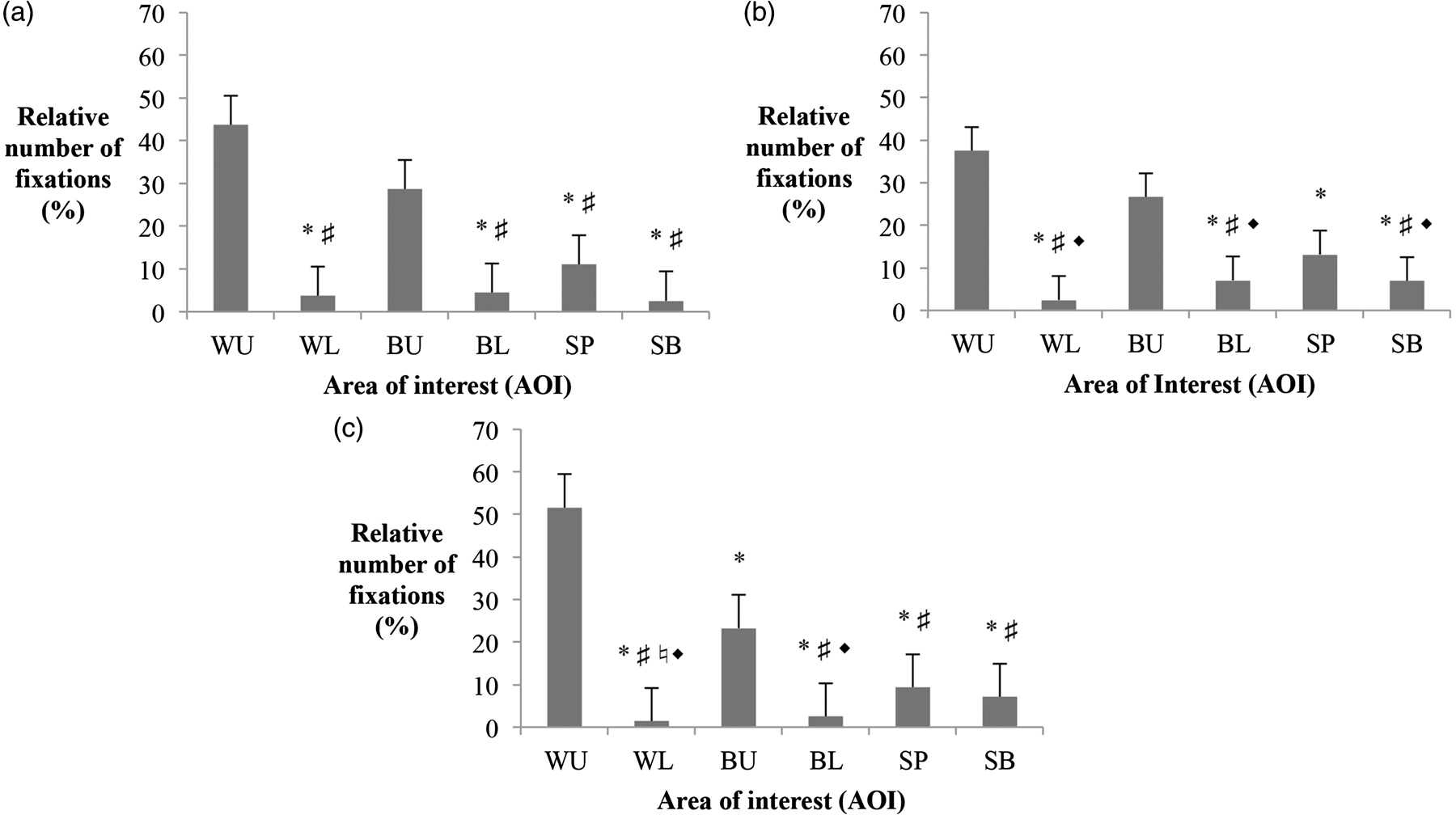
NAT
There were no significant differences between the relative number of fixations on WU (37.49 ± 9.57%) and BU (26.59 ± 14.04%). The relative number of fixations on WU was significantly greater than on all other AOIs (p < 0.002, minimum mean difference = 24.35%, d = 1.25 to 5.54). The relative number of fixations on BU was significantly greater than on all other AOIs (p < 0.03, minimum mean difference = 19.54%, d = 1.72 to 2.68) except SP (13.13 ± 6.15%; Figure 1(b)). The relative number of fixations on SP was significantly greater (p < 0.04, d = 0.86 to 2.12) than on SB (6.97 ± 4.69%), WL (2.45 ± 3.62%) and BL (7.05 ± 7.81%; Figure 1(b)).
INT
The relative number of fixations on WU (51.55 ± 14.60%) was significantly greater compared to all AOIs (p < 0.02, minimum mean difference = 28.32%, d = 2.37 to 4.89). The relative number of fixations on BU was significantly greater (p < 0.02, minimum mean difference = 13.88%, d = 1.78 to 3.68) than on all other AOIs (Figure 1(c)). The relative number of fixations on SP (9.37 ± 7.04%) was significantly greater (p < 0.03, d = 1.15 to 1.55) than on WL (1.40 ± 1.76%) and BL (2.49 ± 4.64%), and the relative number of fixations on SB (7.12 ± 4.58%) was significantly greater (p = 0.032, d = 0.81) than on WL (Figure 1(c)).
Relative total fixation duration on the AOIs
There was no significant coaching level × AOI interaction for the relative total fixation duration on the AOIs, F(18, 171) = 1.04, p > 0.05, ηp2 = 0.01. The relative total fixation duration was significantly affected by the AOI, F(9, 171) = 55.803, p < 0.001, ηp2 = 0.75. Within-group analysis indicated that the AOI had a significant effect on the relative total fixation duration for the NJ group, F(8, 48) = 9.60, p < 0.001, ηp2 = 0.62, the NAT group, F(9, 63) = 19.11, p < 0.001, ηp2 = 0.73, and the INT group, F(9, 54) = 53.87, p < 0.001, ηp2 = 0.9.
NJ
Post hoc analysis indicated no significant differences between the relative fixation duration on WU (40.08 ± 24.02%), BU (27.13 ± 12.35%) and SP (11.02 ± 18.49%). The relative fixation duration on WU was significantly longer than on all other AOIs (p < 0.02, minimum mean difference = 35.37%, d = 2.08 to 2.36). The relative total fixation duration on BU was significantly longer (p < 0.02, minimum mean difference = 22.79%, d = 2.47 to 3.11) than all other AOIs except SP (Figure 2(a)).
(a) Relative total fixation duration (%) NJ group (mean + SE). (b) Relative total fixation duration (%) NAT group (mean + SE). (c) Relative total fixation duration (%) INT group (mean + SE)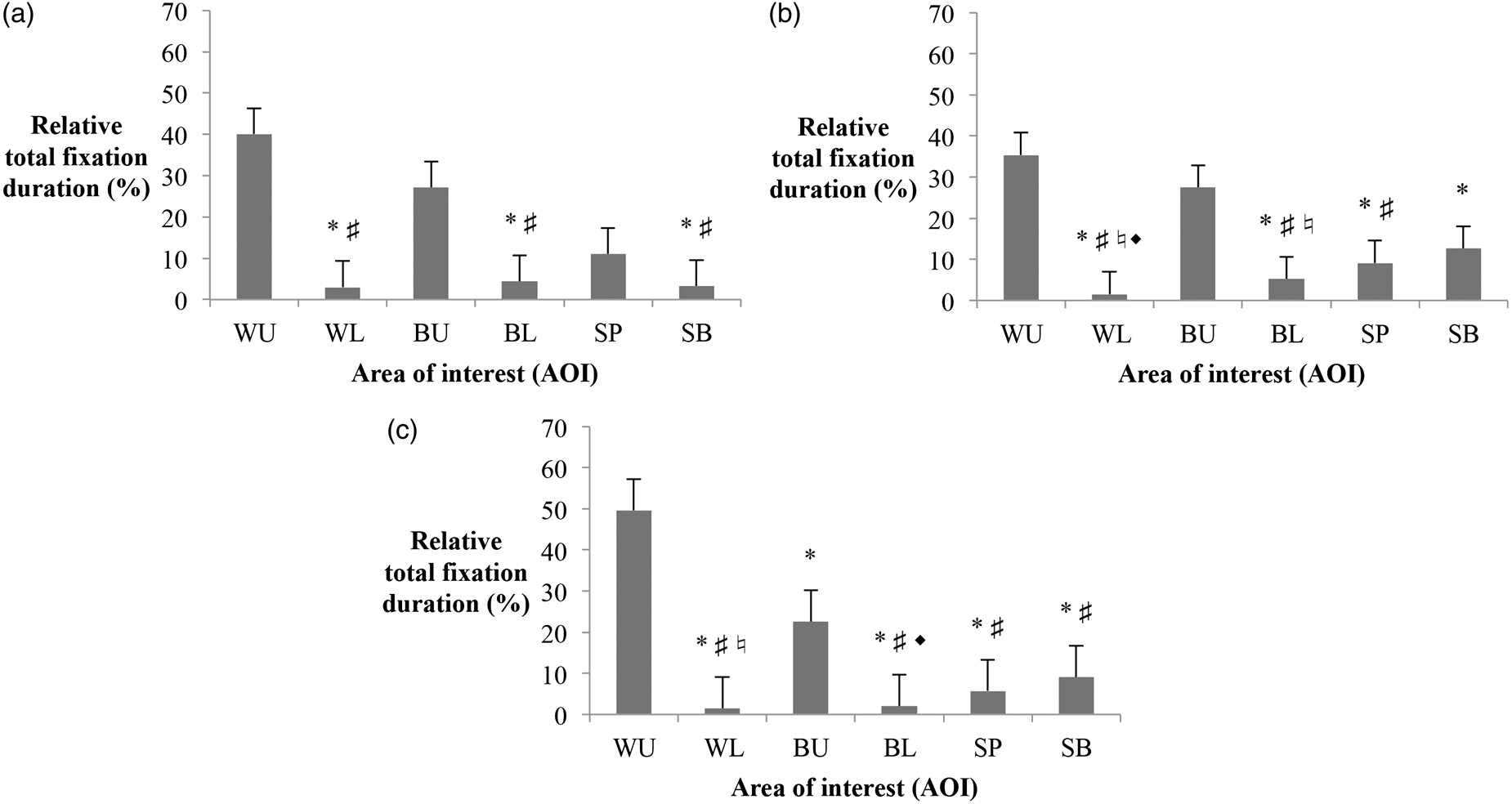
NAT
There was no significant difference between the relative total fixation duration on WU (35.38 ± 13.24%) and BU (27.44 ± 15.39%). The relative total fixation duration on WU was significantly longer than all other AOIs (p < 0.02, minimum mean difference = 22.7%, d = 2.15 to 4.01). The relative total fixation duration on BU was significantly greater compared to all other AOIs (p < 0.05, minimum mean difference = 18.32%, d = 1.68 to 2.67) except SB (12.68 ± 8.88%). The relative total fixation duration on SB was significantly longer (p < 0.03, d = 1.02 to 1.85) than WL (1.55 ± 1.89%) and BL (5.25 ± 6.04%). The relative total fixation duration on SP (9.12 ± 5.60%) was significantly longer (p = 0.011, d = 1.81) than WL (Figure 2(b)).
INT
The relative total fixation duration on WU (49.64 ± 10.09%) was significantly longer compared to all AOIs (p < 0.007, minimum mean difference = 27.06%, d = 2.74 to 6.89). The relative total fixation duration on BU was significantly longer than on all other AOIs (p < 0.03, minimum mean difference = 13.47%, d = 1.59 to 3.23). The relative total fixation duration on SB (9.07 ± 7.02%) was significantly longer (p = 0.24, d = 1.47) than on WL (1.42 ± 2.21%). The relative total fixation duration on SP (5.76 ± 4.46%) was significantly longer (p = 0.038, d = 0.94) than on BL (1.99 ± 3.51%; Figure 2(c)).
Average fixation duration on the AOIs
There was a significant coaching level × AOI interaction for the average fixation duration on the AOIs, F(18,171) = 1.67, p < 0.05, ηp2 = 0.15. Follow-up separate independent one-way ANOVAs for each AOI revealed a significant between-group effect for the average fixation duration on SB F(2, 19) = 3.80, p < 0.05, ηp2 = 0.29. Post hoc analysis found that the NAT group fixated for significantly longer (p < 0.02, d = 1.28) on SB (0.94 ± 0.78 s) in comparison to the NJ group (0.17 ± 0.28 s). No significant between-group effects were observed for the other AOIs (p < 0.05, ηp2 = 0.03 to 0.1).
The average fixation duration was significantly affected by the AOI, F(9, 171) = 19.47, p < 0.001, ηp2 = 0.51. Within-group analyses indicated that AOI had a significant effect on the average fixation duration on an AOI within the NJ group, F(9, 54) = 4.24, p < 0.001, ηp2 = 0.41, NAT group, F(9, 63) = 9.07, p < 0.001, ηp2 = 0.56, and INT group, F(9, 54) = 13.15, p < 0.001, ηp2 = 0.69.
NJ
There were no significant differences between the average fixation duration on WU (0.74 ± 0.45 s), BU (0.78 ± 0.45 s), SP (0.53 ± 0.58 s), and BL (0.41 ± 0.33s). WU was fixated for a significantly longer average duration compared to all other AOIs (p < 0.05, minimum mean difference = 0.44 s, d = 1.17 to 2.28). The average fixation duration on BU was significantly longer (p < 0.05, minimum mean difference = 0.47 s, d = 1.26 to 2.40) than all other AOIs except SP (0.53 ± 0.58 s), and BL (0.41 ± 0.33 s; Figure 3(a)).
(a) Average fixation duration (s) NJ group (mean + SE). (b) Average fixation duration (s) NAT group (mean + SE).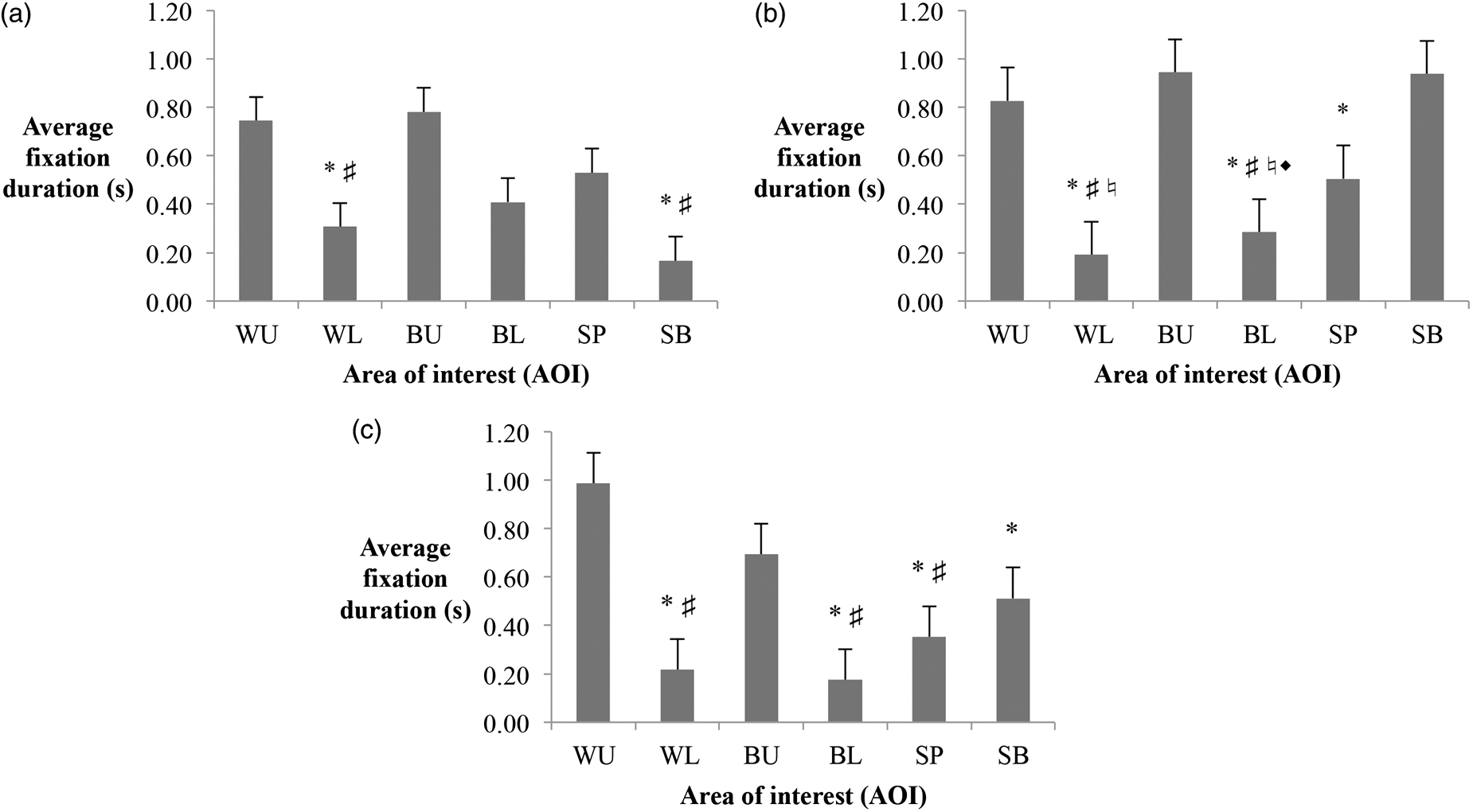
NAT
The average fixation duration on WU (0.83 ± 0.22 s) was not significantly different to BU (0.94 ± 0.55 s), SP (0.94 ± 0.78 s), and SB (0.51 ± 0.31 s). WU was fixated for significantly longer average duration compared to all other AOIs (p < 0.02, minimum mean difference = 0.54 s, d = 2.06 to 4.75). The average fixation duration on BU was significantly longer than on all other AOIs except SP and SB (p < 0.03, minimum mean difference = 0.66 s, d = 1.50 to 2.31). The average fixation duration on SB was significantly longer (p < 0.04, d = 1.10 to 1.28) than on WL (0.19 ± 0.25s) and BL (0.28 ± 0.30s). The average fixation duration on SP was significantly longer than BL (p = 0.12, d = 0.72; Figure 3(b)).
INT
There was no significant difference in the average fixation duration on WU (0.99 ± 0.26 s) and BU (0.69 ± 0.18 s). The average fixation duration on WU was significantly longer than on all other AOIs (p < 0.02, minimum mean difference = 0.47 s, d = 1.47 to 4.54). The average fixation duration on BU was significantly longer (p < 0.02, mean minimum difference = 0.34 s, d = 1.74 to 4.15) compared to all other AOIs except SB (0.51 ± 0.37 s; Figure 3(c)).
Discussion
Judo contests are complex situations, in which judo coaches may observe unfamiliar judokas (e.g. coaching a judoka new to the squad, or observing judokas their athlete may face in future contests). Judo coaches have self-reported that grip and body position are key areas to observe during contests; 3 however, there have been no investigations into the visual search strategies of judo coaches. Therefore, the aim of the present study was to investigate the effect of coaching experience on the visual search strategies of elite (INT) and sub-elite (NAT) judo coaches, and those with no experience (either coaching or playing) of judo (NJ), when observing unfamiliar judokas during the preparation phase of contests. As an exploratory study, the present study can also inform further investigations into judo coaches' visual search strategies.
Findings from the present study did not reveal any expertise-based between-group differences of significance for the relative number of fixations and relative total fixation duration. Within-group differences concerning upper body AOIs were found; these differences varied across groups and suggest that the INT coaches may have adopted an alternative visual search strategy to the NJ and NAT groups. However, due to the lack of between-group differences for the upper body AOIs some caution is warranted, with further investigations required to develop greater understanding of judo coaches' visual search strategies.
The INT coaches fixated more frequently on WU (52% ± 15%) compared to all other AOIs (Figure 1(c)). If, as suggested by Santos et al., 3 grip and body position are key areas attended to by elite coaches, the results of this study show that this information appears to be gathered from the upper body. There was no significant difference between the INT coaches average fixation duration on WU (0.99 ± 0.26 s) and BU (0.69 ± 0.18 s), which in combination with the increased fixation frequency on WU, resulted in increased relative total fixation duration at WU (50 ± 10%) versus BU (23 ± 10%), and versus all other AOIs (Figure 2(c)). Similar to the INT, the NJ and NAT groups fixated more frequently on WU; however, there were no significant within-group differences between WU (NJ: 44 ± 22%; NAT: 37 ± 10%) and BU (NJ: 29 ± 11%; NAT: 27 ± 14%). Similarly, there were no significant differences between the relative total fixation duration on WU (NJ: 40% ± 24%; NAT: 35% ± 12%) and BU (NJ: 27% ± 12%; NAT: 27% ± 14%) within the NJ and NAT groups. These findings suggest that INT coaches employed a strategy whereby they frequently returned to fixate the upper part of the judoka they had been instructed to observe, while maintaining a similar average viewing time looking at both judokas. However, this strategy was not observed within the NAT or NJ group.
While all groups fixated on WU and BU most frequently and for prolonged periods, the drive to look at these areas would have differed. Visual search is driven by the salience of features in the visual scene (stimulus driven, bottom-up signals), and the requirements of the visual search task (goal-directed, top-down signals). 33 The greater familiarity of the NAT and INT groups with the visual scene and instructions (i.e. provide coaching points for the judoka wearing white) would have resulted in goal-directed, top-down signals to obtain contest-specific information. The preparation phase of the contest, as analysed in this study, is a tactical phase where judokas aim to control the space between themselves and their opponent, and attempt to establish their first grip while avoiding their opponent's attempts to grip them. 2 Gripping of the opponent's judogi is essential for the execution of judo techniques, 40 and achieving a favourable first grip is important, with the lapel the most common first grip location. 43 Attempts to grip must be made on or above the belt of the opponent; attempts to grip or make contact below the belt are penalized. 37 Gripping has previously been identified as a key aspect to observe when coaching during contests, 3 and fixating on WU and BU would have provided the NAT and INT groups with information about gripping strategies as key grip locations (i.e. lapel) and the rules locate information about grips in the upper body AOIs. Fixating on these areas appears to have been a purposeful strategy driven by prior knowledge regarding the requirements of the task. That all other AOIs each accounted for ≤ 13% of fixations, and were each fixated for < 13% of clip duration in the NAT and INT groups, indicates the importance of the upper body AOIs to the judo coaches. Furthermore, it is feasible that the NAT and INT groups' would have been looking at specific regions within the upper body AOIs (e.g. lapel as a possible grip location 44 ). However, in the present study, it was not possible to identify fixations on such specific regions. Future investigations should consider approaches that allow identification of specific upper body regions, and the use of adjunct measures such as verbal self-reports of thinking (e.g. Afonso et al. 43 ) to aid in the identification of where coaches are looking.
In contrast to the NAT and INT groups, salient features and attempts to understand an unfamiliar scene would likely have driven the visual search strategy of the NJ group. Movement is a salient feature and can strongly guide visual search and attentional deployment.45,46 Both judoka were engaged in attempts to grip resulting in large amounts of upper limb movement in WU and BU, thus providing similar salient features in the visual scene. In addition to movement, colour, contrast, and size are salient features,45,46 and the two judokas presented such features. The white and blue judogi worn by the judokas contrasted strongly with the tatami (red and yellow matted contest area) and the background (i.e. unlit seating area), and the judoka were the largest moving features in the visual scene (the referee was of a similar size but was largely static). As such, the combination of movement located in the upper body AOIs, and the colour, contrast, and size of the judokas in the visual scene provided strong salient stimuli to the NJ group. Goal-directed, top-down signals can suppress stimulus-driven, bottom-up signals;34,35,47 however, unlike the NAT and INT groups, it is likely that the NJ group's unfamiliarity with the visual scene meant that contest-specific goal-directed, top-down signals were not present and therefore could not suppress the influence of the salient features.
Whereas contest-specific goal-directed, top-down stimuli (e.g., obtain information about gripping) were likely to be absent in the NJ group, the instruction (i.e. provide coaching points for the judoka in white) and attempts to understand an unfamiliar visual scene may have resulted in some goal-directed, top-down stimuli being present. It is probable that the pre-task instruction guided eye movements to the specified judoka. Pre-task instructions can attract eye movements to the specified area, 8 and may do so due to the information provided being held in working memory, before subsequently guiding eye movements to the area. 48 Furthermore, it is plausible that fixating on the upper body AOIs was an attempt to gain some understanding of the unfamiliar visual scene. When presented with visual scenes containing several people and objects, peoples' eyes and heads are the most frequently fixated areas. 49 In particular, fixating on the eyes of a person in the visual scene allows the observer to establish the attention and intentions of that person (e.g. where they are looking and possible future movements). 50 In the absence of information from the eyes, the head and body orientation of a person can provide such information. 51 While the head and eyes were not specified as AOIs in the present study due to tracking limitations, the head and eyes were contained within the upper body AOIs. Consequently, the NJ group may have been looking at these regions within the upper body AOIs in an attempt to gain visual information about the judokas' intentions.
While the upper body AOIs provided contest-specific information to the NAT and INT groups, the INT group fixated on WU compared to other AOIs significantly more frequently and for a significantly longer proportion of the clips. However, in the NAT group there were no significant differences between WU and BU for the relative number of fixations and relative total fixation duration. The greater experience of the INT group may account for their alternative search strategy. In addition to gripping, establishing the handedness of judokas in a contest is important, as handedness can indicate attacking intentions. 41 A judoka's stance can indicate their handedness (e.g., left foot and left hand forward indicates left handedness); however, at higher competitive levels, judoka adopt varied stances not consistently related to their handedness. 40 The use of varied stances may help a judoka disguise their attacking intentions by reducing the number of familiar postural cues available to their opponent,52–54 and well-trained judoka have the ability to attack in multiple directions. 55 As the INT coaches had greater experience of observing judoka in international competition, it is possible that they are more aware of attempts by high-level judoka to disguise their handedness and attacking intentions during contests. The contests observed in this study were from an elite-level tournament; as such, the judokas' are likely to have utilised varied stances as described. Therefore, the INT coaches' eye movements frequently returned to the upper body of the judoka to ameliorate any attempt from the judoka to disguise handedness and attacking intentions. Furthermore, the drive to establish accurate information about the judoka in white could have suppressed the stimulus-driven, bottom-up signals from movement from BU,34,35,47 suggesting fixations on BU were part of a purposeful strategy, and made only when more detailed information that could not be picked up using peripheral vision was required. However, whether specific regions within the white upper body AOI were used to establish handedness could not be established in the present study. As previously mentioned, methods to identify specific regions within the upper body AOIs should be considered in future investigations.
The INT group's strategy of frequently returning to fixate WU could indicate that WU acted as a visual pivot for their visual search. Athletes appear to use visual pivots in a range of sports (e.g. soccer,14,16 volleyball, 12 table tennis,11,32 combat sports9,13,21). The visual pivot allows athletes to utilise central vision to obtain information from the area selected as the pivot, and peripheral vision to gather information from other areas of the visual scene (e.g., other players, 16 distal parts of an opponent's body 14 ). Information gained from the visual pivot may underpin decision-making 16 and facilitate anticipation.11,14 If necessary, athletes can saccade from the visual pivot to other areas to acquire more detailed information, before making a saccade back to the visual pivot. 16
While the use of a visual pivot has been observed in combat sport athletes,9,21 including judoka, 13 how a visual pivot is used by a judo coach observing a contest may differ. Similarities between the visual search strategies of athletes and coaches from the same sport have been highlighted, 16 and it would seem feasible that judo coaches may adopt similar search strategies to judokas. Yet the visual scene presented to the judo coach is dissimilar to the scene presented to the judoka. Investigations into the visual search strategies of combat sport athletes typically involve the participant viewing one person (i.e. their opponent) who is in close proximity and fills the majority of the visual scene. In this instance, it is likely that athletes attempt to gather the majority of their information from the opponent's postural cues to anticipate their movements. 20 In contrast, a combat sport coach viewing a contest, as in the present study, observes two athletes moving in a larger area. When viewing multiple athletes in larger areas, relative information (e.g., relative position of athletes to one another) also informs viewers' decisions. 39 For the elite judo coaches observing the preparation phase, where judokas attempt to control the space between them and their opponent, relative information would have been important. Therefore, it is feasible that WU acted as a visual pivot that allowed them to obtain information about the handedness and attacking intentions of their judoka, while using peripheral vision to gather information about how the space between the judokas was being controlled.
While the within-group analysis suggests that the INT group utilised an alternative visual search strategy to the NJ and NAT groups, the lack of between-group differences indicates similarities in search strategy across the groups. Previous research has found no expertise-based differences in the visual search strategies of coaches 27 and officials.23,24 However, the investigations into officials' search strategies found that despite the lack of expertise-based differences, more experienced officials made more accurate decisions.23,24 The greater accuracy of the experienced officials can be attributed to more effective processing of visual information 23 and use of prior knowledge of similar situations30,31 to inform their decision-making. Consequently, it is possible that judo coaches, regardless of level, while visually attending to similar areas would make different coaching decisions. However, in the present study, coaching decision data were not analysed; therefore, conclusions about the relationships between decision-making and visual search were not possible. Additionally, it is highly probable that coaching decisions will be informed by visual information obtained from multiple phases, therefore any analysis of visual search strategy and coaching decisions should incorporate data from all contest phases, and not solely the preparation phase.
Conclusion
The present study was the first to investigate the visual search strategies of elite and sub-elite judo coaches, and participants with no experience of judo, while observing an unfamiliar judoka during the preparation phase of judo contests. By investigating coaches' visual search strategies, this study adds to previous work that has utilised self-report methods to identify what judo coaches attend to when observing contests, 3 and provides information to inform the development of hypotheses for future investigations into the visual search strategies of judo coaches.
Sub-elite (NAT group) and elite (INT group) judo coaches looked at the upper bodies of the competing judokas more frequently and for greater proportions of the total fixation duration compared to other AOIs, suggesting that the upper body provides important information to coaches during the preparation phase of contests. Grip, body position, and handedness have been previously reported as important aspects during a judo contest,3,20,21 and it appears that judo coaches attempt to obtain information about these aspects from the judokas' upper bodies. It is not known if differences in where the groups looked within the upper body AOIs were present. Future investigations should consider adopting methods (e.g. more specific AOIs, verbal reports of thinking) to establish if such differences exist.
It is possible that elite coaches adopted an alternative visual search strategy to sub-elite coaches (and NJ group), whereby they looked at the upper body of the judoka they had been instructed to provide coaching points more frequently and for longer than the upper body of the opposing judoka. Awareness of elite judokas attempts to disguise handedness and attacking intentions provides an explanation for the INT coaches' search strategy. By fixating frequently on the specified judoka, the elite coaches would have been able to obtain and update visual information to help them decipher any attempts at disguising attacking intentions. The specific regions that allowed them to do this were not identified in this study. Additionally, the upper body of the judoka they had been instructed to provide coaching points for may have acted as a visual pivot for elite coaches' visual search, allowing them to obtain information about the space between the judokas.
The visual search strategy adopted by elite coaches suggests that the upper body of the judoka being coached may be of greater importance to them compared to that of the opponent's. Previous research highlights that elite performers in sport attend to more relevant information compared to sub-elite performers. 25 Therefore, it is feasible that the upper body of the judoka being coached is of greater importance (due to the need to decipher attacking intentions and provide a visual pivot) than the upper body of the opposing judoka. If this is the case then sub-elite coaches should be directed to attend to the upper body of the judoka being coached to a greater extent. However, the lack of between-group differences necessitates caution. It is feasible that expertise-based differences in visual search strategy do not exist. Yet, similar visual search strategies do not necessarily result in similar decision-making accuracy;23,24 and therefore future studies should consider the interaction between visual search strategy, establishing handedness and attacking intentions, prior knowledge, and decision-making in judo coaches of different levels. Additionally, researchers should investigate if judo coaches adopt similar search strategies when observing familiar judokas during contests.
Footnotes
Declaration of Conflicting Interests
The author(s) declared no potential conflicts of interest with respect to the research, authorship, and/or publication of this article.
Funding
The author(s) received no financial support for the research, authorship, and/or publication of this article.