




Abstract
This article presents an evaluation of the effectiveness of an applied mindfulness intervention for stress reduction delivered to Paralympic leaders prior to the Paralympic Games. The intervention group of Swedish Paralympic leaders (n = 10) received a mindfulness intervention of eight web-based seminars, while a Norwegian reference group (n = 6) received no intervention. Three assessments were performed for both samples: at baseline, post-intervention and six weeks post-intervention. The evaluation indicated intervention effects of higher psychological flexibility (p = .03), less rumination (p = .02) and lower perceived stress (p = .001), and offers initial support for the applied usefulness of a web-based mindfulness training program as a supplement in stress-reduction programs for elite sport leaders. General challenges from an applied sport psychology perspective related to the implementation of mindfulness interventions in samples with experienced high levels of stress and perceived time-constraints are discussed.
Introduction
At a managing team meeting arranged by the Swedish Paralympic Committee a year before the Paralympics, a number of those in various leadership positions (e.g. head coaches, trainers, assistants and physiotherapists) expressed concerns about a highly stressful work situation. The work situation of the Paralympic leaders was described as characterized by a high workload in combination with increased general stress during the year prior to the Paralympic Games. Moreover, the leaders on the team were concerned that their opportunities and abilities to change or reduce demands and stressful circumstances were mostly lacking. Thus, they requested psychological support in gaining effective psychological skills for managing stressful circumstances in situations when a high level of cognitive processing is needed, and time for recovery is limited. When searching for available coach support interventions, we identified a dearth of studies in the sport psychology literature on psychological support for elite sport leaders. Psychological support and interventions have been developed primarily to meet the needs of athletes.1–3 The present evaluation of the mindfulness intervention was therefore conducted as a pilot project, arising explicitly from the needs expressed by the Paralympic sport leaders. In order to address the lack of applied knowledge about the effectiveness of interventions targeting psychological experiences of stress among sport leaders, a decision was made to evaluate the intervention using both baseline and post-intervention assessments.
Elite coaching can be rewarding, but there is also uncertainty as to whether the efforts of time and commitment invested by the coach will result in any tangible rewards at important competitions. In the literature, it is acknowledged that being part of a sport management team at an elite level is characterized by a high level of exposure to a number of unpredictable stressors, often in combination with a low level of control over the situation and high demands.4–6 Increased levels of stress may affect psychological processes, for example decision-making ability, reactions and behaviors,7,8 which may adversely affect leaders’ professional effectiveness in coaching and their long-term health (e.g. burnout or other stress-related illnesses).1,9–11 A psychological approach that has demonstrated effectiveness in addressing stress in non-clinical samples is mindfulness.12,13
Mindfulness has its origins in the Buddhist meditative tradition with its focus on the practice of conscious attention in the present moment, including both external events and internal experiences of thoughts, physical sensations and emotions. 14 Kabat-Zinn,15,16 who introduced one of the first mindfulness curricula to be empirically studied, defines mindfulness as a non-judgmental, purposeful and moment-to-moment awareness. Conceptually, mindfulness comprises consciousness, awareness and attention. Awareness can metaphorically be described as resembling radar, consciously scanning a person’s internal and external environment for stimuli located at the centre of attention or peripherally. Attention includes the process of focused consciousness toward a certain stimulus by which the person narrows and intensifies his/her attention. 14
Mindfulness differs substantially from traditional psychological skill techniques (e.g. emotional and arousal regulation, thought control or cognitive reframing) that emphasize increasing the participant’s control of inner states through efforts to alter or reduce stressful or otherwise disturbing stimuli.17–19 In contrast, mindfulness training is focused on non-judgmentally accepting internal states as naturally occurring phenomena, observing thoughts and feelings as non-dangerous psychological states in order to increase one’s awareness of all the experiences the present moment has to offer. 19 Thus, participants in mindfulness training learn to act on situations and other persons more thoughtfully and compassionately, with a high degree of awareness and understanding, rather than acting emotionally or impulsively.13,20
In the clinical literature, mindfulness has received increasing empirical support as an effective treatment for reducing stress-related difficulties and avoiding relapse into a range of various conditions including, for example, depression,21–23 psychosis, 24 worry and anxiety disorders, 25 chronic pain 26 and sleep disturbances. 27 To date, fewer studies have been conducted with subclinical and healthy populations. College students who received mindfulness training showed a general feeling of increased control over life, more acceptance of demanding situations in life, increased positive emotions and reduced experiences of stress as well as an increased ability for non-judgmental awareness. 28 Systematic reviews and meta-analyses have found support for the effectiveness of mindfulness on psychological well-being and stress reduction among healthy participants.13,29,30 Mindfulness also resulted in larger effects than traditional relaxation on decreased rumination and worry as well as on increased ability for empathy and compassion. 13
In the sport psychology literature, there is increasing support for the efficacy and effectiveness of mindfulness interventions for athletes.31,32 For example, Bernier et al. 33 showed that an educational mindfulness practice, based on Mindfulness-based Cognitive Therapy (MBCT) 34 and Acceptance Commitment Therapy (ACT) 35 which was performed during a complete season with seven young golfers, increased their mindfulness skills as well as their awareness of activation level and routines. The golfers also perceived the intervention as positive for their performance. Mindfulness practice has also been associated with an increased experience of flow among athletes as well as decreased maladaptive perfectionism, perceived organizational demands and performance worries.36–38 Long-term effects (e.g. ability to act with awareness, increased trait mindfulness, decreased levels of task-irrelevant worries/thoughts) a year after a mindfulness intervention have also been reported in the literature. 39
Whereas empirical studies have focused on presenting evidence for the effectiveness of mindfulness on demands placed on competitive athletes, its applicability on stress reduction for sport coaches is still largely unexplored. 40 By use of a mixed-method approach including assessments of mindfulness, emotional stability and anxiety as well as qualitative interviews, in a first study on coaches Longshore and Sachs 40 found some initial support that mindfulness practice increased emotional stability and decreased anxiety among coaches. Interviewed coaches also reported that the mindfulness training had a positive impact on other aspects of their lives (e.g. personal life, patience and interaction with athletes). Thus, based on research results in both sport and other settings, mindfulness training could be a promising approach to improve sport leaders’ ability to change their attitudes towards stressors and to help them enable breaks and recovery on a daily basis. 41
The purpose of the present article is to report on an evaluation of a mindfulness intervention with Paralympic leaders conducted in a highly ecological setting prior to the Paralympics. The intervention was an integral part of a larger support program, offered by the Swedish Paralympic Committee, to prepare the leaders before the Paralympic Games. The effectiveness of the intervention was evaluated by use of variables related to mindfulness and stress (i.e. perceived stress, level of mindfulness, rumination, psychological flexibility and sleep quality). The hypothesis prior the implementation of the intervention was that Paralympic sport leaders participating in the mindfulness program would show improved results on all mindfulness-related dependent variables (increased mindful awareness and psychological flexibility, and decreased rumination), decreased levels of perceived stress and improved sleep. The intervention sample was also compared to a reference group, which received no treatment.
Method
Participants
A total of 15 Swedish Paralympic leaders were initially invited to participate in the intervention, and 10 Norwegian Paralympic leaders were invited to be part of the reference group who received no treatment at all. Five Swedish leaders and four Norwegian leaders did not participate in more than the baseline assessment. Thus, these participants were excluded from the analyses and the final samples consisted of 10 Swedish leaders (men = 6, women = 4; mean age = 48.40, SD =8.86) and six Norwegian leaders (men = 3, women = 3; mean age = 38.67, SD = 9.69). All leaders belonged to either the Swedish or the Norwegian Paralympic committee support program and were to participate in the Paralympic Games. Prior to consenting to participate in the intervention, all leaders were given ethical information and signed informed consent. The data collection presented in this article constituted a master’s thesis project conducted at Stockholm University. 42 According to the Swedish law of ethics, student theses written at Swedish universities are regarded as educational papers and are thus not required to receive ethics approval from the national board in Sweden. Nevertheless, the ethics of student projects are judged by the supervisor group at the university to ensure that the Declaration of Helsinki’s ethical principles for research involving human subjects are complied with before students receive approval to conduct their thesis.
Instruments
The Perceived Stress Scale (PSS) 43 is a 10-item inventory that assesses individuals’ perceptions of situations in their lives as stressful. Answers are rated on a scale ranging from 0 (not at all) to 4 (very often). The PSS has revealed adequate internal consistency (<.70) and adequate concurrent and predictive validity in terms of correlations with ratings of life events, depressive and physical symptoms, and use of health care and social anxiety.43,44
The Rumination–Reflection Questionnaire (RRQ) assesses the two sub-dimensions of rumination and reflection. Rumination refers to a person’s tendency for self-focus and has revealed correlations with neuroticism. 45 The RRQ has displayed adequate internal consistency and convergent validity.45,46 In the present study, only the rumination subscale with 12 items was used, based on its association with stress and in order to limit the number of items. Respondents rate their answers on a five-point scale, ranging from 1 (strongly disagree) to 5 (strongly agree).
The Mindfulness Attention and Awareness Scale (MAAS) 47 was used to assess the level of mindfulness among participants. The questionnaire consists of 15 items on which participants rate their experiences of mindfulness during the day. Answers are provided on a six-point scale, ranging from 1 (almost always) to 6 (almost never). A higher score on the MAAS indicates a higher awareness of internal and external experiences and has been shown to be related to a better capacity to alter one’s emotions and higher well-being, perceived autonomy, competence and relatedness, as well as less social anxiety. 47 Studies have shown good internal consistency, test-retest reliability, and concurrent and incremental validity among college students and adult populations.47–49
Sleep was assessed using two subscales from the Karolinska Sleep Questionnaire (KSQ), 50 which includes four items on sleep quality and three on awakening during the night. Respondents rate their answers on a five-point scale ranging from 1 (never) to 5 (always), with a high score on the two subscales indicating disturbed sleep. Studies have shown adequate validity and reliability and have displayed a relationship between disturbed sleep and high work-related demands, low social support at work and high physical workload. 50
Psychological flexibility – that is, a person’s ability to accept unpleasant experiences such as thoughts, feelings and physical sensations and continue to pursue long-term goals and values – was assessed using the 10-item Acceptance and Action Questionnaire (AAQ-II), with a response scale ranging from 1 (never true) to 7 (always true). The scale has demonstrated adequate reliability and validity. 51 The opposite of psychological flexibility is psychological inflexibility, which involves emotional avoidance whereby a person has difficulty distancing him/herself from inner thoughts, feelings and physical sensations, and acts primarily based on emotions instead of long-term goals and values. Psychological inflexibility has shown a relationship with depressive symptoms, worry, stress and psychological ill-being. 51
Procedures
Three assessments were conducted: pre-intervention (five days before the intervention started), post-intervention (immediately after the intervention ended) and six-week follow-up. The intervention group participated in the mindfulness intervention, whereas the reference group received no treatment. The Swedish leaders (the intervention group) were initially contacted by e-mail with information about the study. Interested leaders were thereafter gathered and given verbal information about the study and intervention. The leaders were also given a theoretical lecture on the concept of mindfulness and were allowed to practice a few mindfulness exercises. Leaders interested in participating in the full intervention were included in the study and were provided with the necessary material (e.g. a CD with mindfulness exercises and a logbook with instructions to note how often they listened to it) to take part in the web-based program. Two weeks prior to the start of the intervention, the participants again received written information about the study and its design. The intervention was scheduled to start three months before the Paralympic Games and to end four weeks before the opening ceremony. The intervention leader was a mindfulness instructor with 10 years of experience practicing mindfulness and was also a final-year clinical psychologist student.
The reference sample was selected based on their similarity to the Swedish sample regarding the ratio of leaders to athletes on the team, the general culture across the countries, and the similar goal-setting of the team, which for both samples was to exceed their results in the previous Paralympic Games. The Norwegian leaders were contacted by e-mail three weeks prior to the first assessment. They were provided with information about the study and asked to complete the questionnaire three times during the study (the same time points as the assessments for the Swedish leaders). One week before the first assessment, leaders who had volunteered to take part in the study received further information on how to complete the questionnaires. For both the Swedish and Norwegian leaders, login information and instructions for completing the questionnaires were sent prior to each assessment.
Intervention
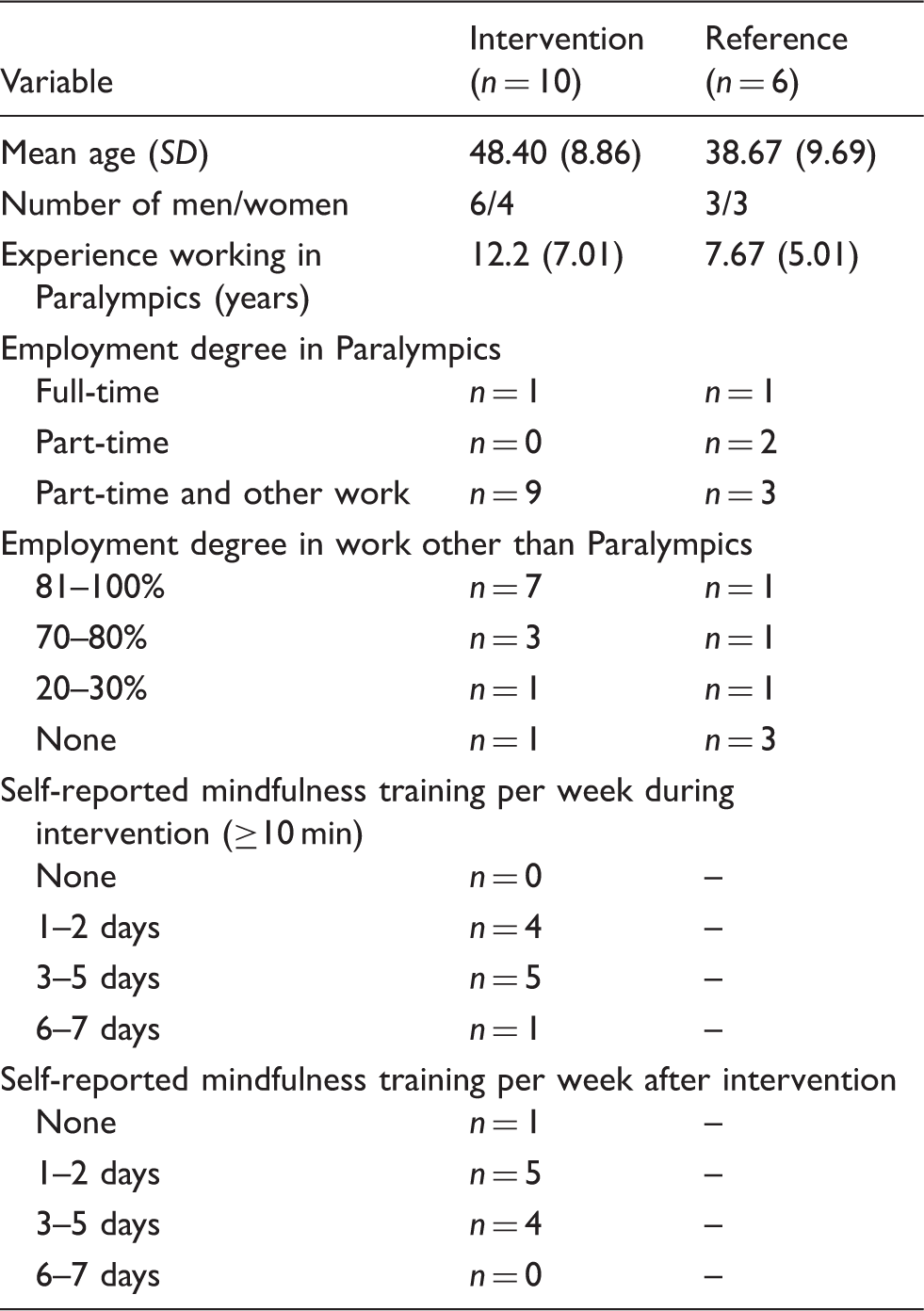
Descriptives of the intervention and reference groups regarding age, number of each sex, employment and level of mindfulness practice during and after the intervention.
In this study, exercises and examples were slightly rewritten in language (e.g. using words like leaders instead of employees, and sport or the Paralympics instead of business or company) suiting sport leaders working for the Swedish Paralympic Committee. Eight web seminars, each given on a Thursday, were offered to the participants. In order to make it easier for the sport leaders to participate, the same seminar was offered in the morning and in the afternoon so they could choose the most convenient time of day. The theme for each seminar was e-mailed to the sport leaders beforehand. The themes were (1) pauses with mindfulness and awareness; (2) mindful work and coaching; (3) mindful communication; (4) mindful travels with a beginner’s mind; (5) mindful meetings; (6) mindful e-mailing; (7) mindful eating and (8) letting go. The seminars were also audio recorded and e-mailed to all participants, which allowed them to listen to the content again after the seminars had been completed. All sport leaders participated in the first two seminars (n = 10); participation decreased slightly over time (Seminar 3: n = 9, Seminars 4–6: n = 7, Seminar 7: n = 5, Seminar 8: n = 8). The intervention leader started each seminar with a review of the previous one and a discussion of good experiences and difficulties or obstacles the participants may have encountered during the week. The seminars always ended with a traditional 10-min mindfulness exercise based on anchoring attention to breathing and the possibility to ask questions and continue the discussion in a chat forum.
Results
Descriptives of the demographic characteristics of the participants in the two samples are provided in Table 1. As shown, all leaders were experienced in working with the Paralympics. One participant in each sample held a full-time position in Paralympic sport, whereas the majority also held part-time positions in non-sport occupations. All participants practiced mindfulness for 10 min or more each week (range: 1–7 days/week) during the intervention, and all but one participant continued to practice after the intervention ended (range: 1–5 days/week).
Mean values and standard deviations for the three assessments and paired sample t-tests in each sample.

AAQ: Acceptance and Action Questionnaire; KSQ: Karolinska Sleep Questionnaire; PSS: Perceived Stress Scale; RRQ: Rumination–Reflection Questionnaire. M (SD): Mean (standard deviation). *p<.05
Paired sample t-tests on the dependent variables, shown in Table 2, were performed to evaluate any changes between the baseline and the post-intervention assessments as well as between the assessments at baseline and six weeks post-intervention. Results revealed no significant changes in the scores for any variable (mindful awareness, perceived stress, psychological flexibility, rumination, sleep quality and awakening) in the reference group across the assessments (p > .05). However, significant changes were revealed in the intervention group regarding perceived stress, rumination, psychological flexibility and sleep quality. Participants in the intervention group scored significantly lower, and the analyses displayed moderate to large effect sizes (i.e. Cohen’s d), at the end of the intervention on perceived stress (t (9) = 2.30, p = .05, d = .78) and rumination (t (9) = 3.38, p = .01, d = 1.22) as well as six weeks after the intervention (perceived stress: t (9) = 4.93, p = .001, d = 1.65 and rumination: t (9) = 2.91, p = .02, d = .93). As shown in Figure 1, mean scores of perceived stress and rumination for the intervention group showed a trend of gradually becoming lower over time even when the intervention had ended, whereas the reference group revealed a rather unchanged pattern. Regarding psychological flexibility, no significant change was detected in the intervention sample immediately after the intervention ended (t (9) = 1.06, p = .32, d = .34), but significantly lower scores indicating increased psychological flexibility were shown six weeks post-intervention (t (9) = 2.60, p = .03, d = .84) with a large effect size. Finally, sleep quality improved significantly, with a large effect size in the intervention sample when the intervention ended (t (9) = 2.54, p = .03, d = .89), but did not display significant changes in the six-week post-intervention assessment (t (9) = 1.29, p = .23, d = .41).
Descriptives of the significant intervention effects of psychological flexibility (AAQ), rumination (RRQ) and perceived stress (PSS). AAQ: Acceptance and Action Questionnaire; PSS: Perceived Stress Scale; RRQ: Rumination -Reflection Questionnaire.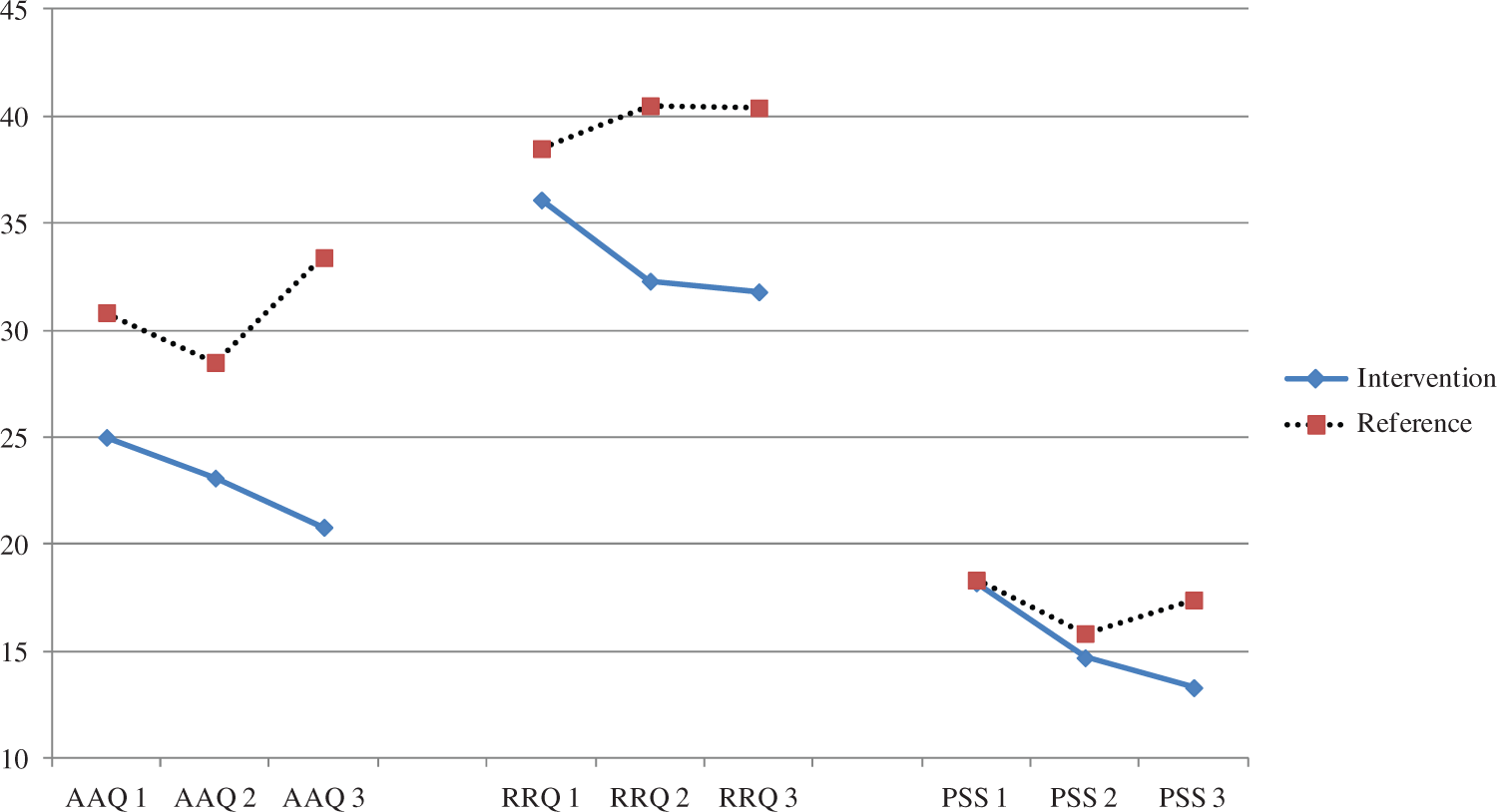
Discussion
The present evaluation of a mindfulness intervention showed no significant change in sleep or in general mindfulness awareness among the intervention participants, but did show a trend of decreased levels of perceived stress, lower rumination and increased psychological flexibility. These results are in line with previous studies on healthy populations, which have indicated positive results after mindfulness training on well-being and stress reduction.23,28,40 According to Kabat-Zinn, 16 mindfulness practice for 45 min six days a week is to be recommended. In the present evaluation, however, participant self-reports showed that they generally practiced mindfulness to a lesser extent than had been recommended at the onset of the intervention. Mindfulness practice on a daily basis with a long duration may be perceived by sport leaders as highly demanding, especially during stressful periods prior to and during championships. The effects of brief mindfulness interventions, with shortened mindfulness programs, have received increased interest in the research literature and shown promising results on, for example, increased mindful awareness, reduced psychological discomfort, self-control and subjective vitality in healthy samples.52,53 Further research is encouraged to continue the investigation of plausible beneficial brief mindfulness interventions among sport leaders suitable to this population’s work situation. Nevertheless, the results from the present evaluation indicate that mindfulness training conducted at a low dosage could be a promising complement to stress management interventions in order to obtain beneficial psychological effects among sport leaders.
From an applied perspective, the utility of mindfulness training might be highly relevant for elite sport leaders working in a highly unpredictable elite sport environment where it is generally difficult to change, control or adequately reduce perceived stressors. Yet, conducting stress-management interventions with healthy populations exposed to a high workload poses the delicate problem of motivating participants to devote and prioritize time on a daily basis to the exercises in the intervention. From the burnout literature and clinical experience, 54 it is known that highly stressed individuals also tend to ignore their bodies’ warning signs as long as they are not immediately severe. Instead, a short-term solution is a common response in which persons react to stress-related emotions by increasing their efforts to manage the work at hand. At the same time, perceived time constraints usually lead people to down-regulate self-care and recovery activities. Unfortunately, this may result in long-term adverse health effects. 54
In the present mindfulness intervention, an approach entailing web seminars offered at two different times of day was chosen in order to facilitate participation and reduce time constraints. Whereas the majority of the leaders took part in most of the seminars, the participation rates varied somewhat over time, suggesting that all participants still could not or did not prioritize the sessions every week. A further complicating matter is that mindfulness may require a period of regular training before participants become aware of any effect. Thus, in similarity to many other behavioral changes, the direct gain of effects will likely not be fully experienced early in the intervention and thus some persistence from the participant will be needed over time. 34 Moreover, various perceived effects may be apparent at various phases of the intervention. In the present evaluation, both perceived stress and rumination already showed significant decreases by the end of the intervention. Psychological flexibility, on the other hand, had not improved significantly until six weeks after the intervention. Thus, the results imply that some effects may occur relatively soon after participants start their mindfulness training, whereas other effects may be delayed. Altogether, these issues suggest that future research and applied work on mindfulness training not only need to consider the efficacy of mindfulness training as a method, but researchers also need to evaluate and design effective strategies to support participants in their performance of continuous mindfulness training despite perceived time constraints and, in the early intervention phases, to motivate participants to persist with the mindfulness training until beneficial effects are likely to occur. Regardless of whether the method itself is highly efficient, the results will depend on the degree to which participants engage in and commit to the mindfulness training and apply the approach learned in their daily activity both during the intervention and after it ends. All but one participant in this evaluation had continued the mindfulness training to some extent at least six weeks after the intervention had ended. As suggested by Thompson et al., 39 the implementation of one or a few booster sessions after an intervention ends may nevertheless help participants maintain their motivation for continued practice over a prolonged time. Furthermore, this may be an important strategy for the retention of elite-level coaches in a highly demanding context.
In the present article, mindfulness training was evaluated in a highly ecological setting with sport leaders at a true elite level, which resulted in the use of small samples and thus decreased power of the statistical analyses. Statistical effects in both the intervention and reference groups might have been displayed with larger sample sizes. A further limitation was that the intervention and reference groups consisted of participants from two different countries; thus, specific parameters related to each Paralympic team and their preparations for the games cannot be ruled out. Sweden and Norway are culturally close, however, and the Paralympic teams were similar with regard to many parameters, such as their goal-setting and the ratio of leaders to athletes. Whereas the results do indicate support for the suitability and effectiveness of applying mindfulness training as part of stress-reduction training among sport leaders, future research that replicates as well as extends the study design is warranted.
Footnotes
Declaration of Conflicting Interests
The author(s) declared no potential conflicts of interest with respect to the research, authorship, and/or publication of this article.
Funding
The author(s) disclosed receipt of the following financial support for the research, authorship, and/or publication of this article: This work was supported by grants from the Swedish Research Council for Sport Science.