




Abstract
We investigated the effect of carbohydrate mouth rinsing on resistance exercise performance. Fifteen recreationally trained women (age 26 ± 4 y; height 1.61.9 ± 5.1 m; weight 59.5 ± 8.2 kg) completed two resistance exercise bouts consisting of three sets of five exercises (half-squat, leg press, bench press, military press, and seated row) to volitional fatigue with a 10 repetition-maximum load. Immediately prior to and during the middle of each exercise bout, subjects mouth rinsed for 10 s with 100 mL of either a 6% maltodextrin solution (CHO) or an artificially flavored solution (PLA) in a randomized, double-blind, counterbalanced fashion. Heart rate and perceived exertion were compared between conditions using a 2 (conditions) × 15 (time points) repeated measures ANOVA. Significant main effects were further analyzed using pairwise comparisons with Bonferroni post hoc tests. Total volume (exercises * sets * repetitions * load) between sessions was compared with a Student’s t-test. Statistical significance was set at p ≤ 0.05 level of confidence. The CHO resulted in more repetitions performed during half-squat, bench press, military press, and seated row, for a significantly greater (∼12%) total volume load lifted versus PLA (p = 0.039, ES: 0.49). Rating of perceived exertion was also significantly lower in the CHO versus PLA (p = 0.020, ES: 0.28). These data indicate that CHO mouth rinsing can enhance high-volume resistance exercise performance and lower ratings of perceived exertion.
Introduction
Carbohydrate supplementation (CHO) is widely used to improve or sustain performance in long duration activities (>60 min). 1 However, the value of CHO supplementation is questionable during resistance exercise and in many team sports, and may be beneficial only in conditions of high volume, and longer duration exercise (>35 min). 2 Mechanisms to explain an ergogenic effect for CHO ingestion on resistance exercise are not clearly indicated. The contribution of blood glucose to energy expenditure during intense exercise is minimal when compared to the high oxidation rates of muscle glycogen. 3 Moreover, the amount of ingested CHO that can be absorbed during 1 h of exercise is relatively small (∼20 g) and makes a minimal contribution to the total carbohydrate oxidation rate 4 except in cases where high concentrations of CHO are used (e.g. ≥20% maltodextrin and dextrose solution) where a higher uptake of glucose can occur. 2 Nonetheless, a few studies have found that resistance exercise performance may be enhanced by CHO ingestion5–8 suggesting that performance in intermittent high intensity exercise bouts (e.g. resistance training or sprint training) might be improved with CHO supplementation prior to and during workouts.
In a review article addressing the potential mechanism for CHO’s ergogenic effect on resistance exercise, Haff et al. 2 cited the increased availability of blood glucose as providing a readily available fuel source for muscle contraction and spares muscle glycogen stores. Additionally, it has been speculated that CHO ingestion might promote other centrally mediated effects that enhance neural drive and inhibit fatigue. 9 The mere presence of CHO in the mouth may activate a novel signaling pathway involved in governing energy balance and feeding behavior via touch and taste sensations. This signaling phenomenon may enhance corticomotor output and attenuate declines in motor function associated with fatigue, providing a neurological basis for enhancements in motor performance observed in many behavioral studies. 1 Thus, some authors have proposed that a CHO mouth rinse could modulate the effects of fatigue,9,10 optimize cognitive performance, 11 improve recruitment and time of the cycling time-trial in well-trained cyclists, 12 and improved the morning performance of countermovement jump height, 10 m sprint times, with no rating of perceived exertion and heart rate changes. 13
Painelli et al. 14 investigated the effect of a CHO mouth rinse on maximal strength and strength endurance. In three experimental sessions (with or without CHO and with a noncaloric sweetener), subjects performed six sets of bench press to repetition failure at 70% of 1 repetition-maximum (RM) with 2 min rest intervals between sets. The results were not significantly different between supplement conditions. However, the workout sessions consisted of only one exercise, which is not representative of practical training scenarios where multiple sets and exercises are performed. Therefore, the purpose of the present study was to investigate the effects of a CHO mouth rinse on the total repetitions over multiple sets of five exercises, heart rate and perceived exertion responses in recreationally strength-trained women.
Methods
Experimental approach to the problem
Characteristic of the participants (n = 15).
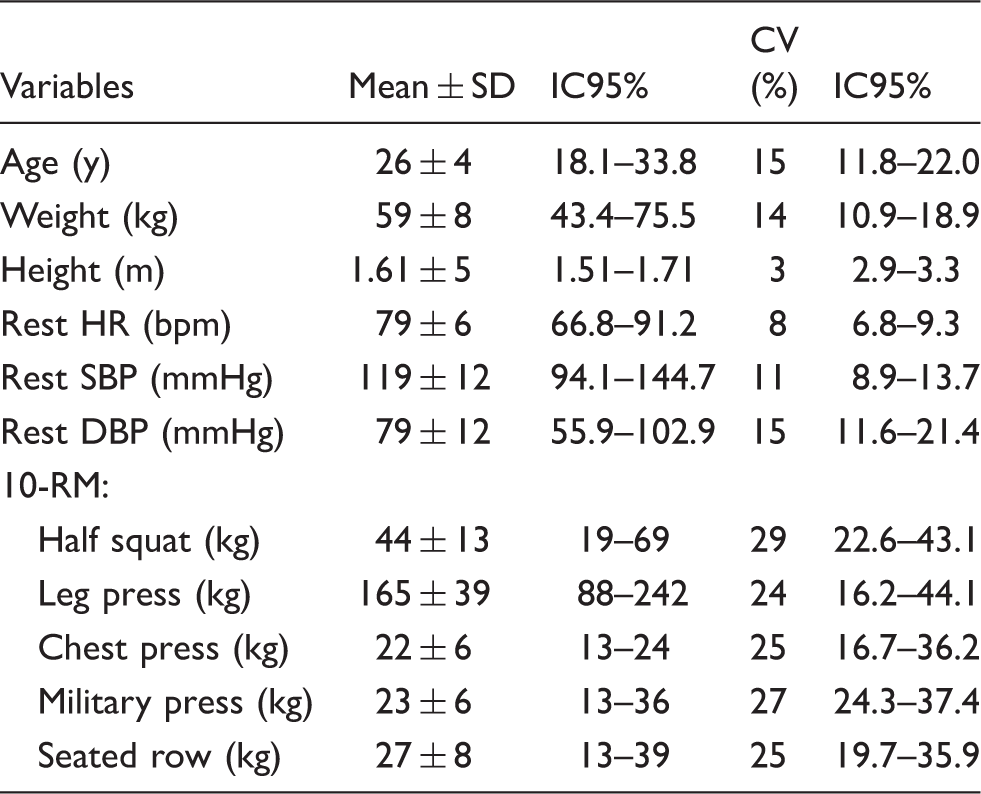
Data are shown as mean ± SD, interval confidence of 95% (IC95%), and coefficient of variation (CV).
HR: heart rate; SBP: systolic blood pressure; DBP: diastolic blood pressure; 10-RM: ten-repetition maximum load.
Participants
Fifteen women (age 26 ± 4 y; height 1.61 ± 5 m; weight 59 ± 8 kg) with 1 to 2 years prior strength training experience served as volunteers for this study (Table 1). The participants’ prior strength training regimen included three one-hour sessions per week; three to five sets per exercise; and six to fifteen repetitions per set. Additionally, potential volunteers were excluded based on the following criteria: (a) subjects could not have used drugs or nutritional supplements during the previous six months that could affect performance outcomes; (b) participants could not exhibit bone, joint or muscular problems that could limit the effective execution of the leg press exercise; (c) participants could not be performing any extraneous structured exercise program for the duration of the study. All participants read and signed an informed consent, which thoroughly explained the testing procedures; the experimental procedures were approved by local ethics committee.
Procedures
In a cross-over, counterbalanced, double-blind design, participants completed two experimental conditions: placebo mouth-rinse (PLA), and CHO mouth-rinse (CHO). The experimental sessions were conducted on different days (72 h apart) and were randomly ordered. The rinsing solutions were coded by a nonaffiliated researcher to ensure double-blinding and all of the tests were performed following an 8 h overnight fast. Participants were encouraged to keep their meals as usual throughout the experimental period, and food intake was standardized in the morning (breakfast was supplied) prior to each test.
Participants attended four data collection sessions. During the first two sessions, participants were tested for a 10-RM load for five exercises in this order: HS, LP, BP, MP, and SR. Two assessment sessions were conducted to establish a reliable 10-RM for each exercise (data for reliability showed on results session). The subsequent experimental sessions were also performed in this exercise sequence. To minimize the possible errors in the 10-RM assessments, the following strategies were employed: (a) all participants received standard instructions on exercise technique, (b) exercise technique was monitored and corrected as needed, (c) body position was held constant (i.e. hand width during BP and foot position during the LP test); and (d) all subjects received verbal encouragement. All 10-RM assessment procedures were performed according to Kraemer and Fry 15 and the higher of the two 10-RM loads (if there was a difference) for each exercise was used during the subsequent experimental sessions.
The next two sessions involved randomized performance of each experimental condition (i.e. PLA or CHO). During each experimental session, subjects began with a 5 min warm-up on a cycle-ergometer (5 min), and then performed 2 sets of 15 repetitions for the LP and BP with 50% of their 10-RM load. Following the warm-up, participants performed three repetition maximum sets (repetitions to failure) for each exercise with a 2-min interval between sets and exercises. The repetition cadence was controlled with a digital sound signal (Beat Test & Training, CEFISE, Brazil) that was adjusted so that each repetition was completed in approximately 2 s. However, if the repetition cadence slowed due to fatigue, the repetitions were still counted in the total score. Heart rate (HR) was measured using a Forerunner 310 XT (Garmin, USA) monitor and we recorded the value showed on final repetition of each exercise. During the test, the participants were also asked to give their RPE using the 1- to 10-point Borg scale after each set in all five exercises. 16
At the commencement of each experimental session, and immediately before performance of the BP exercise (third exercise in the sequence), participants were given 100 mL of PLA or CHO. The participants were instructed to rinse the fluid around their mouths for 10 s, and then spit the solution into a bowl held by the investigator. The placebo (PLA) mouth rinse solution was made from 100 mL of a commercially available non-caloric concentrate sweetened with aspartame and saccharin (Mondelez, Brazil). The CHO mouth rinse contained 6% of maltodextrin (Body Action, Brazil). The strong artificial sweetness reduced any sensory clues that participants might use to consciously differentiate between the CHO and PLA mouth rinses. Furthermore, both PLA and CHO had no color and drinks were served in the black bottle.
Statistical analyses
To determine the sample size, we used previously reported differences in HR and RPE during an exercise session 19 . We calculated that 15 subjects were needed to detect this association with a 2-tailed α = 0.05 and 1 − b = 0.95, 17 and Hedge’s g effect size.
All data are presented as mean ± standard deviation (SD). The reliability of the 10-RM loads for leg press exercise was assessed with the intra-class correlation (ICC) and the reliability was described as “excellent” for ICC values in the range of 0.8–1.0. 18 Heart rate (HR) and RPE were compared between conditions using a 2 (conditions) × 15 (time points) repeated measures ANOVA. Significant main effects were further analyzed using pairwise comparisons with Bonferroni post hoc tests. Total volume (exercises * sets * repetitions * load) between sessions was compared with Student’s t-test. Statistical significance was set at the p ≤ 0.05 level of confidence. Statistical analysis was completed using SPSS v17.0 for Windows (LEAD Technologies).
Results
The 10-RM assessments for each exercise demonstrated high reliability: 18 half squat (intra-class r = 0.87), leg press (intra-class r = 0.97), bench press (intra-class r = 0.84), military press (intra-class r = 0.98), and seated row (intra-class r = 0.95).
There was no difference between CHO and PLA conditions when examining workload of each exercise. However, total volume workload was ∼ 12% greater after the CHO session (7.589 ± 1.914 vs. 6.678 ±1.1741, p = 0.039, ES: 0.49) when compared with the PLA session (see Figure 1).
Volume workload (exercises * sets * repetitions * load).
A higher HR was noted after the resistance training bout, when compared to resting HR regardless of the condition. However, there were no differences between conditions in the HR response (see Figure 2).
Heart rate response (HR). No significant difference between groups. Rating of perceived exertion – Borg CR-10 (RPE).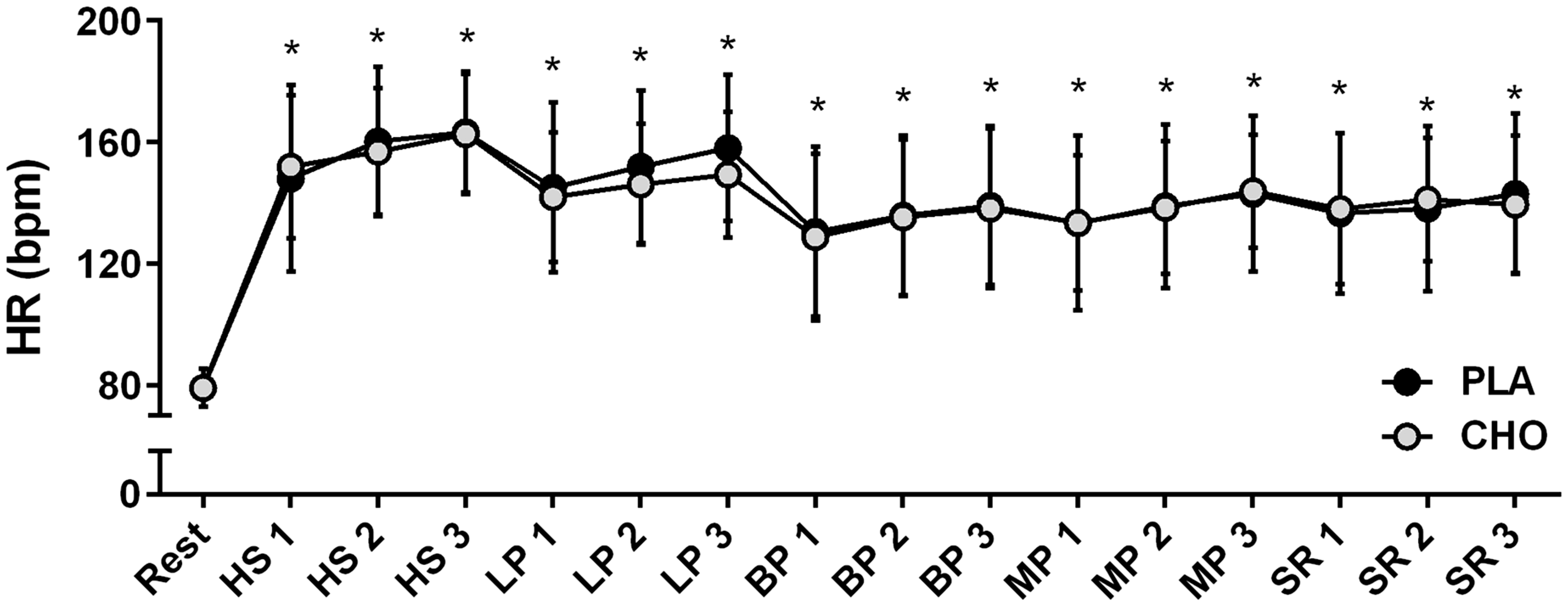
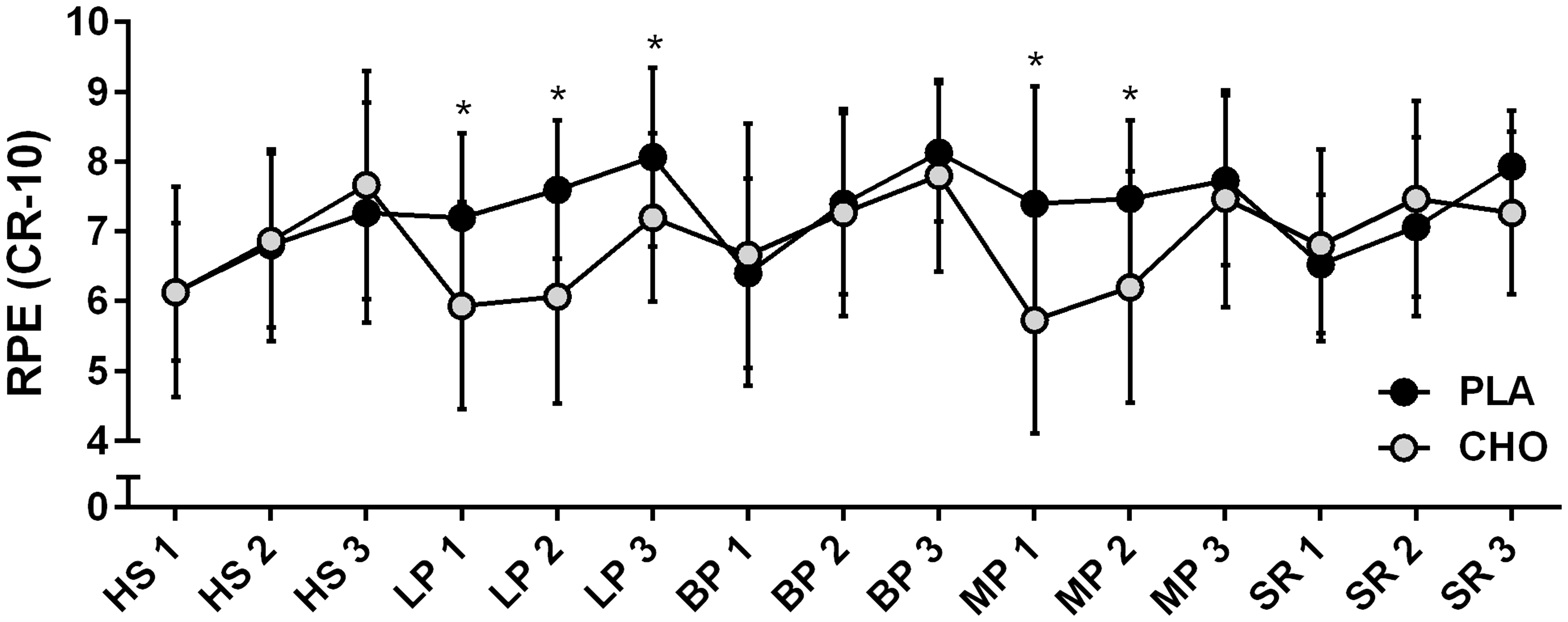
Rating of perceived exertion (see Figure 3) was significantly different between conditions for the Leg Press and Military Press; the CHO condition was significantly less than the PLA condition (p = 0.020, ES: 0.28).
Discussion
The key finding of this study was that CHO mouth rinsing resulted in a greater total volume load lifted and a lower RPE versus the PLA. This finding contradicts the previous study of CHO mouth rinsing on resistance exercise performance, 14 but corroborates several earlier studies on the effect of CHO ingestion on resistance exercise performance.5–7,13 Prior studies investigating the ergogenic effect of CHO ingestion on resistance exercise produced mixed results, both supporting5–7 and refuting19,20 an ergogenic effect.
In a review paper, Haff et al. 2 noted that a key difference between studies finding a beneficial effect of CHO ingestion on resistance exercise and studies that did not was the duration of exercise. Specifically, most studies observing an ergogenic effect of CHO ingestion employed an exercise duration lasting > 40 min,5–7,12 where shorter duration exercise bouts did not display any beneficial effect of CHO ingestion.2,20,21 However, there appears to be a threshold of work that is required before the ergogenic effects of CHO supplements occurrence.
Haff et al. 2 speculated the mechanism behind increased performance in resistance exercise with CHO was due to enhanced blood glucose supplementing diminishing glycogen stores. The current study results were in contrast with the previous report of Painelli et al. 14 that found no benefit from CHO mouth rinsing on the performance of repeated sets of a single exercise (bench press) completed in approximately 20 min. However, the present data displayed a significant enhancement of performance with CHO mouth rinsing, for a whole-body exercise bout consisting of five exercises completed in approximately 50 min.
It is interesting to note that the exercise conditions in which performance is enhanced by CHO mouth rinsing in the present study match the criteria suggested by Haff et al., 2 despite the lack of CHO ingestion. Performance enhancement in the present study cannot be attributed to an increase in blood glucose nor a sparing of muscle glycogen, as no extra CHO was consumed. Rather, the ergogenic effect of CHO mouth rinsing provides evidence of a central effect as the mechanism for CHO enhancing resistance exercise performance.
A central mechanism activated by CHO in the mouth has been documented by Carter et al. 9 and subsequently investigated in several studies. 22 Significant differences in fMRI scans of subjects when tasting CHO versus artificial sweetener have been noted, with CHO in the mouth associated with greater activation of brain regions such as the anterior cingulate cortex and striatum.1,17 In particular, the dopaminergic system of the ventral striatum is implicated in arousal, motivation, and control of motor behavior. 23
During prolonged exercise, afferent input from proprioceptors, thermoreceptors, etc. may, over time, be perceived consciously or unconsciously as noxious stimuli. The response to these unpleasant stimuli could be an inhibition of motor output or central fatigue, as proposed in the Central Governor Model. 24 Chambers et al. 17 proposed that CHO in the mouth increased activity of the dopaminergic pathways of the ventral striatum affecting either the reward or motor functions of the basal ganglia, counteracting the effects of fatigue. This hypothesis could explain why ergogenic effects of CHO on resistance exercise have only been observed with higher exercise volumes/longer durations, as the duration of exposure to fatiguing stimuli may have to accumulate for an extended duration for the CHO-induced activation of the dopaminergic pathway to make an observable difference.
A lower RPE was noted after CHO in the present study. Many studies that report a performance increase from CHO mouth rinsing in cycling time trials have reported no difference in RPE.9,13,17,25 This is likely due to the time-trial model employed in these studies, as during time trials, subjects often pace themselves to keep RPE constant.13,26 In the present, study each set was conducted to volitional fatigue, and thus subjects did not “pace” themselves in any manner, making differences in the perception of effort more noticeable. However, independent of the workload performed, our exercise protocol was performed until muscle failure (i.e. maximal effort). Knowing that ingestion of CHO maintains blood glucose level and enhances muscle glycogen synthesis, 27 can either meet the energy demand or address the effects on activity in the CNS, and might also enhance psychological stress adaptation by attenuating the sense of effort and affective responses during exercise, 28 like observed in our results (lower perceived exertion).
In conclusion, mouth-rinsing a 6% CHO solution before and during a whole-body resistance exercise bout increased volume load lifted and reduced the perceived effort. These data indicate the presence of CHO in the mouth can enhance high-volume resistance exercise performance.
Practical applications
Practitioners can apply these results during most typical workout scenarios by asking their clients to rinse with a CHO solution, consisting of 6% maltodextrin (available in most commercially available sports drinks), prior-to and at the mid-point of a resistance exercise routine. This strategy might be especially beneficial for clients on calorie-restricted diets for weight management purposes in order to maintain training volume with a lower perception of exertion.
Footnotes
Acknowledgements
This study was conducted on Laboratory of Physiology and Biokinetic (UNIG Campus V), Itaperuna, RJ, Brazil. The results of the present study do not constitute endorsement of the product by the authors or the journal and we would like to thanks to all participants in the present study for their cooperation.
Declaration of Conflicting Interests
The author(s) declared no potential conflicts of interest with respect to the research, authorship, and/or publication of this article.
Funding
The author(s) received no financial support for the research, authorship, and/or publication of this article.