




Abstract
In 2010, one of the major rule changes in basketball came into effect. Including an extension of the 3-point line from 6.25 m to 6.75 m, changed shape of the 3-s area, the addition of no-charge semicircles, and modifications of the shot-clock. This study aimed to analyse if the rule modifications influenced the game-related statistics, both short- and mid-term using interrupted time series analysis, and if the rule changes had the same influence on different age groups and genders. The sample was composed by 5296 games from the European championships 2005–2016 for men and women in both senior and youth competitions. The standard game-related statistics were analysed. The game pace has increased or ceased to decrease after the rule modifications. The development towards a higher proportion of field goals being 3-pointers has continued, although the proportion was lowered directly after the rule modifications. The women senior seems to be the category where the rule modifications had the most effect on the continuous development. No general pattern of differences in effects between categories was found.
Keywords
Introduction
In 2008, the International Basketball Federation (FIBA) decided to make significant changes to the rules of the game. 1 These modifications, which came into effect from the season 2010/2011, included moving the 3-point line from 6.25 m to 6.75 m, changing the shape of the 3-s area into a rectangle, adding a no-charge semicircle under the basket, and changing how and when to reset the shot-clock. 2 These rule changes ‘were strived by the attempt to further unify all existing game rules and to have, in the future, only one set of rules for the game of basketball worldwide’. 1 This refers to modifying the rules to approach those of the National Basketball Association (NBA). However, the NBA organises only men’s senior competition, while the rule changes made by FIBA applies to all ages and genders.
An understanding of how rule modifications influence the physiological and technical demands, as well as the tactical dynamics in different categories could be helpful for basketball coaches, strength and conditioning coaches and basketball organisations. Rule modifications could potentially influence the construction of the team, the game strategies adopted and the physical training. FIBA has continuously changed the rules to adjust to the evolution of how the game is played, adjusting to new situations that arise, helping the referees to officiate the game, trying to remove behaviours that are not in the spirit of the game and making the game more amusing for the spectators. 3 Rule changes in basketball do not only counter emerging trends but can also play an active part in shaping the future development of how the game is played.3,4 It has been suggested that it is of vital importance to study how the rule changes affect the way the game is played, to see if they fulfilled their purpose, to try to identify secondary effects from those changes and to help in the process of making new rule changes in the future.4,5 Arias et al. 4 suggested that rule changes should be analysed before they are introduced and should be based on scientific knowledge. It is difficult for the people in charge of sports competitions to propose suitable rule changes, as there is a lack of studies that analyse appropriate modifications to change rules. 4
The complexity of the sport, the amount of people involved in different roles and the influence of previous experiences on the player’s actions, make it difficult to analyse the specific effects of a rule change.3,4 All these factors are probably the reason why, to our knowledge, there have been few attempts to study the effect of rule changes on determinant aspects of the sport. The studies that do exist analyse widely different characteristics, using a range of different methodologies. After the introduction of the shot-clock in 1956 (together with the introduction of the 3-s area), the scoring increased in the men’s European Championships. 3 After its reduction from 30 s to 24 s in 2000, the players’ fitness and the number of actions increased. 6 After the introduction of the 3-point line in 1984 (together with other modifications), the scoring increased in the men’s European Championships. 3 The increased distance of the 3-point line in 2010 decreased the number of attempted and made 3-point shots during the season following the change in the men’s Spanish first league (ACB) and Euroleague.7,8
In basketball, game-related statistics are the standard set of performance indicators and are almost uniformly presented in all major competitions. 9 They capture the major technical–tactical actions such as shooting, passing, rebounding, fouling, stealing and losing possession of the ball, and blocking shots. These variables are also used to calculate other metrics, for example, the number of possessions to define the game pace, and player efficiency rating to capture the global performance of the players.10–13 The game-related statistics have been used in studies that discriminate between winning and losing teams,14–16 analyse home advantage,17–20 discriminate between player’s positions21,22 and between starters and non-starters23,24 amongst others.
Štrumbelj et al. 8 compared the game-related statistics the last season before and the first season after the 2010 rule modifications in men’s Euroleague. They found an increase in the number of 2-point field goals attempted, total rebounds and possessions; and a decrease in the 2-point and 3-point field goal percentages, 3-point field goals attempted and free throws attempted. 8 Over a period of five seasons after the 2010 rule modifications, the number of 2-point field goals attempted increased, while the number of 3-point field goals attempted decreased in the Spanish league cup (Copa del Rey). 25
Articles analysing which variables better discriminated between winners and losers in men senior, women senior and men youth competitions have reported different results.16,26,27 This difference was confirmed when comparing the game-related statistics between genders and competition levels. 28 The difference also existed in possessional effectiveness and situational variables influencing the success.29,30
However, to the best of our knowledge, no studies exist analysing the short- and mid-term effects of the 2010 rule changes on different levels and genders. Considering the potential influence of rule modifications in sports and the scarce literature on the area, this study aimed to analyse if the 2010 rule modifications influenced the game-related statistics, both short- and mid-term in the European championships between 2005 and 2016 using an interrupted time series analysis. Further, we aimed to compare if the rule changes had the same influence on men and women senior and youth categories.
Method
Sample
The study analysed a total of 5296 (available from 5563) games from the European championship for men and women, respectively in senior (n = 379 and n = 321) and youth (n = 2344 and n = 2252) between 2005 and 2016 (see supplemental material). The youth category was composed by the under 20, under 18 and under 16 groups. Games that were missing game-related statistics (n = 48) or that went into overtime (n = 197) were excluded. Also, the last year of women under 16 was removed because more than 60% of the games were missing. A total of 267 games were excluded.
Variables and procedure
This study analysed the following rule changes implemented by FIBA in 2010:1,2
‐ Modifications to the court: (a) extending the distance of the 3-point line from 6.25 m to 6.75 m, (b) changing the shape of the 3-s area into a rectangle and (c) introducing a no-charge semicircle under each basket. ‐ Modification of the shot-clock when fouls and other violations are committed in the frontcourt; change from resetting it to 24 s, to maintain the remaining time if more than 14 s and reset it to 14 s when less remains.
The following game-related statistics were gathered from FIBA’s official website (archive.fiba.com): 2-point field goals made and attempted (2PTm and 2PTa), 3-point field goals made and attempted (3PTm and 3PTa), free throws made and attempted (FTm and FTa), offensive and defensive rebounds (OREB and DREB), assists (AST), steals (STL), turnovers (TO), blocks (BLK), personal fouls (PF) and points scored (PTS). The collected data were gathered by FIBA professional technicians. A data reliability test was not carried out since FIBA technicians have their proper reliability procedures. Furthermore, Sampaio et al. 10 showed a perfect coefficient of agreement (κ = 1.0) for all variables except for assists that had a very high coefficient (κ = 0.92) in their reliability test.
For this paper, we collected game totals (sum of both teams), divided them by two to get the values on a per team scale, and normalised them to 100 ball possessions to control for game pace.10–13,15 The percentage of free throws (FT%), 2-point (2PT%) and 3-point field goals (3PT%) were calculated by dividing the number of made shots by the number of attempted. Ball possessions (POS) were calculated as:
Statistical analysis
We used an interrupted time series approach to analyse the impact of the rule modifications, both directly and over time on the variables grand means, controlling for their level and trend before the rule change.
32
To account for the variability between championships, we used a multi-level segmented regression analysis to create the model for each of the variables.32,33 We included the competition categories and their interactions with the other factors using an effect coding to get the grand mean for each parameter, as well as being able to test for differences in the effect of the rule modifications between categories. The model was defined as:
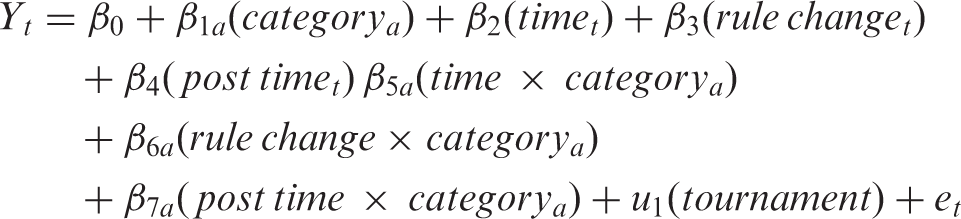
Further, for variables where interactions were present, we performed pairwise comparisons for the estimated values of the direct change and change in trend between the categories. The graphical representations include the fixed factors of the original model, as well as an estimate without rule change and post time to model the predicted evolution without the rule change. All confidence intervals were computed using a 500-iteration bootstrap method. The statistical analyses were made with the lme434 and multcomp35 packages in R 3.4.1. The significance level was set at p < .05.
Results
Results of segmented regression analyses for general effects of the rule modifications.
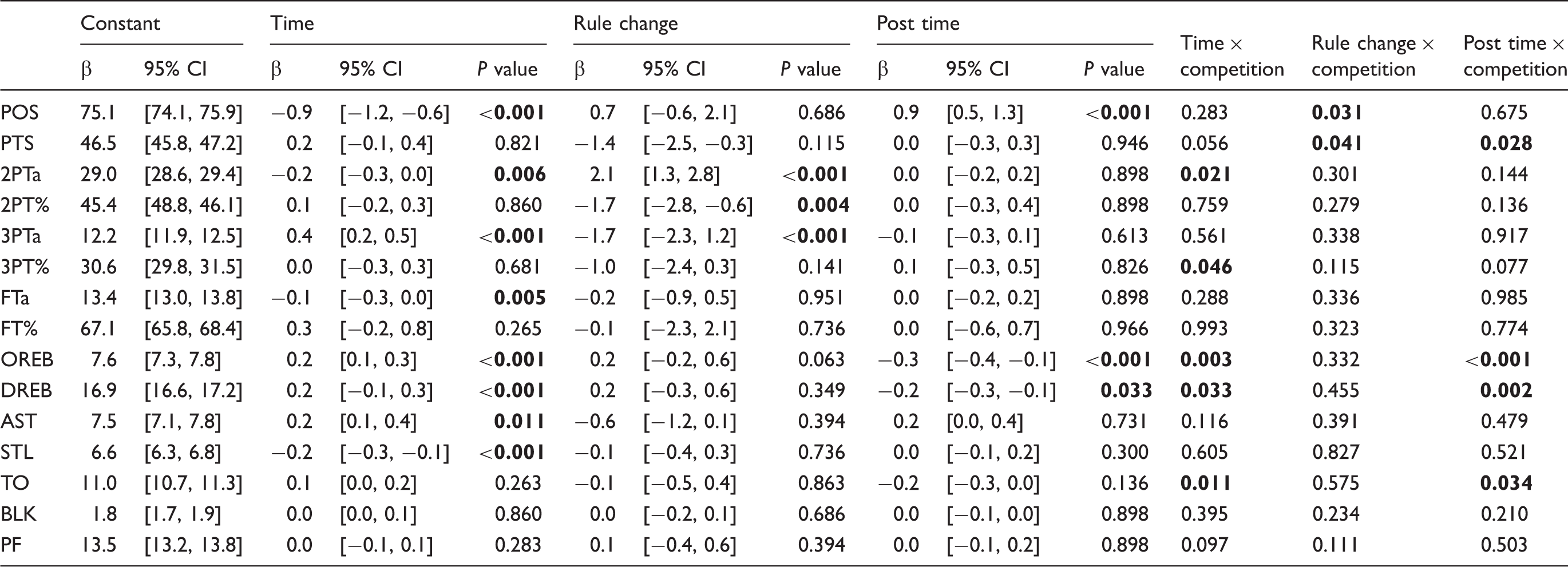
β: Regression coefficients; CI: confidence interval; POS: ball possessions; PTS: points scored; 2PTa: 2-point field goals attempted; 2PT%: 2-point field goals percentage; 3PTa: 3-point field goals attempted; 3PT%: 3-point field goals percentage; FTa: free-throws attempted; FT%: free-throws percentage; OREB: offensive rebounds; DREB: defensive rebounds; AST: assists; STL: steals; TO: turnovers; BLK: blocks; PF: personal fouls. Bold indicates p < 0.05
Results of the pairwise comparison between categories for differences in effects of the rule change.
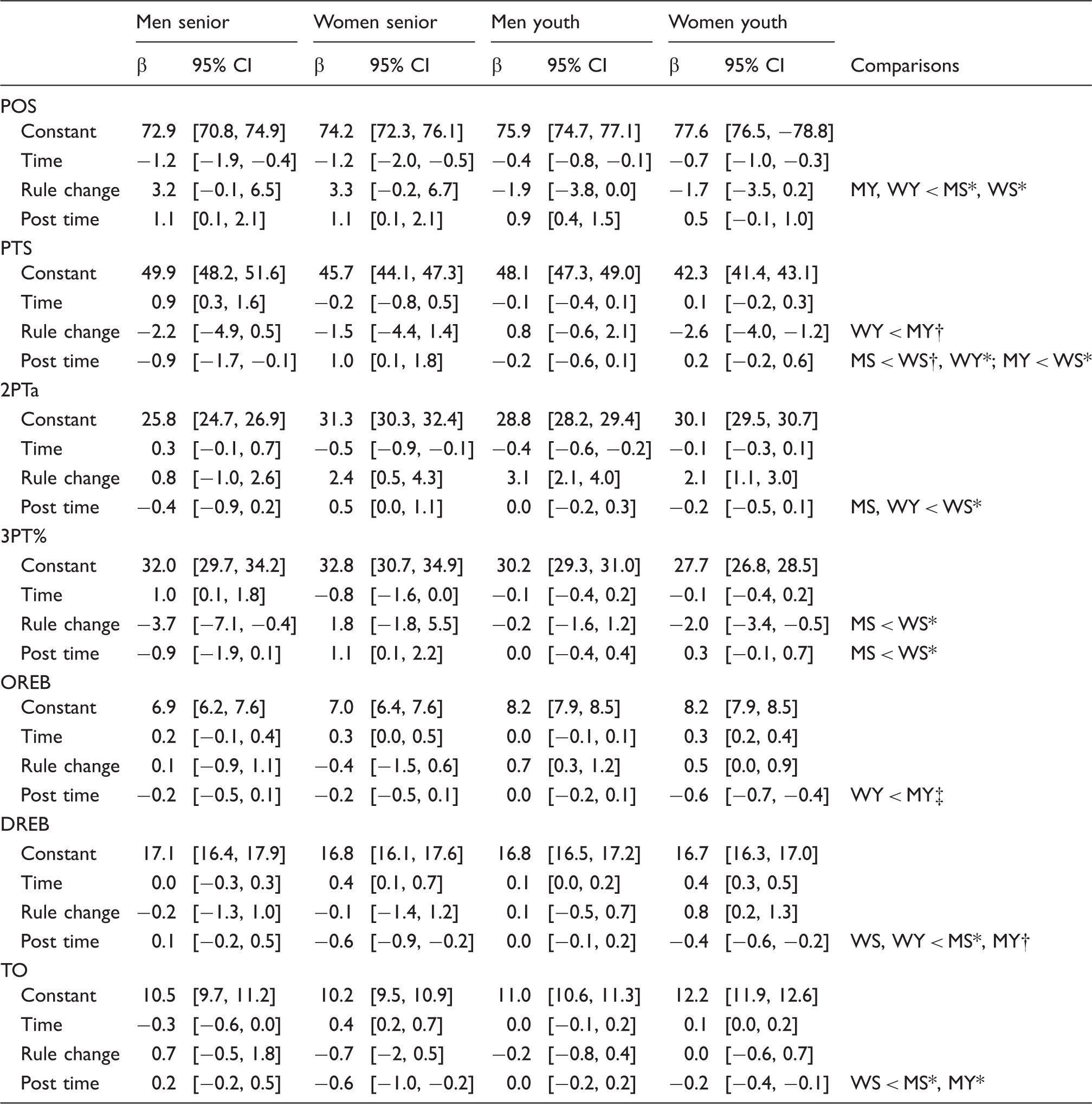
β: Regression coefficients; CI: confidence interval; POS: ball possessions; PTS: points scored; 2PTa: 2-point field goals attempted; 3PT%: 3-point field goals percentage; OREB: offensive rebounds; DREB: defensive rebounds; TO: turnovers; MS: men senior; WS: women senior; MY: men youth; WY: women youth.
p < .05. †p < .01. ‡p < .001.
The direct change in the number of POS was different for the senior categories compared to the youth. It seems to have increased in the senior while decreased in the youth categories. The trend had a general positive change after the rule modifications. Visual representations of the effect for POS in each category are presented in Figure 1.
Trend before rule change (before), impact of rule change (after) and predicted trend without rule change (predicted), for ball possessions (POS) and turnovers (TO) in all categories.
No general change was evident in PTS. There was a difference in direct change between the two youth categories as the PTS decreased in women youth. There was a difference in trend change between men and women. It seems to have had a negative effect in men and positive in women, although not as evident in the youth categories.
The number of 2PTa generally increased, and 3PTa decreased directly. There was a positive change of the 2PTa trend in women senior, different from men senior and women youth. The 2PT% generally decreased directly. The 3PT% was generally unaffected. There were however different effects in the senior categories. The 3PT% decreased directly in men and might have increased in women senior, while there was a positive trend change in women senior and seems to be a negative change in men senior. Visual representations of the general effects for 2PTa and 3PTa are presented in Figure 2.
General trend before rule change (before), impact of rule change (after) and predicted trend without rule change (predicted) for 2-point field goals attempted (2PTa) and 3-point field goals attempted (3PTa).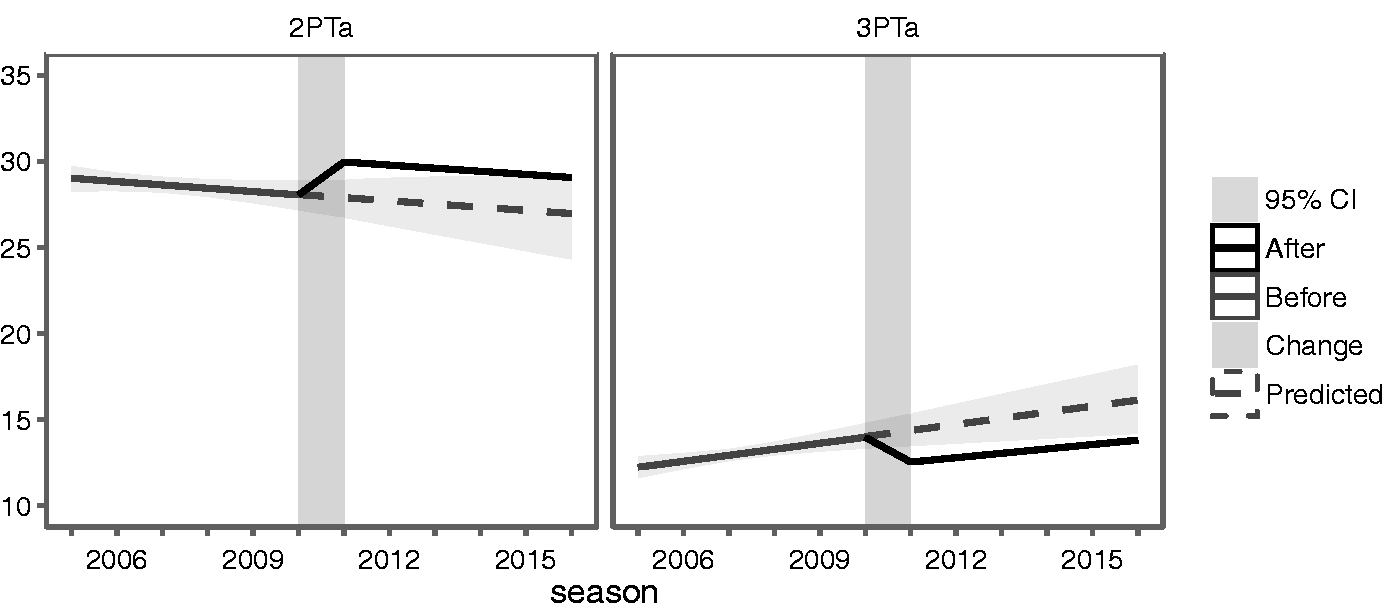
No general direct effects in OREB or DREB were found. There was a negative trend change for OREB in women youth, different from men youth. The trend for DREB was affected negatively in both women categories, different from the men categories.
The trend for TO was negatively affected in women senior, different from the men categories. The variables FTa, FT%, AST, STL, BLK, and PF were unaffected by the rule modifications. Visual representations of the effects for TO in each category are presented in Figure 1.
Discussion
The present study investigated the short- and mid-term impact of the rule modifications implemented in 2010 by FIBA on the game-related statistics in basketball. It further examined whether the rule modifications impacted the genders and age groups differently. The number of POS seems to have increased directly in the senior categories, and the previous trend towards fewer POS has been stopped or reversed. The number of 2PTa increased while the number of 3PTa decreased directly after the modifications, but the trend towards more 3PTa and less 2PTa remained. The 2PT% decreased directly while there were mixed effects on the 3PT%. After the rule modifications, the trend changed towards fewer TO in women senior.
The number of ball possessions is in basketball the measurement used to quantify the game pace.10–13 The direct increase in the number of possessions for the senior categories is in line with earlier studies on the effect of the 2010 modifications. 8 This effect could be expected as the rule modifications included a reduced time on the shot-clock after certain situations, such as offensive rebounds and personal fouls. Teams in younger categories tend to play with a higher number of possessions, 36 indicating that they are not using as much of the available time on the shot-clock. This is a possible explanation as to why the number of possessions did not increase in the youth categories.
A possible explanation for the positive trend change on the number of possessions is that the teams had to find new strategies to score faster in situations with a shorter shot-clock, such as after an offensive rebound or after a defensive foul. As they got better at it, more teams might have adopted these strategies in other game situations, creating a more transitional style of playing with shorter offensive possessions. Previous rule modifications speeding up the game pace have increased the physiological demands. 6 As the game pace has increased as a result of the 2010 rule modifications, it can be expected that the physiological demands have become higher.
In general, the modifications decreased the number of 3-point field goals attempted, while they increased the number of 2-point field goals attempted. These results are in accordance with earlier studies in men senior leagues.7,8 The influence of the 3-point line distance on the amount of 2-point and 3-point field goals attempted has been established in the NBA. 37 Where a shortened distance resulted in higher amounts of 3-point attempts in relation to 2-point attempts and reversed when the line was moved back to the original distance. 37 The trend of an increasing number of 3-point and decreasing number of 2-point field goals attempted remained unaffected after the modifications. This is in line with results from studies analysing the effect over several seasons. 25
The lower 2-point percentage directly after the rule modifications could be due to a change in which shot types were attempted. Previous studies have found that the technical and tactical actions preceding shots affect the shooting percentage.38,39 It is possible that a considerable amount of the extra 2-point field goals attempted were shot types with a lower percentage, such as from dribble as opposed to from pass.38,39
The difference in 3-point percentage between men and women senior, both directly and over time, is notable as the accuracy for different shot types has been shown to be similar between the genders (and competition levels).33,38 This implies that men and women senior teams have adapted their shot selection differently to the extended 3-point line. Men senior teams might have shifted more towards moving into the shot, shooting from dribbling, getting the pass from the same side of the court or shooting under higher defensive pressure, while women teams have done the opposite. 38
The decreasing number of defensive rebounds in both women categories might be a result of the changed distribution between 2-point and 3-point shots, as the shot distance has been shown to influence the possibility of taking an offensive or defensive rebound. 40 The women youth have a decreasing number of both offensive and defensive rebounds. As the variables have been normalised in regard to game pace, this trend indicates a corresponding decrease in the number of missed field goal attempts. However, this is only partially supported by the results.
In women senior, the trend towards more turnovers was reversed after the rule change. Fylaktakidou et al. 41 analysed the turnovers in the women’s Greek league; 81.4% of the turnovers were made inside or around the 3-point line, and the most occurring type of turnover was passing errors. The widening of the 3-point line can, therefore, have created opportunities to play with more spacing in offence, forcing the defence to cover more area. As the women senior teams gradually adapted to the new space constraints, they were perhaps finding better passing options, and therefore reducing the risk of a defensive player being able to deflect the pass.
In the women senior championships, the rule modifications seem to have stimulated the offence more than it has in the other categories. They are playing at a faster pace, scoring more, shooting 3-pointers with higher percentage and making fewer turnovers. Many of these changes are different from the other categories. Therefore, it seems as the rule modifications had the most significant impact on the women senior category. However, there was no evident pattern of differences between genders or age.
It has been shown that altering the spatial and temporal constraints influence the technical–tactical actions performed in other team sports.42–44 The changes after the 2010 rule modifications on the game-related statistics implicate that the changed spatial and temporal constraints imposed on the game have affected the extent to which different technical–tactical actions are being used. It is apparent that the rule modifications influenced the game not only directly but also its continuous development over time.
This study presents certain limitations as it used a correlational methodology, analysing changes in game-related statistics after the implementation of rule modifications. It cannot be concluded that the rule modifications are the underlying cause for the results. These changes might also be influenced by the physiological development of the players, the continuous development of offensive and defensive strategies to counter each other and mimicking of trendsetting teams and players. Rule modifications cannot be considered as an isolated factor affecting the team’s performance.4–6 Therefore, a multifactorial model (technical, tactical, strategical, physical and psychological) should be accounted for to better identify the non-linear evolution of the basketball game. This study was made on European championships, which might not be fully representative for all kind of basketball leagues and levels. However, it has been found that shooting variables remain similar between different competitions and age groups. 33
Further studies on rule modifications are needed to understand its implications fully. The physiological effects need to be studied, as they could have direct implications for the design of training tasks and management of players during competition. Studies using other methods are needed to fully understand the technical–tactical implications of the rule modifications, analysing, for example, the distribution of technical and tactical actions, time-out effects, player rotations and other situational variables.
Conclusions
To our knowledge, this is the first attempt to use an interrupted time series analysis to study rule modifications in sports. It helps to provide a deeper understanding of the implications as it enables the direct and longitudinal effects to be interpreted distinctively from each other.
The conclusions of this article are: (a) The 2010 FIBA rule modifications affected the game-related statistics, both directly and their development over time. (b) The game pace has increased or ceased to decrease after the rule modifications. (c) The development towards a higher proportion of field goals being 3-pointers has continued, although the proportion was lowered directly after the rule modifications. (d) The women senior seems to be the category were the rule modifications had the most effect on the continuous development. (e) No general pattern of differences in effects between categories was found.
This work may help to understand the implications of 2010 FIBA rule changes on the technical–tactical aspects of the basketball game. These findings can assist basketball coaches in adjusting practices and tactical decisions to the new rules. It can also help sporting organisations understand the effects of this and, therefore, future rule modifications.
The coaches both at senior and youth levels should consider the growing importance of the transition game in their practice planning and tactical philosophy. Strength and conditioning coaches should also consider the increasing game pace. To prepare the players to repeatedly run up and down the court at an increasing frequency, they could, for example, reduce the rest time during repeated sprint work.
Coaches should consider the growing importance of the 3-point field goals and continuously adapt their offensive and defensive strategies accordingly. As the amount of 3-point shots is increasing without any drop of shot efficiency in the youth categories, the tactical implications need to be considered already at this level. This also shows the need for technical and physical preparation of young basketball players to be able to shoot 3-point shots efficiently.
Supplemental Material
Supplementary Table -Supplemental material for Short- and mid-term effects of the 2010 rule changes on game-related statistics in European basketball championships: An interrupted time series analysis
Supplemental material, Supplementary Table for Short- and mid-term effects of the 2010 rule changes on game-related statistics in European basketball championships: An interrupted time series analysis by Alexandra Pérez-Ferreirós, Anton Kalén and Ezequiel Rey in International Journal of Sports Science & Coaching
Footnotes
Declaration of Conflicting Interests
The author(s) declared no potential conflicts of interest with respect to the research, authorship, and/or publication of this article.
Funding
The author(s) received no financial support for the research, authorship, and/or publication of this article.
Supplementary material
Supplementary material is available for this article online.
References
Supplementary Material
Please find the following supplemental material available below.
For Open Access articles published under a Creative Commons License, all supplemental material carries the same license as the article it is associated with.
For non-Open Access articles published, all supplemental material carries a non-exclusive license, and permission requests for re-use of supplemental material or any part of supplemental material shall be sent directly to the copyright owner as specified in the copyright notice associated with the article.
