




Abstract
To account for the individual intensity of locomotion tasks, individualised speed thresholds have been proposed as an alternative to global speed thresholds. Methodologies to determine individual speed thresholds have typically been laboratory based, time consuming and expensive, rendering them inappropriate for applied practitioners working with large squads. The current investigation utilised easy-to-administer field tests to individualise speed thresholds. The aim was to investigate differences between high-speed locomotion measured using global and individual speed thresholds. Nineteen, male, professional soccer players completed maximum sprint and maximum aerobic speed protocols and were divided into groups dependent upon maximum aerobic speed performance (high, medium and low). Locomotion data were collected using portable Global Positioning System units and analysed using global and individual analysis methods to determine distances travelled performing high-speed running, very high-speed running and sprinting. In low athletes, the individual analysis method produced significantly higher percentages of high-speed running, very high-speed running and sprinting compared to global (mean differences 7.8%, 6.1% and 1.7%, respectively, all p < 0.001). In medium athletes, no significant differences were found between analysis methods for high-speed running and very high-speed running. In high athletes, the individual analysis method produced significantly lower high-speed running and very high-speed running percentages compared to global (mean differences 11.0% and 6.8%, p < 0.001). Results concluded that global thresholds produced high-speed locomotion percentages significantly higher or lower than individual thresholds for 47% of athletes. The current investigation recommends the use of field tests to individualise speed thresholds, allowing applied practitioners to accurately quantify individual athlete intensity.
Introduction
Determining associations between training load and injury occurrence in team sports is important for optimising performance. A fine balance exists between applying the optimum training stimulus to promote adaptation and exceeding the optimum stimulus, which is associated with a higher incidence of injury.1,2 Consequently, monitoring and understanding training load is vital to facilitate physical performance and reduce injury risk.1,3 Distance travelled performing high-speed locomotion tasks (e.g. high-speed running (HSR), very high-speed running (VHSR) and sprinting (SPR)) has received significant attention when investigating training load.4,5 Faude et al. 6 highlighted the importance of high-speed locomotion by stating that straight-line SPR is the most dominant action when scoring goals. Adding to the importance of SPR, Barnes et al. 7 demonstrated distances travelled SPR in the English Premier League have increased by ∼35% between 2006 and 2013. Considering SPR tasks are associated with impaired muscle function and increased perceived muscle soreness, the volume of SPR completed has implications upon recovery time and injury risk. 8 It is therefore important that high-speed locomotion is quantified accurately. 9
High-speed locomotion tasks are typically banded using speed thresholds. Subjectively, these have been equated to descriptions of movement and designated a specific speed band.9,10 Despite growing interest in the area of Global Positioning System (GPS), there are no consistent definitions for speed thresholds, making comparison between research difficult. 11 Common speed thresholds cited within soccer research are HSR as 4.2–5.5 m.s−1,12,13 VHSR as 5.5–7.0 m.s−1, 13,14 and SPR as >7.0 m.s−1.12,15 In the past, speed thresholds have been applied globally to all athletes. Global speed thresholds allow for comparisons in absolute workload completed by athletes but are suggested to mask important information regarding the relative intensity an individual is working. 12 Athlete’s internal responses to the same external demands vary and result in differing degrees of adaptation. 12 This is further emphasised when monitoring athletes of different ages and maturation levels. 16 Despite allowing for comparisons between athletes, researchers have suggested the potential for large differences in quantifying an individual’s high-intensity demands using global speed thresholds.14,17
Having identified the disadvantages associated with global speed thresholds, researchers have attempted to individualise thresholds using physical performance markers.12,14,18 The aim of individualising speed thresholds is to account for the individual nature of the exercise-intensity continuum and accurately represent the relative intensity an athlete is working. In a recent case study, Abt and Lovell 14 individualised speed thresholds utilising athlete’s ventilatory thresholds. The second ventilatory threshold represented the transition from moderate- to high-intensity exercise. Results found marked differences in high-intensity work performed between athletes of the same playing position using the individualised speed thresholds, whilst negligible results were demonstrated between the athletes using global thresholds. Limitations of ventilatory thresholds to individualise high-speed locomotion are that it is time consuming, expensive and requires access to facilities and expertise to administer. 13 This provides barriers for practitioners working with large squads of athletes. An alternative method for increasing the specificity of speed thresholds is using the athlete’s functional limits of endurance and sprint locomotor capacities. Hunter et al. 12 and Mendez-Villanueva et al. 18 recently applied this to youth athletes using field tests to assess athlete’s maximum aerobic speed (MAS) and maximum sprint speed (MSS). MAS is strongly correlated with vVO2max, whilst MSS allowed for the estimation of an individual’s anaerobic speed reserve (ASR) and transition to SPR. 12 Currently, no research has utilised field tests to individualise speed thresholds in an elite adult soccer population. Additionally, previous research has focused upon competition, excluding training sessions from the analyses. Considering training scenarios may differ significantly from competition, and a high volume of locomotive training load is accumulated whilst training, further analysis is warranted.
To increase the accuracy of assessing athlete locomotion and improve the training monitoring process, the aim of the current investigation was to determine the discrepancies between global and individual methods for monitoring high-speed locomotion. Previous research has used youth athletes, presented results in a case study format and focused solely upon soccer competition.12,14,18 The current investigation focused upon a squad of professional academy soccer athletes, with data collected over a six-week pre-season period consisting of training sessions and matches. Cost-effective, easy to administer, field tests were used to determine individual speed thresholds and increased the utility of the method for applied practitioners. Differences in high-speed locomotion determined using global and individual analysis methods were assessed. The global method used frequently cited speed thresholds for soccer,12,13,15 whilst the individual method used thresholds derived from athlete’s physical testing results.12,18
Method
Design
Data collection for the investigation spanned a six-week pre-season period. Participants took part in 32 training sessions, and two friendly matches, resulting in a total of 645 data points. High-speed locomotion was recorded and quantified for each athlete using 10-Hz portable GPS devices (OptimEye S5B, Firmware Version 7.18; Catapult Innovations, Melbourne, Australia). GPS data for each athlete were analysed using two analysis methods: a global analysis method and an individual analysis method. Distances travelled performing HSR, VHSR and SPR tasks were recorded for each athlete’s training session. Values produced by global and individual analysis methods were compared for each locomotion activity. The two analysis methods, global and individual, were the independent variables within the investigation. The dependent variables within the investigation were HSR, VHSR and SPR distances.
Participants
Nineteen, male, full-time professional soccer athletes from an U21 Premier League academy in the UK (18.2 ± 1.1 years, height 180.3 ± 7.1 cm, weight 75.6 ± 9 kg) participated in the investigation. The participant’s mean involvement in soccer was 8.5 (±1.5) years. Participants had trained four to five times and played one to two competitive matches per week for a minimum of two years. Goalkeepers were excluded from the investigation, as they did not participate in the same training sessions. All participants were briefed with a detailed explanation of the proposed investigation and the requirements. They were informed of potential risks to them and provided written consent. For participants under the age of 18, parental or guardian consent was provided. Participants were free to withdraw at any time, without any repercussions. The investigation was conducted with the protocol being fully approved by the ethical review board at the institution prior to commencing. The investigation conformed to the requirements stipulated by the Declaration of Helsinki, and all health and safety procedures were complied with during the investigation.
Procedures
The day prior to the start of pre-season training, each athlete completed MSS and MAS protocols to determine peak speed and estimate vVO2max, respectively. The MSS protocol required the athlete to complete three maximal 40 -m linear sprints, with self-prescribed maximal rest between repetitions. MSS was defined as the average speed recorded over the quickest 10 m sector and measured using electronic light gates (Brower TC Timing System) to the nearest 0.01 s. Intraclass correlation coefficient for the MSS protocol has been cited as 0.94–0.99. 18 The MAS protocol was a modified version of the University of Montreal Track Test, 19 previously used by Mendez-Villanueva et al. 18 Correlation coefficient for the MAS protocol has been demonstrated as 0.97. 19 The test began with an initial running speed of 8 km.h−1, with the speed increasing by 0.5 km.h−1 each minute. Athletes continued running around a 200 -m athletics track, marked with 20 m intervals, in time with an audible cue, until either exhaustion or three consecutive cones were missed. MAS was estimated as the speed of final 1-min stage completed by the athlete. Testing protocols were completed on the same grass surface and footwear used throughout the investigation. Using MSS and MAS scores, each athlete’s theoretical ASR was calculated. ASR was defined as the difference between the MSS and MAS score and reported in m.s−1. The MSS and MAS protocols were previously utilised by Mendez-Villanueva et al. 18 and Hunter et al. 12 to determine soccer player’s MSS and MAS.
During the six-week investigation, athletes followed the pre-season training plan constructed by the head technical coach and the strength and conditioning coach. Training sessions (mean duration 72 ± 9 min) were a mixture of technical practices, tactical practices, small-sided games, replication of competition and physical conditioning work. GPS units were switched on 15 min prior to the beginning of each training session, in accordance with manufacturer’s instructions, and switched off immediately following the session. Each GPS unit was worn in a designated tight-fitting vest located between the scapulae to reduce unwanted movement. Athletes wore the same unit for each training session to avoid inter-unit error.
Data analysis
GPS devices (10 Hz) were used to record data for each athlete’s training session. It has been shown that 10-Hz GPS devices have an acceptable level of accuracy and reliability when assessing the speed of movement within intermittent exercise.20–22 Specifically, Varley et al. 22 state devices sampling at 10 Hz provide sufficient accuracy when quantifying acceleration, deceleration and constant speed locomotion in team sports. When assessing reliability, Aughey 23 demonstrated a coefficient of variation (CV) of 0.7%–1.3% for 15 m and 30 m sprints, whilst Delaney et al. 24 demonstrated CV of 3.6%–5.9% for quantifying instantaneous speed during acceleration using 10-Hz GPS devices. The mean number of satellites during data collection was 15 ± 1, and the mean horizontal dilution of position was 0.7 ± 0.1. Following the recording of each training session, the individual GPS units were downloaded to a PC and analysed using Catapult Sprint software (Catapult Sprint 5.1.5, Catapult Innovations, Melbourne, Australia). Speed was calculated using measurements of the Doppler shift of signals received, distance was measured using positional differentiation. Distances travelled performing HSR, VHSR and SPR tasks were recorded. The minimum effort duration for high-speed locomotion tasks was 1 s. 12 HSR, VHSR and SPR variables were selected considering their use in previous literature investigating individualised training load in soccer.12–14 This analysis process was repeated twice, once applying global speed thresholds and once applying individual speed thresholds. To allow comparisons between training sessions of different durations and volumes, distances travelled performing each locomotion task were presented as percentages of overall distance travelled within the session. Data were presented as mean ± standard deviation (SD).
Classification of speed thresholds
Distances travelled performing HSR, VHSR and SPR tasks were calculated using global and individual analysis methods. Forms of locomotion was designated a specific speed threshold, which differed for global and individual analysis methods. Speed thresholds used for the global analysis method were locomotion thresholds typically cited within soccer literature. Global speed thresholds for HSR, VHSR and SPR were 4.2–5.5 m.s−1, 5.5–7.0 m.s−1 and >7.0 m.s−1, respectively.12–14 The speed thresholds utilised by the individual analysis method were athlete specific and determined by MSS and MAS performance. The individual analysis method was previously utilised by Hunter et al. 12 and Mendez-Villanueva et al. 18 to represent the functional limits of endurance and sprint locomotor capacities. Individual speed thresholds for HSR, VHSR and SPR were 80%–99% MAS, 100% MAS–30% ASR and >30% ASR, respectively.
Athlete groups
Speed thresholds for LO, ME and HI athlete groups using global and individual analysis methods.

HSR: high-speed running; VHSR: very high-speed running; SPR: sprinting; HI: high; ME: medium; LO: low; MSS: maximum sprint speed; MAS: maximum aerobic speed; ASR: anaerobic speed reserve.
Statistical analysis
Descriptive analyses were conducted on the data set, with normality values assessed using Kolmogorov–Smirnov and Shapiro–Wilk tests. Significance values of p < 0.05 indicate uneven distribution of the data. Skewness and kurtosis values were assessed, with standard error below −2 and above +2 indicating the data were not evenly distributed. To determine the within-group differences in HSR, VHSR and SPR values, Wilcoxon signed-rank tests were used. This form of statistical testing was used as the data were non-parametric. Wilcoxon signed-rank tests were used to determine the differences between HSR, VHSR and SPR values produced by global and individual analysis methods. A Bonferroni adjustment was used in conjunction with the Wilcoxon signed-rank tests. Cohen’s r tests were used to determine the effect sizes of the differences. An effect size of r = 0.10 was considered small, an effect size of r = 0.24 was considered medium, whilst r = 0.37 was considered a large effect size. The level of statistical significance was set at p < 0.05. All statistical analyses were performed using the software IBM SPSS statistics (Version 22; SPSS, Inc., Chicago, IL).
Results
Figure 1 shows the mean distances travelled performing HSR, VHSR and SPR in LO athletes, calculated using global and individual analysis methods. Percentages of distance travelled performing HSR, VHSR and SPR were all significantly higher when calculated using the individual analysis method compared to global (HSR Global Mdn = 24.2, Individual Mdn = 31.5, Z = 11.203, p < 0.001, r = 0.61; VHSR Global Mdn = 8.3, Individual Mdn = 12.3, Z = 11.061, p < 0.001, r = 0.61; SPR Global Mdn = 0.0, Individual Mdn = 1.6, Z = 10.967, p < 0.001, r = 0.60). Large effect sizes were demonstrated for all locomotion tasks. Mean differences were 7.8% (95% confidence interval (CI) ±0.7%), 6.1% (95% CI ± 0.5%) and 1.7% (95% CI ± 0.2%) higher using the individual analysis method for HSR, VHSR and SPR, respectively.
Percentages of distance travelled HSR, VHSR and SPR when utilising global or individual thresholds, in LO athletes. *p < 0.001. HSR: high-speed running; VHSR: very high-speed running; SPR: sprinting.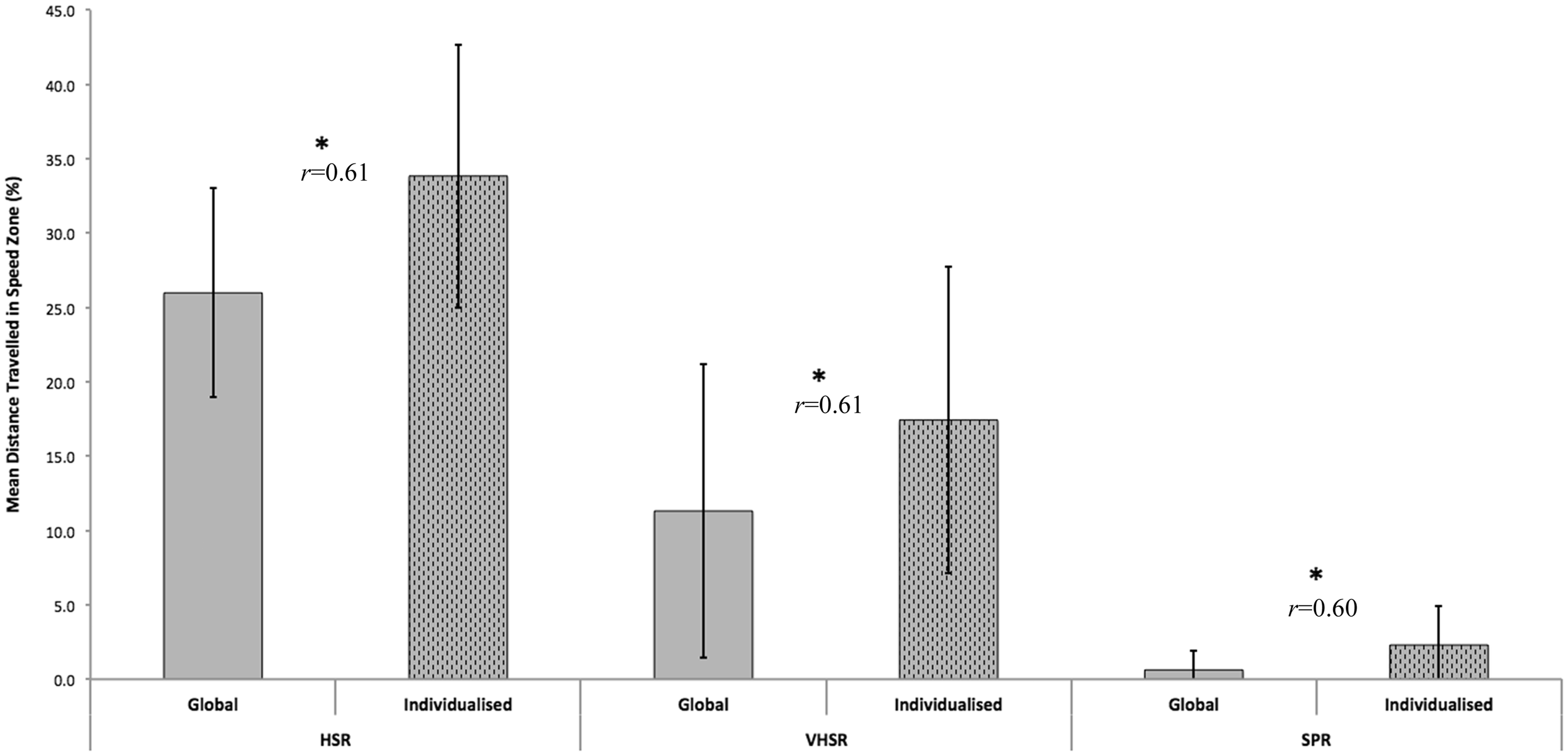
Figure 2 shows mean distances travelled performing HSR, VHSR and SPR in ME athletes, calculated using global and individual analysis methods. For HSR and VHSR, no significant differences in percentages produced by individual and global analysis methods were identified. For SPR, the individual analysis method produced significantly higher mean percentages when compared to the global analysis method (Global Mdn = 0.0, Individual Mdn = 1.6, Z = 11.669, p < 0.001, r = 0.44), demonstrating a large effect size.
Percentages of distance travelled HSR, VHSR and SPR when utilising global or individual thresholds, in ME athletes. *p < 0.001. HSR: high-speed running; VHSR: very high-speed running; SPR: sprinting.
Figure 3 shows mean distances travelled performing HSR, VHSR and SPR in HI athletes, calculated using global and individual analysis methods. Results for the HI athlete group show the opposite trend to the LO athlete group. The individual analysis method produced significantly lower mean percentages when compared to the global analysis method for both HSR (Global Mdn = 37.6, Individual Mdn = 27.3, Z = 9.992, p < 0.001, r = 0.61) and VHSR (Global Mdn = 22.9, Individual Mdn = 16.5, Z = 10.065, p < 0.001, r = 0.62). A large effect size was demonstrated for HSR, with a medium effect size for VHSR. Mean differences were 11.0% (95% CI ± 0.4%) and 6.8% (95% CI ± 0.5%) lower for HSR and VHSR when utilising the individual method compared to global. No differences were seen in SPR percentages between the two analysis methods.
Percentages of distance travelled HSR, VHSR and SPR when utilising global or individual thresholds, in HI athletes. *p < 0.001. HSR: high-speed running; VHSR: very high-speed running; SPR: sprinting.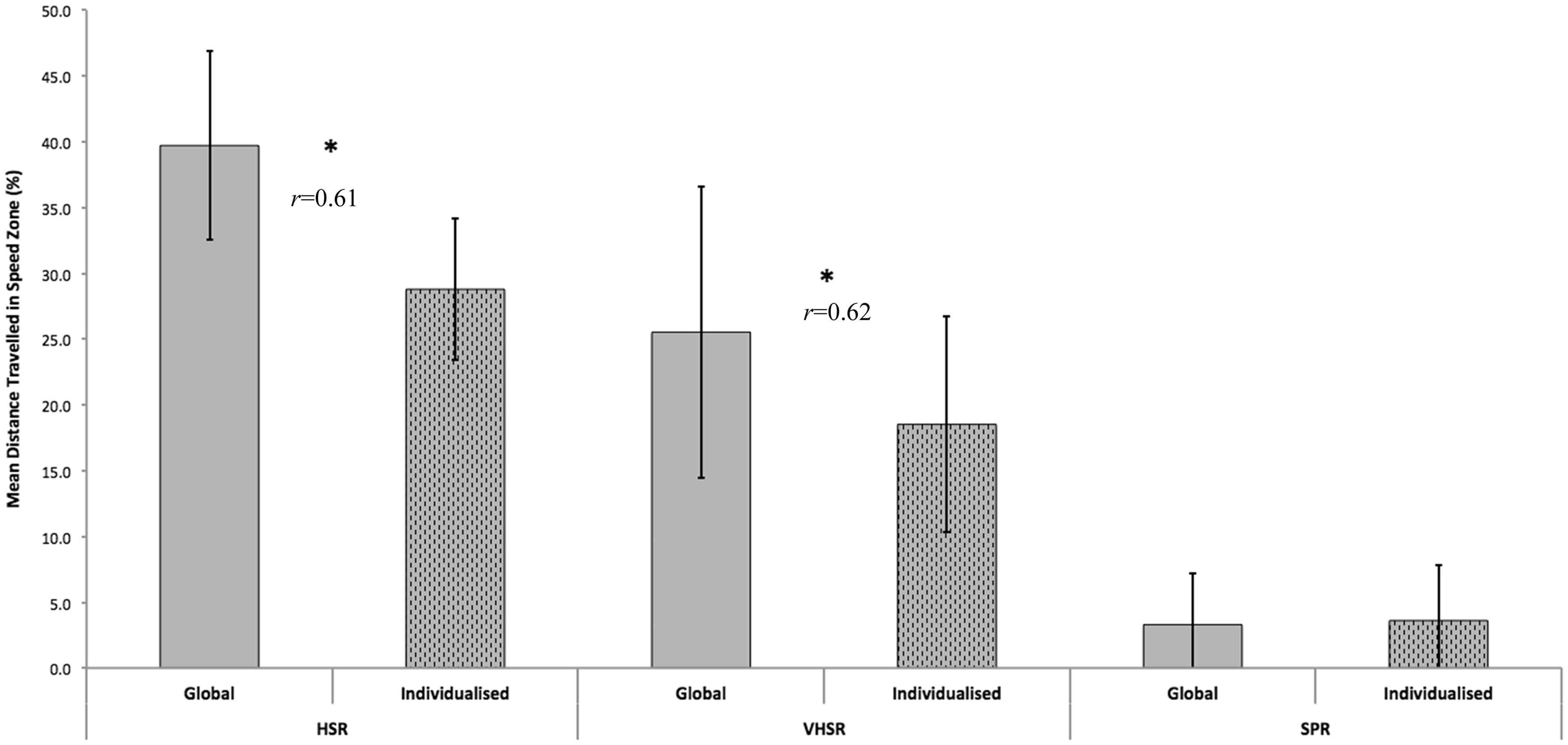
Discussion
The aim of the investigation was to analyse differences between global and individual methods for monitoring high-speed locomotion. Individual speed thresholds for athletes were determined using field-based assessments of MSS and MAS, with athletes subdivided into three groups dependent upon MAS performance. The significant differences in HSR, VHSR and SPR percentages produced by global and individual analysis methods were the result of the speed thresholds employed (Table 1). Results for LO athletes demonstrated mean HSR, VHSR and SPR percentages were significantly higher using the individual analysis method compared to the global. This resulted from lower speed thresholds used for the individual analysis method (≥3.7 ± 0.1 m.s−1, ≥4.7 ± 0.2 m.s−1 and ≥6.0 ± 0.2 m.s−1) in comparison to the global (≥4.2 m.s−1, ≥ 5.5 m.s−1 and ≥7.0 m.s−1). For ME athletes, the only significant difference between analysis methods was between mean SPR percentages, with individual producing significantly higher percentages than global. This was the result of a lower SPR threshold for individual (≥6.6 ± 0.2 m.s−1) compared to the global analysis method (≥7.0 m.s−1). Similar speed thresholds were employed for HSR and VHSR, resulting in no significant differences between analysis methods. For HI athletes, the individual analysis method produced significantly lower mean HSR and VHSR percentages compared to global. This was the result of higher speed thresholds for individual (≥4.8 ± 0.1 m.s−1 and ≥6.0 ± 0.2 m.s−1) in comparison to global (≥4.2 m.s−1 and ≥5.5 m.s−1). For SPR, thresholds employed were similar, resulting in no significant differences.
The current investigation demonstrated the individual analysis method produced significantly higher HSR, VHSR and SPR percentages in LO athletes and significantly lower HSR and VHSR percentages in HI athletes compared to the global analysis method. The findings complement research by Gabbett 16 and Lovell and Abt, 13 despite differences in methodologies. Gabbett 16 recently compared global and individual analysis thresholds in youth Rugby players, individualising speed thresholds using only MSS. Gabbett 16 concluded that individualising speed thresholds increased the HSR attributed to relatively slower athletes and decreased the HSR attributed to faster athletes. Lovell and Abt 13 investigated the differences between high-intensity distances produced by global and individual speed thresholds in elite soccer players. In contrast to the current investigation, where speed thresholds were individualised using field-based performance tests, Lovell and Abt 13 calculated ‘high-intensity’ as distance travelled above the second ventilatory threshold. Results were similar to those demonstrated in LO athletes within the current investigation, with high-intensity distance significantly lower when using global thresholds. Although results produced by Gabbett 16 and Lovell and Abt 13 are similar for HI and LO athletes, the present investigation showed no significant differences in HSR and VHSR percentages produced between analysis methods for ME athletes. Differences in findings are likely the result of further analysis conducted within the current investigation. Current results highlight the importance of subdividing athlete groups, providing insight as to how differences between analysis methods vary within a squad of athletes. Additionally, the current investigation utilised multiple performance markers to determine individual thresholds. When individualising speed thresholds, Hunter et al. 12 recommend multiple performance markers to characterise the functional limits of endurance and sprint capabilities. Multiple performance measures allow for more representation of the relative locomotive training load elicited upon athletes when compared to global speed thresholds. Considering previous research used a single performance marker to individualise speed thresholds, this may provide explanation for differing results within the current investigation.
Current findings have significant implications for applied practitioners aiming to accurately monitor locomotive training load and reduce injury risk. Recent research has focused upon the association between training load and injury occurrence. Gabbett 25 utilised the acute:chronic workload ratio as a tool to identify injury risk, citing a ‘sweet spot’ of optimal training load associated with a reduced probability of injury occurrence. When utilising workload ratios to calculate injury risk, it is vital training load data included is a valid representation of load elicited upon the athlete. Previous research suggests individual speed thresholds produce more accurate representations of actual training load elicited due to individual’s physical performance capacities being accounted for. 12 Integrating individual’s physical capacity within calculation of speed thresholds results in increased validity of training load data. Without acknowledging an athlete’s physical capacities, global speed thresholds may result in inaccurate representations of locomotive training load. Inaccurate representation of training load increases the difficulty associated with prescribing optimal training loads, increasing the probability of inappropriate training load prescription and injury risk. Global speed thresholds allow practitioners to compare performance between athletes and assess an individual’s ability to tolerate locomotive training load. However, if the aim is to accurately quantify the intensity of high-speed locomotion, individual analysis methods distinguish between athletes of differing capabilities and maturation. The current investigation demonstrated individual speed thresholds could be calculated using field-based MAS and MSS tests. This provides practitioners operating with large squads in applied settings an efficient and cost-effective method to individualise the monitoring of high-speed locomotion.
Conclusion
Significant differences were demonstrated between high-speed locomotion percentages calculated using global and individual analysis methods. High-speed locomotion was similar between analysis methods for ME athletes, but global percentages were significantly lower for LO athletes and significantly higher for HI athletes compared to individual percentages. With high emphasis in modern day soccer placed upon physical development, the need to accurately prescribe and monitor training load is paramount. Previous research suggested individual analysis methods account for the relative intensity of locomotion tasks by incorporating each athlete’s physical capacities, with global analysis methods unable to. Comparatively, global speed thresholds allow practitioners to compare physical performance and determine an individual’s ability to tolerate a locomotive training load. If the objective is to accurately quantify the intensity of high-speed locomotion for athletes of differing capabilities and maturation, it is recommended an individual analysis method be utilised. This provides practitioners with the necessary tools to accurately monitor locomotive training load and ultimately optimise performance and reduce injury risk. The current investigation utilised field tests to determine individual speed thresholds, a method that can be replicated effectively for large squads. Although the investigation was conducted in soccer, similarities in movement demands and intermittent speed profiles mean that findings are applicable to the majority of team sports.
Footnotes
Acknowledgements
The authors thank the players who volunteered to take part, and coaches for their cooperation during data collection.
Declaration of Conflicting Interests
The author(s) declared no potential conflicts of interest with respect to the research, authorship, and/or publication of this article.
Funding
The author(s) received no financial support for the research, authorship, and/or publication of this article.