




Abstract
The effects of rational and irrational coach team talks on cognitive appraisal and achievement goal orientation were examined. During the half-time interval of a 60 min football match, 25 male varsity football athletes (Mage = 20.20; SD ± 1.38 years) received a rational (n = 13) or an irrational (n = 12) team talk from a coach. Irrational and rational beliefs were measured before the football match. Task engagement, cognitive appraisal (challenge and threat), and achievement goal orientation (approach and avoidance) regarding second-half football performance were measured following team talk delivery. Athletes in the rational team talk condition reported significantly lower threat appraisal and avoidance goal orientation than athletes in the irrational team talk condition. No significant between-condition differences emerged for challenge appraisal and approach goal orientation. For coaching practice, data suggest that communicating rational or irrational beliefs to football athletes through a half-time team talk will influence appraisal and achievement goal orientation regarding upcoming performance.
Introduction
Irrational and rational beliefs, classified within Rational Emotive Behaviour Therapy (REBT), 1 are emerging as important constructs within sport psychology literature. 2 Irrational beliefs (rigid, extreme, and illogical) are associated with dysfunctional emotions (e.g. unhealthy anxiety) and maladaptive behaviours (e.g. avoidance) that can hinder well-being and long-term goal attainment. 3 In contrast, rational beliefs (flexible, non-extreme, and logical) are associated with functional emotions (e.g. healthy anxiety) and adaptive behaviours (e.g. approach focus) that can aid well-being and long-term goal attainment. 3 Within REBT, irrational beliefs comprise demandingness (a preference transmitted into a demand; e.g. ‘I want to succeed and therefore I must’), awfulising (if an event happens then nothing could be worse; e.g. ‘it is awful to fail’), Low Frustration Tolerance (LFT: adversity or discomfort cannot be tolerated; e.g. ‘I cannot stand failing’), and depreciation (self and/or others rated on the basis of one aspect; e.g. ‘I am a complete failure if I fail’). 4 Alternatively, rational beliefs comprise strong preferences (an assertion of a preference and negation of a demand; e.g. ‘I really want to succeed but that does not mean I must’), anti-awfulising (if an event happens then worse things could occur; e.g. ‘failing is bad but not awful’), High Frustration Tolerance (HFT: adversity or discomfort can be tolerated; e.g. ‘failing is tough but I can stand failing’), and acceptance (self and/or others are not rated on the basis of one aspect; e.g. ‘failing does not make me a complete failure. Failure just shows that I am fallible’). 4 Recent research has shown how sport psychologists can apply REBT to reduce irrational beliefs and enhance rational beliefs among athletes through education and counselling.4–6 However, it is not the sole responsibility of sport psychologists to promote rational beliefs to athletes since all members of an athlete’s support network (e.g. coaches) can be integral in the development of rational thinking.
Although the precise origins of irrational and rational beliefs are not clearly defined by research it is thought that there is a biological basis for such beliefs. 7 Indeed, Ellis 7 suggested that almost everyone is irrational some of the time. It is also recognised that common cultural stereotypes communicated in language, stories, and songs contribute to the development of rational and irrational thinking. 8 In particular, General Semantics Theory 9 suggests that people are influenced by language used in communication with others and oneself. REBT literature suggests that the formation and expression of irrational beliefs is a product of both genetics and socialisation 10 where a predisposition to hold irrational beliefs is exacerbated by those around us whom we look to for guidance. 11 Communicating imprecise language (the verbal expression of rigid, extreme, and illogical beliefs) can therefore augment imprecise thinking. 12 Thus, a coach who communicates irrationality (e.g. ‘we must win’ and ‘it would be terrible to lose’) to their athletes may encourage irrational thinking already innately held in those athletes.
Akin to the Cognitive Appraisals Paradigm, 13 irrational and rational beliefs are ways of appraising (hot cognition) particular representations of reality (cold cognitions) in terms of their personal significance to an individual (goal or motivational relevance). 12 On approach to competitive situations, athletes can cognitively appraise an event as either a challenge (positive) or a threat (negative). 14 In a challenge state, resource appraisals meet or exceed demand appraisals whereas in a threat state, demand appraisals exceed resource appraisals. 14 Rational and irrational beliefs may influence cognitive appraisal through their association with demand and resource appraisals. For example, irrational beliefs are primarily characterised by demandingness 3 which may elevate perceived demand appraisals imposed upon athletes. Compared to threat appraisals, challenge appraisals are associated with a focus on approach goals rather than avoidance goals 15 and superior performance. 16 The notion that achievement goals of approach and avoidance are an important aspect of challenge and threat stems from research demonstrating that participants holding approach goals (striving for competence and success) view important situations (e.g. exams) as a challenge whereas participants holding avoidance goals (striving to avoid incompetence and failure) view important situations as a threat. 17 This Achievement Goal Framework 18 has also been examined in sport settings where approach goals have been positively related to challenge and avoidance goals positively related to threat. 19
Cognitive appraisal is also influenced by socially derived information such as communication with others. For example, Social Comparison Theory 20 proposes that individuals look to others for information on appropriate emotional responses during episodes of stress. Accordingly, individuals may suggest or infer coping strategies based on their own experiences which can help others to focus on the positives. 21 Such social support can convince an individual that they possess coping abilities adequate to cope with the stressor faced. 22 In particular, informational social support contributes to positive appraisal by allowing individuals to clarify their understanding of potentially threatening stimuli. 23 Indeed, challenge appraisals can be promoted via the use of instructions given to athletes on approach to performance. 24
In sum, the provision of information by others can influence irrational and rational thinking and associated cognitive appraisals of athletes facing competition, influencing cognitive, emotional, and behavioural responses. Past research has not examined the influence of rational and irrational instructions on cognitive appraisal and therefore it is unknown whether rational and irrational beliefs expressed through verbal communication can augment adaptive or maladaptive psychological and behavioural approaches to athletic competition. One important opportunity to influence athletes’ psychological and behavioural approaches to competition via verbal communication is through a coach’s half-time team talk common in team sports such as football. Whilst there is a dearth of research on half-time team talks, there is some literature on pre-game team talks. Specifically, research indicates that athletes feel team talks that motivate effort and express emotion contribute positively to performance 25 and are preferred in more important competitions. 26 Team talks that are informational are also associated with greater recipient efficacy beliefs compared to emotional team talks. 27
Overall, the present study sought to examine the effects of rational and irrational half-time coach team talks on the cognitive appraisal (challenge or threat) and achievement goal orientation (approach or avoidance) of football athletes. Based on previous research 24 and REBT theory, 12 it was hypothesised that participants receiving a rational half-time team talk would report higher challenge appraisal and approach goals, and lower threat appraisal and avoidance goals, compared to participants receiving an irrational half-time team talk. It was also hypothesised that both team talk conditions would perceive the second half of their football performance to be equally important because rational and irrational beliefs are theoretically distinct from event importance. 5
Method
Participants and design
Participants comprised 25 male football athletes from one British university football organisation (Mage = 20.20; SD ± 1.38 years). Participants were predominantly White British and experienced football athletes (Mexp = 12.60; SD ± 2.89 years) who represented their first (n = 11) or second team (n = 14). All positions found in a football team were represented including goalkeepers (n = 2), defenders (n = 5), midfielders (n = 13), and attackers (n = 5). The first team coach split participants into two equally matched football-ability teams who were to compete in a 60 min football match consisting of two 30 min halves. During the half-time interval of a competitive football match, participants in team 1 (n = 13) received a rational team talk whilst participants in team 2 (n = 12) received an irrational team talk. We were unable to fully satisfy statistical power given that participants were recruited from two real-life football teams that converged to form a squad of football athletes. Typically, a football squad used for competitive football matches consists of approximately 25 athletes. Nevertheless, drawing participants from real-world football teams whilst adopting an experimental research design in a naturalistic setting offers high ecologically validity. Ethical approval was granted by an institutional ethics panel.
Irrational and rational team talks
The content of team talks was developed by all authors in line with descriptions and examples of irrational and rational beliefs documented in REBT literature. 4 The length of team talks was consistent with previous literature exploring pre-game speeches. 28 Team talks were initially verified by a sport psychology researcher/practitioner with experience of researching REBT and applying REBT principles as a practitioner. Subsequent pilot-testing involving three football athletes confirmed that the team talks were understandable and appropriate for football. The irrational team talk contained statements indicative of demandingness (e.g. ‘you absolutely must play well in the second-half’), awfulising (e.g. ‘losing is terrible and in the second half there could be nothing worse than to underperform’), LFT (e.g. ‘failure to win the second-half would be completely intolerable’), and depreciation (e.g. ‘by performing poorly in the second-half you will have let your teammates down […] making you a poor athlete and a failure’). The rational team talk contained statements indicative of strong preferences (e.g. ‘you want more than anything to play well in the second-half’), anti-awfulising (e.g. ‘losing is very bad but not terrible, so in the second-half there could be much worse things than to underperform’), HFT (e.g. ‘losing the second-half would be tough to handle but it is bearable and would be tolerable’), and acceptance (e.g. ‘by performing poorly in the second-half you will have let your teammates down […] but this does not make you a poor athlete or a failure’). The delivery of each team talk lasted approximately 5 min.
Initial assessment
Four weeks prior to the football match, participants gave informed consent and completed the Shortened General Attitudes and Beliefs Scale (SGABS). 29 The SGABS consists of 26 items, 22 of which form a total irrationality subscale whilst four items form a rationality subscale. Participants rated the extent to which they agreed with each item on a 5-point Likert scale ranging from 1 (strongly disagree) to 5 (strongly agree). Higher scores on each subscale represent stronger beliefs. The total irrationality subscale demonstrated internal reliability in the current study (α = .85) whilst poor internal reliability was found for the rationality subscale (α = .28).
The football match
All participants, university coaches, and confederates attended the university’s outdoor football facilities. Confederate one was a 49-year-old male who had been a professional actor for eight years. Confederate two was a 30-year-old male who had been acting professionally for two years. Confederate one delivered the rational team talk whilst confederate two delivered the irrational team talk. Both confederates were members of the same acting agency based in the United Kingdom (UK) and were chosen to deliver team talks because they were not known to participants and were experienced at learning scripts accurately. Confederates were emailed their team talk four weeks in advance of the football match so team talks could be rehearsed.
Confederates were instructed to deliver their team talk at a moderate pace without using inflection and gesturing to avoid the potential for factors such as change of tone and altered pitch determining subsequent appraisal. Upon arrival to the football match, confederates explained to the third and fourth authors they had fully rehearsed their team talk and were able to deliver their team talk verbatim. Immediately before the football match, confederates were introduced to participants as experienced, professional, university football coaches to promote participant engagement with team talks. The first team coach also explained that confederates would be observing football performance and delivering a team talk during the half-time interval. Accordingly, teams completed a warm-up and their football match. At the half-time interval, both teams were tied on a score of 0–0. Coaches rounded football athletes together whilst the third and fourth author encouraged participants to engage and listen to team talks. The third and fourth authors also checked for the accuracy of team talk delivery which revealed that both confederates delivered their team talk verbatim. After receiving their respective team talk, participants completed a questionnaire booklet regarding their second-half football performance.
Measures
Task engagement
Task importance is an important prerequisite for challenge and threat appraisal. 24 Thus, a one-item task engagement measure was modified from past research. 16 Participants indicated the importance placed on performing well in the second half of their football match on a 6-point Likert scale ranging from 0 (not at all) to 5 (very much so).
Appraisal
The Appraisal of Life Events Scale 30 consists of 16 items forming three subscales that include challenge appraisal (six items), threat appraisal (six items), and loss appraisal (four items). Only challenge and threat subscales were used in the current study as these subscales reflect upcoming events. Participants indicated the extent to which they agreed with each item on a 6-point Likert scale ranging from 0 (not at all) to 5 (very much so). Higher scores on each subscale represent higher challenge and threat appraisal. Each subscale possessed internal reliability in the current study (α = .80, challenge appraisal; α = .89, threat appraisal).
Achievement goals
The Achievement Goal Questionnaire for Sport 31 constitutes 12 items, six of which form an approach subscale whilst the remaining six items form an avoidance subscale. Participants indicated the extent to which they agreed with each item on a 7-point Likert scale ranging from 1 (not at all true) to 7 (very true). Higher scores on each subscale reflect stronger achievement goal foci. Each subscale demonstrated internal reliability in the current study (α = .63, approach; α = .81, avoidance).
Data analyses
Raw data were inputted into SPSS version 22. Outliers (1 score for challenge appraisal and 1 score for total irrational beliefs) with z values ±2SD from the mean were removed from the dataset. 32 An alpha value of <0.10 was set for our main statistical analyses given the directional nature of hypotheses formulated.
Results
Task engagement
Task engagement scores in each condition violated assumptions of normality (p < 0.01). No significant difference in task engagement (U = 62.50, z = −.665, p > 0.05) was found between the rational (M = 4.67, Md = 5.00, SD = .65) and irrational team talk conditions (M = 4.58, Md = 5.00, SD = .51). Ratings of task engagement within conditions were also significantly greater than the median value on the task engagement scale (p < .001), indicating that participants in each condition thought their second-half performance was highly important.
The effects of team talks on cognitive appraisal and achievement goals
Research has suggested that age
33
and internally held beliefs
34
influence rational and irrational thinking. Nevertheless, no significant between-condition differences in age (t (23) = 1.35, p > 0.05), rational beliefs (t (23) = 1.15, p > 0.05), and total irrational beliefs (t (22) = 1.35, p > 0.05) emerged in the current dataset. Controlling for age, rational beliefs, and total irrational beliefs within our main statistical analyses was therefore deemed inappropriate. Based on Zhu’s
35
absolute criterion, all variables displayed either no correlation (r = 0–0.19, p > 0.05) or a low correlation (r = 0.20–0.39, p > 0.05), with the exception of the correlation between threat appraisal and avoidance goal orientation which was moderate and significant (r = .50, p < 0.05). Given that low or non-meaningful correlations were predominantly displayed between variables, main statistical analyses were conducted at the univariate level only.
36
Preliminary analyses indicated that all variables met assumptions of normality and homogeneity (p > 0.05). No significant difference was found in challenge appraisal (t (22) = .27, p > 0.10) between the rational (M = 3.00, SD = .84) and irrational team talk conditions (M = 3.08, SD = .64). In contrast, participants in the rational team talk condition reported significantly lower (t (23) = 2.49, p < 0.10, Mean differences in cognitive appraisal (challenge and threat) and achievement goal orientation (approach and avoidance) between the rational and irrational team talk conditions.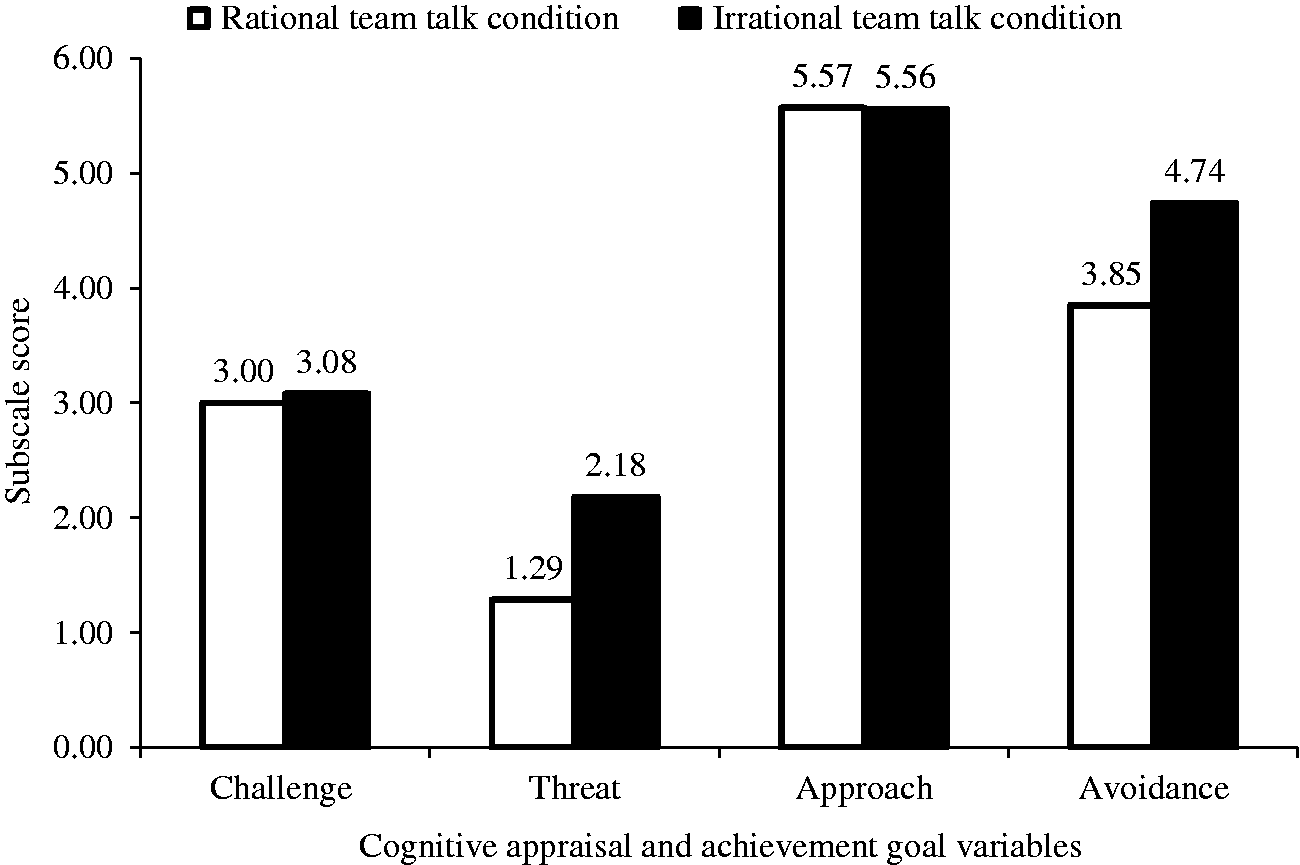
Discussion
The present study demonstrates the effects of rational and irrational half-time coach team talks on cognitive appraisal and achievement goals among varsity football athletes. Data indicate that athletes perceived their second-half football performance to be important regardless of whether they received a rational or an irrational team talk. However, athletes who received a rational team talk reported significantly lower threat appraisal and avoidance goal orientation concerning their second-half football performance compared to athletes who received an irrational team talk. No significant between-condition differences were found for challenge appraisal and approach goal orientation.
Previous commentaries have suggested that promoting rational rather than irrational beliefs to athletes could be demotivating for performance. 37 Nevertheless, athletes in the current study were equally and highly motivated for their second-half football performance irrespective of whether irrational or rational beliefs were communicated through a half-time team talk. This finding is unsurprising given that promoting rational beliefs encourages athletes to adopt strong preferences about events that do not devalue the importance of performance. 5 For example, rational beliefs encourage athletes to draw on healthier motives (e.g. ‘I want’) for upcoming performances whereas irrational beliefs encourage unhealthy motives (e.g. ‘I must’). 5 Indeed, a misconception can exist that rational beliefs are in some way less motivational due to the power of ‘musts’. This misconception is based on an inaccurate understanding of motivation, and in particular, presents motivation as a one-dimensional construct where one can either can be high or low in motivation. Yet motivation is a multidimensional construct where the quality as well as the quantity of one’s motivation is important. For example, whilst ‘I must succeed’ is akin to the introjected regulation construct within Self Determination Theory, 38 ‘I want to succeed’ is much more akin to intrinsic motivation. 39 For acute performance situations, introjected regulation can inspire effort 40 but may also elicit anxiety. The importance of intrinsic motivation for acute and long-term engagement and effort is well known. 41 Therefore, both irrational and rational beliefs can inspire effort but through different motivational mechanisms.
Athletes who received the rational team talk reported significantly lower threat appraisal compared to athletes who received the irrational team talk. The Theory of Challenge and Threat States in Athletes (TCTSA) 14 suggests that a threat state emerges when resource appraisals do not meet demand appraisals. Perhaps communicating irrational beliefs rather than rational beliefs to athletes increased perceived demand appraisals and thwarted perceived resource appraisals on approach to second-half football performance. For example, demand appraisals (as posited in the TCTSA) 14 include danger to esteem which reflects the potential for an event to cause embarrassment partly due to being evaluated by others. The irrational belief that ‘failing makes me a failure’ (as promoted within the irrational team talk) may have augmented perceived danger to esteem and consequently inflated demand appraisals. Other characteristics of irrational beliefs (e.g. LFT) may have thwarted resource appraisals by suggesting that athletes would have diminished efficacy around coping with failure (e.g. ‘I cannot stand failing’). Indeed, Bandura’s Self Efficacy Theory 42 proposes that verbal persuasion is a source of self efficacy among athletes. Research highlights that negative verbalisations characterised by ‘I can’t’ emphasise reduced capabilities and are therefore associated with diminished self efficacy beliefs. 43 Data also highlight that athletes in the rational team talk condition reported significantly lower avoidance in relation to their second-half football performance compared to athletes in the irrational team talk condition. This finding is in line with past research suggesting that demandingness is positively related to avoidance 44 and awfulising is positively associated with submissiveness. 45
The findings that participants in the irrational team talk condition reported higher threat and avoidance are consistent with REBT theory and research. Irrational beliefs concerning stressors are associated with physical and/or mental withdrawal (avoidance) from a situation while rational beliefs are associated with facing up to a situation and taking constructive action (approach). 46 In a recent study of qualified football coaches, 47 irrational beliefs were significantly and positively related to threat but not related to challenge. In another recent study of elite archers, avoidance goals were reduced in five of the six participants following an REBT intervention. 48 Thus, irrational beliefs may increase threat appraisals and consequently trigger a focus on avoidance goals. That said, causation cannot be assumed from extant research and more experimental research is required to examine such a hypothesis.
Given between-condition differences in threat appraisal, the finding that participants in both conditions reported similarly high levels of challenge appraisal is potentially perplexing. Perhaps it is inaccurate to consider challenge and threat as two extremes of one continuum and more accurate to conceptualise challenge and threat as two separate constructs. In other words, when appraising an upcoming event it may be possible to have high challenge and high threat, be high in one state and low in the other, or indeed be low in both states. Some evidence from extant literature indicates that challenge and threat are physiologically distinct while self-reported challenge and threat cognitive appraisals can be very similar on approach to performance situations. 24 The fact that both conditions in the current study reported high challenge may indicate that participants felt the football match was ‘exciting’ but that participants in the irrational team talk condition felt that the football match was also ‘frightening’ (items from the ALE scale). Logically, one can understand how a meaningful event can elicit both excitement and fright. One can reflect on the feelings of waiting to ride a roller-coaster where excitement and fear may both be salient. Future research should therefore investigate the potentially orthogonal nature of challenge and threat and the propensity for performers to experience both challenge and threat. The measures used in the current study should also be taken into consideration when interpreting appraisal and achievement goal data. The ALE scale measures challenge and threat in line with Lazarus’ conceptualisation 13 whereas measures of achievement goals are more aligned to the TCTSA. 14 Thus, it is possible that participants’ challenge and threat appraisal scores do not reflect the cognitive appraisal processes conceptualised within the TCTSA. This finding echoes previous calls for the development of a specific measure of challenge and threat that aligns with the TCTSA. 16
No manipulation checks were taken to confirm participant engagement with team talks and perceived realism of team talks. Future research should therefore confirm team talk engagement and realism by implementing relevant manipulation checks. The poor internal reliability score found for the rational beliefs scale of the SGABS means that data pertaining to rational beliefs should be interpreted with some caution. Perhaps a more internally reliable rational beliefs scale may have revealed different rational beliefs scores among our participants which could have meant controlling for rational beliefs within our statistical analyses was necessary. Emerging research has developed and validated a measure of irrational beliefs for performance contexts (the irrational Performance Beliefs Inventory). 49 The poor internal reliability score found for the rational beliefs scale of the SGABS perhaps justifies the need to develop a full rational beliefs measure that can be used alongside a full irrational beliefs measure relevant to performance contexts. Future research may also wish to confirm the external validity of our findings by recruiting larger samples using an experimental design. Additionally, future research could explore the effects of rational and irrational coach team talks on other outcomes documented in REBT literature (e.g. emotion and performance). Finally, future applied research could document the effectiveness of REBT education delivered to coaches to shape future coaching practice.
In conclusion, the present study found that football athletes were equally and highly motivated for their second-half football performance regardless of whether a rational or an irrational half-time team talk was communicated by a coach. Chiefly, athletes who received a rational team talk reported significantly lower threat appraisal and avoidance goal orientation compared to athletes who received an irrational team talk. It would appear that promoting rational beliefs through a half-time team talk as a coach encourages athletes to adopt a less negative cognitive appraisal state and maladaptive achievement goal orientation in relation to upcoming athletic performance.
Footnotes
Declaration of Conflicting Interests
The author(s) declared no potential conflicts of interest with respect to the research, authorship, and/or publication of this article.
Funding
The author(s) received no financial support for the research, authorship, and/or publication of this article.