



Abstract
The hammer throw is perhaps one of the most misunderstood and difficult events to learn in track and field. Improvements in technique are focused on strategies designed to increase implement release velocity. The purpose of this cross-sectional investigative study was to examine the association between the angle of separation between the thorax and pelvis and performance in the hammer throw. Two male and four female throwers were used to assess positional data of the hammer, thorax, and pelvis. Hammer positional data were used to determine linear hammer speed at release, release angle, and release height. Thorax and pelvis positional data were used to determine thorax rotation relative to the pelvis (separation angle). The association between values of separation angle at key instances and performance was examined. Performance was determined by distance thrown (55.69 ± 3.42 m). Release speeds (24.32 ± 0.70 m/s) were also examined as a contributory factor towards performance and were included to account for instances where throwers released the hammer using sub-optimal release heights and angles which negatively affected distance thrown. The separation angle at its smallest within each turn was found to have a strong negative association with the performance indicators, especially in the first two turns (significant correlates ranged from −0.82 to −0.97). This finding indicates when throwers reduced the separation to a smaller value, performance was enhanced. Separation angle was at its smallest in double support. This suggests that throwers may improve performance by reducing the separation angle during double support phases.
Introduction
The hammer throw is one of four throwing disciplines in track and field. The aim is to throw the hammer the greatest distance. Once released, the hammer undergoes projectile motion meaning the kinematics of the hammer at release are of high importance to throw success, which is measured by distance thrown. Release speed, release angle, and release height will specifically influence distance thrown. Two of the release parameters have optimal values for a thrower. Release height should be as high as possible and will vary for each thrower depending on anatomical constraints such as body height.1–3 The optimal release angle for each thrower will be less than 45° in all instances as the hammer is released above the ground. Once a thrower has developed technique where angle and height are optimized, progression in performance can only be attained through increasing the release speed. Coaches then focus on developing the athlete’s technique and fitness in a way that will enhance the hammer release speed. 1 Utilizing this approach to coaching allows the throws coach to make more accurate adjustments and devise training stimuli to improve performances.
The hammer throw is technically difficult and critical components of the athlete’s kinematics are sometimes misunderstood.
2
Hammer speed is directly manipulated by the thrower applying a force to the hammer’s cable (cable force) whilst performing turns across the throwing circle.2,4 Hammer speed fluctuates within each turn as a result of the tangential component of the cable force (tangential force) alternating between acting in the same (positive tangential force; Figure 1(a)) and opposite (negative tangential force; Figure 1(b)) directions as the hammer linear velocity.1,4 Thorax (or torso) movement is thought to strongly influence speed development.5,6 Shoulder movement relative to the pelvis has been discussed within coaching literature and is commonly referred to as shoulder–hip separation angle within that domain. Less discussion on shoulder–hip separation has taken place within scientific literature.7,8
Action of the tangential component of the cable force when it is (a) positive (acting in the same direction as the linear velocity vector, β < 90°) and (b) negative (acting in the opposite direction to the linear velocity vector, β > 90°).
Shoulder–hip separation angle and thorax–pelvis separation angle, a similar measure, have been examined more thoroughly in other sporting disciplines that involve thorax rotations such as discus and golf. Thorax–pelvis separation differs from shoulder–hip separation in the manner in which it is calculated. Thorax–pelvis separation is computed by examining thorax alignment relative to the pelvis. Shoulder–hip separation is computed by examining shoulder alignment relative to the pelvis. Previous work has found strong agreement between these two angles,9,10 except when a large amount of scapula movement occurs.9,10 In disciplines where thorax–pelvis separation has been examined, strong associations have been observed between thorax and pelvis movement and performance.11,12 Strong association with performance has also been observed in studies that have quantified shoulder–hip interactions.13–15
In the hammer throw, it is accepted that the pelvis leads the thorax during most of the throw, and the angle between these segments (separation angle) increases during single support and decreases during double support.6,16 Morley 5 and Morriss and Bartlett 16 suggested throwers should allow separation to increase during single support which allows the thrower to utilize their trunk muscles to increase hammer speed in the proceeding double support phase. High-level throwers reportedly use this approach, including the current men’s world record holder Yuriy Sedykh. 6 Allowing separation to become large in single support is a technical cue that is often misunderstood and over-coached. Allowing the separation to become too large can be detrimental, as it can lead to large decreases in speed, 17 and can result in an unstable body position going into the subsequent turn. 7 There have been anecdotal suggestions for optimal magnitudes of angle based on the findings of a sample of throwers. 17 One recommendation confirmed by scientific measurement is that the magnitude of separation at the conclusion of single support be between 20° and 40°. 17 It has also been recommended that the single support phase can be more effective when throwers reduce the separation angle during the double support phase.5,8,18 Although a number of recommendations have been made by coaches regarding separation at instances in the throw, limited research exists that examines the relationship between the separation angle and performance. Further investigation is required as conclusions drawn from biomechanical data can result in significant differences in athlete performance.
The purpose of this cross-sectional investigative study was to examine the association between the angle of separation between the thorax and pelvis and performance in the hammer throw. The objective of this study was to provide athletes and coaches with knowledge and insight into how they may improve performance through the manipulation of torso and pelvis positioning at key instances during the throw.
Methods
Participants
Two male (height: 1.92 ± 0.01 m; body mass: 110.39 ± 0.24 kg) and four female (height: 1.71 ± 0.05 m; body mass: 103.73 ± 23.52 kg) hammer throwers participated in this study. All participants gave written informed consent to participate in this study which was given ethical approval by an Institutional Human Research Ethics Committee.
Each participant was in the competition phase of the Australian athletics domestic season and competed in the final of the Australian Athletics Open Athletics Championships (National Championships). At the time of data collection, this pool of participants included the best Australian male and female four turn hammer throwers. The sample size was small; however, the inclusion criteria of being a four turn thrower and competing at the National Championships restricted further recruitment. The small sample also meant genders needed to be pooled together which is discussed further in the Discussion.
Data acquisition
Participants performed 10 throws with a competition-certified standard hammer (7.26 kg for males and 4 kg for females). Throw distance was measured in accordance with the IAAF (International Association of Athletics Federations) competition protocols.
19
Each hammer had two retro-reflective markers positioned on the hammer’s cable at known distances from the center of the hammer’s head. Retro-reflective markers were also positioned over the following anatomical landmarks using the Plug-in-Gait maker placement protocol (Oxford Metrics, Oxford, UK). The markers specifically used to compute variables in this study were: left and right acromion process, sterno-clavicular notch, xiphoid process, spinous process of the C7 vertebra, spinous process of the T10 vertebra, left and right anterior superior iliac spine, and left and right posterior superior iliac spine (Figure 2).
(a) Markers and origins of the thorax and pelvis segments. X axis of each origin (not shown) is perpendicular to the z–y plane. (b) Placement of torso and pelvis markers on a thrower. Only anterior markers shown. Other visible markers in these images were not used in any computations.
A 21 infra-red camera system (Oxford Metrics, Oxford, UK) sampling at 250 Hz recorded three-dimensional marker coordinate data. Testing was performed at an outdoor athletics facility after twilight conditions due to the use of infra-red cameras. All video footage was collected and examined within Vicon Nexus software (Oxford Metrics, Oxford UK) using processing and filtering protocols previously described in the literature. 4
Thorax and pelvis markers were used to determine the angle of separation between the thorax and pelvis (Figure 3) in each throw. As was noted in the introduction, this is a measure similar to shoulder–hip separation and was chosen over shoulder–hip separation to remove the influence that scapula movement has on this angle, which causes overestimation or underestimation.9,10,20 There is strong agreement between these measures when minimal scapula movement occurs,9,10 and it was thought that examining the angle between the thorax and pelvis would give a more accurate representation of how the thorax and pelvis move during the hammer throw. Pelvis markers were used to define the origin of the pelvis rigid segment (Figure 2) based on the methods described by Davis and Colleagues
21
and guidelines of the International Society of Biomechanics.
22
Torso markers were used to define the origin of the thorax rigid segment (Figure 2) based on guidelines of the International Society of Biomechanics.
23
These segment definitions have also been used to examine torso and pelvis interactions in other sports such as golf.
24
Thorax rotations relative to the pelvis were defined using Euler angles with an y–x–z rotation sequence21,25 where the separation was the third rotation of this sequence. Time series graphs of the separation angle were examined to build an understanding of how the angle changes during the hammer throw.
Overhead view of the separation angle. Angle is defined as being (a) positive (pelvis leading thorax) and (b) negative (thorax leading pelvis) for a right-handed thrower.
Hammer marker positional data and direction cosines were used to determine hammer head position. 4 Hammer head positional data were used to determine linear hammer speed, release angle, and release height. These data were used to assess the performance of each thrower using processes described in the following subsection.
Data analysis
Separation angle magnitude at key instances was determined to allow the relationship between separation angle and performance to be assessed. Separation decreases during double support and increases during single support which was highlighted in the Introduction.6,16 This results in there being a maxima and minima in the time-series data within each turn. In this study, separation angle was defined as being positive when the pelvis lead the thorax, which is the case for the majority of the throw. 6 Coaching literature suggests that separation angle is at its maximum during single support and minimum in double support.6,16,18 Technical execution during double support was the focus here, as this position is when a thrower is most stable and most capable of manipulating technique. Focusing on double support provides more applicable data for athletes and coaches. Minima in the separation angle were determined mathematically for each turn and then averaged over each participant’s 10 throws. The averaged value calculated is the minimum separation angle mean for each participant’s four turns.
The relationship between separation angle at its smallest and performance was examined for each turn. Performance was measured by using release speeds and distances thrown during data collection. The optimal distance thrown was also calculated for each throw. Optimal distances and release speeds were examined in addition to the measured distances as throwers may have utilized sub-optimal release heights and angles during data collection. Using a calculated distance also removes the influence of aerodynamic forces on performance. Optimal distance thrown (RC) was calculated using the following equation,
26
where release height (h0) and release angle (θ) were optimized for each individual.
Release height was optimized by being set as high as possible. This position is shoulder height in the hammer throw due to anatomical constraints.1,2,3,6,16 Shoulder height was determined using the vertical position of the acromion process markers. The optimal release angle (θ) for each throw was determined using the following equation, where shoulder height (h0) and release speed (v0) attained in each throw were used.
Data were assessed for normality and homogeneity and were found to not violate these assumptions. Pearson’s product moment correlation (r) was determined for each turn to measure the strength of the relationships between the performance measures and minimum separation angle. This measure indicates the magnitude of association, and whether it was a positive or negative association. A relationship was deemed significant if p < 0.05. A confidence interval of 95% for each correlation coefficient was computed, 27 and correlate magnitudes were classified using definitions described by Hopkins. 28 Scatterplots of the bivariate relationships were also explored to confirm the assumption of linearity. 27 Post-hoc power analyses 29 were performed to assess the statistical power of the correlates. This is particularly important in situations where sample sizes are small. The subsequent power was deemed adequate if greater than 80%. 30
Results
Separation angle (Figure 4) was predominantly positive indicating that the pelvis typically leads the thorax for the throw duration. The separation angle increased during single support and decreased during double support.
Traces of the separation angle for (a) male four turn thrower and (b) female four turn thrower. Note: black lines at the bottom of each graph indicate when the athlete is in double support.
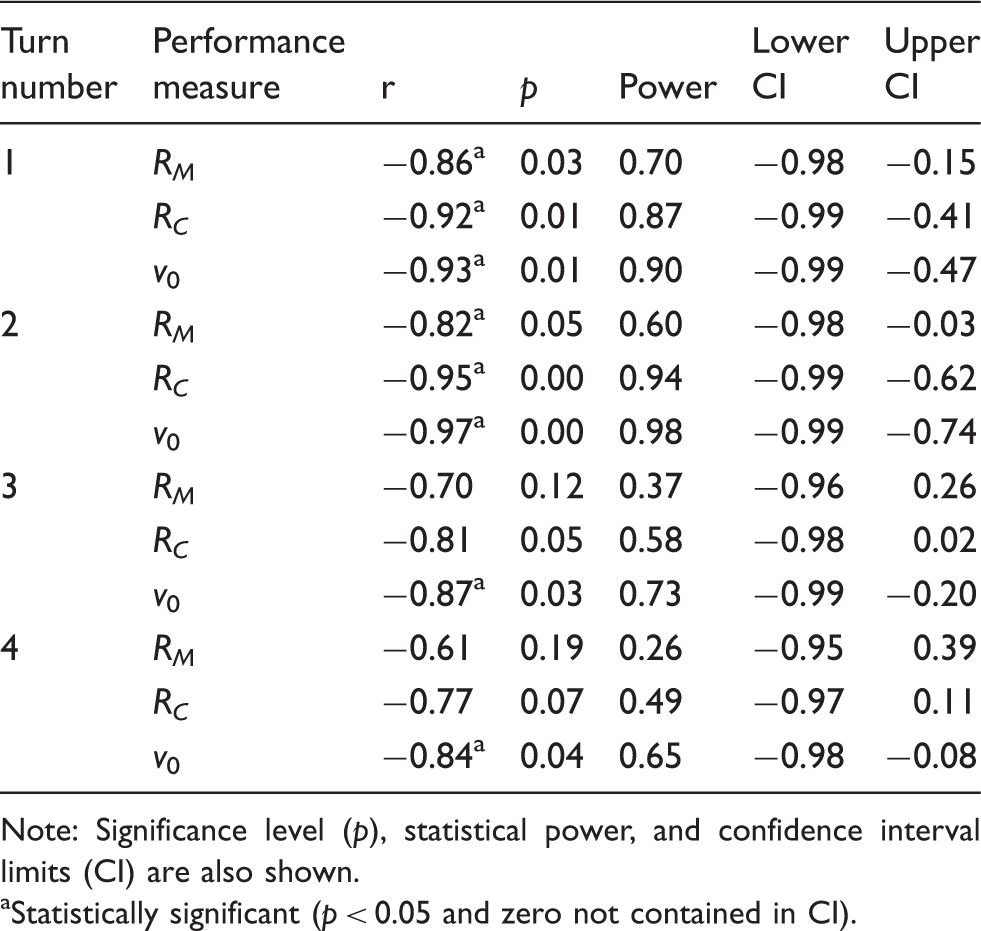
Pearson's product moment correlation (r) for the relationship between the separation angle at its smallest and measured distance thrown (RM), distance thrown calculated using equation (1) and optimal release conditions (RC), and release speed (v0).
Note: Significance level (p), statistical power, and confidence interval limits (CI) are also shown.
Statistically significant (p < 0.05 and zero not contained in CI).
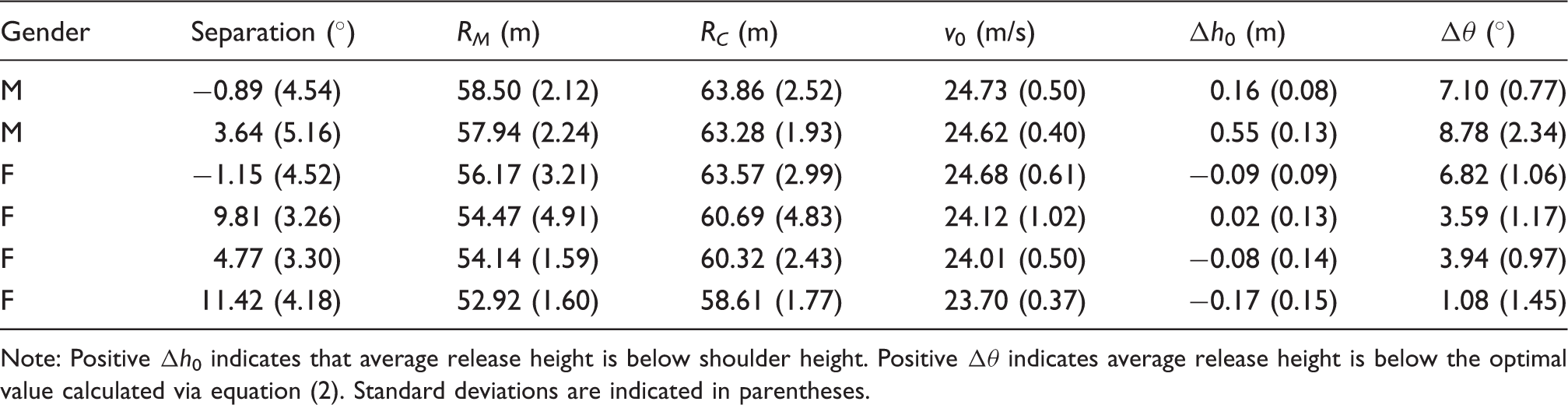
Averages of the separation angle at it smallest over all turns, measured distance thrown (RM), calculated distance thrown (RC), release speed (v0), difference between optimal release height and actual release height (Δh0), and difference between optimal release angle and actual release angle (Δθ).
Note: Positive Δh0 indicates that average release height is below shoulder height. Positive Δθ indicates average release height is below the optimal value calculated via equation (2). Standard deviations are indicated in parentheses.
Discussion
The hammer throw is highly technical and one of the most complicated events to learn in track and field. Coaching strategies for improving technique are designed to increase hammer speed at release and should be designed using objective data reported by researchers and trained coaches. Central to coaching strategy design are data that describe how body segments influence performance. One body segment thought to strongly influence hammer speed development is the thorax.5,6
In other rotational activities, such as golf and discus, both shoulder–hip separation angle and thorax–pelvis separation angle have been used to examine the influence of thorax movement on performance.11–15 Similar work was done here to assess the influence of thorax movement on hammer throw performance. The pelvis typically leads the thorax during a throw with the pelvis-leading magnitude increasing during single support while decreases during double support.6,8,16,18 The time-series separation angle data reported here (Figure 4) supports this belief.
Analyzing time-series data alone does not explicitly show relation to performance. The associations reported here provide insight, although care should be taken when interpreting these due to the small sample size and grouping of genders. The observed associations (Table 1) reveal that when throwers reduced separation to a smaller value during double support, performance was improved. Although thorax–pelvis separation was quantified here, the findings of this study supports those that focus on shoulder–hip separation where it is recommended in coaching literature case studies that throwers should aim to reduce separation during the double support phases.5,18 This recommendation, in conjunction with the recommendation of optimizing separation during single support, is a technical point that is often misunderstood and not properly coached. A thrower can easily increase separation during single support; however, this results in a more unstable position when the thrower returns to double support 18 and can lead to decreases in speed. 16 During double support, it is recommended that throwers should focus on reducing the separation angle, and being in an unstable position may impact on this. In the early turns, which are performed at slower speeds, throwers may be able to account for this. However, as the speed increases, throwers may not be able to account for this instability. It is recommended that throwers can reduce this instability by aiming for the separation to be between 20° and 40°. 18 A separation larger than 40° during turns one and two is a technical flaw that many coaches miss.
The technique adjustment recommended here should be primarily applied to the first and second turns of four turn throwers. However, it may be of greatest benefit for throwers to focus first on applying this to the second turn before focusing on other turns, as the strongest association occurs within the second turn (Table 1).
Significant associations were also observed between minimum separation angle and release speed in the third and fourth turns. However, these findings were underpowered (Table 1), due to unavoidably small sample size and lower level of significance, and should be interpreted with caution. For these two turns, significant associations were not observed between measured and calculated distances which further highlights why caution should be applied here. A possible association may exist in these turns that was not detectable here. It could be beneficial for an athlete to eventually focus on optimizing separation during the double support phases of all turns with care being taken when applying adjustment to the third and fourth turns. Performance should be monitored to assess if other technical issues arise from optimizing separation.
It is suggested that throwers optimize separation during single support and attempt to reduce it in double support. It is currently unknown if throwers can actively manipulate this. However, a thrower is most stable during double support, which may make it possible for performers to apply this technical cue through targeted training.
Finally, it should be noted that the findings reported here are constrained to this cohort of four turn throwers. A small sample was also examined, meaning care should be taken when interpreting these results. In future studies it would be preferable to examine the genders separately, as the different hammer weights may lead to different kinematics. Further investigation involving a larger number of similarly skilled athletes should be carried out to determine a baseline for key critical factors to maximize performance. While this current study had a number of unavoidable limitations, due to the inclusion criteria, this study gives important insight into how throwers may be able to improve performance through the manipulation of separation.
Conclusion
By utilizing this scientific approach to the hammer throw event, the throws coach will be able to make more accurate adjustments and devise training stimuli to better accommodate the athlete. The separation angle between the thorax and pelvis during the hammer throw was examined in this study. The association between the separation angle and performance was analyzed as it was thought a thrower could manipulate this, particularly during double support. The results indicate that this cohort of throwers should aim to reduce the separation angle during double support, particularly during the first and second turns.
In conclusion, the findings of this study can be used by coaches to make technical interventions to improve performance. Coaches may look to the causal relationship between single support and double support to optimize the separation angle during double support. Previous work has suggested that throwers should ensure the amount of separation at the conclusion of the single support phase should be a modest 20° and 40°, which results in the thrower being in a more stable position. 15 With the findings of this current study in mind, being in a more stable position will allow the thrower to be in a stronger position to reduce the magnitude of separation which was found here to be related to performance.
Future research should be undertaken to assess if the relationships found here are present for throwers within different skill levels. Additional research should be performed to determine how technical adjustments improve performance using the recommendations made in the present study.
Footnotes
Acknowledgement
The authors wish to thank the Biomechanics and Performance Analysis Disciplines of the Australian Institute of Sport Movement Science Department for their assistance with data collection.
Declaration of Conflicting Interests
The author(s) declared no potential conflicts of interest with respect to the research, authorship, and/or publication of this article.
Funding
The author(s) received no financial support for the research, authorship, and/or publication of this article.