



Abstract
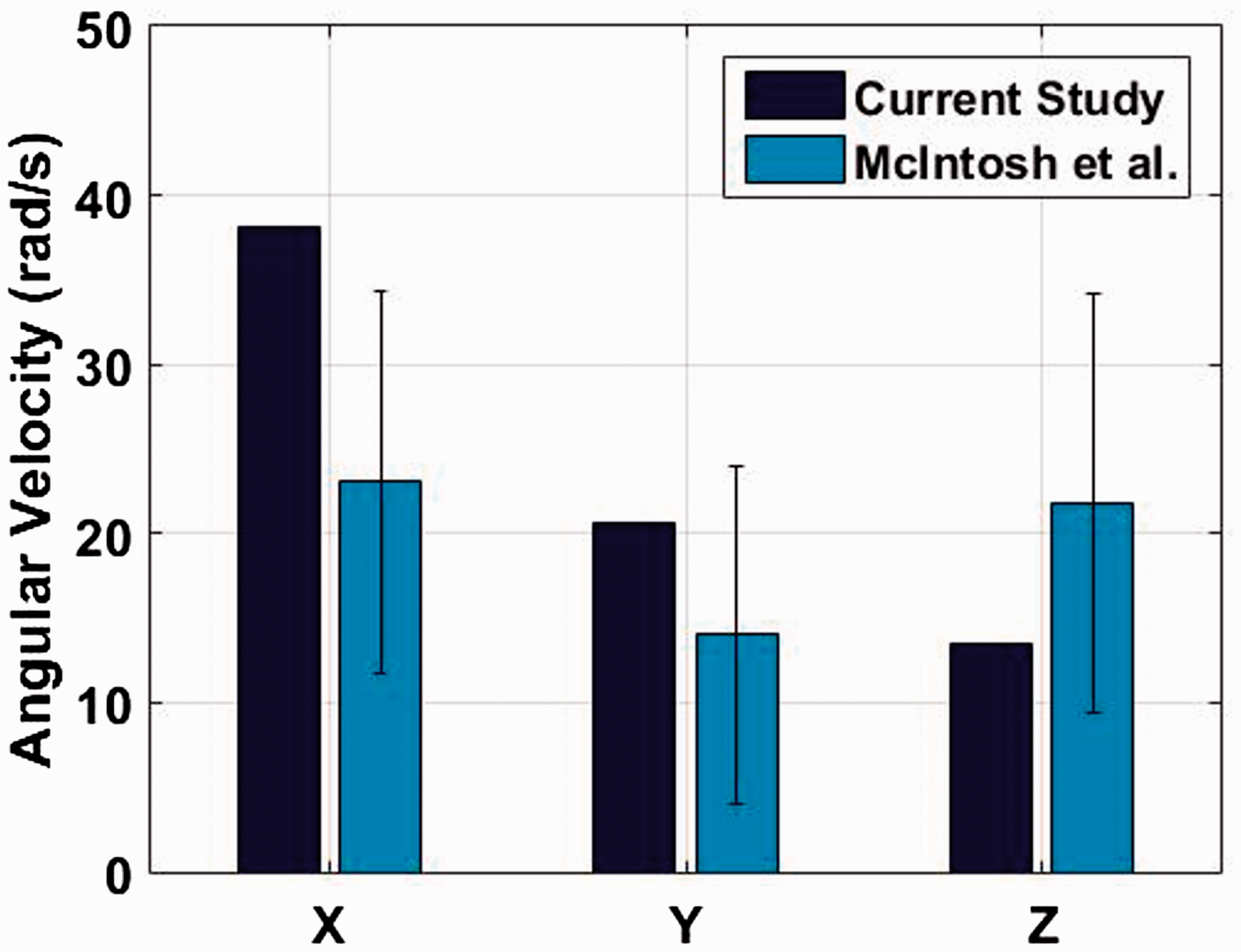
Rugby union players can be involved in many tackles per game. However, little is known of the regular head loading environment associated with tackling in rugby union. In particular, the magnitude and influencing factors for head kinematics during the tackle are poorly understood. Accordingly, the goal of this study was to measure head motion of a visually unaware ball carrier during a real game tackle to the upper trunk with no direct head contact, and compare the kinematics with previously reported concussive events. Model-Based Image-Matching was utilised to measure ball carrier head linear and angular velocities. Ball carrier componential maximum change in head angular velocities of 38.1, 20.6 and 13.5 rad/s were measured for the head local X (coronal plane), Y (sagittal plane) and Z (transverse plane) axes respectively. The combination of a high legal tackle height configuration and visually unaware ball carrier can lead to kinematics similar to average values previously reported for concussive direct head impacts.
Introduction
Head injuries remain a considerable concern in rugby union. An emerging field in brain injury research is the study of repeated sub-concussive head impacts,1–3 defined as “head impacts that do not result in symptoms typically used to define concussion”. 4 The definition of sub-concussive impacts presents challenges as a lower threshold for sub-concussive impacts has not been established. However, for practical purposes, events that result in less than 10g head acceleration have generally not been considered in rugby union head kinematic studies.5,6 In sports such as boxing and soccer, sub-concussive head impacts have been linked with acute changes in brain function, 2 structural changes in white matter, 1 biomarkers of neuronal injury, 3 and short-term cognitive impairments. 7 However, a recent systematic review on sub-concussion found the term to be inconsistently used, poorly defined and misleading and this must be considered when reviewing the abovementioned studies. 8
Head linear and angular kinematics are linked to brain injury.9–13 Studies generally focus on the magnitude of a single hit.9–13 For example, McIntosh et al. 9 found that concussive direct head impacts cause on average 103g of peak resultant head linear acceleration and a change in head angular velocity of 33 rad/s. However, there is an emerging concept of neuronal vulnerability to injury due to repetitive sub-concussive loading if the time between hits is sufficiently small (up to 24 h).4,14,15 Merchant-Borna et al. 4 argue that injury thresholds should not be based on a single hit but that the number and magnitude of hits and the time between hits should also be considered. In extreme cases, rugby union players can be involved in over 30 tackles per game. 16 However, little is known of the regular head loading environment associated with rugby union. In particular, the magnitude and influencing factors for head kinematics during regular rugby union play without any direct head contact are poorly understood, even though a recent video review found that one in seven head injury assessments in rugby union could not be associated with a specific collision event. 17
During one season of an amateur rugby union team, King et al. 5 recorded 181 impacts (0.9% of total impacts) over 95g (head linear acceleration concussion injury threshold utilised for comparison by King et al. 5 ) and 4452 impacts (21.5% of total impacts) over 5500 rad/s2 (head rotational acceleration concussion injury threshold utilised for comparison by King et al. 5 ). However, no diagnosed concussive head impacts were included in this dataset. King et al. 5 reported that inertial head loading (no direct head contact) most likely accounted for a high proportion of these large head kinematic values recorded. However, no further assessment was provided. In rugby union, the ball carrier can be visually unaware of an approaching tackler, i.e. not anticipating the tackle, 18 and failing to brace may result in a higher susceptibility to injury 18 and could lead to higher inertial head loading. Direct measurement of head kinematics during tackling with on-field measurement devices remains challenging. 5 An alternative approach is to use Model-Based Image-Matching (MBIM).19,20 This approach uses multiple camera views of an impact and a computerised skeletal model to extract six degree of freedom head kinematics directly from video. Accordingly, the goal of this exploratory study is to use MBIM to measure head kinematics of a visually unaware ball carrier during a real game shoulder tackle 21 to the upper trunk and to compare to average concussion kinematics values reported in the literature for direct head impacts. 9 The approach provides a case-specific example to the body of evidence on the regular head loading environment in rugby union.
Methods
Similar to a previous video analysis study on knee injuries in rugby union,
22
video search engines (e.g. YouTube) were utilised to identify suitable clips. The three selection criteria utilised were (1) contact was to the upper trunk (Figure 1) of the ball carrier;
23
(2) The ball carrier was visually unaware of the tackle (tackler approaching outside the ball carrier’s peripheral vision);24,25 (3) there was a minimum of three synchronisable camera views of the tackle event available for MBIM reconstruction.
19
Although Tierney et al.24,25 found that the ball carrier is visually unaware during roughly one-third of side-on tackles, only one tackle event satisfied all criteria (due to criterion #3). In this single tackle event, the ball carrier had just passed the ball and was impacted around the left scapula by the tackler (Figure 2). The player received on-field medical attention but was not immediately removed from play (the player was substituted roughly 45 min after the event), and the subsequent medical history is unknown. The tackle was reviewed by the on-field referee/video referees and was deemed legal play as the tackler had committed to the tackle before the ball was passed. The video data were freely available online and no medical data were obtained/reported in this study, so ethical permission was not required, similar to other rugby union video analysis studies.22,26,27
The body regions of the ball carrier. (a) A time lapse of the upper trunk active shoulder tackle with the MBIM matching for one camera view and (b) the MBIM matching for three camera views at time t = 80 ms.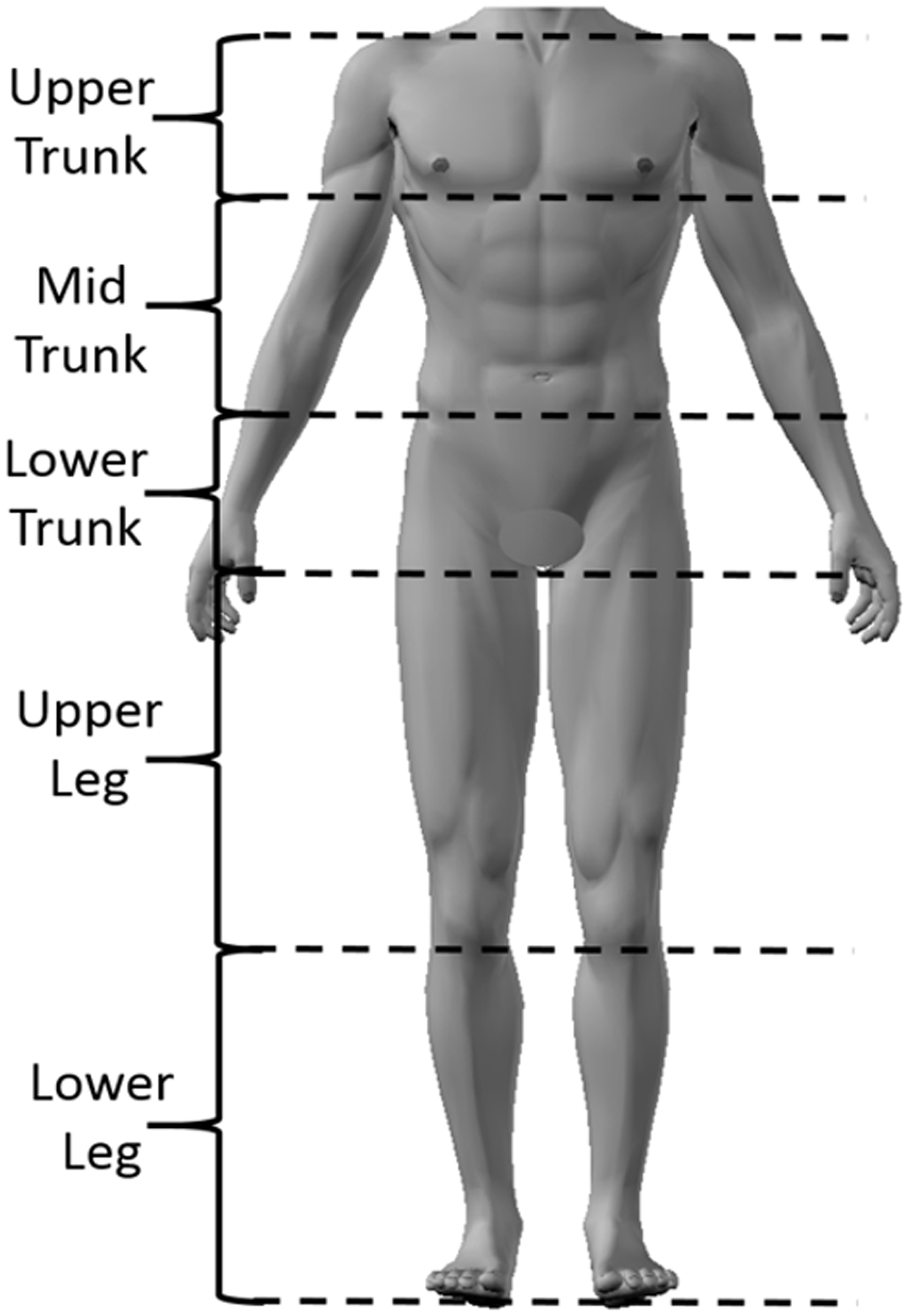
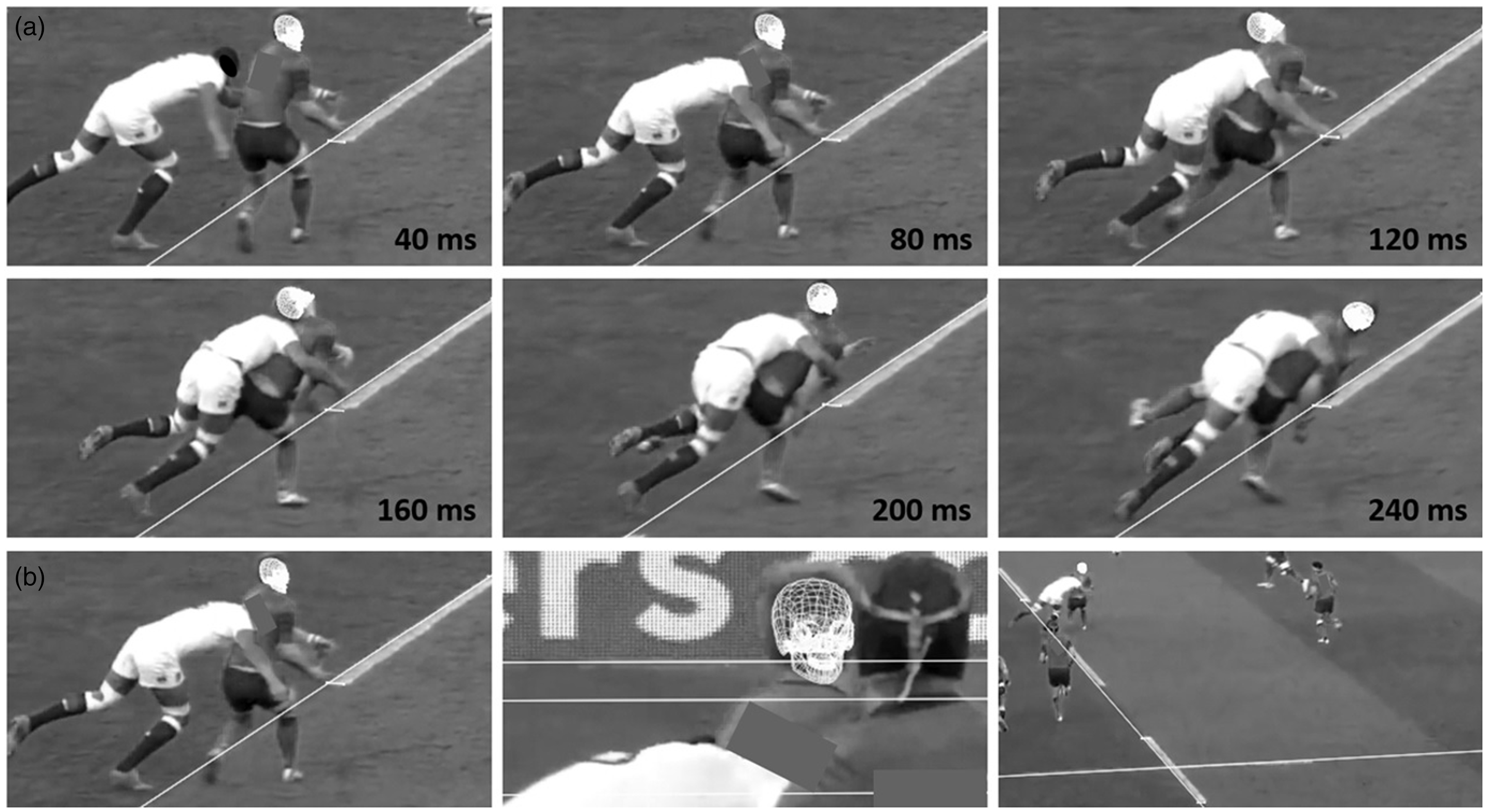
MBIM has been previously described in detail by Krosshaug and Bahr. 28 Briefly, this method uses a multibody skeleton model to estimate human body joint angle time-histories from multiple camera views of human movement. For every video frame, the skeleton model joint angles are manually adjusted to match the segment position and orientation of the model with respect to the target athlete in the multiple camera views. The MBIM technique has been validated previously for six degree of freedom tracking of the pelvis, 28 hip, 28 knee, 28 ankle 29 and head. 19 The MBIM analysis has been shown to be repeatable by both a single researcher and multiple researchers for six degree of freedom head motion data (Intra-class Correlation Coefficients (ICC) greater than 0.9 for six degree of freedom head displacement measurement). 19 The method has previously shown root mean square (RMS) errors of less than 20 mm for linear displacement and less than 0.04 rad for rotational displacement for reconstructing head motion in a vehicle cadaver head-windscreen impact. 19 However, RMS errors up to 5.38 rad/s were reported or the MBIM method for measuring angular velocity during direct head impacts. 19 The MBIM method is considered suitable for measuring componential angular velocity during indirect head impacts (i.e. inertial head kinematics as a result of an impact to the body) for which lower frequency head motion is typically associated with. 30
In this case, matching was conducted on synchronised video of three camera views of the tackle. Each video had a resolution of 720p and frame rate of 25 fps. One researcher performed the matching using 3D animation software Poser 4 and Poser Pro Pack (Curious Labs Inc., Santa Cruz, California). The surroundings were built in a virtual environment based on the dimensions of the rugby field. The videos were imported into the Poser workspace background and the surroundings were then matched to the background video footage for every camera view. As the camera locations were unknown, this was achieved by manually adjusting the camera positioning tool which contains three translational and three rotational degrees of freedom, as well as variable focal length. Since the cameras were moving during the impact, the environment matching was conducted for each individual video frame. A skeleton model from Zygote Media Group Inc. (Provo, Utah, USA) was manipulated to fit the player’s head for each video frame (Figure 2). Linear closing speed estimates were also calculated by tracking the players’ pelvises using the MBIM approach utilised by Krosshaug and Bahr. 28
This approach yielded head successive rotation angles of order yaw-pitch-roll (or Z-Y-X see Figure 319) and linear position measurements every 40 ms. The time derivatives of the yaw, pitch and roll angles were calculated using the Matlab gradient function, and hence the components of the body local head angular velocity (Figure 3) every 40 ms were calculated.
19
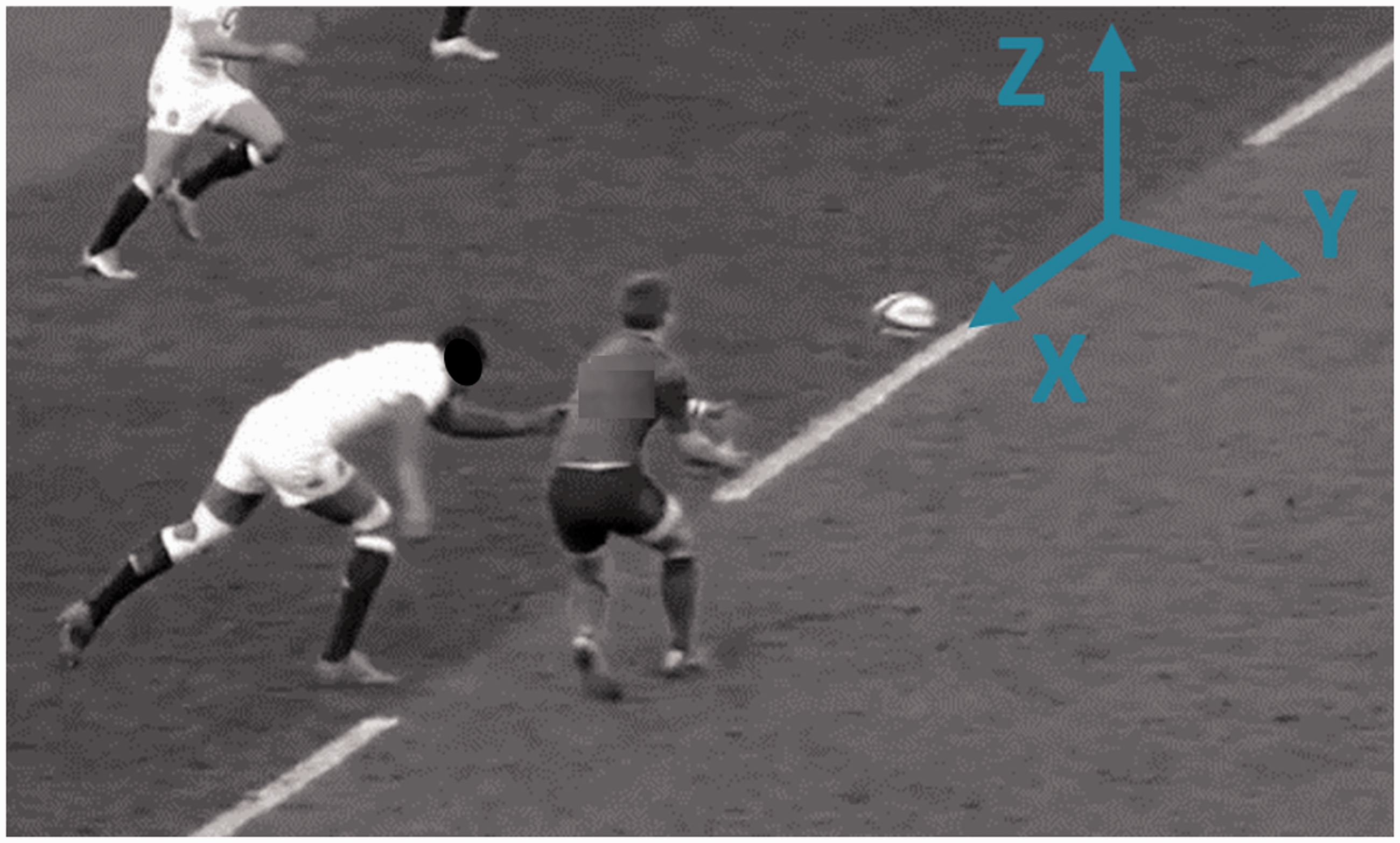
The same method was used to calculate the head and pelvis linear velocity components in the global coordinate system (Figure 4). The maximum change in head componential angular velocity values were compared to the average concussion values reported in the literature for unhelmeted sports.
9
The comparison was not conducted for the maximum change in head linear velocity results, as componential data are not available for unhelmeted sports.
31
The MBIM analysis for this case took roughly 60 h to complete.
The local axes of the head. The global coordinate system utilised for the MBIM method.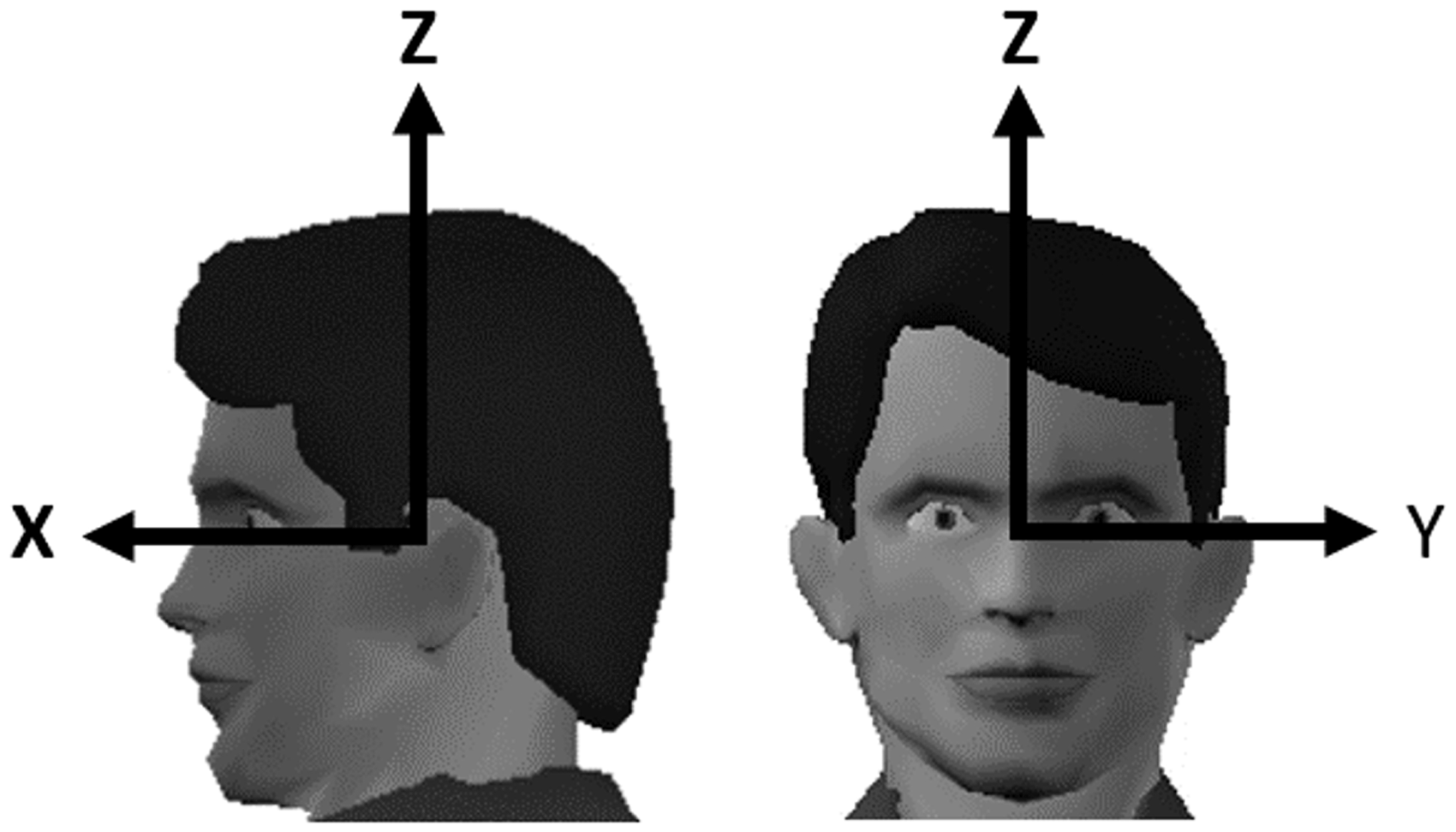
Results
The componential change in head linear velocity is mostly in the global Y direction (lateral for the player) (Figure 5). The componential head angular kinematics from this case are similar to the reported average values for concussive direct head impacts in unhelmeted sports such as rugby and Australian rules football
9
(Figure 6). For the X (coronal plane) and Y (sagittal plane) components, the maximum change in head angular velocity is greater than in average concussive cases. The linear and angular velocity values for each time frame can be seen in Appendix 1. Although it was a side-on tackle,24,25,32 the resultant tackler closing speed was 5.5 m/s (−2.5 m/s, 4.9 m/s and −0.6 m/s in the global X, Y and Z directions, respectively). The resultant ball carrier closing speed was 3.1 m/s (−0.6 m/s, −3.0 m/s and −0.3 m/s in the global X, Y and Z directions, respectively).
The componential change in head linear velocity results for the ball carrier about the global coordinate system (Figure 4).
Discussion
This case study used the MBIM method to measure head kinematics of a visually unaware ball carrier during a rugby union shoulder tackle to the upper trunk. Componential head angular velocities were similar to the average values reported for concussive direct head impacts in unhelmeted sports (Figure 6). 9 Although the long-term medical outcome of this case is unknown, these results support the finding that legal shoulder tackles to the upper trunk where the ball carrier is visually unaware is a concern for inertial head loading. 30 A conclusion regarding injury risk associated with these tackles requires correlation with injury data and this should be a focus of future work. Longitudinal studies considering blood biomarkers, medical imaging, concussion history, medical reports, injury data and overall head impact exposure would be of benefit.
In this case study, the ball carrier was impacted by the tackler just after passing the ball. The tackle was subsequently reviewed by the on-field referee/video referees and regarded as legal play, as the tackler was committed to the tackle before the ball was passed. It could be considered difficult for a ball carrier to protect themselves/brace when impacted from behind and without the ball in their hands. Further work should look at these types of tackles to examine their incidence as well as propensity for injury and high head kinematics. This will build an evidence base for coaches to develop pre-contact tackle strategies such as ensuring ball carriers pass to end off in a protective position.
Recent studies have proposed a biomechanical justification for tackling lower around the mid/lower trunk (Figure 1) in rugby union, for which this case study provides further support.30,33 Upper body tackles,26,27 especially when primary contact is with the ball carrier’s upper trunk, 23 are the main cause of direct head impacts for the tackler. A recent study identified that tackling at the upper trunk has a high propensity to result in tackler direct head impacts and emphasised the importance of tackling lower risk body regions such as the mid and lower trunk. 34 For the ball carrier, studies using multibody models and staged tackles in a motion analysis laboratory have found that higher tackle heights, particularly to the upper trunk but below the legal limit (line of the shoulders), can result in significantly higher inertial head kinematics in comparison to tackles below the upper trunk.30,33 Thus, if contact in this case had been made below the upper trunk of the ball, the ball carrier’s inertial head kinematics would likely have been reduced, potentially by over 50%. 33 The energy transmitted during an impact is attenuated along a damped/deformable linkage system through viscous dissipation. 35 Thus, the head kinematics resulting from an impact to the body are inversely related to the distance of the impact from the head. The overall ball carrier angular momentum about the point of contact is conserved in the tackle. This results in a lower rotational inertia above the point of contact when the tackle height is greater and hence greater head rotations. This highlights the importance for coaches to encourage tackling at lower risk body regions such as the mid and lower trunk.
Limitations
RMS errors up to 5.38 rad/s and 1.29 m/s were measured for componential angular and linear velocity reconstruction in the MBIM validation study, respectively. 19 This should be considered when interpreting the current results. Linear and angular acceleration were not measured using the MBIM method as the sample frequency (video frame rate) was too low (25 Hz) and head acceleration measures typically require 1000 Hz sampling frequency. 5 The frame rate of 25 fps could be considered low for inertial head angular velocity measurement. It is possible that higher frequency head motion was unmeasured. The time duration associated with the head kinematics measured in this study (Appendix 1) are much longer than those typically associated with concussive direct head impacts (peak values usually measured within 54 ms). 36 Only one case was analysed in this current study. Much larger sample sizes were utilised by McIntosh et al. 9 and this should be considered when interpreting the kinematic result comparisons. The study would have benefited from access to immediate and follow up medical data, if applicable, from this case.
The MBIM approach is currently a time-consuming process, as it requires manual frame-by-frame matching. This case took approximately 60 h to complete. Further work should look at automating/semi-automating the MBIM technique. The sample size for this study was only one due to the selection criteria required for the MBIM technique. Ideally, for comparison, the MBIM method could have been conducted on a tackle with similar closing speeds that occurred lower down on the body of an unaware ball carrier. 37 The closing speeds in this case study were similar to the average closing speeds measured in elite level rugby union. 38 Access to multiple camera view-synchronised video footage directly from the sports broadcaster could have allowed more cases to be analysed.
Conclusion

Footnotes
Declaration of conflicting interests
The author(s) declared no potential conflicts of interest with respect to the research, authorship, and/or publication of this article.
Funding
The author(s) disclosed receipt of the following financial support for the research, authorship, and/or publication of this article: The authors received funding from the Irish Research Council for this article.