



Abstract
This study aimed to: (a) examine the relationships between high-level athletes' perceptions of mothers' and fathers' behaviors, their satisfaction of basic psychological needs, and sport motivation and (b) explore whether the sex of the athlete moderated the aforementioned relationships. A total of 333 adolescent athletes involved in intensive training settings completed the Parental Involvement in Sport Questionnaire (PISQ), the Behavioral Regulation in Sport Questionnaire (BRSQ) and the Basic Need Satisfaction in Sporting Context Scale (BNSSS). Data were examined using correlational analyses and partial least square path modeling (PLS-PM). The PLS-PM revealed that father's perceived pressure positively predicted maladaptive outcomes (controlled forms of motivation and amotivation). Perceptions of the mothers' and fathers' praise and understanding positively predicted adaptive athletes' outcomes (self-determined forms of motivation and satisfaction of competence and relatedness), whereas the mothers' and fathers' perceived pressure negatively predicted such adaptive outcomes. Furthermore, differences regarding the aforementioned relationships between mother's and father's behaviors and athletes' outcomes were highlighted across their sex. More significant relationships emerged for boys versus girls and between athletes' outcomes and the perceived behaviors of the same-sex parents. In particular, the direction of relationships between introjected regulation and two parental behaviors (i.e. perception of father's directive behaviors and perception of mother's pressure) was reversed for boys and girls. As a whole, this study highlighted that both parent's and child's sex should be evaluated to understand sport parenting.
Introduction
Over the past 20 years, a large body of research in sport psychology has shown the importance of quality of the environment on athletes' personal development. 1 Parents play a critical role in their children's sporting participation and performance in three ways: as providers, interpreters, and role models. 2 They provide opportunities by offering various types of supports to their child, help children interpret their sporting experiences, and act as role models for sports participation and behaviors. 3 Parental involvement can affect an athlete's development either positively or negatively. 4 Indeed, national tennis coaches stated that 58.9% of the parents had a positive influence (e.g. unconditional love, emotional and organizational support), while 35.9% of parents were reported to have a negative influence (e.g. unrealistic expectations, overemphasizing winning, and being critical) on their child's development. Consequently, a bulk of sport studies have examined how parental behaviors affect their child's development. 5
Tenets of self-determination theory (SDT) provide useful heuristic for investigating the impact of parental behaviors on their children's sport outcomes, as the influence of a set of stakeholder's behaviors was examined within the SDT framework. 6 In SDT, 6 behaviors of individuals (e.g. administrators, coaches, and parents), as may be grounded within the athlete's social environment, can nurture their psychological needs and influence their motivation. Three basic (innate) psychological needs (BPN) are postulated within SDT: (a) the need for autonomy (i.e. the ability to make one's own decisions); (b) competence (i.e. the desire to master one's environment and achieve the desired outcomes); and (c) relatedness (i.e. the desire to interact with, be connected to, and experience caring for other people). The satisfaction of BPN promotes athletes' well-being. 7 Indeed, an autonomy-supportive environment encourages athletes to act on their own, be responsible, and foster a need to control their behaviors. A competence-supportive environment uses positive feedback and encouragement focusing on effort and improvement to achieve goals. Lastly, a relatedness-supportive environment offers the opportunity to have a close, healthy, and affectionate relationship with others. 6
Within the SDT framework, an athlete may engage in a sporting activity for multiple reasons that fall along a self-determination continuum of six types of motivational regulation: intrinsic motivation, four types of extrinsic motivation, and amotivation. 6 Intrinsic motivation refers to behaviors adopted for fun, excitement, and enjoyment. In contrast, extrinsic motivation refers to an athlete acting to meet external demands (e.g. to please people, earn money, or be praised). There are different types of extrinsic motivation which vary along a continuum: (a) integrated regulation (i.e. athletes practicing to be consistent with their values); (b) identified regulation (i.e. athletes acting to achieve personally-valued targets); (c) introjected regulation (i.e. athletes practicing to avoid unpleasant outcomes such as guilt and shame); and (d) external regulation (i.e. athletes practicing to receive a reward or avoid punishment). Intrinsic motivation and integrated and identified regulations represent self-determined forms of motivation, whereas introjected and external regulations are conceptualized as controlled forms of motivation. At the end of the continuum, amotivation refers to an absence of motivation toward sport. Several scholars have suggested that developing self-determined forms of motivation is necessary to pursue a long sports career and to realize well-being in athletics. 6 As such, in the present study, we examined if parental behaviors significantly predicted both athletes' BPN satisfaction and sports motivation.
Some studies have investigated the relationships between parental behaviors or athletes' perceptions of parental behaviors (pressure, support) and athletes' SDT variables (satisfaction of BPN and motivation). 5 Parental pressure has been negatively associated with satisfaction of athletes' BPNs and positively related with amotivation.8,9 In contrast, athletes who perceived that their parents give frequent positive contingent responses to their performance successes also reported high scores of competence, intrinsic motivation, and enjoyment.10,11 Similarly, athletes who perceived that their parents encouraged them to initiate and to make choices also reported high level of self-determined motivation.12,13 However, a significant limitation in this area is that most studies have not examined the role of the sex of parents and children in the relationships between parental behaviors and athletes' outcomes.
Indeed, although parental involvement has been associated with their child's motivational outcomes, children's and parents' sex could moderate the relationship between parents' behaviors and their child's motivational outcomes. Indeed, a study showed that parental pressure negatively predicted the satisfaction of BPNs (autonomy, competence, and relatedness) for boys but not for girls. 8 Moreover, past research revealed very little information on the different roles played by fathers' and mothers' behaviors. In particular, a majority of the studies considered both parents in an undifferentiated way.9,14 One of the few studies examining the effect of parents' sex showed that athletes' perceptions of their mother's praise and understanding behaviors positively predicted their intrinsic motivation. 15 In the same vein, the athletes' perceptions of their mother's directive behaviors negatively predicted their perception of competence, while athletes' perceptions of their father's behaviors were not significantly related to these variables. In line with these preliminary results, several scholars have suggested that the behaviors of each parent should be separately explored.5,15,16 The present study aimed to address this gap in examining athletes' perceptions of their mother's and father's behaviors, their BPN satisfaction and sports motivation among both male and female adolescent athletes involved in intensive training settings.
An issue of particular importance in disentangling the influence of mothers' and fathers' behaviors on children's motivational outcomes involves the issue of measurement invariance of parental behavior across sex. Testing measurement invariance across mothers' and fathers' behaviors is fundamental in such a comparative study in order to confirm that comparisons are made based on questionnaires that measure the same psychometric constructs. Factorial non-invariance could bias interpretation of difference, as it would not reflect the true difference of the parents' behaviors. However, there are no invariance studies of parents' behavior across mothers and fathers in sports settings. For this reason, we examined in the present study the invariance of the Parental Involvement in Sport Questionnaire (PISQ) scores across mothers' and fathers' behaviors. The four behaviors measured in this sports-specific questionnaire are expected to be positively (active involvement, praise, and understanding) or negatively (directive behaviors and pressure) related to the satisfaction of athletes' BPN.6,8,17
In sum, although previous literature has provided evidence for the influence of parental involvement on children's sports outcomes, this line of research should be pursued for a number of reasons. First, the rare examples of research that differentiate mothers' and fathers' behaviors have highlighted that fathers' and mothers' behaviors had a differential influence on athlete outcomes. 15 A more specific examination of each of the parents is thus warranted. 18 Second, the athlete's sex was rarely studied, notwithstanding that fathers of male athletes reported using more directive behaviors and more praise and understanding, compared to fathers of girls. 15 Third, the invariance of the scores of athletes' perceptions of their mother's and father's behaviors has not been tested in previous studies. Finally, the majority of previous studies focused on parental practices in the context of tennis. 16
With these considerations in mind, this study aimed to: (a) examine the relationships between athletes' perceptions of their mother's and father's behaviors relative to their satisfaction of BPN and sport motivation; and (b) explore whether children's sex moderated the aforementioned relationships. According to SDT and literature on parenting in sports,6,8,9,14,17 our central hypothesis was that the athletes' perceptions of parental pressure and directive behaviors will negatively predict BPN satisfaction and self-determined forms of motivation and positively predict controlled forms of motivation. Reverse relationships were expected for athletes' perception of parental praise and understanding and active involvement behaviors.
Method
Participants
Sample 1: A total of 333 French athletes (148 girls and 185 boys, M age = 16.49 years, SD = 1.53, range = 13–18 years) attending intensive sports training programs, voluntarily participated in this study. Intensive training centers are structures that receive the best adolescent athletes in France, five to seven days per week. They had been involved in their sport for 8.12 years (SD = 3.13), they trained for an average of 11.66 h per week (SD = 3.06), participating in 19 different sports, both individual (n = 65) and team (n = 268) sports. They participated in international (n = 11) or national (n = 322) sport competitions.
Sample 2: A total of 240 French athletes (49 girls and 191 boys, M age = 15.47 years, SD = 2.14, range = 12–18 years) voluntarily participated in this study. They practiced for an average of 7.76 years (SD = 2.84) and trained for an average of 9.60 h per week (SD = 5.09). They were involved in 13 different sports, both individual (n = 100) and team (n = 140) sports. Youths participated in international (n = 6), national (n = 78), or regional (n = 156) sport competitions. There was no overlap in the membership of the first and second samples.
Measures
Descriptive statistics of the Parental Involvement in Sport Questionnaire scores and zero-order correlations between mothers' and fathers' behaviors, boys' (number on the left) and girls' (number on the right) sport motivation and satisfaction of basic psychological needs.
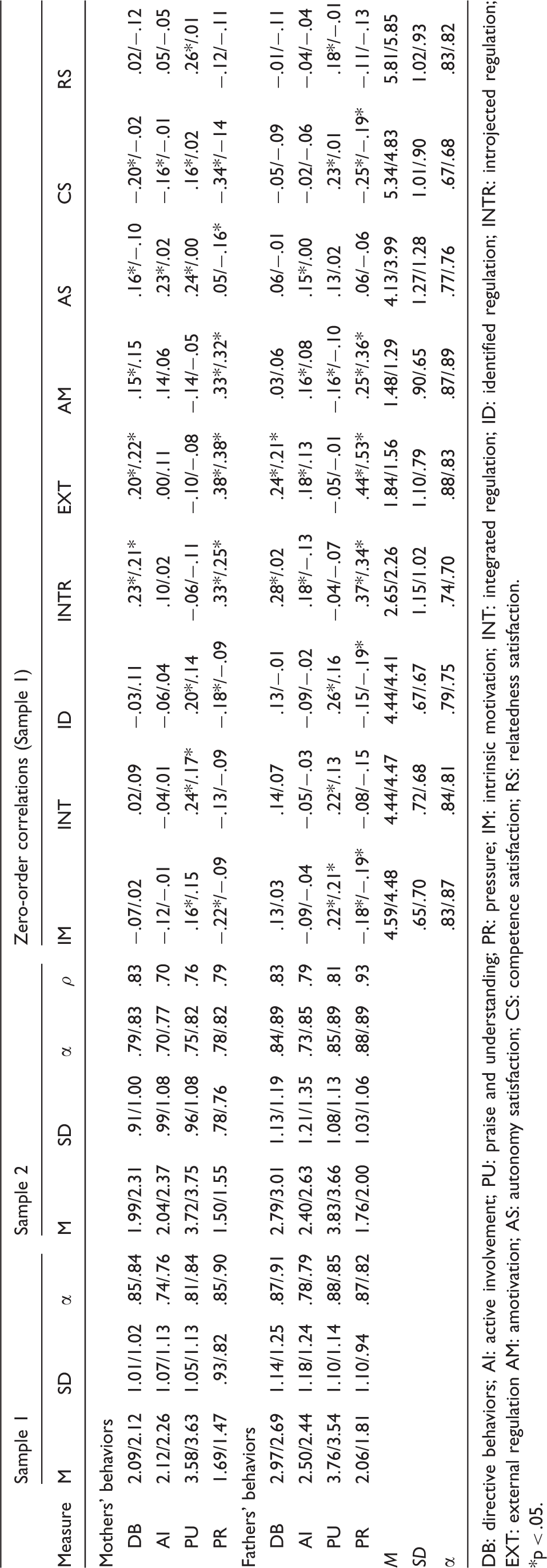
DB: directive behaviors; AI: active involvement; PU: praise and understanding; PR: pressure; IM: intrinsic motivation; INT: integrated regulation; ID: identified regulation; INTR: introjected regulation; EXT: external regulation AM: amotivation; AS: autonomy satisfaction; CS: competence satisfaction; RS: relatedness satisfaction.
*p < .05.
Athletes of Sample 1 also completed the Basic Need Satisfaction in Sporting Context Scale (BNSSCS) and a French version of the Behavioral Regulations in Sport Questionnaire (BRSQ).20,21 Previous research lent credence to the validity and reliability of the BNSSCS and BRSQ scores.20,21 The BNSSCS is a French questionnaire including three subscales of five items each that assess satisfaction of BPNs for autonomy in sports (e.g. “In my sport, I contribute in my training program”); competence (e.g. “… I feel successful”); and relatedness (e.g. “… I feel comfortable with others”). Each item is rated on a 7-point Likert scale ranging from 1 (completely disagree) to 7 (completely agree). Cronbach alphas ranged from .67 to .83 (Table 1).
The French version of the BRSQ was used to measure the child's motivation. 21 The four-item BRSQ subscales assessed intrinsic motivation (e.g. “I practice this sport because I love it”); integrated regulation (e.g. “… because this sport is an integral part of my life); identified regulation (e.g. “… because I enjoy benefits of the sport”); introjected regulation (e.g. “… because I'd feel guilty if I stopped”); external regulation (e.g. “ … to please people who want me to do the sport”); and amotivation (e.g. “… but I wonder why I continue”). Each item was estimated on a 5-point Likert scale ranging from 1 (not true at all) to 5 (very true). Cronbach alphas ranged from .70 to .89 (Table 1).
Procedure
The research was conducted in accordance with international ethical guidelines and approved by our institutional research ethics board. The coaches from each training center were contacted to obtain permission to ask their athletes to participate in this study. Their participation was voluntary. The training centers were selected because their residents were athletes aged 12 to 18 who practice at least at a regional level and have at least 4 years of experience. For athletes' participation, written informed consent and parental consent were requested. Athletes completed questionnaires before/after training session, in groups of 5–15, managed by a researcher. Coaches did not attend these sessions.
Data analysis
Preliminary analyses
Previous literature had validated the construct validity of the PISQ scores measuring both parents' behaviors but in an undifferentiated fashion.14,17 Therefore, before focusing on main hypotheses, we examined the structural stage of construct validity of PISQ scores separately for the mother's and father's scales and then tested the invariance of the PISQ scores across these scales. First, to identify the number of underlying factors, a principal component analysis (PCA) with varimax rotation was independently conducted for fathers' and mothers' perceived behaviors using Sample 1 data. Only items with a loading of .35 or more were retained. 22 Secondly, the structural stage of PISQ scores for both the mother's and father's scales was further examined using Sample 2 data, through confirmatory factor analysis (CFA) and exploratory structural equation modeling (ESEM). Given that the statistical analyses used with Sample 1 could be susceptible to capitalization on chance (i.e. deletion of items with a loading of less than .35), the second sample cross-validated the factor structure of PISQ scores using CFA and ESEM among an independent sample of youth athletes. Multiple fit indices were used to achieve a comprehensive evaluation of fit: the Satorra-Bentler scaled chi-square (SBχ 2 ), the comparative fit index (CFI), the Tuker-Lewis index (TLI), the standardized root mean squared residual (SRMR), and the root mean squared error of approximation (RMSEA). 23 For the CFI and TLI, values greater than .90 supported adequate fit, and .95 indicated excellent fit to the data, whereas RMSEA values smaller than .08 supported acceptable fit and .06 excellent fit. 23
Third, the reliability of each of the PISQ subscales was evaluated with Cronbach's α coefficients and composite reliability values (ρ). An α or ρ value either equal to or greater than .70 indicates acceptable reliability. 24 Fourth, the best fitting model was used for a test of factorial invariance of the PISQ scores across parents' sex (i.e., Samples 1 and 2 were combined to have a sufficient sample size). Particularly, the configural (no equality constraints), metric (equal item loadings), strong (equal item loading and item intercepts simultaneously), and strict (equal item loadings, items intercepts and item error variances simultaneously) invariance were successively tested. 25 The differences in CFI and RMSEA were used to compare nested models. A ΔCFI value equal to or less than .010 and a ΔRMSEA equal to or less than .015 indicated that the equality constraints were tenable.25,26 All models were estimated using Mplus 7.31.
Main analyses
First, zero-order correlations between PISQ, BNSSCS, and BRSQ scores were computed with Statistica Version 7.1 for Sample 1 to examine relationships of athletes' perceptions of their mother's and father's behaviors with athletes' outcomes (motivation and satisfaction of BPNs) separately for boys and girls. Effect sizes were used to compare the strength of the relationships between parental behaviors and their child's outcomes across children's and parents' sex. The use of the effect sizes in the present study was based on the rationale that as effect sizes are independent of sample size.
Secondly, partial least squares path modeling (PLS-PM) was used to investigate multivariate relationships between mothers' and fathers' behaviors and the boys' and girls' outcomes (i.e. sport motivation and satisfaction of BPNs) using Sample 1 data. The tested model is presented in Figure 1. PLS-PM is a variance-based structural equation modeling technique that does not rely on distributional assumptions and is able to deal with relatively small sample sizes.27,28 The approach was chosen because sample size is relatively small (especially for the subsamples of boys and girls) if we consider the number of latent and manifest variables included in the model. All PLS-PM analyses were conducted with the R package labeled PLS-PM.
29
We followed a two-stage modeling procedure: (a) the measurement model (outer model) and (b) the structural model (inner model).7,29 In order to retain a reasonable number of manifest variables in the model, the different constructs were measured by three random aggregates of items.
30
Finally, the PLS-PM model was tested for boys and girls independently.
Model.
Results
Preliminary analysis: Construct validity and factorial invariance across sex of parents
Principal component analysis with a 4-factor solution, standardized factor loadings (λ) and uniqueness (δ) for confirmatory factor analysis (CFA) and exploratory structural equation modelling (ESEM) of fathers' (numbers on the left) and mothers' (numbers on the right) scales.

Note: Bold values denote target loadings. All standardized factor loadings of the CFAs and ESEMs were significant (t > 1.96).
The test of factorial invariance of the PISQ scores across parents' sex indicated that the number of latent constructs could be assumed to be identical across the mother and father scales, as the unconstrained ESEM model fitted the data adequately. Model fit was still adequate when invariance constraints were putted on factor loadings, item intercepts, and residual variance of corresponding item (CFI = .97–.98, TLI = .97–.98, RMSEA = .03, SRMR = .03). Furthermore, ΔCFI values (<.010) and ΔRMSEA values (<.015) provided evidence for strict invariance between mother's and father's scales.
Zero-order correlations
All correlations are detailed in Table 1. Athletes' perceptions of their mother's and father's pressure were positively correlated with their controlled forms of motivation (i.e. introjected regulation, external regulation) and amotivation (r = .25 to .53), whereas athletes' perceptions of father's and mother's praise and understanding were positively correlated with their self-determined forms of motivation (i.e. intrinsic motivation, integrated, and identified regulations; r = .16 to .26). Moreover, results showed differences based on athletes' sex. The number of significant correlations were more numerous for boys' (n = 36) versus girls' (n = 15) outcomes, while it was nearly similar for fathers' (n = 25) and mothers' (n = 26) behaviors. Effect sizes also provided evidence that the outcomes were mainly related to parental behaviors among boys than girls. Most of the differences across athletes' sex appeared in the relationships between parental behaviors and satisfaction of athletes' BPNs. In particular, boys' and girls' competence were negatively correlated with their perceptions of mothers' (r = −.34 and −.14, respectively) and fathers' (r = −.25 and −.19) pressure. However, only boys' competence was negatively correlated with mothers' directive behaviors (r = −.20) and active involvement (r = −.16).
Partial least squares path modeling
Measurement model
Psychometric properties of the outer model.
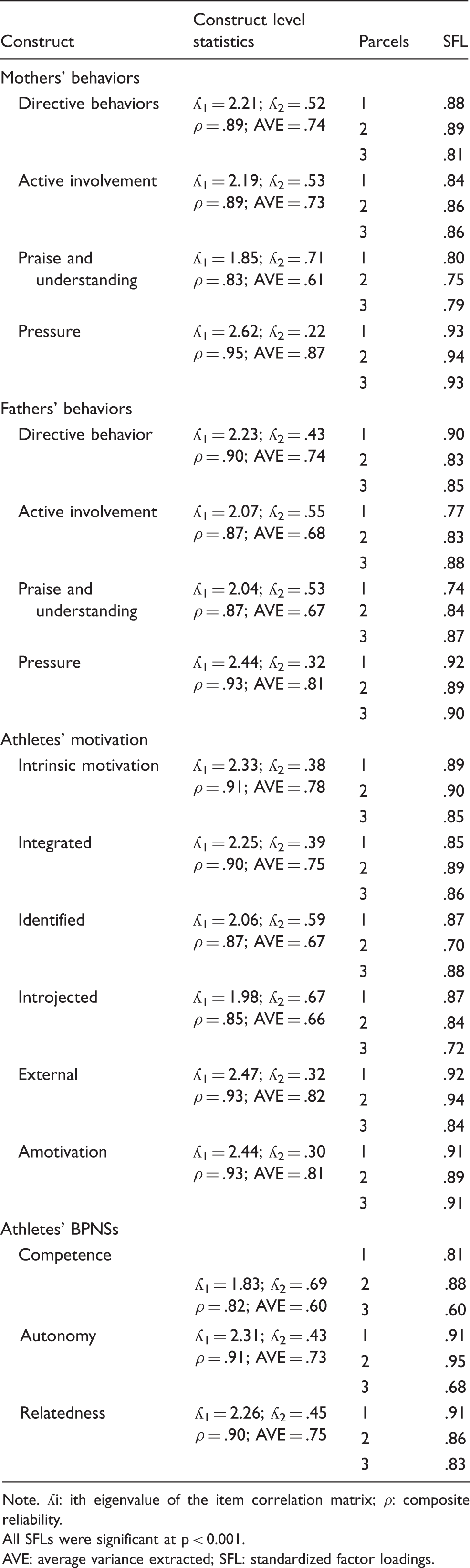
Note. i: ith eigenvalue of the item correlation matrix; ρ: composite reliability. All SFLs were significant at p < 0.001. AVE: average variance extracted; SFL: standardized factor loadings.
Structural model
Structural model.
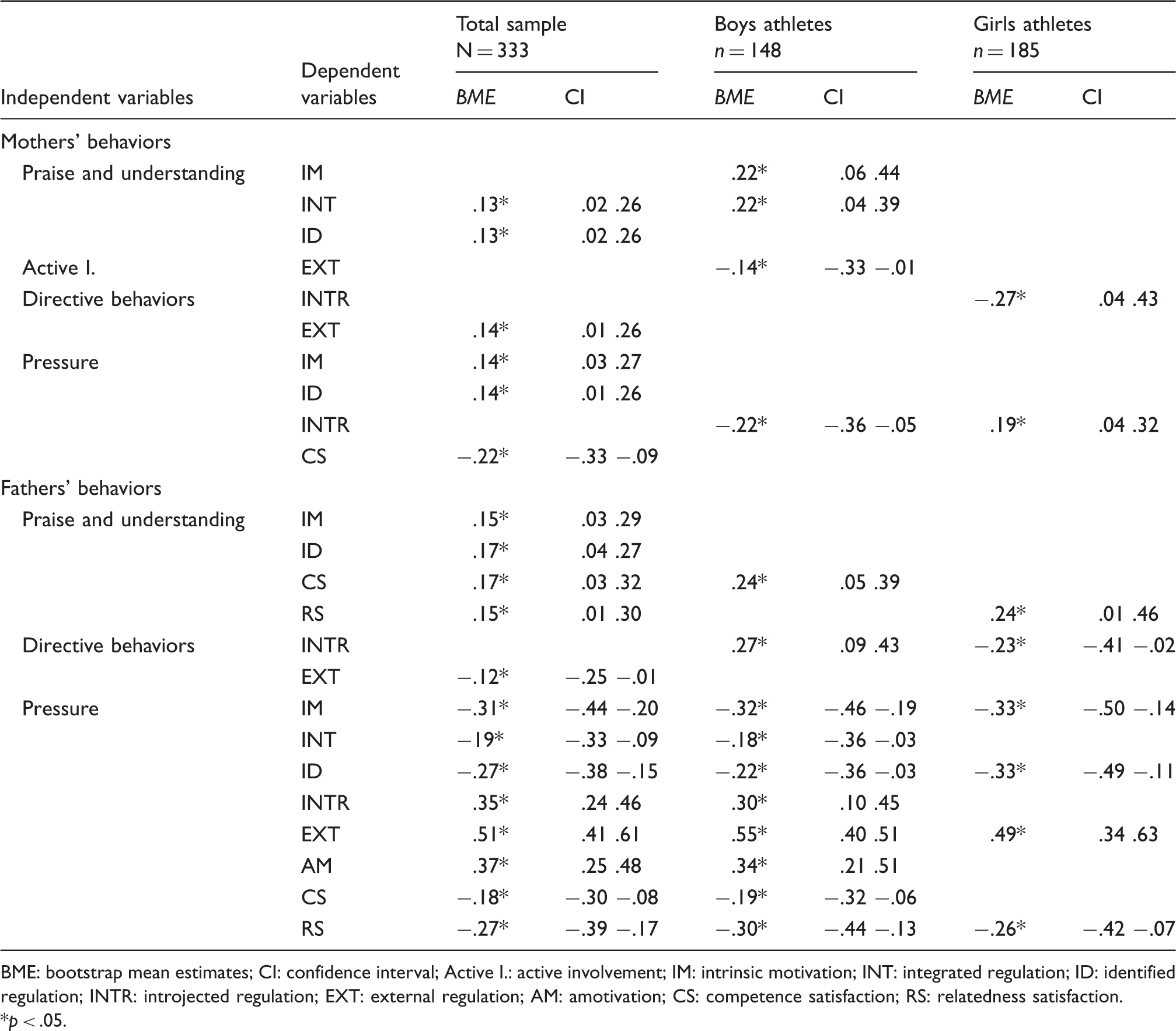
BME: bootstrap mean estimates; CI: confidence interval; Active I.: active involvement; IM: intrinsic motivation; INT: integrated regulation; ID: identified regulation; INTR: introjected regulation; EXT: external regulation; AM: amotivation; CS: competence satisfaction; RS: relatedness satisfaction.
p < .05.
To explore whether children's sex moderated the aforementioned relationships, the PLS-PM model was run separately for boys and girls. Overall, several differences emerged between the two groups. First, the direction of relationships was reversed between introjected regulation and two parental behaviors: perception of fathers' directive behaviors (β = .27 and −.23 for boys and girls, respectively) and perception of mothers' pressure (β = −.22 and .19). Second, some relationships were significant only for boys or girls. In particular, five relationships between athletes' perceptions of fathers' behaviors and athletes' motivational outcomes were significant only for boys, while one relationship was significant only for girls (Table 4). For instance, boys' perception of fathers' pressure (a) significantly negatively predicted integrated regulation (β = −.18) and satisfaction of competence (β = −.19) and (b) significantly positively predicted introjected regulation (β = .30) and amotivation (β = .34). Girls' perception of father's praise and understanding significantly positively predicted satisfaction of relatedness (β = .24). For athletes' perceptions of mother's behaviors, three relationships were significant only for girls, while one relationship was significant only for boys. In particular, girls' perception of mothers' directive behaviors significantly positively predicted introjected regulation (β = .27), while girls' perception of mothers' praise and understanding significantly positively predicted intrinsic motivation (β = .22). Finally, boys' perceptions of mothers' active involvement significantly negatively predicted external regulations (β = −.14).
Discussion
This study had two main aims: (1) to examine the relationships between high-level athletes' perceptions of mother's and father's behaviors, BPN satisfaction, and sport motivation and (2) to explore whether athletes' sex moderated the aforementioned relationships. Results of the present study provide new perspectives into the contribution of parents to their children's experiences in sport by focusing on the role played by fathers' and mothers' behaviors among high-level adolescent athletes, mainly from team sports (78% of participants), training more than 10 h a week. Results have also provided strong evidence for the factorial validity and reliability of PISQ scores for both mothers' and fathers' scales (i.e. structural stage of the construct validity). Of particular importance in the context of the present study is that results also provided evidence for the strict invariance of parental behaviors across mother and father. Although factorial non-invariance could have biased interpretation of difference (i.e. not reflect the true difference of the parents' behaviors), the few former studies focusing on both parents' behaviors have never explored this issue. 15
Relationships between fathers' and mothers' perceived behaviors with athletes' motivational outcomes
It was hypothesized that athletes' perceptions of directive and pressure behaviors would be negatively related with athlete's self-determined forms of motivation and satisfaction of BPNs. Inverse relationships were expected relative to athletes' perceptions of praise and understanding and active involvement in sport. Results of the present study supported these hypotheses by showing that the athletes' perceptions of praise and understanding behaviors from both parents significantly positively predicted self-determined forms of motivation. In contrast, athletes' perceptions of pressure-filled situations, in which their father pushed them hard to compete and/or to win, significantly negatively predicted self-determined forms of motivation. These results are consistent with previous research and provide new information on athletes involved in intensive training settings. 8 Therefore, the perception of parents who support and encourage, showing interest and understanding is positively associated with positive experiences concerning the children's participation in sports. Conversely, the perception of fathers' pressure to win and/or to continually improve, as well as the use of imperatives, is negatively related to children's positive experiences. However, results concerning mother's pressure were counterintuitive. Athletes' perceptions of mothers' pressure positively predicted intrinsic motivation and identified regulation. In the same vein, previous results from cross-sectional studies showed that, in certain situations, traditionally positive or negative outcomes (specifically positive affect and conflict) were associated with both pressure and support. 31 These differences between father's and mother's behaviors could probably be explained by the mother's lack of sporting knowledge, as recognized both by their child and themselves. 32 Thus, the mother's pressure behaviors would be perceived by their child as less legitimate, which would explain the differences in relationships with the athletes' outcomes compared to the father's pressure behaviors. This issue could also explain the different relationships highlighted between athletes' perceptions of father's and mother's directive behaviors and external regulation (i.e. positive relationships for the mother and negative relationships for the father). Furthermore, the forms of controlled motivation and amotivation were positively predicted by athletes' perceptions of their father's pressure. These relationships were in line with previous findings highlighting a positive relationship between parents' pressure and players' amotivation in team sports. 9 Nevertheless, no study has focused on high-level adolescent athletes; therefore, comparisons with previous studies must be made with caution.
Concerning the satisfaction of athlete's BPN for competence, autonomy, and relatedness, significant relationships were identified only for competence and relatedness. Mothers' and fathers' pressure were negatively related to perceived competence. This finding validated results from Amado et al.'s study. 8 They showed that it would be necessary to decrease parental pressure towards one's children in sports and to promote support, to make them more motivated and joyful in fostering positive consequences. Indeed, the athletes' perceptions of their father's praise and understanding were positively associated with their satisfaction of competence and relatedness.
No relationship was found between mothers' and fathers' perceived behaviors with athletes' satisfaction of autonomy. This result was similar to that found by Amado et al. 8 among children in both individual and team sports. The involvement of significant others could also alter the impact that parental behaviors have on children. The impact of parents' support of children's autonomy on their motivation is influenced by autonomy support as provided by peers and coaches. 12 Indeed, the satisfaction of each BPN is sensitive to the surrounding context and therefore is likely to vary across individuals' situations. 6 In intensive training centers, the compulsory nature of sport training sessions may render autonomy less relevant for motivation within this setting. 33 In contrast, competence and relatedness may be especially sensitive to this context and therefore more relevant to change according athletes' perceptions of their mother's and father's behaviors. Coaches could then educate parents to the roles they play on their child's perceived competence and relatedness.
Does athlete's sex moderate the relationships between perceived mothers' and fathers' behaviors on one hand and athletes' motivational outcomes on the other hand?
Fredricks and Eccles study's revealed that both mothers and fathers tended to perceive their sons as more competent and to provide more encouragement and equipment for them than for their daughters. 34 In our study, more relationships were significant for boys as compared to girls. Boys' outcomes were more related to parents' behaviors than were girls' outcomes. The tenets of Eccles' expectancy-value model assume that the child's sex plays a key role in parental socialization. Particularly, the same-sex parent could act as a privileged partner for sport socialization. Our results appear to be consistent with this model. In particular, it suggests that fathers seem to contribute more than mothers to their sons' outcomes, whereas mothers seem to contribute more than fathers to their daughters' outcomes. Nowadays, since Fredricks and Eccles study's in 2005, the studies have not been measuring sex effects in a systematic fashion. 34
Finally, this study highlighted one difference regarding the potential consequences of fathers' directive behaviors and mothers' pressure. As expected, the athletes' perceptions of their father's directive behaviors and their mother's pressure positively predicted introjected regulation—but only among boys for fathers' directive behaviors and only among girls for mothers' pressure. The inverse relationships were shown among boys for mother's pressure and among girls for father's directive behaviors. Although sex differences have already been highlighted with the perceptions of father's directive behaviors, 15 future studies in the high-level sport context are needed to further explore this issue.
Despite this study has provided insightful results regarding the differential role of mothers' and fathers' behaviors on their boys' and girls' motivational outcomes within a high-level context, the main limitations of the present study are that all variables were assessed simultaneously using one source of data (athletes' self-report questionnaires). Therefore, the sense of the relationships between the study variables should be interpreted cautiously. Future research could use longitudinal and experimental designs or collect data by using qualitative methods (e.g. interview, focus group) and interviewing persons within the athlete's environment (e.g. parents, coach, siblings) to better understand positive and negative parental behaviors considering their child's sex. Besides, perceived behaviors may differ from actual behaviors. Thus, it is essential to validate the PISQ against actual parent behaviors. Finally, because multiple family structures exist (e.g. single-parent families, children raised by grandparents, and gay and lesbian parents), future research should take such family structure into account.
Conclusion
Consistent with previous research, this study further highlights the negative relationships between father and mother pressure (e.g. pressure for winning, holding excessive expectations) and their girls' and boys' motivational outcomes. Results of the present study also provided evidence for the role of parental praise and understanding in the positive development and psychosocial consequences of their children. 35 Because parent involvement in sports seems to be extremely complex, 18 being a parent of a youth elite athlete can be challenging and complicated. 36 Parents must reassess their role in the high-level sports context; they have to learn about the social and organizational expectations of the environment. This study offers to researchers, sports psychologists, and coaches a questionnaire measuring specifically mothers' and fathers' behaviors in the sports context. It highlights its utility in discriminating among these behaviors and, as well, taking into account the athlete's sex. The next step is to understand why parents are involved in “appropriate” or “inappropriate” ways, by exploring their goals, experiences, and background.
Supplemental Material
Supplemental material for Relationships between elite adolescent athletes' perceptions of parental behaviors and their motivational processes: Does sex matter?
Supplemental Material for Relationships between elite adolescent athletes' perceptions of parental behaviors and their motivational processes: Does sex matter? by Noémie Lienhart, Virginie Nicaise, Guillaume Martinent, Emma Guillet-Descas and Julien Bois in International Journal of Sports Science & Coaching
Footnotes
Declaration of conflicting interests
The author(s) declared no potential conflicts of interest with respect to the research, authorship, and/or publication of this article.
Funding
The author(s) received no financial support for the research, authorship, and/or publication of this article.
Supplemental material
Supplemental material for this article is available online.
References
Supplementary Material
Please find the following supplemental material available below.
For Open Access articles published under a Creative Commons License, all supplemental material carries the same license as the article it is associated with.
For non-Open Access articles published, all supplemental material carries a non-exclusive license, and permission requests for re-use of supplemental material or any part of supplemental material shall be sent directly to the copyright owner as specified in the copyright notice associated with the article.
