



Abstract
Talent development in sport is a comprehensive area of research with various conceptualisations of how the body moves and how skills are developed. The sports coaching environment is often criticised for a lack of evidence-based approaches to talent development, driven by limited access to appropriate sources of information. The current conceptualisation of motor learning, which harnesses dynamical systems theory and ecological psychology, is a complex and underdeveloped area in sport. Recommendations for talent development are often lost in complex pedagogies, so there is high demand for practical information on the translation of this knowledge. At its core, ecological dynamics views the body as a complex system which can reorganise to solve challenging problems in different ways, and emphasises that personal experiences, the task and the environment are all interacting. The specific elements of nonlinear development (person), representative learning design (task) and the talent development pathway (environment) are key elements for cricket coaching that are yet to be synthesised for the coaches who provide early learning experiences.
Keywords
Introduction
The sport of cricket is steeped in tradition with origins of international-level competition dating back to the mid-19th century with a women’s team competing in Australia by 1890. 1 Since this time, there have been significant changes, not only in the way cricket is played but also how it is consumed by fans and spectators. These changes have challenged the progression of talent development in the sport as different formats of the game require specific skills that don’t always transfer easily between shorter and longer and versions of the sport. Recently, commercialisation of the sport has created demand for a shorter, fast-paced version to attract a wider audience. Two versions have gained popularity in more recent years, featuring only 50-overs to score the highest total in one innings or 20-overs which challenges teams to score at the fastest run-rate. The game has also expanded to include thriving female competitions hosted around the world, competing predominantly in the shorter formats on the international stage. 2 Expert performance and skill development have also changed markedly as a result of these competitions, highlighting the demand for informed practice in the realm of a systematic evidence-based approach rather than an overreliance on tradition.3,4 Despite a strong knowledge base for characterising expert performance in elite male cricketers, the understanding of how to develop these behaviours in female players is now beginning to emerge. There is also a demand for better knowledge translation to the coaches influencing skill development as practice recommendations are currently hidden in complex pedagogies.5,6
In sport and exercise science, the modelling of successful behaviours by other elite athletes was a commonly adopted approach for skill development. An ‘optimal’ technique was believed to be the defining characteristic of expert performance, where elite athletes have superior ability to perform the same exact movement despite dynamic changes in the task or environment.7,8 This observation was based on the assumption that movement patterns are ingrained within the central nervous system 9 and then systematically developed through repetitive training of key components of the movement. 10 In this scheme, the absence of variability is deemed a defining characteristic of expert advantage. In contrast, an inquiry into the movements of elite athletes uncovered the opposite: for example handball throws, 11 long jump approaches, 12 and expert fast bowling 13 are characterised by the performer’s ability to achieve a successful outcome by adapting their movements in relation to the changing task and environment. Traditional coaching in complex sports including cricket has often featured repetition of a single movement until it is mastered to develop an ‘optimal’ technique, despite motor control research encouraging practitioners to redefine how they view variability in performance 14 and practice. 15 Variability has historically been associated with error or lack of control in learning models 16 but the current understanding of variability is that it can be functionally beneficial to performance. The search to control variability and to find unique, personalised solutions to game-related problems (e.g. scoring runs, taking wickets) should be prioritised over the ‘optimal’ technique approach to coaching.
Cricket features a complex contest between two teams on various levels: between the individual bowlers and the two batters; between the batters and the surrounding 10 players on the bowler’s team (fielders); the environmental condition of the field and turf pitch, the weather and the condition of the ball. 17 This complexity has proved difficult to capture in skill acquisition, and key performance behaviours such as batting and bowling are often measured in controlled testing and training environments which might limit transferability to game conditions. 18 Under these controlled environments, there is little variability to test the players, omitting key sources of information including opposition fielders, bowlers 13 or batters 19 that players rely on in the game. 20 There are few characteristics which can be explicitly controlled within the cricket performance environment, so it is difficult to determine whether the behaviours rehearsed in training sufficiently represent those performed during the game. As contests between different people, the task and the environment typically occur simultaneously, this complexity needs to be captured in skill development practices to promote the transfer of skill between training and the game. 21
The theory that best captures multiple systems interacting in complex ways is the dynamical systems theory, where the human body is viewed as a multifaceted system. The human body’s ability to reorganise joints and limbs to perform complex movement tasks is a key tenet of this theory, 22 but it is evident in cricket (and other sports) that movement does not occur in isolation. There is an intricate connection between all elements of cricket: the batter, the bowler, the fielders, and the overall game context. 23 It is integral for coaches to understand that when a batter moves, the subsequent outcome (i.e. runs, wicket) comes as a result of the batter’s ability to redirect the ball delivered by the bowler, the movements of the fielders, and the context of the game (i.e. batting first or chasing, balls remaining, required run rate, competition level, etc.). This connection should also be maintained during skill development to ensure that the learned behaviours also emerge in the performance environment.24,25
Cricket is dominated by a large array of visual information which is available for the performer to utilise and inform their next movement. 26 Our understanding of the way this information is harnessed no longer features the need to cognitively process visual and spatial information because in some cases, there isn’t enough time between the bowler letting go of the ball and the ball arriving at the batter. 27 Instead, visual information of all kinds flows in a landscape that surrounds the person, available for use without the need to process it. 28 This information could contain broad knowledge like the fielders’ positions in relation to the batter, or acute details such as behavioural cues of the hand, wrist, arm or torso as the bowler approaches the crease. This information helps to inform the next action, and that action can also provide the player with different or new information. The coupling of what we see and how we move is referred to as perception–action coupling. 23 For example, moving forward to intercept the incoming ball as a batter may provide a new perspective of the field and fielding at certain angles from the bat influences when and how the ball might come to you. Becoming attuned to these sources of visual information is part of the learning process; just because a visual source is available does not mean necessarily that a performer knows how to utilise it.3,29 To become attuned, those same sources of information need to be present in the learning environment. 30 As learners become attuned to the information that surrounds them in the task and environment, the skills and behaviours they have developed become opportunities to act, otherwise known as affordances. 31 When the affordances found in the game environment are available at training, learners can explore the surrounding sources of environment to promote the transfer of skill.
For example, a batter is likely to achieve a successful outcome (scoring runs) if they perceive there is a gap in the field, and they possess the necessary skill to redirect the ball there. This process is also dependent on whether the ball delivered by the bowler can be redirected to the desired location. Affordances are not only context-dependent but also highly individualised. 32 The skills or capabilities that one player possesses may not result in the same movement that another player uses to achieve a similarly successful outcome, highlighting the need to move away from an ‘optimal’ technique approach to provide individualised coaching. 33 As both skills of batting and bowling are governed by the laws of physics (collision of bat and ball, angles, summation of forces, levers, transfer of momentum), coaches should be aware that differences in physical and mental attributes afford unique movement solutions. 34 As the learning process becomes individualised, the role of the coach becomes facilitative rather than instructional, with an emphasis on creating the optimal learning environment. 35
The theoretical approach which best captures the complexity of athletes and sporting teams as an adaptive system, and how they interact with available information, is ecological dynamics, and it has been used as the basis of this review. The two underlying tenets for coaches to understand feature the following: the constant interaction between a person, their task and the environment; and that perception (what a player sees) and action (how they move) are coupled, continually informing each other. As earlier attempts to apply similar learning approaches to cricket have proven difficult for cricket coaches, 5 and few attempts have been made to bridge the game between research and practice,25,36 we examine the three domains of ecological dynamics in the context of cricket: nonlinear development (person), representative learning design (task) and the talent development pathway (learning environment).
Person: Nonlinear development
The personal factors that influence talent development extend beyond the physical characteristics and traits of an individual. The early developmental experiences of young athletes shape their behaviours through interactions with other siblings, their birth order within the family, and relative age when selected within a cohort among other athletes.36,37 The motor learning that occurs at this young age is facilitated by interactions with siblings in a home environment (e.g. backyard) and experiencing a variety of sports, providing a strong foundation for learning based on curiosity and problem solving.38,39 While some elements of nonlinear development cannot be controlled, early unstructured play and sampling sports can be encouraged to build a stronger base for skill development.
Sibling, relative age and maturation effects
The socio-developmental environment that young learners are exposed to is recognised as a key component of developing expert athletes. Backyards and playgrounds are initial locations for skill development, where informal play allows learners to explore different movement patterns, creative problem solving and feed the learner’s curiosity. This play behaviour is often facilitated by the presence of others, where the role modelling and social interactions between siblings and their subsequent success for their chosen sports are important. Studies have predominantly focused on male athletes, so the interactions between female cricketers and their family or friends are yet to be formally explored. While the presence of a sibling can positively influence skill and social development by providing a partner for unstructured play, they also form a source of emotional and instructional support, or a role model to younger siblings. 40 For those learners lacking this interaction, the social learning occurs at grassroots programmes with peers and coaches, modelling behaviours and searching for emotional and instructional support in the community. Younger siblings often show a greater level of commitment and experience early success, 41 so the development of older siblings becomes largely based on a supportive peer base and welcoming learning environment which community coaches should aim to provide.
Skill development occurs as a function of biological age, with each individual maturing at different rates. 42 More specifically, the sources of information that can be understood and perceived change with age as physical and mental development continues to progress. 43 In combination with the physical capabilities developed from exploring the environment, young learners also usually develop several mental skills with advancing age, including courage and the ability to handle pressure. 44 As age-based competitions are the foundation of entry-level sport, it becomes difficult to distinguish the difference between advanced skill development and early physical maturation,37,45 especially between children born at the start or end of the year. 46 The effects of relative age, which is the specific age at a certain cut-off point in the competition year, 47 have been explored in a variety of team sports including rugby league 48 and basketball. 49 A recent investigation into Australian Football 50 provides insight into the relative age effects, identifying that the confusion between early maturation and advanced skill development extends to perceptions of performance through nominations for awards and draft selection. In highly physical cricket skills such as batting and bowling, similar misconceptions may be made at an early age, potentially limiting access to the talent development pathway based on early selection. 46
In junior representative teams, these players are often successful as a result of their early maturation and therefore dominate selections. If talent development environments are to prioritise development over early success, players that may lack early strength but display tactical knowledge or understanding of the game should also be rewarded with selection for representative teams or academies. If this approach is applied, the other physical and mental aspects of talent development in sport can also be used to evaluate player development. Each person experiences the unique physical effects of puberty at different rates, causing movement patterns to become unstable as the body recalibrates to new limb lengths, growth spurts and other changes affecting body composition. 42 This variable pattern of development is linked to temporary decreases in player performances around puberty, 37 with the added pressure of balancing social implications of skill proficiency and self-efficacy when trying to keep up with peers. It may not be socially acceptable to compete with younger athletes but not all early learning experiences are positive or develop the foundational cricket skill to continue through higher levels of competition. To address this shortcoming in the junior cricket pathway, two separate competitions with revised playing formats are now available for those with the skill proficiency to compete and others who simply enjoy participating. 51 The revisions featured scaled equipment, reducing the length of the pitch and side of the field to make batting and bowling easier to achieve and also promoting learning through the game. 52 This approach can improve skill proficiency early in the learning process and allow players to overcome the effects of early maturation in junior competition.
As young athletes become exposed to the talent development pathway, it is crucial to ensure that learning experiences at the community level are robust enough to accommodate for individual rates of development. 35 The emphasis on selection and early success over long-term development can confuse early maturation with advanced skill development increasing the social consequences of missing out of selections. 37 Allowing young players to explore and compete in a supportive environment can improve skill development to overcome an absence of early learning and the effects of early maturation. This works best when coaches individualise learning tasks and environments to suit the mental and physical skills of the learner.
Early unstructured play and sampling sports
Cricket benefits enormously from large-scale participation and unstructured play that takes place in households as one of the most popular games for children in selected countries. 53 This element of creative play builds social, emotional and physical skills as young learners explore fundamental movement skills (running, jumping, catching), how to compete with others, constructing play rules (‘six and out’), bouncing back from failure (resilience) and problem solving. These skills often transcend the specific game-based rules of sport, where sampling a variety of skills between the ages of 5 and 12 years is believed to be beneficial for developing athletes. 54 Informal play such as backyard cricket is highlighted as a key early learning environment for expert cricketers in the past, with family and friends shaping behaviour and promoting creative problem solving to avoid windows, orange trees or hitting against sloped driveways.38,55 In contrast, physical environments of suburbia including smaller backyards 56 and generational shifts in play behaviour (e.g. screen time, social media, indoor activities) 57 have increased the demand for these skills to be developed in a more formal environment.
Developmental programmes are now addressing this lack of foundational skill by designing games-based programmes specifically for early skill development. The sport of cricket depends on the interaction between a batter and a bowler, which requires a large degree of skill execution. If a young bowler cannot provide the batter with a ball to hit, or the batter cannot interact with a moving ball, time on task and enjoyment are markedly limited. Grassroots programmes are expected to develop cricket-specific skills for early learners while maintaining enjoyment, which are currently being addressed through small-sided games 58 which also feature in other participation sports such as soccer, basketball and Australian Football. 59 While the presence of defenders, or fielders, can be overwhelming to begin with, the interaction between them and the player is integral to the game. 20 Therefore, the game can be scaled down or adapted to allow for the emergence of key behaviours with a shorter pitch, smaller boundaries or less fielders. 52 This adaptive approach also creates an opportunity for more time on task for fielders, with more chances of receiving the ball and more competitive games to maximise learning. Batting in pairs for 24 balls (or four overs) without consequences provides a holistic game experience but entering formal junior competition may still be a difficult transition. 60 Diverse experiences in other sports could possibly aid in the development of patience, resilience and problem solving while also protecting against stress and burnout in young athletes. 37 By allowing young athletes to access games-based learning programmes from an early age, skill development can still be facilitated in an unstructured way despite decreases in informal play across generations. 61
Participating in multiple sports allows young athletes (up to 12 years of age) to experience a variety of skills and is a key socio-developmental element of elite athletes. 54 A substantial time commitment is expected from each individual sport, making it difficult for young learners to maintain diverse activities and a healthy mental status. 62 Consequently, over-commitment to one single sport has been linked to an increased likelihood of dropping out and burning out, so sampling a variety of sports is a protective factor against future physical and mental development. 63 The effects of sampling sports and entrance into talent promotion programmes have been explored in Olympic athletes to characterise differences between world-class and national-levels competitors. 64 World-class athletes entered the international space at a later stage, invested more time in training for other sports, and transferred sports at the latest stage of the junior pathway. While this counteracts the focus on early success in junior sporting teams, club coaches still maintain a heightened expectation of their athletes to specialise in one sport. 65 Similar outcomes were reported in 1558 athletes from diverse sporting backgrounds where sport-specific training loads and success during adolescence were poor predictors of success at the top level of their chosen sport. 66 While cricket is not an Olympic sport and may provide different pathways to success, research indicates that world-class expertise is facilitated through investing in diverse movements and delayed engagement in talent pathways. The current demand for deliberate practice in one sport through the pathway at a young age is counterintuitive, and community coaches are encouraged to recognise the value of sampling sports for skill development in young athletes by allowing them time to commit.
Practical considerations
There are multiple factors that influence a young athlete and their development in sport. While the majority of these factors occur out of the control of the coach, awareness of the various early learning experiences, and how they shape each individual can assist those working at the grassroots level. It is important that young learners are encouraged to engage in unstructured play, which can occur within or outside traditional training settings. This element of game-specific learning is best complemented with experience in a variety of sports and games, so training for other sports should be considered a strong asset as 5–12-year-old learners navigate the sampling years. 54 Awareness of early maturation and nonlinear development also allows coaches to combat the traditional bias towards early maturation over skill development by providing personalised positive learning experiences. Early skill development should focus on exploring new movement patterns and creative problem solving to encourage ongoing learning and curiosity.
Task: Representative learning design
Historically, motor learning research has featured the human brain as a computer-like hard drive that simply inputs information and outputs movement. 67 Learning has traditionally been conceptualised as a predominantly linear process, where learners progress through stages depending on how much they think about the task and error rates. 16 Repetitive, deliberate practice for 10,000 hours 68 was deemed necessary to achieve expertise, but this notion fails to consider that each individual is unique. The nonlinear nature of physical and mental development extends to the development of expertise as well, where unique approaches to movement and problem solving should be accounted for in training practices. The current understanding of motor learning features a brain that is receptive of the surrounding visual information without needing to process it, allowing learners to use the information and knowledge of their own skills to shape their movements.31,69
Skill acquisition and perception–action coupling
There are a number of models detailing how learners acquire skills and how experts differentiate from novices. Early conceptualisations of these models featured deconstructed concepts of computing, comparing the human brain to the simplicity of a hard drive. A classical model used in education curricula featured three stages, where graduating from one to the other was easily observable through reduced error rates, fluid movements and cognitive or attentional focus. 16 The underlying assumption of this classical model was that learning occurs in a linear way, and progressing through the stages requires repetitive, deliberate practice.70,71 Contrarily, it is now commonly believed that skill development is largely nonlinear because expecting each individual to progress through the same predetermined stages is unrealistic. 72 Teaching practices have also changed to reflect this notion, where skill development practices in the classroom and the local sporting clubs are beginning to align by employing nonlinear pedagogy. 73 Instead of operating as a hard drive, the human brain is likely to be more receptive to the information that we see around us. The way a player moves in a complex sport like cricket derives from their perception of the available visual information and the actions they can perform (skills).31,74 The coupling of perception and action is therefore an integral part of the learning process so that movements emerge based on the same information that is present in the game environment.
The presence of these sources of information in a training environment is what makes it representative of the performance environment, increasing the likelihood that a skill may transfer from one to the other. 27 Representative learning design refers to how well the training environment represents the behavioural demands of the performance environment, where the behaviour is intended to be performed.75,76 It is important to consider the origin of these sources of information as training does not need to perfectly replicate a game but should sample the information that players use to inform their actions. 77 In cricket, expert batters utilise visual anticipation by identifying cues in a bowler’s approach, arm position, ball seam and previous situational experiences to prepare their movement response.74,78 Bowlers can utilise similar sources of information in the batter’s feet, bat and skill execution and their own skill execution to inform the next ball they bowl. 13 The relationship between the batter and the bowler, which extends to the fielders surrounding the bat, needs to be present when training those skills. To observe what happens when key sources of information are not present, Pinder et al. 79 examined differences in batting movements when facing a bowling machine compared to a real bowler, capturing the way information and movement were coupled in this skill. While a bowling machine (initial ball flight) preserves some important characteristics of the game, the batter’s front foot movements and initiation of backswing – two crucial components of an attacking bat swing – were delayed. The reduced within-task variability and lack of advanced cues from a bowling machine compared to a real bowler encouraged maladaptive batting behaviours in the experts, while developing batters displayed no difference between the two conditions. These observations highlight the importance of coaches providing learners and experts with a training environment which features the key sources of information they would use in a game.
The learning process also includes becoming attuned to these sources of information, as their presence alone is not enough to help inform actions. 29 It is worth considering that the utilisation of information occurs in a unique way, as each individual may have their own movement solution to solve the same game-based problem that all cricketers are faced with (scoring runs, taking wickets). 33 There is a growing empirical understanding of training practices within cricket, with the rise of games-based approaches evident in other sports as well including Australian football, tennis, soccer and rugby. Low et al. 80 detailed training practice microstructures by capturing the percentage of session duration spent on training form (no decision making, technical practice) or playing form (small sided games, open practice) with comparisons to previous attempts in other sports. While recreational athletes spent half their time in the field, the high amounts of training form in nets for elite and adolescent athletes comes in contradiction with current research. The lack of progression to more open, games-based play to promote decision making and adaptability is believed to limit transfer to the game environment, with sports like tennis integrating the manipulation of court size into their coaching manuals to promote match-play form. 81
The application of small-sided games has been shown to develop physical, tactical and strategic thinking skills simultaneously.59,82 In football (soccer) training, for example, passing channels are best sampled using live defenders, which simulates the pressure of a game context and encourages learners to explore their options in an environment where failure is supported. 83 The passing channels appear organically, just as they do in a game, and by providing a task constraint such as a number of passes in a row, players begin to explore their environment and unconsciously catalogue successful and unsuccessful attempts. In cricket, these channels between players appear as gaps in the field for a batter, or bowling line for the bowler, but just as the performance environment features substantial variability and a live contest, the training environment should also feature these elements where possible. The variability of having realistic opponents helps simulate the performance environment, 84 so practicing batting skills with the inclusion of fielders in an open field environment during cricket training may allow the skill to transfer from training to a game situation.20,24 Further investigations must be made before the contributing components to skill transfer, including open fields, can be fully understood. While this scenario can be difficult to recreate in an enclosed net environment, sampling information such as the relative location of such fielders by placing markers on the ground, or pegs on the net, can help inform decision making for runs-scoring while batting.
The application of representative learning design does not need to perfectly recreate the performance environment, 85 but training cricket skills using this framework can promote skill development for improved game performance. 24 The application of modified games is present in many junior development programmes, but this practice is rarely harnessed at the later stages of development when learners have developed the ability to critically analyse and make informed decisions. A lack of access to an open field environment can be overcome by using other contextual factors, such as observationally based runs-scoring using bat–ball contact and a simulated field to determine success in a closed environment. The presence of goal setting or game scenarios can also be used to sample the mental demands of the game, providing an environment for holistic skill development.
Practical considerations
The underlying tenet of representative learning design is ensuring the training environment provides the same sources of information that athletes use within the performance environment. As the contest between bat and ball is the main feature of cricket, this relationship should be maintained for information and movement (perception and action) coupling to occur in a functional way. The application of modified games is a recommended method of training to improve representativeness and promote holistic skill development. However, there may be limited access to resources at the grassroots and club levels of the sport. This limitation can be overcome with session planning to include contextual information (observational runs, game scenarios) to encourage the simultaneous development of physical and mental skills. The effective application of representative learning design allows players to develop functional movements that are more likely to transfer to the game because they have become attuned to the key sources of information, and how they can best utilise them to achieve a successful outcome.
Environment: The talent development pathway
Research into talent has been dominated by its desire to pinpoint expertise as early as possible. This notion has encouraged the formation of elite junior academies and focusing on one sport early, contradicting recommendations for early unstructured play and sampling sports despite their known contributions to elite performance in adulthood. As current physical performance and future potential are poor predictors of future success, 86 it is integral to support development throughout the pathway to success. While a robust pathway system already exists within major participation sports like cricket, 87 the environments these pathway systems provide learners with can be improved by focusing on long-term, holistic development. The environment that learners are exposed to extends beyond the physical elements of a backyard or locality. The cultural learning environment that the talent development pathway provides, with access to quality coaching and opportunities to learn, is also a key environmental domain. 17 Recent evidence-based recommendations have encouraged sports to provide opportunities for development and access to coaching beyond the talent development pathway. 37
Selections and the pathway
Talent identification has featured heavily in many sporting organisations in the search for the earliest performance indicators of a young athlete being successful in the long term. 88 Football programmes are notorious for scouting players before the age of 10 years old and placing them in elite academies. 89 However, there are socio-developmental consequences of focusing on ‘giftedness’ rather than work ethic and deselection from a representative team or programme.44,90 There is little evidence to suggest that early entrance into specialised talent programmes is integral for adult success but engagement in organised sport can promote free active play in children, a crucial early learning experience. 63 While sport-specific academies may present young and developing athletes with access to resources, the use of talent identification based on current physical performance and potential has been criticised for being poor predictive factors of future talent and adult success.64,86 A focus on development is now being emphasised to allow for an extended learning experience and later selection, which is ultimately more effective than early identification. 90
Talent development pathways in the past have featured stages or steps which illustrate the potential progression from participation to elite performance, but they were often constrained by age and featured little information on how learning progresses deep into adulthood. A widely used model that informs Olympic sports has been adapted to inform the Australian talent development pathway for cricket, featuring four stages (Figure 1): a Foundation stage which captures free play; a Talent stage where junior regional and state/county selections begin to occur; an Elite stage which encompasses the adult state and national level athletes; and a Mastery stage where success at a national or international level is sustained (FTEM). 91 The female talent pathway does not currently feature a second-tier national competition, creating a gap between the end of the junior talent stages and the elite senior stages of the pathway. 92 The later rise of professionalism in women’s cricket also means that the pathway was shaped entirely on the existing men’s programmes with little understanding of the differences in upbringing, development, exposure and opportunities to engage with the pathway for current or recent elite female athletes. While the absence of specific age levels is considered a benefit in this model, the lack of information beyond the competition structures highlighted in the model’s adaptation to cricket can be limiting.
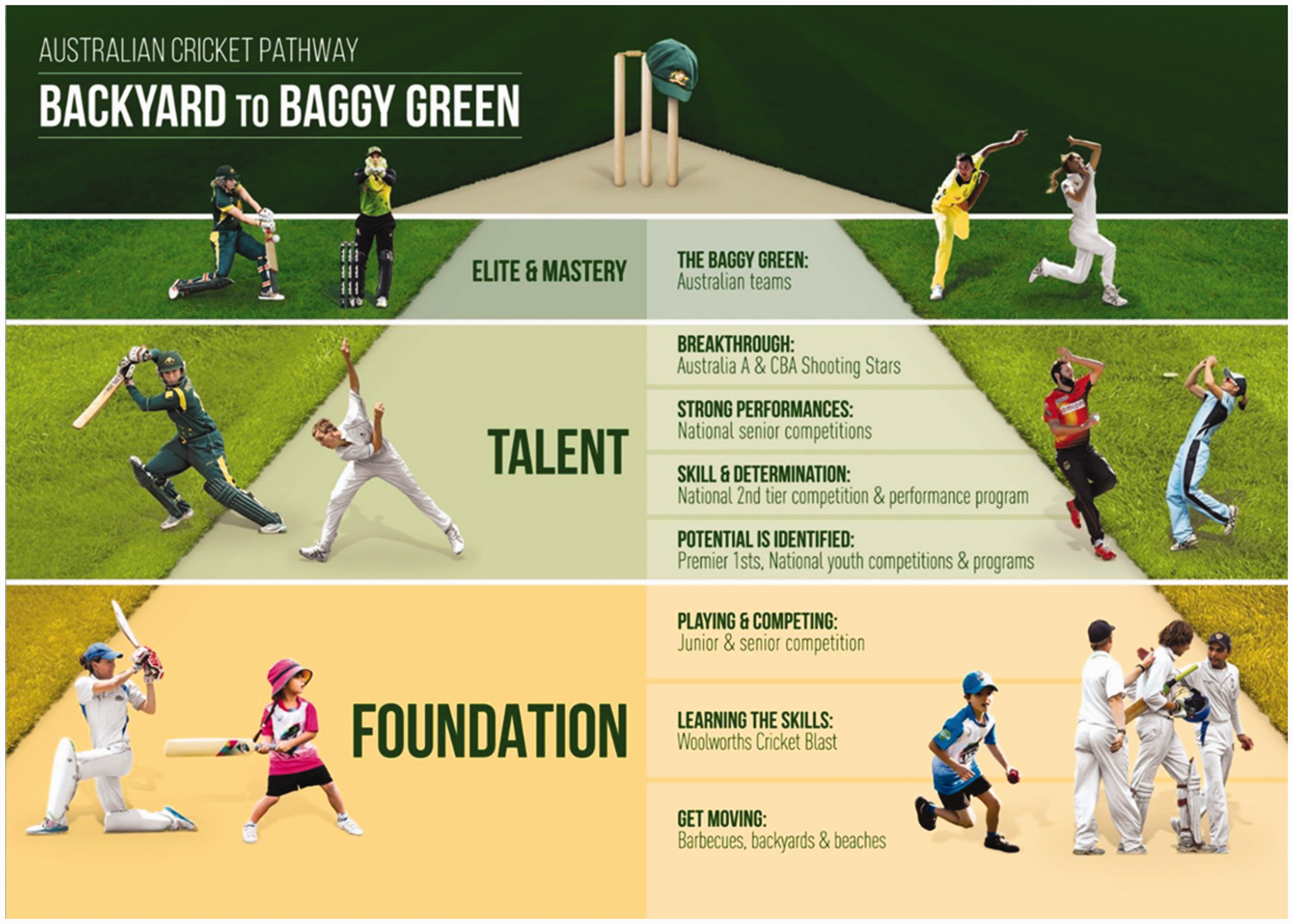
The adaptation of the FTEM model by Gulbin and colleagues for the Australian talent development pathway in cricket.
In such a complex sport like cricket, it is difficult to set specific skill-based benchmarks or achievement expectations while maintaining the importance of nonlinear development. To highlight how nonlinear and unique the road to elite status can be, Gulbin et al. 93 studied the paths to success for 256 elite athletes across 27 sports. Not all athletes entered their sport of specialisation at a recreational level and only 16% of patterns to the elite level of their sport were entirely linear by graduating through each stage of the pathway. Instead, zigzagging patterns were experienced by the majority of athletes, characterised by fluctuations between the stages and sides of the pathway, which can include congruent participation in adult competition and junior academies in cricket. Most importantly, senior success was rarely achieved through only the junior or senior pathway (7%), again highlighting the importance of developmental experiences from coaches and programmes outside of the pathway and the prevalence of nonlinear development in the pathway. As presented, the FTEM model and its adaptation to cricket presents a linear approach to talent development with little opportunity or understanding of how to move between the various stages, especially if early entrance is not achieved.
Talent development environments
The talent development pathway has evolved via research and empirical evidence but the practices that occur within each stage are yet to be fully characterised. A talent development environment is defined as ‘that which adds to the development of those identified as talented’, 35 which highlights the fixation with talent identification that has dominated sport. Challenging this notion, research within the UK elite sporting system evaluated the congruence between research concepts and practice for talent development in a sample of coaches from 13 different sports. In this study, the majority of coaches supported the notion that long-term aims and methods (83%), development over ‘early success’ (87%) and coherent messages for holistic development (93%), were all integral aspects of talent development. To accommodate for the nonlinear nature of development, the opportunity to access talent development should not be restricted to those who benefit from talent identification and early success. Ongoing, holistic development experiences outside of the pathway alongside fluid transition into and out of the pathway should feature in cricket to achieve long-term aims and make it ‘a pathway for all’. 94 Extending the reach of talent development may allow amateurs to continue along the pathway despite their lack of early entrance or late maturation with a diverse set of skills, as found when Olympic athletes delayed their entrance to pathway programmes.37,64 This in turn may improve the standard of the senior amateur competition (Premier 1sts) stage which is the only talent development environment for those who have surpassed the junior talent stages and are yet to break into the senior stages. By putting the focus back on club coaches and state/county associations to provide these ongoing opportunities, local cricket clubs become the foundation of talent development for all athletes, especially when training sessions foster expertise by allowing adaptable and decisive players to emerge.30,95
Practical considerations
While a shift in sports science has emphasised the value of ongoing development over early identification, it is difficult to see how this development is presented within the current pathway structure. The gap between entering the high-performance system beyond a linear trajectory from the junior stages of the pathway is growing with the rise of female professionalism, with the need for talent development opportunities beyond the pathway. Given the elite stage is reliant upon amateur senior competitions, talent development environments now reside with local clubs and state/county organisations, allowing more cricketers to access ongoing development if training practices are well informed. The benefits of this growing catchment for development may only be seen when the transition into and out of the pathway occurs more fluidly, allowing those who mature late or diversely skilled amateurs to continue along their talent development journey. This requires ongoing support and a commitment to the long-term aims from the local cricket clubs to the high-performance programmes.
Summary
Cricket is a complex sport best viewed through the lens of ecological dynamics, allowing coaches and practitioners to take a holistic approach to talent development. By maintaining the connection between person, task and environment, the pathway becomes a more supportive, consistent approach to talent development (rather than identification) by reducing the emphasis on early indicators of success in children. The importance of positive early learning experiences in communities and clubs should be promoted alongside sampling sports for diverse learning experiences prior to entering the pathway. Talent development environments should also provide players with the opportunity to enter and exit the pathway freely without the social implications of performance decrements around puberty in particular. The learning environment young players are exposed to should feature the key sources of information experienced during a game, allowing for the coupling of perception (what we see) and action (what we do). As learning grows, players will become attuned to their unique set of opportunities to act, or affordances, which emerge as they interact with the task, the surrounding environment and their own movement skills rather than recreating a specific technique. Finally, talent development environments should extend beyond the pathway to allow for the opportunity to advance skill development without selections, incorporating local clubs and communities. Not only does this approach provide those players outside of the pathway with the opportunity to continue their development, it also creates a stronger level of community competition. When the community becomes a key talent development environment, access to resources becomes easier and the transition out of elite status becomes a well-supported process. Collectively, these recommendations can help coaches inform their prescription, execution and evaluation of team and individual practices in contemporary cricket.
Footnotes
Declaration of conflicting interests
The author(s) declared no potential conflicts of interest with respect to the research, authorship, and/or publication of this article.
Funding
The author(s) received no financial support for the research, authorship, and/or publication of this article.
