



Abstract
The present study examined the roles of coaching experience and coach training on coaches’ perceived life skills teaching. Canadian high school sport coaches (N = 1356) completed a demographic questionnaire and the Coaching life skills in sport questionnaire. Results suggested that coaches with more experience perceived themselves to discuss and practice life skills and transfer to a greater extent than coaches with less experience. No significant differences were observed based on whether coaches completed coach training, and the interaction effect between coaching experience and coach training was non-significant. Implications for coach education programs are discussed regarding training coaches to explicitly teach life skills through sport.
Introduction
Organized sport has been identified as a setting that can support the psychosocial development of youth, which includes the development of life skills. 1 Within the sport psychology literature, life skills are defined as actionable psychosocial assets (e.g. communicating effectively with teammates, regulating one’s emotions) that enable individuals to succeed in different life contexts (e.g. home, community, school). 2 The notion of transfer is a key component of the life skills learning process, with life skills transfer defined as learning and internalizing a skill in sport (e.g. the ability to lead a drill during practice) and then applying and generalizing that same skill beyond sport (e.g. the ability to lead discussions for a group project at school). 3 Recent reviews of literature have highlighted the importance of life skills acquisition for youth through sport participation and how such skills can facilitate academic achievement, social development, experiences of well-being, and strengthening one’s mental health.4–7
Coaches have been identified as non-parental adults who play a role in the life skills learning process, based on their position in creating and supporting mastery-oriented environments necessary for promoting positive developmental outcomes through sport. 8 , 9 To understand the extent to which coaches are intentional in teaching life skills through sport, Bean et al. 10 developed the implicit/explicit continuum of life skills development and transfer, distributed across six levels: (a) structuring the sport context, (b) facilitating a positive climate, (c) discussing life skills, (d) practicing life skills, (e) discussing transfer, and (f) practicing transfer. According to Bean et al., 10 athletes have a greater likelihood of learning life skills as their coaches’ behaviors move up the continuum, while still addressing previous levels. Further, a sound and well-developed coaching philosophy, that views sport skills and life skills as “equal and inclusive pursuits of coaching,” 10 (p. 460) is positioned as an important precursor playing a role in coaches’ mobility on the continuum, as it drives how life skills are taught.
Côté and Gilbert 11 defined coaching effectiveness as “the consistent application of integrated professional, interpersonal, and intrapersonal knowledge to improve athletes’ competence, confidence, connection, and character in specific coaching contexts” (p. 316). This integrated approach highlights the importance of engaging in different opportunities to gain experience and training in sport. 11 Notably, coaching experience and coach training have been identified as two important variables influencing coaches’ effectiveness in research.11–14 For instance, Lemyre et al. 12 explored youth sport coach learning through formal education, experiences as an athlete and coach, and interactions with others. Previous experiences in sport helped to socialize coaches within the subculture of their sport and understand best coaching practices from others. 12 Acquiring a breadth of coaching experience in other sports has also been shown to diversify coaches’ skillsets to guide coaching in their sport of focus. 15 Coaches with less coaching experience have perceived themselves to have lower competence and more training needs (e.g. to solve problems within new situations) compared to coaches with more coaching experience. 14 Previous research has also found that athletes with trained coaches report higher levels of positive psychosocial skills 16 , 17 and a stronger connection with their coaches and teammates. 18 Langan et al. 13 systematically reviewed the scholarship on the effectiveness of interpersonal coach education interventions and identified several limitations. In most cases, researchers did not assess pre-training coach behaviors, used instruments with weak demonstrated validity, and did not make use of theory; however, the authors acknowledged that methodological issues might have occurred due to the infancy of the topic. 13 Ultimately, providing coaches with a range of learning situations to gain practical experience and training throughout their coaching career is thought to be useful for coaches’ overall development. 11 , 12 , 19 , 20
Specific to life skills, coaching experience and coach training have been situated as important variables in explaining the extent to which coaches intentionally teach life skills. 8 , 21 , 22 In a review of youth development in the context of high school sport, Camiré 23 discussed how less-experienced coaches and/or those without coach training may be unaware of their role in teaching life skills or may be ill-equipped to explicitly teach life skills through sport. A recent position paper stressed the importance of coach training that can help intentionally facilitate positive development (e.g. life skills) of youth athletes, in which coaches are supported by sport organizations and parents throughout the process. 24
Although claims have been made that coaching experience and coach training likely contribute to coaches’ perceived teaching of life skills, such claims have yet to be substantiated by empirical evidence. Thus, the purpose of the present study was to examine the roles of coaching experience and coach training on coaches’ perceived life skills teaching. The study is guided by two research questions: (a) Does coaching experience play a role in coaches’ perceived life skills teaching? and (b) Does coach training play a role in coaches’ perceived life skills teaching? We hypothesized that (a) coaches with more years of coaching experience (≥11 years) would perceive themselves to teach life skills at higher levels of intentionality than less-experienced coaches (≤5 years and 6–10 years) and (b) coaches with coach training would perceive themselves to teach life skills at higher levels of intentionality than coaches without coach training.
Method
Procedure and measures
Prior to data collection, ethical approval was obtained from the University of Ottawa. The present study was completed as part of a larger scale validation project conducted with three Canadian provincial high school sport associations, namely the Alberta Schools’ Athletic Association, British Columbia School Sports, and Manitoba High Schools Athletic Association. In the three provinces where recruitment occurred, high school (i.e. also known as secondary school) spans from grades 9–12, with youth typically entering grade 9 at 13–14 years of age and finishing grade 12 at 17–18 years of age. Each sport association compiles a master list of all coaches registered to coach high school sports (e.g. cross-country running, ice hockey, rugby) within their respective province. The research team emailed an invitation letter to all coaches on these master lists (N = 12,685), inviting them to participate in the study and complete an online questionnaire package. The questionnaire included two parts: (a) a demographic questionnaire and (b) the Coaching life skills in sport questionnaire (CLSS-Q; both outlined in detail below). In total, 10.7% (n = 1356) of coaches completed the questionnaire.
Demographic questionnaire
Participants were asked eight demographic questions relating to their age, gender, ethnicity, highest level of education, years of coaching experience, number of sports coached, gender of athletes coached, and whether they had completed coach training. Coaching experience was organized into a trichotomy of low (≤5 years; n = 260), moderate (6–10 years; n = 182), or high levels of experience (≥11 years; n = 471), reflecting similar groupings of less and more experienced coaches found in previous sport psychology research. 14 , 25 , 26 Coach training was specific to the National Coaching Certification Program (NCCP), given that it represents Canada’s formal national training program for coaches. The NCCP provides formal training to coaches in Canada through a level- and competency-based training structure. Workshops are given for sport-specific and multi-sport training that focus on developing responsible and ethically sound coaching practices. Presently, there are no life skills-specific training opportunities offered for coaches through the NCCP. Coach training was organized as a dichotomy of no (coaches who had never taken part in the NCCP; n = 270) or yes (coaches who had taken part in at least one course in the NCCP; n = 643).
Coaching life skills in sport questionnaire
The 36-item CLSS-Q27 assesses the extent to which coaches perceive themselves to be intentional in teaching life skills through sport and is theoretically anchored in Bean et al.’s 10 implicit/explicit continuum of life skills development and transfer. The CLSS-Q is divided into five subscales and has been shown to have good psychometric properties (e.g. face validity, invariance testing, discriminant, and convergent validity). 27 The stem for each item is: “As a coach, I.” The first subscale, structuring and facilitating a positive sport climate, has 17 items (α = .91) asking coaches if they have structured a safe and intrinsically motivating environment that facilitates positive experiences and enables positive relationships to develop (e.g. “Act in a caring manner”). The second subscale, discussing life skills, has five items (α = .89) asking coaches if they make deliberate efforts to address life skills in sport (e.g. “Describe to athletes what life skills are”). The third subscale, practicing life skills, has four items (α = .87) asking coaches if they provide their athletes opportunities to apply life skills in sport (e.g. “Incorporate life skills into my coaching plan”). The fourth subscale, discussing life skills transfer, has five items (α = .93) asking coaches if they make deliberate efforts to address life skills transfer beyond sport (e.g. “Describe to athletes the contexts outside of sport in which they can transfer their life skills”). Last, the fifth subscale, practicing life skills transfer, has five items (α = .89) asking coaches if they provide their athletes opportunities to apply life skills beyond sport (e.g. “Support athletes in transferring life skills from sport to life outside of sport”). A six-point scale from 1 (strongly disagree) to 6 (strongly agree) is used. Psychometric properties of the CLSS-Q have demonstrated good model fit with the current sample (CFI = .902, SRMR = .056, RMSEA = .060 [90% CI = .057–.062], and SB χ2 = 2409.610 [p < 0.001]). Factor loading for all items was significant and above .32 (range = .55–.86), and internal consistency for the total scale was highly reliable (α = .95).
Data analysis
Preliminary analyses
Descriptive and transformation analyses were completed using SPSS 25. Preliminary descriptive statistics revealed that, on average, participants were 44 years of age (SD = 11.6), predominately male (64.1%), Caucasian (86.1%), and had completed post-secondary education (88.7%). The most frequently reported sports coached were basketball (20.7%), volleyball (19.9%), and track and field (10.1%). Participants coached girls-only (29.1%), boys-only (25%), or mixed-gender sports (31.6%). Participants reported having coached one (57%), two (25.8%), or three or more (17.2%) sports during the school year. They averaged 13.6 years of coaching experience (SD = 10.2) and 68.8% reported having taken part in coach training through Canada’s NCCP.
Next, the percentages of missing data and patterns of missingness were inspected. Percentages of data missing for individual CLSS-Q items ranged between .1 and 1.0% (M = .23%), and Little’s MCAR tests suggested data were missing at random. Missing data were treated using multiple imputations. 28 Following this, all scales were screened for normality using George and Mallery’s 29 guidelines (i.e. values of skewness and kurtosis between ±1.0 are excellent; values approaching ±2.0 are acceptable). Finally, t-tests and chi-square analyses were run to see if coaches differed on coaching experience and coach training on any of the eight aforementioned demographic variables. Through chi-square analyses and t-tests for coaching experience, significant differences were found for gender, χ2 (1, N = 1007) = 41.374, p < .001, age t(808.06) = –14.845, p < .001), and highest level of education, t(870.09) = –10.04, p < .001. Likewise, through chi-square analyses and t-tests for coach training, significant differences were found for gender, χ2 (1, N = 1354) = 27.555, p < .001, age, t(1133) = 5.641, p < .001, and highest level of education, t(666.801) = 6.173, p < .001. No significant differences were found for the remaining demographic variables. Thus, gender, age, and highest level of education were used as covariates in our main analyses. Accounting for missing data, the sample size used for the main analyses consisted of 913 coaches.
Main analyses
Independent factorial analyses of covariance (ANCOVA) were run to assess the main effect of coaching experience and coach training as well as the interaction effect of both these variables on coaches’ perceived level of life skills teaching. Hence, five independent factorial ANCOVAs were run; one for each subscale of the CLSS-Q. For each analysis, coaching experience (≤5 years, 6–10 years, or ≥11 years) and coach training (yes or no) were the independent variables, perceived level of life skills teaching (measured by the CLSS-Q subscales) was the dependent variable, and gender, age, and highest level of education were the covariates. To control for type I errors, a Bonferroni correction was applied by dividing the alpha value of .05 by the number of analyses ran for each independent variable (i.e. five). Thus, the level of significance for the ANCOVAs was set at .01.
Results
Subscale 1: Structuring and facilitating a positive sport climate
No significant main effect of coaching experience, F(2, 904) = 2.188, p > .05, ηp 2 = .005, or coach training F(1, 904) = 0.015, p > .05, ηp 2 < .001 was found for structuring and facilitating a positive sport climate, after controlling for gender, age, and highest level of education. In addition, the interaction effect between coaching experience and coach training was non-significant, F(2, 904) = 0.163, p > .05, ηp 2 < .001.
Subscale 2: Discussing life skills
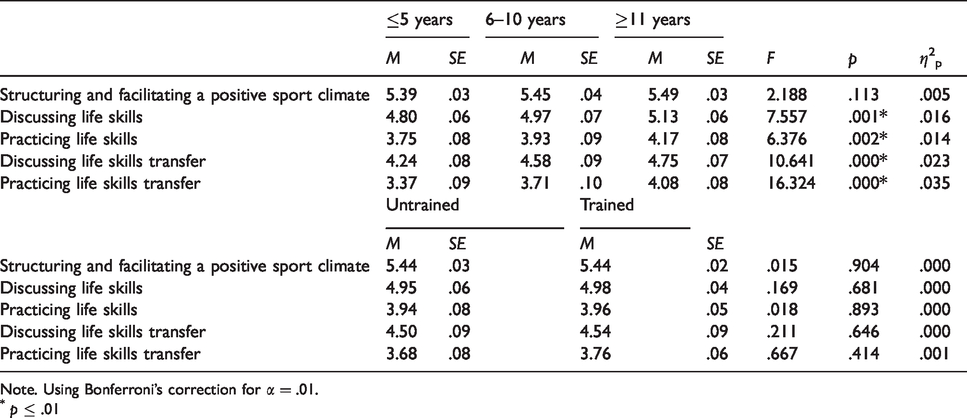
A significant main effect of coaching experience was found for discussing life skills, F(2, 904) = 7.557, p = .001, ηp 2 = .016, after controlling for gender, age, and highest level of education. Post-hoc pairwise comparisons, corrected with a Bonferroni adjustment, suggested that coaches with low levels of experience (M = 4.80, SE = 0.06) perceived that they intentionally discussed life skills significantly less than coaches with high levels of experience (M = 5.13, SE = 0.06, p < .001). No significant differences were found between coaches with moderate levels of experience (M = 4.97, SE = 0.07) and coaches with low and high levels of experience. Coach training, F(1, 904) = 0.169, p > .05, ηp 2 < .001, as well as the interaction between coaching experience and coach training, F(2, 904) = 1.044 p > .05, ηp2 = .002, were not found to have a significant effect on coaches’ perceived discussing of life skills.
Subscale 3: Practicing life skills
A significant main effect of coaching experience was found for practicing life skills, F(2, 904) = 6.376, p = .002, ηp2 = .014, after controlling for gender, age, and highest level of education. Post-hoc pairwise comparisons suggested that coaches with low levels of experience (M = 3.75, SE = 0.08) perceived that they had their athletes intentionally practice life skills significantly less than coaches with high levels of experience (M = 4.17, SE = 0.08, p = .002). No significant differences were found between coaches with moderate levels of experience (M = 3.93, SE = 0.09) and coaches with low and high levels of experience. Coach training, F(1, 904) = 0.018, p > .05, ηp2 < .001, and the interaction between coaching experience and coach training, F(2, 904) = 1.990 p > .05, ηp2 = .004, were not found to have a significant effect on coaches’ perceived practice of life skills.
Subscale 4: Discussing life skills transfer
A significant main effect of coaching experience was found for discussing life skills transfer, F = 10.641, p < .001, ηp2 = .023, after controlling for gender, age, and highest level of education. Post-hoc pairwise comparisons suggested that coaches with low levels of experience (M = 4.24, SE = 0.08) perceived that they intentionally discussed life skills transfer significantly less than coaches with moderate (M = 4.58, SE = .09, p = .010) and high levels of experience (M = 4.75, SE = 0.07, p < .001). No significant difference was found between coaches with moderate and high levels of experience. Moreover, no significant main effect was found for coach training, F(1, 904) = 0.211, p > .05, ηp2 = < .001, or for the interaction effect between coaching experience and coach training, F(2, 904) = 0.914, p > .05, ηp2 = .002.
Subscale 5: Practicing life skills transfer
Last, a significant main effect of coaching experience was found for practicing life skills transfer, F = 16.324, p < .001, ηp2 = .035, after controlling for gender, age, and highest level of education. Post-hoc pairwise comparisons suggested that coaches with low levels of experience (M = 3.37, SE = 0.09) perceived that they had their athletes intentionally practice life skills transfer significantly less than coaches with moderate (M = 3.71, SE = 0.10, p = .021) and high levels of experience (M = 4.08, SE = 0.08, p < .001). Moreover, coaches with moderate levels of experience perceived that they had their athletes intentionally practice life skills transfer significantly less than coaches with high levels of experience, p = .014. Coach training, F(1, 904) = 0.667, p > .05, ηp2 = .001, and the interaction between coaching experience and coach training, F(2, 904) = 1.538 p > .05, ηp2 = .003, were not found to have a significant effect on coaches’ perceived practice of life skills transfer. See Table 1 for analyses on the roles of coaching experience and coach training on perceived life skills teaching.
Between group analyses of coaching experience’s and coach training’s role on life skills teaching.
Note. Using Bonferroni’s correction for α = .01.
p ≤ .01
Discussion
The present study adds to the body of knowledge in sport psychology by using a large sample of Canadian high school coaches to examine the roles of coaching experience and coach training on coaches’ perceived life skills teaching. Supporting our first hypothesis, results indicated that coaches with high levels of experience perceived themselves to intentionally discuss and practice life skills and their transfer to a greater extent than coaches with low levels of coaching experience. These results provide some credence to claims made that it takes time for coaches to learn how to effectively teach sport skills and life skills concurrently 30 and that some coaches (i.e. particularly less-experienced coaches) perceive life skills transfer as an inherently implicit process that requires little deliberate attention. 31
Results related to the practice of life skills transfer (subscale 5) are noteworthy, as coaches with high levels of experience perceived that they had their athletes intentionally practice life skills transfer significantly more than coaches of both low and moderate levels of experience. As coaches accumulate years of coaching experience, it appears that they perceive themselves to be further capable of creating conditions for athletes to apply life skills they have been taught in sport. Importantly, accumulating years of coaching experience, in and of itself, does not necessarily offer coaches the required abilities to explicitly teach life skills. Rather, it is about what coaches learn along their coaching journey that matters. Consistent with the coach development model, 32 one possible explanation is that less-experienced coaches navigating the newcomer stage of development invest most of their time and energy in learning how to manage coaching basics (i.e. learning how to facilitate effective drills), leaving little time and cognitive capacity to teach life skills. Conversely, more experienced coaches in the super competent and innovator stages of development have developed efficiencies in the basics of coaching, 32 giving them the cognitive space to reflect on their coaching philosophy and develop explicit life skills strategies. 10 Moving forward, more research is needed to unpack the study results and examine the variables underlying coaching experience that more precisely explain differences observed in the perceived attention paid by coaches to life skills and their transfer.
Regarding our second hypothesis, no significant differences were observed between untrained or trained coaches regarding how they perceived themselves in teaching life skills. In previous research, Trottier et al. 21 found that coaches recognized NCCP training as helpful in learning how to teach life skills (i.e. teaching youth how to set goals, teaching youth how to balance stressors in life). Although the NCCP in Canada offers multi-sport training opportunities that address athlete well-being (e.g. Empower +, Making Ethical Decisions), 33 it has yet to offer training that is specifically focused on life skills development and transfer. 21 The lack of NCCP material directly addressing life skills may partially help explain why no differences were observed in the present study between coaches based on their training status. However, labeling coach training solely as NCCP and dichotomizing into a yes or no answer should be viewed as a limitation. In future research, the varied forms of training coaches may engage in to refine their life skills teaching abilities should be better recognized and assessed in relation to variables such as modality, duration, and dosage.
Researchers have created and implemented life skills training programs for coaches, such as Coaching for Life Skills 34 and Project SCORE!, 35 but the reach of these niche programs is limited. Moving forward, researchers must forge relationships with coach education organizations and collaborate to develop life skills-specific material to be integrated into large-scale mainstream coach education programs (e.g. NCCP) that have a widespread reach to coaches at all stages of their coaching careers. 36 Such efforts could yield important dividends in training large numbers of coaches to intentionally teach life skills through sport. Acknowledging that the results of the present study are specific to NCCP coach training, we encourage all coaches to partake in various forms of training and knowledge acquisition with the intent to adopt intentional approaches to teaching life skills, regardless of their years of coaching experience.
Although the interaction between coaching experience and coach training did not appear to play a significant role in coaches’ perceived life skills teaching, it is important to note that teaching life skills at explicit levels is a complex process for coaches to undertake 3 , 30 and may require training support structures as coaches gain higher levels of coaching experience. Based on previous research on the importance of coach training and life skills teaching, 17 , 34 , 35 , 37 one might have expected that coaches with low levels of experience would have benefited from NCCP training when commencing their coaching careers. 38 However, present study findings did not indicate this. Rather, it can be inferred that coaches in the present study with low levels of coaching experience may have had difficulty applying knowledge gained from coach education courses to their environment. 39 Due to a lack of prior coaching experiences and general coaching skills, coaches with low levels of experience may benefit from concrete guidelines to support youth’s development that are acquired through life skills-specific coach training. 40 Moving forward, research that more precisely delineates what constitutes “coach training” is needed to better understand how such training can play a role in coaches’ perceived approaches to life skills teaching.
Practical implications, limitations, and future research
Consistent with the presented results, it appears that coaches may especially benefit from exposure to life skills-specific training, whether through formal coach education or informal peer mentoring, as a means to increase their awareness of the important role they play in athletes’ life skills learning process. Such training should be predominantly directed at educating coaches on the importance of coaching sport skills and life skills as inclusive pursuits, whereby both types of skills are taught in an integrated manner. 30 , 34 , 41 While previous research has acknowledged how coaches’ backgrounds can play a role in their coaching practices, 12 , 13 , 25 such research can be extended to examine these biographical features within the context of life skills coaching practices. For example, researchers 20 , 42 , 43 have adapted Jarvis’s 44 work on learning theories to understand how coaches’ biographies, referred to as their previous experiences (e.g. as an athlete, as a coach), values and beliefs (e.g. regarding their role as a coach), and skills and knowledge (e.g. in developing sport skills and life skills) acquired over time could be understood concerning how coaches learn to coach. Building off the findings of the present study, future research can examine the roles of various biographical factors (e.g. coaching values) on coaches’ perceived life skills teaching.
Study limitations should be acknowledged. First, although the sample was large, it was specific to high school coaches in three Canadian provinces and thus may not be representative of coaches across Canada and beyond. Second, despite observed significant differences, it is important to acknowledge the small effect sizes, emphasizing the need for future research to examine coaches’ demographic variables for more definitive conclusions to be drawn. Third, despite using the Bonferroni correction, there is potential for Type 1 error. Fourth, for the purpose of this study, training was dichotomized as engagement or not in NCCP training, meaning that coaches did not specify what NCCP course was taken, and involvement in other forms of coach training was not accounted for. Further, the NCCP training did not offer life skills-specific training. Last, the study design was cross-sectional, limiting the inferences to be made as we cannot ascertain directionality of the effects.
Future longitudinal research would be especially useful to assess how coaches’ perceptions of their life skills teaching behaviors change over time. 3 , 45 For example, pre-post intervention studies could investigate if life skills-specific training plays a role on coaches’ perceptions of life skills teaching. 34 Attention should also be paid to coach developers delivering the training for coaches to learn how to explicitly teach life skills. 22 Comparing sport stakeholders’ (e.g. parents, athletes) perceptions of life skills development and transfer with coaches’ perceptions may also provide insights as to how life skills teaching and learning processes are experienced from multiple perspectives. 46
Conclusion
Results indicated that coaches with higher levels of experience perceived themselves to discuss and practice life skills and their transfer significantly more than coaches with lower levels of experience. Conversely, the lack of significance observed for the role of coach training suggests that the NCCP has a negligible effect on coaches’ perceptions of life skills teaching, most plausibly because the NCCP does not directly address life skills. As a lack of significance was observed for the interaction effect between coaching experience and coach training, researchers should examine what is needed to assist coaches in the complex process of explicitly teaching life skills. Moving forward, further research examining the role of demographic variables on coaches’ perceptions of life skills teaching is warranted, such as longitudinal designs that can assess behavior change over time.
Footnotes
Declaration of conflicting interests
The author(s) declared no potential conflicts of interest with respect to the research, authorship, and/or publication of this article.
Funding
The author(s) disclosed receipt of the following financial support for the research, authorship, and/or publication of this article: This research was supported by a Partnership Engage Grant (number 892-2018-3021) from the Social Sciences and Humanities Research Council of Canada.
