



Abstract
With the development and advancement of technology, various types of high-tech auxiliary equipment have been gradually introduced into football matches to assist referees to officiate the game. The Chinese football Super League (CSL) introduced the video assistant referee (VAR) in the 2018 season. The purpose of this study is to explore the impact of the introduction of VAR on football matches and on referees’ performance. This study compared the data of all 240 games without VAR in the season 2017 and all 240 games with VAR in the season 2018 using Generalized Linear Model (GLM) and means comparison. The following match variables were considered: goals, penalties, red cards, yellow cards, fouls, offsides, playing time in the first half, playing time in the second half and total playing time. The study found that: 1) After the introduction of VAR, the number of offsides and fouls in the Chinese Super League dropped significantly (p < .001); 2) the playing time in the first and second half and the total playing time increased significantly(p < .001); 3) after the introduction of VAR, the home team advantage decreased slightly. The research result can help to better understand the impact of VAR on professional football, especially on the Chinese football Super League, it can also help referees to optimize their refereeing strategy.
Introduction
In football, referees are required to make rapid decisions while considering several sources of information. 1 Football referee decisions might be affected by many factors, such as crowd noise, social pressure, match situations, strength of the teams and so on.2–7 During international matches, referees need to make more than 130 observable decisions. 8 As a result, referee incorrect judgements during matches are relatively frequent and may have a direct impact on the final result. Furthermore, these judgements can have significant financial implications for clubs, managers and players. 8 , 9 Hence, referees need to improve the accuracy of the judgements.
With the development of football, the pace of the game has improved significantly, making it more and more difficult for referees to make correct judgments. In the high-speed gameplay, the referee’s vision is very often blocked by the players on the field. 10 In order to make up for the referee omissions and misjudgments due to their perceived limitations, various types of high-tech auxiliary equipment are being gradually introduced into some sports to assist referee officiating processes. 9 , 11 , 12 This technical equipment can be divided into three types. The first type is to support the referees in decision making, the second type is to replace the referee decisions and the third type is to help the referees to enforce the rules of a particular sport. 9 VAR belongs to the first category.
The overriding philosophy of VAR technology is “minimum interference, maximum benefit.” 13 The VAR team supports the decision-making process of the referee in four game-changing situations: goals and offences leading up to a goal; penalty decisions and offences leading up to a penalty; direct red card incidents only; and mistaken identity.
The use of VAR to assist the referee is as follows
14
:
When an incident occurs, the referee informs the VAR, or the VAR recommends to the referee that a decision/incident should be reviewed. The video footage is reviewed by the VAR, who advises the referee via headset what the video shows. The referee decides to review the video footage on the side of the field of play before taking the appropriate action/decision, or the referee accepts the information from the VAR and takes the appropriate action/decision.
At present, VAR has been used in many national and international games. In the 2018 World Cup, VAR enhanced referee correct judgement rate from 95% to 99.32%. 15 In the Chinese football Super League (CSL), implementing VAR improved the accuracy of judgement, enhanced competitiveness 16 and bettered a fan’s watching experience. 17
However, there have been some disputes over the use of VAR. The main criticism is that VAR’s video playback technology interrupts the game, which may affect the smoothness and rhythm of the game to a certain extent, especially when the game is played in a cold weather. 18 , 19 In addition, the introduction of VAR technology may cause referees to rely too much on VAR, challenging their authority during the game and reducing the players’ trust in referees. It may also hurt the referee’s confidence or create a psychological repulsion, which is not conducive to improving referee judgements. 20 , 21 Furthermore, the introduction of VAR may increase the cost of the league and add more financial burden to the clubs. 16
Given that it remains unclear to what extent video replays can help referees during a match, 22 the aim of this study was to explore the impact of the VAR on the CSL. Three hypotheses are suggested: 1) after introduction of VAR, the playing time in the first half and the second half increased and the number of yellow and red cards decreased; 2) there was no statistical difference between the number of fouls, offsides, penalties and goals; and 3) after the introduction of VAR, the home advantage decreased, which means that home teams ‘number of fouls, offsides, red and yellow cards increased and the number of goals and penalties decreased.
Methods
Data and samples
The sample includes all 480 games played in the CSL during the 2017 and 2018 seasons. VAR was officially launched in the 2018 season. Therefore, a sample of 960 team performance data of the two seasons before and after the launch of VAR were analysed.
Indicators selection and data collection
According to previous studies,23–25 variables that are closely related to the referee judgements in each game were considered: goals, penalties, red cards, yellow cards, fouls, offsides, playing time in the first half time, playing time in the second half and total playing time.
Match statistics were retrieved from the website of “Whoscored” (www.whoscored.com). The inter-operator reliability of the company’s observational system (OPTA Client System) used to collect football match statistics was identified as reliable reaching an acceptable level of Kappa, ICC, r and SEM values. 26 Ethics committee approval of the current study was gained from the local University.
Data analysis
All data were imported into SPSS (ver.22.0) and JASP (ver. 0.11.1) for analysis and the statistical significance was set to p < 0.05. Firstly, an independent-sample T test was conducted to compare the differences between the selected variables of the two seasons with and without VAR. Standardized mean differences (SDMs) were used and the effect thresholds were determined as: slight differences (0-0.2), small differences (0.2-0.6); moderate differences (0.6-1.2), large differences (1.2-2.0), and great differences (>2.0).
27
In the second step, a generalized linear model (GLM) was estimated to investigate if the introduction of VAR has significant effects on referee judgements. It can be specified as follow

where
It is worth mentioning that a simple GLM with VAR as the only one regressor was applied to test if VAR has direct effects on all variables prior to the further analysis. Moreover, in order to determine the link function and distributional family for the GLMs, before estimating them the distribution of the dependent variable
Results
Descriptive statistics of all variables in seasons without and with VAR are presented in Table 1. There was a significant decrease in the number of fouls and offsides after the implementation of the VAR (p < 0.001). Meanwhile, there was an increase in the number of minutes added to the playing time in the first and second half and the full game (p < 0.001).
Changes of indicators before and after the introduction of VAR.

Table 2 lists the estimated results of the generalized linear model. It can be seen that the regression coefficients of “whether to introduce VAR” are significant in the offsides, total playing time, playing time in the 1st and 2nd half equations, indicating that the introduction of VAR has a statistically significant impact on these four indicators. The meaning of the sign (positive or negative) can be interpreted that the number of offsides in the league significantly reduced and both the first half, the second half and the total length of the games significantly extended after the introduction of VAR.
Estimation results of the generalized linear model (GLM).

Significant level:***p<0.01 **p<0.05.
Table 3 lists the estimated results of the generalized linear model. It can be seen that the regression coefficients are significant in the two equations of fouls and offsides when the VAR is introduced. However, the introduction of VAR has no significant impact on the changes of other indicators. The linkage between the introduction of VAR and home team advantage is not strong.
Testing whether the impacts of the introduction of VAR are affected by match location using GLM.

Significant level: ***p<0.01. **p<0.05.
Figure 1 shows the difference of the estimated marginal means (calculated from the estimated results of the GLMs with 95% confidence interval) between home and away games before and after the introduction of VAR in the CSL. In the 2017 season (no VAR), the home teams’ goals and penalties were significantly higher than the visiting teams and the three defence-related indicators (fouls, yellow cards and red cards) were significantly less than the visiting teams. In the 2018 season (with VAR), the number of goals and penalties at both home and away matches increased, while the number of fouls and offsides decreased. Still, the home teams scored more goals and obtained more penalties than away teams. the number of red and yellow cards for home teams increased, while the number of red and yellow cards for away teams had a downward trend.
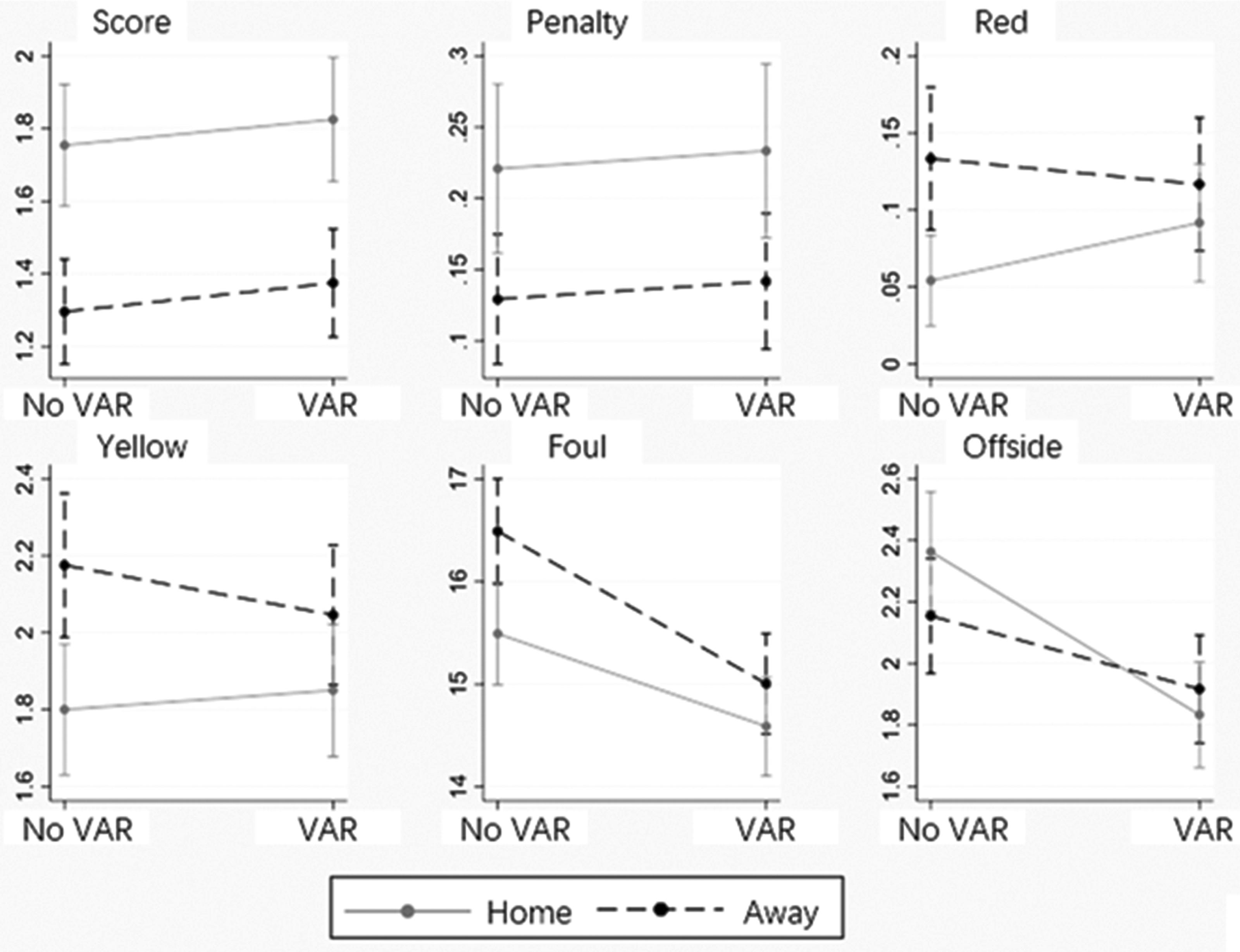
Changes of indicators of home and away game before and after the introduction of VAR.
Discussion
Different technological officiating aids have been introduced progressively in football. The VAR system is one of them. This study explored the influence of the introduction of VAR on the CSL from the perspective of team performance. The study found that: 1) After the introduction of VAR, the number of offsides and fouls in the CSL dropped significantly; 2) the playing time in the first and second half and the total playing time increased significantly; and 3) after the introduction of VAR, the home team advantage has a downward trend.
A significant change after the introduction of VAR was the reduction in the number of offsides. This was probably because the assistant referees tried to avoid misjudgments leading to the loss of scoring opportunities. Therefore, referees perhaps prefer not to make a judgment when they were not completely sure about the offside fouls,28–30 because if a goal was scored, the offside can be also confirmed by VAR. This will make assistant referees dependent more on VAR technology, resulting in a significant reduction in offside decisions. From the perspective of the offensive team, this situation will encourage the offensive players to run through the opponent’s defending line in advance. Since the worst result is to be ruled offside, the offensive players will be more active to make penetrating passes, which will increase scoring chances and goals objectively. This study also found that the number of fouls decreased after the introduction of VAR. This is probably because VAR monitored the entire stadium with minimum of 12 cameras so the movement trajectory of each player and even the “tiny” contact parts of both players can be clearly shown on the video screen, 21 which constrains the players’ malicious fouls. Because VAR allows referees to watch the video, players need to pay more attention to their actions and behaviours when defending. 25
Lago-Peñas et al. 25 found in the German Bundesliga and Italian Serie A that the playing time of the first half and total playing time increased after the introduction of VAR, while the number of yellow cards, fouls and offsides were reduced. These findings are basically consistent with the results of this study. The increase in playing time is largely due to the suspension of the game when VAR is involved. In this process, the referee needs to watch the video and communicate with the video assistant referees and make the final decision. This process will consume more time than the matches without VAR. In the 2018 season, in the first round of the CSL, Tianjin TEDA FC against Hebei CFFC, the visiting team’s striker Lavezzi was tripped in the opponent’s penalty area. The referee watched the video and communicated with the VAR for 6 minutes. In the second round of the 2018 season, Guizhou Hengfeng vs. Hebei CFFC, the referee checked 3 goals through VAR, resulting in a 10 minutes 44 seconds extra playing time. Therefore, some studies have suggested that the use of VAR or similar video-assisted technologies undermine the coherence and fluency of the game. The football game has become fragmented and the artistic charm of football has been seriously damaged due to VAR.18,31
This study found that the introduction of VAR may reduce the home team advantage and referee bias to some extent. According to the previous findings, the referees can be influenced by home games 2 and the density of the home audience will affect the referees ‘mentality when they make judgements, 32 leading to the referees’ decisions in favour of the home team. 33 There are also home team advantages in the CSL. 34 , 35 This study found that the number of offsides by the home team dropped significantly after the introduction of VAR and became lower than the visiting team. This phenomenon was largely related to the psychology of the assistant referees when they officiated the match. The first reason has been mentioned above. The assistant referees were unwilling to raise the flag prematurely. The second reason was that referees were affected by the atmosphere of the home game, which objectively exacerbates this referee’s behaviour.
Before the introduction of VAR, the home teams were better than the away team in almost all indicators, especially higher in goals, lower number of fouls, red and yellow cards. After the introduction of VAR in the 2018 season, the number of fouls, red and yellow cards of the home and away teams were of no significant difference. Although the number of goals and penalties of the home team were still higher than the visiting team, it can be speculated that the home team was more familiar with the stadium and environment, played with the support of a large number of fans and the players had a strong momentum and were more eager to win, 36 so they had more courage to commit offense.
Although VAR appears to improve the accuracy of judgements and makes the game fairer, the long-term impact of VAR on football matches should be further studied from all aspects. In the future, referee opinion about VAR should be included and psychological researches about the VARs should be conducted. Moreover, other variables related to VAR such as team playing style, reputation and situational variables should be considered as well.
Conclusion
The introduction of VAR has brought subtle changes to the Chinese football Super League (CSL). The changes are 1) the offside and fouls in the Chinese Super League dropped significantly; 2) the playing time in the first half, second half and the total playing time increased significantly; 3) VAR technology inhibited the home team advantage to some extent.
This study can help relevant professionals to better understand the impact of VAR on professional football leagues, especially in the CSL and it is possible to optimize referees’ officiating strategies. In general, VAR makes the game fairer and the player’s foul behaviours are restrained. The referee’s judgements are more objective and it is no longer easy to perform artificial match manipulation. The increase in playing time and the decrease in offsides are the inevitable effects of the current level of VAR technology. With improvements in VAR technology and VAR rules, when VAR decisions and feedback become faster and more accurate, football matches will certainly be more exciting.
Footnotes
Declaration of conflicting interests
The author(s) declared no potential conflicts of interest with respect to the research, authorship, and/or publication of this article.
Funding
The author(s) disclosed receipt of the following financial support for the research, authorship, and/or publication of this article: This work is sponsored by the Scientific Research Foundation for the Returned Overseas Chinese Scholars, State Education Ministry.
