



Abstract
A coach has a great influence on athletes’ performance and development. Communication and coaching styles that work with male athletes may not be effective in female athletes. The alignment of coaching to the preferences of female athletes is important for effective coaching and their holistic development. Therefore, it is essential to understand how female athletes perceive an ideal coach. The purpose of this research is to uncover how Singapore national beach volleyball female athletes voice about an ideal coach. Seven Singapore national beach volleyball female athletes were interviewed. Thematic analysis was used to analyze the data. The three main themes are – understanding the female athletes, being a role model with responsibility, and possessing rich experience as a coach and athlete. The three main themes that were developed from the voices of the Singapore national beach volleyball female athletes are supported by the literature on transformational coaching in terms of these components: idealized influence and individualized consideration. The findings of this research could help to establish a more comfortable, trusting and well-communicated training environment for female athletes.
Introduction
Transformational coaching
Transformational coaching is representative of a person-centred approach in coaching.1,2 Sport Singapore (SportSG), a statutory board under the Ministry of Culture, Community and Youth of the Singapore Government, recognizes the coach as the main driving force in striving for sporting excellence in Singapore.3,4 Singapore’s push for transformational coaching reflects the relevance of this theory in the current sporting context. 3 Transformational coaches can skilfully use sport as a platform to help athletes learn life lessons and appreciate their increase in knowledge. 1 By adopting the transformational coaching style, possible outcomes often include an increase in athlete satisfaction, performance, cohesion and intrinsic motivation. 2 Transformational leadership in coaching comprises of four components: idealized influence, inspirational motivation, intellectual stimulation and individualized consideration.5,6
The role of a coach
Coaches conduct training and provide instruction and advice to athletes to improve their sporting performance. 7 Coaches have the greatest influence on athletes as they develop as performers and individuals.7–9 Coaches design game plans and come up with strategies that affect their athletes’ sporting performances during competitions. 10 The coaching context involves a complex system of interactions between the coach, athlete and the environment. 11 The coaching process has a holistic nature, 12 and is not solely about making the connection between coaching content and methods, but more significantly, connections between people and life in general. 13 Becker 9 stated that coaches hold significant accountability for the holistic development of an athlete, including physical, cognitive, tactics, techniques and results. As such, the role of a coach is important because poor coaching may be detrimental to an athlete’s performance and development. Gearity and Murray 14 explained that poor coaches have the tendency to induce self-doubt in athletes, become a distraction during athletes’ performances and are demotivating. Past research had shown that motivational levels of athletes could be affected by coaches’ leadership 15 and coaching styles.7,16 When coaches’ behaviours, leadership and coaching styles are congruent to preferences of athletes,15,17,18 athletes’ satisfaction and team performance may improve. Therefore, it is paramount to recognize the importance of the role of a coach and for coaches to understand the notion of an ‘ideal coach’, so that their coaching can align with the preferences of female athletes, therefore allowing a strong and positive coach-athlete relationship to be established. The coaches’ quest to be an ‘ideal coach’ is a constant work-in-progress to coaching excellence, and there are strong benefits to be had in the practice of caring for elite athletes in sustainable coaching. 19 With a strong and positive coach-athlete relationship, there may be an increase in athletes’ satisfaction, motivational levels, self-esteem, and performance successes, along with a reduction in athletes’ anxiety levels.20–23
Coaching female athletes
According to Merchant, 24 females’ communication styles are more personal and relational. Female athletes prefer a democratic coach-athlete environment where they have a part in decision-making processes.25,26 In addition, female athletes expect coaches to understand them as an athlete and person.19,27,28 As such, when working with female athletes, the coach-athlete relationship should be based on guidance and mentorship. 28 According to Jowett and Cockerill, 8 positive coach-athlete relationships are built on factors such as care and concern, support, mutual respect, trust, and shared knowledge and understanding. Positive reinforcement and encouragement are good motivators for female athletes. 29 For example, elite female soccer athletes were pleased when their coach was ‘available to listen’ and considered athlete opinions. 29 Female athletes tend to seek validation of their feelings and empathy from significant others, 30 including coaches. While past research had explored the coaching preferences of athletes in general,7,15,31 few are in-depth analyses on the perspective of female athletes in a Singapore context. Therefore, this research aims to focus on the perspective of female athletes to gain greater insights about what makes an ideal coach. By understanding the perspectives of female athletes, coaches may be able to work better with female athletes and help them achieve positive developmental outcomes in the sports environment. 32
Beach volleyball: A growing sport
Beach volleyball is seeing a rise in popularity as a legitimate sport since its debut in Atlanta Summer Olympic Games 1996.33–35 The team dynamics in beach volleyball are considerably different as compared to other sports as the team is relatively smaller than other team sports – usually consisting of two athletes and one coach. Unlike sports like soccer and basketball, beach volleyball coaches are not allowed to communicate with their athletes during gameplay, and at half-time or time-outs. Moreover, in beach volleyball, there are no other athletes available for substitution. Since a beach volleyball team is relatively smaller than other sport teams, the coach-athlete relationship is more significant than that of larger sports teams. 36
Singapore national beach volleyball team
Over the recent decade, Singapore’s beach volleyball scene has gained more attention with the increase in participation in overseas tournaments and the active hosting of local and international competitions. In 2016, both male and female teams participated in the World Beach Volleyball Championship in Switzerland. 37 In the following two years, Singapore qualified and competed in the Commonwealth Games, in the 2018 Gold Coast Games. Other than sending athletes to compete in major tournaments, Singapore had hosted a FIVB (Fédération Internationale de Volleyball) World Tour in Sentosa, where international beach volleyball teams from all over the world competed. Currently, the Singapore national beach volleyball team has two local coaches, and one foreign coach, with all of them being male coaches. All female beach volleyball athletes in Singapore only have experience working with male coaches, and not with female coaches. There are few female beach volleyball coaches in Singapore and none of them have worked with the national female beach volleyball team. Apart from Singapore, many elite beach volleyball female athletes from other countries also work with male coaches. Some examples include the United States of America, 38 Australia, 39 and Canada. 40 The Singapore women’s national beach volleyball team consists of senior and youth athletes. Beach volleyball training locations are limited to three locations in the country. On average, the team completes five ball and three gym sessions a week. With the female athletes working closely with the coaches, it is important for the male coaches to better understand and care for female athletes. Caring coaches employ strategies such listening to their athletes, taking time to interact and showing empathy for the individual. These strategies create a training environment where individual and athlete well-being are met. 19
It is important to deepen the understanding of what an ideal coach means to female beach volleyball athletes. Although past studies investigating ideal qualities that athletes look for in a coach have been done in several competitive sporting activities – such as soccer, 29 basketball,25,28 volleyball,41,42 limited research has investigated the qualities of an ideal coach in the context of beach volleyball. In addition, research show that female athletes have their own needs and expectations of a coach.28,30 In this research, the question that will be addressed is: what do Singapore national beach volleyball female athletes voice about an ideal coach within their sporting context? With a better understanding of how national beach volleyball female athletes view an ideal coach, this knowledge can help coaches sustain work with female beach volleyball athletes to develop their potential as athletes and individuals.
Methods
Purposeful sampling 43 was used to identify and select participants for this research. Interviews were selected as the appropriate method to gain a greater understanding of the female athletes’ voices as they shared what an ideal coach means to them. 28 The use of interview is an appropriate method for this research, as it has the capacity to do ‘justice to the nature of the athlete-coach relationship as a socially constructed phenomenon’. 44 Interview data would provide the greatest potential for generating practical and theoretical insights. 44 In this research, participants have worked with a different number of coaches. As one of the authors is a female athlete of the Singapore national beach volleyball team, bracketing was done to temporary set aside any assumptions 45 and biasness based on the author’s experiences with her previous coaches. Initial preconceptions arising from the author’s personal experience with coaching in Singapore national beach volleyball team were identified prior to the start of the research.46,47 The author’s internal suppositions, the knowledge and experience of the national beach volleyball team was bracketed, and interviews were approached openly. These internal suppositions that had been identified were monitored throughout the duration of the whole research as a potential source of insight or as obstacles to engagement. 48 During the interviews, participants were encouraged to elaborate on their own experiences, and the interviewer, who is a female athlete of the national beach volleyball team, was mindful to not interfere with the participants’ articulation of their experiences. This helped the phenomenon from each participant to be presented to the researcher in a clear and unaltered manner, allowing the findings to be collected as the best true image from the participants’ point of view. 49 The data that had been collected and analyzed are kept to the truest meaning of the participants’ experiences in the Singapore national beach volleyball team.
Participants
Upon Institutional Review Board (IRB) approval, the research was proposed to the potential participants. Upon agreement to participate in the research, informed consent was presented to the participants. After the informed consent were signed by the participants, they were contacted for an initial interview with the researcher. A total of seven participants who had rich knowledge and at least one year of experience in the Singapore national female beach volleyball team were recruited. 43 These seven participants are all the senior athletes in the Singapore national female beach volleyball team. While knowledge and experience are important, it is equally important for the participants to be available and willing to participate in the research, with the ability to articulate their experience in an expressive and reflective manner. 50 One participant has worked with one coach, three participants have worked with four coaches, and three other participants have worked with five coaches during their time in the Singapore national beach volleyball team. The ages of the participants were 22 ± 2 years old, with 3.8 ± 1.3 years of experience with the Singapore national beach volleyball team. Values are reported in mean ± SD unless otherwise stated.
Data collection
Semi-structured interviews were conducted at locations that were comfortable and quiet, as identified by the participants. Data collection took place from 10 January to 28 February 2019. For each participant, the official interview lasted an average of 45 minutes. To protect the anonymity of the participants, the authors refrained from using their real names. An introduction regarding this research was given to each participant before the interview. As participants may have had experiences with coaches in other sports, they were reminded that the context of this research is based on their experiences in the Singapore national beach volleyball team. The interview for each participant provided insights into what conceptions the Singapore national beach volleyball female athletes have about an ideal coach. In the interview, general questions were asked to find out the participants’ understanding of an ideal coach in Singapore beach volleyball. The interview guide follows the recommendations of Morgan and Kreuger. 51 Broad and general questions were asked, followed by specific questions that addresses the key questions. Participants were probed to gain better understanding about their answers for the key questions.
At the start of the interview, opening questions were asked regarding the participants’ age, previous playing experiences in the Singapore national beach volleyball team, and the number of coaches they had worked with during their time in the team. Examples of these questions include: “How many years have you been training with the national beach volleyball team?” and “How many coaches have you worked with during your time in the team?”. Then, introductory questions were asked regarding the topic of the research. Some examples of introductory questions include: “Can you share with me three qualities that you think an ideal coach would have?” and “Can you provide me with your understanding of an ideal coach in beach volleyball?” In general, participants gave brief answers and listed three qualities that they felt an ideal coach in beach volleyball should possess. Next, transition questions give participants a logical link to the upcoming key questions. In the interviews with the participants, transition questions tend to ask for brief elaboration of what they have shared regarding an ideal coach. Transition questions asked include: “Can you give me an example of the drill that you mentioned?” and “Can you give me a brief explanation of why you think that is important?”. Subsequently, we delve into the main part of the interview with the key questions. Key questions focus on their unique experiences of the participants with their coaches and draw out the main reasons why they feel that those qualities that they have identified are important for an ideal coach. The key questions focus on the voices of the female athletes and their experiences with their previous coaches in the Singapore national beach volleyball team. Examples of key questions include: “Why is this an important quality for a coach?”, “How did this become an important quality that you look for in an ideal coach?” and “Why/how did you come to realise that two-way communication is important?”. At the end of the interview, participants were asked if they had anything more to add onto their responses, and each interview was wrapped up with a summary of the session.
The author’s iPhone was used as an audio recording device to record the interviews. The interview recordings were transferred to a thumb drive for storage in the authors’ laptop and were transcribed upon completion of data collection. Transcription process took approximately 22 hours. Member-checking was conducted, a process where the participants checked for accuracy and sensitivity of their respective interview transcriptions. All participants had checked for sensitivity and accuracy of their respective interview transcriptions and responded to the member-checking process. Any inaccuracies in the interview transcriptions were corrected with the participants’ feedback. Throughout the research process, any doubts in the interpretation of the data could be clarified with the participants. 52
Data analysis
Thematic analysis was employed to analyze the qualitative data that were collected. Thematic analysis, an independent qualitative descriptive approach, is defined as a method for identifying, analyzing and reporting themes within data. 53 In the first phase of thematic analysis of the qualitative data, the researchers familiarized themselves with the interview data that had been collected and transcribed, by reading and re-reading the data.53,54 It is recommended that the data analysts immerse themselves in the data collected to attain a sense of the whole by reading and re-reading. 55 Authors re-read the transcriptions carefully and repeatedly, to ensure familiarization with the data. In the second phase of thematic analysis, codes were identified for the systematic analysis of the data through initial coding. 53 Codes are ‘building blocks of analysis’ that help to provide a concise summary of a portion of the data collected. 53 In this research, codes are presented as subthemes as building blocks of analysis for creating the main themes. In the third phase of thematic analysis, subthemes were developed into main themes that represent a level of ‘patterned response or meaning within the data set’. 53 In the fourth phase of thematic analysis, the authors met and reviewed the common themes that were created about what the participants thought about an ideal coach. Three main themes were identified from what the participants had voiced out about an ideal coach based on their experiences in Singapore national beach volleyball team. In this phase, it is important to ensure that themes identified can represent the most important elements of the data that had been collected, in relation to the research question. 53 The themes were related yet not repetitive, and they have a singular focus. 53 In the next phase, the themes were defined and named. Under each theme, vivid examples and extracts in the interview data were identified to capture the essence of the theme. In the last phase of thematic analysis, themes were woven together in a logical and coherent manner and presented in this report. 53
Results
The purpose of this research is to uncover how Singapore national beach volleyball female athletes voice about an ideal coach. Three common themes of an ideal coach (see Figure 1) were derived from the voices of seven Singapore female national beach volleyball athletes. The three common themes are – understanding female athletes, being a role model with responsibility, and possessing rich experience as a coach and athlete. With reference to Figure 1, under each common theme, there are related subthemes that have been drawn out from the data collected.

Main themes that surfaced from the voices of Singapore national beach volleyball female athletes about an ideal coach.
Understanding the female athletes
The first common theme that had been derived from the voices of the participants is for an ideal coach to be able to understand the female athletes. As shown in Figure 1, subthemes include – approaching every athlete as an individual, building trust and a comfortable environment for athlete disclosure, and planning effective training. According to the data collected from the participants, the ability to understand female athletes is viewed as the most important quality of an ideal coach. This theme was the most frequently reiterated during the interviews with the participants. Participants mentioned that understanding between a coach and themselves is the foundation for building an effective coach-athlete relationship. A high level of understanding between coaches and female athletes can assist coaches in planning for effective training.
Approaching every female athlete as an individual
The participants felt strongly that an ideal coach needs to understand them and know how and when to approach them. An ideal coach with the right approach may help with the motivation levels of female athletes. A good coach can really push you to your limit, push you but not make you feel angry. Like the words he/she chooses, he/she will choose it very carefully. And you will really feel motivated to play … .an ideal coach in my mind will really have his own method, like the way he/she speaks, the tone, the things he/she does to make his players think: I can, I can! [Participant 2] Some players mindset wise they are very strong, they can take it. But other people … mentally wise they might not be as strong as other players. So, I just think that communication, he/she should understand every player … [Participant 5]
Building trust and a comfortable environment for athlete disclosure
Earning the trust of female athletes can help to establish a comfortable and positive coach-athlete relationship. Results showed that the participants value a comfortable relationship with their coaches as they can share their thoughts, feedback and problems that may be affecting their performance. Participants mentioned that they appreciate it when coaches try to understand why they may not be performing up to expectations during trainings. With female athletes trusting their coaches, stronger rapport can be built between the two parties. With stronger rapport, female athletes would be more comfortable in sharing their thoughts, which may help coaches understand them and plan for better trainings. Other than training issues, participants recognize that coaches should understand them as an individual, not solely based on their athlete identity. … if the person is not performing well for training, I think that the coach should not go and lash out at the person. But maybe try to understand why she cannot do well for that training, instead of like scolding and getting annoyed at the person straight away. [Participant 1] I think an ideal coach would be able to understand that sometimes your life problems will accidentally come into the beach. Like sometimes you very stressed over studies, or something happens in your life, but he/she doesn’t … I feel like an ideal coach will be able to understand, and then maybe talk to you about it. [Participant 6] An ideal coach should also communicate well with their players. It is not just coach and athlete identity … coach, and athletes see each other so often … like almost every day. It’s important to build the rapport la … if the coach doesn’t have a rapport with their players then it won’t be helpful … (with rapport) the athletes won’t feel afraid of telling the coach what they feel. [Participant 7]
Planning effective training
The final subtheme derived from the interview data of the participants states that understanding female athletes can help a coach to plan for effective training that suits the characters of the athletes. Furthermore, with the small team dynamics in beach volleyball, stronger communication and understanding between the coach and athlete are expected as a beach volleyball coach should not need to divide his attention among many athletes. Because only when he/she can relate to us then only, he/she can plan our drills and trainings according to our character or our needs … and cannot always talk about ball ball ball ball ball. You must also talk about some personal stuff. [Participant 2] … Other than just technical skill, he/she can also relate to you on a personal level. Kind of like he/she understands your emotions, your character as you play … if he/she knows that you are those ‘just do it’, he/she won’t ask questions and will just prescribe training accordingly … [Participant 3] Because some players are not comfortable with how the training programme is, but they just don’t want to say … comfortable relationship … that’s very important to me, so I can say anything I want … [Participant 5] Sometimes they give a point for us to improve about on a certain skill, but I feel like the ideal coach should …give us some space to think and correct ourselves … he/she need to trust that if we do not get it, we will go back to ask him/her again … [Participant 6] The previous coach … will only say, ‘why you keep hitting out’, ‘always try to keep the ball in’ but then he never pinpoints what my exact problem is … when the other coach told me about it, I could change and not just worry, feel troubled about why my ball is always going out … [Participant 7]
Being a role model with responsibility
An ideal coach should be a responsible role model for female athletes. According to the participants, behaviours that they look out for in an ideal coach include – setting a good example and accountability.
Setting a good example for athletes
Female athletes shared that their behaviours are dependent on how a coach portrays himself/herself to the team. Participants mentioned that when a coach is always early for training, they will do their best to be punctual or be early for training. However, if a coach is perpetually late, female athletes would question his/her responsibility, and they would tend to arrive later for training. We tend to follow what the coach does … so if the coach always comes late, then we always come late, if he is early, then we will come early. [Participant 1] If the coach is constantly late, then we will feel like if we come early also no use what. He will come late and start training late, then I will be thinking … why not just come later a bit … ? [Participant 4] … what he/she expects of athletes, he/she should also do it himself/herself. If the coach shows us a bad example, we will soon become like … we will slack off and won’t respect the coach as much, which is not very healthy for the coach-athlete relationship. [Participant 7]
Being accountable for actions and words
An ideal coach should be accountable for his/her words and behaviours. When this occurs, and athletes believe that a coach can fulfil the commitments to the coach-athlete relationship, there would be greater levels of trust between the two parties. A coach must uphold what he says. So, if he/she promises us something, then he/she suddenly says that he/she cannot make it. Then it’s not very responsible …and also like giving false promises. [Participant 1] If he/she is not accountable for his actions, then why do I need to be … so like obviously that is not a good role model already what. [Participant 2]
Possessing rich experiences as coach and athlete
Participants shared that an ideal coach is one who has experience as a coach and an athlete. When coaches were once an athlete, only then can they understand what the athletes are going through. Coaches who had been athletes themselves would know what their own athletes need or do not need during critical situations. Furthermore, participants mentioned that coaches with rich experiences as athletes would be able to develop effective training methods as they are coaching.
Knowing what the athletes need or do not need
The participants shared that they appreciate when a coach knows what they need and do not need in crucial situations, such as before a match or after a tough loss. Participants also agree that an ideal coach should be aware of success demands, set realistic expectations and have at least trained at high levels of intensity before to know what they are going through. It is also important that an ideal coach can identify when a female athlete needs help during her down periods. I think when they have the experience as a player, then they know how we feel and how we think on court …going through training as an athlete, the pressure you face when you are on court … if a coach didn’t really have the experience as a player, and then he/she just go take all those coaching courses, then he/she actually didn’t really go through the true process of the sport itself. So, I think being a player is a MUST BE. [Participant 3] Only people that played the sport would understand how the head works during the game … if you don’t do the sport, you won’t get the actual feeling of being under the pressure of wanting to win. I just feel like a coach that doesn’t have prior experience in playing the sport … will only be able to teach us the technical part of the sport. But anything else, I would think that he/she is highly incapable. A bit hard to imagine someone with no playing experience to be able to relate to you on that level. [Participant 6] If the coach was an athlete before, they know the struggles of being an athlete, and they can relate to us so much more. Especially if my coach was once a student-athlete, or maybe like an athlete and working. So, they can better understand the struggles and understand us better … [Participant 7] The senior athletes in the Singapore national female beach volleyball team train six days a week while juggling work or school. As such, participants mentioned that they appreciate when their coach can relate to them both on court and off court.
Developing relevant and efficient coaching
When coaches have experience as athletes, they would be able to incorporate those experiences into their coaching style to facilitate training for their athletes. When a coach had been an athlete previously, they would develop an idea of what coach they would like to have. In addition, previous experience as an athlete can help coaches to develop less experienced athletes through the sharing of ideas, strategies and stories. Especially if your athletes are not very experienced, that is when you need to impart your experience and all the different game strategies to the team … we need someone to facilitate that process. [Participant 2] … within this how many years, he has been playing. What he sees, it’s just very different. From there then he can put into his own coaching style and then pass it down to athletes. So, I think experience is important. [Participant 5] … because being an athlete, you will know what a good coach is, what qualities make up a good coach, and what qualities don’t la! You will know what kind of you want to be or what kind of coach you don’t want to be because you have experience with bad coaches that doesn’t help with your sporting experience at all. [Participant 7]
Discussion
The purpose of this research is to explore how Singapore national beach volleyball female athletes defined an ideal coach within their sporting context. Three common themes of an ideal coach were derived from the voices of seven Singapore female national beach volleyball athletes. The three common themes are – understanding female athletes, being a role model with responsibility, and possessing rich experience as a coach and athlete.
The three main themes that were identified in this study are supported by the literature on transformational coaching. With reference to Figure 2, the three main themes that were developed from the voices of the Singapore national beach volleyball female athletes are supported by the literature of transformational coaching in terms of these components: idealized influence and individualized consideration.1,2
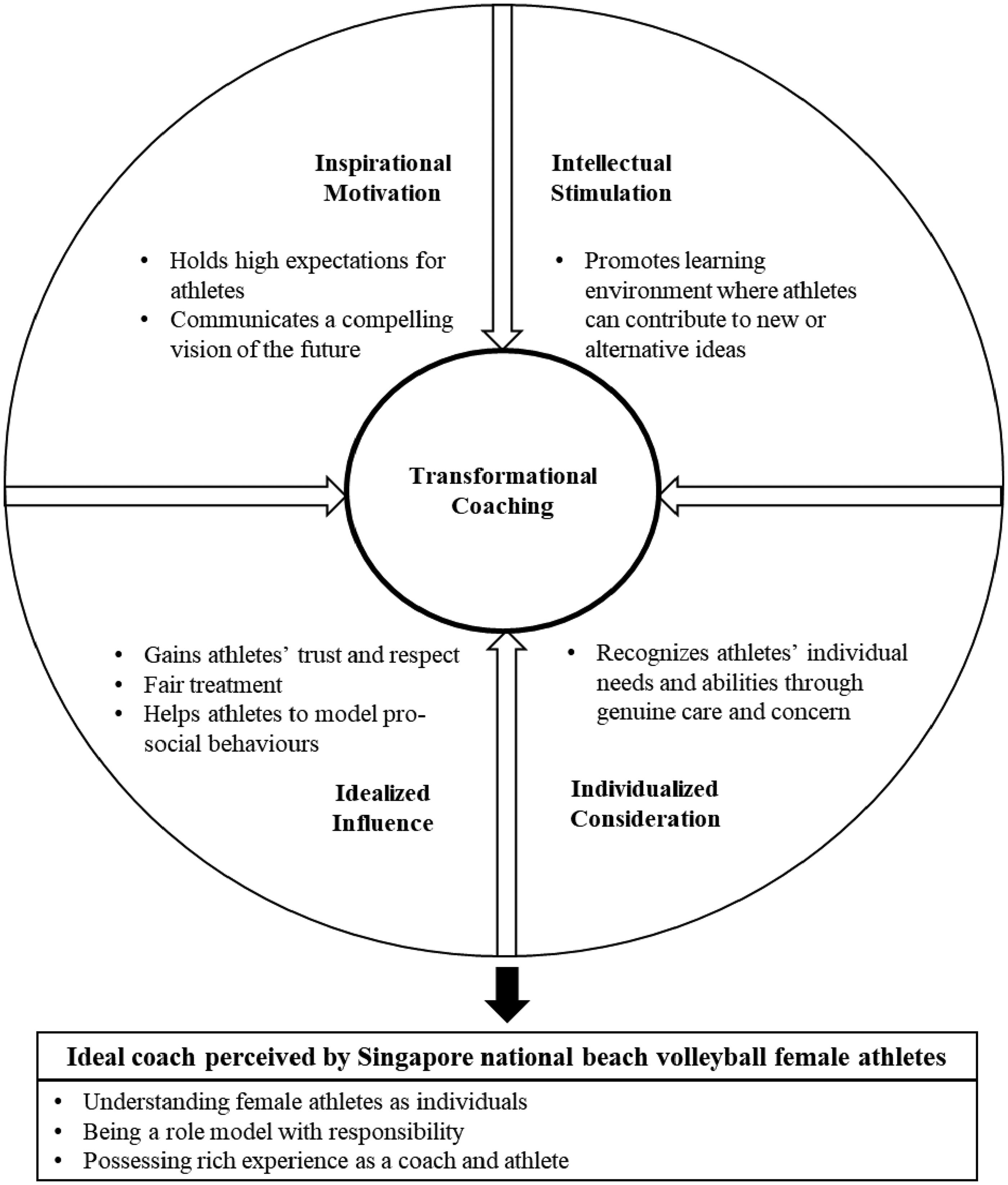
A coach-athlete relationship is one that is intentionally developed, characterized by growing mutual appreciation and respect for one another as individuals. 56 An ideal coach is able to facilitate communication in the coach-athlete relationship, which is one of the most important elements in coaching. 57 With reference to Figure 2, the component of individualized consideration in transformational coaching supports the first theme that explains the need for coaches to understand female athletes. When female athletes feel that a coach understands them, they tend to trust and share their thoughts comfortably with the coach. 58 With a strong coach-athlete relationship, there could potentially be an increase in positive performance outcomes for female athletes. 59 Past research stated that trust and cooperation between coaches and athletes are paramount in changing patterns of poor performance. 60 When coaches can approach the athletes without overstepping their boundaries, a trusting and comfortable coach-athlete relationship can be built. With the wrong approach, female athletes may lose their trust for the coach and the coach-athlete relationship may become distant. When a coach can gain athletes’ trust and respect, positive training and developmental outcomes is likely to follow.
Bloom 61 stated that the discriminating factor between a competent coach from a great one is the ability to know when to communicate with athletes. According to Bloom, 61 it takes a lot of time and effort to be able to distinguish the best communication style for each athlete. However, it is still of great importance that an ideal coach can develop suitable communication styles for each athlete. With a good understanding, an ideal coach will be able to recognize the most suitable method to approach every female athlete, as each is a unique individual with different communication preferences. Research has shown that competitive athletes do complain that the feedback style of a coach is a reason for decreased performance and enjoyment. 14 Therefore, the way that an ideal coach conveys his thoughts and feedback to a female athlete is an important yet deep component of coaching as it may impact the level of motivation and development for female athletes.
Ideally, coaches should be aware of the background and interests of female athletes, 28 and not simply discuss the sport. When coaches understand more about female athletes, they can find out how they prefer to train and incorporate that information into training plans. A coach needs to be able to be aware of the ‘particular traits and requirements’ of any athlete, including their individualities, what they like or does not like doing. 12 Individualized consideration is another component in transformational coaching that can be achieved by recognizing individual needs through genuine care and concern. As one of the most influential leadership behaviours of a coach, individualized consideration significantly impacts the developmental outcomes of athletes. 62 With reference to Figure 2, the component of individualized consideration in transformational coaching reiterates the findings of this research as participants shared that their ideal coach is one who can communicate and understand each female athlete as an individual. Additionally, participants agreed that when coaches possess rich experience as both a coach and an athlete, coaches would be able to understand their athletes better. Werthner and Trudel 63 reported that experience as high-level athlete was a valuable source of knowledge for coaching. When coaches are equipped with experience as an athlete, there may be greater levels of trust within the coach-athlete relationship since athletes believe that their coach would understand the success demands 64 and what they are going through during the training process. Therefore, by possessing experience as a coach and an athlete, coaches would be better able to build a trusting environment and understand their athletes. Furthermore, skilled athletes may have more developed perception, knowledge, and decision-making skills than less skilled athletes.65,66 When skilled and experienced athletes become coaches, these skills could help them in developing their coaching skills.65,66
Participants shared how a coach’s negative behaviours, such as being late for training and poor accountability can undermine the discipline and importance of accountability in the team. Therefore, it is important that an ideal coach is a role model with appropriate pro-social behaviours that athletes can model after. Figure 2 shows that idealized influence includes helping athletes to model pro-social behaviours. Like transformational coaches who practice pro-social behaviour to influence the development of athletes positively, the ideal coach of the participants is someone who they can model after. A limitation of this research is that one of the authors is a female athlete of the Singapore national beach volleyball team. To remove any biasness from the research, bracketing was done to temporary set aside any assumptions 45 and biasness based on the author’s experiences with her previous coaches. Detailed information on the interview questions and how the interviews were conducted were mentioned. The researchers were mindful to present the data collected as accurately as possible, through the participants’ perspective.
Conclusion
A coach is a powerful figure that has great influence 67 on the development of an athlete. While technical and tactical skills are important, it is equally significant for coaches to understand the perspectives and expectations that athletes have, and to align their coaching to athletes’ voices. It is key that coaches working with female athletes should focus not only on the technical and tactical aspect of training but also realize the importance of understanding and developing suitable communication styles to motivate and develop their athletes fully. 19 The three main themes that emerged from the voices of the Singapore national beach volleyball female athletes are – understanding the female athletes, being a role model with responsibility, and possessing rich experience as a coach and athlete. An ideal coach for the Singapore national beach volleyball female athletes is someone who can communicate and relate to them as individuals. By understanding female athletes, better communication between female athletes and a coach can be established and sustained. With better communication between a coach and female athletes, feedback about training can be shared more freely, and the needs of the athletes can be discussed comfortably. Eventually, a coach who recognizes these three qualities of an ideal coach may be able to establish a more comfortable, trusting and well-communicated training environment for female athletes to thrive. From the findings of this research, coaches should develop coaching styles based on understanding, trust and communication, as these qualities are more beneficial and sustainable for the development and performance of the female athletes in the Singapore national beach volleyball team.
Footnotes
Declaration of conflicting interests
The author(s) declared no potential conflicts of interest with respect to the research, authorship, and/or publication of this article.
Funding
The author(s) received no financial support for the research, authorship, and/or publication of this article.
