



Abstract
Background
The current approaches used to develop coaches within many sport organisations extend beyond merely the professional knowledge related to sport-specific aspects. Effective coaching notably entails intrapersonal skills related to learning through experience and developing one’s own approach, and these skills are often targeted in coach development. Recognising that researchers have delivered Coach Development Programs (CDPs) that use strategies like reflective practice to foster coaches’ strategies and attitudes toward reflection, reviewing research in this domain could inform the development of our field. We conducted the current review to examine nonformal intrapersonal CDPs within the academic literature with goals of summarising existing CDPs, while also identifying factors related to their implementation.
Keywords
Coaches are fundamental within the social environment of most organised sports and levels of competition. Optimising the behaviours of coaches is, thus, a critical pathway toward supporting athlete development and supporting the athletes’ pursuit of enhanced expertise. Coaching behaviours indeed have the potential to impact athlete outcomes ranging from sport motivation to injury prevention.1–3 Coach education has accordingly received significant attention in recent years, as evidenced by international efforts on how to develop effective coaches. 4 Many international sporting bodies have integrative approaches to developing coaches (e.g., UK Coaching, United Kingdom; National Coaching Certification Program, Canada; National Coach Accreditation Scheme, Australia). As an example, UK Coaching—the coach development system within the United Kingdom5—requires coaches to gain coaching certificates and entails a multifaceted approach to develop coaches, including formal sessions as well as informal activities with peer coaches or coach developers to acquire new knowledge. Such systems of coach development have garnered the attention of coaching researchers as being effective tools for integrating evidence-based practices into coaches’everyday role with athletes.5–7
Although coach education systems involve numerous components, they often depend upon workshops, interventions, or other learning activities focused on specific topics. While these learning activities have several terms within the literature, Evans et al. 8 defined coach development programmes (CDPs) as “an encompassing term to describe learning activities applied systematically through education, social interaction, and/or personal reflection with the goal of changing (…) coach behaviours” (p. 871). These learning activities often include various methods, such as lectures, workshops, training modules, and discussion groups delivered by professionals, researchers, mentors, or peers. However, CDPs can typically be discerned as time-limited programs or interventions and are typically designed and delivered to target coaching knowledge in a specific domain. 9
CDPs can specifically be considered with respect to the form of coaching knowledge they target. Coaches who support athletes’ development draw from a diverse knowledgebase spanning professional, interpersonal, and intrapersonal facets. 9 This triad of teaching knowledge was identified by Collinson 10 and applied to sports coaching by Côté and Gilbert. 11 Professional knowledge refers to the “what” and “how” of teaching sport skills 11 or subject matter, curricula, and pedagogical knowledge. 10 Second, interpersonal knowledge relates to how coaches foster meaningful and productive relationships with athletes and others in the sports community. 11 Lastly, intrapersonal knowledge is associated with self-awareness and reflective practice, with a focus on how coaches engage in reflection, confront ethics, and learn about their dispositions.10,11
Considering how coaches must engage consistently in all three domains, 11 CDPs have been created to develop each type of knowledge. Even though researchers have conducted empirical studies and comprehensive reviews to understand how we develop knowledge within professional12–14 and interpersonal domains, 8 it is essential to explore the range and scope of intrapersonal CDPs. In a review of programs delivered in sport organisations to develop coaches, Lefebvre et al. 9 noted that interpersonal (n = 18) and intrapersonal (n = 6) CDPs were less common in comparison to the frequent application of professionally-focused CDPs (n = 261). As such, we conducted the current review to identify intrapersonal CDPs reported in academic literature and, in turn, to describe the core characteristics of those interventions and evidence regarding their development and application. Throughout the subsequent paragraphs, we review literature to help delineate activities that may be described as intrapersonal coach development and reflect on how to classify and describe the contexts and ways that coach development programs may be enacted.
Coach development and intrapersonal knowledge
Intrapersonal knowledge is evident in the process whereby coaches learn from personal experience and continually revise their own individual approaches to coaching practice. For instance, the process of developing a coaching philosophy is one strategy commonly drawn upon to promote reflection and understanding of one’s own coaching orientation. Côté and Gilbert 11 also position intrapersonal development as being a critical component of effective coaching – pivotal for other domains like one’s professional knowledge and capacity to manage relationships with athletes and others. Notably, the authors focused on how effective coaches are sensitive toward athletes’ contexts, aware of their own behaviors, and recurrently introspect regarding how they may adjust their coaching practices. As such, there are many skills that may be classified in the intrapersonal domain, as coaches demonstrate intrapersonal development through practices like reflection, introspection, 11 and emotional regulation. 15 The process of developing intrapersonal knowledge is, thus, one that entails reflection on one’s learning and personal coaching experiences, and is regarded by many coaching researchers as a critical domain of focus.16–19
Although approaches can be used to define the intrapersonal domain, reflective practice is a widely-used framework to understand how intrapersonal development might take place. 20 Reflective practices that are targeted at producing intrapersonal coach development include strategies prompted by reviewing video of ones’ own interactions with athletes 21 as well as reflective cards to guide diary-style introspection regarding one’s behaviours. 22 When considering their role within CDPs, reflective practices are evident in interventions using them independently as the central aim of CDPs, but may also be integrated within professional or interpersonal CDPs to advance development. 9 Furthermore, Knowles and colleagues 23 summarised the ideal outcome of reflective practice in the following way: “reflective practice should facilitate the opportunity for experiential learning that has the potential to develop the knowledge-in-action required to be more critical, confident, innovative, informed and thus ultimately effective in what we do” (p. 8).
According to Schön,24,25 reflective practice is crucial for ongoing learning. Schön 25 refers to reflective practice as “a dialogue of thinking and doing through which I become more skilful” (p. 31). For Gallimore, Gilbert and Nater, 26 reflection entails the ability to adapt and change behaviours through pondering, reviewing and questioning of one’s experiences. In the same sense, Miles 27 stated that for learning to take place, professionals should do more than only be part of the professional experience. Indeed, effective coaches tend to personally engage in reflection as a component of their coaching practice, outside of the context of explicit training from outside sources. For example, Gilbert and Trudel 28 followed coaches of six youth sport teams and documented reflective approaches such as advice-seeking from peers, preparing coaching materials, and self-evaluation – especially when developing new coaching strategies.
With this in mind, the utility of reflective practice has gained recognition as a valid resource for personal and professional development for coaches.23,29 According to Cushion and Nelson, 30 coaches ought to work on reflective skills to, among other things, enhance self-understanding while refining coaching skills. 11 However, we have yet to develop an integrated view of the strategies delivered by researchers to promote reflection through CDPs, and the contexts in which these CDPs are evident.
Defining and classifying coach development programs
When defining the scope of where, how, and when intrapersonal CDPs are evident in our literature, it is vital to recognise the different forms that they can take. Lefebvre et al. 9 argued for the necessity of classifying and cataloguing efforts to develop coaches, with the argument that classification systems improve replicability, the development of new interventions, and how new interventions fit within existing interventions. Lefebvre et al. 9 aggregated CDPs in the empirical and applied literature to develop a typology that distinguished CDPs according to: (a) setting (i.e., academic and applied), (b) domain of focus (i.e., intrapersonal, interpersonal, and professional), (c) organisational context (i.e., formal and nonformal) — among others.
Beyond the focus of our review on academic work in the intrapersonal domain, Lefebvre and colleagues 9 noted three contexts defined in earlier literature: formal, nonformal and informal learning.31,32 Nonformal learning is an organised learning opportunity that takes place outside of the formal learning system. These learning opportunities are usually short-term and voluntary activities, such as continuous professional development clinics, workshops, or seminars. 33 Academically-published CDPs tend to be research initiatives that are nonformal in nature. 9 Although it is unclear precisely why academic literature focuses on nonformal CDPs, one possible explanation is that academics may design and deliver CDPs that are: (a) outside of formal coach development schemes evident at a national scale, perhaps, because the nationally run formal coach development programs may be unwilling to publish findings related to an evaluation of their program for fear of giving away a competitive advantage to other countries, and (b) focused on a narrow set of goals related to coach behaviour (e.g., coach-athlete relationship; reflective practice).
In contrast, formal learning is driven by curriculum, and recognised with grades and certificates. 34 Therefore, formal learning is commonly mandated by sports organisations and involves standardised curricula. However, formal coach development is also evident through coaching courses and programs delivered in universities as a step toward a degree or certificate. 35 Defined as such, this type of learning would be a component of a formal program – often entailing a “curriculum” of sorts that is meant to target a specific area of concern as a component of broader educational mandate.9,31 Formal learning using Merriam et al.’s 34 definition is “highly institutionalised, bureaucratic, curriculum-driven, and formally recognised with grades, diplomas, or certificates” (p. 29). Finally, informal learning occurs when knowledge, skills, attitudes, and insights are acquired from social interaction with other coaches during day-to-day coaching experiences.6,36,37 Informal learning is often evident in the social processes of coach mentorship as well as self-directed intrapersonal reflection.
Each of these contexts might entail intrapersonal strategies, and several existing studies have detailed programs to systematically develop coaches’ intrapersonal skillset.21,22,29 Nevertheless, an important note is that definitions for discrete CDPs tend to focus on either formal or nonformal contexts, given that informal activities are by definition less-structured than a systematic CDP.9,32 Furthermore, nonformal programs tend to be more constrained in their focus, and are perhaps most likely to be reported within peer-reviewed CDP studies that document the delivery of CDPs. 31 Thus, while we acknowledge that reflective practices are components of both formal education as well as the informal approaches to learning, a review of nonformal, evidence-based CDPs is critical to advancing our field.
Delivery of CDPs
Beyond classifying CDPs, it is critical to consider the strategies used to change coach behaviour and their potential generalisability within actual coach development systems. In attempt to understand how coach behaviour can be changed, researchers have employed approaches from behavioural change science to examine the delivery methods and learning strategies used in coach education programs.38,39 To this end, one crucial consideration when understanding the design of interventions that are based upon various theories is to distil the underlying and shared strategies used to elicit changes in behaviour. Behaviour change techniques (BCTs) are specifically defined as a systematic procedure to influence the processes behind the regulation of behaviour. 38 As the underlying active ingredients of any intervention regardless of theory, they should be observable, replicable, irreducible and a planned component of the intervention. 39
Allan and colleagues 40 provide an example of the use of BCTs when evaluating coach development programs designed to influence how coaches foster interpersonal relationships with athletes. These authors reported that researchers who design and implement interpersonal CDPs historically under-reported the specific BCTs in their research, and tend to rely on a subset of strategies (e.g., instruction on how to perform the behaviour, behavioural practice, credible source, and feedback on behaviour). 40 Evaluating BCT use may be a valuable way to evaluate the quality of reporting of interventions, ensure consistent reporting of interventions, and ultimately prompt the use of more diverse strategies.
A remaining question within CDPs is to consider the generalisability of research toward coaching practices and their use within community sport systems. Evans et al. 8 argued for the value of the RE-AIM framework 41 to consider internal and external validity in coach development research. Evans et al. 8 conducted a systematic review of interpersonal CDPs with this framework by evaluating reporting of CDPs across the five RE-AIM dimensions: Reach (i.e., the extent that participants in the intervention are representative of a broader population that is the target), Efficacy (i.e., outcomes associated with the intervention), Adoption (i.e., how a particular setting adopts a given policy or program within their practices), Implementation (i.e., how consistently program strategies are adopted), and Maintenance (i.e., the temporal stability of the changes produced by a specific intervention and the extent to which a program is still in place after being introduced). Efficacy was the most frequent focus of research involving CDPs – the remaining four dimensions were infrequently reported on by comparison. 8 The dearth of CDPs reporting on these remaining four indicators of generalisability and practicability mean that it is unclear how effectively research-based CDPs are translated into coaching practice.
The current study
Intrapersonal CDPs employing strategies such as coach reflection are widespread within international sports organisations and have occasionally been targeted by coaching researchers.5–7 Nevertheless, researchers have yet to conduct a review that explores the delivery of evidence-based CDPs targeting the intrapersonal knowledge of coaches. As such, the current review was conducted to examine research-based intrapersonal CDPs within academic literature. We adopted a configurative review approach 42 with a goal of interpreting evidence and drawing key insights for advancing the development of intrapersonal CDPs. Using systematic review strategies, we sought to generally describe peer-reviewed reports that evaluated intrapersonal CDPs. In addition, the design of this review was informed by previous reviews that leveraged frameworks from behavioural change science to examine the nature of CDPs pertaining to coaches’ interpersonal behaviours.8,40 We specifically coded studies in relation to three different domains. First, we reported on the risk of bias within trials to indicate the quality of the evidence base. Second, we examined behaviour change techniques used within each CDP. Third, we evaluated the extent to which researchers reported on characteristics of internal and external validity through the RE-AIM framework.
By cataloguing existing approaches to shape the intrapersonal knowledge of coaches, we hoped to develop a resource for future investigations. Although we entered this review recognising the narrow scope of research involving interventions to explicitly develop intrapersonal skills and knowledge, this step is nevertheless valuable to provide a foundation for future efforts. With this in mind, we decided to include the range of tools presented herein because the evidence pool was relatively constrained. In a larger review, it may not be possible to describe the evidence base to this degree of detail, but we felt that doing so helped this review to guide the field forward. Indeed, the general goal was to ensure that CDPs developed in the future may incorporate ideal strategies to change behaviour and to be readily implemented by stakeholders.
Methods
Search strategy
To review the published literature describing the implementation of CDP trials, we used the Preferred Reporting Items for Systematic Reviews and Meta-Analyses guidelines 43 (see Figure 1). This review was not registered prior to being conducted. The search protocol was conducted on several EBSCOHost online databases, including SPORTDiscus, PsycINFO, and the Psychology and Behavioural Sciences Collection. The search started in June 2018 and was updated in September 2019 to enhance the possibility of including as much published literature as possible.
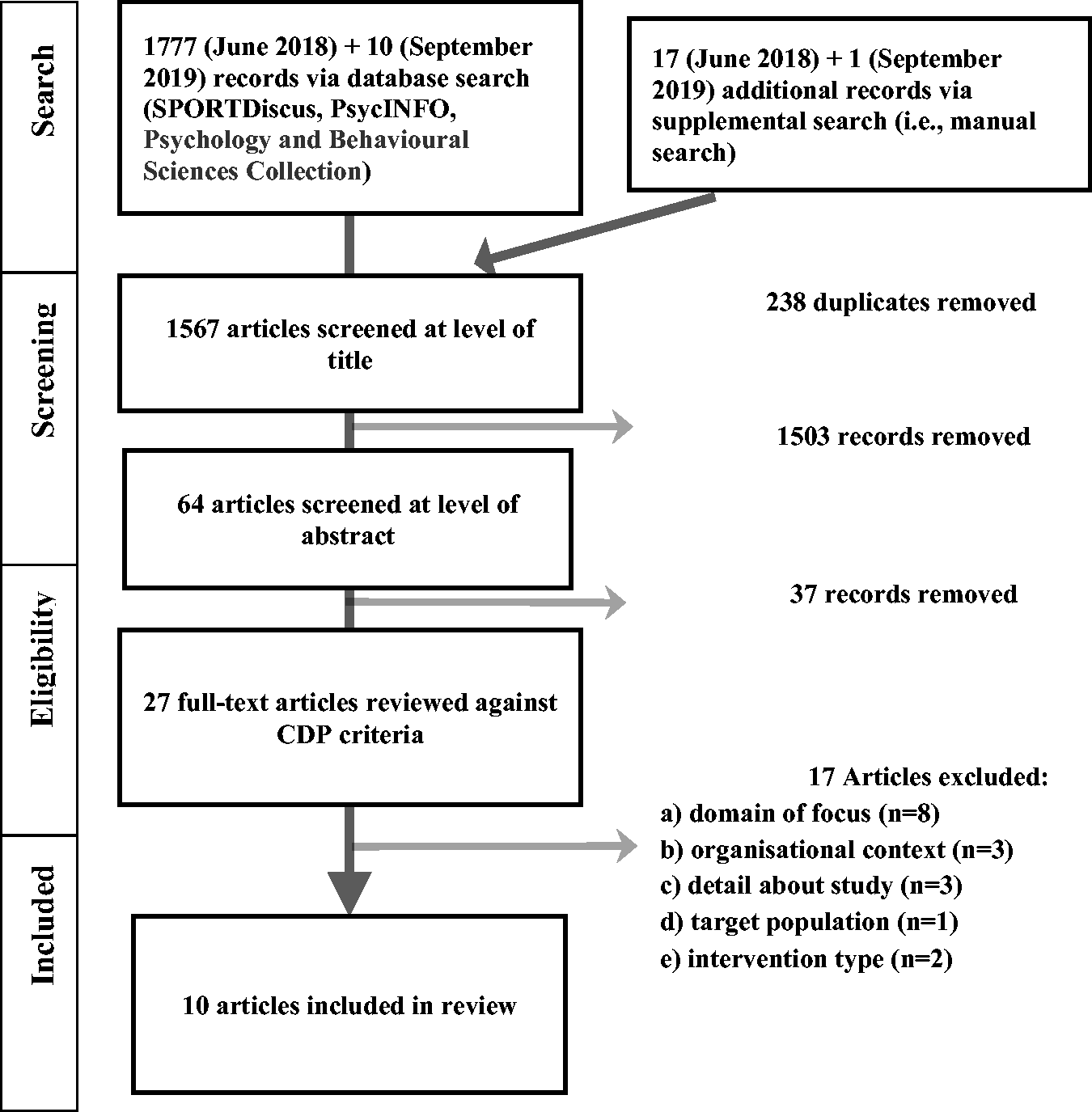
Systematic review flowchart.
The search query was designed to align with those employed in recent CDP reviews.8,40 Four groups of search terms were formed. In group one, sport; in group two, coach*; in group three, educat*, develop*, skill, learn*, “situated learning,” “problem-based learning,” “communities of practice,” intrapersonal, and “intrapersonal knowledge”; and finally, in group four, intervention, program*, course, train*, reflect*, “reflective practice,” and “coach development program.” Asterisks were used after the word as a symbol that broadens a search by finding words that start with the same letters and quotation marks so the search engines find the exact combination of words. Whereas recent searches have employed broader search terms in certain groups from above (e.g., varying terms for sport), we adopted this search strategy to constrain the list of records retrieved to only those that were most pertinent to the current review (i.e., detailing intrapersonal CDPs). A manual search was also conducted in peer-reviewed journals relevant to the study, such as coaching and/or applied sport psychology journals (i.e., International Journal of Sport Science & Coaching, The Sport Psychologist, Reflective Practice, and Sport and Exercise Psychology Review) and in the reference lists of the final studies for review.
Selection process
Table 1 provides study characteristics and was used to select studies for inclusion. The key eligibility criteria were to target only original studies published from 1980 to 2019. The initiation date was set at 1980 to reduce the inclusion of nonrelevant records, as research-informed CDPs began to be documented within academic literature following that date. 40 To include the broadest range of relevant intrapersonal CDPs, these eligibility criteria were inclusive—especially regarding flexibility of the type of study sought for inclusion.
Inclusion and exclusion criteria.
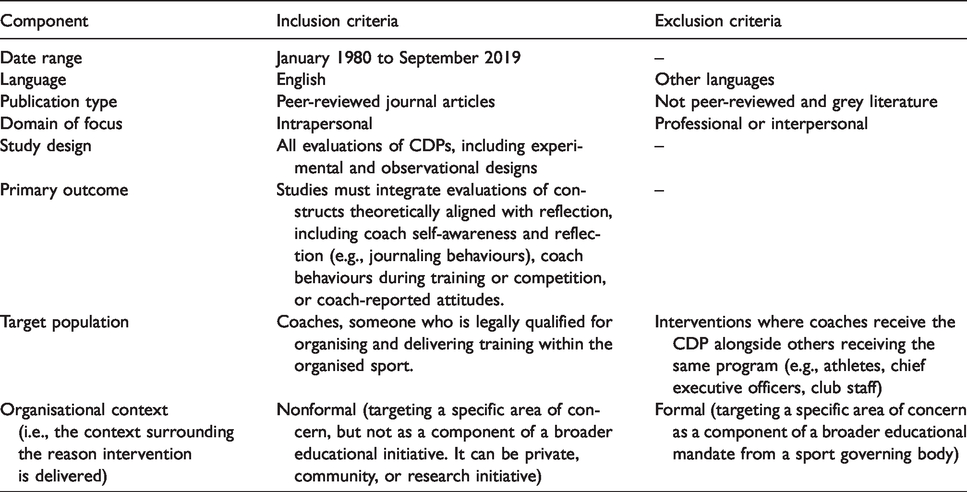
Selected studies were organised using the Mendeley desktop (version 1.19.3). Following the removal of duplicates, the screening process took place in three steps. First, as an initial screening process for nonrelevant records, selection and reduction were independently completed by two researchers (i.e., the first and last authors) at the level of title only using eligibility criteria. Second, these same two researchers independently focused on the abstracts according to eligibility criteria. The third and last step included a full-text screening where the focus was to evaluate the eligibility of each study as an intrapersonal CDP. In the case of disagreements regarding studies’ inclusion, studies were forwarded to the second and third author for additional insights.
Data extraction
The first and last authors extracted and coded information from included studies using a standardised sheet that is available from the authorship team upon request. For each CDP, the information was extracted related to the following domains: (a) authors and country, (b) purpose, (c) participants, (d) study design, (e) outcomes and measures, (f) theory, and (g) reflective tool (i.e., strategy used to prompt reflection).
The coding sheet was also designed to document the BCTs reported by Michie and colleagues, 44 and to describe reporting regarding the RE-AIM framework. 41 The data extraction and coding process for RE-AIM indicators and use of BCTs were conducted by the first and third authors. Allan et al.’s 40 work on the use of behaviour change theories and BCTs in research-informed CDPs led our coding approach, as the CDPs included in our review were analysed according to the BCT Taxonomy v1. 44 Coders (i.e., the first and third authors) followed the online training platform developed through the University College London’s Centre for Behaviour Change (http://www.bct-taxonomy.com). In the methods of each CDP, it was possible to identify the extent that a given intervention included strategies that related to general BCT category, and to identify specific BCTs. Meanwhile, the items for documenting RE-AIM components were adapted from the tool developed by Evans et al. 8 to evaluate interpersonal interventions, which was developed through previous reviews in behavioural medicine.45,46 The RE-AIM coding sheet is provided in supplemental online materials and features 47 items. Studies were attributed a score drawn from twenty items coded using yes (1) no (0) scoring, subdivided into sections for reach (11 items), efficacy, (nine items), adoption (11 items), implementation (nine items) and maintenance (seven items). Each intrapersonal CDP was assigned an aggregate RE-AIM score from low (0–6), to moderate (7–13) and high (14–20).
In addition to extracting the data above, the first and third authors coded studies for risk of bias using the JBI Critical Appraisal Tool for Quasi-Experimental Studies. 47 This tool integrates nine items that evaluate studies about their methodological quality, with items ranging from clarity of the document (e.g., “Is it clear in the study what is the ‘cause’ and what is the ‘effect’?”) to questions regarding study design and measurement (e.g., “Were there multiple measurements of the outcome both pre- and post-intervention?”; “Were outcomes measured in a reliable way?”). Each item was coded as “yes,” “no,” “unclear,” or “not applicable” and aggregated.
Coding protocol and reliability
The data extraction and coding process for RE-AIM indicators, use of BCTs, and risk of bias were conducted by two coders (i.e., the first and third authors). After piloting coding with a single study and revising coding tools for these three issues, reviewers independently reviewed all intrapersonal CDPs. Final coding values for RE-AIM dimensions, BCTs, and risk of bias were thus determined by aggregating the independent codes and discussing discrepancies between coders.
The kappa statistic (κ) was performed as an index of coder agreement across each dimension of the RE-AIM framework, BCTs and the risk of bias tool. 48 Provided that κ accounts for coding agreements based on chance, an adjusted κ was calculated to account for shared bias among coders. 49 According to Landis and Koch, 50 κ values of 0.61 to 0.8 indicate “substantial” reliability and those above 0.81 would be considered “outstanding.” High inter-coder reliability was identified for RE-AIM coding (97% agreement, κ = .94), Critical Appraisal coding (96% agreement, κ = .93), and Behaviour Change Techniques coding (98% agreement, κ = .94).
Results
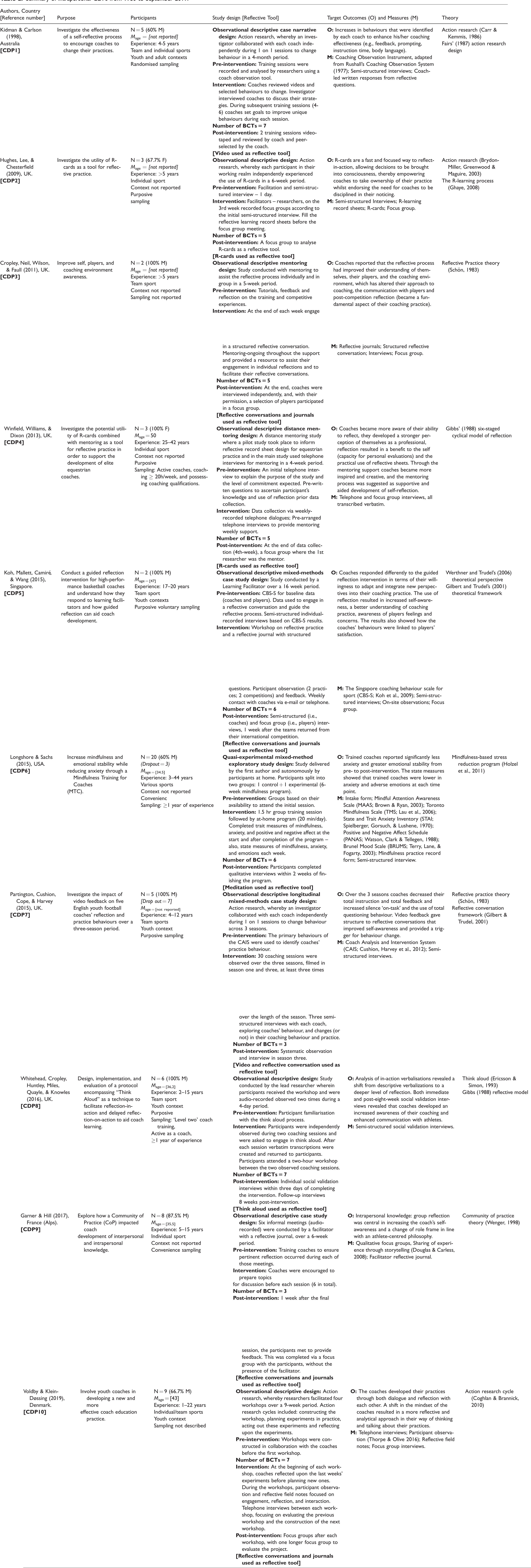
The initial search yielded 1805 unique records, with 27 studies remaining for full-text review after title and abstract screening. Following the application of inclusion and exclusion criteria (see Figure 1), 10 studies were deemed eligible for this review (see Table 2). Of note, each CDP included in this review was assigned a unique identifier (e.g., CDP1-CDP10; see Table 2) which will be used throughout the results.
Summary of intrapersonal CDPs from 1980 to September 2019.
Descriptive characteristics
The majority of intrapersonal CDPs entailed pilot investigations of small samples, whereby both qualitative and quantitative survey data were derived to evaluate perceived effectiveness of the CDP as well as the approaches that coaches used to integrate their knowledge within practice. Duration varied from four days to three years. Although all interventions were conducted over a period of time, the timing and frequency of sessions or interactions with coaches were reported by only three CDPs (i.e., CDPs: 7, 8 and 9). Only one of the trials used a control condition, and primarily examined outcomes related to the coaches’ engagement in reflective practice and insights regarding the process of the CDP (i.e., CDP6). Studies primarily used purposive sampling, selecting small samples (i.e., M = 6.3 coaches, SD = 5.4), using qualitative or mixed-methods approaches.
Studies were evaluated by keeping in mind the exploratory nature of their design. For example, the majority of the studies used a quasi-experimental design, while only one of the studies employed a control group (i.e., CDP6). Studies typically introduced clear definitions of their approach toward reflection and intrapersonal knowledge, utilised pre- and post-test measures of outcomes and process variables, and used appropriate features of study design and measurement.
Five of the CDPs took place in youth sport (i.e., CDPs: 1,5, 7, 8 and 10), and the other five did not provide information regarding the sport context. Although studies were most common within performance contexts, it is notable that several studies were conducted in multiple settings. For example, CDP1 conducted their CDP with five performance-focused coaches that included three who worked with adolescents and two who worked with adults.
The majority of CDPs were conducted in the United Kingdom (n = 5), with the remaining studies being conducted in Australia (n = 1), United States of America (n = 1), Singapore (n = 1), France (n = 1) and Denmark (n = 1). Concerning the mode of delivery, seven CDPs (i.e., CDPs: 1, 2, 3, 4, 5, 7 and 8) were individualised, whereby consultants met individually with coaches at least one time, followed by meetings and/or individual reflective activities. The remaining three CDPs (i.e., CDPs: 6, 9 and 10) were collective, focused around a presentation to a group of coaches. Although none of the CDPs included components that were delivered online, one CDP (i.e., CDP4) included components that were delivered at a distance (i.e., telephone).
Several reflective tools were used as the central component of the intervention, including reflective journals or r-cards to record coaching practices (n = 6), video (n = 2), reflective conversations (n = 4), think-aloud protocol (n = 1), and meditation (n = 1). Although researchers tended to report limited detail when describing how CDPs were delivered, various implementation strategies were used. Workshop and training delivered by a learning facilitator was most common — with the facilitator primarily being a member of the authorship team. Other implementation approaches included non-participant observers, as well as mentoring or ‘critical friend’ relationships.
Behaviour change techniques
Recall that BCTs refer to the underlying approaches to modify behaviour, and serve as the active components of any intervention. 44 The number of BCTs reported across the 10 studies ranged from three to seven (M = 5; SD = 1.4). We will focus on describing these lower-level BCTs, as well as describing the higher-order categories that strategies were derived from (see Table 3).
Content and frequency of BCT use across all CDPs.

Note: BCT groups were identified within the 15 original groupings within the Michie and colleagues taxonomy. Groupings for which no BCTs were identified, and thus excluded from this table, include ‘comparison of outcomes’, ‘reward and threat’, ‘antecedents’, ‘identity’, ‘scheduled consequences’, and ‘self-belief’.
*BCT = Behaviour Change Technique from Michie et al. 44
Perhaps the most notable BCT was self-monitoring of behaviour, which was reported in nearly all interventions. Examples of self-monitoring included strategies to employ journaling or video review of one of the coaching behaviours during training. In CDP1, coaches reviewed videos and selected behaviours to change, and an investigator interviewed coaches to discuss their strategies. During subsequent training sessions, coaches set goals to improve unique behaviours during each session. Other common approaches included social support-practical and instruction on how to perform the behaviour. For example, one CDP that employed social support included training for coaches to ensure pertinent reflection during each focus group and coaches were encouraged to prepare topics for discussion before each session (i.e., CDP9).
The BCTs were also classified into higher-order categories. Similar to the most frequent BCTs described above, studies tended to draw techniques from the categories of feedback and monitoring, social support, and shaping knowledge. Nevertheless, less-frequent categories that were drawn from include comparison of behaviour, goals and planning, associations, and repetition and substitution. For instance, CDP10 used repetition and substitution through several strategies that placed responsibility on coach participants in the intervention (e.g., construct the workshop, act out the experiments, and reflect upon the experiments).
RE-AIM coding
Intrapersonal CDPs provided low-to-moderate information across RE-AIM dimensions (i.e., reporting 2–10 of 20 key indicators; see Table 4). Only one study (i.e., CDP4) reported content that was related to all five dimensions, meaning that studies were rarely designed to comprehensively report on the internal and external validity of intrapersonal CDPs. Rather, studies had the tendency to focus on reporting the effectiveness of strategies used to promote intrapersonal development of coaches, particularly via coaches’ perceptions of effectiveness. In contrast, maintenance, adoption, and reach were relatively under-reported. The following sections describe results across each item included in every dimension of the RE-AIM framework.
Intrapersonal CDPs: RE-AIM and risk of bias scores.
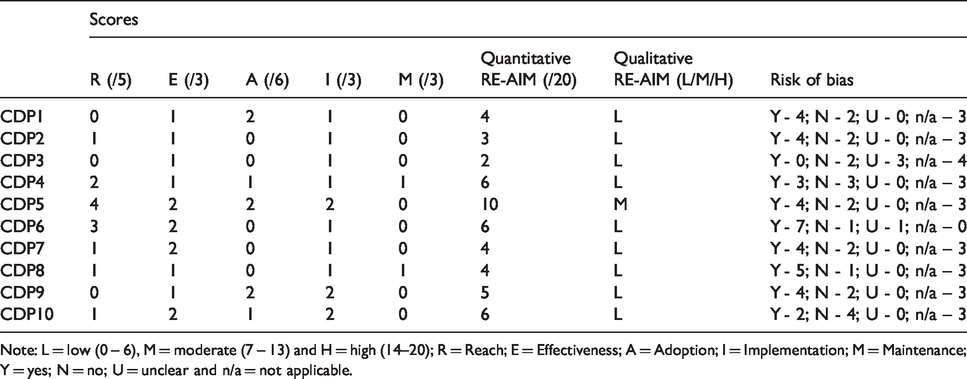
Note: L = low (0 – 6), M = moderate (7 – 13) and H = high (14–20); R = Reach; E = Effectiveness; A = Adoption; I = Implementation; M = Maintenance; Y = yes; N = no; U = unclear and n/a = not applicable.
Reach
Reach refers to the extent that participants in the intervention are representative of the group that is the target of an intervention. 41 Regarding how the target population was defined, assumptions underpinning all studies were that coaches were the target. However, no study reported on the coach population that researchers sought to represent during recruitment. By extension, there was not enough information available to consider the extent to which the study sample was representative of the broader population targeted within a study. The majority of studies described the sampling approach, with most authors employing purposive and convenience sampling strategies that are common to small, exploratory, and/or qualitative investigations of coach development. The most frequent reporting involving eligibility involved the inclusion criteria for participation, with six studies (i.e., CDPs: 1, 2, 4, 5, 6 and 8) reporting criteria that needed to be met for coach participants, such as qualifications, coaching time per week, and the level of performance for athletes. The participation rate was poorly reported as only three CDPs (i.e., CDPs: 6, 7 and 10) reported the number of participants retained or the number invited relative to those who participated.
Efficacy
The efficacy dimension evaluates the positive and negative outcomes of interventions under optimal as well as real-world conditions. 8 Researchers reported diverse approaches to measure the relative influence of intrapersonal CDP strategies on the thoughts or behaviours of coaches. These spanned qualitative interviews, focus groups, systematic observation, field notes, quantitative self-reported coach behaviour measures, and critical friend feedback from other coaches. Given the reflective goals of the CDPs, the assessment of efficacy most frequently involved in-depth qualitative approaches to understand coaches’ experiences during CDPs and their application within coaching. These included qualitative interviews (n = 9) and focus groups (n = 6), as critical friend/participant-observer feedback (n = 2), and written responses within reflective activities or journals during the CDPs (n = 6).
The majority of efficacy outcomes nevertheless focused on coach or investigator reports of shifts in coaching attitudes or behaviours. For instance, 90% of studies reported that coaches reported feeling more aware of their ability to reflect and felt that reflection held the potential to benefit their coach behaviour. However, measures of effectiveness did not extend to outcomes beyond those directly related to the coach. For instance, none of the CDPs evaluated theoretical outcomes of coach reflection such as coach adherence to reflection or athlete performance, and only two CDPs evaluated athletes’ perceptions. None of the trials integrated measures of long-term outcomes, beyond a 6-month post-intervention period.
Understanding the exploratory nature of these CDPs, it should also be noted that dropout rates were poorly reported, and unintended consequences were not reported. Nevertheless, the benefits and the barriers to the intervention were considered in five CDPs (i.e., CDPs: 1, 2, 5, 6 and 10). For instance, CDP10 reported that the authors had to divert from their original idea of asking coaches to complete reflection logs – because of noncompliance – and instead completed weekly phone interviews with coaches.
Adoption
Adoption involves understanding how a program is taken up in a particular setting. 41 This dimension was under-reported by most CDPs, meaning that it is challenging to understand the context within which the studies were conducted entirely. For instance, only four studies (i.e., CDPs: 1, 4, 9, and 10) reported on who delivered the CDP with respect to the skills or expertise of the individuals, or who the individuals were relative to the authorship team. As another example, none of the studies reported on the process of recruiting organisations from which coach participants could be identified, and the rates at which organisations adopted the CDP.
Implementation
Implementation is related to how the program is put into practice at both the individual and organisational level, and whether or not the program is implemented as intended. 41 Seven CDPs (i.e., CDPs: 1, 5, 6, 7, 8, 9 and 10) offered information regarding the duration of the CDP and duration of contacts with coaches, while three CDPs (i.e., CDPs: 5, 9 and 10) reported about the extent to which the protocol was delivered as intended. Examples of reporting on implementation involved studies that described: (a) coach adherence to the program as an indicator of whether or not the entire protocol was delivered as intended, and (b) coach attendance as an indicator of the extent to which coaches received all components of the CDP. Another example of implementation reporting refers to the costs of delivering the CDP, which is considered essential to report as a metric related to the potential for organisations to implement activities beyond the study context. Regarding this indicator, only CDP6 reported details regarding actual or plausible costs of delivering activities related to the CDP.
Maintenance
Maintenance at the individual level refers to the temporal stability of the changes produced by a specific intervention. Alternatively, at the setting level maintenance assesses if and how the program is still in place. 41 One study (i.e., CDP8) reported coach maintenance of reflective CDP strategies through interviews conducted at a follow-up after completing the intervention. In this study, coaches were interviewed 2 months after the last session in the CDP to discuss the extent to which the coaches were still employing reflective strategies. Although a similar paucity of studies reported on setting-level maintenance, two CDPs (i.e., CDPs: 1 and 4) provide examples of how maintenance within sport organisations was reported-on. In one case, the CDP was a pilot study, and the authors reported how the findings had been implemented at the instructor level by the British Horse Society Coach Education system after conducting the study. 29 In the other case, the study reported that it was a pilot program for the Australian Coaching Council, subsequently used to inform a self-reflective coach education resource. 21
Discussion
The purpose of this study was to describe the evidence base regarding nonformal intrapersonal CDPs that have been designed and studied in the academic literature. In addition to summarising general information (e.g., location, sample) related to the design and evaluation of CDPs, we also report on (a) the use of BCTs, (b) internal and external validity (via RE-AIM), and (c) risk of bias. In doing so, we provide a comprehensive account of how intrapersonal CDPs are delivered, as well as their potential for impact in the broader coaching community.
Our review revealed the relatively narrow scope of this research, totalling only 10 investigations. Most of the CDPs included in this review were evaluations of reflective activities conducted one-on-one between facilitators and coaches, often guided by frameworks related to reflective practice. Researchers had the tendency to employ small-scale pilot studies that ranged from four days to three years in duration, rarely incorporated methodological features to test the effectiveness or delivery of the CDP, and tended to under-report the BCTs that were the backbone of the intervention. This evidence base involves fewer studies—and in some cases, lower-quality studies—when compared to other recent reviews of interpersonal CDPs. 8 Nevertheless, this review identifies valuable trends in how researchers prompt reflection among sport coaches and thus advances the study of how to develop coaches’ intrapersonal skills. Our discussion focuses on (a) unpacking the direct findings from this review, and their implications for intrapersonal CDPs and coach development more generally, and (b) highlighting how the “blind spots” from this review uncover new frontiers in relation to evaluating future research assessing coach development.
Designing and implementing of intrapersonal CDPs from academic settings
Perhaps the most notable observation was that the 10 intrapersonal CDPs that we reviewed showed promise for the enhancement of coaches’ intrapersonal knowledge and behaviours. Coaches who took part in the CDPs reported developing self-awareness, an awareness of players’ feelings and concerns, and an understanding of how to improve their coaching practices through reflection. For instance, CDP1 and CDP7 used video and journals to increase behaviours that were identified by each coach to enhance his or her coaching effectiveness. In particular, video feedback gave structure to reflective conversations that improved self-awareness and provided a trigger for behaviour change. Many of the coaches who participated in these CDPs were satisfied with their participation. CDP10 also reported that several coaches who at first had been doubtful, in the end, concluded that the reflection activities had been valuable. As one coach stated: “I mean. I had been working against myself in a way… That was kind of a punch in the kidney. It was really something that required some deep thoughts” (p. 7).
Nonetheless, the findings of these studies must also be considered in relation to methodological rigour and the strength of available evidence. Consistent with Walker and colleagues’ 4 systematic review of informal and nonformal learning for sport coaches, the vast majority of CDPs included in this review involved observational descriptive designs. For example, qualitative methods were most frequently used in these CDPs. Qualitative designs fit within the time period of coaching research (i.e., calls for more qualitative research on coach learning throughout the 2000s), 4 but were also described as being ideal for understanding coaches’ attitudes and strategies related to the reflection activities they were engaged in. Correspondingly, nearly all of the CDPs included in this review used non-random sampling methods. Purposive sampling—commonly used in qualitative research to identify and select information-rich cases regarding the phenomenon of interest51—was most frequently employed. While qualitative methods allowed valuable in-depth explorations of coaches’ thoughts and experiences as they related to reflective practice, none of the CDPs reported quantifiable changes in coach behaviour or the effects of reflective practice on athlete outcomes. Moving forward, qualitative descriptions of intrapersonal CDPs and coaches’ experiences participating in these CDPs should be complemented with comprehensive evaluations of coach behaviour and related outcomes with larger sample sizes to provide an indication of whether or not the CDP does, in fact, change coach behaviour.
With respect to changing behaviour, BCTs reflect the building blocks of interventions and are important to recognise as a means of understanding why or how an activity might change coach behaviour. Among the BCTs identified across the investigations, self-monitoring of the behaviour was most frequently reported — an unsurprising finding considering the necessity for introspection and self-awareness involved with reflective practice. For example, the CDPs included this review frequently relied on reflective conversations and reflective journals as tools to promote self-reflection, and thus, professional growth.24,25 Perhaps it is the reflective focus that defines these interventions that produced the higher focus on self-monitoring when compared to a recent review of BCTs in interpersonal CDPs. 40 Although self-monitoring of the behaviour was the most commonly used BCT, each reflective tool had the potential to invoke several BCTs, including: self-monitoring of outcome(s) of behaviour, social support, instruction on how to perform the behaviour, demonstration of the behaviour, habit formation, and behavioural practice/rehearsal. These findings are more consistently aligned with the aforementioned investigation of interpersonal CDPs. 40 Furthermore, both studies found under-reporting of the specific BCTs, which seems to suggest that the use of BCTs were a by-product of the intervention design.
While the more explicit and systematic use of BCTs may optimise changes observed in CDPs, researchers also need to develop interventions that can be widely adopted, implemented, and maintained. The present review offers an essential starting-point in the translation of sports coaching research to practice by analysing how intrapersonal CDPs reported on each dimension of the RE-AIM framework. 41 Similar to previous research in sport,8,52 studies in our review rarely reported elements within the dimensions of maintenance, adoption, and reach. Indicators of efficacy and implementation were more commonly reported, although RE-AIM dimensions were poorly reported overall. In fact, only CDP4 reported on all five RE-AIM dimensions. This pattern of reporting is not surprising when considering that most studies were preliminary and focused on how coaches evaluated the CDP strategies and their usefulness in real-world coaching contexts. Indeed, this pattern of reporting is evident in many nascent areas of study regarding novel interventions. 53 Nevertheless, the breadth of CDPs within community sport systems means that coach developers are already likely using strategies to shape intrapersonal skills — and researchers should be considering the potential for their efforts to contribute to these real-life contexts.
New frontiers in interventions related to intrapersonal coaching skills
Our observations within this review highlighted proverbial blind spots, which we anticipate researchers may lean toward to advance the scope of research involving intrapersonal development of coaches. We specifically focus on: (a) frameworks that guide the reflective approach, (b) integration with other domains of coach knowledge, and (c) implementing intrapersonal CDPs in formal and informal settings.
Framework to understand the nature of “intrapersonal knowledge”
First, recall that reflective practice was the prevailing lens through which researchers changed coach behaviour. Reflection is indeed a powerful tool advocated for by coach educators around the world, 5 with many reflective strategies and concepts being commonplace in contemporary coaching discourse. 54 For instance, concepts and strategies like role frames (i.e., idiosyncratic theories of practices coaches use to guide action) and reflective conversation (i.e., iterative process of generating and experimenting with coaching strategies) seem increasingly evident in the realm of coach development. 55 Indeed, it is important to understand the distinction between reflective practice and critical reflection. Reflective practice is a “step back after an event to evaluate what happened and will determine how best to proceed” (p.15). 51 In contrast, critical reflection is a process whereby investigators have to push the matter further and induce coaches to delve deeper and question their thought-process. 56 Thus, although we expect that intrapersonal knowledge is incorporated into CDPs with some degree of intentionality, it is presumably less common for varying CDPs to adopt the reflective strategies that were at the heart of the studies reported on in this review.
Nevertheless, it is important to note that intrapersonal development extends beyond the scope of reflective practice (e.g., introspection 11 ). Emotional regulation57–59 is one example of a topic that seems critical to integrate within coach development. Of note, empirical evidence is accruing regarding the degree to which coaches must engage in efforts to manage their own emotions, and how coaches come to influence experiences of athletes and others in their organisations through their emotional displays. As such, we call for coaches interested in this domain to consider how numerous theoretical frameworks and coach development strategies might relate to intrapersonal development.
Integration with other domains of coach knowledge
Second, it is essential to note that this review focused on the application of CDPs designed for promoting intrapersonal knowledge in isolation. However, intrapersonal knowledge can also be used in tandem with other types of coach development. For instance, interventions designed to shift the leadership approach of coaches might involve education about how coaches can self-evaluate their own leadership approach and relationships with athletes. This begs the question: Should intrapersonal skills be developed in isolation, or instead be integrated with the broader spectrum of skills required of coaches?
Although it seems that intrapersonal approaches are readily applied within formal training pathways in ‘practice,’ we are nevertheless unaware of published CDPs that explicitly merge critical reflection that is promoted in the CDPs from this review within other types of coach development. However, we anticipate that intrapersonal skills are particularly amenable to integration within other types of coach development related to professional and interpersonal domains. Perhaps the way forward is to develop CDPs that integrate self-reflection strategies and related BCTs (i.e., self-monitoring) to help advance their ability to learn and apply other knowledge.
Delivery through formal and informal contexts
Third, and closely related to the point above, is an observation that intrapersonal components are likely integrated into formal and informal contexts. Notably, when Ciampolini et al. 60 analysed scientific studies published between 2009 and 2015 to identify the teaching strategies adopted in small-scale, large-scale, and university-based coach education programs, the authors found a common intention to engage coaches in group discussions and reflection. This highlights the importance of intrapersonal knowledge in broader learning contexts, particularly in relation to learner-centred approaches. 60
Indeed, the current review highlighted the value of some BCTs like self-monitoring to be integrated within formal and informal coach development pathways. However, the broader nature of reflection within formal and informal coaching feel beyond the scope of this review – and presumably has yet to be comprehensively targeted by coaching researchers. Gilbert and Trudel 61 notably observed that there is limited empirical evidence regarding how intrapersonal components are integrated in coach education, and the efficacy of these strategies for prompting coach reflection. This issue is of particular note in relation to coaching communities of practice, which have typically been studied using observational or qualitative approaches. Coaching researchers may consider evaluating process of implementing communities of practice as an intervention within sporting organisations, by tracking aspects such as the extent to which coaches adopt communities of practice, the reach of communities of practice (i.e., do all coaches engage within them), and how well they are maintained over time.
Limitations and future directions
The findings of this review are based on a small number of studies (n = 10) that focus primarily on the youth sport context. As such, researchers must apply caution when analysing the current findings. In addition, limited details regarding how information was reported in the included CDPs was a concern throughout the review. While it is possible that some authors collected the relevant information, we could not evaluate information that was not included in the published study. This finding — in addition to the small sample sizes and heterogeneity regarding the measures used within studies from this review — meant that we could not produce an aggregated estimate of intrapersonal CDP efficacy.
Reporting was a particular concern in relation to RE-AIM coding. Our review reinforces the call for more consistent reporting8,46,52 across the RE-AIM indicators. It would be beneficial if future CDP research explicitly reported on aspects such as: target population, associated costs, feasibility, and unintended consequences or results. Regarding the translation into practice of future CDPs or any interventional studies, research should shift from the historical focus on efficacy and progress to a balanced way to design and evaluate interventions through an internal and external validity inclusion. 41 Research translation would also be pushed-forward by the integration of representatives from key stakeholder groups within collective procedures to develop and evaluate CDPs in real-life contexts. 62 This means that researchers should integrate coaches, coach developers, and athletes in the process of developing new CDPs.
Conclusion
Intrapersonal skills and knowledge related to self-awareness and reflection are core competencies in the process of becoming a successful sports coach. In this review, we synthesised the findings of 10 CDPs to shape intrapersonal knowledge in sports coaching, most of which leveraged tools related to personal reflection and reflective practice. This review also applied the RE-AIM framework and BCT taxonomy as a critical step in ensuring that researchers design and report intrapersonal CDPs in ways that are suited to advance our literature and build from previous research. In addition to substantive findings from this review about how previous studies were designed and reported, we anticipate that the future of intrapersonal CDPs might involve their sole use to promote reflective coaching skills alongside concurrent use within CDPs to develop other coach competencies (e.g., leadership style, injury prevention).
Footnotes
Declaration of conflicting interests
The author(s) declared no potential conflicts of interest with respect to the research, authorship, and/or publication of this article.
Funding
The author(s) received no financial support for the research, authorship, and/or publication of this study.
