



Abstract
Limited evidence exists demonstrating reliability of using direct measures to quantify punching velocity. The aim of this study was to establish the intra- and inter-day reliability of a linear positional transducer (GymAware) and accelerometer (PUSH Band 2.0) for the quantification of peak punching velocity in trained junior boxing athletes. Eighteen males aged 16.7 years (±1.2) with at least two years of boxing experience participated in the study. On two separate days, participants performed five dominant-hand crosses with maximal effort. Ordinary least-products regression analysis was used to compare mean and maximum peak velocity scores between devices within each day of testing. Two-way mixed intraclass correlation coefficients (ICC3,1) and Pearson’s r with 95% confidence intervals (95%CI) were also used to compare mean and maximum peak velocity within devices across days. Maximum peak (∼7.5 ms vs. ∼6.2 ms) and mean peak (∼7.0 ms vs. 5.4 ms) velocity was higher when measured via GymAware compared to PUSH Band 2.0 on both days (all P ≤ 0.012). The within-device mean (ICC3,1 = 0.871, 95%CI = 0.689, 0.950) and maximum (ICC3,1 = 0.853 95%CI = 0.650, 0.942) peak velocity scores for the GymAware across Days 1 and 2 demonstrated very high reliabilities. Mean (ICC3,1 = 0.309, 95%CI = –0.170, 0.670) and maximum (ICC3,1 = 0.227, 95%CI = –0.173, 0.637) peak velocity for PUSH Band 2.0 demonstrated weak reliabilities. Proportional bias was found for Day 2 mean and maximum peak velocity and when both days were pooled. Fixed bias was observed for mean (Day 1) and maximum peak velocity when both days were pooled. These results may provide useful information for professionals working with boxing or combat-sport athletes.
Keywords
Introduction
Boxing is a combat sport, with the aim of scoring points by using a series of punching techniques to strike an opponent. After a match has ended (if a knock-out is not achieved), both the quality and the quantity of strikes ultimately determined the victor.1–4 As such, a means of objectively measuring punch quality may provide valuable information for both coaches and athletes during training, competition preparation, and to monitor changes in punch ability over time. In particular, peak punch velocity and power can influence the quality of a punch, and ultimately the impact force applied to an opponent. 1 Therefore, punching velocity (a contributing factor to overall power) is of considerable importance, 2 and may be a key determinant of successful outcomes in both amateur and elite boxing competitors.3,4 For example, Smith et al. 5 demonstrated that peak punching power was greatest in elite compared to both intermediate and novice boxers. Indeed, as demonstrated by Pierce et al., 6 professional boxers who achieved higher cumulative power (e.g., volume of punches × the force of each punch), and executed a greater number of punches, won by unanimous decision regardless of the weight category. Based on these findings, punching velocity may serve as an informative measure due to its relationship to punching power 2 and its importance as an offensive action, or to break through opponent defenses. 7
In sport and human performance settings, kinematic data, including velocity, can be obtained via wearable technologies, such as inertial measurement units. A commercially available, inexpensive and user-friendly inertial measurement device is the accelerometer, which has recently gained popularity for measuring a variety of linear and angular spatio-temporal dynamics across weightlifting, kicking, cycling and throwing sports. 8 However, several accelerometers have demonstrated a poor ability to accurately measure linear kinematics during various tasks including powerlifting, 9 resistance exercises (e.g., bench press, squat and deadlift) 10 and athletic movements (e.g., vertical jump) 11 when compared with linear position transducers (LPTs). Therefore, a more plausible means for measuring linear kinematic data might be via LPTs, which use a tethered cord to measure two variables; displacement and time.12–15 In contrast to many wearable accelerometers, LPTs have shown a high degree of reliability in the measurement of vertical kinematics in resistance training,12,13 athletic movements13,14 and also in the horizontal plane. 15 However, evidence from combat-sports (e.g. punching movements) appears limited.
In boxing specifically, limited studies have investigated the contributing kinematic factors of punching quality. In particular, only a handful of studies have assessed peak and mean power in adult amateur1,16 and elite boxers, 3 and a paucity of evidence exists regarding peak punching velocity.17–19 For example, Whiting et al. 19 used video recording to assess punch characteristics in experienced boxers, and a similar approach was adopted by Wailiko et al. 17 to determine punch velocity of Olympic boxers. However, video recordings can often be time consuming and impractical in an applied setting. Alternatively, Lambert et al. 18 compared the reliabilities of a LPT (i.e., GymAware) and an accelerometer (i.e., Crossbow) during a straight-punch. The authors reported excellent reliability scores for both the LPT and accelerometer for peak punching velocity and acceleration (intraclass correlation coefficient [ICC] = 0.922–0.981), with an acceptable coefficient of variation (CV) of between 6.5–12.9%. Additionally, Lambert et al. 18 reported that the GymAware LPT demonstrated moderate-to-strong concurrent validity to assess straight punch kinematics in inexperienced participants. In this instance, the cohort consisted of healthy adults with no previous boxing experience, and in particular, evidence suggests that there are notable differences in punching kinematics between experienced boxers and untrained punchers. 3 Thus, although the within-device reliability reported in untrained adult populations are promising, several biomechanical and strength differences between trained boxing athletes and untrained individuals3,20 warrants further investigation. Moreover, limited data exists in youth athletes using such methods, which may well be affected by varying biomotor qualities. 21
Given the contribution of velocity to punch quality, and due to the limited kinematic data available regarding punching performance in boxing altogether, efficacious and practical methods to measure punch velocity are warranted in well trained boxers; especially for youth boxing athletes. Therefore, the primary aim of this study is to investigate the reliability of two commercial devices (GymAware and PUSH Band 2.0) on measures of peak velocity for crosses in trained, youth boxing athletes. We also aimed to explore potential differences and bias between devices when measuring punch velocity. Based on previous research in other athletic movements,12–15 we firstly hypothesize that the GymAware will demonstrate acceptable reliability for mean peak (averaged across five trials) and maximum peak (highest recorded) punching velocity. Secondly, we hypothesise that the accelerometer will show poorer reliability within testing days when compared to the GymAware.
Methods
Participants
Eighteen healthy, trained junior male boxing athletes, who competed at national and international level, volunteered to participate in this study. The mean and standard deviation (±SD) for age, body mass and height of the athletes was 16.7 years (±1.2), 57.9 kg (±9.2) and 171.8 cm (±8.1), respectively. All participants had been involved in full-time boxing training and strength and conditioning training for at least 2 years, training approximately 18 hours/week (discounting any off-site training camps or competitions). All participants were free from injury and permitted to partake in all training activities during the data collection period. Prior to participation, each participant or parent/guardian provided written informed consent. All testing was conducted at the Inspire Institute of Sport, India, in accordance with Edith Cowan University Human Research Ethics Committee (ethics approval number: 21747).
Procedures
The participants were divided into two separate testing groups, which was dependent on their respective training schedules and availability. All testing was conducted within the Exercise Physiology Laboratory at the Inspire Institute of Sport, Bellary, India on three separate days (familiarisation, and testing Day 1 and Day 2). An illustration of the data collection set-up is displayed in Figure 1.
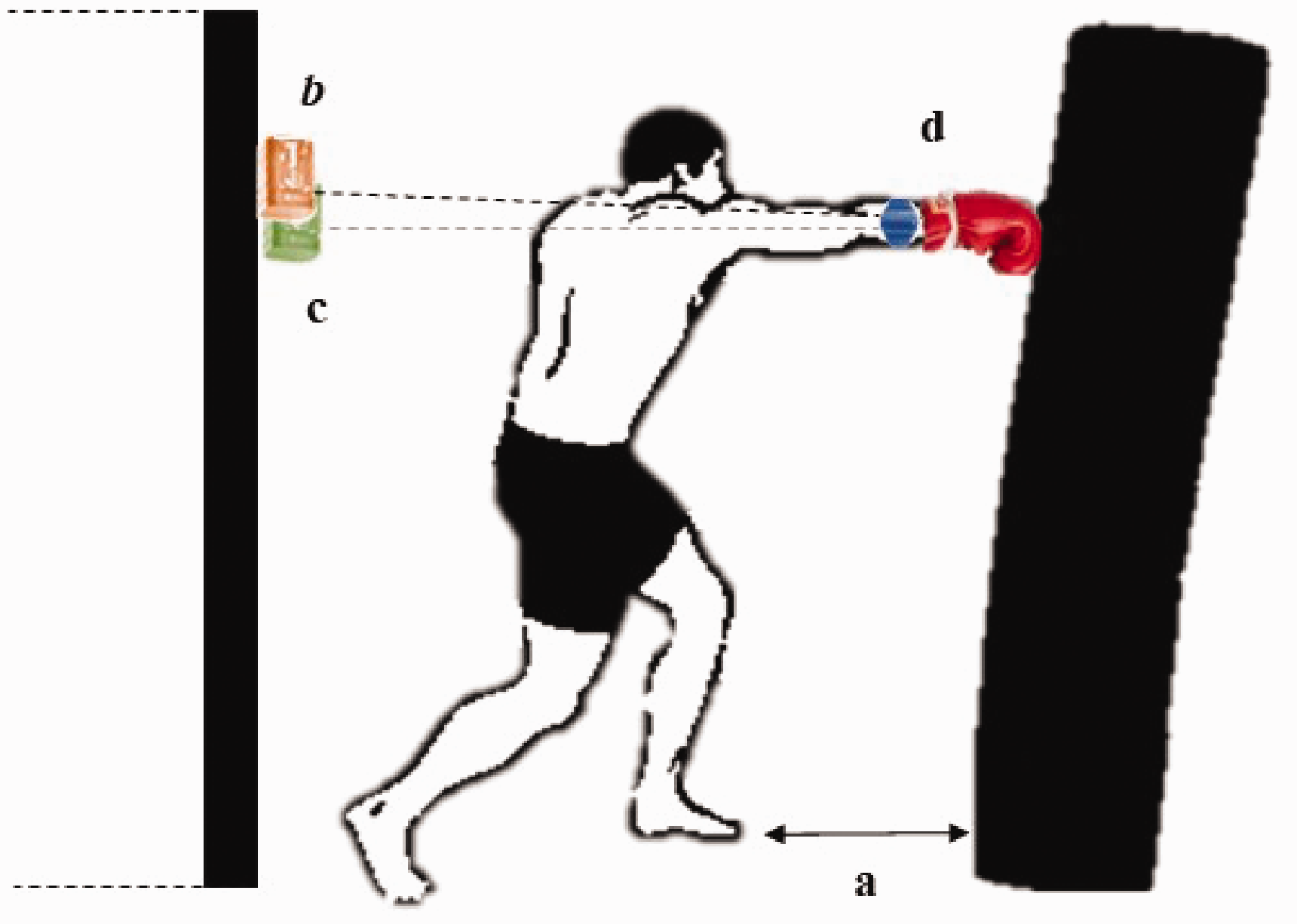
Data collection set-up. (a) indicates the distance (individualised for each participant) of the front foot to the base of the punching bag. (b) indicates a proposed height for the GymAware device in a previous boxing reliability study. 18 (c) indicates a newly proposed height of the GymAware device used in the current study. (d) indicates the placement of the PUSH Band 2.0 device.
First, a familiarisation session was conducted one-week prior to the first testing session (i.e. Day 1), which outlined the testing procedures and specific punching techniques to all of the participants. A strict straight punch using the rear, dominant hand (i.e., cross) was used to collect all measures. Participants were asked to perform twenty crosses as part of the familiarisation session, during which time the distance of the front foot to the punching bag was recorded for each participant. The distance of the front foot to the punching bag was determined by asking each participant to stand (in a fighting stance) at approximately ‘one-arm’s length’ from the punching bag, to allow for full elbow extension during a cross and adjusted accordingly as required.
Punch velocity was recorded using two devices; GymAware (GymAware, Kinetic Performance Technology, Canberra, Australia) and the PUSH Band 2.0 (Push Inc., Toronto, ON, Canada) simultaneously. Both devices recorded at a sampling frequency of 200 Hz, with the GymAware sampling and time-stamping displacement data at 20 millisecond time points, which is then down-sampled to 50 Hz for analysis. The PUSH Band 2.0 device was fixed to the distal wrist of the punching arm and secured in position under the boxing glove strap. The GymAware was fixed to an upright, immovable metal surface, with the tethered cord and Velcro strap placed around the metacarpophalangeal joints of the punching hand. The relative height of the GymAware (e.g., the bottom of the device aligned with the top of the shoulder of the punching arm) has been previously proposed. 18 However, during initial pilot testing, this height was deemed unfavourable due to the tethered cord being unwound at a decline from the upright support surface to the hand (Figure 1(b)). Therefore, the height of the device was adjusted so that the tethered cord was parallel to the ground upon completion of each punch as determined during familiarisation (Figure 1(c)), which corresponded to the bottom of the device being in-line with the deltoid tuberosity (i.e., upper 1/3 of the humerus) of the punching arm. The positions of each device were recorded for each individual and the same placements and positions were used for each device on both testing days. The data from the GymAware was sent via Bluetooth to a standard proprietary product software application, which was downloaded onto an iPad. The PUSH Band 2.0 was Bluetooth connected to an iPhone PUSH application (v.1.10.4) to record the data. The GymAware mode was set to ‘Torso Twist’ and the PUSH Band 2.0 mode was set to ‘Free Motion Capture’ for all testing measures.
After a seven-day interval period, all participants reported back to the laboratory for the first testing session (Day 1). During the interval period between testing Day 1 and Day 2, all participants continued with their standard boxing and physical training as per their usual weekly training routines, and all testing was performed around these training routines so as not to disturb each athlete’s physical and tactical regime. The seven-day interval period also allowed athletes to be tested at the same time-point of their weekly schedule, which controlled for potential confounders such as fatigue level and recovery time. During the testing sessions, each participant performed a standardised warm-up consisting of 20 shadow boxing punches of both hands, followed by five sub-maximal punches of their dominant hand on the punching bag at approximately 70% of their max punching velocity. All participants were then fitted with the GymAware and PUSH Band 2.0 devices, repositioned according to their familiarisation set-up specifications, and asked to deliver five maximal effort punches, each separated by 30 seconds.
Statistical analysis
Data from the PUSH Band 2.0 were filtered using a fourth-order, zero-lag, Butterworth low-pass filter with a 12 Hz cut-off frequency.
22
The GymAware uses an adaptive sampling rate and filters the output to remove noise, and so additional filters were not used.14,18 Mean peak (across five trials) and maximum peak (highest recorded) punching velocity from both the GymAware and PUSH Band 2.0 were recorded and exported into an excel spreadsheet (Microsoft Excel version 2016, Microsoft Corporation, Redmond, WA, USA). All data were then transfigured and imported into a statistical program IBM SPSS (version 25; SPSS Inc., Chicago, IL, USA) for further analysis. Within device (inter-day) test-retest reliability was established using two-way mixed intraclass correlation coefficients (ICC3,1), with 95% upper- and lower-bound confidence intervals (95% CI). The strength of the ICCs were set by using the guidelines provided by Koo et al.
23
(i.e., below 0.50 = poor, between 0.50−0.75 = moderate, between 0.75−0.90 = good, above 0.90 = excellent). Pooled mean peak velocity scores and pooled maximum peak velocity scores (combining scores for Days 1 and 2) were then tested for between-device (inter-unit) reliability using Pearson’s r correlation with upper- and lower-bound 95% CIs. The strength of the Pearson’s r correlations were set by using the guidelines provided by Schober et al.
24
(i.e., 0.00–0.10 = negligible, 0.1–0.39 = weak, 0.40–0.69 = moderate, 0.70–0.89 = strong, and 0.90–1.0 = very strong). Additionally, validity was also assessed using an ordinary least products (Model II) regression analysis. This test was chosen as it considers potential measurement error of both devices.25,26 Similar to other studies,11,27 the degree of fixed bias was determined using the 95%CI of the y-intercept and deemed not to exist if 0 was included in this value. Proportional bias was also determined from the 95%CI of the slope. If the 95%CI included the value 1, it was deemed that no proportional bias existed. To comply with standard reliability assessment practices,
23
the within-day and between-days coefficient of variance (CV), standard error of mean (SEM) scores and p-values were also reported. All data was checked for normality assumption using Shapiro-Wilk test and was classified as normal, and independent t-tests were used to compare the maximum and mean peak velocity scores of the same device across days, and between devices on the same day. Standard errors of measurement and minimal detectable change (MDC) scores were calculated for Day 1 GymAware and PUSH band 2.0 mean and maximum peak velocity scores. Standard errors of measurements were calculated using the following equation:
Results
All velocity values (means and standard deviations [SD]) and results on independent t-tests, including effects sizes for both devices across Days 1 and 2, as well as the MDC90 scores are presented in Tables 1 and 2. In addition, box and whisker plots representing the mean, median and interquartile ranges for each day and for each device are presented in Figure 2(a) and (b).
Values presented for the mean peak velocity scores for the GymAware (GA) and PUSH Band 2.0 (PUSH) across Day 1 and Day 2.

Note: All values presented as mean ± standard deviation (SD).
SE: standard error; 95% CI: confidence interval; CV: coefficient of variation; ICC: intraclass correlation coefficient.
Values presented for the maximum peak velocity scores for the GymAware (GA) and PUSH Band 2.0 (PUSH) across Day 1 and Day 2.

Note: All values presented as mean ± standard deviation (SD).
SE: standard error; 95% CI: confidence interval; CV: coefficient of variation; ICC: intraclass correlation coefficient.
Figure 2. Maximum peak punching velocity (a) and mean peak punching velocity (b) across day 1 and day 2, between the GymAware (GA) and PUSH Band 2.0 devices (PUSH). The box and whisker plots represent lower and upper interquartile range, while the blue and black horizontal lines indicate the mean and median values, respectively. *denotes significant difference (p < 0.05) between devices; #denotes significant difference between days for the PUSH band 2.0 device.
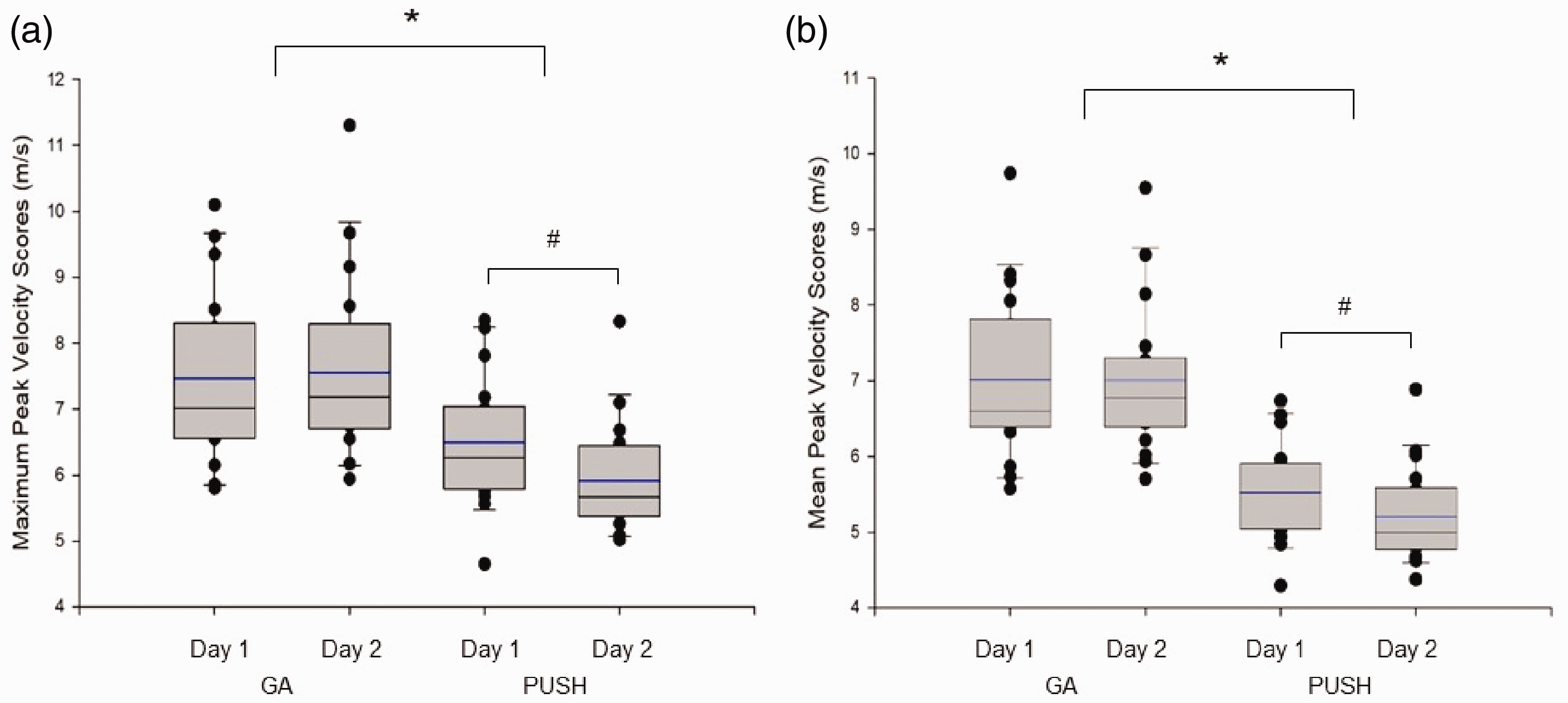
The within-device mean peak (ICC3,1 = 0.871, 95% CI = 0.689, 0.950, g = 0.01, p = 0.49) and maximum peak (ICC3,1 = 0.853, 95% CI = 0.650, 0.942, g = 0.06, p = 0.43) velocity scores for the GymAware across Days 1 and 2 demonstrated good reliability, respectively. The within-device mean peak (ICC3,1 = 0.309, 95% CI = −0.170, 0.670, g = 0.49, p = 0.07) and maximum peak (ICC3,1 = 0.227, 95% CI = −0.173, 0.637, g = 0.63, p = 0.03) velocity scores for the PUSH Band 2.0 across Day 1 and Day 2 demonstrated poor reliabilities, respectively. For Day 1, the MDC90 for mean peak velocity for the GymAware was 0.91 m/s (13%) and 1.24 m/s (22%) for the PUSH band 2.0. The MDC90 for maximum peak velocity was 1.15 m/s (15%) and 1.97 m/s (30%) for the GymAware and PUSH band 2.0 devices, respectively. All of the velocity measures for Day 2 were under the MDC90 thresholds, indicating stability in the measures across timepoints.
The within-participant mean peak velocity CV’s were 4.21% for the GA, and 7.44% for the PUSH Band 2.0, which is considered acceptable for both devices. 29 Pooled results for Days 1 and 2 to determine the between-device reliability scores showed a weak correlation for maximum peak velocity (r = 0.325, 95% CI = −0.003, 0.591, g = 1.15, p = 0.05) and a moderate correlation for mean peak velocity (r = 0.540, 95% CI = 0.257, 0.737, g = 1.93, p = <0.001) (refer to Tables 1 and 2). Results of the ordinary least-products regression analysis for mean and maximum peak velocity for both devices on each separate day, and for both days combined, are shown in Figure 3. Proportional bias was found for Day 2 mean and maximum peak velocity and when both Day 1 and Day 2 scores were pooled. Fixed bias was observed for mean (Day 1) and maximum peak velocity when both days were pooled (refer to Figure 3(a) to (f) for 95% CIs of slopes and y-intercepts).

Displays results of least products regression analysis for mean peak velocity for (a) Day 1, (b) Day 2, (c) both days pooled, and maximum peak velocity for (d) Day 1, (e) Day 2, and (f) both days pooled. Bolded values indicate bias.
Discussion
Punching velocity is an important physical quality in boxing. Among others, peak punch velocity has been suggested to be a predictor of successful outcomes in both elite and sub-elite boxers.6,16,18 However, evidence supporting the use of commercial devices to measure punching velocity, such as LPTs and wearable accelerometers, remains scarce. To the authors knowledge, only one study currently exists examining the reliability of an LPT and accelerometer combination for measuring punching velocity. 18 Therefore, we investigated the reliability of two common devices; the GymAware LPT and the PUSH Band 2.0 accelerometer to measure peak punch velocity in youth boxing athletes. The GymAware demonstrated ‘good’ reliability for mean and maximum peak velocity within and between days. However, mean and maximum peak velocity recorded from PUSH Band 2.0 demonstrated ‘poor’ reliability. Weak correlations were found between devices for mean and maximum peak velocity. As such, the results suggest that the GymAware offers potential to reliably measure the velocity of crosses in youth boxing athletes. Collectively, the initial findings of this study may be of use to strength and conditioning professionals working with boxing athletes who are interested in monitoring punch kinematics using portable and relatively inexpensive equipment. Although beyond the scope of this study, further research is required to determine the validity of each device in punching movements in order to determine whether such devices are sensitive to fatigue-related changes, training adaptations and differences in punch performance between boxing athletes of various ages and experience levels.
The reliability results of the GymAware in the current study are similar to that of Lambert et al., 18 however, our accelerometer results are rather contradictory to the authors findings. Firstly, we observed far lower within- and between-day reliability scores for the PUSH Band 2.0 when compared to the Crossbow accelerometer scores obtained in Lambert et al. 18 In fact, Lambert et al. 18 reported good levels of reliability for peak velocity during maximum intent punches for both the Crossbow and GymAware devices (ICC = 0.922–0.981), respectively Two prominent differences though exist between our study and that of Lambert et al., 18 which may require consideration. Firstly, our population were junior boxing athletes with considerable boxing experience, many of whom had competed in both domestic and international competitions, and in contrast, Lambert et al. 18 recruited untrained adults. Secondly, Lambert et al. 18 used a single session design, which does not account for differences between days. As such, we suggest that comparative results between the studies should be taken in context. On its own, our study has provided initial evidence that the GymAware may be more reliable device when measuring mean and maximum peak punching velocity compared to the PUSH Band 2.0.
Ordinary least-products regression analysis determined whether fixed or proportional biases existed between devices. Proportional bias was observed on Day 2 (mean and maximum peak velocity), and when both Day 1 and Day 2 scores were pooled (refer to Figure 3). Although the reasons for the bias observed on Day 2, as compared to Day 1, is somewhat unclear, there are several factors that may contribute, at least in part, to this result. For example, markedly different velocity scores were noted for the PUSH Band 2.0 across days, with values being lower on Day 2 for mean peak (-5.8% change from Day 1, p = 0.07) and maximum peak velocity (-8.9% change from Day 1, p = 0.03). Conversely, values remained stable for the GymAware. Additionally, while we cannot rule out subject variability between days entirely, the similarity of GymAware scores on Day 1 and Day 2 do not corroborate this hypothesis. Furthermore, a smaller MDC90 indicates a more sensitive measure,30,31 and our results show that the GymAware (for both mean and maximum peak velocity) had smaller Standard Error and MDC90 scores compared to the PUSH Band 2.0, indicating that the GymAware is more sensitive at detecting real change. Nevertheless, given the change in mean and maximum peak velocity scores for Day 2 compared to Day 1 for both devices did not meet the MDC90 thresholds, it is unlikely that the change in scores are related to subject variability and are more likely due to device biases. Akin to our findings, other studies have noted comparable proportional bias for the PUSH Band 2.0. In these studies, velocity scores were overestimated (opposite to the current observation), compared to three-dimensional motion capture during the bench press 27 and vertical jump. 11 Fixed bias was also observed for Day 1 mean peak velocity, and maximum peak velocity when both days were pooled. Once again, these results displayed inconsistency. Correlation coefficient values were also calculated. These values were r = 0.540, p = 0.0007 for mean, and r = 0.325, p = 0.05 for maximum peak velocity between the PUSH Band 2.0 and the GymAware, respectively. Although the latter is considerably lower than the maximum velocity correlation coefficient (r = 0.781, p = 0.001) reported between the Crossbow and the GymAware device in Lambert et al., 18 it is important to remember that this coefficient does not account for potential error existent within both devices. Thus, given the inconsistency of the findings we recommend that these results be interpreted with caution. Future research should consequently look to expand upon these results and use similar statistical approaches to account for device error and establish if the PUSH Band 2.0 and GymAware are valid when compared with either three-dimension motion capture11,27 or optic laser. 32
The present study reported high reliability scores obtained for the GymAware, but the maximum peak velocity scores observed are disparate to other studies. For example, our results are noticeably higher (7.46 m/s ± 1.28) compared to Lambert et al. 18 (6.54 m/s ± 1.16). However, the maximum peak velocity scores observed for the PUSH Band 2.0 (6.49 m/s ± 0.96) are comparable to the Crossbow maximum velocity scores reported in Lambert et al. 18 (6.67 m/s ± 1.13). Additionally, our maximum peak velocity results (for both devices) are considerably lower when compared to the maximum velocity results reported by Whiting et al. 19 in experienced adult males boxers. The disparities in results between our study, and that of Lambert et al., 18 and Whiting et al., 19 may be due to heterogeneity of the studies; particularly, the different punch techniques used (e.g., jab versus cross), age or experience level of participants, or differences in data collection methods between studies. Specifically, Whiting et al. 19 recruited four boxing-trained adults (aged 24.2 ± 4.2 yrs) who performed jabs, while Lambert et al. 18 recruited 44 untrained adults (aged 22.2 ± 2.9 yrs) who performed crosses, with the latter being the same punch technique in our study. Dunn et al. 4 recently demonstrated differences in variability between punch techniques, with ‘jabs’ demonstrating the highest variability (CVs of 4.4%‐13.6%) compared to ‘crosses’ which demonstrated the lowest variability (CVs of 2.0%‐6.8%). Indeed, we found acceptable within-participant CV percentage scores for mean peak velocity for the PUSH Band 2.0 (7.44%) and for the GymAware (4.21%), respectively. It was proposed that, due to jabs being used as a tactical punch to set-up a power punch (i.e., cross or bent arm punch), individuals may subconsciously use jabs as a preparatory technique, which may increase the performance variability of the technique. An early case-study in a professional heavyweight boxer 33 reported an observationally greater impact velocity of 8.9 m/s, compared to our results. Even greater punch velocities have also been reported in other types of combat sports during striking maneuvers. In particular, Smith and Hamill 34 reported punch velocities (using boxing gloves) of approximately 11.5 m/s for fifteen adult karate athletes. Thus, although it is difficult to make direct comparisons to other studies due to methodological differences, collectively our maximum peak velocity results, at the very least, suggest that they were in a range lower than previous reports in elite adult combat sport competitors. This is not unexpected, given that youth individuals show decreased intra-muscular synchronization, decreased relative muscle size, decreased power during short-range contractions, and decreased type II motor unit activation compared to adults. 35 As such, and with the paucity of evidence in youth boxing athletes, our results provide initial evidence of a punching velocity range that may be expected for elite junior boxers. We suggest that future studies should concurrently investigate the use of portable commercial devices with other validated techniques in order to provide more specific and accurate information regarding overall punch characteristics for both elite and amateur boxing athletes.
Other factors may require consideration when interpreting the velocity and reliability results between studies. For example, we tested inter-day reliability, compared to the single-session design by Lambert et al. 18 As such, given the large differences observed between and within devices in both the present study and that of Lambert et al., 18 we recommend that further research should be conducted using multiple devices across two time-points, preferably separate days, to establish between-day reliability. However, we acknowledge that this approach may also be subject to factors that are related to the athlete, rather than inconsistencies with the device. This observation was noted for the PUSH Band 2.0 (e.g. maximum velocity decreased on Day 2), but was not observed with the GymAware, rendering this supposition difficult. Another possible, albeit unlikely, factor is that the GymAware measured from a static position (fixed and mounted to a pole), while the PUSH Band 2.0 (attached to the open end of the chain; wrist) may have been sensitive to small movements or changes in technique about the forearm and wrist. It is also difficult to know if the starting position of the GymAware, in relation to the shoulder joint, significantly contributed to the differences in velocity scores observed between our study and that of Lambert et al. 18 In the previous study the device was secured above the participants punching shoulder, 18 which created a downward gradient of the tether, and appeared to impact the consistency of the data obtained during our own pilot testing. Thus, we adjusted the position so that the tether was parallel to the ground.
With respect to the hardware used, we are uncertain if the sampling frequency of the PUSH Band 2.0 (200 Hz) or the GymAware (200 Hz, down sampled to 50 Hz) are adequate to accurately measure punch velocity. Lambert et al. 18 used the Crossbow, which is an industrial accelerometer that samples at 1000 Hz. However, in other research investigating athletic movements using force plates, sampling frequencies below this range (25-100Hz) are deemed adequate and reliable to measure resistance-based exercises. 36 Despite this, Hori et al. 37 recommend that a minimum sampling frequency of 200 Hz be used for velocity measures (countermovement jump task), which is the sampling frequency of the PUSH Band 2.0 and GymAware devices. Though, a noticeable difference is the duration of a typical countermovement jump task for athletic males (∼500ms), 38 as compared to an experienced boxer’s punch (∼139ms). 19 Assuming these values are similar in the current study, and by using the total punch time reported by Whiting et al., 19 this would result in approximately 27.8 sample points being recorded for each individual punch from both the GymAware and PUSH Band 2.0. Thus, it is somewhat unclear whether the devices used in this study are optimal for capturing high-speed movement, warranting further comparative research with devices that sample at higher or lower frequencies.
From a practical standpoint, and in order to provide transparent information for professionals aiming to conduct similar data collection and testing, we acknowledge several issues encountered. Initially, we frequently encountered problems connecting devices via Bluetooth, which would repeatedly drop out of signal and/or disconnect, and resultantly certain trials had to be re-performed. It may be that, at this stage, the current available commercial LPT and accelerometer devices inappropriately record data at horizontal movements, although we do openly acknowledge that many devices are not designed or intended primarily for this purpose. There are a handful of boxing specific accelerometer devices (e.g., Hykso, Corner, StrikeTec etc.) that have been designed to capture numerous punch qualities, but to our knowledge there are no reliability or validity studies to demonstrate their efficacy for elite or recreational persons. A recent review by Worsey et al. 39 has highlighted the scarcity of robust evidence in this area across boxing and indeed other combat sports. As such, data collection for boxing athletes using either untried commercial products, or GymAware or PUSH Band 2.0 devices, should be interpreted with caution, especially if using these data to make training-based recommendations. In addition, given the paucity of data regarding punch velocity for boxing athletes using LPTs or accelerometers, it must be noted that our intention is not to refute the findings in other studies but to provide comparative discussion regarding the measurement of boxing punch kinematics. Furthermore, nor did we aim to discredit the use of any commercial product. Rather, we have tested the devices outside of their usual application in an area that has been currently underexplored to provide information for professionals considering this specific application, and to promote further interest and research in this area.
Conclusion
To our knowledge this is the first study to compare the use of an LPT and accelerometer to assess punch velocity in junior boxing athletes. Collectively, the results of this study suggest that the measurement peak punch velocity is more reliable when captured using a LPT, but is less reliable when using an accelerometer. In particular, the GymAware demonstrated ‘good’ reliability, while the PUSH Band 2.0 demonstrated ‘poor’ reliability for peak and mean maximum velocity, respectively. Due to the lack of evidence in this area, we suggest that future studies conduct research using the same methodological approaches as we have used to test different commercial accelerometer and LPT devices for boxing and other punching-related combat sports athletes. We also suggest that such observations are conducted in accordance with other biomechanical measurement techniques, such as three-dimensional motion capture, to establish validity of portable commercial devices to measure punch characteristics (e.g. kinetic and kinematic qualities). Overall, the findings provide preliminary information for strength and conditioning professionals working with boxing athletes; in particular, juniors. Such information may be used in future to monitor fatigue-induced changes and training related adaptations in punch kinetics.
Footnotes
Author contributions
DMH, CL and KC contributed to the experimental design. DMH and CL contributed to the data analysis, results and original manuscript draft preparation. KC and SK collected the raw data, and GGH contributed to the manuscript preparation and editing.
Acknowledgements
The authors would like to acknowledge the Inspire Institute of Sport, India, for their assistance with this project.
Declaration of conflicting interests
The author(s) declared no potential conflicts of interest with respect to the research, authorship, and/or publication of this article.
Funding
The author(s) received no financial support for the research, authorship, and/or publication of this article.
