




Abstract
Sport participation is an important means for adolescents to achieve moderate-to-vigorous physical activity (MVPA), yet most high school students including athletes do not achieve the 60-minute daily MVPA guideline. As psychosocial factors influence athlete engagement and physical activity during sport, the perceived environment created by coaches could play a role in this influence. Guided by self-determination and achievement goal theories, this four-month prospective study examined the direct and indirect effects of perceived coach-created environment on high school athletes’ MVPA and sedentary behavior (SB) during sport. During the third to fourth week of a sport season, 225 high school athletes (Mage = 15.24 years) completed a survey assessing perceptions of coach-created empowering and disempowering climates as well as psychological need satisfaction and frustration. Four months later, their MVPA and SB percentage times (%) during sport were measured using accelerometers. Path analyses partially supported our hypothesis, indicating significant direct effects of a perceived empowering climate on need satisfaction (β = .41) and need frustration (β = –.29), and direct effects of a perceived disempowering climate on need frustration (β = .38) and MVPA% (β = –.28). No significant indirect effects on MVPA% or SB% were found. Findings support and provide new insights into the important role of disempowering beyond empowering climates in predicting high school athletes’ PA. Specifically, when coaches display ego-involving and controlling behaviors, high school athletes may disengage during sport and achieve less overall MVPA. Further examination of these relationships using a longitudinal design across more diverse samples is warranted.
The National Federation of State High School Associations’ annual survey shows increasing number of high school athletes (from 6.0 to 7.9 million) in the past two decades; approximately 70% of high school students play on one or more sport teams. 1 Sport participation is therefore an important means for adolescents to stay physically active. Longitudinal research evidence supports the positive influence of sport participation on adolescents’ physical fitness and moderate-to-vigorous physical activity (MVPA) that would extend to their adulthood. 2 In fact, sport participation was the only form of physical activity (PA) associated with a lower prevalence of overweight and obese high school students. 3
Although sport participation has shown positive associations with multiple health-related outcomes, many adolescent sport participants still do not meet the recommended 60-minute daily MVPA guideline. 2 ,4–6 For instance, Fenton and colleagues 4 , 5 found that about 30–40% of the boys aged 9–16 who played recreational organized soccer in Greece, France, and the U.K. did not meet this PA guideline. Additionally, sedentary behavior (SB), a predictor of deleterious health consequences, 7 has been found to be high among youth sport participants based on the relatively limited amount of evidence. 5 , 8 Fenton and colleagues 5 found that approximately 44% of the boys’ soccer players engaged in more than 8 hours of daily SB. Unfortunately, the low levels of PA among youth sport participants exist not only in daily life but also during sport participation. Recent studies in several European and North American countries have shown that youth sport participation alone might not be sufficient for the youth to reach 60 minutes of MVPA. 2 , 4 , 5 , 9 Specifically, youth soccer players engaged in only about 50% of practice time in MVPA, 4 while participants of some other youth sports, such as baseball and hockey, engaged in even less than 20% of practice time in MVPA. 6 Meanwhile, these studies showed large within-group variability in the participants’ PA during sport, which might be partly attributed to psychosocial factors, such as the environment created by coaches. 10 , 11
Self-determination theory (SDT) 12 is a well-established theoretical framework that examines health-related outcomes in adolescent athletes by considering the social environment and motivation in sport. 10 , 11 , 13 A key tenet of SDT is that the environment within a social context (e.g., sport) is a primary factor that can support the three basic psychological needs—autonomy, competence, and relatedness—essential to fostering self-determined motivation and subsequent physical and psychological outcomes. 14 Autonomy refers to volition and the experience of having choices; competence refers to a sense of effectiveness in an environment; and relatedness refers to a sense of belonging and connection with others within a social context. 15 Satisfaction of these three psychological needs (i.e., the “brighter side”) within the sport context increases engagement in practice and positive health-related outcomes, whereas frustration of these three psychological needs (i.e., the “darker side”) leads to disaffection and maladaptive functioning in adolescent athletes. 16 , 17
Within the context of youth sport, coaches, peers, and parents are significant social agents who influence athletic experience and behaviors, 16 , 18 although coaches are normally the ones who make decisions on the practice content and are more prone to affect athletes’ PA and SB during sport. The social environments created by coaches can positively influence athletes’ motivational outcomes through need satisfaction, though at the same time can contribute to the majority of their negative experiences through need frustration. 16 Therefore, further understanding of both positive and negative dimensions of the coach-created environment on athletes’ physical and psychological consequences is warranted in order to optimize their performance.
Motivation researchers have conceptualized social environments based on both SDT (i.e., supporting or thwarting autonomy, competence, and relatedness) and achievement goal theory (AGT). 16 , 19 AGT categorizes social environments that operate in achievement contexts into two different motivational climates based on the definition of competence: 20 (1) a task-involving climate that emphasizes effort, personal improvement, and task mastery; and (2) an ego-involving climate that emphasizes normative evaluations and outperforming others. According to Duda, 19 a positive coach-created environment can be referred to as an empowering motivational climate that supports personal choices (i.e., autonomy support), encourages goals that focus on effort and task mastery (i.e., task-involving), and promotes a sense of belonging and connection among athletes (i.e., relatedness support). In contrast, a negative coach-created environment can be interpreted as a disempowering motivational climate that devalues athletes’ perspectives, disrespects or belittles athletes (i.e., controlling), and focuses mostly on performance goals and peer comparison (i.e., ego-involving). Despite the critical role of coach-created environment, Fenton and colleagues 10 pointed out that “studies to date have neglected to examine the consequences of empowering motivational climates for autonomous motivation and in turn, PA participation amongst youth” (p. 425). Three of their studies indicated that athlete perceptions of a coach-created empowering climate was associated with MVPA and SB both during and outside of sport. 10 , 11 , 13 Whereas these researchers conducted an initial study on the effect of a perceived empowering climate on athletes’ MVPA, the effect of a perceived disempowering climate on PA and SB has yet to be examined.
Although SDT investigations have studied recreational youth sport participants’ PA during sport, 13 it is unclear in the literature how social environments in sport contribute to health-related outcomes in more competitive youth athletes who may have potentially higher levels of PA during sport. Fenton and colleagues’ works on perceived empowering climates health-related outcomes are novel and informative, yet these studies were cross-sectional and focused only on soccer players, particularly boys in Europe. 10 , 11 , 13 As Vallerand and Bissonnette 21 suggested, “it would be important to complement theses [cross-sectional] results with a prospective study, in which motivational styles are assessed at Point A and outcomes are assessed much later at Point B” (p. 604). Therefore, this four-month prospective study sought to fill the research gap by examining the roles of perceived empowering and disempowering climates, through both the “brighter” and “darker” sides of motivational pathways (i.e., need satisfaction and frustration), in high school athletes’ MVPA and SB during sport. 22 , 23 This study, being the first to include the influence of a perceived disempowering climate on high school athletes’ accelerometer-measured PA during sport, would add important empirical evidence to this growing body of literature. Our findings, in line with the International Olympic Committee’s 24 recommendation “to assess if coaches are adequately prepared to cope with the unique pedagogical physiological and psychological needs of young people during growth and development” (p. 844) and SHAPE America’s National Standards for Sport Coaches’ Standard 2 25 to “use long-term athlete development with the intent to develop athletic potential, enhance physical literacy, and encourage lifelong physical activity,” would inform coaching education to create an environment that fosters need satisfaction and physical activity in athletes in the long run. 19
Guided by SDT and AGT, this study tested two path models (see Figures 1 and 2) that examined the direct and indirect effects of perceived coach-created environment at the beginning of a season on high school athletes’ PA during sport four months later. We hypothesized the following relationships in the models:

Hypothesized model illustrating relationships among study variables. Solid lines represent positive relationships; dashed lines represent negative relationships.

Competing model illustrating relationships among study variables. Solid lines represent positive relationships; dashed lines represent negative relationships.
A perceived empowering climate would positively predict need satisfaction at Time 1, which would in turn predict MVPA positively and SB negatively at Time 2.
A perceived disempowering climates would positively predict need frustration at Time 1, which would in turn predict MVPA negatively and SB positively at Time 2.
Need satisfaction and need frustration would mediate the relationships between coach-created climates and PA during sport.
Method
Participants
Four hundred and fifty-four athletes aged 14–18 years from two high schools in the southwestern U.S were invited to participate in the study; 81% consented to participate in the study. Due to incomplete survey data or invalid accelerometer data, the final participants of the study were 225 athletes (Mage = 15.24 ± 1.14 years; 56.9% male, 45.3% Caucasians) across seven individual and team sports. Figure 3 presents the process of including and excluding the data in this study, as well as the final number of participants in each sport. Specifically, 114 athletes’ (31.1%) data were excluded due to less than three days of accelerometer wear time (at least 30 minutes each time) from missing optional practice sessions, and 27 athletes’ survey data were excluded because of invalid or excessive (>50%) missing data. A series of t-tests showed no significant differences in any variables between the excluded and the final participants.
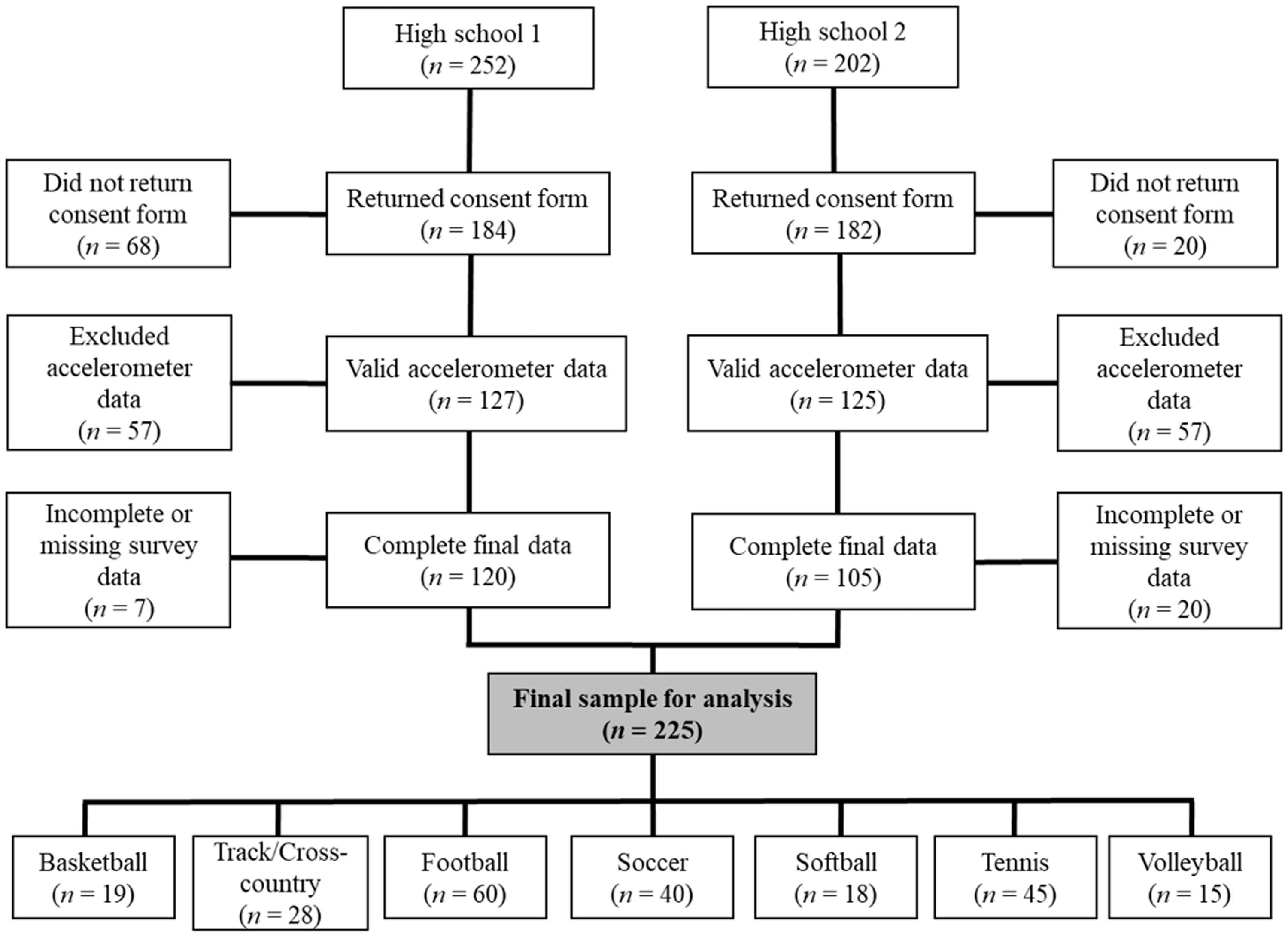
Flow chart for participant invitation, inclusion, and exclusion with final number of participants by sport.
Of the 225 final participants that provided acceptable and quality data, none missed more than two items in each measure, contributing to less than 1% of total missing values in several survey items. These missing values were replaced using a person mean substitution deemed appropriate. 26 This sample size is considered adequate, larger than a minimum of 177 participants revealed in a priori power calculator for structural equation models (http://www.quantpsy.org/rmsea/rmsea.htm) based on the desired power (π = .80), statistical significance (α = .05), degree of freedom in the model (df = 21), and anticipated null and alternative RMSEA values (.05 and .10, respectively).
Measures
Demographics
Participants reported their age, gender, race/ethnicity, and sport background (e.g., current sport, years of participation).
Coach-created environment
Athlete perceptions of coach-created environment were measured using the 34-item Empowering and Disempowering Motivational Climate Questionnaire (EDMCQ-C). 27 Participants reported on the kind of atmosphere their current coach had created in the last 3–4 weeks on a 5-point Likert-type scale ranging from 1 (strongly disagree) to 5 (strongly agree) with respect to five subscales: an empowering climate includes (a) Task-Involving (e.g., “My coach encouraged players to try new skills”), (b) Autonomy-Supportive (e.g., “My coach gave players choices and options”), and (c) Socially Supportive (e.g., “My coach could really be counted on to care, no matter what happened”) subscales, and a disempowering climate includes (d) Ego-Involving (e.g., “My coach substituted players when they made a mistake”), and (e) Controlling Coaching (e.g., “My coach was less friendly with players if they didn't make the effort to see things his/her way”) subscales. The scores of this measure showed good validities and reliabilities in youth athletes aged 8–17 years across various sports and countries. 27 , 28 Mean scores for empowering climates and disempowering climates were used for data analyses.
Need satisfaction and need frustration
With regard to athlete perceptions of their sport, satisfaction of autonomy, competence, and relatedness was measured using a 6-item autonomy scale 29 (e.g., “I help decide what I do when participating in my sport”), the 5-item Perceived Competence subscale (e.g., “I think I am pretty good at my sport”) of Intrinsic Motivation Inventory (IMI), 30 and the 5-item Need for Relatedness Scale (NRS) 31 (e.g., “In my team, I feel supported”), respectively; frustration of the autonomy (e.g., “I feel prevented from making choices with regard to the way I train”), competence (e.g., “There are situations where I am made to feel inadequate”), and relatedness (e.g., “I feel I am rejected by those around me”) was measured using the 12-item Psychological Need Thwarting Scale (PNTS). 22
Participants responded to these items on a 7-point Likert-type scale ranging from 1 (strongly disagree) to 7 (strongly agree) that best reflected their perceptions. The item scores were averaged to create respective satisfaction and frustration of the three psychological needs, which were further averaged to create one need satisfaction and one need frustration variable, for data analyses. The scores of these measures revealed good validities and reliabilities in assessing need satisfaction and need frustration in high school-aged athletes across sports and countries. 16 , 22
Physical activity during sport
Accelerometer-measured MVPA and SB during athletes’ sport participation were assessed with wrist-worn Actical® activity monitors (Philips Respironics, Bend, Oregon, USA). Each participant wore an Actical® accelerometer during their sport practices for 3–5 days of the same week. To adequately capture the sporadic movement of athletes, accelerometers were initialized with an epoch length of 15 seconds after taking into account each athlete’s age, gender, height, and weight. 32 The activity energy expenditure (AEE) was utilized to categorize PA intensities, including SB (AEE < 0.01 kcal·kg−1·min−1), light PA (LPA; 0.01 ≤ AEE < 0.04 kcal·kg−1·min−1), moderate PA (MPA; 0.04 ≤ AEE < 0.10 kcal·kg−1·min−1), vigorous PA (VPA; AEE > 0.10 kcal·kg−1·min−1), which were further computed to measure the total time spent on MVPA and SB. 33 Due to varying numbers and lengths of sport practices across different sport teams, the percentage time (%) of MVPA and SB for each period was calculated, and the average MVPA% and SB% across all sport practices were used for data analyses.
Procedure
After receiving approval from the university’s Institutional Review Board (IRB), informed parental consent and child assent were obtained in accordance with the IRB and school district requirements. A four-month prospective research design was used, supported by the previously mentioned Vallerand and Bissonnette’s 21 four-month prospective protocol, that showed a period of time needed before motivational factors can influence behavioral outcomes. This time gap also helped reduce athletes’ reactivity of becoming more engaged in practices soon after responding to the survey items on motivational constructs. During the third to fourth week of the season (Time 1), the coach-created environment and satisfaction and frustration of psychological needs were assessed. The athletes spent about 20 minutes completing a survey during a sport practice and were assured that their responses would remain confidential. Four months later (Time 2), athletes’ accelerometer-measured MVPA and SB percentage time (%) were assessed during their sport practices for at least three times on the same week, similarly to Schlechter et al.’s 9 protocol that measured participant PA during two practices.
Data analysis
After screening the data for outliers and normality, three steps were performed with a statistical significance level of p < .05 as the criteria for all analyses. First, descriptive statistics and bivariate correlations were computed to examine the relationships among the study variables. Second, internal reliability, intraclass correlation coefficients (ICCs), and confirmatory factor analyses were used to examine the reliabilities and validities of the study variables as preliminary analyses to confirm their adequacy for subsequent path analysis. Third, in order to test the influence of empowering and disempowering climates on accelerometer-measured MVPA and SB during sport, path analyses were conducted for one hypothesized model (two variables for general need satisfaction and need frustration; see Figure 1) and one competing model (six separate variables for specific satisfaction and frustration of autonomy, competence, and relatedness; see Figure 2) using AMOS Version 24.0. Although athletes are nested within teams and corresponding coaches, multilevel models were not considered due to both small number of teams and small team sizes (<20) that would provide unacceptably biased parameter estimates. 34 , 35
The two path models were tested to compare whether general or specific need satisfaction and frustration would result in a better-fitting model, because research evidence indicated that both approaches were deemed appropriate and produced significant findings. 36 The model fits were determined using goodness-of-fit indexes: (a) acceptable fit when comparative fit index (CFI) and Tucker-Lewis Index (TLI) are above .90, and root-mean-square error of approximation (RMSEA) is with its 90% confidence interval (90% CI) below .08; 37 (b) good fit when CFI and TLI are above .95, and RMSEA with its 90% CI is below .06. 38 RMSEA can sometimes be a high value above .06 due to a small df, while a RMSEA 90% CI that includes .06 still indicates a good fit. 39
Based on modification indices and χ2 difference (Δχ 2 > 3.84), theoretically appropriate direct paths from motivational climates to MVPA/SB% would be added to a model for improved fit to the data than the original model. 40 Finally, to test for the statistical significance of the indirect effect in the SEM models, a bootstrapping technique with 5,000 resamples and bias-corrected 95%CI was utilized. 41 An indirect effect is significant when the bias-corrected 95%CI does not include zero.
Results
Descriptive statistics are presented in Table 1. All study variables except SB showed good internal reliability and normal distribution (|skewness| and |kurtosis| <2). Additionally, the three-day ICCs for MVPA% and SB% were .86 and .37, respectively, indicating good inter-session consistency for MVPA but not for SB in this study. This pattern can be attributed to high PA and very low SB (i.e., a floor effect) during sport in this sample. On average, 55.32 min per sport practice were recorded, in which the athletes in this study spent most of the time (M = 42.60 min; 71.9–87.3% across seven sports) on MVPA and only negligible amount of time (M = 0.63 min; 0–2.9% across seven sports) on SB. More specifically, more than half and about one-fourth of their practice time were spent on MPA and VPA, respectively. In terms of motivational variables, athlete perceptions of motivational climates and psychological needs were generally positive, characterized by moderate-to-high empowering climates and need satisfaction as well as low-to-moderate disempowering climates and need frustration. Bivariate correlations revealed expected association patterns between coach-created environments and satisfaction or frustration of psychological needs, except that need satisfaction was not significantly associated with disempowering climates.
Descriptive statistics and internal reliabilities among study variables (N = 225).
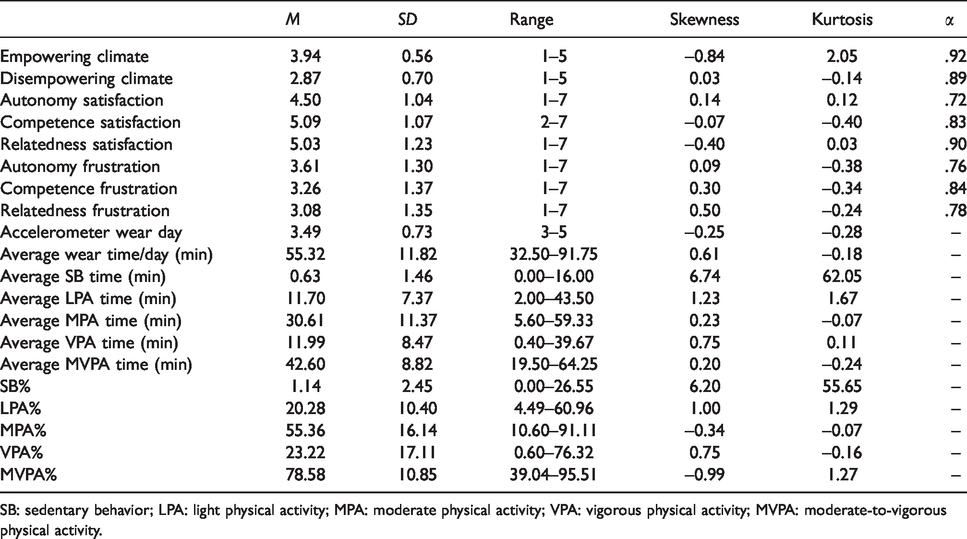
SB: sedentary behavior; LPA: light physical activity; MPA: moderate physical activity; VPA: vigorous physical activity; MVPA: moderate-to-vigorous physical activity.
Bivariate correlations revealed expected association patterns between coach-created environments and satisfaction or frustration of psychological needs (see Table 2), except that need satisfaction was not significantly associated with disempowering climates. With respect to the relations of PA during sport with motivational variables, MVPA% was weakly and negatively associated with disempowering climates (r = –.26) and need frustration (r = –.16), and SB% was weakly and positively associated with need frustration (r = .14).
Bivariate correlations among coach-created environment, psychological needs, and PA during sport (N = 225).
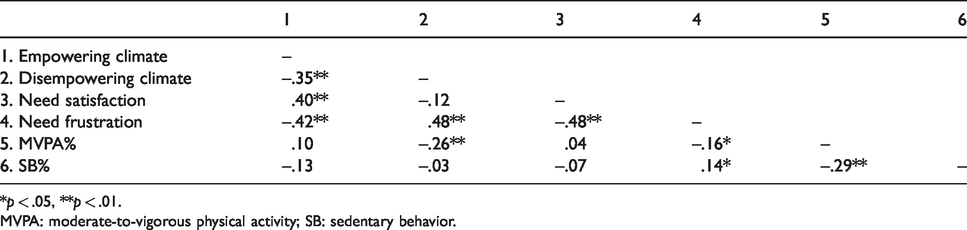
*p < .05, **p < .01.
MVPA: moderate-to-vigorous physical activity; SB: sedentary behavior.
Two confirmatory factor analyses indicated good fits for need satisfaction, χ2(1) = 0.12, p = .72, CFI =1.00, TLI = 1.03, RMSEA = .00, 90%CI [.00, .13], and need frustration, χ2(1) = 3.57, p = .06, CFI = .99, TLI = .97, RMSEA = .11, 90%CI [.00, .24], as appropriate composite variables in place of separate variables for autonomy, competence, and relatedness to be used in the path model. Based on the goodness-of-fit indexes, the original hypothesized model revealed a poor fit to the data, χ2(4) = 20.15, p < .01, CFI = .93, TLI = .73, RMSEA = .13, 90%CI [.08, .20]. Based on the modification indices and theoretical appropriateness, an additional direct path from disempowering climate to MVPA% was added (see Figure 4). This modified model demonstrated a good fit to the data, χ2(3) = 5.45, p = .14, CFI = .99, TLI = .95, RMSEA = .06, 90%CI [.00, .14]. The modified model also explained more variance in MVPA% (8.4% vs. 2.8%) than the original hypothesized model without a direct path and thus served as the final model for interpretation, while the competing model with separate variables for satisfaction and frustration of autonomy, competence, and relatedness exhibited a poor fit, χ2(14) = 128.40, p = .00, CFI = .83, TLI = .46, RMSEA = .19, 90%CI [.16, .22].
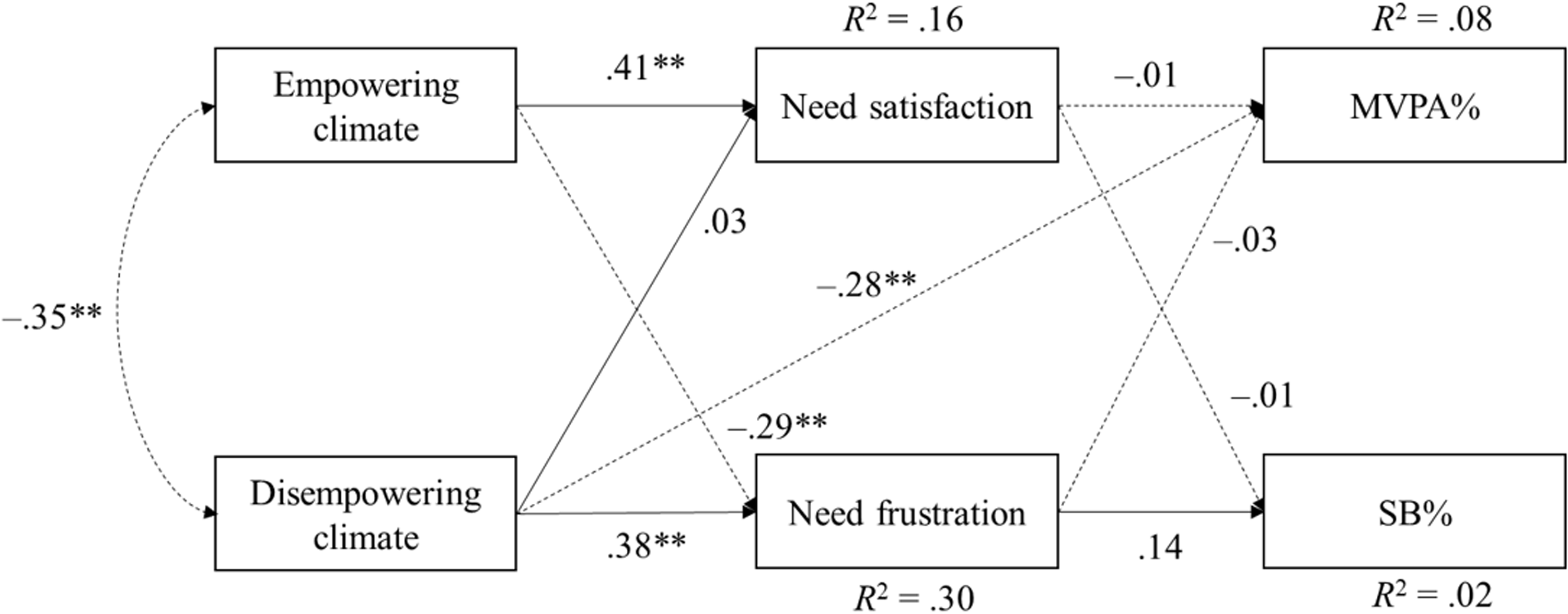
Final model illustrating relationships among study variables. Solid lines represent positive relationships; dashed lines represent negative relationships. *p <.05; **p <.01. MVPA = moderate-to-vigorous physical activity; SB = sedentary behavior.
The final model accounted for 15.9%, 31.0%, 8.4%, and 2.0% of the variance in need satisfaction, need frustration, MVPA%, and SB%, respectively. Specifically, empowering climates had a significant direct effect on need satisfaction (β = .41) and need frustration (β = –.29), whereas disempowering climates had a significant direct effect on need frustration (β = .38) and MVPA% (β = –.28) but not on need satisfaction. Need satisfaction and need frustration had no significant direct effects, and empowering (95%CI = –.04–.05 and –.09–.00, respectively) and disempowering climates (95%CI = –.07–.05 and –.04–.13, respectively) had no significant indirect effects, on MVPA% and SB%.
Discussion
This study aimed to examine the direct and indirect effects of perceived coach-created environment on accelerometer-measured MVPA and SB during sport through satisfaction and frustration of basic psychological needs in a sample of high school athletes. In contrast to previous studies that showed 20–50% of MVPA during sport among recreational youth sport participants, 4 , 6 this study revealed an average of 72–87% of MVPA during sport among a sample of high school athletes. This finding suggests that youth athletes who are more competitive have greater engagement during practice and are more likely to obtain physical health benefits solely from sports.
Consistent with SDT, path analysis demonstrated that athlete perceptions of an empowering climate positively predicted need satisfaction and negatively predicted need frustration, and that perceptions of a disempowering climate positively predicted need frustration but not need satisfaction. This may be explained by the brighter and darker sides of SDT in that positive social environments more strongly predict need satisfaction and negative social environments more strongly predict need frustration. 42 A perceived disempowering climate had a significant negative direct effect on MVPA% in the current study, revealing that more coach-created ego-involving and controlling behaviors predicted less MVPA among athletes during sport practices within a four-month period. This result implies that high school athletes could become disengaged and put forth less effort at sport practices due to a perceived disempowering climate, which might lead to poorer sport performance.
The significant effects of perceived coach-created climates on MVPA% during sport through the darker side pathway, interestingly, were different than in previous research. Specifically, Fenton and colleagues 13 found a positive indirect effect of coach-created autonomy support on MVPA% through autonomous motivation (i.e., the brighter side pathway). These discrepancies can be partially attributed to the differences in (a) the variables that we measured, which were empowering and disempowering climates instead of autonomy support and controlling behavior, (b) the sample characteristics (age, country), (c) the contexts (sports, competitive level), and (d) research design, which was prospective in this study instead of cross-sectional such as in Fenton and colleagues. 13 The current study, to our best knowledge, was the second to test how coach-created climates influence accelerometer-measured PA during sport, and thus further investigation of these relationships across more diverse samples is warranted.
Contrary to the hypothesis, neither perceptions of an empowering nor disempowering climate had an effect on SB during sport. Although there is no previous evidence examining SB during sport using a motivational framework for direct comparison, Fenton and colleagues 11 found that autonomy support had an indirect effect on athletes’ daily SB, in which only 1.6% of the variance was explained. A plausible explanation for the nonsignificant finding in this study is that the athletes were generally physically active during sport practices under coaches’ instructions. These athletes had an average of only 1.14% of time. in SB during sport, which resulted in a floor effect and limited the variability for statistical significance. However, the path from need frustration to SB% (β = .14, p = .07) in this study approached statistical significance, and its strength was comparable to the path from autonomous motivation to daily SB (β = –.15, p < .05) from Fenton and colleagues’ 11 findings. Deviating from previous evidence and SDT tenets of psychological needs as mediators, none of the indirect effects were significant in the current study, which might be due to the fact that motivational regulations were not accounted for as in previous studies. 10 , 11 , 13 Another potential explanation is that psychological needs may better serve as mediators for outcomes related to the psychological than physical aspect. 42
Limitations and future directions
Limitations of this study include (a) using a sample of high school athletes across seven sports from only two schools in the U.S., (b) having confounding variables that could not be controlled for, such as the weather during sport practices, and (c) measuring coach-created environments, need satisfaction, and need frustration at Time 1, and PA during sport at Time 2, such that the autoregressive effects of MVPA and SB could not have been controlled for.
As previously stated, the number of teams and team sizes were too small for conducting multilevel modeling in this study. Further investigation of the coach-created environment’s effects on accelerometer-measured MVPA and SB during sport, with a larger representative sample and sufficient subsample sizes, is needed in order examine both individual- and team-level predictions. Additionally, future research may include observational tools, such as the System for Observing Fitness Instruction Time (SOFIT), 43 to provide triangulation and further evidence of the contents that contribute to the MVPA or SB time. Furthermore, researchers may implement a longitudinal research design, such as using three-wave cross-lagged panels, 17 to investigate the indirect effects of coach-created environments on PA during sport. We were not able to include more data collection sessions in this study, or included both survey and accelerometer measurements in Time 1 and Time 2, because of the logistical concerns and time constraints of the coaches during the sport season. Moreover, if practically possible, researchers should implement an experimental design to examine the effects of motivational interventions with empowering coaching strategies on athletes’ PA during sport.
Despite these limitations, this study was the first to show evidence regarding the importance of the coach-created environment by including both positive and negative dimensions in predicting accelerometer-measured SB in addition to MVPA during sport. This approach, along with a prospective design, helps resolve some of the issues in the extant literature that assessed only the brighter side (e.g., autonomy support, need satisfaction) of SDT using a cross-sectional design. 13
Practical implications
In addition to empirical evidence, this study also offers practical significance to support the International Olympic Committee consensus statement on the health and fitness of young people through physical activity and sport to counter the rising physical inactivity of children and adolescents, as well as the SHAPE America’s 50 Million Strong initiative that promotes students’ opportunities to enjoy healthy, meaningful PA. High school students, particularly those in the U.S., are the most vulnerable group of youth with low PA engagement and high risks for obesity. Over 90% of these adolescents, particularly girls, do not meet the recommended guideline of 60-minute daily MVPA. 44 As physical education is not universally required across high schools in the U.S., school sport participation serves as a significant means for PA engagement, especially since more than half of the high school population play on at least one school team. 1 By creating an environment that focuses on task mastery, considers athletes’ needs and desires, and fosters social connections, rather than one that focuses on social comparison and exhibits controlling behaviors, coaches can influence high school students’ physical health by satisfying their psychological needs and facilitating more MVPA during sport practice. This motivational mechanism might in turn help students meet the recommended PA guideline through sport and beyond during their leisure time. 45 High school sport is an ideal intervention setting also because those students are in a critical developmental stage of developing self-determined motivation and healthy habits for lifelong PA. 46
At the organizational level, our study findings help inform school policies and coaching education programs. Schools and sport associations (e.g., SHPAE America, National Alliance for Youth Sports) may create programs with empowering coaching strategies for coaches to engage athletes of all abilities in more MVPA and less SB. Given the maladaptive effects of disempowering climates on MVPA, sport organizations ought to start a call to action that urge high school coaches to minimize peer comparison and controlling behavior that would frustrate athletes’ autonomy, competence, and relatedness. Instead, coaches need to provide choices and rationales for practice plans, treat athletes with respect regardless of their skill level, and praise athletes for their effort and improvement, not for defeating others, in order to enhance their athletes’ PA engagement during sport and subsequent athletic performance and health outcomes. With a more empowering and less disempowering climate in their sport environment, athletes can be more engaged and physically active during sport practices, which would translate to greater overall PA to meet the recommended 60-minute daily MVPA guideline.
Conclusions
This study is the first to show research evidence regarding the importance of the coach-created environment, including both empowering and disempowering climates, in predicting accelerometer-measured SB in addition to MVPA during sport. This approach, along with a prospective design, helps resolve some of the issues in the extant literature that used only self-report measures and assessed only the brighter side (e.g., autonomy support, need satisfaction) of SDT using a cross-sectional design. Findings indicate that (a) an empowering climate positively predicted need satisfaction and negatively predicted need frustration, (b) a disempowering climate positively predicted need frustration, but not need satisfaction, and (c) a disempowering climate had a significant negative direct effect on MVPA%. These results provide further empirical support for studying disempowering climates beyond empowering climates in predicting physical outcomes, as well as offer practical implications for coaches to engage their athletes by optimizing the motivational environment.
Footnotes
Acknowledgment
We are grateful to Xiaofeng Yang, Yina Yan, Mi Hu, Yue Hu, and Yanxiu Wang for their assistance in data collection.
Declaration of conflicting interests
The author(s) declared no potential conflicts of interest with respect to the research, authorship, and/or publication of this article.
Funding
The author(s) disclosed receipt of the following financial support for the research, authorship, and/or publication of this article: This study was supported by a research grant from the Society of Health and Physical Educators (SHAPE America).
