




Abstract
The purpose of this study was to examine the effect of achievement goal orientation and perception of error on the sport-confidence of adolescent athletes and the moderating effect of perception of error in a competitive sports environment to provide basic data for improving the sport-confidence of adolescent athletes. The subjects of the study were middle and high school athletes (N = 300, Males = 218, Females = 82) registered in institutions under the Korean Sport & Olympic Committee. The data were analyzed using descriptive statistics, confirmatory factor analysis, correlation analysis and hierarchical regression analysis. Results revealed that athletes’ achievement goal orientation positively predicted sport-confidence and these pathways were moderated by athletes’ perception of error. The implications for athletes and researchers from those results are discussed.
Introduction
There has been a long-term journey for athletes to develop themselves into an excellent performer. 1 Various psychological variables are being studied in the field of sports psychology, as athletes must maintain their best physical and psychological conditions in order to achieve the highest level of performance. 2 One of the most important psychological factors for an athlete is sport-confidence, which is directly related to the peak performance of an athlete. Also, achievement goal orientation has been pointed out as an important variable in the development of confidence in adolescent athletes. This is because the perception of competence through achievement goal orientation of athletes is a key factor that positively influences confidence in athletes. Meanwhile, adolescence is a period of rapid physical, psychological, and social growth, which is also extremely important for adolescent athletes to improve and develop their athletic skills. Adolescent athletes in the process of improving and developing their athletic skills experience big and small mistakes in training and athletic situations, and their level of confidence can vary depending on how they perceive their error. In a competitive sports situation, the perception of error is expected to act as a variable that can have a positive or negative impact on the cognitive factor, sport-confidence. Therefore, this study aimed to examine the influence of adolescent athletes’ achievement goal orientation and adolescent athletes’ perception of error on their sport-confidence.
Sport-confidence
One of the most important psychological factors for athletes is confidence. 3 As commonly seen in internet news articles, many athletes cite confidence as the driving force behind good performance. Furthermore, confidence was cited as a factor that positively influenced peak athletic performance and is perceived as an important cognitive factor for athletes. 4 Therefore, the concept of confidence has long been a topic of interest for leaders in the field of sports as well as researchers, and numerous studies have since confirmed the close relationship between athletes’ confidence and successful performance.5–8 Furthermore, confidence not only influences the peak performance of athletes, but also provides mental comfort to athletes in competitive situations and induces positive emotions that increase effort. 9 As such, confidence is a factor that positively influences athletes emotionally, cognitively, and behaviorally. Therefore, confidence is a critical psychological factor that athletes must possess in training and match conditions.5,10 Furthermore, confidence is also important for adolescent athletes, who are in the process of growth and development.
Particularly, adolescent athletes experience growth in a transitional period when they undergo rapid social, emotional, and physical changes, which is often accompanied by psychological instability. 11 For adolescent athletes, confidence not only provides psychological stability but also acts as a driving force behind proactive and active behavior during this period, and also has a positive relationship with increased match performance, the ultimate goal for athletes. 12 With the rising importance of sport-confidence in the sports environment, multiple studies have examined the factors improving the sport-confidence of athletes. In addition, confidence has proven to be important to athletes of various ages, and there have been considerable research on sport-confidence among teenagers. The reason why confidence is important for young athletes is that it is a time when self-esteem and self-identity are formed, and the formation of confidence during this period helps form a positive self-identity.13,14 In the preceding studies of adolescent athletes, many variables such as achievement goal orientation, self-efficacy, anxiety, flow, and performance were studied along with confidence.15–19 Among these factors, achievement goal orientation has been pointed out as an important variable in the development of confidence in adolescent athletes.15,18–20
Achievement goal orientation and sport-confidence
Achievement goal orientation refers to the individual’s own criteria for success and failure in performance-driven environments as well as their prioritized standards in determining whether they are skilled. 21 It can be interpreted as the manifestation of their competence or skills. The perception of competence can be divided into task-orientation achievement goals and ego-orientation achievement goals depending on the subjective interpretation of the individual. 22 Typically, athletes with task-orientation achievement goals focus on the learning and mastery of skills, and their improvement compared with their prior performances. 23 Furthermore, they also tend to choose challenging tasks, and demonstrate tendencies of consistently striving to achieve them. 24 In contrast, athletes with ego-orientation focus on competing with others and compare their performance with others.25,26
Studies conducted in the context of sports have shown that athletes' achievement goal orientations predicted self-confidence.27,28 According to Machida, Marie Ward, & Vealey, among the variables that can predict of sources of self-confidence in collegiate athletes, there is achievement goal orientation. 24 They noted that athletes' task-goal orientation and task-involving motivational climate were positive predictors of both controllable and uncontrollable sources of confidence. Task orientation athletes have improved their confidence by attending to resources of self-confidence they can control.
H1-1: Task goal orientation of adolescent athlete will have a positive effect on their sport-confidence
On the other hand, ego-goal orientation athletes focus on resources of sport-confidence that they can't control and enhance their confidence by comparing their achievements with other people. In this context, the study by Magyar and Feltz noted that ego-goal orientation was positively associated with source of sport-confidence. 29 Also, a study by Vealey and her colleagues mentioned that ego orientation collegiate athletes improved confidence through demonstrating their ability. 18 Therefore, according to prior research results, ego-goal orientation had a significant impact on sport-confidence.30,31
H1-2: Ego goal orientation of adolescent athlete will have a positive effect on their sport-confidence
In this model of achievement goal orientation, the most important implication is the perception of competence according to achievement goals, which plays an important role in the development of confidence in adolescent athletes in sport environments.32,33 According to Vealey et al., 18 athletes’ perception of their competence, or the desire to prove their skills, is an important factor in improving their confidence. Therefore, the perception of competence through achievement goal orientation of athletes is a key factor that positively influences confidence in athletes.
Perception of error and sport-confidence
On the other hand, adolescence is a period of rapid physical, psychological, and social growth, which is also extremely important for adolescent athletes to improve and develop their athletic skills. 34 In this process of development, adolescent athletes experience big and small mistakes in training and competitive situations. Furthermore, sport situations are characterized by clear wins and losses, with errors and failures being inevitable for athletes. 35 According to behavioral psychologists, errors lead to negative emotions 36 and difficulties in performance 37 as such, errors have long been defined as behaviors that require correction or should be avoided.38–40 Therefore, studies on errors have adopted a preventative standpoint to stop them from happening. However, recent studies have begun to focus on the positive aspects of errors. 41
The perception that athletes have of their errors can be defined in the concept of perception of error. Perception of error describes individuals’ tendencies towards errors, 40 which are associated with individual attitudes towards accepting and processing errors. 42 Existing studies on perception of error have taken place largely in the business and educational scenes. Rybowiak, Garst et al. 43 asserted that a positive perception of error had a positive influence on the experimental and forward-thinking behaviors of technicians. Hetzner et al. 44 found that a positive perception of error had a positive influence on the work attitudes and achievements of the members of an organization. On the other hand, Shin et al. 45 found that learners perceiving errors positively had defiant attitudes towards errors and attempted to utilize them in their performance. Considering how a positive perception of error leads to a defiant attitude in subsequent performance, it is possible to expect that such a positive perception of error can lead to results that assist in the development of confidence.
H2: The perception of error of adolescent athlete will have a positive effect on their sport-confidence.
Interaction effects of perception of error between achievement goal orientation and sport-confidence
As a result of looking at the prior studies, many studies on the relationship between achievement goal orientation and sport-confidence have been made. The higher achievement goal orientation, the more positive the sport-confidence has been shown.15,30,31 In the relationship between confidence and errors, highly confident individuals tended to retain positive attitudes, set goals, and strive to achieve them despite negative results such as errors and failures. 46 On the other hand, individuals lacking confidence demonstrated negative attitudes towards errors and failures, and were passive towards work, showing tendencies such as avoiding difficult tasks.46,47 However, there is a lack of research on the relationship between achievement goal orientation and perception of error. Baron & Kenny 48 explained that the moderating effect is validated when the relationship between predictors and criterion variable is weak or inconsistent in each study. Even if the achievement goal orientation is high, it can be expected that the level of sport-confidence can vary depending on the perception and attitude of accepting errors. Therefore, the way errors are perceived can lead to differences in confidence levels 49 in competitive sports environments, the perception of error of individual athletes is considered to be a variable that can positively or negatively influence sport-confidence.
Based on the relevance of each variable so far, it is expected that a positive perception of error will have a positive impact on the level of sport-confidence. So we expected the following hypothesis to show the moderating effect of the perception of error in the relationship of achievement goal orientation and sport-confidence.
H3-1: There will be enhancing effect of perception of error in the relationship between task goal orientation and sport-confidence.
H3-2: There will be enhancing effect of perception of error in the relationship between ego goal orientation and sport-confidence.
Therefore, this study aimed to examine the influence of achievement goal orientation of adolescent athletes on their sport-confidence, and to verify the moderating effect of perception of error in the relationship between achievement goal orientation and sport-confidence. The ultimate objective of this study is to provide basic data for improving the sport-confidence of adolescent athletes in competitive sports setting.
Method
Participants
The participants of this study were selected using purposive sampling. We conducted a survey with 300 middle- and high-school athletes whose schools were registered with the Korean Sport & Olympic Committee and who competed in individual and team sports. The male participants (n = 218) had more than female participants (n = 82). Participants’ sport included soccer (n = 70), hockey (n = 10), volleyball (n = 23), baseball (n = 36), basketball (n = 15), tennis (n = 25), table tennis (n = 22), weightlifting (n = 11), judo(n = 44), taekwondo (n = 30), Athletics (n = 14).
Procedure
This study was approved by the Institutional Review Board of the Seoul National University(SNUIRB). A pilot study was conducted with 30 adolescent athletes to confirm their understanding of the survey items, and the main study was conducted with 300 participants after revising and supplementing the contents of the questionnaire. Researchers visited each school between July 24, 2019 and September 30, 2019 to conduct the surveys. The purpose and process of the study were explained to the athletes and their coaches in each school, and the athletes who obtained written approval from their legal representatives participated in the survey. The survey was self-administered and took approximately 15 minutes to complete.
Measures
Achievement goal orientation
To measure the level of achievement goal orientation of adolescent athletes, this study utilized the sport goal orientation tool developed by Duda 50 and adapted by Kim 51 as the Korean Achievement Goal Orientation Scale. This tool has two components, namely task goal orientation and ego goal orientation, with 7 and 6 questions, respectively, totaling 13 questions. The questions are scored on a 5-point Likert scale from 1(strongly disagree) to 5(strongly agree).
Perception of error
Perception of error among adolescent athletes was measured with the Error Orientation Questionnaire (EOQ) originally developed by Rybowiak et al. 43 This study used the version modified and adapted by Shin et al. 45 The scale consists of four sub-factors, namely learning from errors, challenging errors, burden from errors, and contemplation of errors, with a total of 18 items. Items are scored on a 5-point Likert scale from 1(strongly disagree) to 5(strongly agree).
Sport-confidence
To measure the sport-confidence of the adolescent athletes, we utilized the Korean Sport Confidence Questionnaire, adapted by Kim 52 into Korean from the original version developed by Vealey et al. 18 The scale consists of a total of four sub-factors (coach leadership, proving skills, physical/mental preparation and social support) and a total of 15 items, which are rated on a 5-point Likert scale from 1(strongly disagree) to 5(strongly agree).
Data analysis
Data collected was analyzed using SPSS 23.0 and AMOS 21.0 programs. First, we analyzed the descriptive statistics to understand the overall trends of data (mean, standard deviation, skewness, kurtosis), followed by correlation analysis of the study variables. We also conducted confirmatory factor analysis to verify the construct validity of the measurement tools and conducted an analysis of reliability by factor (Cronbach’s α). Furthermore, we conducted hierarchical regression analysis to verify the moderating effect of perception of error. All statistical significance levels (α) were set to .05.
Results
Descriptive statistics, construct validity and correlations
The descriptive statistics analysis confirmed that there were no missing values or incorrect data. In addition, the values of both the skewness and the kurtosis do not exceed ±2, indicating that the measurement are statistically normally distributed. 53 The range of skewness values for achievement goal orientation was –.099 to .270, with a range of kurtosis was shown from -.108 to .278. Also, the range of skewness values for perception of error was −.103 to .460. The value of kurtosis was −.056 to 1.04. The range of skewness values for sport self-confidence was shown from −.167 to −.732 with the range 4of kurtosis values from −.063 to .525. The following are the results of the internal consistency of the measurement tool. The most commonly used reliability evaluation method for internal consistency is to use the Cronbach α coefficient. The Cronbach α value has a value between 0 and 1 and the closer it is to 1, the more reliable it is to be judged. Typically, a Cronbach α value of 0.7 or higher is considered reliable. Therefore, reliability of measurement tool was taken in accordance with this method in this study (see Tables 1 to 3). Achievement goal orientation (ego-goal .732, task-goal .815), perception of error (Learning .890, Challenge .731, Burden .787, contemplation .819), Sport-confidence (Coach Leadership .804, proving skill .780, physical/mental preparation .769, social support .696) showed that the Cronbach α value met the 0.7 criterion.
Descriptive statistics of achievement goal orientation questionnaire.

Items were deleted.
Descriptive statistics of error orientation questionnaire.

Descriptive statistics of sport-confidence questionnaire.

Confirmatory factor analysis was conducted to verify the construct validity of achievement goal orientation scale. Goodness of fit was dissatisfactory with
After this, Confirmatory factor analysis to verify the construct validity of achievement goal orientation was conducted again. Goodness of fit was satisfactory with
Internal model fit in the measurement for achievement goal orientation.

***p < .001.
The construct validity of scale for error orientation questionnaire was acceptable with fit indices from CFA (
Internal model fit in the measurement for error orientation.

***p < .001.
Confirmatory factor analysis to verify the construct validity of the sport-confidence scale indicated adequate goodness of fit with
Internal model fit in the measurement for sport-confidence.

p<.001.
Table 7 shows the correlation of key variables. Correlation analysis was conducted using the overall mean of each variable to examine the relevance between the variables. The results of the correlation analysis conducted to understand the relationships between the study variables. First, sport-confidence had significant positive correlations with task goal orientation (.493**), ego goal orientation (.333**), and perception of error (.354**). Task goal orientation and ego goal orientation had a positive correlation (.213**), and error perception and task goal orientation (.307**) also showed a positive correlation.
Descriptive statistics of key variables and Correlations.

Note. 1: Task goal orientation, 2: Ego goal orientation, 3: Perception of error, 4: Sport confidence, **p<.01.
To analyze the moderating effect, a three-step hierarchical regression analysis should be performed with three regression equations below.



According to Cohen, Cohen, West, and Aiken, the moderating effect is divided into three types: enhancing interaction effect, buffering interaction effect, and antagonistic interaction effect based on the beta value of the interaction term. 54
The criterion for determining enhancing interaction effect is that the values of b1, b2, b3 are all positive (+) or negative (−). The basis for determining buffering interaction effect is when the value of b1 is negative (−), b2, and b3 are both positive (+) or the value of b1 is positive (+), b2, and b3 are both negative (−). The criterion for determining antagonistic interaction effect is that the value of b1 and b2 is positive (+) while the value of b3 is negative (−) or the value of b1 and b2 is negative (−) while the value of b3 is positive (+).
A hierarchical regression analysis was conducted to understand the interaction effect of perception of error on the relationship between task goal orientation and sport-confidence in adolescent athletes. The results are shown in Table 8. The hypothesis1-1 that task goal orientation will have a positive effect on sport-confidence (β = .335, p < .001) was supported. Also, the hypothesis2 that perception of error will have a positive effect on sport-confidence (β = .268, p < .001) was supported. And R2 increased to 24.3% in Model 1, 28.8% in Model 2, and 30.8% in Model 3. Moreover, in Model 3, where the interaction term was entered, the explanatory power increased significantly to 30.8% (ΔR2=.020, p < .01).
Interaction effects of task goal orientation and perception of error.

p < .01, ***p < .001.
The results of this study show that among the three types of moderating effects, antagonistic interaction effect is corresponding. Because, in model 3 it turned out to be b1 = .333, b2 = .274, b3 = −.256 (p < .001). Figure 1 is a graph showing that the higher the perception of error which means the more positive interpretation of mistakes, the less the task goal orientation affects the sport-confidence, while the lower the perception of error, the more the task goal orientation affects the sport-confidence. Therefore, the hypothesis3-1 we set up was rejected.
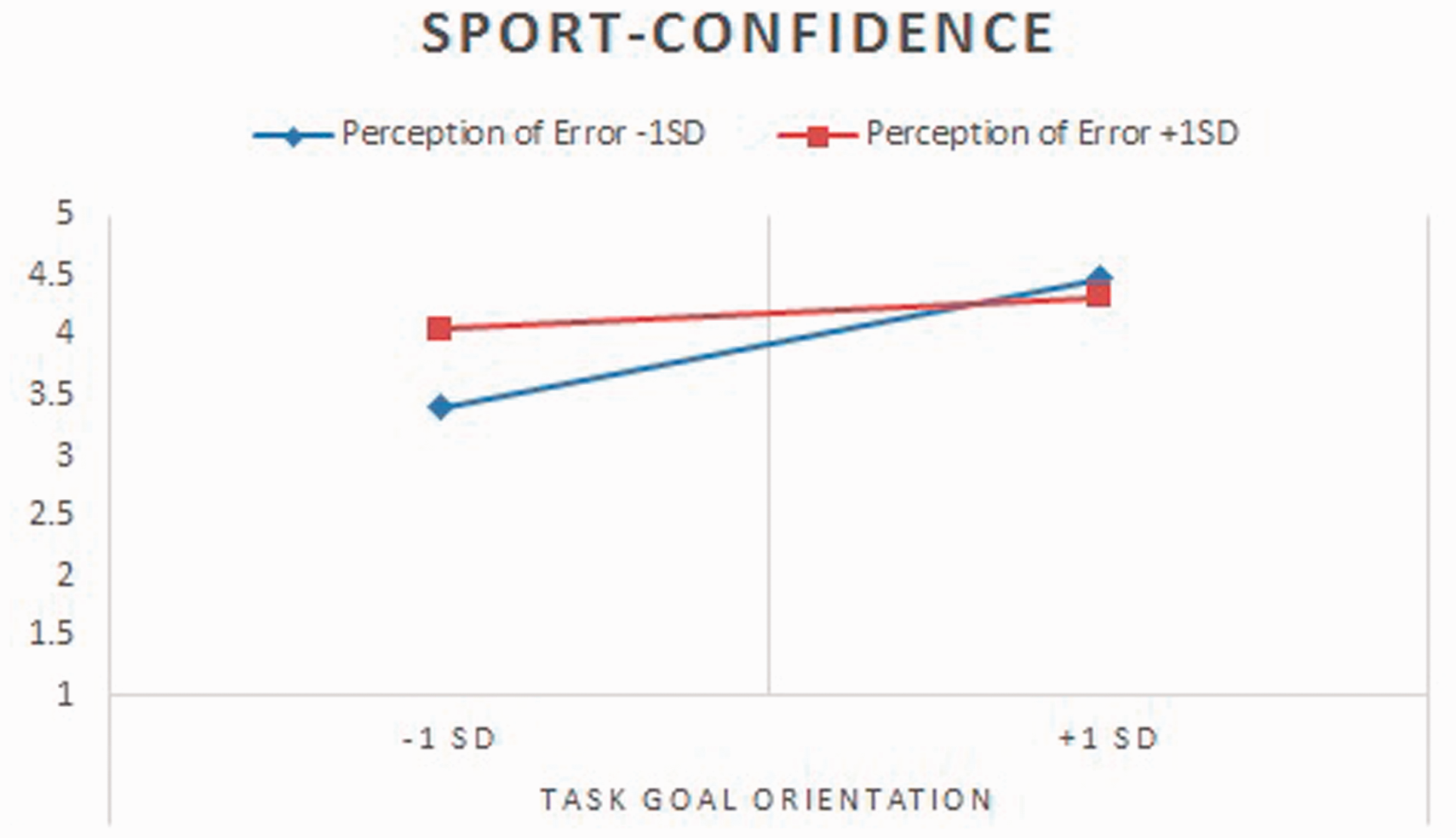
Interaction effects of task goal orientation and perception of error.
We conducted a hierarchical regression analysis to understand the interaction effect of perception of error in the relationship between ego goal orientation and sport-confidence in adolescent athletes. The results are shown in Table 9. The hypothesis1-2 that ego goal orientation will have a positive effect (β = .207, p < .001) on sport-confidence was supported. Also, the hypothesis2 that perception of error will have a positive effect (β = .400, p < .001) on sport-confidence was supported. R2 increased to 11.1% in Model 1, 22.2% in Model 2, and 23.4% in Model 3. Moreover in Model 3, where the interaction term was entered, the statistical power increased significantly to 23.4% (ΔR2 = .011, p < .05).
Interaction effects of ego goal orientation and perception of error.

p<.05, ***p<.001
The results of this study show that among the three types of moderating effects, antagonistic interaction effect is corresponding. Because, in model 3 it turned out to be b1 = .216, b2 = .404, b3 = −.176(p < .05). Figure 2 is a graph showing that the higher the perception of error, the less the ego goal orientation affects the sport-confidence, while the lower the perception of error, the more the ego goal orientation affects the sport-confidence. Therefore, the hypothesis3-2 we set up was rejected.

Interaction effects of ego goal orientation and perception of error.
Discussion
Athletes in their adolescence go through an important period of their sport career as they develop and improve their athletic skills. 34 Furthermore, sport situations are characterized by clear wins and losses, and errors and mistakes during training and on the field are therefore inevitable. 35 Therefore, this study focused on the positive aspects of errors and aimed to verify the moderating effect of perception of error in the relationship between achievement goal orientation and sport-confidence among adolescent athletes. The following discussion is based on the findings of this study.
First, hierarchical regression analysis found that both task goal orientation and ego goal orientation, as components of achievement goal orientation, significantly influenced sport-confidence. This can be explained in reference to existing studies from a similar context, which assert that perception of competence, or the desire to prove one’s skills, influences confidence in a sports environment. Furthermore, task and ego orientation only differ from the perspective of standards of achievement, while they share the same achievement-orientation tendencies 55 as such, it appears that both tendencies had a significant influence on sport-confidence. Moreover, in a competitive sports environment where winners and losers coexist, it may be difficult to determine which achievement orientation—task or ego—is relatively more positive for athletes. However, as adolescent athletes are in a phase of growth and development, developing a task goal orientation to value skill growth and the process of learning, rather than comparing oneself to others and pursuing victory at all costs, appears to be more beneficial. 56 This requires interventions that are customized to the developmental stages of athletes.
Next, the moderating effect presented in the results of this study was different from our expectations and acted as a significant antagonistic interaction effect. As suggested in the results, task goal orientation and ego-goal orientation did not have a significant impact on sports confidence for group with high level of perception of error, and both task and ego goal orientation had a greater impact on sports confidence for groups with low level of perception of error. Interpreting these results means that it is better to maintain a high level of perception of error. This is because sport-confidence can be interpreted as being basically high in the case of high perception of error, although the relationship between the former and the latter cannot be clarified. However, considering the reasons for the antagonistic interaction effect, which is different from our expectations, it is believed that the following reasons may be given below.
The first is the specificity of the sports. Adolescence is a period of mental, social and physical development and is still immature, with characteristics that are psychologically unstable and have distinct mood swings. 57 Adolescent athletes also have less athletic experience and less experience of matches than adult athletes, so their coping skills, especially during the development process, are relatively weaker and capable than adult athletes. 58 Given these characteristics of adolescent athletes, even if they had a positive perception of errors, they were believed to have influenced their sport-confidence by the many characteristics that occur during the special period of the aforementioned adolescence.
Second, in this study, statistical analysis was conducted without distinguishing between individual and team sports, so it is possible that the effects of perception of error will vary due to the specificity of the sports. When looked at prior studies on the specificity of the sports, it can be inferred that the effect of perception of error on sport-confidence may vary depending on the characteristics of the sports. In the study by Simon and Martens, the level of anxiety was measured by separating the athletes from the individual and team sports, and it was shown that the level of anxiety of athletes in individual sports was higher than that of the athletes in the team sports. 59 That's because athletes in individual sports have to handle the game on their own and their skills lead to the outcome of the game. In addition, Lee, Cho and Lee reported that athletes in individual sports experience a lot of fear of failure and mistakes due to the pressure that they should be responsible for winning or losing. 60 Therefore, even a positive perception of error can show that the impact on his or her sport-confidence varies depending on the characteristics of the sports. For this reason, it is unlikely to completely rule out the possibility of being partially affected by the specificity of the sports. However, since no empirical studies have been reported to describe the mechanisms that produced these results objectively or clearly, it is necessary to be cautious about the results and inferences produced. It is expected that further research will reveal the influence of perception of error in more depth if a study is conducted to verify differences between individual and team sports by reflecting the specificity of the sports.
Since the aforementioned reasons may have resulted in different results from our hypothesis, various variables that could affect the relationship between perception of error and sport-confidence should be considered together through follow-up studies.
Furthermore, errors are part of sports and become inevitable for athletes. As such, the individual perception of errors commonly experienced during training and matches is an important issue in athlete performance. Therefore, this study expects that a positive perception of inevitable errors in sports and a clear achievement orientation will play an important role in improving sport-confidence, a mandatory cognitive factor for peak performance among adolescent athletes. Previous research suggests that interaction with the surrounding environment is an important factor to maximize the educational value of errors. 61 In order for errors to play the role as self-compensation for adolescent athletes, the information contained by errors should be actively utilized, and the role of the surrounding environment is important.38,61 The most influential environmental factor for adolescent athletes is their coaches. 62 Therefore, rather than reprimanding and criticizing errors, the role of coaches to guide them to use as their own growth development is important.
In sum, this study confirmed the influence of achievement goal orientation and perception of error on sport-confidence in adolescent athletes and verified the moderating effect of perception of error.
Limitations & recommendations
There are some limitations and recommendations which should be considered for future research. First, the variable “perception of error” has been mainly studied on adults at industrial situation. This is because how to deal with errors in the industry is considered a very important factor because they are linked to the interests and losses of the organization. 38 Furthermore, studies are underway at industrial contexts on how to take advantage of these errors beyond changes in the positive perception of them. Even in sports, errors inevitably occur to athletes in training or competition situations, which is considered an important factor that can affect the athletes' behavior, cognition and emotional aspects as well as their winning and losing games. Nevertheless, prior research on the perception of errors in sports is still quite insufficient. Ultimately, for athletes, winning or losing a game is of considerable importance, as sports include elements of competition. Therefore, it can be seen that studies only focused on the resulting aspects of errors, such as strategies to cope with negative emotions experienced by athletes in the process. On the other hand, studies focusing on the causes and processes of errors fundamentally and the positive aspects of errors have been insufficient for athletes. For these reasons, there was some difficulty in comparing this study with prior research. Subsequent studies will need to focus on the process and positive aspects of errors, not the resulting aspects of errors, and further explore the individual, social and cultural factors that affect errors for athletes through in-depth interviews and open-ended questions.
Second, when the modification of the model is made according to the factor loading, model fit of the first model in the verification of the validity of the measurement through a confirmatory factor analysis, it is more desirable to verify the validity of the modified model in the new sample. However, there is a limitation in this research that the same sample was analyzed twice due to the limitation of data collection.
The third is a recommendation for future research. The ultimate purpose of sport psychology is related to the peak performance of athletes. Therefore, future research needs to examine the relationship between the variables that measure athletes' performance, which will identify the difference in actual performance resulting from the perception of error that was intended to be identified in this study. This basic data will help athletes make use of errors for their own development, which will also help improve their ultimate goal of performance.
Footnotes
Declaration of conflicting interests
The author(s) declared no potential conflicts of interest with respect to the research, authorship, and/or publication of this article.
Funding
The author(s) received no financial support for the research, authorship, and/or publication of this article.
