



Abstract
Coaching turnover has significant implications for both athletic organizations and athletes. This study examined how the two distinctive types of passion were associated with turnover intention among high school athletic coaches. Moreover, this study used emotional exhaustion as an underlying mechanism in the relationship between passion and turnover intention. A total of 358 athletic coaches in the United States participated in the online survey assessing their levels of harmonious passion, obsessive passion, emotional exhaustion, and turnover intention. The results revealed that emotional exhaustion was negatively linked to harmonious passion but positively linked to obsessive passion. Emotional exhaustion, in turn, was positively linked to turnover intention. Additionally, this study found the indirect effect of emotional exhaustion in both passions-turnover intention relationship. The results of this study highlighted the significant roles of different types of passion in athletic coaches’ wellbeing and turnover intention.
Introduction
Passion, defined as “a strong inclination toward personally meaningful and highly valued activities that one loves, finds self-defining and to which substantial time and energy is invested” (Vallerand, 1 p. 2), is a significant psychological construct that has received a considerable amount of attention from both researchers and practitioners. 2 Previous literature on the topic has shown that passion in the workplace can have a significant impact on a diverse range of employee outcomes, such as better interpersonal relationships, a greater sense of commitment to the job, job satisfaction, a more incredible amount of employee creativity, and better job performance, in various occupational settings.3–6 Practitioners have also recognized that passion helps employees achieve their personal goals. It is an essential element in achieving organizational goals and executing diverse mid- and long-term strategies. 7
The investigation of the role of passion in sports leadership, in particular, coaching, is warranted given that the context requires coaches to devote a substantial amount of their personal resources (e.g., time and energy) to their efforts to achieve team or individual wins and other developmental goals. 8 Indeed, the previous literature has noted that passion is one of the most integral elements of coaching. It causes coaches to concentrate on their roles and generate more successful outcomes.9,10 The importance of investigating the role of passion in coaching is highlighted when we consider its significant implications for athletic coaches’ sense of well-being and turnover intention. Coaching has long been considered demanding and a time-consuming occupation 11 that has a heavy workload, a high degree of unpredictability (in terms of match outcomes), intense encounters in the human relationships involved, as well as the pressure to demonstrate a persistent winning performance.8,12 Consequently, the growing amount of coaching turnover should set off alarm bells. Unfortunately, coaching turnover is costly,13,14 negatively affects organizational outcomes (e.g., team performance, team dynamics, and the culture of a program), and is detrimental to athletes’ well-being since it can lower their levels of confidence and heighten their anxiety.15,16 Despite these negative implications, the previous literature has failed to study the intentions of coaches to leave their programs and has been unable to find the underlying mechanisms that cause this. We expect that passion is an essential and intrinsic aspect of coaching, which can reduce athletic a coach’s intention to quit his or her position since it has been found that a greater sense of passion helps organizational leaders overcome obstacles during adverse situations17,18 by generating internal resources and causing them to have a more outstanding commitment toward their tasks. 19
However, the association between passion and its consequences is not as simple to diagram as it might at first appear. There are two types of passions, i.e., harmonious passion and obsessive passion, which can result in positive and negative outcomes, respectively. 20 This implies that while coaches should be passionate about achieving the organizational goals, such as attaining a winning performance and developing players, their passion, when it is detrimental, i.e., when it is obsessive, may lower their sense of well-being and adversely affect their job-related mindset (e.g., turnover intention). Thus, it is crucial to understand how each type of passion is linked to consequences that are either positive or negative for coaching.
Finally, the previous literature on the impact of passion on turnover intention has pointed out a theoretical gap because there has been a failure to identify the underlying mechanism mediating the relationship between the different types of passion and turnover intention. 21 We expect that emotional exhaustion, which is a feeling of being overwhelmed and emotionally depleted at work, 22 may play a mediating role in this relationship. We choose emotional exhaustion as the mediator since it is one of the most prevalent phenomena to which athletic coaches are very vulnerable in their jobs. 23 Moreover, the literature on coaching and general occupations has often24,25 agreed that it is the “best indicator” (Donahue et al., 26 p. 345) and core representative of burnout syndrome.22,27
The current study examines how the two distinctive types of passion, i.e., harmonious and obsessive, contribute to the intention to leave one’s position among high school athletic coaches in the U.S. This study suggests that emotional exhaustion is an essential underlying mechanism in the passion-turnover-intention process. More specifically, the purposes of this study are to examine a) the relationship between harmonious passion and emotional exhaustion, b) the relationship between obsessive passion and emotional exhaustion, c) the relationship between emotional exhaustion and turnover intention, and d) the full mediating effect of emotional exhaustion in both the harmonious passion-turnover intention relationship and in the obsessive passion-turnover intention relationship.
Literature review
The dualistic model of passion
Passion reflects a powerful attraction to activities that one likes, deems very important, and regularly spends significant time and energy. 28 Passion plays a supporting role in various aspects of one’s life, as it can provide a meaning and purpose for life and drive an individual to actively participate in activities about which s/he feels passionate. 1 However, the dualistic model of passion notes that passion can sometimes have negative consequences, as there are distinctive types of passion, namely harmonious passion and obsessive passion. Harmonious passion was defined as a voluntary motivating factor that induces employees to perform their own tasks, whereas obsessive passion was defined as a compulsory motivating factor that pushes employees to engage in their duties for achievements. 28 The result of passion in one’s life can be different, depending on which type of passion dominates. 29
The bifurcation of harmonious and obsessive passion stems from their internalization process. That is, the type of passion experienced depends on whether the individual’s autonomy was supported by the environment. 29 Individuals with a high degree of harmonious passion tend to give meaning and value to a particular activity and pursues it based on autonomous reasons, such as the satisfaction and pleasure derived therefrom. Harmonious passion, which has undergone an autonomous internalization process concerning the value and importance of the object, is more active, leading individuals to participate in the activity voluntarily. Individuals high on harmonious passion tend to avoid feelings of being overwhelmed and to perceive the activity as important and controllable. 30 On the other hand, individuals high on obsessive passion tend to experience pressure to engage in activities in order to get something out of it, rather than focusing on the pleasure derived from the activity itself. Obsessive passion, which has undergone a controlled and coercive internalization process, is more passive, being derived from needs for obtaining social acceptance or self-esteem. As such, although individuals high on obsessive passion can enjoy the passionate activities, they suffer from internal compulsions that they must engage in them. Ultimately, they lose control of their passionate activities, which constitute a large part of their identity, causing conflicts with diverse feature of life.29,30
In the context of sports, most of the research on passion has tended to focus on followers (e.g., the athletes on athletic teams or the employees in the sports industry) and the impact of passion on various types of athletes’ consequences.31–33 Vallerand et al. 32 conducted a series of studies on sports and found that the athletes who participate in sports and have the harmonious type of passion experience better and more pleasant emotions than athletes who have the obsessive kind of passion. This empirical result has been demonstrated in subsequent studies. For example, Lafrenière et al. 33 have reported that the level of athletes’ passion is a predictor of pleasant emotions. Philippe et al. 5 have suggested that harmonious passion is negatively related to pleasant emotions, while obsessive passion is positively related to unpleasant emotions. A key finding is that unpleasant emotional experiences in sports increase the symptoms of athlete burnout.23,31 In particular, Curran et al. 34 have shown that the harmonious passions experienced by young athletes are negatively related to exhaustion, but that obsessive passions are not associated with exhaustion. They also demonstrated that the relationship between harmonious passion and exhaustion is mediated by self-regulation. Although the results vary somewhat, overall, athletes’ level of passion is related to exhaustion, and their emotional experience is assumed to mediate the relationship between passion and exhaustion. Regarding the relationship with organizational effectiveness, the previous literature has noted that having both types of passion predict high levels of achievement through deliberate practice.20,31 For example, obsessive passion has even been found to be positively linked to such organizational outcomes as organizational citizenship behavior and occupational commitment among employees in the major five professional sports leagues in the United States. 35
In the coaching context, the previous literature has noted that coaches are indeed highly passionate about their duties and sports 36 but that too much involvement with their sport might lead them to feel burned out and stressed. 24 Most of the research on passion in coaching has tended to focus on its impact on either the interpersonal outcomes, such as the quality of the coach-athlete relationship, the athletes’ happiness, or the types of coaching behavior such as autonomy-supportive behaviors and the types of feedback the coaches offer.37,38 For example, Lafrenière et al. 37 found that having harmonious passion successfully predicted autonomy-supportive behaviors, which in turn has been positively associated with coach-athlete relationship quality and athletes’ happiness. On the other hand, coaches having an obsessive passion has been positively associated with controlling behaviors. Recently, Moen et al. 39 examined the predictability of coaches’ passions on their well-being and found that harmonious passion is negatively associated with the three components of burnout through positive effects. In contrast, obsessive passion has been positively associated with burnout through adverse effects.
The relationship between passion and emotional exhaustion
Emotional exhaustion, one of the sub-categories of job burnout, 22 refers to the fatigue caused by a rapid depletion of emotional resources. Employees with high level of emotional exhaustion tend to be mentally exhausted and physical tired 40 while continuous experience of emotional exhaustion can result in negative outcomes, such as reductions in self-efficacy, self-esteem, and job performance. 41 Thus, Indeed, coaching science has been continuously interested in the burnout syndrome (see Olusoga et al. 42 ) as the profession involves intense human relationships, external pressure to win, and unavoidable failure derived by the unpredictable competition outcomes11,43 which can lead coaches to exhaust their mental and emotional energies.
Previous literature has identified several key mechanisms between the two types of passions and emotional exhaustion such as emotions, satisfaction, and ruminative thoughts generated by each passion, conflict at work, the extent to which individuals engage in physical activity and recovery experience after works.4,28,44–46 For example, previous literature has noted that harmonious and obsessive passion, respectively, generate different types of emotions in that harmonious passion generated pleasant emotions (e.g., fun and enjoyment), while obsessive passion generated unpleasant emotions (e.g., guilt and frustration)/depressive moods.4,28,46 As emotional exhaustion was negatively linked to pleasant emotions and positively linked to unpleasant emotions, harmonious passion and obsessive passion might was significantly associated with emotional exhaustion in different ways. In addition to felt emotions, harmonious passion was found to positively associated with job satisfaction and negatively associated with conflict at work, which in turn can decrease and increase emotional exhaustion. Interestingly, Caudroit et al.
46
found that harmonious passion was positively associated with leisure activity participation after work and negatively associated with work/family interference among teachers whereas Obsessive passion was positively linked to only work/family interference. Further, Donahue et al.
26
found that harmonious passion was negatively linked to rumination and positively linked to recovery experience after work which could positively and negatively associate with emotional exhaustion. Finally, Burke and Fiskenbaum
47
noted that employees with obsessive passion were more likely to preoccupy with their works and could not let go of their duties, which in turn made them vulnerable to develop burnout. Based on these previous evidence, we posits that: H1: Harmonious passion is negatively linked to emotional exhaustion H2: Obsessive passion is positively linked to emotional exhaustion
The relationship between emotional exhaustion and turnover intention
Turnover intention is defined as the process by which workers look for alternative job positions and compare their current jobs with the different options before determining whether to remain in or leave their jobs. 48 Previous literature has noted that turnover intention is the most important variable for predicting workers' actual turnover behavior. 49 In coaching context, recent data from the United States showed that 18.9% of head football coaches in Southern California have left their schools, while an estimated 129 out of 560 Florida high schools (23.0%) lost their head coaches during the 2016 offseason. 50 Similarly, top European football leagues are also suffering from a high turnover rate in coaches. 51 As mentioned above, as coach turnover adversely affect team operation, coaching effectiveness, and athletes’ wellbeing,13–16 it is important to understand how to mitigate coaches’ intention to leave their occupations.
Emotional exhaustion, which can cause a state of job dissatisfaction in the course of job performance,
52
develops into a skeptical or lethargic state, prompting a cynical, indifferent, and aggressive attitudes toward others, which in turn results in reduced job performance and eventual transition out of the profession prematurely.
53
That is, emotionally exhausted coaches are more likely to experience tension, irritability and fatigue, which can reduce their involvement in coaching and confidence, which in turn may lead them to think of quitting their occupations. Ample empirical evidence has shown that emotional exhaustion was positively linked to the intentions to leave their occupations among high school athletic coaches
25
and human service employees.
53
Accordingly, we posited that: H3: Emotional exhaustion is positively linked to turnover intention
Indirect effects of passions on turnover intention
In this study, it was hypothesized that athletic coaches’ harmonious passion and obsessive passion would be significantly linked to emotional exhaustion and turnover intention in different ways (see Figure 1). According to the previous literature, harmonious passion at work has been positively linked with pleasant emotions and higher levels of job satisfaction and negatively correlated with rumination and work/family interference. Moreover, it has been found to lead employees to participate in leisure activities and engage in recovery experience after work. On the other side, obsessive passion at work is positively linked with conflict at work and work/family interference and negatively correlated with rumination. These underlying mechanisms have been found to mediate the relationship between harmonious passion and emotional exhaustion, as well as obsessive passion and emotional exhaustion. As a result of experiencing those psychological processes, athletic coaches with a high degree of harmonious passion may experience low levels of emotional exhaustion, whereas athletic coaches high on obsessive passion may have the opposite experience. Further, as emotional exhaustion leads athletic coaches to experience tension, irritability, fatigue, and reduced job satisfaction, they will be more likely to think of leaving their professions.25,26 Accordingly, we posited that: H4: Emotional exhaustion mediates the relationship between harmonious passion and turnover intention. H5: Emotional exhaustion mediates the relationship between obsessive passion and turnover intention.
Method
Procedure and participants
The online survey was used to survey athletic coaches of public high schools in the U.S on March, 2018. After receiving the approval of the university research ethics protocol, the researchers first contacted a commercial website (http://mchdata.com) to purchase email addresses of high school athletic coaches. Since there was no specific category of coaches in the database of the company, the researchers obtained the physical education teachers’ data first and then extracted athletic coach samples by contacting them in advance. Thus, all of the participants in this study were fulfilling the dual role of teaching and coaching. The researchers sent a pre-notification email which included the information on the study purpose and the eligibility of the survey through Qualtrics program. After one week, a second email with a survey link was sent to each participant. In this email, the forms of informed consent were included. The researchers sent a reminder email one week after the second email was distributed. A total of 530 athletic coaches of 3,000 participants initiated the survey (response rate = 17.7%) and the researchers removed several responses (n = 172) due to missing data. Thus, a total of 358 was the final number of the participants (response rate = 11.9%).
As a result, participants consisted of 358 high school athletic coaches in 38 U.S. states. The sample had a mean age of 40.85 years (SD = 13.47; 20 years to 71 years); 68.7% of them were male, 68.8% were Caucasians, and 51.9% had master’s degrees. The participants had an average coaching experience of 13.44 years (SD = 11.18), ranging from 1 to 43 years.
Instruments
Harmonious and obsessive passion
Athletic coaches’ distinctive types of passion were measured by the short version 44 of the Passion Scale. 28 It measures the level of the two different types of harmonious passion and obsessive passion. Each subscale has three items (e.g., “My work is in harmony with other things that are part of me” for harmonious passion and “I have the feeling that my work controls me” for obsessive passion). Responses were made on a five-point scale ranging from 1 (strongly disagree) to 5 (strongly agree). Previous literature showed an acceptable internal consistency reliability 54 and it was good in the current study (Cronbach’s α = .89 for harmonious passion and .71 for obsessive passion).
Emotional exhaustion
The three-item short version of the emotional exhaustion subscale of the Maslach Burnout Inventory22,55 was used to measure the athletic coaches’ feelings of emotional exhaustion. The specific subscale of emotional exhaustion was used as it was often deemed as the key characteristic of burnout. 22 Responses were rated on a five-point format from 1 (strongly disagree) to 5 (strongly agree). A sample item is “I feel drained at my work”. Riley, Allen, and Smith 55 showed an acceptable Cronbach’s alpha of .83 and it was acceptable in the current study (Cronbach’s α = .85).
Turnover intention
The three-item turnover intention scale 56 was used to measure athletic coaches’ turnover intention. Responses were made on five-point scales and averaged across items to create a turnover intention scale. A sample item is “I will try to leave this coaching staff within the next year”. The scale had a good internal consistency reliability of .86 from a sample of athletic coaches in previous research 57 and was it was good in the current study (Cronbach’s α = .92).
Data analysis
As a preliminary analysis, data screening process was initiated before the main analyses using IBM SPSS 25.0 software program. After verifying the basic assumptions, the two-step approach of using the concurrent confirmatory factor analysis (CFA) to evaluate the measurement model and structural equation modeling (SEM) analysis to test the proposed hypotheses was conducted. 58
The verification of the content validity of the questionnaire used in this study was determined by three sport management professors through reviewing the suitability and the composition of the items. Based on the results of content validity, the questionnaire was revised and supplemented. In addition, CFA was utilized to confirm the construct validity of the internal structure of the questionnaires. 59 In addition, the researchers tried to improve the logic and the reliability of paper measurement by verifying the convergent validity in the process of CFA. The convergent validity was evaluated by examining the factor loadings, composite reliability, and the average variance extracted (AVE).60,61 Discriminant validity was also determined by comparing the square root of AVEs with correlations among the proposed latent factors. 60
After examining the adequacy of the measurement model, this study utilized SEM to investigate the relationships among the proposed latent factors. For all latent variable analyses, the multiple goodness-of-fit statistics including Tucker-Lewis index (TLI), comparative fit index (CFI), the ratio of χ2/df, standardized root mean square residual (SRMR), and root mean square error of approximation (RMSEA) were used to examine the extent to which the hypothesized model fit the data.59,62 The ratio of χ2/df less than 2.00 reflects good fit and ratio less than 3.00 indicate adequate fit. For CFI and TLI, values ≥.90 indicates an acceptable fit and values ≥.95 reflects good fit. Values ≤.08 of SRMR and RMSEA indicates acceptable fit and values ≤.05 reflects good fit. 62 Finally, we conducted a Sobel’s test which allow us to evaluate the underlying mediating effect of emotional exhaustion in the two types of passion and turnover intention. 63
Result
Correlational analysis and descriptive statistics
As can be seen in Table 1, participants had moderate level of harmonious passion (M = 3.14. SD = .1.37), obsessive passion (M = 2.93; SD = .85) and emotional exhaustion (M = 3.59; SD = .92), and low levels of harmonious passion and turnover intention (M = 2.57. SD = 1.17). The correlation analysis shows that all the latent variables are correlated in the hypothesized way in that harmonious passion had negative correlation with obsessive passion (r = −.28, p < .001), emotional exhaustion (r = −.38, p < .001), and turnover intention (r = −.20, p < .001) whereas obsessive passion had positive correlation with emotional exhaustion (r = .43, p < .001) and turnover intention(r = .32, p < .001). Finally, emotional exhaustion had positive correlation with turnover intention (r = .42, p < .001).
Descriptive statistics and correlations among study constructs.
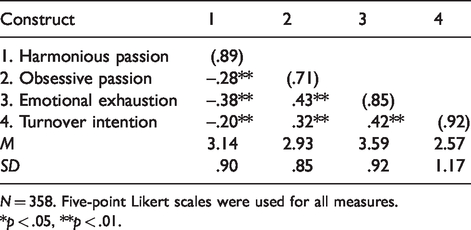
N = 358. Five-point Likert scales were used for all measures.
*p < .05, **p < .01.
Measurement model and structural model testing
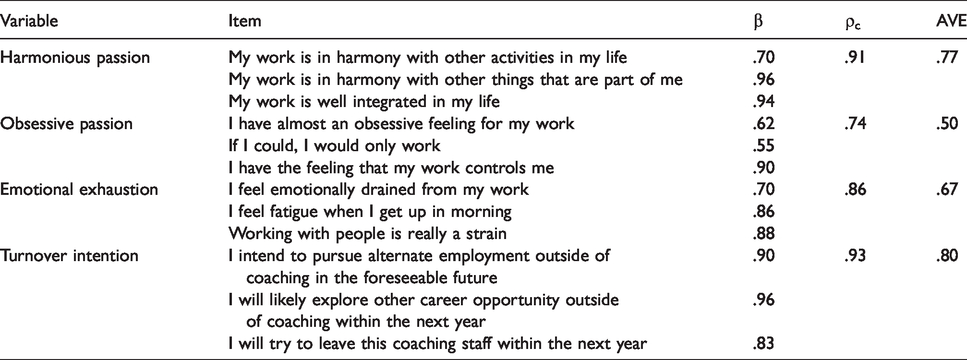
Before examining the hypothesized relationships between the proposed variables in the structural model, we conducted the concurrent CFA to verify how the observable variables define the designated latent variables and assess the psychometric properties of the measurement model. The concurrent CFA reported that the fit of the measurement model was adequate for the data, χ2/df = 569.97/260 = 2.19, CFI = .96, TLI = .95, RMSEA = .050 (90% CI: .044, 056, p = .49). Next, the analysis was carried out using the Rho coefficients were used to evaluate the reliability of the scales and all the values were > .70. The factor loadings of all the constructs were significant (.55 to .96), and all the Rho coefficients were > .70 and AVE values for all constructs were > .50 (see Table 2). Finally, discriminant validity was supported as AVE values for all constructs were larger than the corresponding correlations between constructs.
Psychometric properties of the proposed constructs.
Further, the results of SEM indicated that the structural model was an acceptable fit for the data, χ2/df = 118.27/48 = 2.44 (p < 0.01); TLI = .97; CFI = .98; RMSEA = .063 (90% CI: .049, .078, p = .07); SRMR = .050. Further, as depicted in Figure 2, emotional exhaustion had negative association with harmonious passion (β = −.17; p < .001) and positive association with obsessive passion (β = .62; p < .001), thus supporting Hypothesis 1 and Hypothesis 2. Further, emotional exhaustion had positive association with turnover intention. (β = .61; p < .05), thus supporting Hypothesis 3. Mediation analyses indicated that emotional exhaustion fully mediated the harmonious passion-turnover intention relationship β = −.09; p < .05 (sobel test, t = −3.06; p < .01) and the obsessive passion-turnover intention relationship, β = .23; p < .01 (sobel test, t = 4.05; p < .001), supporting Hypothesis 4 and 5.

Proposed conceptual model. H4 and H5 represent the mediating effects of emotional exhaustion.
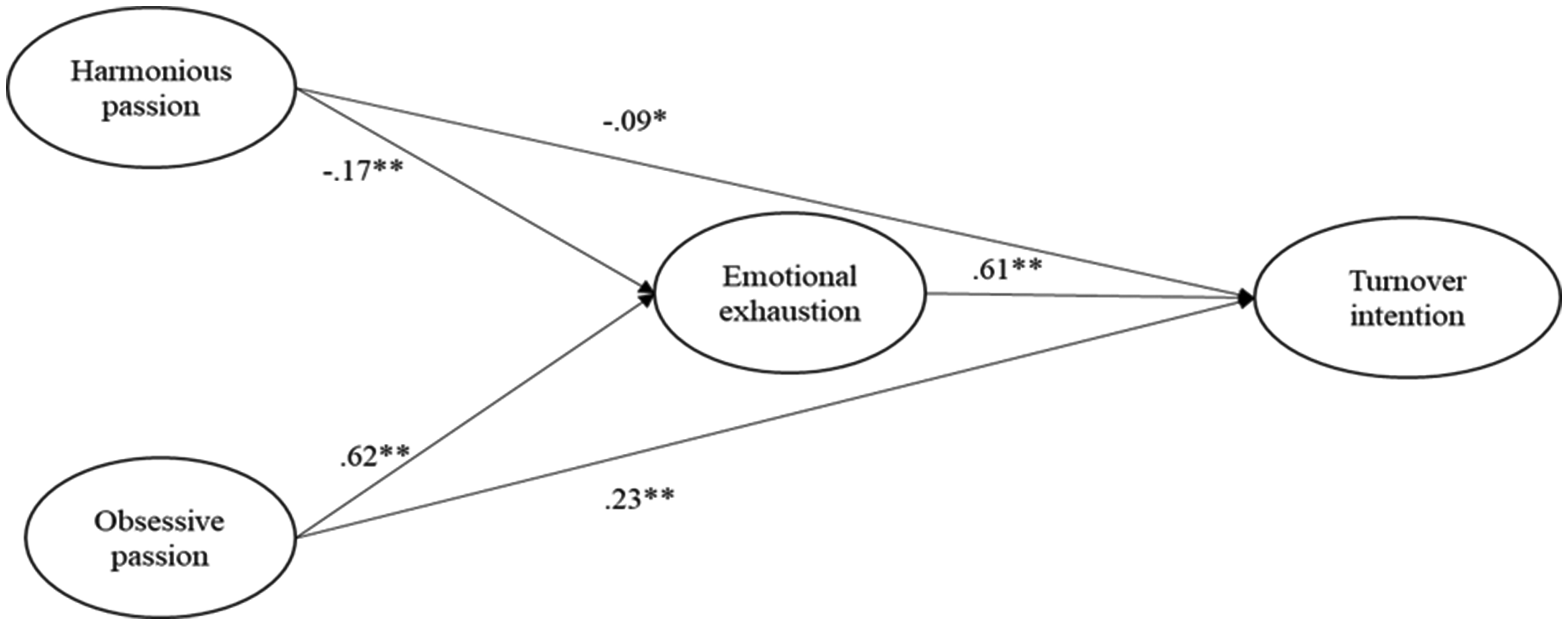
Final structural model.
Discussion
The purposes of this study were to investigate the relationships among harmonious passion, obsessive passion, emotional exhaustion, and turnover intention among high school athletic coaches. The results suggested that harmonious passion was negatively linked to emotional exhaustion while obsessive passion was positively linked to emotional exhaustion. Emotional exhaustion, in turn, was positively linked to turnover intention. Further, emotional exhaustion fully mediated the harmonious passion-turnover intention relationship and obsessive passion-turnover intention relationship. There are significant theoretical implications derived by the findings of this study.
This study found that harmonious passion was negatively linked to emotional exhaustion whereas obsessive passion was positively linked to emotional exhaustion. Although there has not been much research on why harmonious passion and obsession passion differ in relation to one’s emotional exhaustion, some explanations have been offered. Mageau and Vallerand 64 noted that due to the constant rumination during passionate activities, obsessive passion may prevent immersion in the activities and, in turn, to reduce one’s positive physical and emotional wellbeing. Carpentier, Mageau, and Vallerand 65 examined the relationship between the two types of passions, rumination, immersion experience, and individual wellbeing and found that harmonious passion was positively linked to wellbeing through an immersive experience in the passionate activities. However, obsessive passion did not significantly predict the immersion experience in the passionate activities. Instead, it was found to be positively associated with rumination, which negatively predicted well-being. Thus, individuals with high harmonious passion can have flexible participation in passionate activities and experience high level of life satisfaction, emotional attachment, and pleasant feelings. 66 However, individuals high on obsessive passions experience high levels of compulsion toward the activities, resulting in low immersion, high levels of rumination, conflict, and unpleasant emotions.30,66 Further, harmonious passion leads individuals to engage in their tasks flexibly which in turn help them let go of work after works. Thus, one can promote the prevention of emotional exhaustion through enjoying life outside of work and returning to work fully recovered and refreshed the next day. Scholars has noted that relatively little is known about the role of passion in organizational outcomes in the leadership context. 18 However, this study contributes to the existing leadership studies by demonstrating the significant associations between passion, emotional exhaustion, and turnover intention.
On the other hand, the positive association between obsessive passion and emotional exhaustion may be because of unpleasant emotions derived by obsessive passion. Philippe and colleagues 45 found that obsessive passion was positively linked to unpleasant emotions among athletes. As unpleasant emotions have the potential to increase one’s job burnout, especially the emotional exhaustion component, obsessive passion might contribute to emotional exhaustion in this study. In our contexts, athletic coaches with obsessive passion are more likely to have unpleasant emotions when facing inevitable loses and dealing with athletes, parents, and media, which in turn make them feel exhausted, with little energy. This study can contribute to coaching literature by showing how different types of passion associate with whether athletic coaches were likely to experience emotional exhaustion. In fact, previous sport literature has treated obsessive passion in positive ways, as it can be significantly associated with sport employees’ work-related attitudes such as commitment and organizational citizenship behaviors. 11 However, this study provides a balanced view on the obsessive passion constructs, as the obsessive passion can be beneficial for the sport organizations at the expenses of coaches’ wellbeing.
Further, the positive association between emotional exhaustion and turnover intention may exist because of negative job-related attitudes developed by emotional exhaustion. Schneider 67 noted that employees tended to be more interested in and stay for a longer period of time in those organizations aligned with their personal values, personalities, interests, and goals, because such organizations can increase their job satisfaction. Conversely, this implies that employees can have a stronger intention to leave organizations that fail to maintain a sufficient level of job satisfaction. Emotional exhaustion is a form of stress which can increase negative job-related attitudes toward organizations, such as feeling of loss and job dissatisfaction, which in turn can reinforce the desire to leave the organization.68,69 Thus, athletic coaches who continuously experience various factors that contribute to emotional exhaustion (e.g., pressure to win, workloads, dealing with parents and media) become unsatisfied with their jobs to the extent that they consider quitting, leading to the host of problems previously mentioned in the introduction.
This study also found that both types of passion were significantly linked to turnover intention through the mediating effect of emotional exhaustion, placing a great importance on passion in order to manage coaches’ turnover intention. Harmonious passion had negative association with emotional exhaustion, which in turn had positive association with turnover intention. Thus, harmonious passion has the potential of reducing turnover intention through reducing the effects of emotional exhaustion on turnover intention. In contrast, obsessive passion had positive association with emotional exhaustion, which can increase turnover intention level. Thus, turnover intention will be more likely to be increased when obsessive passion is strengthened, because it can make individuals emotionally exhausted. Antecedents of turnover intention in previous literature tended to be organizational-level factors (e.g., organizational climate and organizational change); group-level factors (e.g., transformational leadership and transactional leadership); and individual-level factors (e.g., organizational commitment and emotional abilities such as emotional intelligence and emotional labor;25,69,70) However, this study shows that coaches’ passion can play a significant role in reducing their turnover intention. Thus, this study can add important knowledge to the current coaching literature by introducing passion as a critical antecedent of turnover intention. More importantly, this study found the psychological mechanism of turnover intention processed as feelings of emotional exhaustion mediated the relationship between both types of passion and turnover intention.
Practical implications
Many studies on coaching have helped to better understand coaching experience and strived to provide coaches with an optimal environment. The findings of the current study suggest that harmonious passion is negatively linked to turnover intention through the mediating role of emotional exhaustion. Given this finding, athletic departments should devote more of their efforts to better organize the athletic coaches’ workplace conditions to stimulate their harmonious passion, which can not only enhance their well-being but also increase the likelihood they will retain their coaches. For example, research has shown that individuals are more likely to experience harmonious passion when exposed to an autonomy-supportive social environment. 30 This can be achieved if athletic departments allow their athletic coaches to raise their voices and share their opinions in decision-making processes, which can positively influence their coaching practices.71,72 Athletic directors can show an empowering leadership style, which is the process of giving those working under them a higher degree of autonomy in decision-making through delegation of more authority, the expression of trust in their capabilities, and the sharing of various plans and ideas to improve job performance. 73 This may be particularly relevant in contexts that trigger such environments. 71 On the other hand, top-down management systems may reduce athletic coaches’ feelings of autonomy, which can undermine their harmonious passion and stimulate their obsessive passion. Thus, it is possible that when athletic departments try to manage their coaches by assigning team goals, overly structuring their roles, providing specific instructions, and monitoring them for mistakes, the coaches may internalize this sense of a lack of control and experience lower levels of harmonious passion, as well as higher levels of obsessive passion.
On a different note, there should be an effort on the developments of interventions aimed to enhance athletic coaches’ harmonious passion. As a part of this, future coaching education programs may need to provide sessions which can strengthen harmonious passion and mitigate obsessive passion in order for coaches to avoid emotional exhaustion and turnover intention in their coaching careers. Such a session may need to explain the difference between harmonious passion and obsessive passion and their consequences, thus encouraging coaches to engage in harmonious passion, rather than obsessive passion. Additionally, in order to protect coaches from emotional exhaustion, they must be aware of how their experience of harmonious passion work together to perceive sports as enjoyable and challenging, rather than being compromised or threatened by punishment and criticism. 74
Limitations, future research directions, and conclusion
One of the limitations was that this study used cross-sectional design, thus causal interpretation of the results is not encouraged. Further, this study measures the subjective perception of passion and turnover intention through the questionnaire. In reality, collecting data through self-administered surveys is an effective way to achieve research goals, but the stereotypes of respondents may generate a risk of distorting the relationships between variables. In order to generate causal-effect relationship and evaluate the proposed variables more accurately, it is necessary to conduct a quasi-experimental research design with a random sampling process and supplement the detailed data by using qualitative data obtained from in-depth interviews.
Several options are plausible for extending the model used in the present study. For instance, future research could examine different antecedents of high school coaches’ turnover intention, including school characteristics (e.g., size and location of schools); employment characteristics (e.g., win-loss record, amount of school support, and reward system); and personal characteristics (e.g., personality, coaching experience and political skills). Further, several other mediators are available, such as positive/unpleasant emotions, basic needs satisfaction, and self-confidence. Finally, as this study found that harmonious passion was a health-beneficial type of passion, it is important to identify which factors (i.e., internal [e.g., self-confidence and internal motivation] and external factors [e.g., environment and perceived leadership style]) might predict harmonious passion in coaching contexts.
Further, this study collected data from high school coaches in the United States, limiting the generalizability of the findings of this study. Many high school coaches in the United States hold voluntary roles, serve as teachers and coaches, receive a significant amount of attention from the community, and face a high level of competition. However, this is primarily the American model, and thus the results from high school coaches or coaches who manage high school athletes in other countries may be different. For example, young people in European countries compete for their local municipality’s club teams, not for their high school teams. Coaches in South Korea fulfill a coaching role only in high schools. These differences may result in the differences in the levels of obsessive passion or the outcomes of each passion. Since this is only speculation, future research may look into the differences in the dynamics each kind of passion has for those in different countries to obtain generalizable claims about the role of passion.
Finally, this study focused on the negative coaching consequences (i.e., emotional exhaustion and turnover intention) of passion. However, the previous literature has found that the two types of passion can also have a positive impact on work-related outcomes in both general and sports-organizational settings. 35 Future research should investigate how the different kinds of passion are associated with organizational effectiveness in coaching (e.g., team records) and its underlying mechanisms.
To conclude, this study revealed that athletic coaches’ passion has a potential to increase/reduce their intention to leave the coaching profession, depending on which type of passion is dominant. Harmonious passion could mitigate coaches’ turnover intention by reducing the level of emotional exhaustion, whereas obsessive passion works in the opposite way. Thus, athletic departments should acknowledge the different types of passion and their different capabilities of affecting coaches’ turnover intention.
Supplemental Material
sj-pdf-1-spo-10.1177_1747954120976955 - Supplemental material for The roles of different types of passion in emotional exhaustion and turnover intention among athletic coaches
Supplemental material, sj-pdf-1-spo-10.1177_1747954120976955 for The roles of different types of passion in emotional exhaustion and turnover intention among athletic coaches by Ye Hoon Lee and Heetae Cho in International Journal of Sports Science & Coaching
Footnotes
Declaration of conflicting interests
The author(s) declared no potential conflicts of interest with respect to the research, authorship, and/or publication of this article.
Funding
The author(s) disclosed receipt of the following financial support for the research, authorship, and/or publication of this article: This work was supported by Hankuk University of Foreign Studies Research Fund (of 2021).

References
Supplementary Material
Please find the following supplemental material available below.
For Open Access articles published under a Creative Commons License, all supplemental material carries the same license as the article it is associated with.
For non-Open Access articles published, all supplemental material carries a non-exclusive license, and permission requests for re-use of supplemental material or any part of supplemental material shall be sent directly to the copyright owner as specified in the copyright notice associated with the article.
