



Abstract
We aimed to investigate if social networks measures can be used as indicators of training tasks' adjustment level to soccer players’ tactical skills. Twenty-four U17 male soccer players (16.89 ± 0.11 years) participated in this study. The System of Tactical Assessment in Football (FUT-SAT) was used to identify players’ tactical level and to organize them into three groups: Higher tactical level (Group 01), Intermediate tactical level (Group 02) and Lower tactical level (Group 03). Then, the players performed three High difficulty Small-Sided and Conditioned Games (HD-SSCG) and three Low difficulty Small-Sided and Conditioned Games (LD-SSCG). Teams’ interaction patterns and players’ prominence were analysed based on macro (Density – D and Clustering coefficient – CC) and micro networks (Indegree, Outdegree, Total links and Eigenvector) measures. We found that Group 01 presented higher D (p = .004 and ES = 1.189) and CC (p =.004 and ES = .785) at HD-SSCG than Group 03, whereas Group 03 presented higher values of D (p = .003 and ES = 1.200) and CC (p = .037 and ES = 1.180) at LD-SSCG than Group 01. When training tasks difficulty were adjusted to players’ tactical level, teams played more collectively and players were more actively engaged in ball circulation. We concluded that macro and micro networks measures can be applied in training context as indicators of training tasks adjustment to players' tactical level.
Introduction
Recently, several researches highlighted the benefit of applying game-based approaches to improve players' performance through representative learning environments in team sports.1–3 The use of Small-sided and Conditioned Games (SSCG), as representative training tasks, seems to be interesting since it stimulates players’ perceptual-motor skills acquisition, autonomy and ability to co-adapt their actions to key constraints that emerge in a dynamical context. 1 However, coaches need to carefully manipulate key constraints to expose players to a rich, but appropriate and adjusted learning environment for most of them. However, it is an extremely difficult process since it involves players with different skills levels and capabilities of play. 4
Task difficulties and complexities need to be adapted to players’ skills level, since this correct adjustment can potentially improve exploratory behaviors and functional performance.5,6 Machado et al. 5 revealed that high difficulty tasks inhibit the players’ capacity to explore different actions to solve game problems (i.e. exploratory behavior), and decreased the performance of younger teams, as well as teams composed of players with a lower tactical skills level. Accordingly, Machado et al. 7 highlighted that the same game configuration (3vs3 or 4vs4) and conditions used (Maintaining Ball Possession Games and Progression to the Target Games) stimulate different tactical behaviors of players of different age-categories. In this perspective, a better adjustment of training tasks' difficulty and complexity level might stimulate players’ higher engagement during SSCGs and, consequently, improving their performance. 5 , 8
In this perspective, Scaglia et al. 2 conceptualizes this greater players’ engagement within the game as Game State and the search for promoting training tasks that facilitate the players to achieve it, is a key pedagogical principle for applying game-based approaches to enhance learning in team sports, such as soccer. 2 , 9 Thus, these game-based approaches highlights the need to understand game's systemic organizational process, i.e. the game's structures and its dynamics that defines their internal logic, to recreate similar and representative conditions during training process, according to players' skills levels. 2 , 9 Therefore, we support the idea that the training process is not enough to be only game-based, but rather both a player-centered and game-based approach.10,11
Accordingly, understanding the importance to provide representative learning design, coaches and staff need to find an alternative of analysis which might provide assertively this information regarding the adjustment of tasks to players’ skills level. It is broadly knowing that the acquisition of this information could be streamlined if obtained through instruments such as Global Positioning System or other player tracking tools. However, in turn, these instruments require a high investment from sports institutions, which would make it difficult for several clubs and soccer youth academies to have access to these expensive tools. In addition, adjusting the training tasks to the players' intrinsic dynamics is an even more difficult task to succeed in practice contexts such as soccer academies, since there are several players with distinct skills levels. In this sense, we seek to investigate low-cost alternatives that allow the acquisition of information about the correct adjustment of training tasks' difficulty to players' skills level in a relatively faster way.
Considering the previous studies that show the importance of Social Network Analysis (SNA) to assess interpersonal interaction in soccer,12–15 we sought to explore it as an attempt to evaluate teams’ interaction patterns and players’ prominence levels in training contexts. Several studies used macro-networks measures, such as density and clustering coefficient, to analyze which playing styles were adopted by teams (individual or collective) during competitions and training contexts, considering the network of interactions established between the players.12,16,17 In addition, micro-networks measures have also been used to assess how players are involved and their importance for the establishment of team's interaction patterns. 14
Thus, this information provided by SNA might help us to better understand how the teams’ collectively involvement might be affected by players’ skills level and by tasks' difficulty levels as well as help us to understand players’ engagement during these tasks. Therefore, this study aimed to investigate if social networks measures can be used as indicators of training tasks' adjustment level to soccer players’ tactical skills. This information might be useful for coaches to better adjust their tasks to the training content they intend to emphasize and to their players’ skills level, providing representative and appropriate learning environments for most of them.
Methods
Participants
Twenty-four youth and non-elite male U-17 soccer players (16.89 ± 0.11 years) participated in this investigation. We provided a brief explanation of this study procedure and only the players whose parents signed a consent form participated. The procedures of this investigation agreed with the Resolution of the National Health Council (466/2012), the Declaration of Helsinki (2013) and were previously approved by the Ethics Committee in Research with Human Beings (N. 73222617.0.0000.5404).
Experimental design
The experimental design comprises two stages (Figure 1): (a) the identification of players' skills level; and (b) application of different SSCGs with different difficulty levels.

Research experimental design and Small-Sided and Conditioned Games (SSCG) applied. Note: The order of the SSCG were randomized through the three training sessions.
Identification of players’ tactical level
The System of Tactical Assessment in Soccer (FUT-SAT) was used to evaluate players’ tactical level. 18 All players participated during four minutes Goalkeeper + 3vs3 + Goalkeeper small-sided game (field size: 36 meters in length x 27 meters in width), where the teams needed to score more goals than opponent. Moreover, to better use playing time, we placed balls around the pitch for a fast replacement. Through FUT-SAT, player tactical actions, with and without ball possessions, were evaluated. This system allows the assessment of those actions based on five core offensive tactical principles (penetration, offensive cover, depth mobility, width and length, and offensive unity) and five core defensive tactical principles (delay, defensive cover, balance, concentration, and defensive unity). 19
FUT-SAT comprises the following Macro Categories: (a) Observation, which tactical principles, the place where the action took place and the action outcome were analyzed; (b) Outcome, providing measures as Tactical Performance Index, Tactical Actions, Percentage of Accuracy and Place of Action Related to the Principles to identify players' tactical performance. To perform this test, the coach organized the players into balanced teams and all the games were recorded and analyzed following all the procedures proposed by Costa et al. 18 All the players wore vests with specific colors and numbers to correctly identify them in the video analysis. A standardized warm-up of 10 minutes was performed previously the test to better prepare the players to achieve higher performance.
After the assessment of players' tactical actions, we used Tactical Efficiency Level (TEL = percentage of successful tactical actions/total of tactical actions) as an indicator of player tactical skill level. Then, by convenience, we ranked players based on their tactical efficiency level, organizing them in different groups: Higher tactical skill level (Group 01); Intermediate tactical skill level (Group 02); and Lower tactical skill level (Group 03). Group 01 was composed of eight players with the highest tactical efficiency level (1st Player: TEL = 94.14; and 8th Player: TEL = 88.3) and Group 03 was composed of eight players with the lowest tactical efficiency level (17th Player: TEL = 74.42; and 24th Player: TEL = 69.61). Regarding Group 02, it was composed of the players who occupied the ninth to the sixteenth position, considering their tactical efficiency level (9th Player: TEL = 82.33; and 16th Player: TEL = 78.54). A one-way ANOVA test was applied to confirm the differences in players’ tactical efficiency levels between the three groups. We found significant differences between the three groups of players with different tactical skills levels (p < 0.05; F(2,25)=77.07).
Application of small-sided and conditioned games with different difficulty levels
To better understand the adjustment of training tasks to players’ tactical level, we designed two SSCGs with different difficulty levels, based on an index proposed by Travassos 20 and applied by Machado et al. 5 The equation considers the ratio between the number of opponents in the game and the number of action possibilities of the player with ball possession (Difficulty level = (number of opponents/number of action possibilities of ball carrier) × 100). We consider an action possibility for a player with ball possession the following actions: keep the ball, shot at each opponents’ goal, and pass the ball to each teammate. Then, we proposed a High Difficulty Small-Sided and Conditioned Games (HD-SSCG) and a Low Difficulty Small-Sided and Conditioned Game (LD-SSCG).
Both Group 01 and Group 03 played three HD-SSCG and three LD-SSCG. Teams composed of players of Group 01 played against players with similar tactical efficiency level, and the teams were composed of the same players over the three games, in each condition (HD-SSCG and LD-SSCG). Also, players of Group 03 played against players of the same group, to minimize the influence of player tactical skill level on team performance. The HD-SSCG was a Gk + 4vs4+Gk game and the LD-SSCG was a Gk + 3vs3+GK + 3 game. Since in the HD-SSCG the player with ball possession had the actions possibilities of passing the ball to three teammates and goalkeeper, maintaining ball possession (through dribble or progression) or shooting at goal, against four field opponents and the opponent goalkeeper, this game presented a difficulty level of 83.33% (Difficulty level = (5/6) × 100). In the LD-SSCG, the player with ball possession, in a specific moment, had the possibilities of: (a) passing the ball for the two teammates; (b) passing the ball to the own goalkeeper; (c) passing the ball to the three floaters; (d) maintaining ball possession (through dribble or progression); or (e) shooting at goal. Since the defense team had three players and one goalkeeper, this game presented a difficulty level of 50% (Difficulty level = (4/8) × 100) (for more details, please see Machado et al. 5 ).
In LD-SSCG, players of Group 02 participated in the game as inside floaters, i.e. playing always with the team with ball possession. In an attempt to minimize the effect of floaters on teams’ interaction patters of both groups (Group 01 and Group 03), the same players participated in both the LD-SSCGs played by Group 01 and those played by Group 03. Therefore, only three players from Group 02 played at LD-SSCG as floaters, while the other players did not participate in the SSCGs of this second stage of the experimental design.
Both HD-SSCG and LD-SSCG were played in pitches with the same dimension (47,72 m × 29,54 m) (Figure 1). The duration of both games was 10 minutes, with 10 minutes of the interval between both game conditions played in training sessions. Also, we randomized the order of the games through the three training sessions. For example, in the 1st session, Group 01 played the HD-SSCG followed by the LD-SSCG, and in the 2nd session, they played LD-SSCG followed by the HD-SSCG. Data collection lasted one week, which was performed in three training sessions, with at least 48 hours between them.
Data collection
We used Social Network Analysis to evaluate teams’ interaction patterns and players’ prominence. Social Network Analysis has been supported by several researches to understand players’ interpersonal interaction in sports contexts. 12 , 15 In team sports, players interact through passes or synchronization of their movements. 21 Then, we analyzed teams passing distribution to evaluate interpersonal interactions, considering only completed passes performed between teammates. 12 , 21 In each SSCG, two weighted adjacency matrices were designed (one for Team A and one for Team B). Therefore, twenty-four matrices were built (Group 01: 6 matrices in HD-SSCG and 6 matrices in LD-SSCG; Group 02: 6 matrices in HD-SSCG and 6 matrices in LD-SSCG). These matrixes were used to build a finite n × n network, where number “1” represents each player’s interaction with his teammate. 15 Since we used weighted and bidirectional (passes from player A to B was different than passes from player B to A) matrices, we counted the total of passes (interactions) performed by each player with each teammate. 14
Regarding the analysis of teams’ interaction patterns (macro-level), we used two global network metrics: density and clustering coefficients. 22 The density measures the homogeneity of players' interactions, where values range from 0 (lack of cooperation) to 1 (maximal cooperation). Clustering coefficients indicate the interconnectivity level between close teammates, where values also range from 0 (lack of cooperation) to 1 (maximal cooperation). 12 Regarding players’ prominence, we used the following metrics: Indegree (number of passes received by each player); Outdegree (number of passes completed performed by each player); Total links (total of interactions performed between teammates during the game); Eigenvector, which indicates the crucial role of a single player in the offensive phase. 12 The analysis was performed through the software Gephi 0.9.2.
Data reliability
The FUT-SAT and Social Network analysis were performed by trained evaluators and the test–retest design was used for reliability, with a three-week interval between evaluations. We followed the Tabachnick and Fidell 23 recommendations and re-analyzed 11% of the overall sample (369 actions). For FUT-SAT analysis, we used Cohen’s Kappa test to calculate the coefficient of reliability. 24 We found values ranged from 0.846 to 0.900 for intra-observer reliability and values ranged from 0.810 to 0.876 for inter-observer reliability. Also, we used the Intraclass Correlation Coefficients (ICC) to evaluate data reliability for Social Network Analysis. For reliability purpose and to ensure data consistency, 68 offensive sequences were re-analyzed (10% of overall sequences). 23 , 25 We found an ICC of 0.89 for intra-observer reliability and an ICC of 0.87 for inter-observer reliability.
Statistical analysis
The Kolmogorov-Smirnov and Box’s M tests were used to verify data normality and the homogeneity of covariance matrices, respectively. 26 Since normality assumption was rejected, the Mann-Whitney test was used to identify the main differences between groups of players with different tactical skill levels (Group 01 vs Group 03) and SSCGs with different difficulty levels (HD-SSCG vs LD-SSCG). Also, we used the Wilcoxon test to compare players’ prominence between two games' conditions (HD-SSCG vs LD-SSCG at Group 01; HD-SSCG vs LD-SSCG at Group 02). Moreover, effect sizes (ES) were calculated for pairwise comparisons (ES = z.√n) and the values were reported as: negligible (<0.1), small (0.1–0.29), medium (0.3–0.49) and large (>0.5). 27 Statistical analysis was performed with the IBM SPSS 20.0 software.
Results
Regarding macro network measures, we found significant differences between HD-SSCG and LD-SSCG for both groups (Figure 2). Group 01 teams presented higher values of density (p = .004 and ES = 1.189 – large) and clustering coefficient in HD-SSCG (p = .004 and ES = .785 – large). However, teams composed of players with lower tactical skills level presented higher values of density (p = .003 and ES = 1.200 – large) and clustering coefficient in LD-SSCG (p = .037 and ES = 1.180 – large). Moreover, it was possible to observe that in HD-SSCG, Group 01 showed higher homogeneity in players’ interactions (p = .004 and ES = 1.189 – large), as well as adopted a more collectively game style (p = .004 and ES = 1.178 – large). In LD-SSCG, Group 03 presented higher homogeneity on players’ interactions (p = .003 and ES = 1.20 – large), playing more collectively (p = .004 and ES = .852 – large).

Macro-network measures in groups of players with different tactical level at High Difficulty Small-Sided and Conditioned Games (HD-SSCG) and Low Difficulty Small-Sided and Conditioned Games (LDSSCG).Data presented as mean and standard deviation.
Regarding players’ prominence measures, we found that both groups of players presented higher values for the Eigenvector metric at HD-SSCG than LD-SSCG (Group 01: p < .001 and ES = 1.544 – large; Group 03: p = .001 and ES = 1.357 - large) (Figure 3). However, when we individualized the analysis through the Wilcoxon test (Table 1), i.e. comparing a single player prominence between two game conditions (HD-SSCG and LD-SSCG), we found that players with low tactical skills level received more passes (Indegree) in LD-SSCG (p = .043 and ES = .825 - large). Also, players of both groups presented higher influence on teams’ interaction patterns in HD-SSCG (Group 01: p = .043 and ES = .825 - large; Group 02: p = .043 and ES = .813 - large).
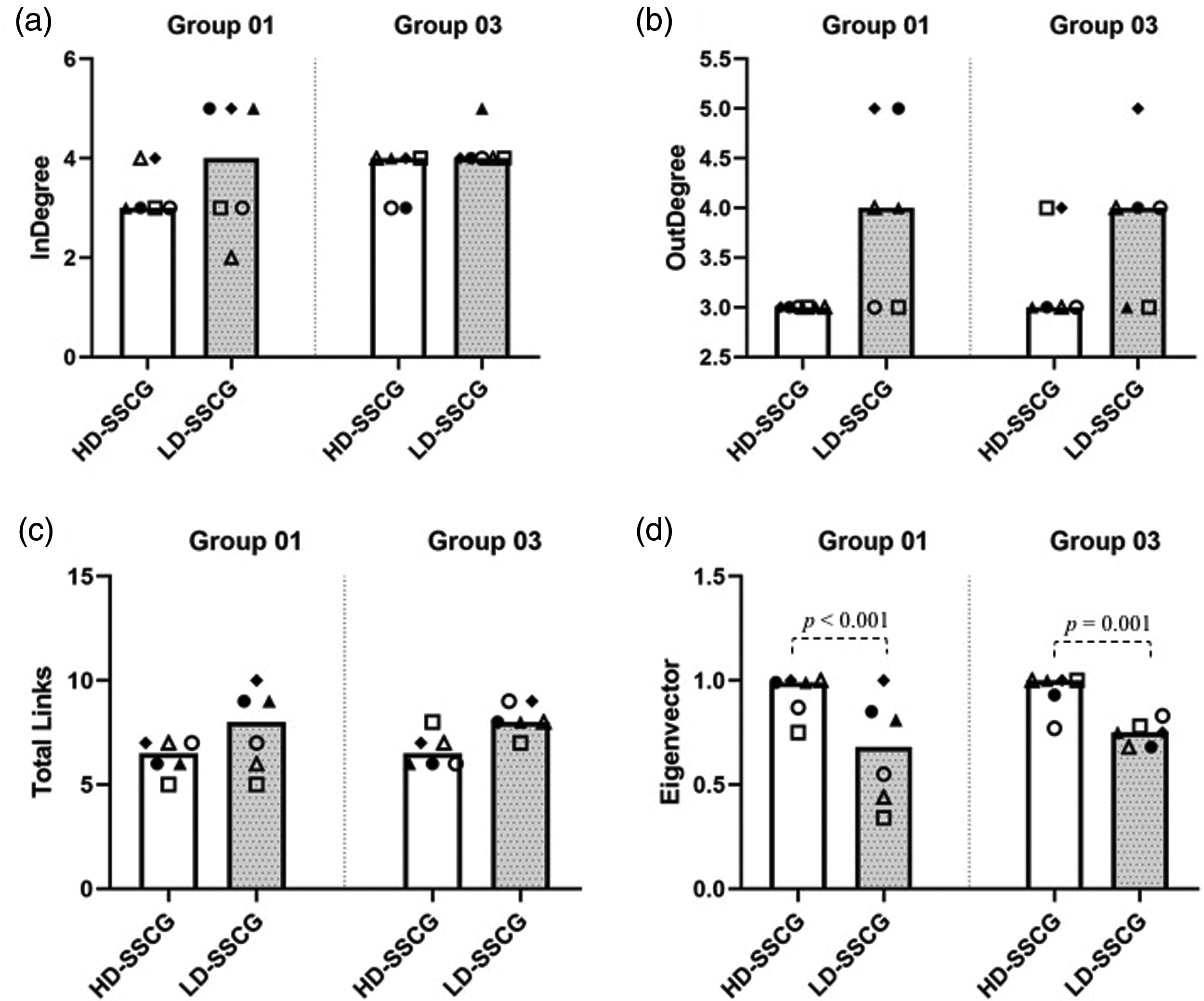
Micro-network measures presented both by each player and by groups of players with different tactical level at High Difficulty Small-Sided and Conditioned Games (HD-SSCG) and Low Difficulty Small-Sided and Conditioned Games (LD-SSCG).Data presented as mean and standard deviation.Legend: Each symbol represents one player in both games conditions (HD-SSCG and LD-SSCG).
Players prominence in High difficulty Small-Sided and Conditioned Games (HD-SSCG) and Low difficulty Small-Sided and Conditioned Games (LD-SSCG).

Data presented as median (minimum-maximum).
Discussion
This research aimed to investigate if social networks measures can be used as indicators of training tasks adjustment to soccer players’ tactical level. Regarding macro network measures, we found that teams composed of highly skilled players (Group 01) presented higher collectively involvement (density and clustering coefficient metrics) at HD-SSCG, and teams composed of low skilled players (Group 03) played more collectively in LD-SSCG. These results were interesting to show that when training task difficulty seems to be more adjusted to players’ tactical level, they seek to adopt a more collective game style to solve game problems. When the task presents a low difficulty, in the case of LD-SSCG for the players in Group 01, there seems to be no need for all players to be involved in the offensive process. Otherwise, when the task seems to present a high level of difficulty for the players, as in the HD-SSCG task for the players of Group 03, they reduce the collectively offensive playing style.
Almeida et al. 28 also observed that teams with more experienced players showed a more collectively offensive playing style, while teams composed of players with less experience players adopted a direct playing style, prioritizing individual actions during small-sided games. Praça et al. 17 found that teams composed of players with better tactical skills presented higher values of macro-network measures in small-sided games situations. At LD-SSCG tasks, we had the presence of three floaters and researches found that the presence of inside floaters increased density values, indicating these game configurations stimulates teams to adopt a more collectively playing style.29,30 However, we also found that the adoption of a more collectively playing style in SSCG with floaters might be conditioned by players’ tactical level, since teams composed of players with different tactical level adopted different playing styles at LD-SSCG. Therefore, we support that these macro-network measures can be used in the training context to show the adjustment of the tasks to players’ tactical level.
Regarding players’ prominence level, we found that when the passes received were compared by players in two different conditions (HD-SSCG and LD-SSCG - see Table 1 for Wilcoxon test), low skilled players received a relatively higher number of passes in LD-SSCG tasks. Possibly, in this task, the players were able to move better and provide their teammates with more passing options, largely due to the presence of floaters in this game condition. In this perspective, Indegree measure is an extremely important metric to provide information regarding players' capacity to put himself in a game situation that stimulates ball circulation, since after received the pass the player could opt for an individual possibility of action (such as dribble, shot or progression), this being a possible justification for not being able to observe differences for Outdegree and Total Links measures. This highlights the importance to adjust the task according to individual constraints (e.g. tactical level).
We also found that the Eigenvector metric showed good sensitivity in distinguishing tasks with the different difficulty levels. In HD-SSCG players of both groups (Group 01 and 03) showed a more active role in the offensive phase. Moreover, it was also interesting to observe that players of Group 01 presented a higher dispersion of Eigenvector measure at LD-SSCG (range of minimum and maximum values, see Figure 3(d)). This information indicates that in low difficulty games, these players showed greater heterogeneity in the contribution of each one to ball circulation, whereas in high difficulty games, they already seem to contribute to the team passing network better and equally. Through this network information, we found that all players of Group 01 seem to contribute more actively to the offensive construction in HD-SSCG. As we can observe, some players of Group 01 presented higher Eigenvector metric in LD-SSCG, actively contributing to team ball circulations, and other players presented lower values for the same metric and game condition, indicating that those players didn’t show an important and active role to team passing network.
Therefore, it is extremely important to identify the degree of players' involvement in the game. Scaglia et al. 2 support the need to promote an interaction of learning and game environments, and thus enhance players’ learning for all. In this sense, it is necessary to provide tasks that encourage greater active engagement of the players in the game, defined by the authors as game state. 8 However, it is important to highlight that we only analyze the offensive phase, therefore, we are not able to generalize these results regarding teams’ interaction patterns and players’ prominence to defensive situations.
However, information of teams’ interaction patterns and players’ prominence, analyzed in this study through social network measures, can be used by coaches as important indicators for a better adjustment of training tasks to players’ skills. In a recent systematic review, 31 researchers highlighted the most significant studies on network analyses and important factors associated with tactical actions, only two papers that met the inclusion criteria used network measures in SSCG. However, even though other researches used such analyzes to understand teams’ tactical performance in SSCG, 17 , 30 it is important to highlight that the present study differs from the others in seeking to understand how these network measures are affected both by players’ tactical level and by the pedagogical strategy used to adjust the task difficulty to players’ skills.
Since the implementation of game-based approaches is a very difficult and complex process, as it requires that coaches be able to carefully adjust their tasks to players’ intrinsic dynamics and training content which they intend to emphasize, we support that the pedagogical strategies used in this study can help coaches to better design their small-sided games to enhance players’ performance. However, this research has limitations: (a) the use of players with intermediate tactical level (Group 02) as floaters may have affected players' involvement (both Group 01 and 03 players) on passing networks; (b) the lack of information regarding floaters performance at LD-SSCG, i.e. when they played with players of higher tactical level (Group 01) and with players of lower tactical level (Group 03).
Conclusion
We conclude that social network measures can be applied in the training context as an indicators of training tasks adjustment to players' tactical level. Macro-networks measures, such as density and clustering coefficient, can highlight the degree of collective involvement in teams' offensive actions. We found that higher skilled players showed a more collectively playing style in HD-SSCG, whereas lower skilled players presented higher teams’ interaction patterns in LD-SSCG. Therefore, regarding these macro-network measures, we concluded that when training tasks seem to be adjusted to players' skills level, the teams were stimulated to play more collectively.
Moreover, we found that players’ prominence measures presented better sensibility to distinguish training tasks with different difficulty levels. In HD-SSCG, players of both groups were stimulated to present an active role in team ball circulation. However, higher skilled players presented higher and equally engagement in the offensive process during HD-SSCG, whereas lower skilled players were able to better provide passing opportunities for their teammates in low difficulty game's tasks. This information might be useful for coaches to verify the adjustment of training tasks difficulty to players’ skills level, stimulating a better and high active engagement of their players during the games, in an attempt to enhance their learning.
Footnotes
Declaration of conflicting interests
The author(s) declared no potential conflicts of interest with respect to the research, authorship, and/or publication of this article.
Funding
The author(s) disclosed receipt of the following financial support for the research, authorship, and/or publication of this article: This work was supported by the Fundação de Amparo à Pesquisa do Estado de São Paulo [2017/12142-5].
