



Abstract
Employing an arched back posture during the bench press exercise is increasingly popular. Vertical displacement of the barbell is commonly believed to be the key difference influencing strength performance between an arched and flat back bench press technique. However, comparisons between these back postures using a free weight barbell are lacking. Directly comparing performance between each posture is confounded by many variables such as proficiency and fatigue. This investigation aimed to investigate whether changing back posture alone can influence barbell kinematics, to indirectly assess potential performance differences. Twenty males performed one repetition of the bench press exercise using either an arched or flat back posture, at 25%, 50% and 75% of their one repetition maximum, in a repeated measures study design. Statistical significance was considered at p < 0.05. Changing back posture alone, reduced vertical displacement (approximately 11% average difference across all load conditions) and barbell to glenohumeral joint moment arm (approximately 20% difference) in the arched posture compared to the flat posture. These changes occurred without any specific cueing of the barbell motion and may increase the potential for lifting higher loads and decrease cumulative joint exposure. Additional cueing and training may be required to maximize the mechanical advantage available with each back posture. The arched posture appears to have an increased potential for further improvements in vertical displacement and moment arm through specific cueing. Future comparisons should consider if each back posture’s potential mechanical advantage has been maximized when assessing differences between techniques.
Introduction
Performing the bench press exercise with an arched back has gained increasing popularity, as it lifts the chest higher off the bench, requiring less vertical barbell displacement. 1 This can reduce the mechanical work (product of force and distance) required to move a specific external load, which can provide an advantage when aiming to maximize the load lifted. 1 Only one study has investigated this hypothesis and found no differences in one repetition maximum (1RM), between an arched and flat back bench press posture. 2 However, the comparison used a smith machine, which restricts horizontal barbell motion (glenohumeral joint flexion/extension in the sagittal plane).
Although vertical barbell displacement is attributed to be the primary difference between using an arched and flat back posture, horizontal barbell motion may also differ and potentially impact performance. The horizontal distance between the barbell and the glenohumeral joint, creates a moment arm that influences the required mechanical work by modulating joint moment. Reducing this moment arm to decrease the glenohumeral joint moment has been hypothesized a strategy to surpass sticking points. 3 Expert lifters have been observed to bench press with a shorter barbell to glenohumeral joint moment arm than novice lifters (approximately 6 cm difference). 4 Differences in moment arm between specific phases of the bench press have also been observed. Expert competitors reduced the barbell to glenohumeral joint moment arm during the ascent phase (upward movement of the barbell from the chest) such that it was shorter than the moment arm in the descent phase (downward movement of the barbell towards the chest), whereas novice lifters used a greater moment arm in the ascent compared to the descent phase. 5 Additionally, 1RM can be up to 22% higher when using a free weight barbell compared to a smith machine which has been attributed to the smith machine’s restriction of horizontal barbell motion that creates a fixed and constant moment arm throughout the lift.6,7 Thus, horizontal barbell motion may also influence the potential to lift higher loads, but it is unknown if there is a difference in horizontal motion between using an arched and flat back technique. Previous evidence has demonstrated that changing spine motion can influence the motion of the extremities and vice versa.8,9 It is plausible that changing back posture during the bench press has the potential to influence both vertical and horizontal barbell kinematics when using a free weight barbell.
Directly comparing performance (e.g. 1RM) between techniques when using a barbell provides multiple challenges. A repeated measures design can control for differences between participants. However, each participant would still need to be equally proficient and trained in both techniques at the same instance in time to provide an unbiased comparison of strength. Alternatively, these techniques can be compared indirectly by assessing differences between each back posture’s biomechanical profile to inform on potential differences that may provide a mechanical advantage. Quantifying inherent differences in barbell kinematics between back postures can aid in the design and interpretation of the research comparing these bench press postures as well as inform coaches on selecting and programming changes in technique.
The purpose of this study was to investigate whether changing back posture alone, can influence barbell kinematics in the bench press exercise. We hypothesized that vertical displacement relative to the onset of the lift and moment arm between the barbell and glenohumeral joint, would be lower when using an arched back posture.
Methods
Participants
A convenience sample of twenty healthy males (Mean ± SD age 21.9 ± 1.7 years; mass 95.7 ± 19.6 kg; height 1.77 ± 0.10 m) without upper body injury, who had at least two years of resistance training experience that included weekly use of the bench press exercise, were recruited. Participants provided written informed consent. All procedures were approved by the University of Waterloo research ethics board.
Procedures
A repeated measures comparison was used to compare barbell kinematics during the flat and arched back bench press postures. Participants performed one session where they bench pressed using both a flat and arched back posture with a load of 25%, 50% and 75% of their self-reported 1RM (Mean ± SD 135 ± 21; Range 102-166 kg) in a random order. 1RM was not specifically tested as the focus was to compare barbell kinematics between each technique and not maximum effort performance. Conducting a repeated measures design mandated a strategy that would reduce the likelihood of fatigue but also negated the need for a highly precise 1RM. High loads and fatigue can influence barbell kinematics in addition to changes in back posture.3,10,11 It is also unknown if these changes with load and fatigue would occur differently between each posture. Demand and fatigue may be influenced by the experimental testing procedures, along with cognitive demand required to follow instruction especially when performing the exercise according the experimental technique, as it may differ from the participant’s regular practice. 12 Demand and fatigue may also cause the participants to unintentionally revert to previously practiced movements. 13 Thus, to isolate the effects of back posture and avoid confounding factors that may additionally influence barbell kinematics, low to moderate loads were tested. Similarly, only one repetition was used to facilitate the participant’s focus on the instructed technique and to avoid deviations. The range of loads tested include loads that are used in training the bench press exercise for different purposes,14–16 and provide a vehicle to predict changes in technique as higher loads are approached. Additionally, assessing this range of loads provides insight into the threshold at which the biomechanical effects of only changing back posture outweigh previous practice or preferred motor patterns.
Participants were instructed on how to perform each bench press technique. For the flat technique a neutral spine with five points of contact were maintained throughout the lift which included the head, upper back, buttocks and both feet. 17 For the arched technique the same five points of contact were maintained but with an arched back posture. For the arched back posture, participants were instructed to moderately extend their spine but to avoid maximal spine extension. This was done to avoid forcing participants into unfamiliar and uncomfortable positons. Participants were allowed to warm up with the barbell as they usually would before a training session in preparation to lift 75% 1RM. After, this they performed one repetition at each load (25%, 50%, 75% of 1RM) with each technique, in a random order (6 lifts in total). Instruction was to keep a controlled self-selected pace to avoid jerky movements and refrain from bouncing the barbell off the chest, throughout all trials. Each participant also selected their own grip width but kept it consistent throughout all trials. Participants also paused for at least 1 second after unracking the barbell, before beginning the lift. A minimum of 3 minutes of rest was allocated between each trial.
An eight camera Vicon MX20 system (VICON, Oxford, UK) was used to track markers (14 mm Pearl Hard Reflective Marker, VICON, Oxford, UK) on the upper body of the participant. A marker on the right acromion represented the position of the glenohumeral joint and a marker on the second metacarpal of the right hand was used as a surrogate for barbell position. Position data were sampled at 50 Hz using VICON Nexus 1.7.1 software (Oxford, UK). 18 MATLAB R2014b (MathWorks Inc., Natick, MA, USA) was used to analyze the data.
Data were smoothed to reduce noise, using a zero phase second order (effective fourth order) low pass Butterworth filter with a 6 Hz cut off, as the majority of the signal power was well below this frequency. To confirm that the data was minimally influenced by the filter, a reanalysis of 36 trials without filtering showed that the mean and standard deviation of the difference was -0.01 ± 0.01 and 0.00 ± 0.04 cm for the vertical and horizontal displacements described below.
Since barbell kinematics were of interest and minimal lateral motion occurred during the barbell bench press, only the analysis of the vertical (anterior/posterior anatomical axis) and horizontal (superior/inferior anatomical axis) axes are presented here. The phases of the lift were partitioned based on position of the barbell in the vertical axis. The onset of the lift was visually determined as the instant before the barbell began to lower, following the pause after unracking the barbell. A single rater detected these onsets, blinded to the condition. Thirty six trials were rated a second time to determine intra-rater absolute consistency estimated by the standard error of measurement error (SEM= SDdiff/√2). 19 The SEM was 0.02 seconds which indicates that the rater had a high consistency for visually detecting the onset. The lowest vertical position during the lift was defined as the bottom position representing contact with the chest. The descent phase of the lift was from the onset till the barbell reached the bottom position. The ascent phase was from the bottom position to the instant the barbell position matched the height of the onset of the lift, which was considered to be the end position. Since pace was not specifically controlled, each phase was time normalized to 50 points to allow for an equal number of points when comparing barbell kinematics across trials and between phases. This was selected based on the average time of each phase across trials which ranged between 0.9 and 1.7 seconds, to reduce scaling the data by large amounts.
Peak vertical displacement was calculated as the difference in barbell height between the start and bottom positions. The mean horizontal distance between the glenohumeral joint and barbell was calculated for both the descent and ascent phase to determine the mean moment arm of the loaded barbell with respect to the glenohumeral joint. Moment arm was also recorded for the start, bottom and end of the lift.
The bench occludes the participant’s back, preventing the use of optical markers to measure back posture. To quantify the differences between the postures during the arched and flat technique, a rigid plate holding five markers was affixed on the skin overlaying the sternum, using double sided tape. The orientation of the plate with respect to the global coordinate system, was calculated using a flexion-extension, lateral bend and axial twist Cardan angle sequence. The mean flexion-extension angles were used to represent chest inclination so that differences between back postures could be inferred. Specifically, an increase in back extension would increase the chest inclination angle.
Statistical analysis
A two-way repeated measures ANOVA was conducted to assess differences in vertical displacement, moment arm at the start, bottom and end positions of the lift, as well as chest inclination angle (SPSS 26.0, IBM Corporation, Armonk, NY, USA). The independent variables were technique (arched or flat) and load (25%, 50% and 75%). A three-way repeated measures ANOVA was conducted to compare the mean barbell to glenohumeral joint moment arm between techniques. The independent variables were technique (arched or flat), phase (descent or ascent) and load (25%, 50% and 75% of 1RM). The Shapiro-Wilk test confirmed that the sampled variables were normally distributed. If sphericity was violated as per Mauchly's Test of Sphericity, the Huynh-Feldt correction was used. Bonferroni post-hoc pairwise comparison testing was conducted for any significant effects or interactions. Statistical significance was considered at p < 0.05. Hedges’s gz effect size and 95% confidence intervals (CI) were calculated for the pairwise comparisons. Hedges’s gz effect size were interpreted as small (gz = 0.2), medium (gz = 0.5), and large (gz = 0.8). 20
Results
Since discrete values were used to evaluate barbell kinematics, Figure 1 provides a visualization of the time normalized barbell kinematics to enhance the reader’s interpretation of the difference between techniques, by representing the time dependent motion from which the discrete values were extracted.

Mean barbell kinematic profile across participants of each technique for each load relative to the glenohumeral joint marker (x = 0, y = 0). The descent phase of each lift is depicted in black and the ascent phase in grey. The arched technique is represented by the solid line and the flat technique by the dashed line. Each lift starts at the top of the trace with the maximum point of the descent phase and switches to the ascent phase at the common minimum point at the bottom of each trace.
There was a significant interaction of technique*load (p = 0.028) for vertical displacement. Pairwise comparison showed that vertical displacement between the onset and lowest point on the chest was lower during the arched technique for the 25% (p < 0.001, CI: −5.5, −3.4, Hedges’s gz = 1.91), 50% (p < 0.001, CI: −5.5, −3.7, Hedges’s gz = 2.30) and 75% (p < 0.001, CI: −4.3, −2.5, Hedges’s gz = 1.67) loads (approximately 11% average difference across all load conditions, Table 1). Vertical displacement was also lower (p = 0.015, CI: −1.9, −0.2, Hedges’s gz = 0.68) for the 75% load compared to the 25% load, when performing the flat technique (Table 1).
Mean ±SD of the barbell kinematic variables for the arched and flat bench press techniques.
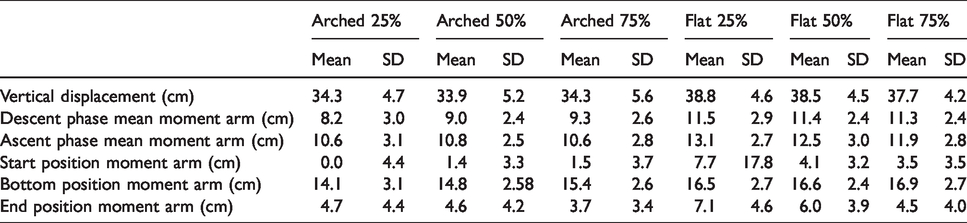
Moment arm at the start, bottom and end positions of the lift had a main effect for technique (p < 0.001). Pairwise comparison revealed that the moment arm at the start (p < 0.001, CI: −4.0, −1.8, Hedges’s gz = 1.18), bottom (p < 0.001, CI: −2.5, −1.3, Hedges’s gz = 1.34) and end (p < 0.001, CI: −2.2, −0.8, Hedges’s gz = 0.92) was lower during the arched technique (Table 1). There was also a main effect of load for the bottom (p = 0.014) and end (p = 0.003) positions. Pairwise comparison revealed that the bottom position was farther (p = 0.045, CI: 0.0, 1.7, Hedges’s gz = 0.58) and the end position was closer (p = 0.008, CI: -3.1, -0.4, Hedges’s gz = 0.74) to the glenohumeral joint during the 75% load compared to the 25% load (Table 1). The difference between the end position at the 75% compared to the 50% load had an effect size of 0.55 which can be considered medium, but the pairwise comparison was not significant (p = 0.059, CI: 0.4, 2.4, Hedges’s gz = 0.55).
The analysis of mean moment arm revealed an interaction for technique*phase (p = 0.002), phase*load (p = 0.015) and technique*load (p = 0.040). Pairwise comparisons showed that mean moment arm was shorter during the descent phase compared to the ascent phase for both the arched (p < 0.001, CI: −2.5, −1.1, Hedges’s gz = 1.16) and flat (p = 0.002, CI: −1.7, −0.5, Hedges’s gz = 0.79) techniques. Mean moment arm was shorter in the arched compared to the flat technique for both the descent (p < 0.001, CI: −3.3, −1.9, Hedges’s gz = 1.67) and ascent (p < 0.001, CI: −2.4, −1.2, Hedges’s gz = 1.42) phases. The magnitude of the difference between phases decreased, but was still significantly different, as load increased from 25% (p < 0.001, CI: 1.1, 2.7, Hedges’s gz = 1.06), followed by 50% (p < 0.001, CI: 0.7, 2.1, Hedges’s gz = 0.92) and 75% (p = 0.008, CI: 0.3, 1.6, Hedges’s gz = 0.63). Similarly, the magnitude of the difference between techniques decreased, but was still significantly different, as load increased from 25% (p < 0.001, CI: 1.9, 3.9, Hedges’s gz = 1.36), followed by 50% (p < 0.001, CI: 1.2, 2.9, Hedges’s gz = 1.10) and 75% (p < 0.001, CI: 1.0, 2.3, Hedges’s gz = 1.14).
The angle of chest inclination had a significant main effect for technique (p < 0.001) but not load (p = 0.203). Pairwise comparisons showed that the back posture during the arched technique (mean ± SD -54.5 ± 6.5°) created a greater (p < 0.001, CI: 6.2, 11.1, Hedges’s gz = 1.60) chest inclination angle than the flat technique (mean ± SD -45.8 ± 7.4°).
Discussion
Back posture affected barbell kinematics during the bench press without any specific cueing of barbell motion. As hypothesized, vertical displacement decreased when using the arched back posture due to the height of the chest. This investigation provides novel evidence that the arched back posture can also cause reductions in mean moment arm between the barbell and glenohumeral joint. This could be due to changes in joint coordination that accompany changes in back posture. The arched posture creates a start and end position with a shorter barbell to glenohumeral joint moment arm, contributing to the reduced mean moment arm during the lift.
These results indicate that the arched back posture may increase the potential for lifting higher loads, due to the reduction in mechanical work. The reduced vertical displacement may also indicate that the arched back posture may require less glenohumeral joint extension. Together, this may reduce cumulative joint stress at a specific load to improve the capacity and tolerance for training.21–24 This is particularly of importance to powerlifters, bodybuilders and those who regularly use the bench press in their training. Alternatively, the increased mechanical work and range of motion associated with the flat back posture, may be thought to increase training stimulus at a specific load or increase range of motion to enhance muscle hypertrophy. 25 However, it is unclear how this increased demand would be distributed between the joints, connective tissues and muscles. The joint kinematics used to acquire the additional range of motion may also influence this distribution. More sophisticated three-dimensional approaches that model the individual joint moments and forces to estimate load distribution, may further inform on how each technique can be used to obtain the desired tissue stimulus and outcome.26,27
Both the arched and flat back techniques had a larger mean moment arm in the ascent phase than the descent phase. This may be an inherent motor pattern in the bench press exercise that is not affected by back posture. To achieve the barbell path previously observed in elite performers (lower moment arm in the ascent phase compared to the descent phase), 5 barbell motion may need to be specifically cued, independent of back posture. This may be particularly facilitated by the arched back posture, due to its shorter moment arm in the start position which would not require additional glenohumeral joint flexion beyond that which already occurs during the lift. This can be accomplished by attempting to press the barbell horizontally towards the start position instead of the observed end position which had a larger moment arm than the start. The flat technique may not allow for such a change as the start and end positions are farther from the glenohumeral joint and may require additional glenohumeral joint flexion, beyond what may be biomechanically possible. The arched back posture also has the potential to further increase vertical displacement by increasing spine extension, much like the extreme arched postures used by some competitive powerlifters.
The differences in vertical displacement observed in this study appear to be greater than the differences previously observed when comparing the arched and flat back postures using a smith machine (greater than 1 cm difference). 2 These differences can possibly be a result of restricted horizontal barbell motion when using a smith machine. The current study showed that lifters modify horizontal barbell motion between back postures, which might allow them to create or maintain the decreased vertical displacement in the arched posture. Thus, comparing techniques using a smith machine does not encompass all the differences between the arched and flat back postures that may influence the ability to lift loads. In comparison to the previous evidence that assessed moment arm between expert and novice lifters, the current study observed smaller changes in moment arm (approximately 2 cm vs 6 cm difference). 4 The previous study was performed more than thirty years ago and used a between participant design. In addition to differences in methods and technology, the variation when comparing between individuals can be higher, leading to larger absolute mean differences. Hence, a direct comparison of absolute values between these studies is difficult. The absolute value of change in barbell kinematics may also influence the performance of each individual differently, due to inter-individual differences such as anthropometry. The differences in moment arm presented in the current study appear to be of a medium to large effect size based on the within participant variation.
As with other investigations of the response in human motion due to an intervention,28,29 there was a range in responses within the current study. Decreases in vertical displacement and mean moment arm with the arched posture relative to each individual’s flat posture ranged between 3-22% and 1-41% respectively, across loads. This suggests that changing back posture alone will not always maximize the potential for improvement available to each posture. Specific training and cueing may be required to overcome preferred or practiced movement strategies, to utilize any advantages that each technique may offer. Future comparisons should investigate more than the automatic changes that occur with each back posture and consider if the potential mechanical advantages available to each back posture have been maximized.
Since evidence comparing the arched and flat back postures while performing the bench press exercise is scarce, this work provides preliminary insight and direction for future work. However it is not without limitations. Although, the chest inclination angle is proportional to spine extension, the absolute difference between chest inclinations do not represent an equivalent difference in spine extension. Hence we are limited in our description of postural differences between the techniques. This two dimensional analysis provides variables to infer the external mechanical work, but the internal biomechanical work of the body should also be considered especially when choosing to implement any changes. For example, if unaccustomed to the arched back posture, it may initially require more effort relative to a previously practiced posture, until sufficient practice and adaptation occurs. One repetition at low to moderate loads were tested in this study but additional changes in barbell kinematics may occur with higher repetitions and higher loads.3,10 The current study indicates that the magnitude of the differences between back postures may decrease as load increases. Alternatively, increasing proficiency may help maintain the observed potential mechanical benefits at higher loads. Although the 25% and 50% loads might not be a large portion of the load used for strength specific training, they can be used when targeting technique, strength endurance, hypertrophy or power.14–16 Analyses of these loads can also inform coaching and programing the transition between techniques, which may initially include lighter loads.
In summary, changing from a flat to an arched back posture reduced vertical displacement and barbell to glenohumeral joint moment arm. These changes occurred without any specific cueing of the barbell motion and may increase the potential to lift higher loads and reduce cumulative joint exposure. Additional cueing may be required to maximize the mechanical advantage accompanying each back posture. The arched posture appears to have an increased potential to further improve vertical displacement and moment arm through specific cueing. Future comparisons should evaluate if each back posture’s potential mechanical advantage has been maximized when assessing differences between the arched and flat back bench press posture.
Footnotes
Declaration of conflicting interests
The author(s) declared no potential conflicts of interest with respect to the research, authorship, and/or publication of this article.
Funding
The author(s) received no financial support for the research, authorship, and/or publication of this article.
