




Abstract
The purpose of this study was to explore the association between coach leadership and the coach-athlete relationship. Eighty-one elite athletes (M = 20.4 years; SD = 3.8; 58% female and 42% male) responded to questionnaires pertaining to their coaches’ leadership behaviours and the quality of their relationship. The overall model for predicting the quality of the coach-athlete relationship according to perceived coach leadership behaviours explained 61% of the variance. Three transformational leadership behaviours were positively associated with the quality of the coach-athlete relationship: individualized consideration, appropriate role-modelling, and fostering acceptance of group goals and teamwork. Based on a gender comparison, men perceived higher levels of leadership pertaining to role-modelling and intellectual stimulation, in addition to higher levels of quality for the coach-athlete relationship. This research emphasizes the importance of engaging in transformational leadership behaviours with regards to associations with perceptions of the coach-athlete relationship in elite sport contexts.
In elite sport, the coach-athlete relationship is recognized as one of the key elements that affects the trajectory of an athletic career. 1 Accordingly, Côté and Gilbert 2 proposed that coaching effectiveness is comprised of professional (i.e., sport-specific/instruction), interpersonal (i.e., relational), and intrapersonal (i.e., capacity for introspection and reflection) knowledge and behaviours. Although professional behaviours of coaches such as instruction, support/encouragement, and management are integral to the coaching process, it is important to recognize the role of coaches’ interpersonal behaviours as a crucial element of coaching effectiveness. Interpersonal coach behaviours have attracted growing research attention,3–5 as they are associated with numerous positive athlete benefits.6–8 Understanding the mechanisms underlying the associations between coach leadership and the quality of the coach-athlete relationship is an important endeavor in coaching science. The present study explored how coach leaderhisp is related to the quality of the coach-athlete relationship using the full range leadership model as a theoretical framework.
The full range leadership model suggests that certain types of leadership styles are more effective at establishing quality rapport between individuals. The different types of leadership styles included in the full range leadership model are laissez-faire, transactional, and transformational. Laissez-faire behaviours imply the avoidance of decision-making and indifference towards one’s followers. 9 Transactional behaviours represent those that are more active in nature, but that are contingent on the adequacy of the followers’ abilities to execute specific standards or task. Transformational leadership behaviours relate to more proactive attempts to empower, inspire, and challenge followers to facilitate individual, team, and organizational outcomes. 10 According to Callow and colleagues, transformational leadership consists of six dimensions.6–8 Appropiate role-modelling, where leaders foster trust and respect and serve as role models for their followers. Fostering the acceptance of group goals and teamwork refers to leaders promoting cooperation among followers to attain common goals. Intellectual stimulation consists of facilitating followers’ efforts to be creative and innovative. Inspirational motivation relates to motivating and challenging followers by displaying enthusiasm, articulating a compelling vision, and providing meaning to tasks. High performance expectations represent expressions of expectations for excellence, quality, and/or high performance on the part of followers. Finally, individualized consideration refers to the genuine display of care and concern for followers’ development and achievement.
Sport research has shown that transformational leadership is related to athletes’ sport performance,11,12 sustained effort, 6 experiences of wellbeing, 13 perceptions of task cohesion, 8 and youth development. 14 Further, there is evidence to suggest that athletes who have coaches that engage with transformational leadership behaviours will find them to be more competent and be more satisfied with their coaching.15,16 Accordingly, it is likely that athletes are more satisfied with the coach-athlete relationship when coaches use more transformational type behaviours—however, this relationship has yet to be examined.
The coach-athlete relationship has been defined as the situation in which coaches and athletes’ feelings, thoughts, and behaviours are interconnected. 17 This relationship has been described in depth, with a major model comprising the dimensions of closeness, commitment, and complementarity [i.e., 3Cs 17 ] Closeness refers to the interpersonal feelings experienced by coaches and athletes. Commitment refers to the interpersonal thoughts of coaches and athletes for maintaining a close relationship over time. Complementarity refers to the coaches and athletes’ interpersonal behaviours of leadership (reciprocal) and cooperation (corresponding complementarity). Together, these dimensions represent indicators of the quality of the coach-athlete relationship. 17 Previous studies examining the 3Cs have shown that when athletes had higher perceptions of the Cs, they were more satisfied with their performance, personal treatment, and training. 18 Quality coach-athlete relationships have also been associated with athletes’ increased motivation 19 enhanced physical self-concept, 20 wellbeing, 21 improved physical and cognitive performance, 22 and team cohesion. 23 On the other hand, poor coach-athlete relationships have been associated with athlete burnout 24 and interpersonal conflict. 22
Despite the growing research pertaining to transformational leadership, 3 no studies have explicitly explored its association with the quality of the coach-athlete relationship. 4 Given that transformational leadership behaviours inspire, empower, and guide athletes in a way that nurtures honest and trustfully relationships, we hypothesize a positive association with coach-athlete relationship quality. As Jowett and Shaguman 25 stated, coaching based on interpersonal relationships is likely to lead to harmonius and stable relationships that are maintained over time and the journey to development skills and performance success is more likely to occur. Conversely, transactional leadership (i.e., contingent rewards) may not follow this pattern, as the recognition given by coaches is largely limited to the athletes sport achievements and behaviours.
In addition to the main aim of this study, we also wanted to explore the integrative model of gender and leadership from Korabik and Ayman. 26 This model describes the influence of gender on the relationship between leader behaviours and follower outcomes. For instance, Cronin and colleagues 27 found male athletes to perceive greater levels of coach transformational leadership, whereas Vella et al. 14 and Wells et al. 28 did not find gender differences in perceptions. Similarly, and based on the 3Cs, Jowett and Don Carolis 29 found girls to perceive better quality relations with their coaches than their male counterparts.
Therefore, the purpose of this study was to examine how coaches’ leadership behaviours are related to the quality of the coach-athlete relationship, as measured by the 3Cs. This study hypothesized that coach transformational leadership behaviours would be positively associated with athlete perceptions of the overall quality of the coach-athlete relationship. The secondary aim of this study was to compare the coaches leadership behaviours and the quality of coach-athlete relationship regarding to gender. No hypotheses were made about gender differences.
Methods
Participants
This study employed a cross-sectional design involving 81 elite athletes. Participants were members of the National High-Performance Centre in Madrid, Spain. On average, athletes were 20.4 years of age (SD = 3.8) with 47 self-identifying as female (58%) and 34 as male (42%). The athletes all identified as Caucasian and were involved in a wide range of sports (i.e., archery, athletics, boxing, golf, gymnastics, hockey, judo, karate, kayak, orienteering, triathlon, weightlifting, wrestling). They were trained by their coach for 2.9 (SD = 2.3 years). In line with Jowett’s 20 coach-athlete relationship descriptions, 52.6% represented relations that were newly or moderately developed (i.e., under 2 years) and 47.4% that were established (i.e., over 2 years).
Measures
Demographics
As described in the previous section, participants responded to items related to demographic characteristics, that is age, gender, sport, and the number of years they had participated with their current coach.
Coach leadership
We administered the Spanish version 30 of the Differentiated Transformational Leadership Inventory for Youth Sport (DTLI-YS; 31]. The Spanish version of the DTLI-YS has 23-items within six subscales: contingent rewards (e.g., “My coach gives me special recognition when I do very good work”); fostering acceptance of group goals and teamwork (e.g., “My coach develops a strong attitude and spirit among team members”); appropriated role-model (e.g., “My coach leads from the front whenever he/she can”); intellectual stimulation (e.g., “My coach challenges me to think about problems in new ways”); inspirational motivation a (e.g., “My coach talks enthusiastically about what needs to be accomplished”); and individual considerationa (e.g., “My coach recognizes that different players have different needs”). Each item was responded to on a five-point Likert-type scale anchored by 1 (Not at all) and 5 (All the time); thus, higher scores represented greater amounts of leadership behaviours. In the present study, all factors had acceptable McDonald’s ω’s (>.71; .90 for overall scale; see Table 1).
Descriptive statistics and correlations of study variables.
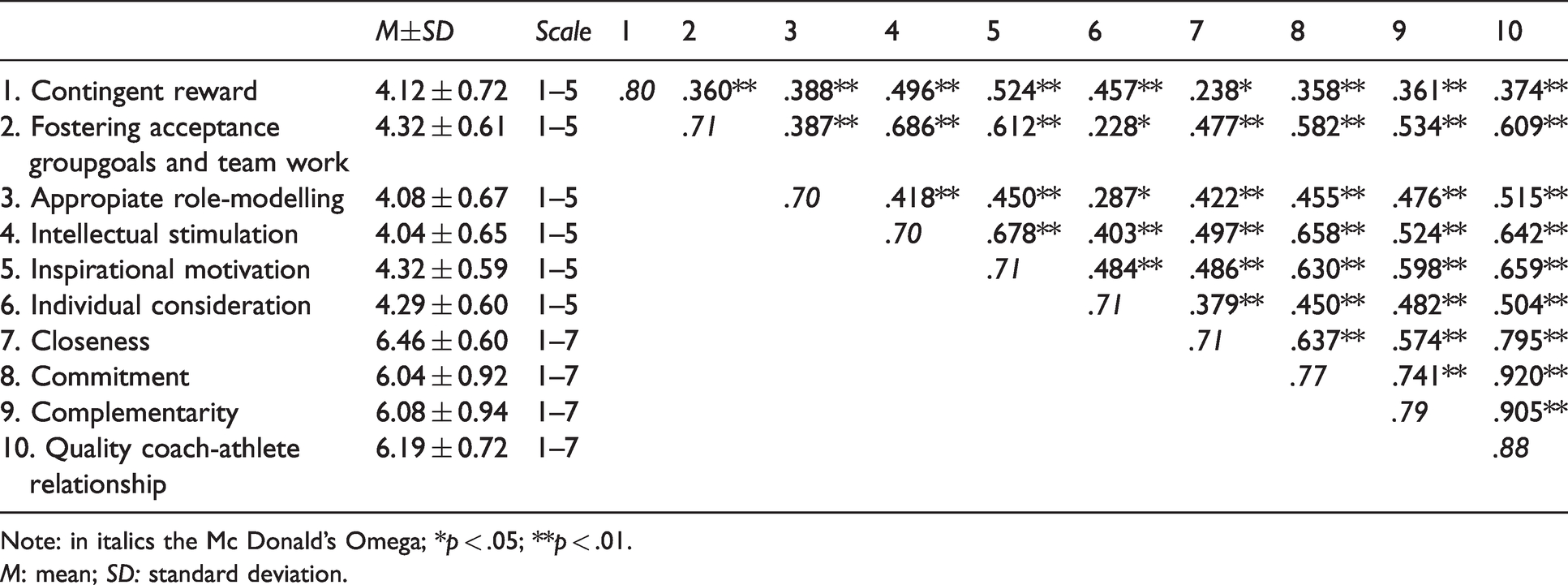
Note: in italics the Mc Donald’s Omega; *p < .05; **p < .01.
M: mean; SD: standard deviation.
Coach-athlete relationship
We used the Spanish version 31 of the Coach-Athlete Relationship Questionnaire (CART-Q17,32) which was validated in a dance context, making minor changes (wording) for this study. For example, instead of teacher, taught, and dance, we used the original words of coach, train, and sport from the English version. The CART-Q comprised of 11-items involving three subscales: closeness (e.g., “I respect my coach”), commitment (e.g., “I feel committed to my coach”), and complementarity (e.g., “When I am coached with my coach, I am ready to do my best”). Each item was responded to on a seven-point Likert-type scale anchored by 1 (Strongly disagree) and 7 (Strongly agree). All factors had acceptable McDonald’s ω’s (>.70; .88 for overall scale; see Table 1), and as the factors were highly correlated between them, the current study used a global score which is consistent with past literature (e.g.,14,18,24)
Procedure
Following ethical approval from the lead authors’ institution, the head of the National High-Performance Centre of Madrid was contacted to gauge their interest in allowing their athletes to take part in the study. Once they agreed, the informed consent from participants was obtained prior to approaching athletes. An individual from the research team described the study to interested athletes and aided in the distribution of the paper-and-pencil questionnaires at the centre. Athletes completed the questionnaire privately in their room. From the 160 questionnaires distributed, 86 were returned, and five of those were discarded as they were not completed. The entire sampling period took approximately one week.
Data analysis
We first examined the bivariate correlations of the study variables. To determine the unique contribution of individual athletes’ perceptions of coach leadership on the quality of the coach–athlete relationship, we performed a standard multiple regression analysis. The criterion variable was a composite score of coach-athlete relationship quality, and the predictor variables were the six leadership subscales of the DTLI-YS. Mann-Whitney U tests were applied for gender group comparisons. The f2 and r indexes were the effect size indicators. 33 Data analyses were performed with IBM SPSS version 26.0 34 and the α-level was set at .05.
Results
Preliminary analysis
Means, standard deviations, correlations, and McDonald’s omegas (ω’s) for the study variables are reported in Table 1. Provided that the amount of missing data was limited (i.e., less than 3% of scale-scored items), missing values were overcome using the harmonic mean of remaining items on the subscale. 35 Three cases were identified through Mahalanobis distance as multivariate outliers with p < .001 and were deleted, leaving 78 cases. The post hoc power with this sample was .98 for large effect sizes at α = .05. The correlations showed direct and significant relationships among all variables.
Main analysis
Table 2 presents the results of the overall model for predicting the quality of the coach-athlete relationship based on coach leadership was significant (F(6,71) = 18.77; p < .001; R2 = .61; Cohen’s f2 = 1.59). The adjusted R2 value of .58 indicated that almost two-thirds of the variability of the quality of coach-athlete relationship was predicted by coach leadership subscales. For the three regression coefficients that were significant, 95% confidence intervals were calculated: fostering acceptance group goals and teamwork (0.033 to 0.539), appropriated role-model (0.048 to 0.418), and individualized consideration (0.098 to 0.525). These three predictor variables in combination contributed.11 in unique variability (semipartial correlations). Altogether, 50% (47% adjusted) of the (shared) variability in the quality of coach-athlete relationship was predicted by the six predictor variables. The size and direction of coefficients suggested that the overall quality of the coach-athlete relationship was positively related with transformational behaviours such as fostering acceptance of group goals and teamwork, appropriated role-modelling, and individualized consideration. Multicollinearity was optimal for the four regression analyses as all tolerance values were above 0.10 and the variance inflation factor (VIF) values for each predictor variable was below 3. 36
Standard multiple regression results.
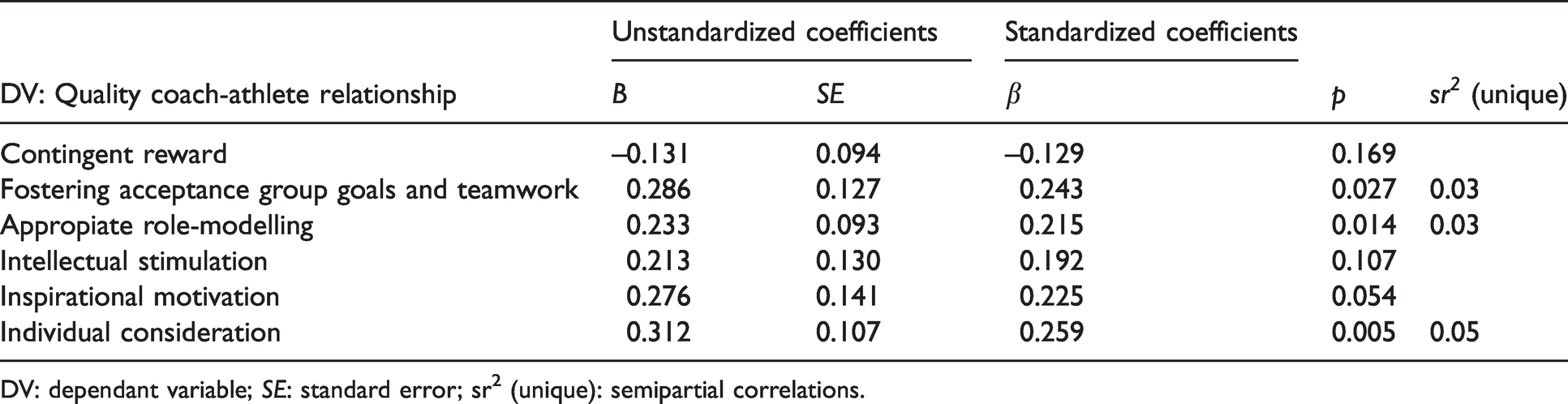
DV: dependant variable; SE: standard error; sr2 (unique): semipartial correlations.
Gender comparisons are reported in Table 3. Men perceived higher levels of coach leadership for appropiate role-modelling (z = 2.1; p = .017; Cohen’s r = 0.24) and intellectual stimulation (z = 1.9; p = .023; Cohen’s r = 0.22), and also perceived better quality relationships with their coaches (z = 1.8; p = .032; Cohen’s r = 0.21) than women.
Gender comparison results.

Note: Significant difference between groups at *p < .05.
M: mean; SD: standard deviation.
Discussion
This study examined how coaches’ leadership is associated with athletes’ perceptions of the quality of the coach-athlete relationship. In relation to the main aim, the overall model for predicting the quality of the coach-athlete relationship according to perceived coach leadership behaviours explained 61% of the variance. Three transformational leadership behaviours were positively associated with the quality of the coach-athlete relationship: individualized consideration, appropriated role-modelling, and fostering acceptance of group goals and teamwork. In relation with the secondary aim, men perceived higher levels of coach leadership for appropiate role-modelling and intellectual stimulation. They also perceived their relationship with their coach to be of higher quality than women.We will describe the relevance of these findings, highlight the limitations of this research, and propose practical implications in the following sections.
Regarding the general correlations, we found direct relationships between all variables. Our results of the coach leadership and coach-athlete relationship were in agreement with previous studies with samples of similar age7,12,14,18,21,37 and with those involved in individual sport types. 37
In relation to the regression analysis, a high variance (61%) of the coach-athlete relationship was explained by coach leadership. This is a novel finding. Previous research has suggested that coach leadership and coach-athlete relationships may work synergistically,14,23,38 however, this proposition had not been explicitly explored. This result is in agreement with Jowett and Nezlek, 18 whereby for high sport level (national or international level), the quality of the coach-athlete relationship was stronger than for low levels of competition (club or regional level). Our study sample was comprised of elite athletes, so this study would posit that at elite levels, coach leadership behaviours are associated with perceptions of the coach-athlete relationship. Being involved in elite sport implies intense training sessions with stresfull, and extreme events (e.g., injuries, burnout), so a quality relationship with a coach could serve as a source of support in challenging situations.18,35–38
The regression coefficients demonstrated how three transformational leadership behaviours were positively associated with the quality of the coach-athlete relationship. In this regard, caring for the other within a relationship, considered in this study as individual consideration, seems to play a central role in the quality of that relationship. 20 The individual esteem-related support has been highlighted as a key behaviour in transformational leadership in sport environments.12,14,22 The appropriated role-modelling of behaviours refers to when leaders foster trust and respect and serve as role models for their followers. Indeed, coaches represent salient roles within the sport environment and are seen as experts in the area. 2 Accordingly, all other social agents (e.g., athletes, parents, sport staff) interact with and observe coaches, 14 so how they behave is expected to be positively associated with the quality of the coach-athlete relationship. Fostering the acceptance of group goals and teamwork refers to leaders promoting cooperation among followers and get them to work together towards a common goal. Surprisingly this result could be expected among team sport, 8 however in our study most of the sport disciplines were individual in nature. So even in those sports, the perception of inclusion, of being supported, of emphasizing a common goal are of relevance for developing the coach-athlete relationship.6,39 Perhaps at elite level and in individual sports, the intensity and demands placed on the coach-athlete relationship are higher and therefore there is a higher need of feeling supported.40–43
Regarding the gender comparison, men rated some transformational leadership behaviours higher than did the women. Specifically, we found higher perceptions of intellectual stimulation and appropiate role-modelling for men, which is supported by a previous study. 27 Men also perceived that their relationship with their coach reached higher levels of quality than women. Even though we did not ask for the coach gender, 90% of the coaches at the National High-Performance Center are men, so our results may be biased in the sense that men feel more comfortable and complimentary with their coaches than women. Indeed, same gender coach–athlete dyads (men athlete-men coach) appear to perceive higher levels of quality relationship than their other gender coach–athlete dyads.18,44 Future research should purposefully strive to uncover these differences and actively recruit samples within centres that do not have such an unequal representation as was found in our context.
The current research adds to the growing body of evidence that suggests that coach leadership influences the quality of coach-athlete relationship in an elite athlete sample. It is however important to recognize certain research limitations. First, this study was correlational in nature, and causal relationships between these data cannot be assumed. A longitudinal design throughout a season or over several seasons may offer a better perspective for how this relationship changes over time. Secondly, the size of the sample, although unique, was small and the study may have deficient in statistical power detect smaller effects than f2 = .19. 33 Thirdly, about the tools, event though we applied the Spanish version of the DTLI-YS, 30 we did not measured the high performance expectations from the original DTLI 7 and this dimension could be relevant at elite sport level. 45 Also, we only considered the CART-Q as a direct measure of athletes’ perceptions, we did no considered the metaperspective (i.e., the degree to which one relationship member can accurately infer the other member’s closeness, commitment, and complementarity) to further understand the co-orientation of the relationship.17,19,32 In the same vein, coach behaviours were assessed by means of the athletes’ perceptions, so they were not cross-checked with any other observation methodology. For instance, a newly developed observation instrument, the Coach Leadership Assessement System (CLAS) can be used in future studies to substantiate athletes’ perceptions. 46
The practical implications of this research lead us to propose coaches could enhance the use of interpersonal behaviours in their coaching routines. It has been suggested that caring for each athlete as an individual, promoting intellectual stimulation, behaving as a role-model, and fostering the coaching activities as a team, would help at developing the coach-athlete relationship . In this regard, it is more about the quality of the interactions than the quantity of them. 37 Therefore, we suggest that Coaches Development Programs should include interpersonal skills and behaviours in their requirements and contents of their courses. 47
Footnotes
Declaration of Conflicting Interests
The author(s) declared no potential conflicts of interest with respect to the research, authorship, and/or publication of this article.
Funding
The author(s) disclosed receipt of the following financial support for the research, authorship, and/or publication of this article: This work was supported by the “Salvador Madariaga” program of the Ministry of Sciences, Innovation and Universities of the Government of Spain. (PRX19/00106).
