




Abstract
In rugby league and rugby union, the ball carrier is vulnerable to injury during a tackle. The height of the tackle has been associated with injury risk. The extent to which a ball carrier may alter their approach entering a tackle in response the tackler’s body height is unknown. This exploratory study aimed to identify if, when and how, the ball carrier modified their motion when being tackled in response to tackling instructions given to the tackler. Three-dimensional analysis was completed on 15 adult male rugby union/league players performing a front-on, one-on-one tackle at differing tackle heights. Repeated measure factorial analyses of variance were used to test for differences (P < 0.05). The ball carrier used two movement strategies: (1) increasing their stability by flexing their trunk, knee, and hips more when entering mid/high torso tackles; (2) offloading the ball or performing an evasive movement strategy by positioning themselves in a more upright body position when being tackled at a lower torso tackle height. This preliminary evidence suggests it may be beneficial for a coach to provide different instructions to the ball carrier to modify their movement strategies when being tackled in response to the height of the tackler to improve their performance and decrease their potential injury risk.
Introduction
The tackle is an integral event in rugby league and rugby union, and accounts for the highest proportion of injuries during match1–3 and training1,3 situations, including head injuries4–6 and concussion.7–11 In professional rugby union, approximately 25–30% of head injuries and concussion in the tackle occur to the ball carrier. 11
To date, the focus of tackle technique research in the rugby codes has been directed toward technical proficiency in relation to injury prevention and/or performance, 12 and has primarily employed a qualitative two-dimensional (2D) video approach. 13 2D video analysis of real game situations provides critical insight on how injuries occur during the tackle and how tackle performance can be optimised. The ball carrier is most frequently tackled in a game when they are running at a slow speed, 14 and when the ball carrier is injured in a tackle, it is most often while they are running at slow speed.14,15 A ball carrier’s highest propensity for a head injury occurred when they were static and the tackler was moving at high speed. 5 Tackle height is a significant risk factor for injury. Among legal tackles, most tackles involve contact to the upper (36%) or mid/lower (32%) torso. 14 The upper body tackle has the greatest risk of concussion, and by virtue of risk and frequency, it accounts for 83% of concussions to the ball carrier in professional rugby league. 16 High tackles that are deemed illegal (i.e., defined as contact made on/above the ball carrier’s shoulder) in professional rugby union are 36 times more likely to result in a Head Injury Assessment (HIA) compared to a legal tackle. 5 The overall risk of a head injury is 4.3-fold greater when the tackler makes contact above the sternum of the ball carrier, even when legal. 5
Technique has also been identified as a risk factor for injury, 12 including head injury, 17 to the ball carrier. Head injury risk is reduced when the position of the ball carrier is bent at the waist position as opposed to an upright position at contact,5,18 straight back posture, leg drive upon contact, 18 and explosiveness on contact.17,18 Essential insight into how the ball carriers’ and tacklers’ behaviour during a tackle interact to alter injury risk can be ascertained when both ball carrier and tackler technique are analysed.5,17,18
Three-dimensional (3D) motion capture analysis 19 is considered the ‘gold standard’ for quantitative video analysis, overcoming the limitation of the qualitative 2D issues, such as inconsistent/no definition, 13 trouble coding the event,20,21 and reliability.13,21 Research utilising 3D retroreflective motion-capture to study the tackle is emerging, with only eight laboratory studies published to date.22,23 The limitations of time, space and cost of 3D retroreflective motion-capture, and the methodological issues associated with measuring accurate in-game 3D tackling technique are yet to be overcome. 22 Only three 3D tackling studies reported ball carrier biomechanics. Head kinematics of the ball carrier were modelled in two 3D studies,24,25 identifying higher resultant head acceleration in a high rather than low trunk tackle height. 25 The third 3D study only qualitatively categorised the ball carrier movement prior to impact, finding that the ball carrier modified their movement according to tackle type. 26 Therefore, the aim of this exploratory study was to identify if, when, and how, the ball carrier modified their motion when being tackled, in response to specific tackle instructions given to the tackler. It was hypothesised that when anticipating an upper torso tackle, the ball carrier would employ a head position ‘up and forward’ and less trunk flexion compared to the lower torso tackles.
Methods
Participants
Using the trunk flexion angle at contact of a tackler when they performed an upper and lower torso tackle, 27 we estimated a prior sample size calculation for two-tailed t-test with an error probability and statistical power of 95% using G*Power software. 28 A sample size of 14 participants was deemed sufficient. Amateur or semi-professional male adult rugby league or rugby union players (n = 15) who were injury free at the time of testing were recruited from grade competitions. The participant’s playing history and current playing details were recorded. Written informed consent was obtained from each participant prior to their participation in data collection. The study design and methodology was approved by university Human Research Ethics Committee.
Experimental procedures
Each data collection session involved two participants who were randomly allocated a ball carrier or tackler role. Prior to the tackle data collection phase, each participant answered questions regarding their sporting participation and had their anthropometric measurements taken (height; body mass; pelvis, xyphoid and chest depths) to later input into the mathematical model. To measure the participant’s 3D motion during the tackle, 85 retroreflective markers were placed on both participants whole body. 29 With the participants in an anatomical standing position, a static trial was recorded.
Under the guidance of an expert coach, participants were given instructions to perform a set of 10 trials of four different tackling instructions of a one-on-one, front-on, torso tackle, for a total of 40 tackles. Participants performed the 40 trials in one of two orders: (i) LowerNRL, MidTorso, UpperNRL and then UpperPop; or (ii) UpperNRL, UpperPop, LowerNRL and then MidTorso. The participants were given 30 seconds rest between each trial and approximately five minutes rest between each tackling variant (i.e. after 10 trials) to minimise the effects of fatigue. The entire series of 40 tackles thus took 35 minutes. Once all 40 tackle trials were completed, the roles of ball carrier and tackler were swapped, and the study methods were replicated once more with the participants in their new roles. The total session duration was approximately three hours involving: two 35 minute tackle sets; attachment of the retroreflective markers on each participant and static trial prior to each tackle set; completion of sporting history participant questionnaires; and anthropometric measures of each participant.
Four tackling instructions
The four tackling instructions performed in this study are outlined in Table 1, in accordance with the tackle torso height and type of torso contact. Appendix 1 provides animation video of these tackle instructions. Two of the tackling instructions, the UpperNRL and LowerNRL, were based on the traditional, one-on-one, front-on, tackling technique outlined in the National Rugby League (NRL) Coaching Manual 30 and TackleSafe program. 31 The NRL TackleSafe program 31 categorises tackle type by tackle height based on the previous research of Tierney and Simms 32 The NRL coaching manual 30 was used as the basis for two of the tackling instructions in which the tackler contacted the ball carrier on the lower (LowerNRL) or upper torso (UpperNRL).
Categorisation of the tackling instruction.

These two NRL tackle instructions were modifying based on the expert coach’s playing and coaching experience. The expert coach is a recently retired dual international rugby league and rugby union representative player with coaching experience with both junior and senior rugby league and rugby union players. The tackling instructions were modified by instructing the tackler to change the way they contacted the ball carriers’ torso via a vertical ‘pop action’ (UpperPop) or by slightly increasing the height at which the tackler contacted the ball carrier from lower to mid torso and redirecting the ball carrier into a vertical and backward direction (MidTorso). The rationale for the UpperPop instruction was to focus on redirecting the motion of the ball carrier into a vertical direction rather than counteract the horizontal opposing direction of the ball carrier. Whereas, the MidTorso was employed to enable the tackler improved positional awareness of the attacking player(s) by allowing them to position their posture in a more head up and forward posture and partially bent over posture, and then to contact the ball carrier’s torso above their centre of gravity, to reorientate the ball carrier’s forward motion into a vertical direction.
Each tackler was instructed to perform each of the four tackling instructions by the expert coach who attended all data collection sessions, who verbally explained, physically demonstrated, and supervised each session. Each instruction period prior to each tackling instruction typically lasted five minutes and was concluded when the coach was satisfied that the tackler understood the important principles required. Coaching feedback was given to the tackler after every trial by the expert coach. The ball carrier was present when the tackler was given the coaching instructions, and thus was not blinded to the four tackling instructions that they would subsequently encounter. Ball carriers were instructed not to brake or change line at impact. Following the instruction period, the tackler performed several familiarisation trials of that tackling instruction.
Tackling trials
As the literature on whether or not tackling technique differs when engaging with the dominant or non-dominant shoulder side is mixed,33,34 for each of the 10 trials, the first five trials were completed using the dominant shoulder side, and then the subsequent five trials were completed using the non-dominant shoulder side.
To limit the confounding factor of speed of the tackler and ball carrier, 11 standardised instructions were provided to the participants. Participants stood stationary approximately 4-metres apart. They were instructed to run towards each other and engage in player contact at an estimated 80% intensity of their match play tackle. These experimental task instructions resulted in a slow tackle speed; defined as walking or jogging into the tackle by Fuller, Ashton, Brooks 15 .
Due to the concern of the skin mounted retroreflective markers, each tackle was not completed to the ground. The experimental tackle condition was completed on 20 m2 foam matted area (1000 × 1000 × 40 mm jigsaw mat underlay, 2000 × 1000 × 40 mm Tatami Judo mat (Southern Cross Mats, Sydney, NSW & Melbourne, Victoria).
Data collection
The whole-body 3D kinematic of both participants for each tackling trial was recorded with 15 Oqus 700+ motion capture cameras (300 Hz; data collection volume 10×10×6 m) using Qualisys Track Manager software (v.2018.1, Qualisys AB, Göteborg, Sweden) and analysed with Visual 3D software (Version 6, C-Motion, Germantown, MD, USA). A sampling rate of 300 Hz was based on the spectral analysis 35 of the tackler’s and the ball carrier’s 3D head linear and angular acceleration. The median frequency that captured 99% of the data occurred below 49 Hz. Prior to calculating the kinematic variables, the raw kinematic data was interpolated with a cubic spline and then filtered with a zero phase fourth order low pass Butterworth digital filter (fc = 18 Hz). As per the protocol of Schaefer, O'Dwyer, Ferdinands 29 the segmental masses and inertial properties were modelled. To calculate joint and segment angles a local Cartesian coordinate system (x-axis mediolateral; y-axis anterior-posterior; and z-axis superior inferior directions) was employed and x,y,z Cardan sequence used.
Three time-points were identified for tackler and ball carrier behaviour, based on Kawasaki, Tanabe, Tanaka 27 : two steps prior to contact (Step 2); one step prior to contact (Step 1); and contact between the ball carrier and tackler. The detailed procedures to determine the frame of occurrence of each event is outlined in Appendix 1 and were confirmed through visual inspection. At these three time-points within a tackle, joint angles (ankle, knee, hip, lumbopelvic [lumbar segment relative to the pelvis segment], thoracolumbar [lumbar segment relative to the thoracic segment], Trunk-Pelvis [trunk segment relative to the pelvis segment]), and segment angles (thigh segment, pelvis segment and trunk segment relative to the laboratory coordinate system) of the ball carrier were calculated. The speed of each player approaching the tackle (at the time of pre-contact) and at the time of contact was obtained from the player’s resultant centre of mass velocity.
Statistical analysis
The kinematic variables of the four types of tackling instructions were verified to ensure the assumptions of sphericity and normality of distribution were met. A series of repeated measure analyses of variance (RM ANOVA) using Statistica (v.13.3, StatSoft Inc., Tulsa, OK, USA) was then conducted to ascertain if any significant changes (p < 0.05) occurred within the means of any of the outcome variables between the four types of tackling instructions (LowerNRL, MidTorso, UpperNRL, UpperPop). This statistical procedure was performed for the approach and contact speed, and the sagittal plane angles at each event (step 2, step 1, contact). Results are reported as means with 95% confidence intervals.
Each statistical analysis involved two or three factors. The four different of tackle instructions was represented by the ‘type’ factor. The factor of ‘dominant shoulder side’ denoted when the tackler used either their dominant or non-dominant shoulder side to engage body contact with the ball carrier. The ball carrier’s rear lower limb (the foot that made foot-ground contact at Step 2) and lead lower limb (the other foot that made foot-ground at Step 1) represented the ‘lower limb’ factor. For the ankle, knee, and hip angles, three factors (type x dominant shoulder side x limb) were used. For the trunk joint angles (lumbopelvic, thoracolumbar, trunk-pelvis), segment angles (thigh, pelvis, trunk, head), contact speed, approach speed two factors (type x dominant shoulder side) were employed.
Factorial ANOVAs were used in this study as several dependent variables were being assessed and this enabled management of the experimental-wise error and allows tests of individual variables when significant effects are identified. This is important when measuring a large quantity of sources of variance (i.e. type of tackle instruction, dominant/non-dominant side shoulder engagement by the tackler, and leading or rear lower limb), as this statistical procedure should be a lower variance when considering experimental error. 36 Where such main effect(s) or interaction(s) occurred in the RM ANOVA, Tukey post hoc tests were executed to determine the precise locus of effect. Partial eta square in accordance with Richardson 37 was used for effect sizes and defined as trivial (<0.099), small (0.099–0.0588), moderate (0.0588–0.1379) and large (>0.1379).
Results
Participant characteristics
Rugby union (n = 8), rugby league (n = 2), or players that played both rugby codes (n = 5) were recruited (mean age: 24.3 ± 6.1yrs, height: 1.8 ± 0.1m, body mass: 91.4 ± 12.8kg). Participants played in either a forward (n = 8) or back (n = 7) position. Playing experience ranged from 4–30 years (12.7 ± 6.3) with participant’s highest level of participant at club rugby (n = 9), regional (n = 3), state (n = 2) or national level (n = 1).
Approach speed/speed at contact
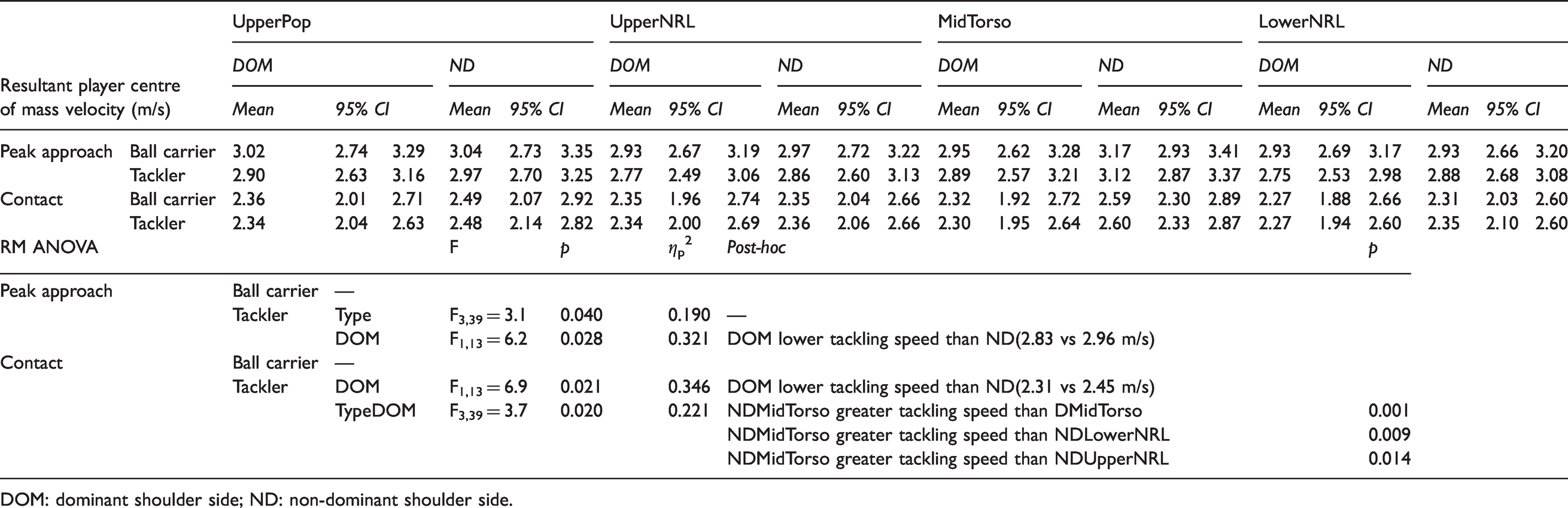
Peak approach speed before contact or at contact of the ball carrier and tackler (Table 2) revealed no significant main effect of type of tackle. A significant type*dominant shoulder side interaction was observed for the tackler, but not the ball carrier approach speed. Post-hoc testing revealed that for the non-dominant shoulder side UpperNRL and LowerNRL and the dominant shoulder side MidTorso instruction the speed at contact remained unchanged, but for the non-dominant shoulder side MidTorso instruction, the tackler significantly increased their speed at contact (Table 2).
Resultant centre of mass velocity (mean ± 95% confidence interval and RM ANOVA results) of the ball carrier and tackler across four variants of the tackling technique.
DOM: dominant shoulder side; ND: non-dominant shoulder side.
Kinematics at the time of step 2, step 1, and contact
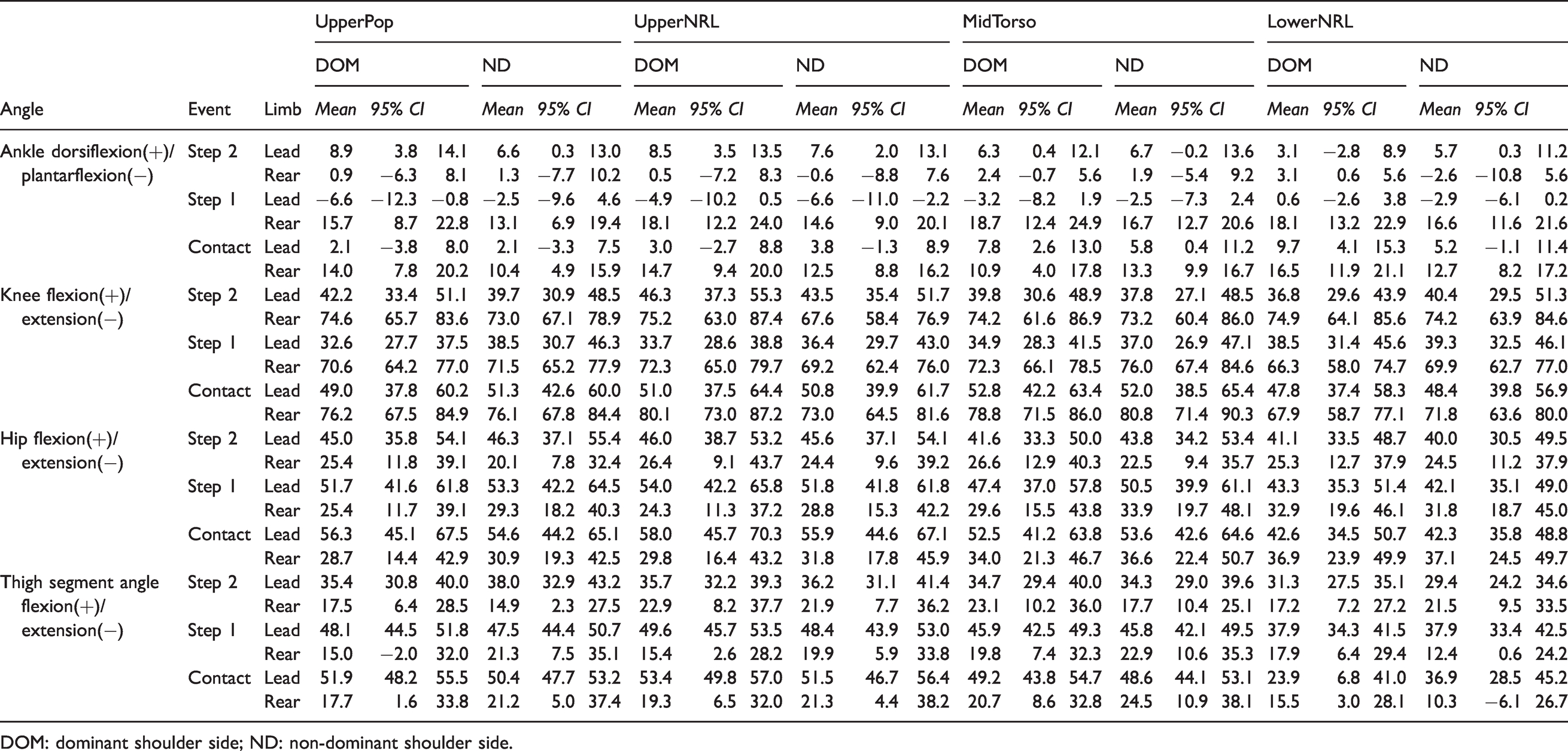
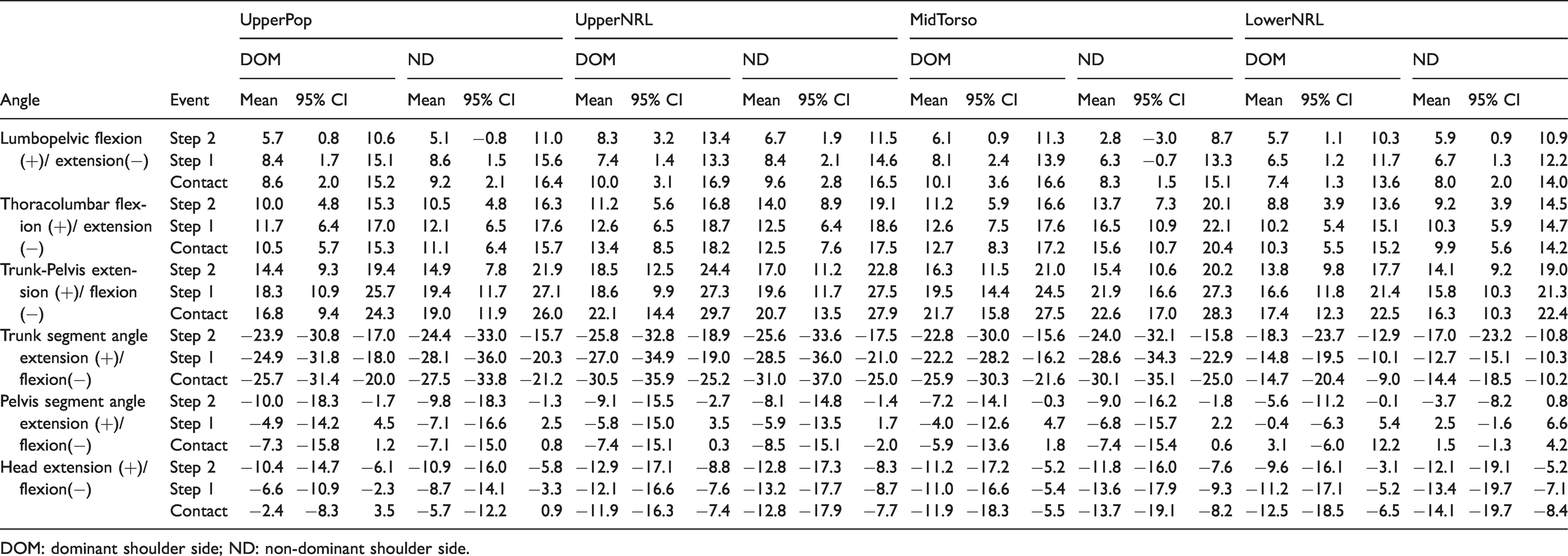
The ball carrier’s kinematics (means, standard deviations) at three key time-points in the four types of tackle instructions are listed in Table 3 for the lower limb angles and in Table 4 for the trunk head angles. The significant main effect and interactions of the RM ANOVA for the ball carrier are outlined in detail for lower limb angles at contact (Appendix 2), at one (Appendix 3) and two (Appendix 4) steps prior to contact.
The ball carrier’s lower limb angles (mean ± 95% confidence interval) at three key events across four variants of the tackling technique.
DOM: dominant shoulder side; ND: non-dominant shoulder side.
The ball carrier’s trunk and head angles (mean ± 95% confidence interval) at three key events across four variants of the tackling technique.
DOM: dominant shoulder side; ND: non-dominant shoulder side.
The ball carrier did not change their ankle or lumbopelvic kinematics. When being tackled by the LowerNRL, the ball carrier had less knee flexion at contact than the MidTorso, and less hip flexion of the lead lower limb at contact and step 1 compared to all other instructions.
Less trunk and pelvis flexion were used in the LowerNRL compared to all other instructions. Thoracolumbar posture of the ball carrier was dependent on the tackler using their dominant or non-dominant shoulder side. Greater thoracolumbar flexion was observed in the non-dominant shoulder side when comparing MidTorso to UpperPop, and LowerNRL at contact and at Step 1, and UpperNRL at contact. UpperNRL instruction at contact showed greater thoracolumbar reflection than LowerNRL, for both shoulder side engagements, and the UpperPop for the non-dominant shoulder side.
The ball carrier maintained a similar head posture in the UpperNRL, MidTorso, and LowerNRL throughout the tackle, but at step 1 in the UpperPop the ball carrier began to decrease their head flexion and continued to decrease head flexion until contact, compared to the other instructions.
Discussion
This exploratory study was the first to employ 3D motion capture to quantify the ball carrier’s body posture when entering a front-on, one-on-one, torso tackle. The ball carrier was observed to modify their behaviour in response to anticipated changes in the tackler’s motion. These body position modifications by the ball carrier during the tackle may offer a possible intervention for the reduction of injury and concussion risk during the tackle for the ball carrier. Specifically, the ball carrier positioned their body at contact using one of two movement strategies: (1) increasing their stability via flexing their trunk, knee, and hips more when entering mid or high trunk tackles; or (2) offload the ball or perform an evasive movement strategy by positioning themselves in a more upright body position when being tackled at a low trunk tackle height.
When entering into a tackle, coaching guidelines recommend the ball carrier ‘lean forward’ as a safer technique, 31 as a bent at the waist trunk position reduced the risk of HIA compared to upright trunk position. 5 The ball carriers in this study adopted the strategy of a forward (flexion) trunk lean when the tackler engaged in body contact at mid and upper torso height. Interestingly, in anticipation of the contact at the lowest tackle height (LowerNRL), the ball carrier positioned their trunk and pelvis in a more upright posture two steps before contact and maintain this posture until contact. This approach to engagement at the lowest tackle height may be attributable to the ball carrier’s instinct to attempt to either offload the ball, or perform an evasive movement. The lack of previous research as to whether these strategies are associated with tackle height or a trunk posture make it challenging to confirm or refute this notion.
Even when an upper torso tackle height was maintained in this study, it was observed that the ball carrier modified their head posture in response to the type of contact by the tackler. In the UpperPop, the ball carrier reorientated their flexed head posture of 10.4° two steps to prior to a more neutral head flexed posture of 2.4° at contact. It is likely that the ball carrier’s reorientation to a more neutral head alignment was in response to the tackler performing a vertical ‘pop action’ just prior to torso contact, where the tackler attempted to reorientate the ball carrier’s horizontal trajectory to a vertical trajectory. When the tackler did not execute this ‘pop action’ when tackling at the same upper torso height (UpperNRL), the ball carrier maintained the same slight head flexed posture (range 11.9°–13.2°) from two steps pre-contact to contact; a strategy also observed in the MidTorso and LowerNRL torso tackle heights.
Previous 2D research suggests that the ball carrier’s approach the tackle with a ‘straight back’ posture or neutral spine posture is associated with a lower risk of head injury. 18 In this study, during all four of the tackling instructions the ball carrier attained a relatively ‘straight back’ posture throughout the tackle, ranging from 8.8° to 16.5° of thoracolumbar flexion and 2.8° to 10.1° of lumbopelvic flexion. Significant changes in the ball carrier’s thoracolumbar posture in response to tackle height were observed in this study; a MidTorso displayed significantly greater thoracolumbar flexed posture compared to the LowerNRL tackle one step before contact and at the time of contact, as well as differences observed at contact between the higher tackle heights of the UpperNRL and UpperPop tackles compared to the lower tackle heights of the MidTorso and LowerNRL tackles.
The use of ‘leg drive on contact’ by the ball carrier is not described in NRL coaching manuals.30,31 However, 2D video analysis has revealed that when a ball carrier employs this strategy they can reduce their risk of injury 18 and improve their likelihood of breaking the tackle or offloading the ball. 38 The ball carriers in the current study were observed to modify their leg drive upon contact in response to the tackler’s body position via reorientating their hip and knee posture. In the MidTorso compared to LowerNRL, the ball carrier had greater flexion of their knee and their hip of the lead lower limb at contact. The lower limb flexion strategy is likely to reduce the ball carrier’s centre of gravity height and improve their stability, thus providing a better strategy to increase the chance to break the tackle. Greater hip flexion of the ball carrier’s lead lower limb at contact was also observed in the UpperNRL and MidTorso compared to the LowerNRL, suggesting this strategy to lower their centre of gravity is also used when the ball carrier is being tackled in an upper torso tackle. In a lower torso tackle (i.e., LowerNRL), the ball carrier employed an alternative strategy of less knee, hip and trunk flexion, likely, to position themselves in a more advantageous position to fend off the tackler.
The ball carrier demonstrated a significant main effect of dominant shoulder use during the tackle with less head flexion at contact and step 2 and greater lumbopelvic flexion at step 1 in dominant compared to non-dominant shoulder engagement. However, these significant differences were <2° and thus was deemed functionally irrelevant based on the minimal detectable change of kinematic variables during gait. 39 Post-hoc testing did not reveal any significant shoulder engagement dominance differences and thus coaches can assume the ball carrier employs a similar motion when being tackled on either side of their body by the tackler.
Several limitations are associated with this study. First, this study is a pilot study and requires replication with a larger sample size. Second, as all participants were adult males, of varying playing positions and skill levels from both rugby codes, generalisability is also limited, that is, the findings of this study may not be generalised to players of different age, sex, or skill level. Third, the traditional tackle instructions were based on the rugby league tackle model, as such, the UpperNRL and LowerNRL tackle technique may have been novel to the rugby union participants but not to the rugby league participants. The potential implication of this was not explored in this study. Fourth, this study constrained the ball carrier movements by instructing them to engage in front-on, one-on-one player contact at a similar contact intensity. Fifth, the ball carrier was not blinded to the tackle instructions (i.e., they were present when tackling instructions were given to the tackler), which may have influenced their motion. Sixth, the results may not extrapolate to real-life match play, for example a tackle with more than one tackler, or different tackler and/or ball carrier speeds. Seventh, the testing environment (i.e., indoor laboratory-based setting) may have adversely influenced the participant’s ability to perform some or all the various tackles. Finally, this study did not record injury history of these healthy participants that were uninjured at the time of testing and it remains unknown if previous injury(s) altered a participant’s tackle motion.
Practical Implications
In this study, 3D motion capture found that ball carriers use two movement strategies when tackled: (1) increasing their stability via flexing their trunk, knee, and hips more when entering mid/high torso tackles; (2) offloading the ball or positioning themselves in a more upright body position when being tackled at a lower torso tackle height. Coaches should be aware of the natural response of ball carriers to tackler’s body position and target height, and seek to recognise and adjust, where appropriate, behaviour in players who do not respond in the ways we have described in this study. These findings, together with knowledge of tackle injury-risk factors, could inform future coaching interventions for the ball carrier to optimise their performance and mitigate injury risk during the tackle.
Conclusion
Coaches should be cognisant of the differing response of the ball carrier entering a front-on, one-on-one torso tackle based on the tackler’s motion and instruct the ball carrier of these alternative movement strategies. A ball carrier can increase their stability during a mid/high torso tackle height by lowering their centre of gravity via increasing their knee, hip and trunk flexion. In a lower torso tackle height, the ball carrier can position themselves in a more upright trunk posture and flex their knees and hips less to position themselves to offload the ball or perform an evasive maneuverer.
Supplemental Material
sj-pdf-1-spo-10.1177_17479541211024022 - Supplemental material for Three-dimensional mechanics of the rugby tackle, does the ball carrier alter their movement into contact in response to the tackler’s position?
Supplemental material, sj-pdf-1-spo-10.1177_17479541211024022 for Three-dimensional mechanics of the rugby tackle, does the ball carrier alter their movement into contact in response to the tackler’s position? by Suzi Edwards, Timana Tahu, Matthew Buchanan, Ross Tucker, Gordon Fuller and Andrew J. Gardner in International Journal of Sports Science & Coaching
Footnotes
Acknowledgements
The authors would like to thank Mr Kim Colyvas from The Statistical Support Service at The University of Newcastle for his statistical guidance.
Declaration of Conflicting Interests
The author(s) declared the following potential conflicts of interest with respect to the research, authorship, and/or publication of this article: Matthew Buchanan and Suzi Edwards declare that they have no conflict of interest. Andrew Gardner, Ph.D. serves as a scientific advisor for hitIQ, Ltd. He has a clinical practice in neuropsychology involving individuals who have sustained sport-related concussion (including current and former athletes). He has been a contracted concussion consultant to Rugby Australia (2016–2020). He has received travel funding or been reimbursed by professional sporting bodies, and commercial organisations for discussing or presenting sport-related concussion research at meetings, scientific conferences, workshops, and symposiums. He has received research funding from the National Rugby League (NRL) for the Retired Players Brain Health research program. Previous grant funding includes the NSW Sporting Injuries Committee, the Brain Foundation (Australia), an Australian-American Fulbright Commission Postdoctoral Award, a Hunter New England Local Health District, Research, Innovation and Partnerships Health Research & Translation Centre and Clinical Research Fellowship Scheme, and the Hunter Medical Research Institute (HMRI), supported by Jennie Thomas, and the HMRI, supported by Anne Greaves. Ross Tucker is a research consultant to World Rugby (Pty) Ltd, the governing body for Rugby Union globally. Timana Tahu is a transition officer with National Rugby League School to Work program.
Funding
The author(s) disclosed receipt of the following financial support for the research, authorship and/or publication of this article: Research support was provided for this project from the National Rugby League (NRL) Rugby League Research Committee (RLRC).

Supplemental Material
Supplemental material for this article is available online.
References
Supplementary Material
Please find the following supplemental material available below.
For Open Access articles published under a Creative Commons License, all supplemental material carries the same license as the article it is associated with.
For non-Open Access articles published, all supplemental material carries a non-exclusive license, and permission requests for re-use of supplemental material or any part of supplemental material shall be sent directly to the copyright owner as specified in the copyright notice associated with the article.
