



Abstract
The spike attack is one of the most important skills in beach volleyball, and as an overarm movement, places significant load on the shoulder joint that could lead to increased risk of injury. An analysis of the different techniques used by elite athletes could provide important insights regarding the etiology of these injuries. This study aimed to assess the spike attack arm swing techniques of Olympics and World Championships (1996-2019) beach volleyball winners and to investigate possible gender differences. Twenty-five male and twenty female winners were assessed on video recordings from eighteen competitions. The different arm swing techniques in the cocking phase (Straight, Bow-and-arrow high, Bow-and-arrow low, Snap, and Circular) were classified by two experts. Intra-rater reliability of both experts (κ = 1.000, P < .001 and κ = .969, P < .001 respectively) and inter-rater reliability (κ = .969, P < .001), assessed by Cohen’s Kappa, were almost perfect. There were significant gender differences in arm swing techniques (P < .001) with a large size effect (Cramer’s V = .650). The most frequent technique for men was the Bow-and-arrow low (56%) followed by Circular (24%) and Bow-and-arrow high (20%), while for women were the Bow-and-arrow high (30%) and Snap (30%), followed by Bow-and-arrow low (25%) and Straight (15%). The results showed a great variation in arm swing techniques even among world class beach volleyball players as well as significant gender differences, and could allow us to develop interesting hypotheses regarding the mechanisms that could lead to shoulder overuse injuries.
Introduction
During a beach volleyball game, which lasts 45.1 min on average, the players of a team perform at least 100 overhead attacks, which is the most effective way to score a point.1–5 During an overhead attack, the players use various kinds of techniques such as spikes and shots.6–9 While the spikes are performed with maximal power, shots are applied to direct the ball to an open area of the court. The most frequent technique is the spike accounting for 59% of all attacks.4,9–11 A reason for this high frequency of spikes is that defenders have less time to react to a spike compared to a shot. Furthermore, the efficiency of the spike is the most important factor for winning a match in beach volleyball.12–14 In high level games in tournaments organized by International Volleyball Federation (FIVB) and European Volleyball Federation (CEV), the first spikes following a service have a scoring percentage of 57.3% which is 5.1% higher than for shots. 10
Despite a lower risk for acute injuries compared to other team sports,15–16 the high frequency of overhead movements used in volleyball attacks could lead to risks of overuse injuries in the shoulder joint. Among the overuse problems in indoor volleyball, shoulder injuries are at 16–19%. 17 This could be due to the large number of attacks (N = 40000/year) a volleyball player performs. 18 Interestingly, female volleyball players had a six times greater risk of experiencing pain on the dominant shoulder than male players. 19
In beach volleyball, it was reported that 10% of the injuries were at the shoulder joint due to overuse. 20 Furthermore, the 20% of the injuries reported among the beach volleyball players that participated in the tournaments organized by Association of Volleyball Players (AVP) were located at the shoulder. 21 A typical overuse injury is the infraspinatus syndrome during the spike, 22 which is caused by repeated traction and micro trauma due to compression at the spinoglenoid notch. 23 Various authors suggested that the most dangerous manoeuvres during the spike attack are the shoulder flexion at the elevation of the arm and the increased maximal external rotation.24–25 Furthermore, the supraspinatus tendon as well as other muscles and tendons involved in the spike attack have an increased risk for overuse injuries when the humerus is flexed over 90°. 26 The 30% among the 84 professional players that participated in the beach volleyball grand slam in Klagenfurt had a prevalence of infraspinatus muscle atrophy, while a 63% of the players had reported pain in the hitting shoulder. 23 Although data of gender differences regarding shoulder injuries in beach volleyball is scarce, there is some indication that shoulder problems could be gender related. Specifically, it was reported that 9.3% of the male and 13.3% of the female professional beach volleyball players had a shoulder surgery. 27 Furthermore, a significantly worse shoulder function was observed, as assessed with the simple shoulder test, in females as compared to males. 28
A probable reason for the high amount of shoulder injuries could be the various spike techniques used by volleyball players. During the aerial phase of the spike, the shoulder movement is subdivided in the wind-up, the cocking phase, the acceleration phase and the follow through phase.26,29,30 Various researchers found that there are no significant inter-individual differences in the acceleration and follow through phase.29,31,32 However, Seminati, Marzari, Vacondio, & Minetti 33 assumed that there are different techniques in the cocking phase and that these techniques may differ in their risk of an injury. There are also various techniques described in the beach volleyball literature. These techniques are distinguished in Straight, Bow-and-arrow, Snap, and Circular arm swing. 32 However, it seems that the most common techniques are Bow-and-arrow34–36 and Straight.34,37 In a recent study concerning the arm swing technique during the spike attack in elite beach volleyball players, 38 the Bow-and-arrow technique was divided in a high and low technique according to the position of the elbow and the wrist joint in relation to the shoulder joint and the forehead. They reported that the most frequent techniques among players were the Bow-and-arrow low (51.6%) and Bow-and-arrow high (37.4%), while 11% utilized the Circular and Snap arm swing. Seminati et al. 33 compared the Bow-and-arrow high or low (referred as the traditional technique) and the Snap and Circular (referred as the alternative technique). Based on kinematic analyses, they reported that hand and ball speed were 5% higher for the alternative technique and furthermore suggested this as a potential solution against chronic shoulder pathologies as it reduces the shoulder flexion during spiking. They argued that the alternative technique was safer compared to the traditional one, since the sudden transition from negative to positive velocity (at the end of the cocking phase) is closer to the articular limits of the shoulder in the traditional technique. Moreover, in the alternative technique, the shoulder initiates the forward motion with internal rotation and the external rotation occurs only in the last phase of the trajectory. Although clear technique differences between male and female beach volleyball players have been observed, 4 there are no studies available that investigated possible differences in spike arm swing techniques between genders.
Therefore, the aim of the present study was a) to assess the distribution of spike techniques in beach volleyball players that have won the Olympic Games or World Championships and b) to compare the distribution of spike techniques between male and female players that have won the Olympic Games and World Championships. Based on data from the literature we hypothesized that a) that we will observe the whole variety of spike techniques in Olympic or World Championship winners both in male and female players and b) there will be significant differences in the distribution of spike techniques between the genders.
Methods
Ethics committee approval statement
The Ethics Committee of the School of Physical Education and Sport Science at Thessaloniki approved the design of the study (Approval number EC-34/2021) because it fulfilled the criteria of good scientific practice, as set out in the Research Ethics Code of the Aristotle University of Thessaloniki and in the existing legislation. Informed consent from the players was not obtained as the analyses were performed from publicly available broadcasts for which they agreed on participation.
Sample description
Beach volleyball was introduced in the Olympic Games in 1996. We included the overall population of Olympic winners up to date, and the World Championship winners from the same time period. Therefore, the sample included all the male (N = 25) and female (N = 20) winners of the Olympic Games (N = 6) and World Championship (N = 12) tournaments held between 1996 and 2019. In case a player has won more than once, he or she has been included once in the data.
Parameters measured and their selection
Descriptive statistics of the height, the age and the dominant hand were analyzed. The height and the age of players were retrieved from FIVB and the Beach Volleyball Database websites. The dominant hand (right and left) was analyzed from the video recordings. The arm swing technique in the cocking phase of spike attacks from the identified athletes was categorized. Video recordings from television broadcasts were captured using a Mac mini desktop computer. QuickTime Player (version: 10.5) in normal speed, slow motion speed, and frame by frame modus was used to analyse every spike. The spike techniques chosen for analysis were captured during the game when the serve reception and set (hand or bump set) was ‘perfect’ which means that the athlete could attack under ideal conditions.8,39 The spikes performed with a second contact, after a quick set, or after a back-set were excluded from the analysis to avoid any unwanted variations due to the specific playing situation. All spike attacks under ideal conditions of each player during the final game were analysed to include at least five spikes for each player. During pilot tests of other FIVB finals we did not observe any intra-athlete variations in arm swing technique under ideal conditions irrespective of the position (left, middle or right), direction (line or cross), or technique (wrist in or out) of the attacks. Hence, in case that a player did not play enough attacks under ideal conditions during a match, the data were collected from another match (e.g., semi-final of the tournament or another FIVB final).
The classification scheme of the arm swing motion during the spike was based on the arm swing techniques descripted by Sellinger & Ackermann-Blount 32 and Giatsis et al. 38 We distinguished a total of five techniques for the arm swing, whereby the arm swing is defined as the phase after the take-off until the final cocking phase is reached. These arm swing techniques are the Straight, the Bow-and-arrow high (BA-high), the Bow-and-arrow low (BA-low), the Snap, and the Circular arm swing. The five techniques (see Table 1) are depicted in Figure 1.
Definitions of the different arm swing techniques with regards to wrist and elbow positions during different phases.

BA: bow-and-arrow.
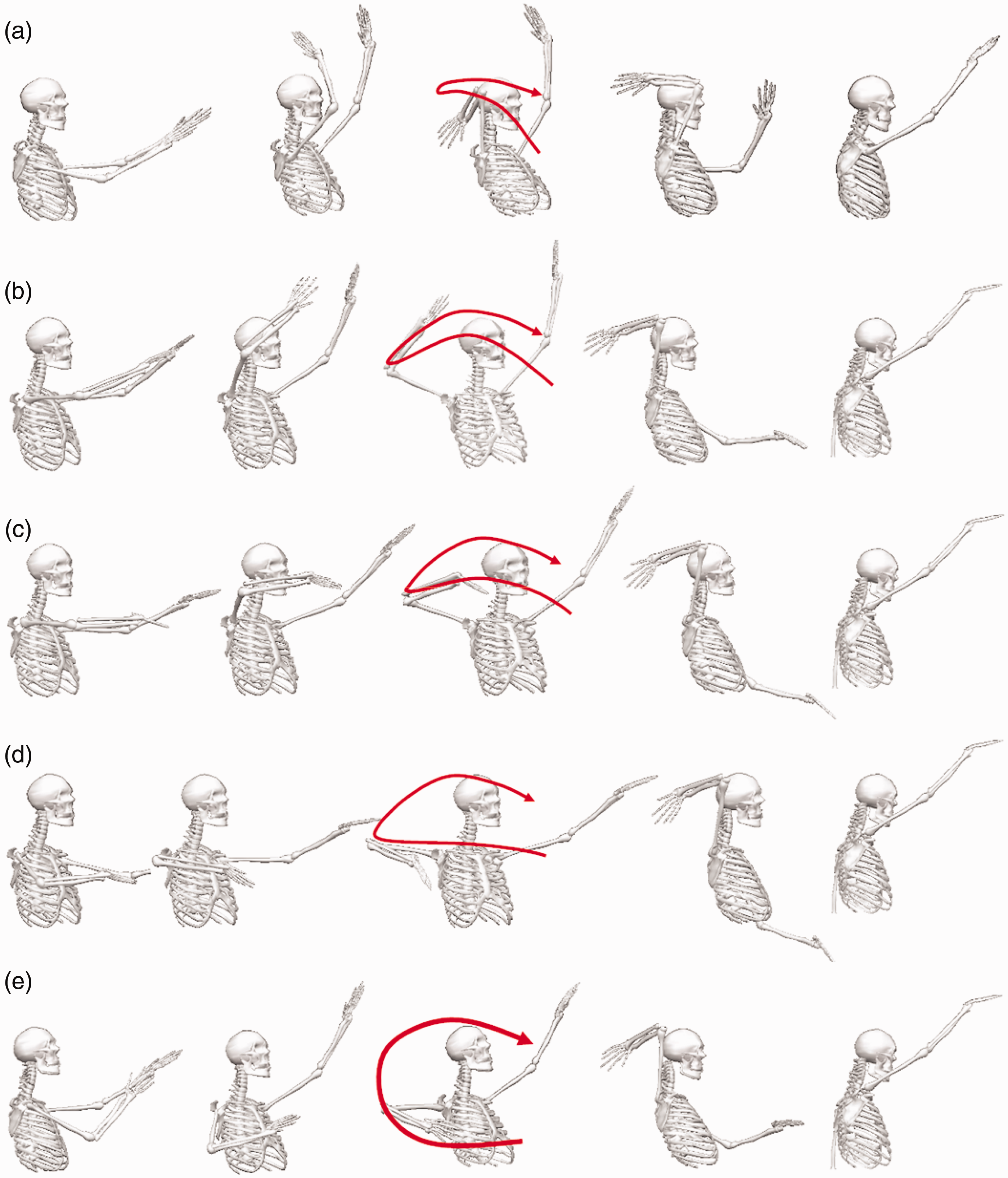
Arm swing techniques. (a) Straight, (b) bow-and-arrow high, (c) bow-and-arrow low, (d) snap and (e) circular. The “A, B, C and D” techniques have a full stop at final cocking position while “E” technique has a continuous arm movement during the whole attack movement.
To be able to distinguish between the different techniques, the position of the elbow and the wrist joint in relation to the shoulder joint and the forehead were used for the different definitions. In the Straight technique the position of elbow in the final cocking phase is vertical to the shoulder joint and the wrist is above or behind the head. In the arm swing cocking phase of the two subtypes (high and low) of the Bow-and-arrow techniques, the elbow of the hitting arm is located at or above the shoulder and the forearm and wrist is clearly above the shoulder height. In the Bow-and-arrow high, the wrist of the hitting arm is raised above the forehead in the cocking phase and remains there in the final cocking position, and in the Bow-and-arrow low, the wrist of the hitting arm stays at forehead level or below in the final cocking phase. In the Snap arm swing, the elbow and the wrist are on shoulder level or slightly below in the final cocking phase. In the Circular arm swing, as opposed to the Snap and the Bow-and-arrow arm swing techniques, the elbow of the hitting arm continuously moves downwards with a semi-circumduction around the shoulder joint during the cocking phase. The hitting arm is first elevated until the wrist is at the same or slightly above the shoulder height and then rotates downwards and around the shoulder during the cocking phase.
Data collection
The classification of the different arm swing techniques was performed by two beach volleyball experts in coaching and kinesiology (G.G., C.D.). In case where the two experts’ assessments differed, another expert (M.T.) classified the players. If fewer than two experts assigned the player to the same technique, he was considered as unassigned. Furthermore, a handball expert (D.H.) analysed the players to confirm that even non-beach volley experts can interpret each technique correctly (with this analysis methodology).
Statistical analysis
An intra-rater reliability analysis using Cohen’s Kappa statistics was calculated for every expert to determine observation consistency of the arm swing classification. The retest of the arm swing classification was done after a period of one month from the first test to avoid the possibility of carry-over-, transfer-, memory-, and practice effects induced by familiarity with the assessment. There was almost perfect agreement between the two observations for both experts (κ = 1.000, P < .001 and κ = .969, P < .001, respectively). Furthermore, the agreement of the two observations by the handball expert was almost perfect (κ = .938, P < .001).
An inter-rater reliability analysis using Cohen’s Kappa statistic was carried out to find the degree of consistency of the arm swing classification between the two main observers. The Cohen’s Kappa coefficient indicated almost perfect agreement for arm swing classification of the observers (κ = .969, P < .001).
A possible gender difference in the arm swing techniques was assessed using Fisher’s exact tests. The significance level was P < .05. Also, Cramer’s V effect size (ES) was calculated to assess the magnitude of the effect of the observed differences between the genders. The ES were considered to be small (0.10), medium (0.30), and large (0.50). 40 Statistical tests were performed with SPSS (version 25).
Results
The arm swing techniques of 45 (Male = 25; Female = 20) players were analysed. The six Olympic Games and 12 World Championships (1996–2019) were won by athletes from nine nations. The mean height of men and women was 195.9 ± 7.4 cm and 180.6 ± 7.3 cm, respectively. The height range was 186–211 cm and 165–196 cm for men and women, respectively. Ninety-two percent of the men and 90% of women were right-handed. Left-handed players won World Championships but not Olympic Games in both men and women.
Collapsing the data from male and female players, the BA-low (42.2%) was the most common technique followed by BA-high (24.4%). The players applied both the Snap and the Circular technique with equal percentages of 13.3% each. The Straight technique was only applied by 6.7% of the players. Differences between the genders were also observed. The most frequent technique for the males was the BA-low (56%) followed by Circular (24%) and BA-high (20%). No players could be identified that have used the Straight or the Snap arm swing techniques. For females, the most frequent arm swing techniques were the BA-high (30%) and the Snap (30%) followed by BA-low (25%) and Straight (15%), while no female player used the Circular technique (Table 2). A Fisher’s exact test of independence confirmed a significant gender difference in the distribution of arm swing techniques (P < .001). Circular arm swing and BA-low had higher frequencies in males as compared with the females. Snap and Straight arm swing techniques had higher frequencies in females than males. A large (.650) Cramer’s V effect size confirmed the meaningfulness of the observed gender differences in arm swing techniques (Table 2).
Absolute and relative frequency distributions of arm swing technique of males and females.
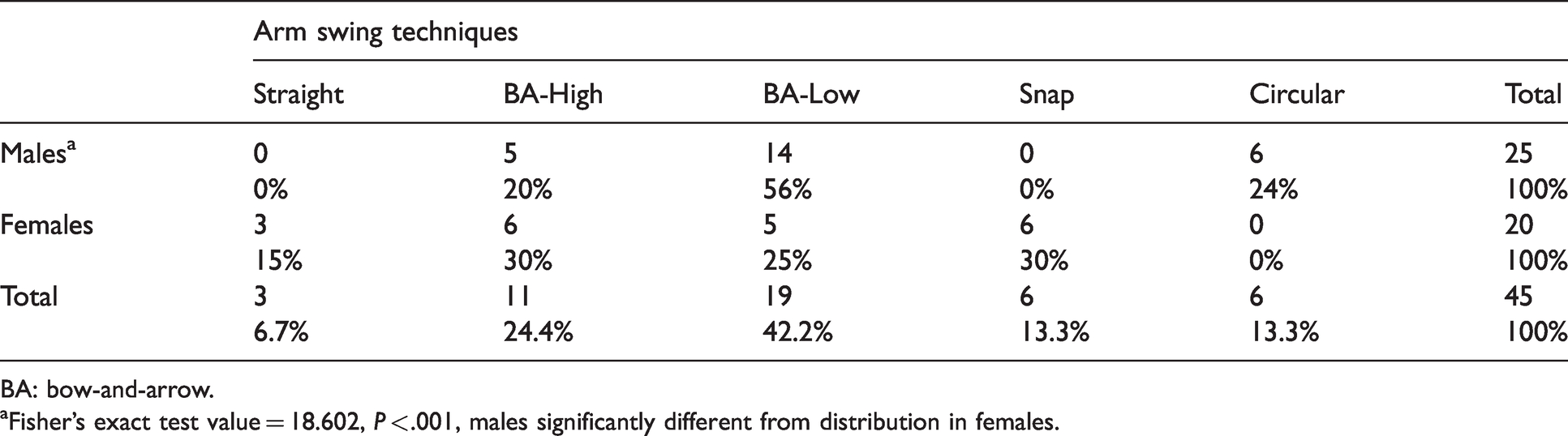
BA: bow-and-arrow.
aFisher’s exact test value = 18.602, P < .001, males significantly different from distribution in females.
Discussion
The results of the present study demonstrated that the male and female beach volleyball winners of Olympics and World Championships use different arm swing techniques during the spike attack. However, contrary to our first hypothesis, not all spike techniques evaluated were observed in both genders. While no male athlete used the Straight or the Snap techniques, no female athlete used the Circular technique. As a consequence, the distribution of the techniques used, was significantly different between males and females. This supported our second hypothesis.
A detailed analysis revealed that the predominant technique for men was the Bow-and-arrow low (56%) while the rest of the players used the Circular (24%) and BA-high (20%). Giatsis at al. 38 reported similar results in the men’s 2017 beach volleyball World Championship as 51.6% of the players used the BA-low technique. However, the Circular technique (24%) was observed more often (+17.4%) than in the present study. This was not the case for the BA-high technique which was observed less often (−17.4%) than in the present study. It should be noted that the sample of Giatsis et al. 38 included only seven out of 96 players (7.3%) that were winners of Olympics and World Championships.
Contrary to the men’s sample, the most frequent arm swing techniques in women were the BA-high (30%) and the Snap (30%), followed by BA-low (25%). This led to significant (P < .001) gender differences with a large effect size in the distribution of arm swing techniques. Interestingly, 15% of the females used the Straight technique which was not observed in male players. Common characteristics of the Straight and the BA-high techniques are the high elbow over the shoulder height and the wrist above the forehead. These characteristics could relate them with overuse injuries in the supraspinatus tendon or other muscles and tendons involved in the spike. 26 Both techniques, but especially the Straight technique, have the humerus flexed over 90° in the elevation and a maximal external rotation in the cocking phase.24,25 It was suggested that the increased risk of developing infraspinatus syndrome, 22 which is common in professional beach volleyball players 27 could be caused by the extreme shoulder movements during spike. Moreover, it was observed that 30% of the professional players (male and female) participating in one of the most important Grand Slam FIVB tournaments had an infraspinatus muscle atrophy in the hitting shoulder while pain was present in 63% of all players. 23 The larger presence of Straight, Bow-and-arrow high and low in the present study could explain these results, as infraspinatus is the main external rotator of the shoulder joint which is activated especially in these arm swing techniques. The results of the present study also suggest that female players could have a higher risk for shoulder injuries because the techniques mostly used by them involve extreme shoulder movements as Straight and BA-high are more frequent in women (45%) than in men (20%). Unfortunately, only very few studies investigated the gender effect in the prevalence of shoulder overuse injuries. At one hand, as reported that 9.3% of the male and 13.3% of the female professional beach volleyball players had a shoulder surgery supporting our assumption that females have a higher risk for shoulder injuries. 27 On the other hand, 31.5% of the male and 26.7% of the female players were diagnosed with an infraspinatus atrophy which would be in contrast with this assumption. It was reported that 57% of the male and 60% of the female indoor volleyball players have experienced shoulder problems, with significantly worse shoulder function, as assessed with the simple shoulder test, in women (9.0) compared to men (10.1). 28 However, as no information about the arm swing technique was provided, studies that relate arm swing technique with shoulder injuries are warranted.
A professional beach volleyball player could play about 25 tournaments per year (5–7 games per tournament) with a number of 83 rallies per game2,13,39 resulting in a high number of spikes. Adding to the large number of games per year, the hours of training, using a high-risk technique could increase the chance for overuse injuries in the shoulder joint.20–22 For this reason, it is suggested to reduce the repetitions of spikes performed during practice, especially in players with symptoms of shoulder overuse injuries.
Τhe frequency of the predominant Bow-and-arrow techniques (high and low) and the Straight, as observed in females, could be expected as most beach volleyball books propose only these techniques.6,35–37,41,42 Only Selinger & Ackermann-Blount 32 proposed an alternative arm swing technique and recommend the Circular and Snap techniques. Furthermore, Seminati et al. 33 recommend the Circular or Snap technique with better performance in ball and hand speed than the traditional techniques for volleyball players. Seminati and co-workers also recommend these alternative techniques as safer because the circular movement of the arm leaves the glenohumeral joint in its natural position with reduced shoulder flexion compared to traditional techniques. They argue that the most dangerous manoeuvres occur during the spike when the humerus is flexed over 90° together with maximal external rotation, which stresses the musculotendinous structures and lead to subacromial impingement. Furthermore, the alternative techniques allow the humerus to accelerate continuously in a circular motion which might reduce high accelerations that occur at the transition between the cocking phase and the acceleration phase. Selinger & Ackermann-Blount 32 also suggest that the alternative techniques are recommended for fast attackers. This is reasonable as the moment of inertia around the shoulder is reduced compared to the Straight and Bow-and-arrow high technique and allows higher movement velocities. This was confirmed by the higher hand velocity that was found in the alternative techniques. 33 Despite the better performance in spike with alternative techniques, beach volleyball is also dependent upon a multitude of variables that affect the outcome of the game, such as serve reception, setting, blocking, serving, accuracy of shots in attack and other personal abilities of the players. 43 Furthermore, the outdoor conditions (e.g., depth of sand, speed of wind) often make it difficult for players to use the same technique in spike. In a recent study, 38 it was revealed that there were no differences regarding performance between players using the various arm swing techniques in elite beach volleyball.
Furthermore, most of the elite beach volleyball players look at the position of the defender just before take-off or at the apex of their jump, so they could choose the right place to hit the ball. This tactic in their attack might make it difficult to utilize the Circular technique. However, in the highest level of world beach volleyball the Circular or Snap techniques could be interesting alternatives to traditional techniques regarding both performances and avoid overuse injuries. With 24% of the men using Circular and 30% of the women using Snap, it seems that these techniques are already common at the highest level of beach volleyball. Especially for players that use the BA-low technique, with the elbow already near or at the shoulder height, a change in their technique seems feasible. The sample of our research is small for general conclusions of the use of the arm swing techniques by the total winners or other players of the FIVB, AVP and CEV, but from the results it seems that even with the traditional techniques there were players who dominated in the sport of beach volleyball.
Finally, our results need to be considered carefully due to possible shortcomings of the methodology. Our analyses only included spike movements under ideal conditions where we observed very consistent behavior of the players irrespective of the side (left, middle, right) or direction (line or cross, wrist in or our) of the attack. However, future studies should also investigate the variability of the players in other situations e.g., when the ball was set from the back of the court and how possible variations are related to arm swing technique. Furthermore, the classification of the players’ arm swing technique in the cocking phase from the television broadcasts did not allow for accurate kinematic measurements. However, the high intra- and inter-rater reliabilities observed in our assessments indicate high precision and objectivity. Furthermore, the high intra and inter-rater reliability of the handball expert indicate that assessing the arm swing techniques from video is easy for coaches and players. It is very important for coaches to know the techniques applied by world-class players and to evaluate the techniques of their own athletes to make modifications, if necessary. If possible, future studies should include larger samples from both genders across different qualification levels and ages. Furthermore, we recommend that future studies will include precise kinematic analyses of the arm swing techniques to better estimate the stress for the musculoskeletal system.
Conclusion
In conclusion, the results of the present study demonstrated that the male and female beach volleyball winners of Olympics and World Championship use different arm swing techniques during the spike attack. Male athletes did not use the Straight or the Snap techniques, while female athletes did not use the Circular technique. Consequently, the distribution of the techniques used, was significantly different between males and females. These results can provide interesting hypotheses for the prevalence of shoulder injuries in female athletes.
Footnotes
Acknowledgements
This investigation was conducted at the Department of Physical Education and Sports Science of the Aristotle University of Thessaloniki. The authors acknowledge any financial interest of benefit they have arising from the direct applications of their research.
Declaration of Conflicting Interests
The author(s) declared no potential conflicts of interest with respect to the research, authorship, and/or publication of this article.
Funding
The author(s) disclosed receipt of the following financial support for the research, authorship, and/or publication of this article: Dr. Nick Stergiou is supported by the Center for Research in Human Movement Variability and the NIH (P20GM109090, R15AG063106, and R01NS114282).
