



Abstract
This study aims to investigate the communicative content of nonverbal (emotion) expressions of soccer coaches during a game and how these provide information about the current situation and how this information might impact players’ self-confidence during a game. In Studies 1 (N = 137) and 2 (N = 102) we investigated if soccer coaches are estimated to be happier and are rated higher on dimensions related to social status when their team is leading compared to when it is trailing. Results showed that observers rated coaches as happier, more dominant, more proud, and more confident when their team was leading. In Study 3 (N = 152), participants watched short videos depicting the coach's NVB during a game and rated whether the coach's team was trailing or leading. The results showed that observers could clearly distinguish between leading and trailing coaches. In the fourth study, 72 soccer players were asked to watch the same videos from the first three studies and rate their own level of confidence in reaction to the coach's NVB in a hypothetical scenario. The results indicate that a coach's NVB can influence his athletes' self-confidence during a game. The practical implications of the findings regarding the body language of coaches are discussed.
Communication between individuals is essential in group life. Within humans and animals, communication critically depends on nonverbal behavior (NVB; e.g., body language, facial expressions, etc.) as this has the potential to inform others about emotions, intentions, motives, and thoughts.1,2 Observers of NVB can make a whole range of accurate inferences about the internal states of people 3 or the current situation (i.e., the process of social referencing 4 ) and as a result of this, might be affected by these nonverbal expressions. 3 The present research attempted to investigate this basic theorizing in the context of soccer coaching. More specifically, we tested if professional soccer coaches' NVB changes in line with whether their team is currently leading or trailing, whether observers would perceive these changes and might even be affected by the observed NVB of soccer coaches.
Evolutionary research has shown that primates send dominant and proud nonverbal signals when a fight is won to display high status and superiority to the opponent and intimidate other potential attackers.5–7 On the other hand, when an antagonistic encounter is lost, submissive nonverbal signals can be considered helpful to avoid further potentially life-threatening attacks. 6 Due to these hypothesized benefits, the communicative function of nonverbal expressions has become increasingly important in the course of evolution.8–10 As a result, humans' perceptual abilities have become well adapted for the communication of dominance and submission.11,12 In general, people are well-equipped to draw precise conclusions from brief observations of another person's NVB.13,14 These include emotional states,10,15,16 relational orientations 17 ) social inferences (i.e., social status 2 ) and social intentions. 18 The abundant social information from individuals’ NVB is for example evident in research showing nonverbal ‘leakage’ of emotions. 19 Studies have shown that emotions can be involuntarily revealed through transient facial expressions or partial changes in facial regions defined as micro-expressions.10,20 Thus, emotions or other internal states 18 of the individual can become visible through the leakage of brief nonverbal expressions.
Based on this theorizing, it seems feasible that analogous to primates displaying certain nonverbal cues and signals as a result of winning or losing a status contest, athletes and coaches would also show certain nonverbal behavioral changes in response to leading and trailing in sports (e.g., See literature 21 for a recent review). Several studies in sports have provided evidence for the evolutionary theorizing on winning and losing NVB and have shown that athletes' nonverbal expressions differ during successful or unsuccessful sporting performances (see literature 22 for a review). Children and adults with and without domain-specific sport knowledge were shown to assess the current score, based on the athletes' NVB without knowing the score. 23 Besides, athletes who were leading are rated higher on behavioral dimensions related to social status (more dominant, prouder, and more self-confident) based on their NVB than athletes who were trailing. 24 Furthermore, research showed that testosterone levels in athletes rise when they win a competition, which is associated with nonverbal expressions of dominance. 25 In contrast, trailing athletes showed lower testosterone levels associated with expressions of submissiveness. 26
Of further relevance to the present research, a recent review in sport psychology has summarized and integrated a vast amount of research on how initial success and failure in sport influence a range of psychological, physiological, and behavioral variables. 27 Specifically, the authors conclude that successful or unsuccessful events during a sport contest (e.g., a goal) lead to measurable changes in psychological variables (e.g., confidence), physiological variables (e.g., arousal), and behavioral variables (e.g., NVB) in members of the successful or unsuccessful team. Pertinent to the present studies, these behavioral changes are observed and have the potential to affect observers, thereby contributing to instances in sport where “success breeds further success” 27 or failure breeds further failure. 22 One explanatory mechanism of how this might occur is by transferring positive or negative emotions between teammates during a game,28–30 possibly potentiating positive or negative emotions. Similarly, the perception of opponents' and team members' feelings might affect outcome expectations 31 later in the game, which could also impact performance. Likewise, a coach might also have an influence in upward or downward spirals of a team.
The present research
Several lines of research have studied the potential impact coaches might have on their athletes (e.g. coach-athlete relationship, tactical match analyses or constructive verbal feedback.32–34 Given frequently found statements that conclude that most communication occurs via nonverbal signals as opposed to verbal messages35,36) it seems surprising that there has been limited research investigating NVB in sports coaches and how this particular coaching behavior might impact athletes. First research has shown that certain emotional displays by coaches have the potential to predict athletes’ experienced emotions, inferences about the quality of their performance, and objective team performances. 37 Besides, there is preliminary evidence that the relationship between team performance and coaches’ affective displays varies depending on the expression’s intensity. 38 In addition, a recent experimental study 39 showed that the emotional expressions (i.e., pride and shame expressions) of a soccer coach while giving feedback to players influenced players emotions and their performance in a standardized soccer passing task. The present research attempted to extend these findings by investigating the influence of coaches’ NVB during a game on their athletes (e.g. performance-related inferences). For this purpose, the NVB of soccer coaches was investigated by adopting a similar research paradigm that has been used in the study of athletes' NVB.23,40
Although the evolutionary theorizing seems plausible in explaining winning and losing NVB of athletes in physical competition, it remains unclear if coaches of athletes would also show systematic changes in NVB as a function of leading and trailing and whether observers could accurately interpret these without being aware of the score. It seems feasible that the coach as a leader of a sports team would be similarly affected by trailing and leading and this would show in his or her NVB. Following recent recommendations for conducting research on NVB in sports the broad metatheoretical assumptions of evolutionary theorizing need to be specified to fit particular situations with middle-level theories. 21 In this respect, social functional theorizing on emotions 17 seems helpful in setting up the present research. A central premise of this perspective is that emotional expressions evolved to facilitate social relationships and ongoing social interactions. More specifically, literature on social referencing 4 suggests that recognizing and utilizing other people’s nonverbal expressions is essential for adaptive social functioning. From this follows that observers of coaches’ NVB should be able to draw meaningful inferences from this.
To provide a general model on the effects that emotional expressions can have on observers, van Kleef 3 proposed the emotions as social information model (EASI-model) to better understand how nonverbal expressions may exert interpersonal effects. Central to the model is the assumption that nonverbal expressions affect observers via two routes: Inferential processes and/or affective reactions. Of particular relevance to the present research is the inferential pathway. Inferential processes describe how an observer of the expression is able to infer certain information about internal states (e.g., feelings, attitudes, motivation, cognitions) of other people and the current situation. Applied to the present research, an observer of a coach’s NVB might make emotional inferences (i.e., the leading coach is happier than the trailing coach), social inferences (i.e., the leading coach possesses higher status), and situational inferences (i.e., the team of the happy coach is leading [without knowing the score line]). In turn, these inferences might affect observers’ cognitions. We attempted to test these assumptions in a series of four studies. In a first study, we investigated whether a soccer coach is considered happier by observers when his team is in the lead or unhappier when his team is behind. In a second study, we tested whether a coach’s NVB is rated higher on behavioral dimensions related to social status (pride, self-confidence, and dominance) when their team is leading compared to when it is trailing. In a third study, we attempted to address the question of whether it is possible to infer tendencies in the score line based on soccer coaches' NVB. In the fourth study, we examined the interpersonal effects of the coach's NVB on his athletes in a hypothetical research scenario similar to the paradigm of Furley and Schweizer. 24 More specifically, we tested if the coach's NVB could influence the self-confidence of his athletes in a hypothetical scenario.
Study 1: Emotional judgements of coaches’ NVB depending on the score line
Both athletes and coaches experience different emotional states, depending on whether they are successful or unsuccessful. 41 It is also known that emotional states show in a person’s NVB. 42 Hence, it seems feasible that a soccer coach would be perceived as happier or unhappier by observers depending on his team’s score. To test this hypothesis, a random sample of video clips displaying televised behavior of soccer coaches was shown, and the subjects were asked to rate the coaches’ NVB on a continuous scale regarding the emotions happy and unhappy while the score was occluded. We hypothesized to find a linear relationship between the game’s current score line and the participants’ emotional inferences.
Method
Participants
We recruited a convenience sample of 137 participants (95 male, 42 female; Mage = 36.55 years; SD = 12.96 years) for Study 1. 43% reported that they had been actively playing soccer at a recreational level, while 55.5% (one answer missing) did not play football. 34.3% did not follow soccer on TV, 23.4% watched under two hours of soccer per week, 25.5% watched 3-5 hours per week, and 16.8% watched 5 and more hours per week. Participants gave written informed consent before the study. A sensitivity analysis showed that the study had sufficient power (.95) to detect a small-to-medium effect of f = .12 on a 1x5 repeated measure ANOVA. 43
Stimuli
The selected video sequences of televised soccer games (see Figure 1 for a single frame of example stimuli used) were taken from a convenience sample of the first and second German Bundesliga, UEFA Euro League, Champions League, and Primera Division (First Spanish football league) during the Season 2017/18. To ensure that the selected stimuli were suitable to test the hypothesis (i.e., a soccer coach is perceived as happier, based on his NVB, when his team is leading compared to trailing), various selection criteria were determined in advance. By following the theory on micro-expressions,10,20 we made sure that no obvious nonverbal signals associated with success (e.g., raising both fists above the head) and failure (e.g., covering the face with both hands) were seen in the videos (cf. Tracy and Matsumoto 44 ) as these would be too informative cues to estimate the score. Additionally, the selected video sequences only showed the coaches. Further people (e.g. co-trainers, players from the opposing team) were made unrecognizable (this includes obscuring the whole body). Finally, only videos were selected that met our predefined score categories and thereby served as the study's experimental manipulation. The selected videos had a mean duration of 4.85 s (SD = 2.2).

Sample frame of the video stimuli used in the present research.
Score categories
The manipulation of the study involved the actual score of the soccer games during the videos. Videos were selected from five different score categories: (1) far behind, which was defined as at least two goals behind; (2) close behind, which was defined as one goal behind; (3) draw in which the score was even; (4) close lead, which was defined as one goal ahead; and (5) high lead, which was defined as at least two goals ahead. A total of 100 video sequences were collected; 20 in each experimental category that fit in the mentioned selection criteria. The study was carried out as an online study due to the Covid-19 pandemic using the software Unipark. The respective software randomly sampled five videos from the five performance categories and showed the 25 selected video clips in different random orders for every participant. Thus, each participant saw different videos in a different order. This approach helps to ensure that results do not depend on specific order effects of stimuli. 23
Measure
Participants rated the short video sequences on a continuous with 100 points with the poles unhappy (0-points) and happy (100-points) after every video. Participants gave their ratings by clicking the left mouse button to log in their rating on the continuous scale.
Procedure
Participants were asked to estimate the happiness or unhappiness of the coach on a continuous scale based on video footage of the coach's NVB. All videos were presented silently to ensure that ratings were based on NVB and not, for example, crowd noise. Before commencing the study, perceivers filled out a questionnaire gathering demographic data.
Data analyses
A 1 x 5 (far behind, close behind, draw, close lead, and high lead) repeated measures ANOVA on the average happiness estimates of the coaches within the respective experimental categories was run to test if participants rated the coaches as happier when they were leading compared to trailing. We followed up this ANOVA with a series of polynomial linear contrast analyses (see literature23,24,40).
Results
Figure 2 visualizes the descriptive results of Study 1. ANOVA revealed a significant main effect of the actual score on the happiness estimates (F(4, 544) = 135.200, p = .0001, ηp 2 = .499) as score estimates corresponded in a linear manner with the score categories.

Mean happiness (0 = very unhappy; 100 = very happy) estimates as a function of score category. Error bars represent standard errors.
Follow-up polynomial linear contrasts revealed a strong linear relationship between the happiness estimates and the score categories (F(1, 136) = 312.990, p = .0001, ηp 2 = .697) demonstrating that the happiness estimates corresponded in a linear manner with the scores during the game. Soccer experience or soccer TV consumption did not significantly influence the pattern of results when entered as an additional between-subject factor or covariate.
Discussion
Study 1 showed that the coach is considered to be happier when his team is in front and unhappier when his team is behind based on his NVB. The effect sizes of the overall analyses can be considered as large. 45 The results of Study 1 provide evidence for the social-functional theorizing of nonverbal expression4,17 and the EASI model by showing that the coach sends nonverbal signals during a game that are influenced by the current score and inform observers about his emotional state. More specifically, there seems to be a linear relationship between the current score and the coach's perceived happiness.
The next study attempted to further investigate if the coach’s NVB allowed further social inferences beyond the coach’s emotional state. Following biological research on the communication of social status information in competitive situations5–7 and the results of Furley and Schweizer 24 that athletes communicate high social status when winning and low social status when losing, Study 2 attempted to test if this would also show in a coach’s NVB.
Study 2: Dominance, pride, and confidence of soccer coaches
Although Study 1 provided evidence that soccer coaches are perceived as happier when leading and as unhappier when trailing, it remains unclear how coaches change their nonverbal behavior when leading or trailing. We did not expect that coaches would show a distinct nonverbal expression of leading or trailing during ongoing competition as no victory or defeat has occurred yet. Because the quality and diversity of the sampled stimulus material rendered behavioral coding difficult, Study 2 focused on whether leading and trailing coaches would be rated differently by untrained observers on dimensions associated with social status as this is readily communicated in all kinds of social encounters. 46 In this respect, the goal of Study 2 was to replicate Furley and Schweizer 24 that leading athletes are rated higher on behavioral dimensions related to social status (more dominant, prouder, more self-confident) based on their NVB than athletes who were trailing. We used a similar paradigm to Furley and Schweizer 24 with video clips showing the NVB of soccer coaches during the game. Participants were asked to rate the same video clips from the first study on three dimensions (dominant, proud, and self-confident) based on the coach’s NVB on a continuous scale, while the score was occluded. We hypothesized to find a linear relationship between pride, dominance, and confidence ratings as a function of score category.
Method
Participants
We recruited a convenience sample of 102 participants (51 male, 51 female; Mage = 35.78 years; SD = 17.18 years) for Study 2. 46.1% reported to have played football at a recreational or organized level, 28.4% reported to be involved in another sports, whereas 25.5% were not actively involved in any kind of sport. On average the sample reported to watch 1.43 hours of soccer per week on television. Participants gave written informed consent before the study. A sensitivity analysis showed that the study had sufficient power (.95) to detect a small-to-medium effect of f = .14 on a 1x5 repeated measure ANOVA. 43
Procedure
Everything was handled identically to Study 1 except for the following changes. This time participants rated the Coaches’ nonverbal behavior on three continuous scales with 100 points. To be comparable with the research who assessed the NVB of athletes, 24 we used the identical dominance (with the poles submissive [0-points] and dominant [100-points]), pride (with the poles ashamed [0-points] and proud [100-points]), and confidence scales (with the poles insecure [0-points] and confident [100-points]).
Results
Figure 3 visualizes the descriptive results of Study 2. ANOVAs were run to examine the main effects of score category (far behind, close behind, draw, close lead, and high lead) for each of the dependent variables. The results reveal significant main effects on the dominance scale (F[4, 404] = 12.098, p < .001, η2p = .107), pride scale (F[4, 404] = 36.379, p < .001, η2p = .265), and confidence scale (F[4, 404] = 20.671, p < .001, η2p = .170).

Mean ratings (0 = very low; 100 = very high) of dominance, pride, and confidence as a function of score category. Error bars represent standard errors.
Polynomial linear trend analyses demonstrated a linear relationship between score category and dominance ratings (F[1, 101] = 23.024, p < .001, η2p = .186), pride ratings (F[1, 101] = 78.158, p < .001, η2p = .436), and confidence ratings (F[1, 101] = 38.108, p < .001, η2p = .274), highlighting that dominance ratings, pride ratings, and confidence ratings corresponded in a linear manner to the actual score categories. Soccer experience or soccer TV consumption did not significantly influence the pattern of results when entered as an additional between-subject factor or covariate.
Discussion
Study 2 supports the hypothesis that NVB of leading vs. trailing coaches is rated higher on behavioral dimensions related to social status when the coach’s team is leading compared to when it is trailing. All three dimensions, pride, confidence, and dominance were rated higher by observers when the coach’s team was in the lead and lower when his team was behind. As the three dependent measures were highly correlated (all r > .397) and have been linked to the dimension of social status in the past, this suggests that soccer coaches change their NVB along the verticality dimension of social behavior when they are leading or trailing. 46 The vertical dimension of status in social relations stands in contrast to the horizontal dimension of emotional closeness of relationships. 46 In modern societies, sports competitions can be considered an institutionalized form of status contests. 47 In these contests, signaling cues associated with social status, such as dominance, pride, and confidence, might be related to the adaptive behavior of letting other people know who deserves high or low status. 48
The main effect of the actual score for each dependent variable represents a medium-to-large statistical effect. 45 Therefore, the result extends the findings from Furley and Schweizer 24 that also coaches seem to signal NVB related to social status when currently leading or trailing. Both Studies 1 and 2 support the social functional theory of emotional expressions and the EASI model. In Study 3 we attempted to extend these findings and test if observers would also be able to correctly infer contextual information from a coach’s’ NVB.
Study 3: Estimating score tendencies in televised sports competitions based on coaches’ NVB
The goal of Study 3 was to replicate the studies of Furley and Schweizer 23 on athletes with a similar paradigm using video clips showing the NVB of soccer coaches during the game. Participants had to estimate what the score was based on the NVB of the coaches while the score was occluded. The participants viewed a sample of videos showing professional soccer coaches during the game and were asked to estimate if the depicted coach's team was leading or trailing. We hypothesized to find a linear relationship between the game's current score line and the participants’ ratings of the score.
Method
Participants
We recruited a convenience sample of 152 participants for Study 3 (102 male, 48 female, two participants did not provide information on their gender; Mage = 29.07 years; SD = 9.69 years). 32.2% of the sample reported having active soccer experience (from recreational sports to organized club sports) and 65.8% (2 answers missing) no active soccer experience. They reported to watch on average 1.62 hours of soccer per week. The participants gave written informed consent before the study. A sensitivity analysis showed that the study had sufficient power (.95) to detect a small-to-medium effect of f = .11 on a 1x5 repeated measure ANOVA. 43
Procedure
Everything was identical to the previous two studies except for the following changes. Participants were asked to estimate the team's score based on video footage of the coach's NVB. This time participants were tested individually on a standard 17-inch notebook placed about 60 cm away from the perceivers in a lab instead of online. The study was programmed with PsychoPy. 49 Participants rated the short video sequences on a continuous 200-point scale (-100 = trailing by far; 0 = draw; and 100 = leading by far) after every video. Participants gave their ratings by moving a mouse cursor from the middle (0 points) of a 200 points scale to either the left pole (-100 points; team trailing by far) or right pole (100 points; team leading by far) and clicking the left mouse button to log in their rating.
Results
Figure 4 visualizes the descriptive results of Study 3. ANOVA revealed a significant main effect of the actual score on the score estimates (F[4, 604] = 134.621, p < .001, η2p = .471) as score estimates corresponded in a linear manner with the score categories.

Mean score (0 = far behind; 1 = high lead) estimates as a function of score category. Error bars represent standard errors.
Follow-up polynomial linear contrasts revealed a strong linear relationship between the score estimates and the score categories (F[1, 151] = 426.637, p < .001, η2p = .739) demonstrating that the score estimates corresponded in a linear manner with the scores during the game. Soccer experience or soccer TV consumption did not significantly influence the pattern of results when entered as an additional between-subject factor or covariate.
Discussion
The results confirmed our hypothesis that nonverbal cues from the coach during a competitive situation could be used by observers to estimate the score of his team. The results can be interpreted as a large statistical effect. 45 These findings are in line with the studies of Furley & Schweizer23,24 on the NVB of athletes in competitive situations. It seems to be possible to estimate score tendencies not only by the athletes’ NVB during competition, but also by their coaches’ NVB.
Hence, NVB of coaches in a game does not only inform emotional and social inferences, but also inferences about the current situation (e.g. the score). Consequently, if the coach changes his NVB according to the score and this gets detected by observers, the question arises whether this might have interpersonal effects on players who perceive the coach’s NVB. Athletes may note that coaches' expressions communicate information about their emotional state, social status, and situation, which could then inform athletes' understanding of the situation and their responses to this (cf. social referencing 4 )
In Study 4, we attempted to test this question by creating a hypothetical scenario to investigate whether the coach's NVB might have the potential to influence the self-confidence of his players.
Study 4: the influence of soccer coaches NVB
A large body of research has shown that a person's nonverbal expressions can influence observers (e.g. literature3,50) Furthermore, research in sports has shown that the NVB of athletes during a competition influences the opponents' confidence. 40 Also, the pre-competition NVB of athletes51–54 and the post-competition NVB of athletes 55 influence the impression formation process, the expectancy of success and confidence levels of both opponents and teammates observing the NVB. However, little research is known to have examined the interpersonal effects of coaches' NVB. Therefore, we tested if the soccer coach’s NVB might have interpersonal effects on his athletes in a hypothetical research scenario similar to the paradigm of Furley and Schweizer. 24 To be more precise, we investigated if the coach's NVB could influence athletes' confidence levels. In Study 4, soccer players were asked to watch the same videos from the first three studies and had to indicate how much confidence the coach’s NVB gave them. Based on the first three studies, we expected that soccer players would be more confident when perceiving NVB of a coach who was currently leading than a coach who was trailing without being aware of the score.
Method
Participants
We recruited a convenience sample of 72 soccer players (69 male, 3 female; Mage = 24.88 years; SD = 4.59 years) for Study 4. They had an average experience of playing 19.28 years (SD = 5.52 years) of soccer at the club level and reported to watch an average of 4.78 hours of soccer per week (SD = 3.11 hours). Participants gave written informed consent before the study. A sensitivity analysis showed that the study had sufficient power (.95) to detect a small-to-medium effect of f = .16 on a 1x5 repeated measure ANOVA. 43
Procedure
Everything was identical to Study 2 and 3 except for the following changes. This time participants were all soccer players and asked to assume the following hypothetical scenario. “Imagine a tied score and you look to your coach. Does the NVB of the coach give you confidence for winning the progressing game or not?” Participants were asked to rate how much confidence the coaches NVB gave them on a continuous scale with 100 points. This scenario and scale was based on Furley & Schweizer 40 and assessed confidence in winning the game (with the poles not at all confident [0-points] and very confident [100-points]).
Results
Figure 5 visualizes the descriptive results of Study 4. ANOVA revealed a significant main effect of the actual score on how confident the soccer players reported they anticipated to be to win the game after looking at their coach (F(4, 284) = 108.966, p = .0001, ηp 2 = .605).
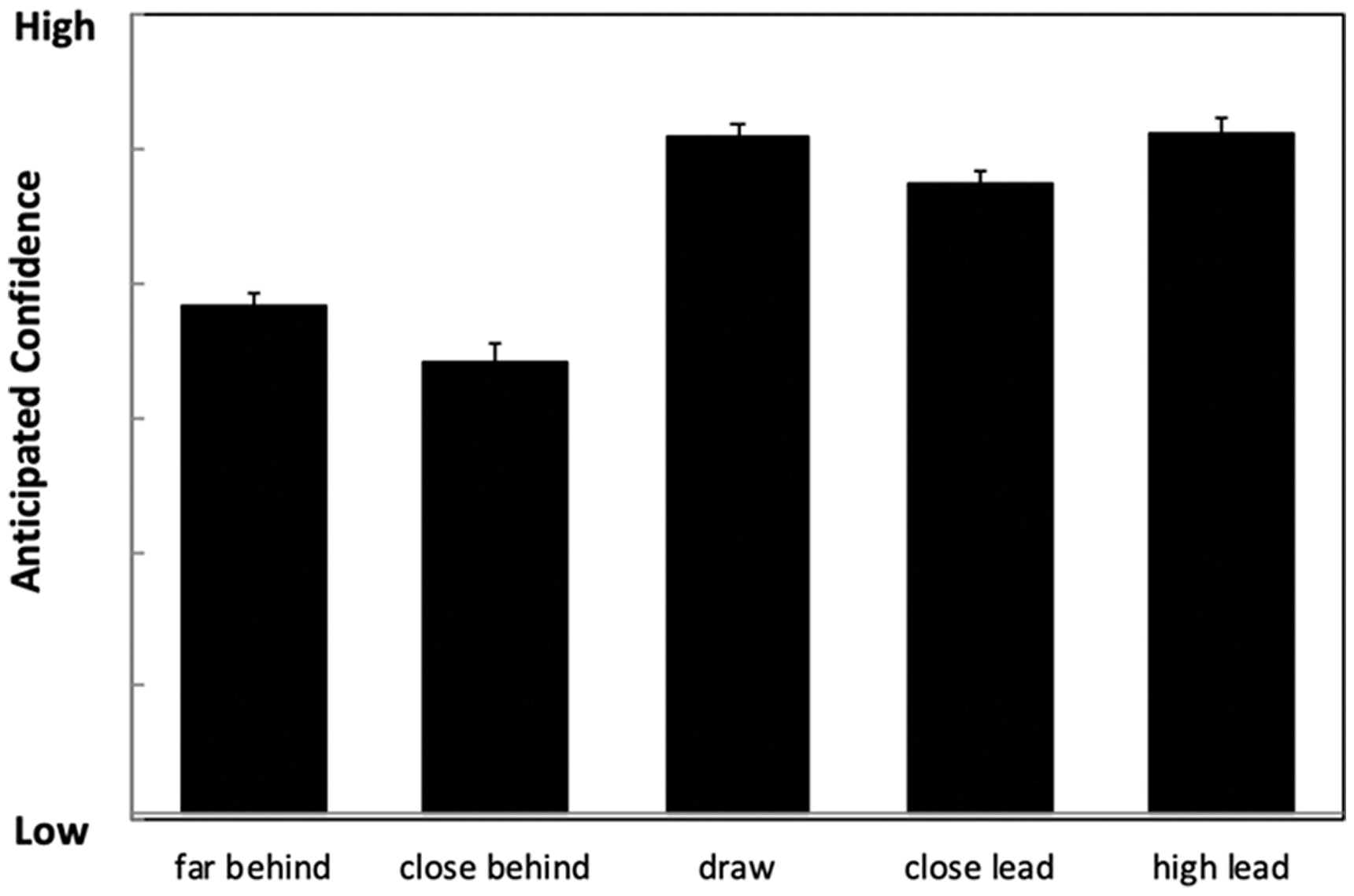
Mean anticipated confidence to win the game (0 = not at all confident; 100 = very confident) estimates as a function of score category. Error bars represent standard errors.
Follow-up polynomial linear contrasts revealed a strong linear relationship between the anticipated confidence estimates and the score categories (F(1, 71) = 243.497, p = .0001, ηp 2 = .774).
Discussion
Study 4 confirmed our hypothesis that players felt more confident of winning the game when they observe the coach’s NVB while his team is currently ahead and less confident of winning the game when they see the NVB of a coach whose team is currently behind (without knowing the score). The main effect of the actual score on how confident the soccer players were after looking at their coach represents a large statistical effect. 45 These results can be seen as the first evidence that the coach's NVB could have an interpersonal impact on the players. As the study was conducted as a hypothetical scenario, further research is needed to substantiate these results in more representative sport settings. Further research is also needed to find out which non-verbal signals from the coach positively or negatively influence players and what other possible interpersonal effects exist that might influence the players’ performance (e.g., cognitions, emotions).
General discussion
This research aimed to investigate the communicative content of nonverbal (emotion-) expressions of soccer coaches in a game. In addition, we examined how they provide specific information about the situation and how this information affects players' situation appraisal (i.e., confidence) in a hypothetical scenario. The present research was the first to demonstrate that soccer coaches display nonverbal cues during a match that correlate with his team's score. Study 1 demonstrated that a soccer coach is considered happier by observers when his team is in the lead and unhappier when his team is behind. In a second study, we confirmed that a coach's NVB is rated higher on behavioral dimensions related to social status (pride, self-confidence, and dominance) when their team is leading compared to when it is trailing. In Study 3, we showed that it is possible to infer tendencies in the score line based on soccer coaches' NVB. Study 4 provided first indication that a coach’s NVB might influence his athletes’ confidence during a game.
The results can be considered supportive of evolutionary theorizing on non-verbal expressions5–7 and the thin slices hypothesis.11–14 More importantly, the findings extend previous research on NVB in the field of sports. Similar to the finding that athletes' non-verbal expression change depending on whether they are leading or trailing,23,24 also coaches seem to communicate emotional and status-related information as a function of whether their team is leading or trailing. In line with research on social referencing 4 and the EASI-model, 3 results show that observers of coaches’ NVB can draw meaningful inferences based on the NVB by the coach without knowing the actual game score. More specifically, observers of a coach’s NVB could make relatively accurate emotional inferences (i.e., the leading coach is happier than the trailing coach), social inferences (i.e., the leading coach expresses higher status), and situational inferences (i.e., the team of a leading coach is inferred to be leading).This process might have interpersonal consequences as indicated by Study 4 as soccer players reported that they anticipated being more confident of winning a game when observing the NVB of a coach who was actually winning. This finding supports the idea that the NVB of coaches has a possible influence on sporting performance and could contribute to “success breeding success” 27 or “failure breeding failure”. 22
The present research cannot answer what mechanisms explain the pattern of changes in the coaches’ NVB. This should be addressed by future research. Nevertheless, the current research points to some important practical implications as the NVB of coaches seem to be able to have an impact on athletes. In this respect, future research on NVB in sports should scrutinize the reciprocal relationship of NVB and sport performance by looking into different pathways of how NVB of coaches and players interact with performance.
Athletes and coaches are often trying to control their NVB when interacting with spectators, referees, teammates or opponents.22,56,57 In this respect, Erving Goffman58–60 was one of the first to explicitly state that people can purposely control their NVB to convey particular impressions. However, research shows that people cannot always keep up their “masquerade” when intentionally modifying their NVB for self-presentation purposes56,61 and leak information via autonomous NVB, especially when stressed, fatigued, or engaged in another task.22,62 Hence, deliberately controlling NVB during a game might be more difficult for coaches than expected.22,56 However, this should not discourage coaches from trying to work on their NVB during a game, as this might positively impact their coaching behavior and facilitate their team’s performance. In this respect, it seems advisable that coaches not only focus on tactical match analyses, constructive verbal feedback, or their coach-athlete relationship,32–34 but also on training their body language as substantial aspects of communication occur on a non-verbal level.35,36
The present research has both strengths and weaknesses. One strength of the present research is its experimental control, multi-study investigation, and statistical power of the analyses. Further, naturally occurring NVB of professional coaches were investigated and were not artificially created, which is often the case in research on NVB in sports.51–54 Hence, the results are likely to be transferred to the field, and our studies have high external validity, at least regarding the perception of the coach’s NVB. The confidence findings from Study 4 lack external validity as the hypothetical scenario is arguably quite different from the potential effects of a coach’s NVB on the playing field (e.g., more distractions from other team members, opponents, spectators, different distances from the coach) and need to be reproduced in more naturalistic settings.
A further limitation of our research concerns potential selection bias 63 due to the sampling of the stimulus material. Even though we carefully considered the selection of the stimulus material, we cannot completely exclude the possibility that NVB might not only be correlated with the score but may also be influenced by a third unknown variable that can be found in the videos. As we used televised recordings of the NVB of the coaches, the shown footage might be somewhat biased as a coach’s NVB is not shown throughout the game but only shown at selected moments from the broadcast director. Therefore, the stimulus material might not be a representative sample of a coach’s NVB during the entire game. Besides, there may be additional difficulties in the stimulus material, as some coaches are more extroverted than others, and some video clips provide more information than others. Furthermore, coaches whose teams are often in the lead (e.g. FC Bayern) would always be rated more favorably by the subjects regardless of score category. We tried to reduce this problem by deliberately selecting leagues (e.g., Primera Division) with which our German participants likely are less familiar. Further, we made sure that the score category was not confounded with the coaches’ team's strength. Another limiting factor was that some coaches were seen in several score categories.
In conclusion, the present research adds to the growing body of research on NVB in sports by providing evidence that the NVB of coaches allows observers to draw a range of meaningful inferences and might have an important influence on other people. In line with research on the interpersonal effects of NVB,3,50 the study provided indication that the NVB of a coach during a game might have an interpersonal effect on his players. Taken together, the findings suggest that a coach’s NVB is of importance during a game and deserves future investigation.
Footnotes
Acknowledgements
Special thanks go to Max Meinold, Dennis Czolkos, Linus Petrusch, Fabio Forster, Sebastian Wagner, Kushtrim Sadiku, and Yannik Wendler for helping with the data collection and programming in this study.
Declaration of Conflicting Interests
The author(s) declared no potential conflicts of interest with respect to the research, authorship, and/or publication of this article.
Funding
The author(s) received no financial support for the research, authorship, and/or publication of this article.
