




Abstract
Augmented feedback supplements or replaces task-intrinsic feedback and is common in team sports, however, no studies have reported on augmented feedback provision in professional Australian Football (AF) practice. This study investigated the effects of practice characteristics (feedback intervention frequency, practice time, practice type, season phase, practice activity form and competitive match result) on the duration of feedback provided by professional AF coaches. Two linear mixed-effects models were constructed. The first examined the collective associations between these practice characteristics and feedback durations while the second model investigated the associations between the same practice characteristics and previous match result. Results showed the feedback intervention frequency, practice time and a practice time*feedback intervention frequency interaction explained 65% of feedback duration whenever feedback was provided. Additionally, practice time, feedback intervention frequency, a practice time*match result interaction and a match result*feedback intervention frequency interaction explained 99% of feedback duration in-season. Important factors that were hypothesised to affect feedback durations in AF such as practice type, practice activity form or season phase did not contribute any explanatory power. This study provides information on how professional AF coaches provide augmented feedback in-situ and provides opportunities for skill acquisition specialists to aid coaches when delivering augmented feedback.
Introduction
Skilled performance in team sports is the result of many hours of high-quality practice by the performer. 1 , 2 Such practice involves interaction with the environment, teammates and coaches. 3 The performer-coach relationship has been of interest to sport performance researchers for several decades. 4 , 5 Côté and Gilbert 6 reviewed this relationship by integrating a coach’s knowledge and athlete outcomes in specific contexts. Thus, understanding coach-athlete interactions forms an important part of the training process. One of the most common interactions between players and coaches is augmented feedback, i.e. all feedback that supplements or replaces task-intrinsic feedback and comes in many forms such as verbal-, video- or bio-feedback. 7 This information aims to supplement athletes’ intrinsic feedback, correct errors, refine performance by facilitating achievement of the behaviour or motivate the performer. 7 , 8 Many elements of coaching, including the provision of augmented feedback, remain largely guided by precedence and emulation. 9 , 10 Hence, it is worthwhile to examine the current provision of augmented feedback used by coaches in a high-level team sport setting.
Augmented feedback is considered an important aspect of skill acquisition, and has been studied extensively. 1 , 8 , 11 , 12 Contemporary provision of augmented feedback in team sport is pervasive, and often viewed as a main role of the coach. 13 , 14 In team sports, performance environments have often been referred to as “messy learning environments”, where decisions are made and actions are produced under considerable uncertainty. 15 Consequently, the information presented to the individual or team is usually present from task performance, however the performer(s) have difficulties interpreting it to produce an optimal response or behaviour change. Therefore, the provision of augmented feedback is common in team sports, especially coaching feedback and video reviews. 16 There are many different types of augmented feedback that coaches can provide, which are characterised by the content (knowledge of results versus knowledge of performance) and timing (concurrent feedback and terminal feedback). 3 Furthermore, knowledge of performance feedback is differentiated between descriptive i.e. simply describe the error(s) committed, and prescriptive feedback i.e. detail on how to correct the error identified. 3 Moreover, concurrent feedback is presented during the performance of the activity, whereas terminal in contrast is provided after the performance attempt, and before the next attempt begins. In this study, we will notate terminal feedback across team sport practice.
Previously, studies have investigated the relationship between the content, frequency and/or timing of augmented feedback, and performance and learning in motor tasks. For example, Swinnen et al. 17 investigated instantaneous versus delayed feedback for a simple motor task with delayed feedback demonstrating superiority for learning. Here, frequent and instant feedback seemed to reduce the performers ability to interpret task-intrinsic information to the detriment of long-term consolidation of learnt behaviour. Additionally, investigations into coach observations in association football have reported that coaches provide less prescriptive feedback during playing-form activities (these activities are the most similar to match-play because of their variability which has better long-term retention and learning, 14 compared to training-form activities, which encompass traditional skill and technique practices, along with physical training) however, are unable to recognise that the feedback provided by coaches in these activities had more questioning, praise and more silence ‘on-task’. 18 Coaches who are unable to recgonise how much feedback they provide during practice may benefit from systematic approaches to measure feedback. It is useful for coaches to understand their feedback provision as increased amounts of augmented feedback can negatively affect an athletes ability to retain information 1 , 3 and also affect their ability to use task-intrinsic feedback 8 (as augmented feedback is the easier option to interpret, if available). Importantly, while augmented feedback is beneficial to learning motor tasks, it is often not available, or it is less frequent during later task performance i.e. competition. Consequently, the frequency and duration of augmented feedback can affect performance and learning outcomes.
The Australian Football League (AFL) is the professional competition of Australian Football (AF) that involves 18 teams. AF is a complex team sport 19 , 20 with 18 players per side (16 players per side for the women’s AFL competition, i.e. AFLW) playing on large field sizes that are oval in shape but can vary in length (175 m–155m) and width (141 m–110m) with the aim being to score goals located at each end of the field. Augmented feedback studies in AF are scarce. 21 , 22 Recently, Mason et al. 23 reported professional coaches provided 10.9 coach-player instances and 4.6 coach-team instances of augmented feedback on average per quarter (elapsed time of about 28-30 minutes per quarter) during AFL matches. These results demonstrate the amount of information coaches can provide to individuals and comparatively show the reduced amount of interaction they have with the team. This highlights a fundamental difference when assessing the feedback coaches provide during practice and games. Contextually, coaches are not limited to intervene during practice as they are during competitive games which may see them liberally provide augmented feedback. Moreover, different practice activities, such as activities with more players on bigger fields which are more complex (i.e. messier learning environments), may warrant increased provisions of augmented feedback. In these contexts where the task complexity is increased due to increased player numbers or different spacings per player, it is potentially more difficult to generate and utilise task-intrinsic feedback as collective learning i.e. team sport performance, is multilevelled, 1 , 7 meaning using task-intrinsic feedback may become more difficult as the tasks complexity increases. For example, a coach may provide terminal descriptive feedback after a performance repetition has been performed by the team. The content may focus on the defensive shape of the team, but each player has a different role when it comes to the defensive shape depending on their position, their strengths, where their opponent is etc. Consequently, messier learning environments may make learning too complicated at times, and may justify the inclusion of augmented feedback to help facilitate a players or teams ability to detect and correct errors. 3 , 23 Here, augmented feedback may be advantageous in comparison to task-intrinsic feedback, as it is more interpretable by the player or team. However, there must be a context dependent approach considering competitive matches rely on the players and team to self-organise into appropriate solutions without much coach input. Nonetheless, given the absence of published evidence in AF, it would be valuable to investigate the practical implementation of augmented feedback by AF coaches, and to determine whether this aligns with existing, evidence-based strategies in sport. Currently, we do not know the factors or context of when and the duration of terminal augmented feedback that coaches provide during practice. By understanding this, skill acquisition specialists can help determine what factors influence terminal augmented feedback duration within practice and can help optimise its delivery to maximise learning outcomes.
Accordingly, this study aimed to explore the factors associated with the duration of time coaches spend providing terminal feedback delivered to the whole team during each practice activity (i.e. after a performance attempt and before the next attempt begins). Factors such as the practice type, activity form, phase of the season, practice activity time, the number of feedback interventions and competitive match result were investigated. It was hypothesised that coaches would deliver increased terminal feedback durations to the team during more complex practice types. Moreover, terminal feedback duration delivered to the whole team was expected to be greater during pre-season than in-season. This was expected as coaches have more time at practice during the pre-season period.
Materials and methods
Participants
One professional AF club consisting of 46 male professional Australian footballers (age: 23.28 ± 4.35 years) participated in their normal training across one entire season from November to September. Eight senior and development coaches within the professional club also participated (6.8 ± 6.5 years AFL coaching experience; 11.5 ± 5.1 years playing AFL). The coaching staff designed and implemented the training with no intervention from the researchers to ensure ecological validity of the data collection. Approval was obtained for this study through the University’s ethics committee.
Data collection
Collectively, 37 pre-season and 35 in-season training sessions were observed. This study observed terminal augmented feedback, as it was only notated if it occurred after a performance attempt was completed and before the next performance attempt begun, within the one activity. Feedback was recorded if a coach stopped the drill and addressed the whole team. For example, if the players dropped the footballs or stopped moving whilst the coach addressed the whole team, the time providing feedback begun. When the players started using the football or moving within the activity again, the time providing feedback was stopped. Feedback provided before the first performance attempt or after the last performance attempt of the activity was excluded as the focus was terminal feedback aimed at the collective team level. Coach feedback provided to individual players was not notated as it was too difficult to notate and not the purpose of the current manuscript. Whilst not intervening can be a contextually appropriate coach feedback strategy, the investigation focused on when coaches actively provided verbal feedback to the team. Each practice activity that had zero seconds of active coach feedback provided to the team, characterised by no active interaction, were notated accordingly i.e. zero seconds of feedback were notated. One investigator (RT) was present at every session and notated the start and finish of coach feedback live on field.
The terminal feedback was coded into two categories. Firstly, the frequency was recorded by the total number of times coaches intervened. Secondly, the duration of interventions was the sum of time that coaches spent intervening. Both were then categorised according to each practice type as per the methods of Tribolet et al., 24 with the exclusion of ‘line specific’ practice activities (this activity type was not notated, as described below). As per the methods of Ford et al., 14 these practices were subdivided into training form and playing form. Training form practice is performed in isolation or in small groups and generally involves part-practice type drills 25 that are repetitive. Comparatively, playing form practice categories have a game-related focus and commonly emphasises certain aspects that occur during a game such as stoppages (when play stops and is reset by the umpire via a ball up or throw in) or relate to transitioning between certain phases such as attack to defence. This activity form also includes line-specific (positional) setups. Problematically, feedback was constantly provided during the line-specific practice type and deemed too difficult to quantify and as such, terminal feedback in this position-specific practice was not analysed. Although relevant, verbal feedback is extremely difficult to quantify in this practice type as coaches may perform one repetition of the activity, then as the players reset for the next repetition, the coaches chat to the positional group e.g. the midfield or to an individual player. It is very hard to determine which they are doing. Therefore, notating these interactions across three different positional groups i.e. forwards, midfielders and defenders, was too difficult. Future research may focus on just this practice type as it contains a significant amount of player and coach interactions. Furthermore, conditioning drills were not analysed as they were beyond the scope of the research. Anecdotally, these practice activities are not about acquiring or improving a skill but improving the physical capacity of the athletes. In this practice type, the coaches would anecdotally typically provide motivational and encouraging feedback.
For each field session, training was filmed by placing elevated cameras perpendicular to the field and behind the goals. Training footage was coded using SportsCode (SportsTec Limited, version 9.4.1, Warriewood, Australia) with the lead investigator notating the information. To assess coding reliability, a random subset of data that comprised of pre-season and in-season practices consisting of 10 training sessions was observed a second time by the same coder after a three-month washout period.
Statistical analysis
Coding reliability was assessed using an intra-class correlation coefficient (3, k). 26 This method of reliability testing is based on the consistency of coding. The intra-class correlation coefficients assessed the annotations of feedback durations and feedback frequency interventions across practice types. Prior to statistical analyses, assumptions of independence and collinearity (r ≥ 0.8) were checked and scatterplots and Cook’s distance were used to determine potential influential data points. No collinearity was detected. The study design located units of analysis (each training session) nested in clusters of units (phase of the year). This form of analysis involves both fixed effects, defined as variables yielding a systematic influence on the dataset, and random effects, which have non-systematic influences on the dataset. Random factors were included in the model which enabled random deviations for each condition to the overall fixed intercept and fixed coefficients. The 95% confidence intervals were calculated to assess the precision of the estimates.
A ‘step-up’ model construction strategy was employed, similar to models previously used in team sport. 27 The process began with an “unconditional” model containing only a fixed intercept and the level 2 random factors (training session identifier and season phase). However, season phase did not explain any variance when comparing the first model iteration with training session identifier nested in season phase. Thus, it was removed from the random effects structure and did not contribute to further model construction. The model was then developed by adding each single level 1 independent variable as a fixed effect, with the exception of match result which was included in the second model assessing in-season explanatory factors. Variables were retained when they yielded better model fits (lower Akaike Information Criterion and significant Likelihood Ratio Test p value). Initially, linear mixed-effects models were constructed on the full dataset of 433 observations, including observations where the coaches did not provide any feedback time. After removal of influential datapoints using Cook’s distance (4/n cut-off to identify points that influence the outcome of the regression), diagnostic plots of residuals indicated poor model fit for the data. Subsequently, 326 observations where coaches provided zero seconds of feedback (i.e. actively chose not to intervene) were removed. A full factorial model was subsequently constructed on 107 observations and deemed to appropriately fit the data. There were no influential datapoints based on the conservative Cook’s distance threshold employed (remove values > 1). Lastly, a second linear mixed-effects model was constructed that included competitive match result (win or loss) as a fixed effect. Similar to model 1, observations where coaches did not provide feedback were excluded, resulting in a total of 29 observations during the in-season phase. A full factorial model was constructed and deemed most appropriate.
Inspection of the residuals were performed using diagnostic plots. Coefficients were converted to standardized coefficients (beta weights) to identify which independent variables were most important in explaining the dependent variable. The continuous independent variables were standardised since they were on vastly different scales (e.g. seconds and counts). Standardising adjusts the interpretation of the coefficient for each independent variable in the model. Here, the beta weights represent the z-score change for a 1 standard deviation change in the value of each independent variable. 28 The t statistics from the mixed models were converted into partial eta squared effect sizes and associated 95% confidence intervals. 29 Cut-off scores of 0.01 (small), 0.06 (moderate) and 0.14 (large) were used to interpret the effect sizes. 30 All statistical analyses were conducted using the lme4, 31 lmerTest 32 and effectsize 29 packages in R statistical software. 33
Results
The intra-class correlation coefficients demonstrated high reliability (r = 0.92-0.95) for the annotations of terminal feedback durations and feedback frequency interventions across practice types. Descriptive statistics for terminal feedback durations in each practice type and across season phases are presented in Table 1. The best model fit included random intercepts for each training condition. Model 1 displayed a marginal r2 value of 0.60 and a conditional r2 of 0.65. Practice time (β = 0.45[95%CI 0.32:0.58], p < 0.001, η2 = 0.32), feedback intervention frequency (β = 0.48[95%CI 0.36:0.60], p < 0.001, η2 = 0.38) and a practice time*feedback intervention frequency interaction (β = 0.26 [95%CI 0.11:0.42], p = 0.001, η2 = 0.10) were all positively associated with feedback duration (Figure 1). Longer feedback durations were provided when coaches intervened more often and when the practice time in a drill was longer (Table 2).
Descriptive statistics examining the number, duration and proportion of time spent providing feedback during each practice type and across the season (pre- and in-season).

aContinuous indicates continuous feedback throughout. It was not possible to quantify augmented feedback in this practice type. The proportion of practice time spent providing feedback is calculated by dividing the time spent providing feedback by the total time in each practice type and multiplying by 100.
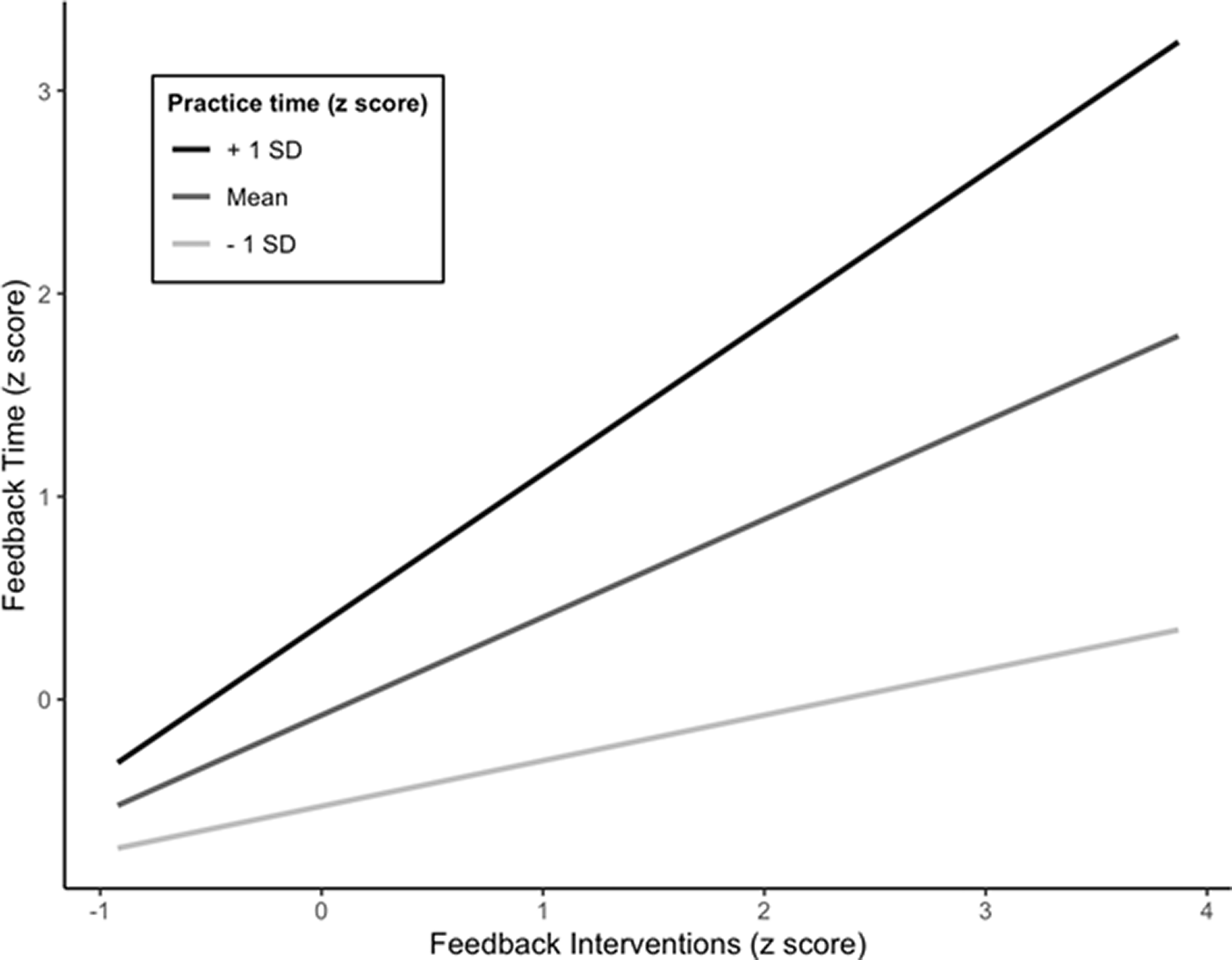
Z-score relationships between number of feedback interventions and practice time on total feedback duration per practice activity.
Standardised coefficients, 95% confidence intervals, degrees of freedom, t-values, -2log likelihood ratio tests, p-value, AIC, partial eta squared effect size and associated 95% confidence intervals for each independent variable using a step-up approach.

CI: confidence interval; df: degrees of freedom; AIC: Akaike Information Criterion.
Note: Likelihood ratio test based on comparison with previous model.
Effect size is an approximation based on the t value obtained from each variable included in the model.
Beta weights (or standardised coefficients) refer to how many standard deviations the dependent variable will change, per standard deviation increase in the predictor variable. They are sample specific weightings to ease the interpretability of coefficients.
Model 2 focused on terminal feedback duration in-season while incorporating match result as a fixed effect and revealed a marginal r2 value of 0.88 and a conditional r2 of 0.99. Practice time (β = 0.45[95%CI 0.29:0.61], p < 0.001, η2 = 0.62), feedback intervention frequency (β = 0.32[95%CI 0.18:0.45], p < 0.001, η2 = 0.53) and a feedback intervention frequency* match result interaction (β = 0.61[95%CI 0.41:0.81], p < 0.001, η2 = 0.65) were all positively associated with the time coaches spent providing feedback (Figure 2). The relationship between the number of feedback interventions and the average length of feedback duration was dependent on the previous match result. Specifically, lower feedback intervention frequencies after a loss were associated with lower feedback durations, whilst higher feedback intervention frequencies after a win were associated with greater feedback duration.

The model fitted time spent providing feedback interaction plots presenting (a) Interaction effects between practice time and match result on feedback duration and (b) Feedback interventions and match result on feedback duration.
Conversely, a practice time* match result interaction (β = −0.36[95%CI −0.62:-0.09], p = 0.013, η2 = 0.27) was negatively associated with terminal feedback duration. Specifically, the effect of practice duration on feedback duration up to ∼400 seconds practice time was higher for a loss, however there was a negligible effect of winning or losing on feedback duration at lower practice durations. Further, the effect of practice duration on feedback duration tended to increase after a win (Figure 2(a)). Longer practice durations after a competitive match win led to larger feedback durations. The main effect of match result (p = 0.102, η2 = 0.13), the practice time*feedback interventions interaction (p = 0.240, η2 = 0.07) and the three-way interaction of practice time*feedback interventions*match result (p = 0.496, η2 = 0.02) were not associated with feedback duration.
Discussion
This study investigated the factors associated with team-level terminal verbal feedback duration provided by AFL coaches during practice. The main findings revealed that a practice time*feedback intervention frequency interaction explained 65% of the variance in terminal feedback durations provided across the season. Further, a practice time*match result interaction, and match result*feedback intervention frequency interaction explained 99% of the variance in terminal feedback duration during practice in-season. These findings highlight the duration of terminal feedback AFL coaches provide to the team during practice is mainly associated with the number of times they intervene, the duration spent in a particular practice activity, and the previous game’s result as opposed to the type of practice activity, the representativeness of the practice activity or the phase of the season.
Coach interaction with players in practice can substantially influence skill transfer in team sport. 34 Here, terminal feedback duration during practice activities was associated with greater practice time spent in the particular activity (η 2 = 0.32[95%CI 0.18:0.45];p < 0.001) and feedback intervention frequency within the particular activity (η 2 = 0.38[95%CI 0.24:0.50];p < 0.001) (Figure 1). The results indicate that longer activities provide more opportunity to provide feedback, potentially because more information has been observed. This leads to an increased terminal feedback duration. Here, coaches may provide longer feedback duration when the practice activity is longer because the relationship between collective team behaviour and augmented feedback delivery is mediated by time. That is, the more complex the collective behaviour exhibited in the activity is, the more time the coaches allocate to it, which leads to increased feedback duration. Recent research has confirmed that practice types with increased complexity e.g. match simulation, comprise a large proportion of practice across the pre- and in-season phases. 24 Moreover, although the results from this study confirm that practice type did not contribute any explanatory power to either model, the largest proportions of time spent providing augmented terminal feedback relative to the total practice activity time across the in-season period were match simulation (7.4%) and transition (4.4%), suggesting that coaches provide increased information in more complex practice types.
It has been documented that coaches implement longer average practice activity durations in match simulation, transition and breakdown practice types in professional AF. 24 Coaches may implement longer practice activities because they want players to adequately attune to relevant information sources by maximising their exposure to those specific environments e.g. match simulation. However, by extending the practice activity time, coaches tend to provide increased terminal feedback durations, based on the results of this study. We speculate these results are mediated by the relationship between time on task and errors, where more errors are committed over longer timeframes. This may be a result of attention-limit issues as the activity progresses, where an increase in errors may be attributed to a delay in perceptual recognition and processing, 7 , 25 rather than delayed motor responses. Nonetheless, coaches may feel the innate urge to quickly provide prescriptive information on how to correct these errors. Indeed, Bjork 35 identified that players and coaches alike do not value errors for their self-organisational characteristics and subsequent benefits of self-discovery in the post-training environment e.g. competition, and would rather provide direct feedback quickly, to correct the error. Further, the team may be making more mistakes as the activity continues due to fatigue. These findings have implications for the salience and potency of augmented feedback. For example, if coaches provide increased terminal feedback durations as the practice drill continues, players may use this source of information for regulating movements instead of task-intrinsic feedback as augmented feedback is the most easily accessible source of information. 36
The findings of this study would be valuable to share with coaches, along with existing strategies on skill transfer e.g. a scheduling method that can help coaches intervene less to enhance skill transfer uses a bandwidth approach to provide feedback. 3 For example, a coach can intervene and provide feedback when five positional errors in the defensive half have been committed. No feedback is provided on the first 4 errors made. This approach helps players self-regulate behaviour by providing opportunities to identify the mistake, then correct and reorganise in relation to the appropriate aspects of information in the activity, such as their teammates, the opponents and their position.
The second model described terminal feedback duration including match result as a fixed effect. Match result did not explain feedback duration as a main effect. Relative to practice activity duration, the relationship between feedback duration and match result was mixed. Although there was a limited effect, practice activities with low practice durations observed slightly higher terminal feedback durations after a loss. In longer duration practice activities, AFL coaches provided increased terminal feedback durations after a win (Figure 2(a)). For example, in a practice activity that was 10 minutes long, coaches intervened to provide 50% more augmented feedback the week after winning a competitive match (75 seconds) compared to losing (50 seconds). Although previous research has reported the number of interactions of feedback coaches provide does not change when there is a higher chance of winning or losing during a competitive AFL match, 23 the current findings indicate a change in coaching style and information delivery during practice the week after winning or losing a match, relative to practice time. Enhanced learning and increased motivational properties of augmented feedback have been established when provided after successfully performed trials 37 , 38 which may help explain why coaches provide increased feedback durations during practice after a win when practice time is longer.
A positive association between feedback interventions and feedback duration was evident, however, there was an interaction between feedback interventions and match outcome (η 2 = 0.65[95%CI 0.34:0.79];p < 0.001) such that the effect of feedback interventions on feedback duration increased following a win (when compared with following a loss, Figure 2(b)). This was a cross-over effect whereby when only one feedback intervention was provided, it tended to be of longer duration than following a loss, whereas, when two or more feedback interventions were provided, the total feedback duration tended to be longer following a win, with increasing effects based on the number of interventions provided. This positive relationship becomes increasingly stronger after winning. Feedback duration appears to be short when a few interventions are used, however they are much longer when several feedback interventions are provided. Such a finding implies that the professional coaches in this study provided more information after recent success.
The information players perceive and subsequently utilise depends on the task being performed. 39 In this study, practice type and practice activity form did not have any explanatory importance to terminal feedback duration in either model. These findings and notable absence of factors that skill acquisition specialists typically think would influence feedback duration are particularly noteworthy, as it showcases that these AFL coaches did not explicitly change feedback durations depending on the practice activity being performed. For example, some practice types involved more complex representations of gameplay such as collective offensive organisation against multiple opponents, higher pressure from defenders during kicking activities and positioning at stoppages. In simple practice activities, expert performers are able to identify and correct errors intrinsically and without recognition or communication from coaches. However, more complex practice activities may require more augmented feedback as players are unable to identify critical information sources. Thus, approaches to augmented feedback should be context dependent. Skill acquisition specialists can help coaches reflect on the appropriateness of interventions during practice and determine whether the additional information given to the players is necessary to firstly, acquire the skill or behaviour, or secondly, achieve the skill or behaviour at a higher rate than without the augmented feedback.
Although this was the first study to provide a longitudinal analysis of augmented terminal feedback in a professional AF team practice, some limitations must be considered. Firstly, terminal augmented feedback content is an important factor when determining its usefulness in team sport. This study was not able to measure the content of the feedback provided. A potential avenue for future research is putting microphones on the coaches and performing qualitative analyses to further understand the feedback content. Moreover, our initial approach involved analysing all observations, including where zero seconds of feedback was provided by coaches. However, after trying different error structures and removing influential datapoints, the resulting models were extremely poor fits for the dataset. Consequently, we must acknowledge this limitation in the analyses. Additionally, the analyses were only performed within one professional AF team, and therefore may not be generalisable to other teams. Nonetheless, the longitudinal data collection strengthens the interpretation and provides crucial insights into how augmented feedback is provided by coaches in the ecologically valid environment of professional AF practice.
Conclusion
This study explored the factors associated with terminal feedback duration in professional AF practice. When coaches provided terminal augmented feedback during practice, feedback intervention frequency, practice time and an interaction between the two variables explained 65% of the variance in feedback duration. When the previously played match result was added as a fixed effect in-season, feedback intervention frequency, practice time, a practice time*match result interaction and a feedback intervention frequency*match result interaction effect explained 99% of the variance in feedback durations. Importantly, practice type and the practice activity form did not contribute any explanatory power in either model. Skill acquisition specialists can help coaches navigate how to optimise augmented feedback delivery within team sport. The relationships between factors that explain feedback duration in professional AF illustrates a complex interplay of interactions however these did not include factors that are typically thought to guide feedback during training. Coaches and practitioners working in Australian football and other team sports should discuss the systematic and beneficial implementation of augmented feedback for task-related performance and learning.
Practical applications
An in-situ measurement of augmented feedback can assist practitioners working with coaches about when and how often they provide additional information to the team Feedback durations (implicitly) change the week after a competitive match pending on the previous match result. Coaches must be aware of the implications this can have on the transfer of practice to matches There is a complex interaction of factors that explained feedback duration, highlighting the importance of skill acquisition specialists to help implement pedagogical frameworks to deliver augmented feedback
Footnotes
Acknowledgements
The authors would like to thank the coaches of the Sydney Swans Football Club for their assistance throughout this project.
Declaration of Conflicting Interests
The author(s) declared no potential conflicts of interest with respect to the research, authorship, and/or publication of this article.
Funding
The author(s) received no financial support for the research, authorship, and/or publication of this article.
