




Abstract
The study investigated the extent of individualisation, readjustment and athlete codetermination of high-performance training. Individualisation refers to the extent to which the training design is tailored to an athlete's individual wishes, interests, strengths, and weaknesses. Readjustment refers to the adjustment of day-to-day training to an athlete's current physical, health-related and psychological constitution. Athlete codetermination refers to an athlete's involvement in decision-making on the training design. German national-squad members in athletics and volleyball (n = 336) reported these variables in an online questionnaire. Analyses revealed four central findings: (1) Large parts of athletes’ training were characterised by high degrees of individualisation, readjustment and athlete codetermination. (2) These characteristics were more pronounced in athletics than in volleyball. (3) They explained large parts of the appropriateness of athletes’ training (whether the training was ‘just right’ for an athlete's performance development). Consistently, greater extents of individualisation, readjustment and athlete codetermination of training control were associated with better multi-year performance development. (4) Participation in performance analytics had no additional, specific effect on training appropriateness. All the results consistently applied to both youth age and adult age. In conclusion, greater extents of individualisation, readjustment and athlete codetermination of the training design apparently facilitate long-term training efficiency.
In high-performance sports, a few milliseconds, centimetres, or a single action can make the difference between victory and defeat. Athletes and coaches undertake extensive efforts to optimise their training process and maximise the athlete's performance in critical competitions. The present study explores the extent to which the training of high-performance athletes is characterised by individualisation, readjustment and athlete codetermination. The study also examines whether these characteristics are associated with training appropriateness and athletes’ long-term performance development.
When designing training, coaches draw on a specific mixture of the traditional training methodology within the community of a sport, their coach education, own experience and to some part intuition and instinct.1–4 Coaches endeavour to teach their athletes perceptual-motor and tactical skills in the most effective way;5,6 from a physiological perspective, they aim to induce optimal functional overreaching while avoiding overtraining. 7 It is believed that even nuanced details of the training process may significantly affect athletes’ later performance. Coaches thus not only determine the number of weekly practice sessions and the types of exercises and playing forms, they also define details such as the amount of each activity, the duration of each game format, the number of sets and repetitions per set in each exercise, the intensity and inter- and intra-set rest intervals, the exact way of executing each exercise or game and the efficient organisation of each session.8–10 Training is mostly done as team practice, and coaches design group training plans that extend over weeks, months, and seasons.10–13
While practice is mostly designed for groups, athletes within these groups differ individually, for example, regarding years of experience, individual strengths and weaknesses, health-related constitution, load tolerance and psychological conditions.8–10,14,15 This suggests a certain degree of individualisation – that is, differentiation of the training design between athletes – to tailor the training to each athlete individually. Furthermore, training effects are to some degree uncertain and sometimes do not elicit the anticipated performance progress. Also, an athlete's physical and mental shape-on-the-day, health, load–recovery balance and mood may vary over time. These factors may sometimes suggest revisions of the original training plan and readjustment of the training design on a day-to-day basis.8,10
The coach continuously observes the athlete in competition and daily practice and assesses their performance development, shape-on-the-day, health-related and mental constitution, and load–recovery balance. This subjective assessment is often supplemented with more objective tests and performance analytics. They are designed to monitor the training load, assess the athlete's health and evaluate performance components such as perceptual-technical and tactical skills, physical abilities (speed, agility, power, strength, endurance and flexibility) and psychological skills (e.g. concentration and self-regulation).16–19 These procedures typically involve multidisciplinary perspectives including biomechanics, kinesiology, sports medicine, physiology, exercise science and psychology. 20 According to traditional training theory literature,12,21 the idea of training control implies a recurrent cybernetic loop: (1) The coach defines the goals and training design for a defined period. → (2) The athlete executes the training plan. → (3) The athlete's performance components and development are evaluated based on the coach's assessment and performance analytics. → (4) This evaluation informs the training design in the subsequent period. → (5) The athlete executes the training plan … etc. Here, one might take the stance that the elite athlete's role includes more than just executing the coach's instructions. Rather, athletes themselves may be a significant factor in codetermining the training control.22–24 Athlete codetermination has been widely neglected in traditional conceptions of training control in training theory literature. However, elite athletes have extensive experience and first-order perceptions that neither coaches’ observations nor performance analytics may capture—at least not as “fine-grained” as athletes themselves do: For example, day-to-day perception of their own body, shape-on-the-day, stress, health, load–recovery balance and psychological situation, as well as factors like how well certain exercises, playing forms, ways of executing them or load intensities suit a particular athlete, and also simply how much an athlete does or does not like doing them.9,22,25 In this way, elite athletes may be considered as experts of themselves. Consequently, athletes’ communication of their experiences, perceptions and perhaps preferences may potentially provide a fruitful contribution to training control and effectiveness.
In summary, any training at any time is located somewhere on the following three continua: (1) from entirely identical training design for all athletes to entirely individualised training for each athlete; (2) from complete adherence of each athlete's training to an original training plan to continuous readjustment of each athlete's training to their current constitution; and (3) from determination of the entire training design by the coach to determination of the entire training design by the athlete(s). These three dimensions were the subject of the present study. The aim was to investigate to what extent the training of high-performance athletes involves individualisation, readjustment and athlete codetermination, and whether these three characteristics are associated with training appropriateness, effectiveness and efficiency.
Typical individual and team sports may differ in the extent of individualisation, readjustment and athlete codetermination. Hence, this study takes potential differences into account and exemplifies this comparison by involving athletics and volleyball. In both sports, training is typically organised as team practice and largely focuses on perceptual-motor skills and physical conditioning.26,27 In athletics, athletes perform individually in competitions. At the elite level, their training is focused on continuously improving nuances of each athlete's individual skill technique through exercise forms. While practicing as a group, athletes’ tasks often vary individually. 26 In volleyball, athletes perform jointly in competitions, and a player's actions and their quality rely on teammates’ actions. At the elite level, their training is mainly focused on continuously improving team and group tactics through playing forms and sub-phases of play: aligning actions of different players within offense and defence plays, playing systems, and offense–defence–transition, especially coordinating the positioning and timing of different players’ actions, and anticipating teammates’ decisions and actions. 27 These factors may limit the scope for individualisation, readjustment and athlete codetermination in volleyball compared to athletics.
The coach–athlete interaction and athlete codetermination in the training process have extensively been studied with regard to youth athletes’ autonomy perception, motivation and psychological well-being (see Nichol et al., 24 for a review.). The present study begins to explore potential associations with athletes’ training appropriateness and performance development in a select sample of youth and adult elite performers.
The aim was to explore three questions: (1) To what extent is the training of high-performance athletes characterised by individualisation, readjustment and athlete codetermination? (2) Do these characteristics differ between an individual sport (athletics) and a team game sport (volleyball)? (3) Do individualisation, readjustment and athlete codetermination of training control facilitate training appropriateness and performance development? To the best of our knowledge, this is the first time these questions have been explored among high-performance athletes. We therefore formulate no directed a-priori hypotheses.
Methods
Participants
The sport directors of the German Athletics Federation and the German Volleyball Federation sent e-mails to all national-squad athletes inviting them to participate in the online questionnaire. Between October 2019 and January 2020, 336 (40%) of the national-squad athletes participated, 194 from athletics and 142 from volleyball. Table 1 describes demographic and participation variables of the athletes. The convenience sample exceeded the minimum size suggested by an a-priori power analysis, n ≥ 191 (G*Power 3.1.9.7, two-tailed, Cohen's d = 0.20, α = 0.05, 1 − β = 0.80).
Demographic and participation variables of the participants. a
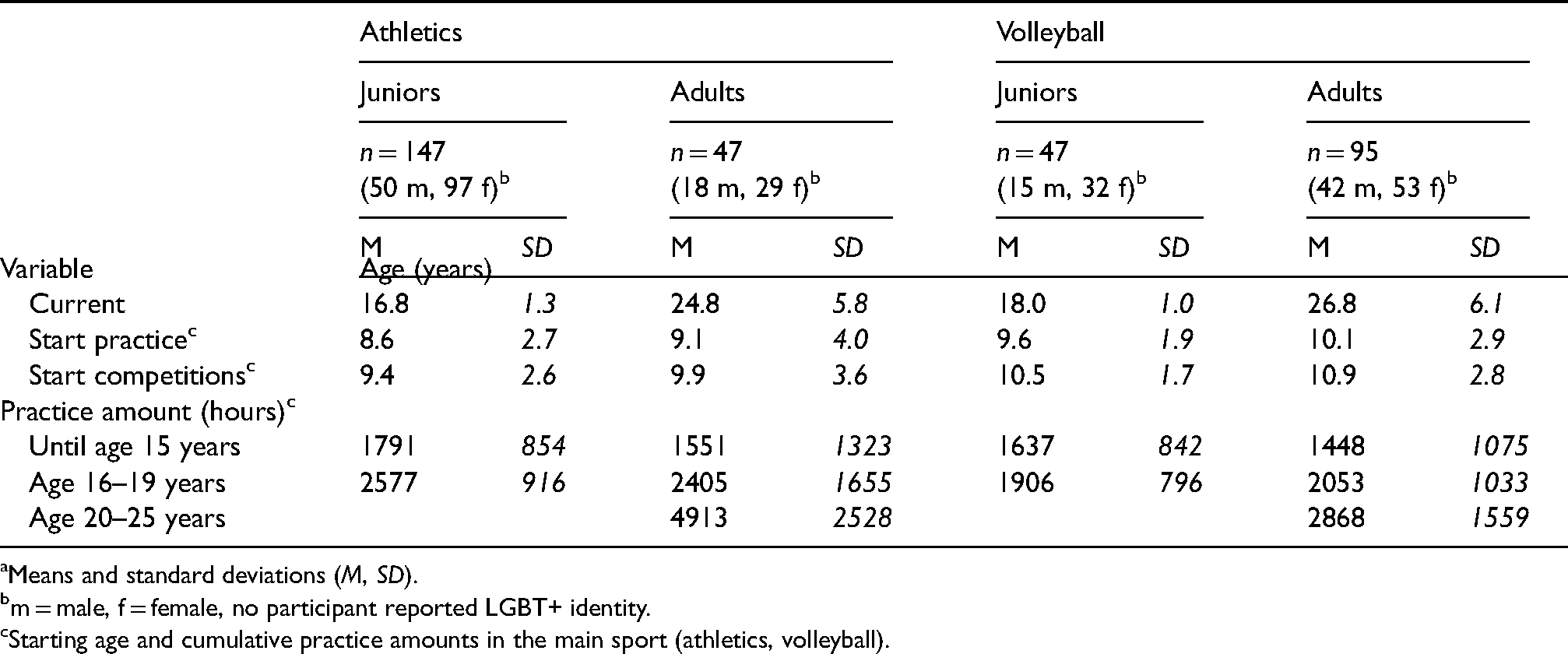
Means and standard deviations (M, SD).
m = male, f = female, no participant reported LGBT+ identity.
Starting age and cumulative practice amounts in the main sport (athletics, volleyball).
Of the entire sample, 309 participants (92%) achieved top-10 placings at national junior championships; 74 (22%) achieved a top-10 result and 30 (9%) won medals at international junior championships. Of the 142 adult athletes, 114 (80%) were placed among the top 10 at open-age national championships; 53 (37%) achieved international top-10 placings, and 34 (24%) won medals at Olympic Games, world, or European championships.
Data collection
We used a performance and participation history questionnaire that had been validated in equivalent elite samples28–30 (retest reliability 0.80 < rtt < 1.00; external validity 0.81 < r < 1.00). A briefing sheet informed the athletes about the purpose of the study, voluntariness and anonymity of participation and data protection. The participants consented by opening the link to the questionnaire. It took the athletes on average M = 39 minutes (standard deviation SD = 15) to complete the questionnaire. Ethical approval was provided by the authors’ faculty ethics committee.
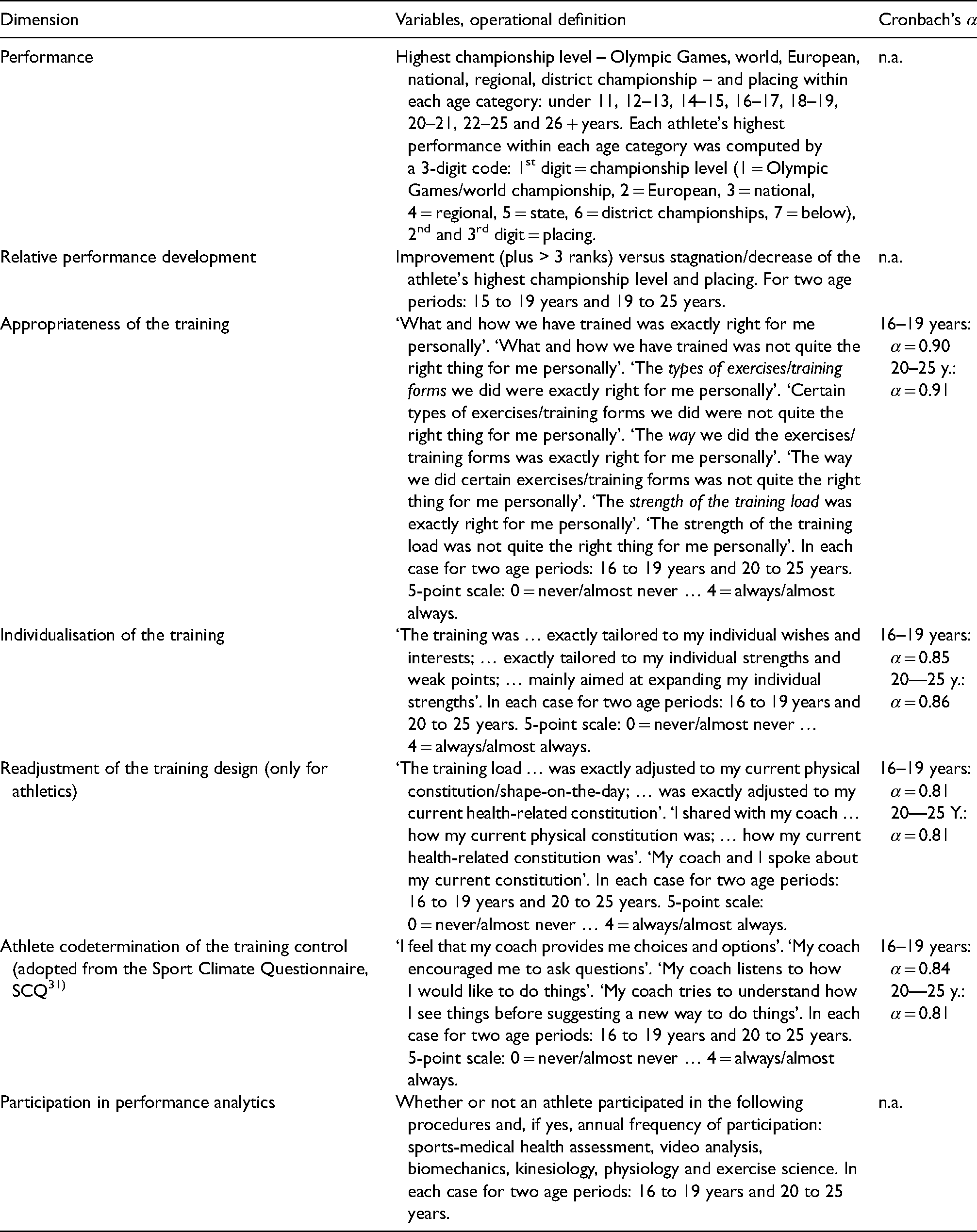
The cross-sectional retrospective questionnaire measured, amongst others, athletes’ socio-demographic variables, competition level and placing within each age category, training volume and participation in several performance analytics procedures (see Table 2). The questionnaire was complemented by relevant questions on athlete codetermination of training control adopted from the Sport Climate Questionnaire (SCQ). 31 In addition, we conducted preliminary interviews with nine national-squad coaches from both sports and pilot tests involving eight athletes. Based on these insights, we developed indicators of training appropriateness, the extent of individualisation and, for the athletics subsample, the occurrence of readjustment of the training design to an athlete's current constitution. For all these questions, the question stem, format and response scale was kept identical to the SCQ. Items were arranged in random order. All variables were measured for two age periods: 16 to 19 years and 20 to 25 years. Table 2 describes the recorded variables, dimensions, operational definitions and internal consistency of the multi-item scales (Cronbach's α).
Recorded variables, dimensions and internal consistency (Cronbach’s α).
Validity and reliability
An explorative factor analysis (varimax rotation; 70% cleared total variance) extracted three factors (Kaiser criterion) with a clear dimensional structure. The model had high factor loadings of designated items and low cross-loadings on other factors: individualisation (factor loadings: 0.72 to 0.86, cross-loadings: −0.09 to 0.22), readjustment of the training design (factor loadings: 0.61 to 0.78, cross-loadings: 0.08 to 0.34), and athlete codetermination (factor loadings: 0.68 to 0.85, cross-loadings: −0.13 to 0.12). The internal consistency (Cronbach's α) of each scale was acceptable (0.80 < α < 0.92; Table 2). Leave-one-out analyses did not provide any improvement of any scale. Furthermore, a retest after 4 weeks (n = 21) showed acceptable retest reliability for all variables (0.74 < rtt < 1.00).
The questions on the appropriateness of the training referred to appropriateness for athletes’ performance development. To test external validity, we differentiated between athletes with multi-year relative performance improvement (championship level and placing) and those with performance stagnation or decrease (see Table 2) and compared their reports on training appropriateness (5-point scale from 0 to 4). Within junior age (16 to 19 years), the values were M = 3.14 (SD = 0.58) versus M = 2.57 (SD = 0.75), t = 6.01, p < .001, Cohen's d = 0.83. For adult age (20 to 25 years), the values were M = 3.10 (SD = 0.74) versus M = 2.27 (SD = 0.74), t = 4.72, p < .001, Cohen's d = 1.13. These results corroborated that athletes’ reports on their training appropriateness reflected their performance development.
Furthermore, it is theoretically conceivable that perceiving greater extents of individualisation, readjustment and athlete codetermination results from better performance development, or vice versa—another relevant point regarding validity. In the first case, it would be expected that athletes with multi-year performance improvement differed from those with performance stagnation or decrease by showing a more positive change over time of reported individualisation, readjustment and athlete codetermination. The present data enabled the testing of this hypothesis: The groups with performance improvement and with performance stagnation/decrease from age 15 to 19 years were compared regarding their development of individualisation, readjustment and athlete codetermination from age period 16–19 years to age period 20–25 years. Repeated measures analysis of variance (ANOVA) revealed that the groups did not differ in the development of individualisation (F = 0.14, p = .709) and readjustment (F = 0.91, p = .346). In terms of athlete codetermination, athletes with performance stagnation/decrease from 15 to 19 years old even showed an increase over time (16 to 19 years: M = 2.03, SD = 0.90; 20 to 25 years: M = 2.48, SD = 0.70), while the participants with performance improvement did not (16 to 19 years: M = 2.56, SD = 0.92; 20 to 25 years: M = 2.56, SD = 0.81; F = 4.33, p = .041). The finding suggests that perceiving greater levels of individualisation, readjustment or athlete codetermination was not a function of preceding positive performance development.
Finally, it is relevant that participants with multi-year relative performance improvement did not engage in greater amounts of sport-specific practice than did their counterparts with relative performance stagnation/decrease (15 to 19 years: improvement M = 2275 h, SD = 1022, vs. stagnation/decrease M = 2331 h, SD = 1298, t = 0.25, p = .805; 20 to 25 years: M = 3554 h, SD = 2106, vs. M = 3764 h, SD = 2941, t = 0.31, p = .758). This means that differences in multi-year performance development reflected differences in multi-year efficiency of practice (Δperformance/practice amount).
Data analysis
Analyses were performed with SPSS 26.0 (IBM, Armonk, NY) and included three progressive steps:
To describe the extent of individualisation, readjustment and athlete codetermination of training control and compare them between athletics and volleyball. To analyse whether and how individualisation, readjustment and athlete codetermination explained individual differences in the appropriateness of athletes’ training using multivariate linear regression analyses (MLR). This step included two additional sub-analyses: (a) It is conceivable that older and/or more successful athletes were generally more likely granted greater extents of individualisation, readjustment and codetermination,32–34 implying that individualisation, readjustment and codetermination followed success, not vice versa. To begin to investigate this hypothesis, we subsequently added athletes’ age and performance level as predictor variables. (b) To investigate whether performance analytics had an additional, specific effect on training appropriateness, we added the participation frequency of each athlete in each of the performance analytics procedures as predictor variables (see Table 2). To compare athletes who showed multi-year relative performance improvement with those who had performance stagnation/decrease (i.e., competition level: highest championship level and placing; from 15 to 19 years and from 19 to 25 years) regarding the extent of individualisation, readjustment, and athlete codetermination of training control.
The performance developments (improvement vs. stagnation/decrease) from 15 to 19 years old and from 19 to 25 years old were widely unrelated (χ2 = 0.13, p = .803). Likewise, training appropriateness, individualisation, readjustment and athlete codetermination, respectively, during age periods 16 to 19 years and 20 to 25 years were only modestly correlated (0.25 < rtt < 0.46). That is, these variables were not stable characteristics of an athlete but varied considerably in the course of their career, demanding separate analyses for each age period. Male and female participants did not significantly differ from each other in any of the variables (0.03 < t < 1.99; all p > .05), and there were no interactions of sex and performance development (0.01 < F < 2.49; p > .05). Both sexes were thus pooled in analyses. Furthermore, there was no interaction of sport (athletics, volleyball) and performance development (0.00 < F < 1.58; p > .05). Thus, both sports were pooled for analyses 2 and 3 described above.
Descriptive data include means and standard deviations (M, SD). Group comparisons (athletics vs. volleyball; performance improvement vs. stagnation/decrease) were done using an unpaired t-test. MLR analyses were conducted with backwards variable inclusion (inclusion criterion p < .10). Effect sizes are expressed as Cohen's d for group comparisons and as adjusted R2 (R2 adj ) for MLR. All hypothesis testing was two-tailed. A value of p < .05 was considered statistically significant.
Results
Table 3 shows the extent of individualisation, readjustment and athlete codetermination of training control, and the comparison between athletics and volleyball. Sample and subsample mean values ranged from M = 2.17 to M = 2.98 on the 5-point scale (0 = ‘never/almost never’ to 4 = ‘always/almost always’). That is, both during youth and adulthood, large parts of the participants’ training were highly individualised, readjusted to the athlete's current constitution, and codetermined by the athlete. Individualisation and athlete codetermination were more pronounced in athletics than in volleyball, both during youth and adulthood. Effect sizes were medium to large (Table 3).
Extent of individualisation, readjustment and athlete codetermination of training control a of high-performance athletes during age periods 16 to 19 and 20 to 25 years and comparison between athletics and volleyball.

5-point scales: 0 = ‘never/almost never’ … 4 = ‘always/almost always’.
d = Cohen's d.
The results of the MLR analyses are displayed in Table 4. More than half of the variance of the training appropriateness (0.53 < R2 adj < 0.58) was explained by either individualisation alone (Model 3: adult training, both sports), individualisation and athlete codetermination (Model 1: youth training, both sports; Model 4: adult training, athletics), or individualisation, readjustment, and athlete codetermination combined (Model 2: youth training, athletics).
Results of multivariate linear regression analyses (MLR). Dependent variable: Appropriateness of athletes’ training during two age periods, 16 to 19 years (top) and 20 to 25 years (bottom). Backward inclusion method (inclusion criterion p < 0.10); predictor variables in Models 1 and 3: Individualisation and athlete codetermination; in Models 2 and 4: Individualisation, readjustment and athlete codetermination. R2 adj = adjusted R2.
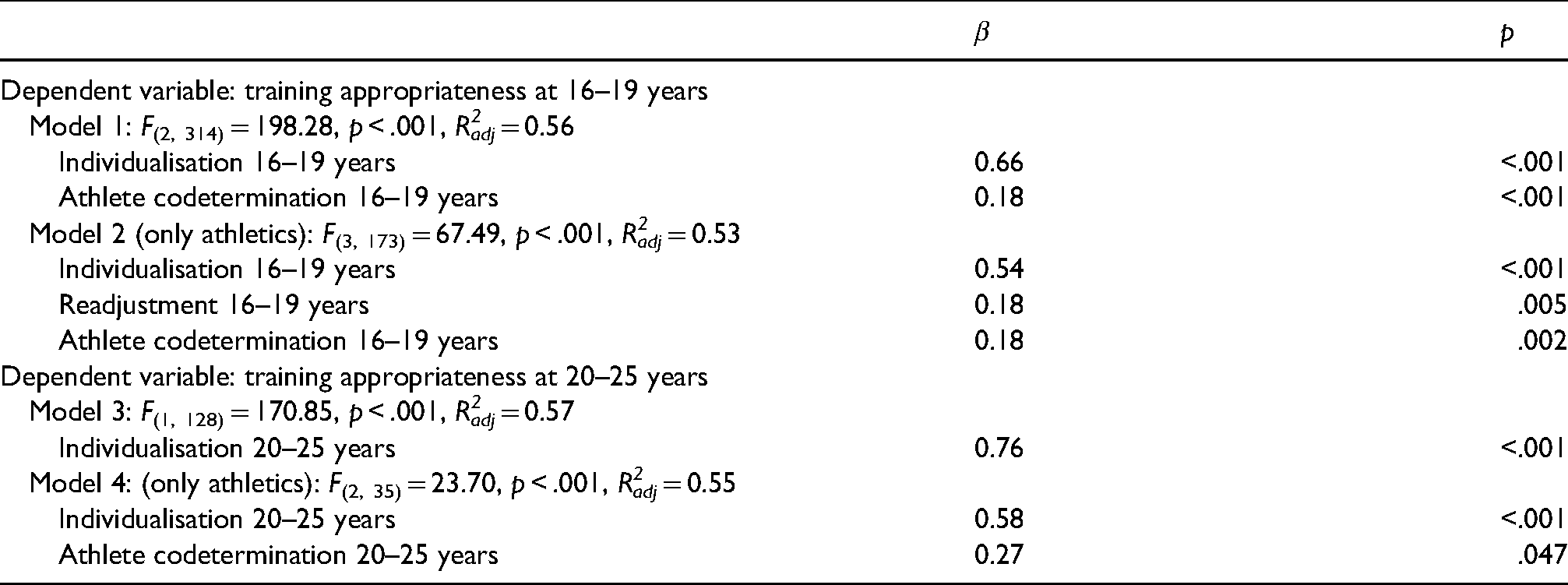
When adding the athletes’ age and/or performance level as predictor variables to each model (individually or combined), they were non-significant (p > .10) and were excluded from the model. Thus, the effects displayed in Models 1 to 4 applied regardless of athletes’ age and performance level. Furthermore, when adding the participation in the various performance analytics procedures as additional predictor variables to each of the models in Table 4, they were, again, non-significant (p > .10) and were excluded from the model. That is, when considering individualisation, readjustment and athlete codetermination, participation in performance analytics had no additional, specific explanatory effect on individual differences in training appropriateness.
Table 5 shows the comparison between athletes with multi-year relative performance improvement and those with performance stagnation/decrease (championship level and placing), both during youth and adulthood. Athletes with multi-year performance improvement reported greater extents of individualisation, readjustment and athlete codetermination of training control. Effect sizes were generally small to medium for junior age and large for individualisation and readjustment in adulthood. The effect size of athlete codetermination in adulthood was similar to that during youth age, but only approached significance (p = .075).
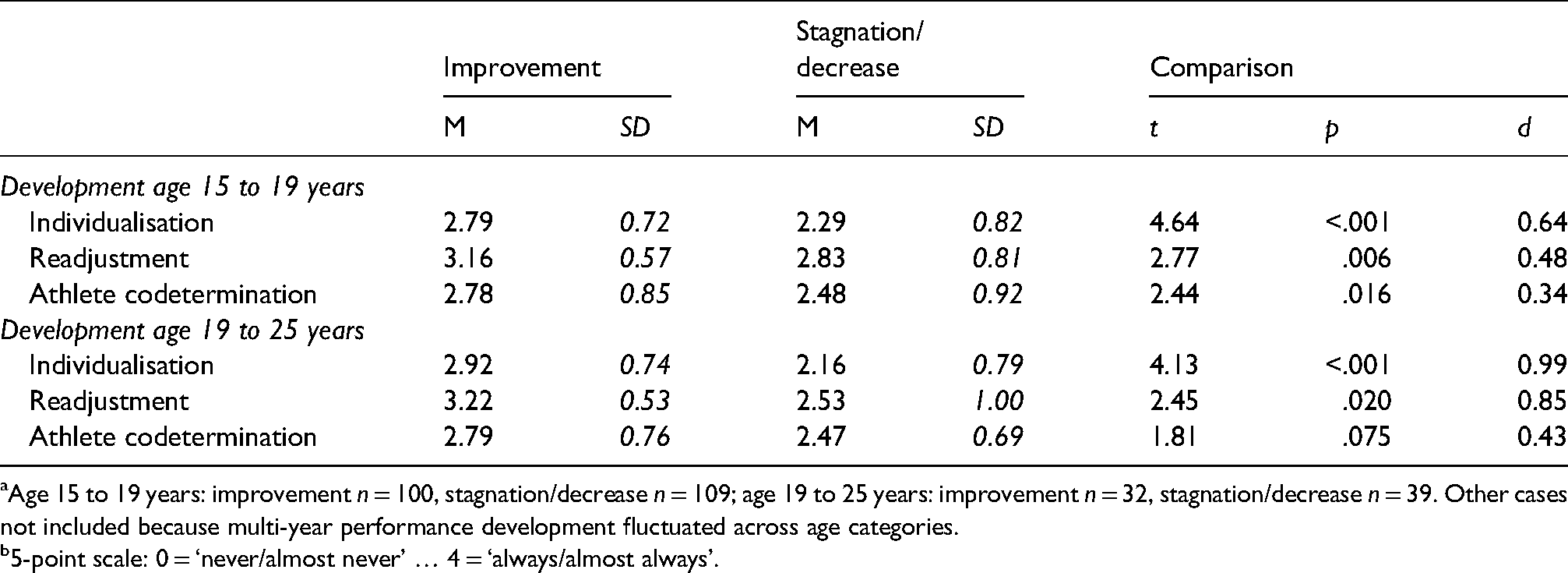
Age 15 to 19 years: improvement n = 100, stagnation/decrease n = 109; age 19 to 25 years: improvement n = 32, stagnation/decrease n = 39. Other cases not included because multi-year performance development fluctuated across age categories.
5-point scale: 0 = ‘never/almost never’ … 4 = ‘always/almost always’.
Discussion
Athletes’ training varies in the ratio between commonality across athletes versus individualisation (i.e., individual differences) across athletes, adherence to a training plan versus readjustment to the athlete's present constitution, and between coach determination versus athlete codetermination of the training design and control. We explored the extent to which the training of a select sample of elite performers from athletics and volleyball was characterised by individualisation, readjustment and athlete codetermination. Four central findings emerged: (1) Large parts of the training of these high-performance athletes were characterised by high degrees of individualisation, readjustment and athlete codetermination. (2) These characteristics were more pronounced in athletics than in volleyball. (3) Individualisation, readjustment and athlete codetermination of training control facilitated training appropriateness, irrespective of athletes’ age and performance level. Consistently, higher levels of individualisation, readjustment and athlete codetermination of training control were associated with better multi-year performance development. (4) Participation in performance analytics had no additional, specific effect on training appropriateness.
The observed consistent predictor effects on the athlete-assessed training appropriateness and on the factual development of athletes’ competition level – both during youth and adult age – corroborate the robustness and nomological validity of the findings. Furthermore, differences in multi-year performance development were not explained by differences in athletes’ training volume: Participants with multi-year performance improvement and with performance stagnation/decrease did not significantly differ in their cumulative sport-specific training amounts. The data signify that greater extents of individualisation, readjustment and athlete codetermination were associated with both greater training effectiveness and greater training efficiency (performance improvement per training amount). 35
The present findings extend and partly challenge some traditional views of the planning and control of the elite training process in four – presumably interrelated – regards. (1) Among these elite athletes, the coach–athlete power relationship was obviously not as asymmetric as some have postulated.36–38 For example, participants reported that they codetermined most of their training. (2) Besides the coach's observation of their athletes and performance analytics,1,2,17 the athlete's communication of their experiences, perceptions and preferences is apparently an important source to inform the appropriateness, effectiveness and efficiency of the training process. (3) Unlike the assumed premise of traditional training theory that planned and executed training are identical,12,13,39 readjustment of the training design on a day-to-day basis was common. (4) Participation in performance analytics had no specific effect on training appropriateness, which questions the traditional view of the ‘cybernetic loop’ of performance analytics and training control.12,21 In sum, these observations together with extant research8–10 suggest that coaches and athletes form a framework concept for a defined period of training that has to be understood as a flexible, somewhat ‘fluid’ hypothesis. This hypothesis is recurrently tested and readjusted based on day-to-day experiences and observations. In this context, the athlete's experiences, perceptions and preferences provide relevant information to inform training appropriateness, which the other sources – coach observation and performance analytics – cannot equivalently provide. The athlete's experiences, perceptions, and preferences are partly subjective, but are highly ‘fine-grained’ and holistic, in that they integrate perspectives of physiology, medicine, kinesiology, psychology, and pedagogy (e.g. Saw et al.,19 Lazarus, 40 McNair et al., 41 Marsh et al. 42 )
In former literature, the coach–athlete interaction and athlete codetermination have mainly been addressed with respect to the athlete's basic psychological needs satisfaction, well-being and motivation.23,24,43 The present observations suggest that the effect of athlete codetermination on performance development is not contradictory to the effects on the athlete's psychological well-being and motivation. The effects are rather concordant: greater extents of athlete codetermination may facilitate both, the athlete's psychological well-being and motivation as well as performance progress. However, whether these are unrelated or related effects is still widely unstudied – for example, whether the effect on psychological well-being and motivation is moderated by the effect on performance progress or vice versa.
As expected, all three dimensions – individualisation, readjustment and athlete codetermination of training control – were more pronounced in athletics than in volleyball. Unlike typical individual sports, team sports like volleyball require joint performance. Each player's actions rely on and are aligned with teammates’ actions. To achieve this, playing systems, tactics and plays require joint practice of common tasks. 27 This requirement presumably leaves less scope for individualisation, readjustment and athlete codetermination of training control. Furthermore, some reports suggesting asymmetrical coach–athlete power relationships – which may limit athlete codetermination – were from team game sports.37,44,45
Finally, the effect size of athlete codetermination of training control on adult performance development was similar to the effect during youth age, but was non-significant. It may be that the effect is in fact less reliable in adulthood than during youth age. It should be considered, however, that the adult subsample was comparatively small (n = 71) and below the minimal sample size suggested by the a-priori power analysis (n ≥ 191).
Practical implications
The present findings suggest some clear implications for practitioners. To facilitate the athlete's performance progress, both during youth and adulthood, coaches should seek to tailor large parts of the training to athletes’ individual characteristics, adjust the training to the athlete's current constitution, and involve the athlete in decision-making on the training design. This implies to encourage athletes to share their experiences, perceptions and preferences as well as to develop their confidence and competencies to do so (e.g., by facilitating and deliberately training self-perception). Furthermore, these topics may be integrated in coach education.
In all this, it should be noted, however, that individualisation, readjustment and athlete codetermination did not apply to athletes’ entire training. Even athletes with better performance development reported that considerable parts of their training were determined by the coach alone, uniform across athletes and adhered to the original training plan.
Limitations and future directions
The study has several strengths, such as exploring a new subject, involving a select elite sample and combining athlete-assessed training appropriateness with participants’ factual performance development. However, the study does have limitations. The major limitation is that the study is correlational and, strictly speaking, does not allow us to draw causal conclusions. Furthermore, the adult subsample was comparatively small and below the size suggested by the power analysis. Also, athletes estimated training appropriateness, individualisation, readjustment, and codetermination over relatively long time periods. In addition, although reliable and valid, the retrospective recording of several variables implied the common potential limitations in power, selection effects (e.g. survivor bias), and possibly recall bias. Finally, the participants competed at a very high level. The scope of the findings may not extend to younger athletes or lower performance levels.
The goal for future work is to extend the present research questions to larger adult samples, to other sports and perhaps to younger and lower performing athletes. The characteristics of training control may be recorded over shorter timescales. This may, for example, include observations during the preparation and competition period within a season. Furthermore, it will be interesting to investigate whether and how the concordant effects of athlete codetermination on psychological well-being, motivation, and performance progress are related: e.g., whether the effect on performance progress moderates the effect on psychological well-being and motivation or vice versa. Finally, and perhaps most importantly, future research may explore two pursuing questions: First, in which way do individualisation, readjustment and athlete codetermination occur in the coach–athlete interaction? And second, which aspects of the training process and what ranges of variation do they concern (e.g., types of exercise and game formats, ways of executing them, volume and intensity of loads, etc.)? To begin to explore these aspects, qualitative coach and athlete interviews may be a promising approach.
Footnotes
Acknowledgement
The authors would like to express their sincere thanks to the sport directors and national coaches of the German Athletics Federation and the German Volleyball Federation for their support of the project. As well, the authors would like to thank the reviewers for valuable feedback on an earlier draft of this paper.
Declaration of conflicting interests
The author(s) declared no potential conflicts of interest with respect to the research, authorship and/or publication of this article.
Funding
The author(s) received no financial support for the research, authorship and/or publication of this article.
