



Abstract
This study examines how the probability of becoming a professional football player depends on the birth month (relative age effect) and birth order. These two factors are random and cannot be controlled by the athlete. If these factors influence the probability of the occurrence of top athletes, they not only create inequality but also close the disciplines to potentially talented athletes, lowering the level of competition. Therefore, in this study, we statistically clarified the presence or absence of “giftedness of life” by focusing on the birth month and birth order of professional football league players in the Japan Professional Football League (J-League). Our results indicate that the probability of the occurrence of J-League players decreases significantly with increasing birth order and birth month (180 days, from April onward). Moreover, we found that second-born players with an older brother had higher estimated salaries than players without siblings. These results reveal the characteristics of excellent football players and suggest the importance and direction of improvement in talent discovery and development in sports. Based on our results, we recommend improvements in the player training system to buffer the effects of relative age effect and birth order.
Introduction
Fairness, equality, and justice (equity) are basic principles that require emphasis in a society, especially in competitive sports—for both competitions and training and selection of players. Fairness in sports has become an increasingly researched topic in recent years with the identification of rules that create misaligned incentives.1,2 Each time this has happened, the governing bodies of the sport have evolved by clarifying the winning criteria through changes in the way they operate and the sports’ rules. This has also been the case in the development and selection of players. However, even if the management of competitions and the training and selection of athletes have achieved fairness through strict standards, there may be distortions in the social system itself.
Fairness in the training and selection of players refers to players with the same physical abilities who exert the same amount of effort being selected with the same probability at various stages. However, in practice, players are expected to be differentiated by exogenous environments such as facilities and instructors. Furthermore, selection of players can be affected by social factors, including those that cannot be controlled by the individual, such as the birth month (relative age effect [RAE]) and birth order (in sibling relationships).
The purpose of this study was to empirically clarify the relationship between RAE and sibling order and the performance of top Japanese football players. Specifically, we analyzed the effect of RAE and birth order on the probability of the occurrence and performance of players in Japan's first professional football league (Japan Professional Football League [J-League])—i.e., players who passed many selection rounds.
The phenomenon of RAE has been extensively studied. Many studies have highlighted the disadvantage of children who are relatively younger within their grade in school 3 and the long-term consequences of RAE. 4 Distortions in the identification and development of talent in sports have been studied in several sports (including football) and countries. The first report of RAE in sports was a 1984 study by Grondin et al. 5 who found unequal distribution of birth months among Canadian ice hockey and volleyball players. Grondin and Koren 6 found a significant RAE in US Major League Baseball players born after 1940, Cobley et al. 7 reported RAE among German football players and coaches in the 1960s, and Wattie et al. 8 reported it among Canadian ice hockey players in the late 1970s. Thus, RAE in sports is a long-standing phenomenon. Since Barnsley et al. 9 reported RAE among Canadian youth ice hockey players, it has been observed in various countries and sports, such as US baseball, 10 English tennis and swimming, 11 Dutch tennis and football, 12 US and Canadian basketball and golf, 13 French basketball, 14 Hungarian swimming, 15 and Chinese football. 16 The distortions examined in this study are two-fold: RAE (“When were you born?”) and birth order effect (BoE; “Among your siblings, which number are you?”).
In sports, RAE occurs due to differences in maturity. 17 Differences in physical size, strength, and nervous system development caused by the time lag of almost one year (i.e. between the first and last months of birth in the same school year) can lead to disadvantages in sports. In contact sports, there is a high probability that players who are born too late and are of small stature will choose to withdraw from competition due to disadvantages such as failures caused by physical size differences. 18 As in American football, it has become clear that players are less likely to be disadvantaged by RAE when considering both their age and weight. Therefore, the participation rate of younger players is higher among teams of the same age. However, the inclusion of these two factors highlighted the difficulty in creating teams. 19 In other words, players who are evaluated solely based on their physical attributes due to a developmental time lag of almost one year are selected for higher-level categories. Moreover, these players receive advanced training, and their RAE becomes fixed. This has implications for future income. 20 As identified by Hurley et al. 21 discrimination in RAE is a social problem that needs solving as it distorts the discovery and development of talent in sports.
Birth order is found to have an effect in various fields such as science, literature, and sports. 22 The relationship between birth order and intellectual level and educational attainment has been shown to favor the first-born children.23,24 Furthermore, in a study of the impact of birth order on years of education and salary, a significantly negative effect of birth order was observed. 25 In sports, however, there is a strong correlation between the physical activity levels of oneself and one's siblings, 26 and younger boys with older siblings are more likely to participate in sports. 27 Hopwood at el. 28 concluded that siblings play an important role in the development of skills. Therefore, birth order is a factor that influences performance in sports.
In a study on US major leaguers, Sulloway and Zweigenhaft 29 reported that compared with older brothers, younger brothers scored more home runs and stolen bases, played more games, and had more years in the major leagues. Previously, we surveyed the top 50 Japanese national football players since 1993 (when the J-League started) with data on their siblings and found that the average birth order was approximately 2.4; that is, the average player was the second or later child (Yamamoto, unpublished data). According to the National Institute of Population and Social Security Research (NIPSS; 2015), 30 the average number of siblings in the age group in which the top 50 Japanese national football players were born (1961–1992) was 2.83 in 1962. The number dropped to 2.65 in 1967. From 1972 to 1992, the number hovered around 2.2. Seven among the top 50 players (14%) were born in the 1960s. The remaining 80% were born in the 1970s or later, and the birth order of these members was approximately 2.4—exceeding the average number of siblings in the Japanese population (2.2).
Competition between siblings may promote performance through motivation to train harder and prepare more effectively. 31 Moreover, elite-level athletes are more likely to be younger brothers with a lower birth order. 28 Carette et al. 32 reported that younger brothers with a lower birth order had higher motivation to win. Influence from older siblings also helps younger siblings improve their skills and abilities.33,34 Simultaneously, a sibling can have a negative effect. For example, in rugby, younger brothers receive statistically more yellow cards during a game than older brothers. 35
How do the psychological and sociological findings surrounding birth order and sibling relationships apply to sporting events? The answer is particularly relevant to football, which has a large playing population of approximately 800,000 in Japan. 36 How does the aforementioned tendency to select more players born after the second child for the Japanese national football team reflect on the registered players of the J-League?
In this study, the research theme—buffering the giftedness of life to become a J-League player—is based on the idea that RAE and birth order have a common problem: causing inequality in that the path to becoming a professional football player is narrowed or determined by circumstances beyond one's control, regardless of one's will and effort. The giftedness of life is the notion that life is a “gift” from nature or God and that recognizing it acknowledges that no matter how much effort we put into developing and exercising our talents and abilities, they do not originate entirely from our own handiwork, nor are they even entirely our own. 37 Although the month and order of birth fall under the category of “giftedness of life,” acquired social and environmental factors may also have a significant impact on the RAE and birth order in sports. Of note, in Japan, a child's school grade is determined by age, and children born from April 2 to April 1 of the following year are in same grade. 38 In this study, we re-examined the findings of previous studies on RAE using different testing methods and procedures. The following hypotheses were formulated and tested:
Hypothesis 1: The probability of becoming a J-League player depends on the birth date; the probability decreases the further the birth date is from April 2.
Hypothesis 2: J-League players are more likely to be second-born; those with a first-born older brother are more likely to become J-League players and perform better.
Hypothesis 1: Although many studies have been conducted on RAE, we verified the results derived from the conventional nonparametric testing method by conducting the same test after using a parametric testing method—generalized additive models (GAMs). We assumed that these tests would yield results similar to those of previous studies. If Hypothesis 1 were proven, we would be able to verify the results obtained in previous studies and determine the exact probability of the occurrence of J-League players. Hypothesis 2: Considering that many players who are the second or later child were selected for the Japanese national football team, it can be inferred that J-League players are the second or later child. Furthermore, if older siblings are male, it is expected that their physical fitness improves more than playing with children of the same age, because they spend more time together given their matching play and sports orientation. Therefore, in a J-League player whose first child is a boy, we hypothesized an increased likelihood that the second child will become a J-League player and have a higher competitive performance than the first child.
The purpose of this study was to evaluate the characteristics of professional football players by testing hypotheses 1 and 2 and obtain useful knowledge for the discovery and development of talent in sports by seeking ways to eliminate social environmental factors to buffer the giftedness of life.
Materials and methods
Data collection
We collected information on the name, team, birth date, age, physical characteristics (height and weight), playing position, birth order, and sibling composition of J-League players registered with J-League First Division (J1) and Second Division (J2) clubs that produce many members of the Japanese national football team. For the J1 players, we collected information on estimated annual salary, number of games played, and playing time as proxy indicators of performance. We used the 2014, 2016, 2018, and 2020 editions of the Soccer Digest J-league Players File (Nippon Sports Kikaku Publishing Inc)39–42 to collect and compile information on J-League players (Table 1). The number of games played and time spent in official matches were collected from the official website of the J-League for the years 2016, 2018, and 2020.1
Summary statistics.
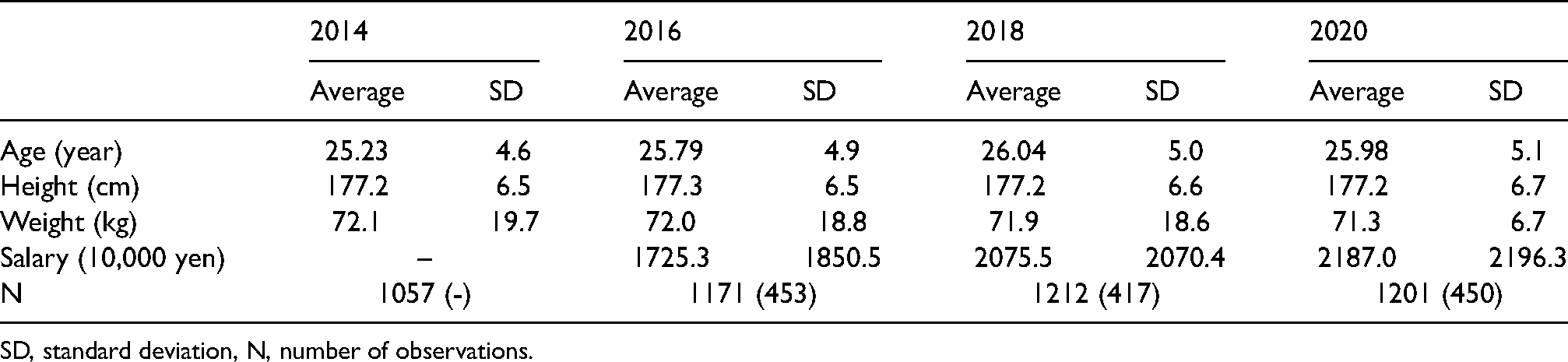
SD, standard deviation, N, number of observations.
Athlete information was anonymized from the time of analysis after data collection, and care was taken to ensure that individual athletes and teams were not identified in the analysis. This study was approved by the Research Ethics Committee of the College of Sport Sciences, Nihon University.
Verification of the RAE
In this section, Hypothesis 1 will be tested as a test of the RAE. We estimate—in an “exploratory” manner—whether the probability of the occurrence of J-League players depends on the time since April 2 (regarding birth date) and, if so, which shape it has and structural change points. In the subsequent two sections, we examine the dependence of this probability on time (if any) using a “confirmatory” test.
(A)#Verification of the RAE using the GAM
We conducted an exploratory parametric analysis using the GAM to test whether the probability of the occurrence of J-League players depends on their birthdays. Previous studies divided the data at an arbitrary interval starting from April 2 (for Japan) and tested whether excellent players were concentrated in the group born close to April 2. After dividing the population by birthdays in 1-month and 3-month intervals, researchers used nonparametric rank relationships to test the hypothesis that the probability of being an excellent athlete is higher for those born earlier in the group (starting April 2).
43
However, the results of these analyses vary depending on the bandwidth (time interval for splitting), which can introduce arbitrariness. For example, if we divided the group by a bandwidth (β) of 1 or 3 months, we would see differences between 12 and 4 grooves, respectively.2 Conversely, we cannot use a parametric analysis to estimate the correct probability of occurrence of the best players based on the distance from April because these analyses assume a linear relationship or have a limit when trying to add nonlinearity.
44
In this study, to eliminate arbitrariness in the setting of the bandwidth (β) and to free up the number of points at which structural changes occur, the RAE was examined by GAM. This expresses the occurrence of Y (the expected probability of the occurrence of excellent players) as a sum of several flexible terms (X) in the birth order starting at April 2 as follows:
The general estimation model for the GAM is as follows:
For the estimation of GAM, we divided the data into 36 classes with April 2 as the first class, March 31 of the following year as the 36th class, and the minimum range as 10 days. The 36 classes were not determined arbitrarily but by selecting 10 days as the unit of observation of the data. 4
The probability of the occurrence of J-League players in each of these 36 categories was estimated using GAM, and the range width was optimized according to the concentration of the data
We began by pooling the data at four time points—2014, 2016, 2018, and 2020—to get an idea of the overall trend. The same players were sometimes included at all four time points, whereas new players who entered the market entered at one time point but exited at a different one.
Figure 1 shows the results of the estimation for the RAE (
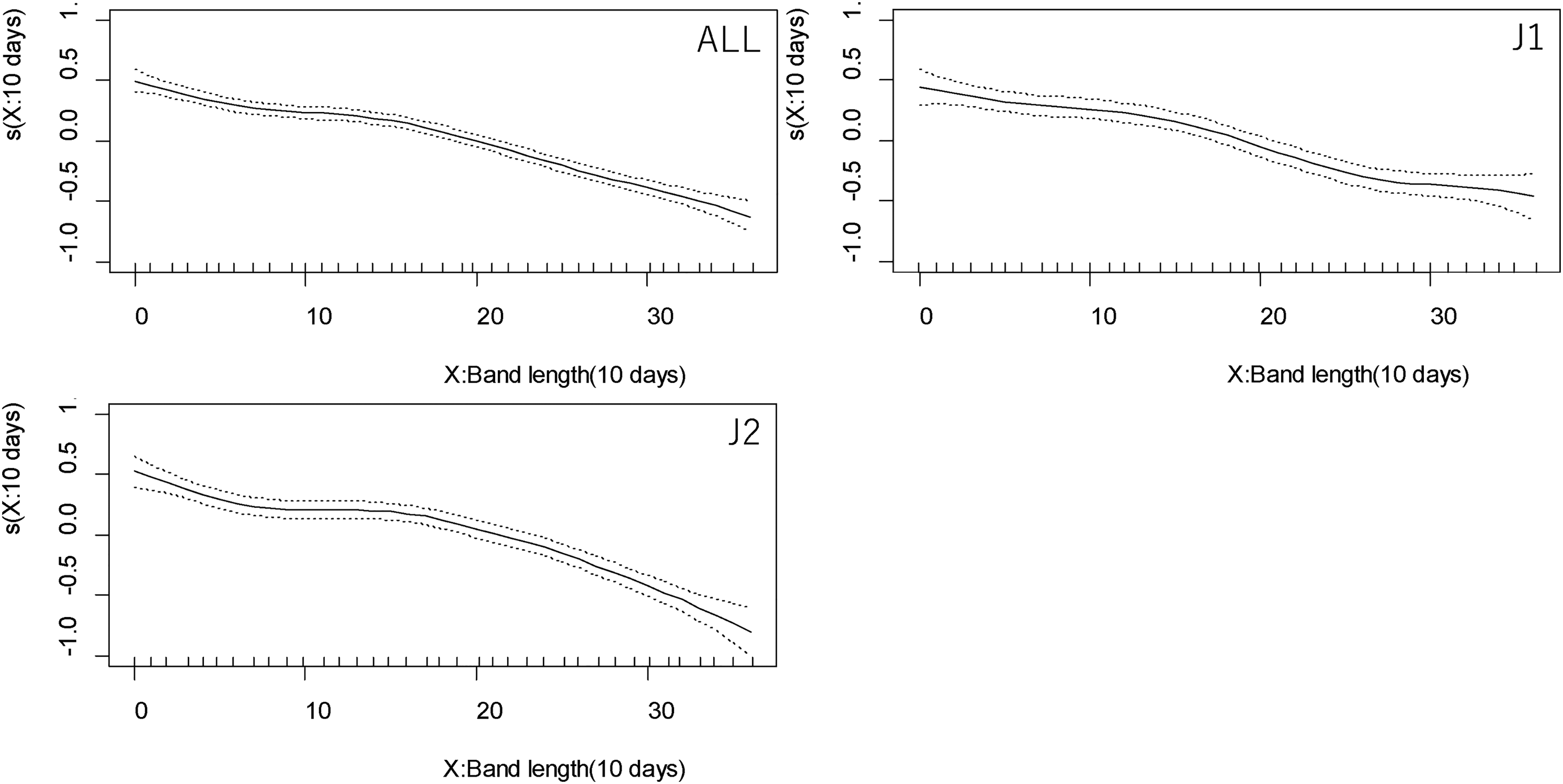
Transition in RAE for becoming a J-League player. Dotted lines indicate 95% confidence intervals for estimates. J-League, Japan Professional Football League; RAE, relative age effect.
The estimated results show that the probability of the occurrence of J-League players decreased with time (birth date) elapsed from April 2. This result is the same when we divide the data into J1 and J2. Particularly, the probability of becoming a J-League player decreased significantly after 150–180 days following April 2. Specifically, the probability differed by a factor of 2.3 between the succeeding 50 and preceding 50 days counted from April 2. In this estimation, the individual fixed effects were ignored, and results were estimated using pooled data. Figure 2 shows the estimated statistics of the RAE (
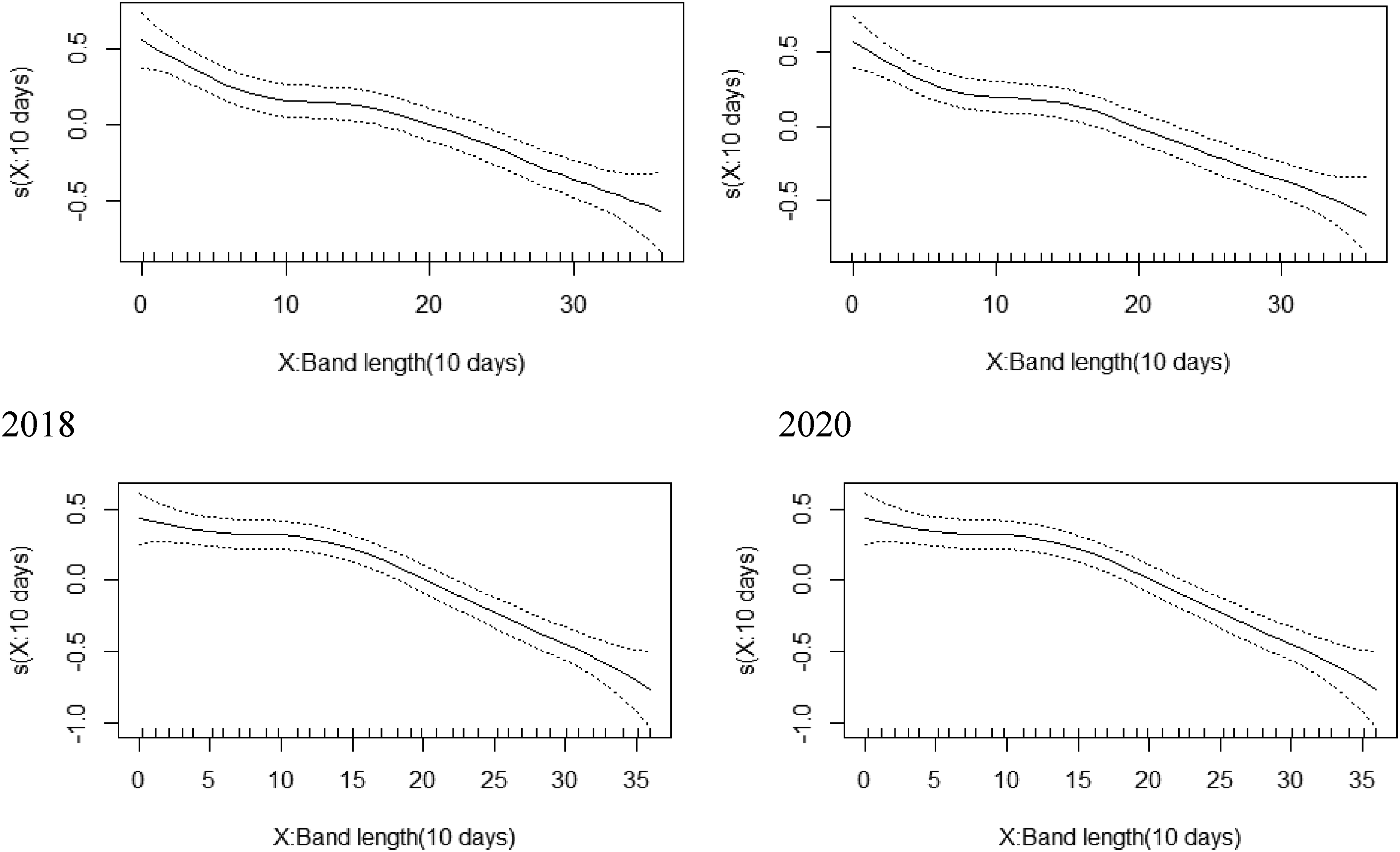
Transition in RAE for becoming a J-League player by year. Dotted lines indicate 95% confidence intervals for estimates. J-League, Japan Professional Football League; RAE, relative age effect.
(B)#Significance test for the RAE
Through exploratory analysis using GAM, we found that the probability of the occurrence of a J-League player depends on the distance of their birth date from April 2 and especially decreases significantly after 180 days. Therefore, as in previous studies, we conducted a test analysis to determine the significance of the results estimated in the previous section.
We assumed that the probability of the occurrence of a J-League player is not based on a Poisson process but has a time-dependent trend. Conversely, the birth of a human is based on a Poisson process—i.e., it is difficult to choose a specific month or day to have a child, and birth is considered a random event.5 If a same number of J-League players are born from the same population, we can assume that the probability of the occurrence of J-League players will be uniformly distributed across each month. However, the RAE would change the distribution of the probability of the occurrence of J-League players. Therefore, we tested the hypothesis that J-League players were born at a higher level than in a uniform distribution in Group I (April–June) and Group II (July–September) and at a lower level in Group III (October–December) and Group IV (January–March).
The hypothesis regarding lower-level players was rejected at the 1% level of significance for both groups (Table 2). Furthermore, a chi-square test conducted for each of the four groups showed that the divergence between Groups I and II could not be rejected even at the 5% level, but significant differences occurred in all combinations for each of the other groups (Table 3). Thus, if we assume that the best players joined the group of the best players in football, there is a significant difference depending on their birth date, while the probability of becoming a J-League player decreases significantly, especially after 180 days—that is, September–December and January–March. Thus, there is a significant effect of the RAE between J-League players born in April–September and those born in October–March.
Detecting the RAE of J-League players per quarter of a year using the chi-square test.
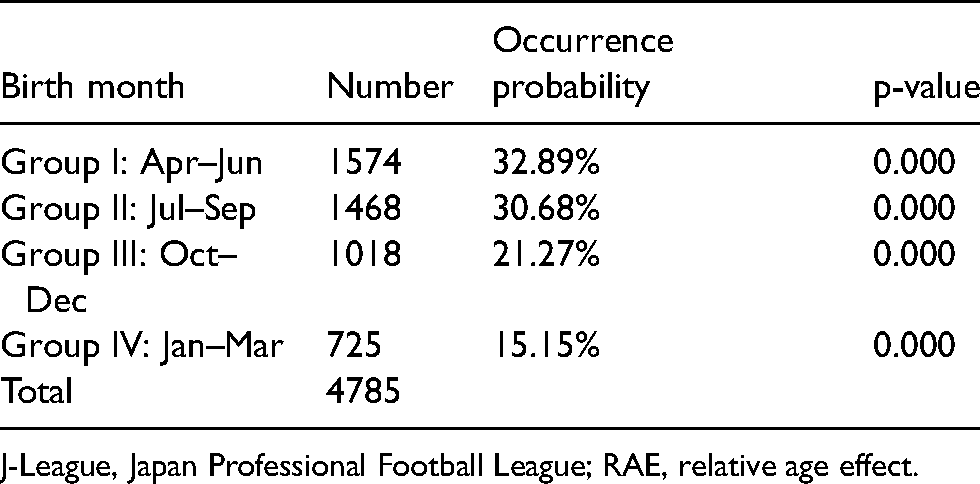
J-League, Japan Professional Football League; RAE, relative age effect.
The matrix of RAE in J-League players per quarter of a year.
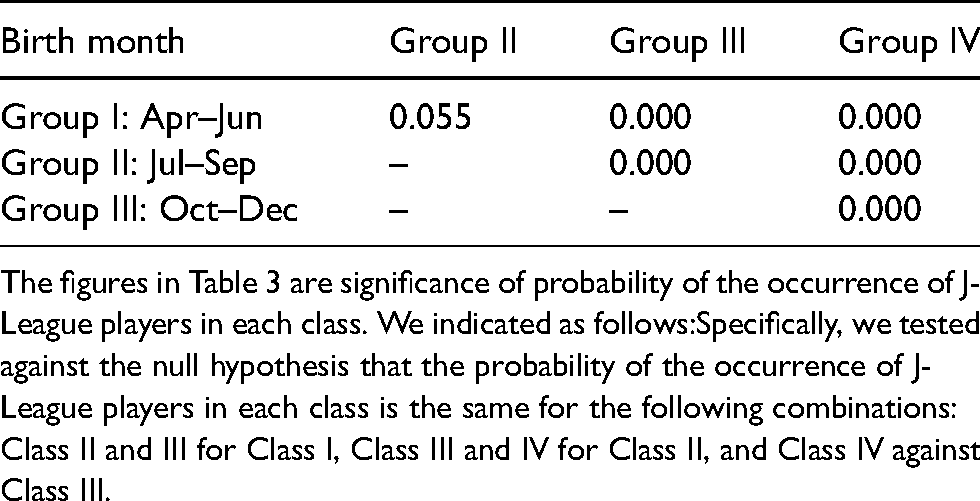
The figures in Table 3 are significance of probability of the occurrence of J-League players in each class. We indicated as follows:Specifically, we tested against the null hypothesis that the probability of the occurrence of J-League players in each class is the same for the following combinations: Class II and III for Class I, Class III and IV for Class II, and Class IV against Class III.
Distribution of birth order
The average birth order of the top 50 national team players with known siblings since the start of the J-League in 1993 is the second child or later (Yamamoto, unpublished data). Does this mean that the second child has a higher probability of being selected into the national team?
(A)#Distribution of sibling relationships among J-League players
First, we evaluated the distribution of sibling relationships among J1 and J2 players and calculated significant differences using a chi-square test (Table 4). In total, 4640 J-League players had siblings in 2014, 2016, 2018, and 2020. The ratio of first-born players was 23.99%; second-born players, 53.69%; and third and subsequent children, 22.33%. Based on the hypothesis that groups I, II, and III have similar developmental processes, we tested for significant differences among the groups. The alternative hypothesis (that there is no difference in development between the first and third or later children) was rejected at the 10% level, although not rejected at the 5% level.
The matrix of RAE in J-League players by birth order.
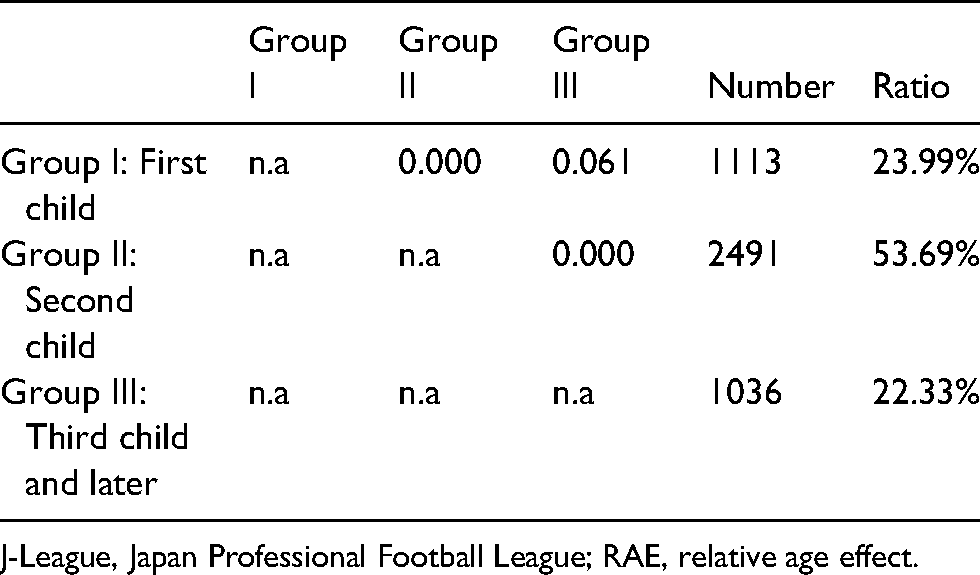
J-League, Japan Professional Football League; RAE, relative age effect.
More than half of the J-League players were second-born children (Group II, 53.69%). There was a clear difference between Groups I and III and Group II that was rejected at the 1% level, indicating that J-League players were most often second born. However, such a difference is highly dependent on the distribution of the population. For example, as the number of children without siblings increases, the number of players without siblings increases and the population of second-born children decreases, which changes the distributional differences. Moreover, players who are third or later in birth order occur only when there are three or more siblings, and their numbers decrease significantly as the birthrate declines.
Next, we focused on the gender of the first child. Typically, parents cannot decide the sex of their child. As with birth dates, gender is randomly generated and follows a Poisson distribution. Table 5 shows the difference between a player who has only two siblings and a player whose first child is an older brother or sister.
Sex of the first child.
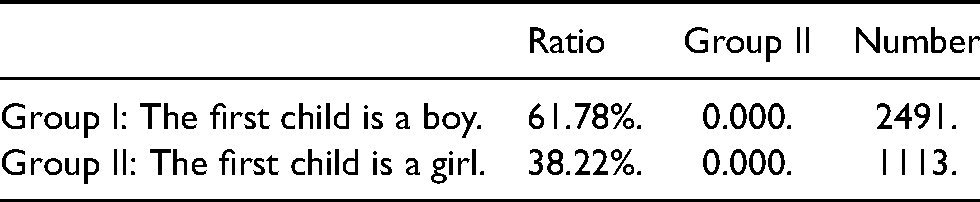
Among the J-League players with only one sibling, 61.78% had an older brother and 38.22% an older sister. Assuming that sex assignment occurs randomly, there was no disparity based on whether the first child was male or female, indicating that the probability of the occurrence of a J-League player depends not only on birth order but also on the sex of the first child.
This is termed “becoming an excellent athlete who is selected to represent Japan according to birth order.” Our results confirm this hypothesis. Many J-League and Japanese national team players are the second child; among them, there is a high probability that the first child is an older brother, although this does not imply excellence or high performance. This is because player performance is highly dependent on the number of siblings or the state of the population of siblings.
Estimation of the BoE
We also focused on the estimated annual salary of J-League players and the number and duration of official matches they played as a proxy for players’ performance given that the national team is composed of the highest-performing players in the J-League. We used the estimated annual salary of J1 players to test whether relative age and birth order have an effect on this salary and the number of games and minutes played in official matches.
The variance of an individual's (i) annual salary (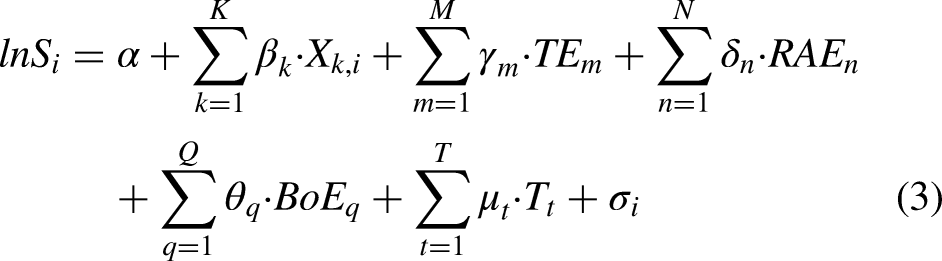
We estimated models (1) through (5) in OLS (Ordinary Least Squares) based on equation (3). The error terms (
Together with birth order, there was a strong correlation with “family size”: the larger the family size, the higher the probability of having a J-League player. Therefore, we estimated Model 01 to Model 05 as follows: Model 01 to Model 03 used all data to identify RAEs and BoEs; Model 04 and Model 05 were restricted to only children and families with two siblings.
Model 01 was a paced model that included RAE, BoE, other individual characteristics such as player position, and fixed effects such as team and time of year (since it was pooled data). We used the model to explain the legalism of the annual salary of J-League players (
Effects of RAE and birth order on J-league players’ performance (1).
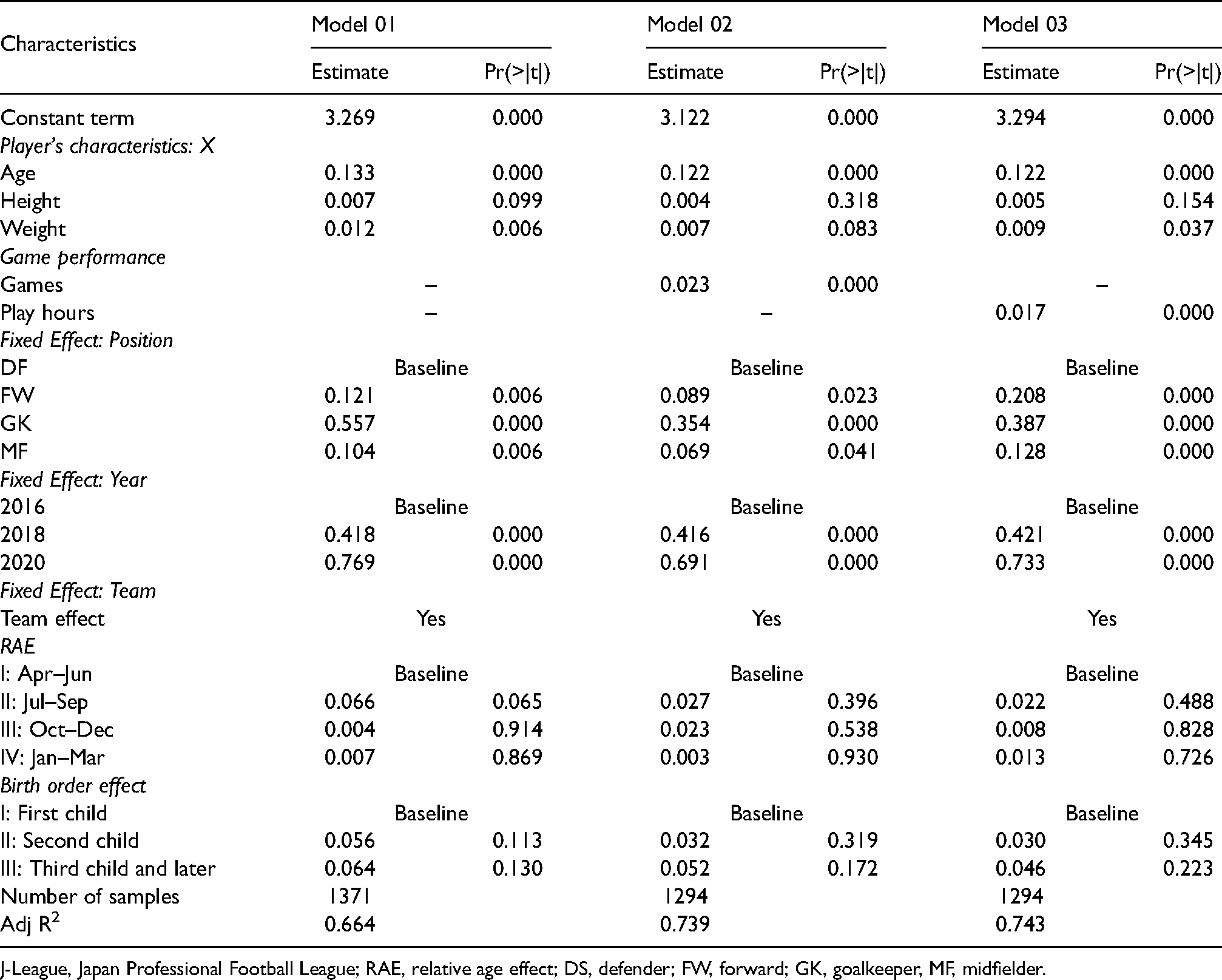
J-League, Japan Professional Football League; RAE, relative age effect; DS, defender; FW, forward; GK, goalkeeper, MF, midfielder.
Therefore, in Model 04, we excluded players who were the third or later child and examined the estimated annual salary difference by gender of the first child between “II: Second child and older brother” and “III: Second child and older sister” using “I: First child” as baseline. Additionally, Model 05 used “I: Second child and older brother” as baseline to examine the effect of gender on “II: Second child and older sister” (Table 7). In Model 04, in which the gender of the first child was considered, we found no effect on players with an “older sister,” but players with an “older brother” had an annual income effect of + 7.9% compared to first-born players. In Model 05, we excluded first-born players and used only the players who were the second child to examine whether a gender difference existed. The RAE and the BoE were analyzed using the estimated annual salary as a proxy for performance. For birth order, players who were the second child and had an older brother had a positive salary effect and performed better.
Effects of RAE and birth order on J-League players’ performance (2).
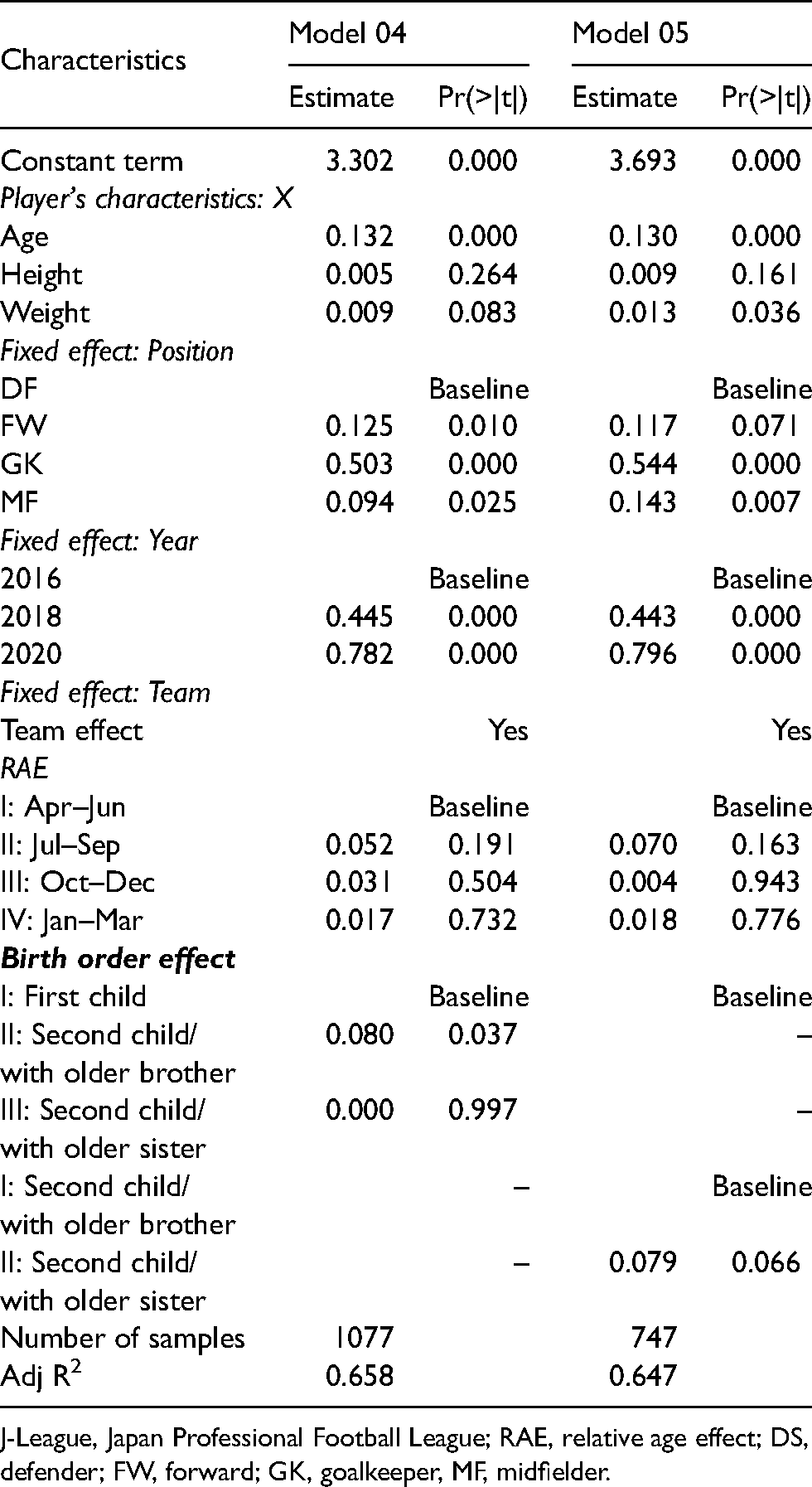
J-League, Japan Professional Football League; RAE, relative age effect; DS, defender; FW, forward; GK, goalkeeper, MF, midfielder.
Discussion
Testing the RAE (Hypothesis 1)
Regarding Hypothesis 1, the probability of becoming a J-League player was 2.3 times higher for players born on the first 50 days after rather than preceding April 2. Moreover, an inflection point was identified 180 days after April 2, after which the probability of becoming a J-League player dropped significantly. Therefore, Hypothesis 1—that the probability of becoming a J-League player depends on one's birth date and diminishes the farther from April 2—was proven. Furthermore, the inflection point of whether a player can become a J-League player in domestic football was on the 180th day (6 months), and we confirmed a polarizing trend in the 6 months before and after the 180th day (April–September and October–March). Thus, those born in April–September are more likely to become J-League players.
Most studies of RAE in sports aggregated birth months by quarter and compared the groups. Furthermore, according to Ostapczuk and Musch, 43 quarterly aggregation was recommended because 6-month aggregation would reduce the accuracy of the results. In the present study, considering the diminishing trend away from April 2, the bandwidth was not divided into 180 days but rather into four groups of approximately 90 days each. The results were similar to those of the previously mentioned study. However, as shown in this study, we recommend the statistical procedure of confirming the existence of structural points of change through exploratory analysis (GAM) and verification analysis (analysis of variance and chi-square test).
The modern football coaching system is designed to selectively reject players who were born in later months and are disadvantaged in terms of size and strength. 53 If there are large individual differences in biological maturity during the growth period, and if these differences already affect the coaching environment in terms of equal opportunity and player evaluation in football, it is necessary to incorporate the RAE into the method of player evaluation and classify teams according to their birth month. Because the results of this study indicate that the 180th day is an inflection point, we propose that an evaluation criterion of 6 months from April 2 be added to the evaluation of Japanese football players during their growth period. The solution to the RAE using this evaluation criterion is discussed hereafter.
Testing the BoE (Hypothesis 2)
Concerning Hypothesis 2, we found that J-League players are often second-born children and that second-born children with first-born brothers perform better, thereby confirming Hypothesis 2. According to the Current Population Survey of the Ministry of Health, Labour and Welfare, 54 the first child is the most common birth each year. For example, there were 612,148 youth athletes (born in 2000) who were male high school seniors in 2018, and the percentage of birth order was 298,903 (49%) for the first child, 222,900 (36%) for the second, and 93,345 (15%) for the third and subsequent children, with the first child accounting for approximately half of the births. Among the approximately 610,000 boys, the number of first-borns was the highest and 52,738 are registered with the JFA, indicating that approximately 1 in 12 boys in their third year of high school is involved in football. The ability level of these players varies from beginners to youth national team players. Thus, as in the demographic survey, half of high school seniors registered with the JFA were first born, including those who are only children. In the following year (2019), 80 youth players became J-League players after graduating from high school, including both high school students and those from club teams. Only 0.15% of youth players became professional football players. Of these 80 players, 55 were registered with J1 and J2 teams in 2020 and, of these, 33 (60%) were second born.
In early childhood, younger children see the actions of their elders and develop a desire to replicate them. By taking advantage of these unique characteristics, it may be possible to eliminate the inequality among siblings as shown in this study. This can be achieved by having the first child (including those without siblings) participate in activities in different age groups where they are the youngest among siblings. Thus, the second-child advantage in football—such as “large numbers” and “high performance”—can be eliminated by presenting first-born children with an older brother and placing them in a second-born-child-like environment. These factors should be considered when organizing teams in the field of coaching. A solution to the second-born child advantage in football is discussed hereafter.
Problems related to the giftedness of life and consideration of ways to resolve inequality
In 1997, the Fédération Internationale de Football Association (FIFA) adopted the selection year, divided into January–December according to the birth dates of the players, to form national and age-group representative teams. European youth football teams have also been organized based on school year (which generally starts in September), but this was changed to follow the selection year of FIFA. Before adopting the new system, there were few good players from June to August in German football; however, the RAE shifted to October–December in 2007, 10 years after adopting the new system. 43 Moreover, in Europe, players who left the development team (a subordinate organization of the professional team) were newly recruited to the general football team, suggesting that this may have a buffering effect on the RAE. 55 The RAE appears and disappears easily, mainly due to the participation and withdrawal of players born early. Therefore, to eliminate the polarization in the pronounced RAE observed in J-League players, we recommend that football coaches organize their teams in 6-month units starting at elementary school age. There have been two proposals to change the traditional classification period, one with a duration of >1 year and another of <1 year. 56 The RAE was eliminated by 96% when the duration was divided into 6-month segments. 57 In this study, we also found that the probability of the occurrence of J-League players decreased after 180 days (6 months), counting from April. Because player units are typically formed with players born April–September and October–March (following year), we propose a method of forming teams of one to four consecutive units with the grades above and below and then moving the teams around for a few months to reorganize them for practice and games.
Klint and Weiss 58 stated, “When people perceive competence in sports, they will continue to participate actively; conversely, those who do not feel competent will not continue to participate in sports.” In a study of field hockey players, Barnsley and Thompson 9 reported that players born early are more likely to experience frustration and failure and, as a result, are less motivated to continue playing. If one of the causes of late-born players’ withdrawal from competition is their own lack of athletic competence, then in the aforementioned team formation, a unit of players born October–March (following year) becoming the oldest can alleviate their relative lack of athletic competence compared to players born April–September of the same year. This would lead to elimination of the RAE.
The method of eliminating the RAE proposed above has a secondary effect: younger children would be able to share and participate in many activities with older brothers who were born one or two grades above them in the same semester and who are highly competitive. The influence of older siblings helps younger siblings to improve their skills and abilities.33,34 This is because younger siblings have a strong desire to catch up with their older siblings 32 and, as Hopwood et al. 28 highlighted, need to develop creativity, decision-making skills, and tactical intelligence to win. If an environment can be created such that the first child can continue to play football without leaving the sport, the number of first-born children will increase and become equal to or exceed that of second-born children, approaching a Poisson (uniform) distribution and eliminating the problem of second-born child dominance. The giftedness of human life would remain constant; however, the RAE in football and the problem of birth order are caused by social and environmental factors. As long as we misinterpret man-made problems as insurmountable, it will be difficult to achieve world-class competitiveness in football and other sports.
Finally, although we have treated the RAE and birth order as separate factors, we hypothesize that the withdrawal of first-born children (born October–March of the following year, including late births) from competitive sports is the main cause of the RAE. In future studies, we will test the hypothesis that first-born children have been eliminated from the sport rather than that there are many second-born children. If the withdrawal statuses of athletes born October–March of the following year are linked with the withdrawals of first-born children, the solution recommended in this study may solve these two problems simultaneously.
We tried to elucidate the characteristics of excellent football players and find a way to eliminate social environmental factors so as to buffer the giftedness of life and obtain knowledge useful for the discovery and development of talent in sports. We found significant polarization in the RAE of J-League players, with the majority being born between April and September, with a significant decrease in those born between October and March. Furthermore, although there was no positive estimated annual salary effect in either the RAE or the BoE, there was a positive effect for a second-born player who had an older brother. To solve the problems of the RAE (polarization) and birth order (second-born child dominance), we recommended the formation of teams with multiple 6-month units at the instructional site. In this way, the players would become the older or younger brothers in teams and spend time together through practice and games. In future studies, we will seek the causes of players’ withdrawal from competition in the developmental age group.
