




Abstract
Because of the role of mental fatigue in the development of elite soccer players, it has been a topic of interest for researchers in the last decades. First, we aim to shed light on the literature published about mental fatigue in soccer in the last 10 years. Second, based on the results obtained, we propose a new perspective on the role of cognitive effort in soccer. A systematic review (SR) was conducted following the PRISMA guidelines and registered in PROSPERO. A total of 18 articles met the inclusion criteria. The results showed an increase in the publications related to mental fatigue from 2014 onward. They were compared according to focus, sample, instruments and outcomes. Our proposal assumes that physical-physiological, technical-motor and tactical-cognitive demands entail a cognitive load that reduces the performance of players. Studies that prioritise controlling behavioural and physiological responses in cognitive tests are still needed.
Introduction
High-level soccer teams undertake high training and game load throughout the season.1,2 Some players play as many as 80 games in a competitive year and intersperse these games with practice sessions and trips that top 100,000 kilometres per season. 1 The sum of these conditions has a considerable impact as, even when subjected to situations of high physical, technical, tactical and cognitive demands throughout the season, players are required to sustain high levels of individual and collective performance.3,4 These physical and technical requirements can be observed in all behaviours/movement skills performed to meet the needs of the game (i.e. sprints, jumps, runs with direction changes, and technical actions, among others), and they generate significant changes in physiological responses. 5 Tactical and cognitive demands, on the other hand, are related to the need to make a large number of decisions in a time- and space-constrained environment.6,7 It can be exemplified by observing that a normal person makes about 6,000 decisions throughout the day while a football player usually makes more than 2,500 decisions in only 90 minutes. 7 Thus, if we consider that every decision made in the game leads to a physical and technical response of the player and the realisation of a tactical behaviour, it is reasonable to say that the physical, technical, tactical and cognitive requirements are directly associated with his performance.7,8
However, it is noteworthy that the need to sustain performance in the face of the number of training sessions 9 , the match exigency demands and the amount of trips has raised a debate in literature on how these factors impact variables such as loss of playing quality and increased incidence of injuries. 1 Overall, studies have highlighted fatigue as one of the main aspects that influence these variables.10,11 Historically, one of the traditional models used in the research of exercise physiology is the Hill, Long and Lupton model in 1924 12 , called the cardiovascular/catastrophic model. In this model, the researchers associate fatigue mainly with the insufficiency of the cardiovascular system to supply oxygen demands during exercise, the production of blood lactate and the reduced capacity for muscle contraction. This model predicts that as peripheral fatigue develops during exercise, a compensatory mechanism in the central nervous system recruits additional muscle fibres that help maintain the work rate. Progressively, this process will continue until the motor units available in the muscles are recruited, reaching a point where the work rate will fall and fatigue will manifest. 12
In contrast to the cardiovascular/catastrophic model, evidence shows that factors associated with the ability to generate muscle contraction cannot determine the regulation of physical performance and exercise tolerance.13,14 In a long-term effort, for example, studies have shown that there is a recruitment of approximately 35%–50% of the muscle fibres directly involved in the physical task 15 , with this amount reaching up to 60% in maximum effort conditions. 16 In this way, the evidence indicates that a high physical effort is not determined by the capacity to generate muscle strength, but by the willingness to perform maximum effort (motivation) and the way the physical task is perceived (perception of effort).13,17 Indeed, a study conducted by Blanchfield 18 shows that motivational self-talk strategies reduce the subjective perception of effort by increasing the tolerance to physical effort in a constant load test.
Based on this evidence, the interpretation of the phenomenon of fatigue based only on variables of physical and physiological nature reduces the possibility of a deeper understanding of the impact of this phenomenon on the performance of soccer players, leaving some points to be clarified3,19–21. Thus, another strand of studies on fatigue has started to consider aspects of human cognition. 20 According to previous research, psychological aspects are more directed to individual characteristics, such as personality, leadership, motivation, between others. Cognition, on the other hand, is the basis for the decisional and attitudinal elements of the individual, the processes that are associated with cognition (cognitive processes) act to solve specific problems, among the cognitive processes we can mention attention, memory, perception, information processing, between others. Supported by scientific evidence in the fields of neuroscience and sports psychology, this strand has considered the impact of a phenomenon known as mental fatigue. 19 Mental fatigue can be conceptualised as a sensation experienced during or after a prolonged period of cognitive activity, characterised by feeling tired and lacking energy.19,22 This phenomenon has a direct implication on the performance of soccer players as it influences aspects such as perceived exertion, physical tiredness and even the risk of injury23–25.
Martin and collaborators 26 claimed that the deleterious effect of mental fatigue is associated with adenosine accumulation in the brain. In this sense, cognitive activity that occurs in brain regions associated with more complex mental processes is impaired by adenosine accumulation and reduction of surrounding glucose. This temporary shortage of glucose and increased adenosine levels obstruct the release of neurotransmitters such as dopamine.26,27 The result is an increase in effort perception and a decrease in motivation and level of engagement in the activities undertaken and, consequently, reduced performance. 26
Based on the aforementioned evidence, investigations into the state of mental fatigue in football suggested that when the player reaches this state, there is a significant loss of performance (e.g., physical, technical, tactical and cognitive).11,28 However, there are still points to be clarified about what happens before the player reaches the state of mental fatigue. One of the hypotheses about what leads players to a state of mental fatigue may be associated with issues related to the cognitive load imposed by the activity and, consequently, the cognitive effort invested acutely (demands that arise throughout the games and training) or chronically (demands that arise throughout the season).29,30 When not properly controlled, these factors seem to reduce the recovery process and lead the player into a state of mental fatigue, causing a greater number of errors in decision-making, decreased performance and risk of injury. 3
Furthermore, in soccer, increase in competitiveness increases the cognitive load that must be managed by the players in each game and training. This requires the players to substantially increase their cognitive effort investment in an attempt to maintain their performance levels6,29, for example, their eye movements. Thus, the probability of the soccer player going into a state of mental fatigue increases due to a high cognitive effort investment during the game or throughout the season3,23. Recent investigations that sought to understand the impact of mental fatigue reported evidence regarding the negative effects of this phenomenon on the physical5,21, technical21,31, tactical11,32 and cognitive 20 aspects of soccer performance. Studies also showed that mentally fatigued players are less coupled with their group and their task goals 32 , in addition to displaying reduced levels of motivation and enthusiasm 33 , increased difficulties in expressing emotions 33 , reduced level of discipline 34 and significant loss of concentration and the ability to focus on relevant details. 34
The studies highlighted above provide enough evidence on the negative impact of mental fatigue on soccer players. However, it is worth mentioning that the theoretical background regarding the influence of mental fatigue on soccer performance is recent and has been substantially developed over the last 10 years based on the psychobiological model. 27 This model considers that the conscious regulation (decision-making) of the exercise rhythm is determined by motivation and, above all, by the subjective perception of effort19,35,36. However, there are still some doubts about the use of this model to explain the phenomenon of mental fatigue in the context of soccer, in addition to other points to be considered, understood and evaluated on this phenomenon, such as the influence of cognitive effort on the occurrence of the state of mental fatigue. Although mental fatigue cannot be characterised as a subjective state, it can be assessed subjectively with visual analogue scales21,31 and objectively through a global positioning system 32 or mobile eye tracking 29 , for instance. Nevertheless, its effects and results are objective, for instance, increasing the adenosine concentration, as mentioned in the introduction. Thus, the present review aims to describe the currently available evidence in the literature about the influence of mental fatigue in soccer and to discuss the possibilities for future investigations and interventions.
Methods
Search limits
An exhaustive and systematic search of five scientific literature databases (Web of Science-All Databases, Scopus, PubMed, SPORTDiscus, ERIC-EBSCO and Academic Search Ultimate) was conducted. On the one hand, these databases were selected because they included articles published in journals indexed in the Journal Citation Report (JCR) or a similar index (e.g., the Scimago Journal Rank [SJR]). On the other hand, a systematic search was conducted to obtain an extended examination of the phenomenon under study. Table 1 shows the search strategy used in each database or journal.
Search strategy of each database.
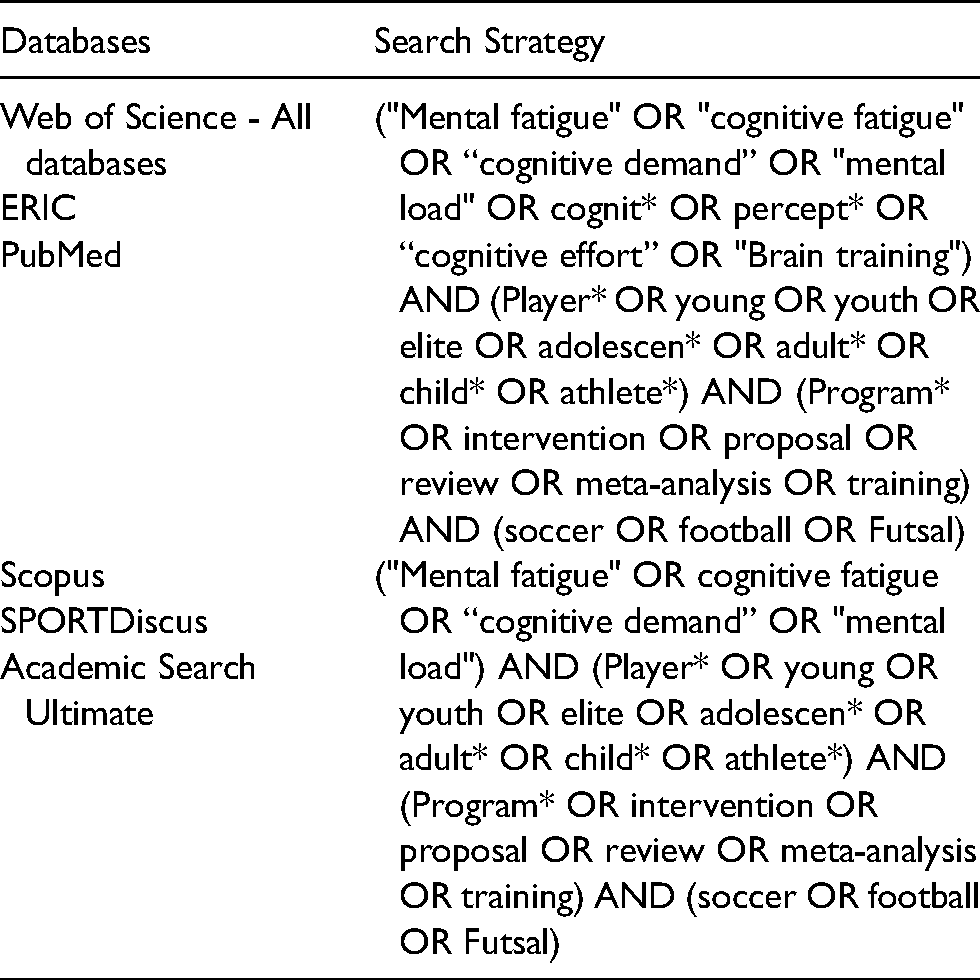
The search was conducted following the Preferred Reporting Items for Systematic Reviews and Meta-Analyses (PRISMA) guidelines 37 and the PICO strategy: Participants, Intervention, Comparison and Outcomes (see Table 2). The search finished on September 27th, 2021.
PICOS strategy (participants, interventions, comparisons, outcomes, study design).
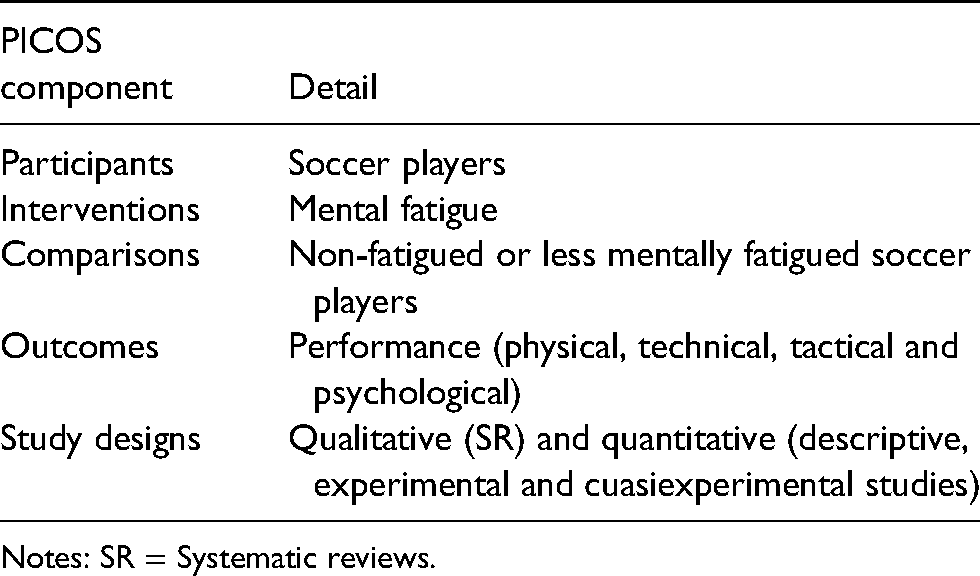
Notes: SR = Systematic reviews.
Selection criteria
Articles were included based on the following criteria: (a) studies published in peer-reviewed international journals indexed in JCR or SJR databases, (b) studies published from 2009 to 2019 (both inclusive), (c) studies that included quantitative and/or qualitative methods and findings, (d) articles that focused on mental fatigue in soccer players and (e) studies published in English or Spanish.
As exclusion criteria, we decided not to include articles (a) not indexed in JCR or SJR databases, (b) articles conducted on other sports/contexts different from soccer/football/futsal, (c) articles with not enough data to complete the table results and (d) articles focused on neuromuscular fatigue or subjective perception of fatigue, but not on mental fatigue. Figure 1 shows the number of articles excluded because of these reasons.
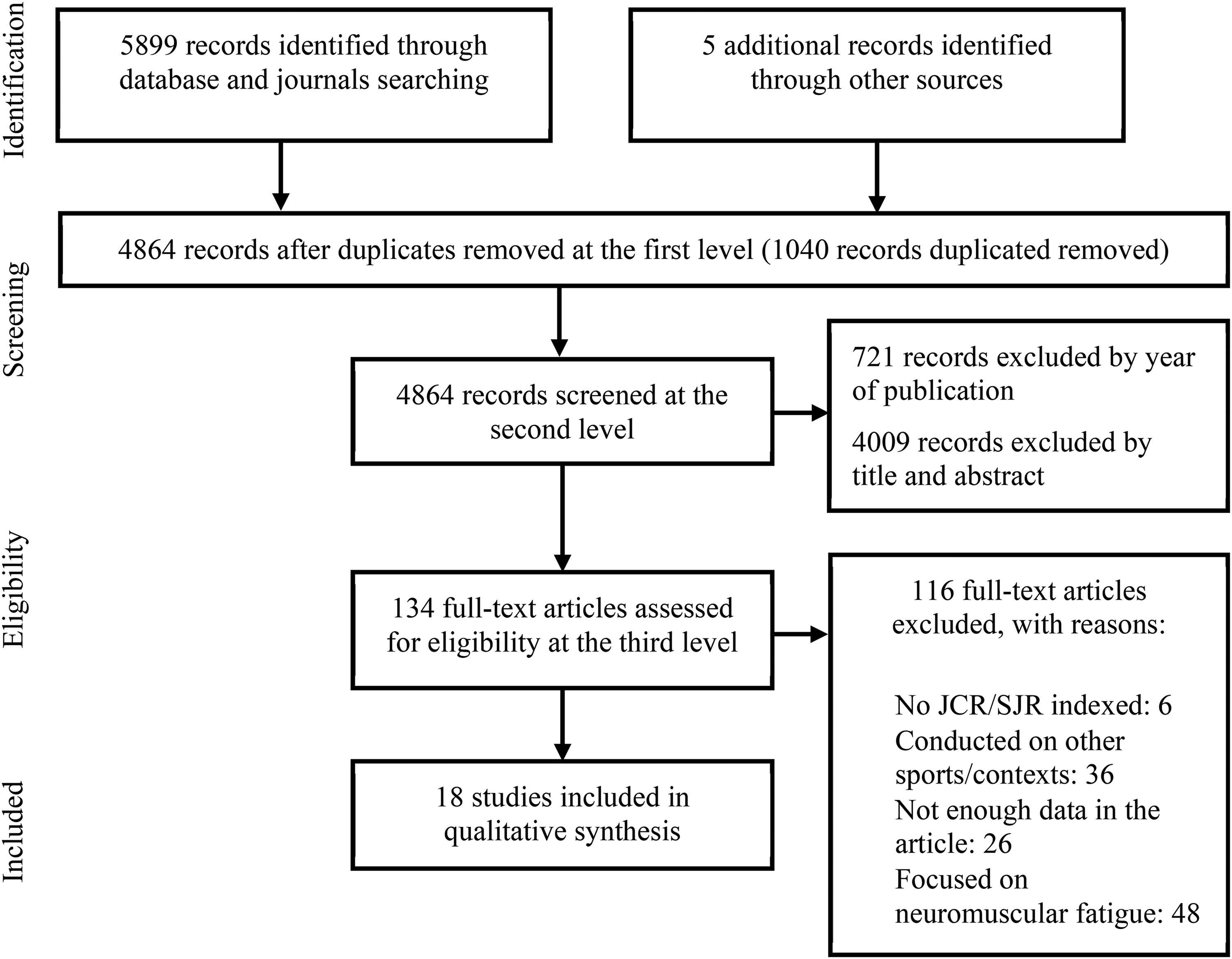
Flow diagram of the systematic search process.
We decided to include both quantitative and qualitative articles in the SR for two reasons. First, the sample of the review would be too small if we removed the qualitative ones because this line of investigation does not count with many articles published. Second, both quantitative and qualitative research can play a role in research synthesis 38 , maximising the strengths of both approaches and increasing the relevance of the SR. 39 Although calls have been made previously to further use and explore mixed-methods reviews in a systematic process, these methods are still not commonly used or have little awareness surrounding them. 40 Thus, since no previous SRs on this topic consider both designs (qualitative and quantitative), we decided to include them for this review, with the purpose of adding new knowledge to this field.
In short, a qualitative synthesis might be used to explore the findings of a prior quantitative synthesis or vice versa. 41 Duplicated documents were disqualified at the first level of exclusion. At the second level, documents were selected according to their year of publication, title and abstract. Finally, at the third level of exclusion, the selected articles were fully read, and some were disregarded for the final analysis. The systematic search process and the number of results can be found in Figure 1, following the indications of PRISMA. 41
Subsequent to the elimination of many articles at the first level of exclusion, 5,899 original articles were retrieved as potential studies to be included in the review. A total of five articles were included in the sample from the reference lists of other articles. Then 4,730 were discarded at the second level of exclusion. Finally, after reading the full text of 134 articles, 18 were included in this study.
Data extraction and reliability
After the initial search, the articles that did not fit the date of publication were discarded at the first level of exclusion. The articles that met the selection criteria were retrieved for this review. To obtain relevant information, the following categories were used 42 : authors, location, objectives, sample size, method, data sources and results. Mendeley was used to collect the documents from all the databases and filter the results.
The first and the second author did the screening and data extraction processes. They screened all the articles at the first and second exclusion level separately. Then they met to check the articles selected for each one. They reached an agreement about the doubtful articles.
Quality assessment and level of evidence
First, the quality of the review process was assessed and included in the PROSPERO register. It is an international database of prospectively registered SRs in health and social care, welfare, public health, education, crime, justice and international development. Key features of the review protocol are recorded and maintained as a permanent record. This allows researchers to comply with PRISMA, provides a public record of their planned methods and raises awareness of their review, and allows comparison of manuscript findings.
Second, the quality of this SR was also assessed using the PRISMA guidelines. 41 This evaluation tool includes an evidence-based set of items to report the quality of the SR and meta-analysis.
Third, the criteria for assessing the quality of the selected studies were based on the Checklist for Measuring Study Quality (e.g. is the hypothesis/aim of the study clearly described? 43 ), the Strengthening the Reporting of Observational Studies in Epidemiology (STROBE) Statement (e.g. is it possible to use the design in other studies? 44 ), and the Consolidated Standards of Reporting Trials statement (e.g. the study’s blinding and quality assessment 45 ).
Fourth, previous studies46,47,48 were used to obtain a quality score for each investigation based on the following criteria: (a) programme description, (b) JCR/SJR journal, (c) detailed methodological description, (d) sample or number of participants and (e) length of the implementation. Each item was scored from 0 to 2 using the criteria described in Table 2. A total quality score from all the selected publications was calculated by adding up the number of positive items between 0 and 10. Investigations were classified as follows: (a) low quality: a score lower than 3; (b) moderate quality: a score between 4 and 6; and (c) high quality: a score of 7 or higher. Two experts on physical education independently performed this evaluation. They, along with the second author, met before the assessment to clarify how to decide between all the options (e.g. how to decide between a brief undetailed description and a detailed description). Some articles not included in this SR were taken as examples to discuss the assessment criteria. When the two experts reached an agreement in all the criteria, they were prepared to begin the evaluation of all the articles separately. The selection criteria to be an expert were as follows: (1) to have published articles in top indexed journals (JCR) in the last five years, (2) to have participated in an SR, (3) to have at least one master’s degree in physical education and sport and (4) to have a minimum experience of five years as a researcher. Cronbach’s alpha (0.95) indicated high reliability among the individual evaluations. 46 After that, the second author met with the two experts to reach an agreement in those articles in which they did not agree.
Results
The evolution of publications about mental fatigue is shown in Figure 2. Here it can be observed how the number of publications in the last 10 years is increasing, from two publication in the years 2009–2010 to 10 publications in the last three years.

Evolution of publications in mental fatigue in soccer in the last ten years.
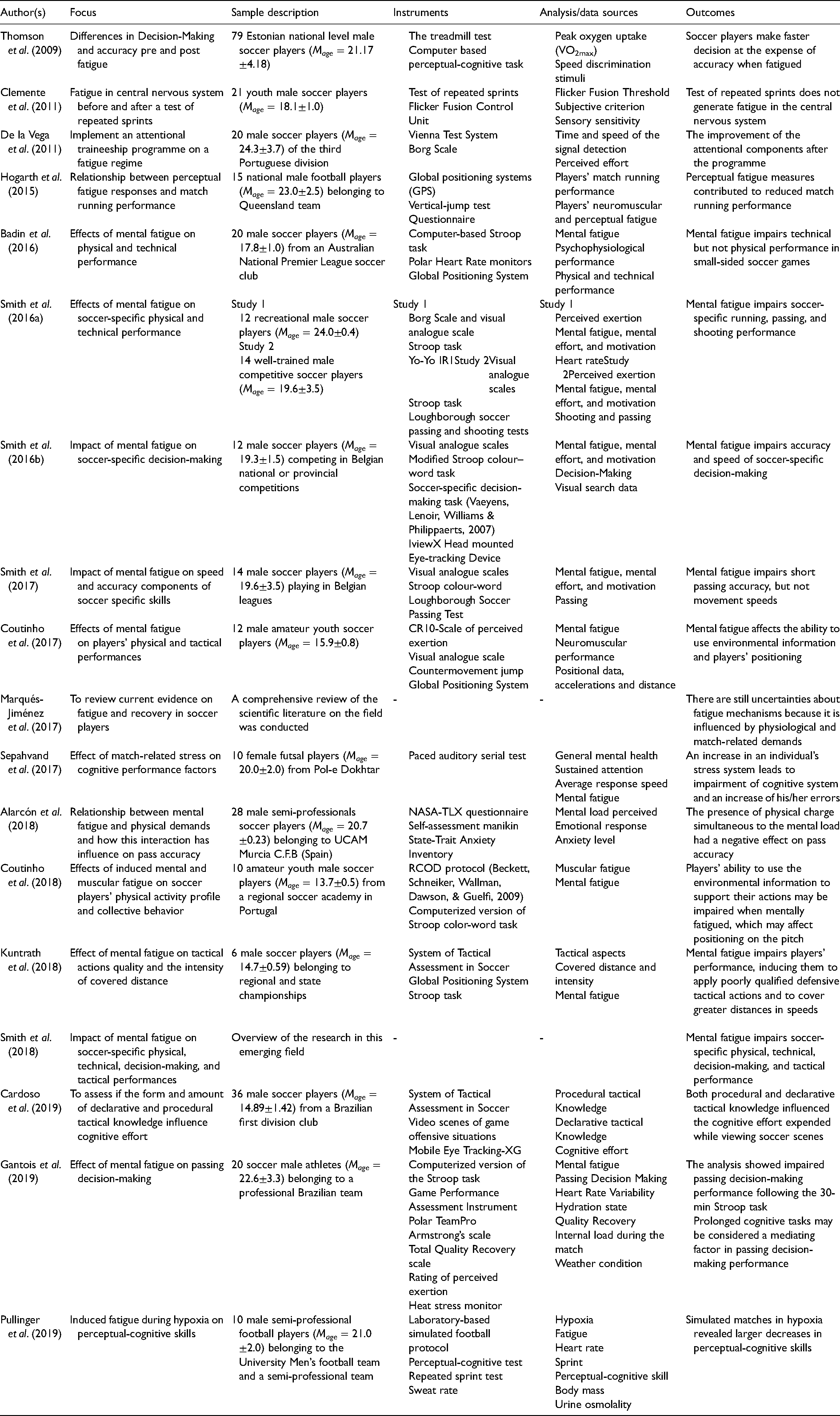
Table 3 shows the 18 studies conducted around the world in the last 10 years. The most important and relevant information from each study was assessed following the structure used in previous SRs 47 : author(s) and publication year, focus, sample description, analysis/data sources and outcomes.
Investigation quality score checklist.
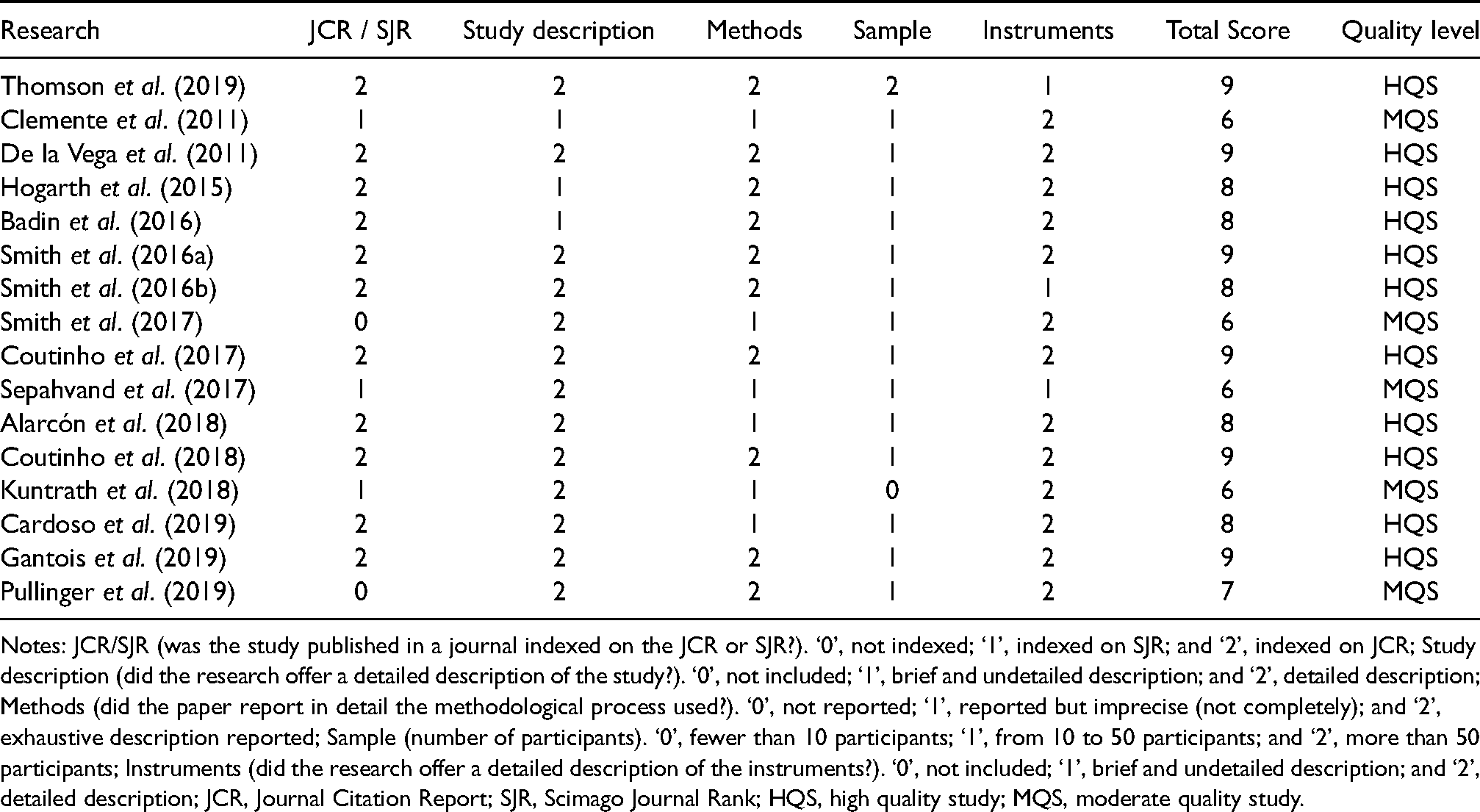
Notes: JCR/SJR (was the study published in a journal indexed on the JCR or SJR?). ‘0’, not indexed; ‘1’, indexed on SJR; and ‘2’, indexed on JCR; Study description (did the research offer a detailed description of the study?). ‘0’, not included; ‘1’, brief and undetailed description; and ‘2’, detailed description; Methods (did the paper report in detail the methodological process used?). ‘0’, not reported; ‘1’, reported but imprecise (not completely); and ‘2’, exhaustive description reported; Sample (number of participants). ‘0’, fewer than 10 participants; ‘1’, from 10 to 50 participants; and ‘2’, more than 50 participants; Instruments (did the research offer a detailed description of the instruments?). ‘0’, not included; ‘1’, brief and undetailed description; and ‘2’, detailed description; JCR, Journal Citation Report; SJR, Scimago Journal Rank; HQS, high quality study; MQS, moderate quality study.
Synthesis of studies included in the systematic review.
Discussion
This paper aims to describe the currently available evidence in the literature about the influence of mental fatigue in soccer and to discuss the possibilities for future investigations and interventions, considering cognitive effort as an intervening variable to mental fatigue and its detrimental effects on the performance of soccer players. In general, it is possible to highlight a growing interest in this topic over the last 10 years. Such interest is related to the fact that research systematically indicates a negative effect of mental fatigue on sports performance of soccer players, leading to physical3,5,21, technical21,31,49, tactical11,32, and cognitive damage20,50,51.
Because of these impairments, researchers are increasingly focused on building knowledge about the influence of mental fatigue on soccer players and identifying forms of intervention that minimise its effects.11,28 However, it is noteworthy that there is still a small amount of evidence in the specialised literature that seeks to evaluate the influence of cognitive effort on soccer players and its impact on the onset of mental fatigue. 29 Apparently, this is due to the difficulty in evaluating and controlling this variable during practice sessions and games. In short, based on the content up until this point, research efforts may have been undermined by a number of different terms that are used interchangeably without clear definition or theoretical stance. 29 Below are some of the main points of the papers selected for this review and some future perspectives for the studies on cognitive effort and mental fatigue in soccer.
Focus
Regarding the focus of the papers selected for this review, 17 out of 18 articles examined the effects of mental fatigue on the performance of soccer players, and only one study investigated the influence of cognitive effort on soccer players.
There was also a change in the direction of the selected papers over the years. The first studies on this subject published between 2009 and 2015 sought to substantially address intervening aspects of mental fatigue and its responses at the cognitive23,52,53 and the physical level. 5 These studies can be considered as the first evidence that cognitive fatigue results in the impaired performance of soccer players. Subsequently, from 2016, the focus has been on performing experimental work, aiming to induce players to a state of mental fatigue. In this scenario, players participated in previously defined laboratory tasks (using tests such as the Stoop test) lasting from 20 to 40 minutes to induce players to a state of mental fatigue. Subsequently, they performed an experimental task to evaluate their performance. Thus, the players were evaluated in two situations, a control one (i.e. without mental fatigue induction) and an experimental one (i.e. with mental fatigue induction), to examine how mental fatigue affects the performance of soccer players11,20,21,31,32,49–51,54,55.
With respect to cognitive effort, a recent study conducted by Cardoso and colleagues 27 provided a different approach by removing the fatigue induction task (fixed load) and using pupillometry to assess the level of cognitive effort during a soccer-specific video task. This paper aimed to identify the association between cognitive effort and the amount of players’ tactical knowledge. The evidence from this study allowed us to identify pupillary behaviour as a physiological marker conducive to the assessment of cognitive effort in soccer, opening up an important reflection on the control of this variable in the training context before the player undergoes a state of mental fatigue.
Sample description
The samples of the selected articles are heterogeneous, which allows us to infer that the effects of cognitive effort and state of mental fatigue affect different populations of soccer players. In this review, it was observed that from the 16 selected experimental articles, 15 evaluated male soccer players, and only one study evaluated female players. It is worth mentioning that this study was performed in futsal. 54 Nine of the selected studies evaluated soccer players competing at the highest competitive levels, participating in the first, second, or third division of the national championships. Five studies evaluated young soccer players, and two studies evaluated semi-professional players. Two of the selected studies were literature reviews and did not account for the description of the samples of the present study.
Instruments and data resources and analysis
As for the main instruments and data analysed presented in the selected articles, the following stand out: (1) instruments and metrics regarding mental fatigue induction tasks, (2) instruments and metrics of subjective scales of mental fatigue and physical effort evaluation, (3) instruments and metrics for the assessment of cognitive effort (e.g. pupillometry and pupillary behaviour) and (4) instruments and metrics for the assessment of tactical, technical, physical and cognitive performance.
Regarding the mental fatigue induction tasks, different tasks were used, especially the paper21,55,56 and computer versions of the Stroop test.11,49 These tests lasted between 20 and 40 minutes. The Stroop test requires attention and inhibition of automatic response, being a task that potentially induces mental fatigue when used over a long period. 11 Although not an ecological task, it requires relevant and necessary cognitive skills for soccer performance, namely, selective and sustained attention and inhibitory control. 11 In the practice of soccer, selective and sustained attention allows the active processing of information from the enormous amount of information available during the game. 57 In view of the information available in the environment, the ability of players to inhibit automatic responses, initiated actions or inappropriate behaviour or to compete with distracting stimuli that may compromise performance is considered important. 6
In an attempt to find more ecological tasks, it is worth mentioning the use of a 20-minute coordinating/mental task. 32 Concomitantly to the mental fatigue induction task, some studies gathered information on heart rate, number of response errors and stimulus response time to identify the level of engagement and attention on tasks21,55,56.
Regarding the use of subjective scales to assess the state of mental fatigue, we highlighted the use of the visual analogue scale (VAS) to measure the level of mental fatigue, mental effort, and motivation; the BRUMS questionnaire to evaluate the measures of fatigue; the NASA-TLX for workload assessment and the scale proposed 55 to measure motivation20,31,32,49,55. To assess the perceived exertion index on the physical task, the studies used the Borg Scale 21 and its adapted version (CR-10)21,32,56.
For the assessment of cognitive effort, the use of the pupillometry technique during a specific video task in soccer is highlighted. This technique takes into account that players who require less cognitive effort (i.e. less pupil dilation) to make decisions on specific tasks are less likely to undergo a state of mental fatigue compared with players who require a greater cognitive effort for making decisions. 29
Finally, regarding the instruments and equipment for performance evaluation, it is worth highlighting the use of heart rate measurements for physiological measurements21, . 49 As for physical measurements, evaluations of total distance travelled, vertical jumps and sprint velocities, among others, were used. 21 It is noteworthy that in recent studies, the use of GPS has been considered as an important resource for the evaluation of physical variables in competitive contexts.32,56 For the evaluation of technical performance, the articles used the Loughborough Soccer Passing Test and the Loughborough Soccer Shooting Test (LSPT and LSST) to evaluate passing and kicking efficiency 21 , evaluations through small-sided games49,56 and specific passing tasks. 31 With respect to tactical performance, studies used the System of Tactical Assessment in Soccer (FUT-SAT) to evaluate the player’s tactical efficiency based on the core principles of soccer11,29, in addition to the assessment of the team’s collective behaviour through small-sided games.32,56 Finally, for cognitive performance, studies used video tests to evaluate decision-making 20 and other laboratory tests that provide cognitive skills measurements.50,54
It should be noted that the data analysed and the metrics generated from the aforementioned instruments and equipment have been very useful in enlightening the influence of cognitive effort and mental fatigue on the performance of soccer players.
Outcomes
Most investigations on mental fatigue and cognitive effort in the literature point to the influence of these variables on players’ performance. In the present review, considering only soccer players, it is evident that in a state of mental fatigue, players show significant decrease in performance. In this scenario, we highlight studies that evaluated the influence of mental fatigue and cognitive effort on the performance of players in different dimensions, namely, two studies that evaluated its influence on physical performance, one study on technical performance, and seven studies on cognitive performance and seven studies that evaluated more than one dimension of the game in the same paper. The subdivisions considering the game’s divisions (physical, technical, tactical and cognitive) were designed to make the understanding of the impact of cognitive effort and mental fatigue on the players’ performance more didactic. We highlight below the main findings for each of the dimensions of the game.
Regarding the effects of mental fatigue on physical performance, it can be observed that when mentally fatigued, players show a reduction in their total distance and lower average speed in stages that comprised lower speeds, such as walking and running at low intensity5,21. Note that these studies did not observe changes in players’ physiological responses 21 , albeit changes in subjective responses were observed (e.g., perceived exertion indices). These results confirm that subjective measures are important indicators to identify mental fatigue in soccer and that increased subjective perception of effort reduces physical performance. However, it is noteworthy that the interpretations for these results are centred on the psychobiological model. 19 In this model, it is assumed that the conscious regulation (decision-making) of the exercise rhythm is determined by the motivation and the perception of the effort . 17 These assumptions are distinct from those traditionally prioritised by exercise physiology, in which fatigue is understood as a process with an exclusive neuromuscular and metabolic origin associated with a physiological marker. 19 These issues highlighted above deserve further exploration since when assessing physical responses in reduced game situations, an opposite response to the results reported above is observed. Thompson and colleagues 58 conducted a study with English academy soccer players and concluded that mental fatigue is experienced as a result of match-play in the remaining 24 hours post-match.
Results showed that there is an increase in the number of physical actions in repeated sprints 46 and the distance travelled at higher speeds. 11 These findings seem to occur because the dynamic nature of small-sided games allows players greater freedom to adjust their efforts and change the pace of the game 46 as players can adapt their behaviours since they are not pushed to the maximum of their exercise tolerance. Thus, although there is a tendency for higher perceived exertion indices in subjective responses after mental fatigue32,49, the assumptions of the psychobiological model do not seem to fully meet the specificity of the soccer game. Despite the prevailing aerobic metabolic and endurance demands of the game, the frequent decision-making situations are based on problems about field occupancy and management of the playing space rather than in the effort itself as recommended by the psychobiological model. 36
Regarding technical performance, the studies evaluated the effects of mental fatigue particularly on passing and kicking skills31,49,55. In general, in a state of mental fatigue, passing tasks resulted in a higher number of penalties for errors, lower accuracy of perfect passes and more errors in targets. 31 As for the kicking test, in a state of mental fatigue, there was a decrease in kicking accuracy and ball speed in goal attempts. 21 By testing the hypothesis that mental fatigue would have negative effects on technical performance in small-sided games, Badin and colleagues 46 observed that players displayed a decrease in the quality of technical actions such as ball possession and tackles. According to Smith 21 , technical performance was impaired in mental fatigue because of a reduction in the amount of attention allocated to the task.
As for cognitive performance, a significant influence of the state of mental fatigue and cognitive effort was observed on aspects related to players’ decision-making, perception, attentional levels, and tactical knowledge about the game. For example, Smith 20 found negative effects of mental fatigue on decision-making time and accuracy. It was likely that the impairment of cognitive skills, such as the decrease in attentional levels 59 and the efficiency of information processing60, may have influenced players’ decision-making. 21 The results of this study also showed the impacts of mental fatigue on players’ visual search, causing negative effects on decision-making time and accuracy. In attempting to identify a way to reduce the deleterious effects of mental fatigue on soccer players’ decision-making, Cardoso and colleagues 29 demonstrated that tactical knowledge about the game is a factor that favours the player to make decisions employing less cognitive effort, reducing their chance of undergoing a state of mental fatigue.
Finally, with respect to the tactical dimension, it was observed that the effects of mental fatigue negatively influence the tactical responses at the collective and individual levels. At the collective level, it was possible to notice lower lateral synchronisation, dispersion and contraction velocity of the team in six versus six small-sided games. 32 At the individual level, Kunrath and collaborators 11 demonstrated that in a state of mental fatigue, actions related to the core tactical principles of balance and defensive unity are impaired.
The results of studies on cognitive effort and mental fatigue reinforce the need for greater control of these variables to reduce their negative effects on players’ performance. Thus, it is important to monitor cognitive effort during tasks (e.g. training, matches, travels, etc.) to avoid reaching a state of mental fatigue61. However, when the player undergoes a state of mental fatigue, speeding up recovery to reduce its effects becomes a necessary action.
Proposal for an association between cognitive effort and mental fatigue and future work guidelines
To guide research on this subject, investing in the understanding of mechanisms related to mental fatigue and its negative influence on the performance of soccer players is recommended. For this purpose, it is important to highlight that the mechanism proposed by Smith and colleagues 3 clarify important aspects related to mental fatigue. In this paper, the author describes the stimulus that leads the player to enter a state of mental fatigue, the mechanisms involved, and the outcomes and deficiencies caused by it in soccer. However, studies that prioritise controlling behavioural and physiological responses in cognitive tests are still needed.
This is due to the fact that most studies still have difficulty systematising and indicating how the tasks performed (whether in vivo or in situ) are associated with the characteristics (individual and collective) of the players and lead to the onset of mental fatigue. This fact makes it difficult to control and evaluate the process of recovery from mental fatigue and even to prevent its occurrence. Given these difficulties, we deem necessary a research avenue to assist in the process of control and evaluation of this variable in the context of soccer.
Therefore, the management of cognitive load and the evaluation and control of cognitive effort are important aspects to be considered in training, in games, and during the recovery process of players. However, more studies are needed to identify the real associations between the state of mental fatigue, cognitive effort and its influences on the performance of soccer players. Besides, further studies should be conducted to identify the main forms of measurement for the control and evaluation of cognitive effort/mental fatigue state in the context of soccer.
It is expected that following this direction will result in a substantial progress in the control and evaluation of the stages that precede the onset of mental fatigue in soccer (i.e. cognitive load and cognitive effort) to maximise the control of these variables and avoid players getting into a state of mental fatigue and consequently having their performances harmed.
